
情态动词+被动语态-参考模板
高中英语情态动词的用法一.can和could特别说明:(1)could用来表示请求时,语气委婉,主要用于疑问句,不能用于肯定句,答语应用can(即:could不能用于现在时态的简略答语中)。
如:——Could I use your dictionary?——Yes, you can.(否定回答可用:No, I’m afraid not.或者是you can’t)表示推测时,could不是过去式,只是语气更委婉;若是推测已发生的事或过去的情况,用can/could have done (2)can和be able to辨析can(could)和be able to都可以表示能力,意思上没有区别。
但can只有现在式和过去式,而be able to则有更多的形式。
如:I’ve always wanted to able to speak fluent English.Those bags look really heavy, are you sure you’ll be able to carry them on your own?但是,表示在过去某时的某一场合经过一番努力,终于做成了某事,通常不用could,而用was/were able to来表示。
这时,was/were able to相当于managed to do或succeed in doing。
如:After the accident it was a long time before she was able to walk again.The fire was very big, but most people were able to escape from the building.(3) 惯用形式“cannot …too…”表示“无论怎么……也不(过分)”。
如:You cannot be too careful.你越小心越好。
惯用形式“cannot but+ 不定式(不带to)”表示“不得不,只好”。
如:I cannot but admire her determination.我不得不钦佩你的决心。
二.may和might二.must和have to注意:表示”偏要,硬要做某事-how old are you, madam?-if you must know, I’m twice my son’s age(如果你非得知道,是我儿子年龄的两倍) 四.shall和should五.will和would特别说明:would与used to辨析would可用来表示过去反复出现的动作,但不能表示过去存在的状态,所以我们不能说:“she would be a quiet girl.”另外,would强调过去某种特定情况下的活动,是完全过去的事情,同现在没有联系。
而used to则着眼于过去和现在的对比,隐含现在已不存在,动作或状态都可表示。
Would可以表示不规则的习惯,used to则不可。
如:He used to be a naughty boy and cause trouble.I used to get up at six in the morning.Sometimes she would take a walk in the neighboring woods.In those days, whenever I had difficulties, I would go to Mr. Chen for help.六.need和dare七.ought的用法:说明:should与ought to 表示“应该”时的区别should 表示自己的主观看法,而ought to的语气中,含有“按道理应该……”之意。
若要反映客观情况或涉及法律义务和规定,一般用ought to。
如:You should help them with their work.You are his father. You ought to get him to receive good education.八.“情态动词+have done”用法被动语态1. 被动语态的基本时态变化被动语态通常为十种时态的被动形式, 被动语态由be+过去分词构成,be随时态的变化而变化。
以do为例,各种时态的被动语态形式为:1) am/is/are +done (过去分词) 一般现在时例Visitors are requested not to touch the exhibits.2)has /have been done 现在完成时例All the preparations for the task have been completed, and we're ready to start.3)am/is /are being done 现在进行时例A new cinema is being built here.4)was/were done 一般过去时例I was given ten minutes to decide whether I should reject the offer.5)had been done 过去完成时例By the end of last year, another new gymnasium had been completed in Beijing.6)was/were being done 过去进行时例A meeting was being held when I was there.7)shall/will be done/ be going to be done/ be about to be done/ be to be to done一般将来时例Hundreds of jobs will be lost if the factory closes.8)should/would be done/ was\were going to be done/ was\were about to be done/was\were to be to done过去将来时例The news would be sent to the soldier's mother as soon as it arrived.9)shall/will have been done 将来完成时(少用)例The project will have been completed before July.10)should/would have been done 过去将来完成时(少用)例He told me that his new clothes would have been made very soon.2. 被动语态的特殊结构形式1)带情态动词的被动结构。
其形式为:情态动词+be+过去分词。
例The baby should be taken good care of by the baby-sitter.2) 有些动词可以有两个宾语,在用于被动结构时,可以把主动结构中的一个宾语变为主语,另一宾语仍然保留在谓语后面。
通常变为主语的是间接宾语。
例His mother gave him a present for his birthday.可改为He was given a present by his mother for his birthday.3) 当“动词+宾语+宾语补足语”结构变为被动语态时,将宾语变为被动结构中的主语,其余不动。
例Someone caught the boy smoking a cigarette.可改为The boy was caught smoking a cigarette.4)在使役动词have, make, get以及感官动词see, watch, notice, hear, feel, observe等后面不定式作宾语补语时,在主动结构中不定式to要省略,但变为被动结构时,要加to。
例Someone saw a stranger walk into the building.可改为A stranger was seen to walk into the building.5) 有些相当于及物动词的动词词组,如“动词+介词”,“动词+副词”等,也可以用于被动结构,但要把它们看作一个整体,不能分开。
其中的介词或副词也不能省略。
例The meeting is to be put off till Friday.3. 非谓语动词的被动语态v.+ing 形式及不定式to do 也有被动语态(一般时态和完成时态) 。
例I don't like being laughed at in the public.二、It is said that+从句及其他类似句型一些表示“据说”或“相信”的动词如believe, consider, expect, report, say, suppose, think等可以用于句型“It+be+过去分词+that从句”或“主语+be+过去分词+to do sth.”。
有:It is said that… 据说,It is reported that…据报道,It is believed that…大家相信,It is hoped that…大家希望,It is well known that…众所周知,It is thought that…大家认为,It is suggested that…据建议。
例It is said that the boy has passed the national exam.(=The boy is said to have passed the national exam. )三、谓语动词的主动形式表示被动意义1.英语中有很多动词如break,catch,clean,drive,lock,open,sell,read,write,wash等,当它们被用作不及物动词来描述主语特征时,常用其主动形式表达被动意义,主语通常是物。
例This kind of cloth washes well.注意:主动语态表被动强调的是主语的特征,而被动语态则强调外界作用造成的影响。
试比较:The door won't lock.(指门本身有毛病)The door won't be locked.(指不会有人来锁门, 指“门没有锁”是人的原因)2. 表示“发生、进行”的不及物动词和短语,如:happen, last, take place, break out, come out, come about, come true, run out, give out, turn out等以主动形式表示被动意义。
初中英语8种时态及情态动词的被动语态 总结表格版
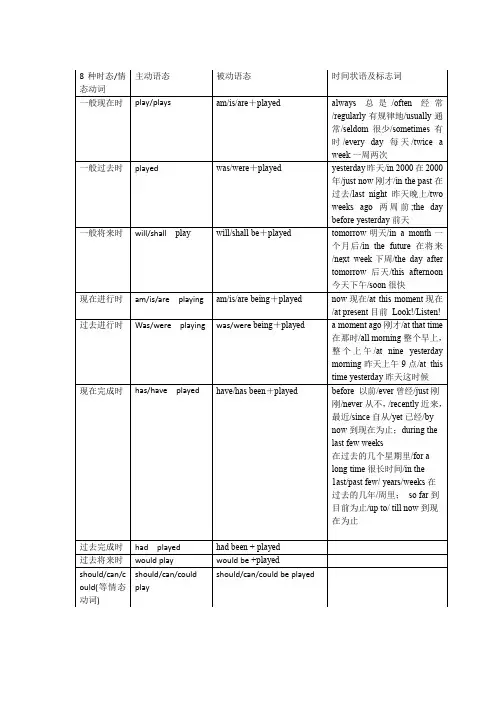
tomorrow明天/in a month一个月后/in the future在将来/next week下周/the day after tomorrow后天/this afternoon今天下午/soon很快
现在进行时
am/is/are playing
am/is/are being+played
一般现在时plຫໍສະໝຸດ y/playsam/is/are+played
always总是/often经常/regularly有规律地/usually通常/seldom很少/sometimes有时/every day每天/twice a week一周两次
一般过去时
played
was/were+played
yesterday昨天/in 2000在2000年/just now刚才/in the past在过去/last night昨天晚上/two weeks ago两周前;the day before yesterday前天
should/can/could(等情态动词)
should/can/could play
should/can/could be played
时态解题步骤
看时间标志词确定时态看主语与动词关系确定语态看人称确定单复数
现在完成时
has/have played
have/has been+played
before以前/ever曾经/just刚刚/never从不,/recently近来,最近/since自从/yet已经/by now到现在为止;during the last few weeks
在过去的几个星期里/for a long time很长时间/in the 1ast/past few/years/weeks在过去的几年/周里;so far到目前为止/up to/ till now到现在为止
(完整版)含情态动词的被动语态
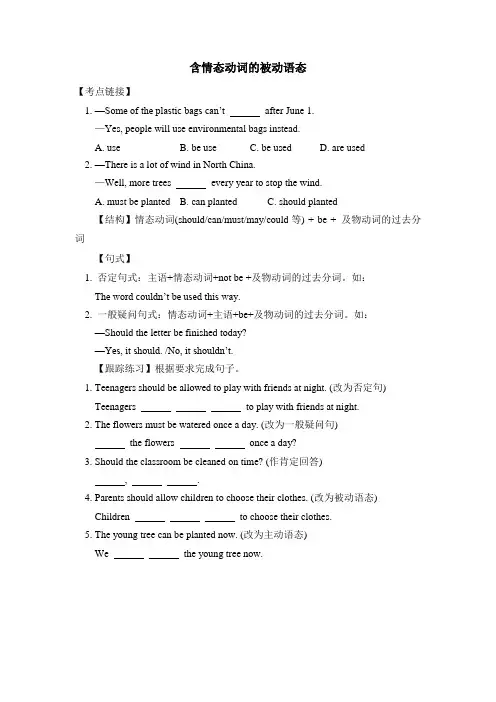
含情态动词的被动语态【考点链接】1. —Some of the plastic bags can’t after June 1.—Yes, people will use environmental bags instead.A. useB. be useC. be usedD. are used2. —There is a lot of wind in North China.—Well, more trees every year to stop the wind.A. must be plantedB. can plantedC. should planted【结构】情态动词(should/can/must/may/could等) + be + 及物动词的过去分词【句式】1. 否定句式:主语+情态动词+not be +及物动词的过去分词。
如:The word couldn’t be used this way.2. 一般疑问句式:情态动词+主语+be+及物动词的过去分词。
如:—Should the letter be finished today?—Yes, it should. /No, it shouldn’t.【跟踪练习】根据要求完成句子。
1. Teenagers should be allowed to play with friends at night. (改为否定句)Teenagers to play with friends at night.2. The flowers must be watered once a day. (改为一般疑问句)the flowers once a day?3. Should the classroom be cleaned on time? (作肯定回答), .4. Parents should allow children to choose their clothes. (改为被动语态)Children to choose their clothes.5. The young tree can be planted now. (改为主动语态)We the young tree now.各种时态的被动语态八大时态的被动语态的构成:1.一般现在时的被动语态构成:(am/is/are +done)如:I am asked to study hard. 我被请求努力学习。
被 动 语 态和情态动词

被动语态句子的主语是动作的承受者时,谓语要用被动语态。
构成形式为:be +动词的过去分词,时态通过be的变化形式来体现。
主要有:am/is/are+done was/were+done has/have been done had been done例如:He was invited to the conference yesterday. He has been invited to the conference since we went away.不定式的被动语态:to be done.例如:focused training will also play a role in enabling records to be broken.专项训练队打破记录也能发挥作用。
动名词的被动语态:being done 例如:farmers dislike being paid to do nothing. 农民不喜欢不劳而获。
情态动词的被动语态:情态动词+ be +动词的ed形式例如:their work conditions should always be supervised by their parents. 他们的工作环境应该受到父母的监督。
A new cinema ___ here. They hope to finish it next month.A. will be builtB. is builtC. has been builtD. is being built. 答案:D一.It is done that 句型动词say, believe, report, announce, suppose, know, consider, hope, prove等以it 作形式主语时用被动语态,后面接that 从句。
例:It is said that he has come back from France.二.动词的主动形式表示被动意义:表示状态特征的连系动look, appear, become, seem, taste, wear, feel, smell, sound, taste, prove+形容词/名词构成的系表结构。
【语法透视】:含情态动词的被动语态
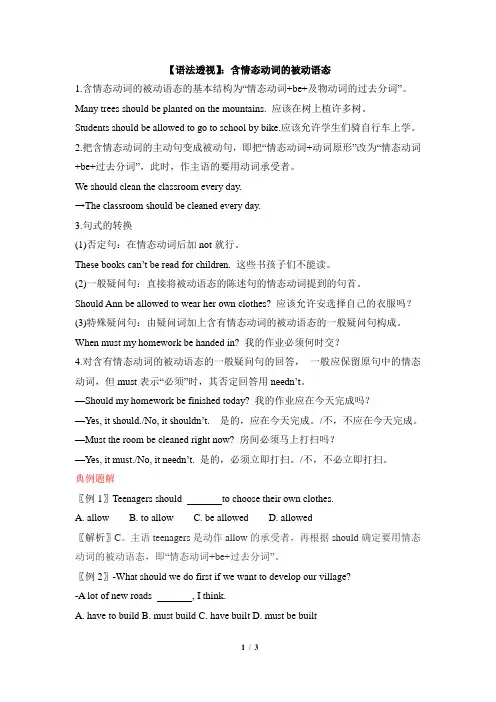
【语法透视】:含情态动词的被动语态1.含情态动词的被动语态的基本结构为“情态动词+be+及物动词的过去分词”。
Many trees should be planted on the mountains. 应该在树上植许多树。
Students should be allowed to go to school by bike.应该允许学生们骑自行车上学。
2.把含情态动词的主动句变成被动句,即把“情态动词+动词原形”改为“情态动词+be+过去分词”,此时,作主语的要用动词承受者。
We should clean the classroom every day.→The classroom should be cleaned every day.3.句式的转换(1)否定句:在情态动词后加not就行。
These books can’t be read for children. 这些书孩子们不能读。
(2)一般疑问句:直接将被动语态的陈述句的情态动词提到的句首。
Should Ann be allowed to wear her own clothes? 应该允许安选择自己的衣服吗?(3)特殊疑问句:由疑问词加上含有情态动词的被动语态的一般疑问句构成。
When must my homework be handed in? 我的作业必须何时交?4.对含有情态动词的被动语态的一般疑问句的回答,一般应保留原句中的情态动词,但must表示“必须”时,其否定回答用needn’t。
—Should my homework be finished today? 我的作业应在今天完成吗?—Yes, it should./No, it shouldn’t. 是的,应在今天完成。
/不,不应在今天完成。
—Must the room be cleaned right now? 房间必须马上打扫吗?—Yes, it must./No, it needn’t. 是的,必须立即打扫。
含情态动词的被动语态结构例句

含情态动词的被动语态结构例句被动语态是英语语法中的一个重要部分,它用来表示主语是动作的接收者,而不是执行者。
而含情态动词的被动语态结构更是一种常见的语法结构,它能够更准确地表达说话者的情感和态度。
本文将为大家介绍含情态动词的被动语态结构,并提供一些例句以供参考。
一、什么是含情态动词的被动语态结构含情态动词的被动语态结构是指在被动语态中使用情态动词,以表达说话者的情感和态度。
情态动词包括can、could、may、might、must、shall、should、will、would等。
在使用含情态动词的被动语态结构时,需要注意动词的时态、语态和人称的变化。
二、含情态动词的被动语态结构的用法1. 表示可能性当含情态动词的被动语态结构中使用may、might、could等动词时,可以表示可能性。
例句:The package may be delivered tomorrow.这个包裹可能明天送到。
The meeting might be postponed due to bad weather.会议可能因为天气不好而延期。
2. 表示推测当含情态动词的被动语态结构中使用must、should等动词时,可以表示推测。
例句:The letter must have been lost in the mail.这封信一定是在邮递过程中丢失了。
The project should have been finished by now.这个项目现在应该已经完成了。
3. 表示义务和责任当含情态动词的被动语态结构中使用must、should等动词时,可以表示义务和责任。
例句:The report must be submitted by Friday.这份报告必须在周五之前提交。
The students should be given more opportunities to express their opinions.应该给学生更多表达意见的机会。
含情态动词的被动语态_图文

3. Trees must be watered every day. Trees mustn't be watered every day. Must trees be watered every day?
2. The books may___ for two weeks.
A. be kept
B. be borrowed
C. keep
D. borrow
3 The broken bike____ here by Mr Smith.
A. can mend
B. can mended
C. can be mend D. can be mended
_o_w__n_d_e_c_i_si_o_n_s_. _______________________
4b Fill in the blanks with the correct forms of the words in brackets.
Should teenagers b_e__a_s_k_e_d (ask) to move out when they start working? In many Western countries, teenagers _a_r_e_a_l_lo_w__e_d__ (allow) to move out at eighteen. Their parents believe that they should _b_e__e_d_u_c_a_te_d__ (educate) v. 教育;教导 to take care of themselves from a young age. This way, when they _s_t_a_r_t_ (start) working they can manage their own lives.
5. 含情态动词的被动语态
知识讲解
2. 含情态动词的被动语态的不同句式 肯定句: 否定句: + 情态动词 + be +done V.ed today. (+ 其他) e.g. The work must be 主语 + 情态动词 + not be + V.ed (+ 其他) e.g. The work can’t be + done today
含情态动词的被动语态
情境导入
Bedrooms must be cleaned every day. Should students be allowed to have part-time jobs?
知识讲解
Bedrooms must be cleaned every day. Should students be allowed to have part-time jobs? 1. 含情态动词的被动语态:情态动词 + be + V.过去分词 e.g. The window may be broken by Tom. The trees must be planted by the workers. The work must be finished today.
典例精析
2. (广东汕尾中考)—I don’t think sixteen- year- olds D to drive. —I agree. They aren’t serious enough at that age.
A. can allow C. should allow
B. need be allowed D. should be allowed
课堂小结
含情态动词的被动语态
常见的情态动词的被动语态怎么构成?
常见的情态动词的被动语态怎么构成?被动语态用于表达主语受动作影响的情况。
对于常见的情态动词,被动语态的构成方法如下:1. Can:被动语态为can be + 过去分词。
例如:2. Could:被动语态为could be + 过去分词。
例如:- 主动语态:She could solve the problem.- 被动语态:The problem could be solved by her.3. May:被动语态为may be + 过去分词。
例如:- 主动语态:They may finish the project.- 被动语态:The project may be finished by them.4. Might:被动语态为might be + 过去分词。
例如:- 主动语态:I might visit my friends.- 被动语态:My friends might be visited by me.5. Must:被动语态为must be + 过去分词。
例如:6. Should:被动语态为should be + 过去分词。
例如:- 主动语态:We should attend the meeting.- 被动语态:The meeting should be attended by us.7. Would:被动语态为would be + 过去分词。
例如:- 主动语态:She would buy a new car.- 被动语态:A new car would be bought by her.需要注意的是,有些情态动词的被动语态形式并不常用,因此在实际应用中需要根据上下文和常用惯进行选择。
以上是常见的情态动词的被动语态的构成方法。
希望对您有所帮助!。
被动语态以及情态动词构成及用法详解(推荐文档)
被动语态用法详解TENSE 主动语态被动语态一般现在时be+V.\V.s am\is\are+V (p.p)一般将来时will\be going to\be (about)to+V. will be +V(p.p)现在进行时am\is\are+V.ing am\is\are+b eing+V(p.p)一般过去时①was\were②V.ed was\were+V( p.p)现在完成时have\has+V.p.p have\has+be en+V(p.p)过去完成时had+V.p.p had+been+V( p.p)过去进行时was\were+V.ing was\were+being+V(p.p)情态动词情态动词+V. 情态动词+be+V(p.p)被动语态牢记一点, be加动词过去分词。
分析句中主和谓,承受者作主语即被动。
短语动词不可忘介、副词。
另有不及物动词,只有主动无被动。
还要注意其时态,与主动语态全相同。
不用被动语态的情况1)不及物动词或动词短语无被动语态(即多数的瞬间动词):appear, die(死亡),disappear(消失), end (vi. 结束), fail, happen, last, lie, remain, sit, spread, stand break out, come true, fall asleep, keep silence, lose heart, take place. After the fire, very little remained of my house. 比较: rise, fall, happen 是不及物动词;raise, seat是及物动词。
(错)The accident was happened last week.(对)The accident happened last week.要想正确地使用被动语态,就须注意哪些动词是及物的,哪些是不及物的。
含情态动词的被动语态讲解及练习
第七单元语法知识含有情态动词的被动语态,情态动词有should, may, might, can, could, must,will,would 等。
一、基本句型结构:1肯定句:主语+情态动词+be+过去分词(+by...)・・・・eg: Teen agers should be allowed to go shopp ing.Tables can be made of ston es.The work must be fini shed today.The flowers may be pla nted in February.2、否定句:主语+情态动词+not +be+ 过去分词(+by...)・・・・eg: Teenagers shouldn ' t be allowed to go shopping.Tables cantbe made of ston es.The work mustn t be finished today. (mustn t [加?mt】:不能)The flowers mayn t [me ?it] be pla nted in February.3、一般疑问句:情态动词+主语+be+过去分词(+by...)?・・・・eg: Should tee nagers be allowed to go shopp ing?Yes, they should. No, they should n t.Can tables be made of stones? Yes, they can. No, they can t.Must the work be fini shed today?Yes, it must. No, it needn t./ No, it don t have to.May the flowers be pla nted in February? Y es, they may. No, they mayn't.4、特殊疑问句:特殊疑问词+情态动词+主语+be+过去分词(+by...)?• • • •eg: What should tee nagers be allowed?Whe n must be work be fini shed? Whe n may the flowers be pla nted?What can tables be made of?二、含有情态动词的主动语态与被动语态的转换:eg: 1). We(主语)can (情态动词)write (谓语)letters (宾语)in_English.(宾语补足语)Letters (主语)can (情态动词)be_written_ (谓语)in English (宾语)by us.(宾语补足语)2) . Parents (主语)should (情态动词)allow_ (谓语)teenagers(宾语)to_choose_ their own_ clothes.Teenagers (主语)should (情态动词)be_allowed (谓语)to choose their own clothes (宾语)by their parents. _ (宾语补足语)3) . You (主语)must (情态动词)clean (谓语)your bedroom (宾语)every. day.(时间状语)Your bedroom (主语)must (情态动词)be cleaned (谓语)every. day (时间状语)by you.(宾语)例题:1.The old people should ________________ (speak) to politely.2.Anna ______________ (in vite) to my birthday party.3.Teen agers should ________________ (allow) to surf the In ternet.4.We should clean the classroom every day.(被动语态)The classroom __________________________________ every day.5.Eightee n-year-olds should be allowed to drink. (否定句)Eightee n-year-olds _________________________________ allowed to drink.6.The lights should be turned off whe n you leave he classroom.(主动语态)You ____________________________________ the lights whe n you leave the classroom.7.What school rules do you think should be ________________ (change)?。