
六年级英语上Unit4知识点汇总
六年级英语上Unit4知识点汇总
(二)句型:本单元主要谈论自己及朋友或笔友的爱好,需
要用:like +doing(动词的ing 形式)。
本单元时态为一般
现在时态(表示经常性或习惯性做某事)
1、你的爱好是什么(单数)?我喜欢画画。
What is your hobby? I like drawing
pictures.
2、你的爱好是什么(复数)?我喜欢远足和听音乐。
What are your hobbies? I like going
hiking and listening to music.
3、她的爱好是什么(单数)?她喜欢跳舞。
What is her hobby? She likes dancing.
4、Amy的爱好是什么(复数)?她喜欢唱歌和弹琵琶。
What are Amy’s hobbies? She likes singing
and playing the pipa.
5、他的爱好是什么?他喜欢踢足球和爬山。
What are his hobbies?He likes playing football and
climbing mountains .
6、她喜欢作字谜游戏吗?不,她喜欢看电视。
Does she like doing word puzzles?No, she doesn’
t. She likes watching TV.
7、你喜欢画卡通吗?是的。
Do you like drawing cartoons?Yes, I do.。
六年级英语Unit4 Li Ming Comes Home知识点归纳总结
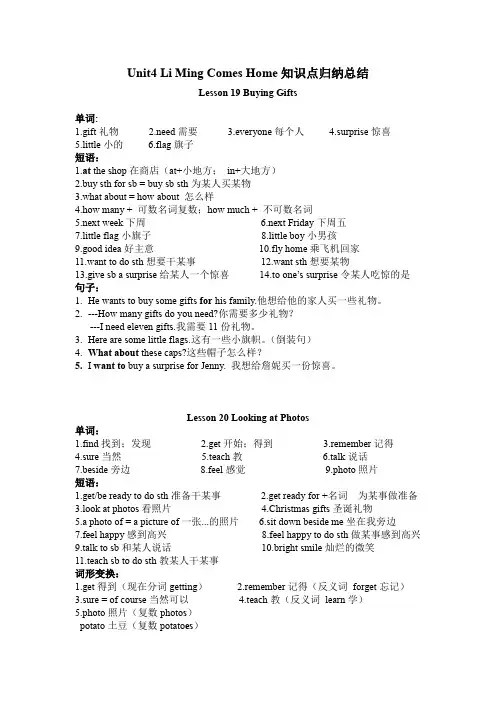
Unit4 Li Ming Comes Home知识点归纳总结Lesson 19 Buying Gifts单词:1.gift礼物2.need需要3.everyone每个人4.surprise惊喜5.little小的6.flag旗子短语:1.at the shop在商店(at+小地方;in+大地方)2.buy sth for sb = buy sb sth为某人买某物3.what about = how about 怎么样4.how many + 可数名词复数;how much + 不可数名词5.next week下周6.next Friday下周五7.little flag小旗子8.little boy小男孩9.good idea好主意10.fly home乘飞机回家11.want to do sth想要干某事12.want sth想要某物13.give sb a surprise给某人一个惊喜14.to one’s surprise令某人吃惊的是句子:1.He wants to buy some gifts for his family.他想给他的家人买一些礼物。
2.---How many gifts do you need?你需要多少礼物?---I need eleven gifts.我需要11份礼物。
3.Here are some little flags.这有一些小旗帜。
(倒装句)4.What about these caps?这些帽子怎么样?5.I want to buy a surprise for Jenny. 我想给詹妮买一份惊喜。
Lesson 20 Looking at Photos单词:1.find找到;发现2.get开始;得到3.remember记得4.sure当然5.teach教6.talk说话7.beside旁边8.feel感觉9.photo照片短语:1.get/be ready to do sth准备干某事2.get ready for +名词为某事做准备3.look at photos看照片4.Christmas gifts圣诞礼物5.a photo of = a picture of一张...的照片6.sit down beside me坐在我旁边7.feel happy感到高兴8.feel happy to do sth做某事感到高兴9.talk to sb和某人说话10.bright smile灿烂的微笑11.teach sb to do sth教某人干某事词形变换:1.get得到(现在分词getting)2.remember记得(反义词forget忘记)3.sure = of course当然可以4.teach教(反义词learn学)5.photo照片(复数photo s)potato土豆(复数potato es)tomato西红柿(复数tomato es)1.---What are you doing?你正在干什么?---I’m getting ready to go home next week.我正在为下周回家做准备。
Unit4Ihaveapenpal知识点总结人教PEP版英语六年级上册
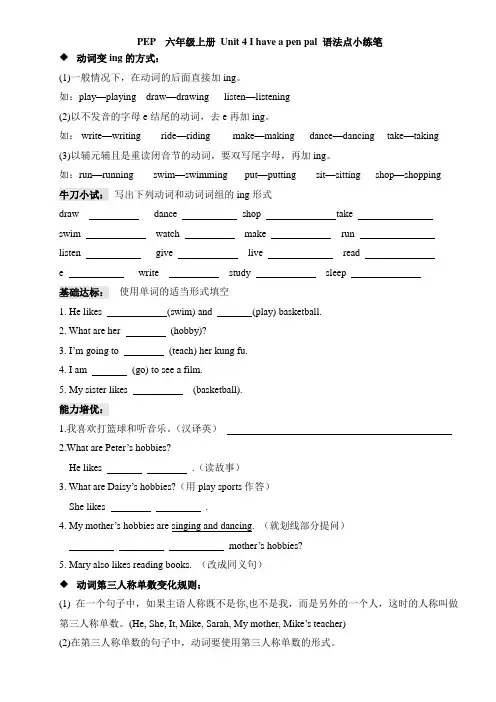
PEP 六年级上册Unit 4 I have a pen pal 语法点小练笔◆动词变ing的方式:(1)一般情况下,在动词的后面直接加ing。
如:play—playing draw—drawing listen—listening(2)以不发音的字母e结尾的动词,去e再加ing。
如: write—writing ride—riding make—making dance—dancing take—taking (3)以辅元辅且是重读闭音节的动词,要双写尾字母,再加ing。
如:run—running swim—swimming put—putting sit—sitting shop—shopping牛刀小试:写出下列动词和动词词组的ing形式draw dance shop takeswim watch make runlisten give live reade write study sleep基础达标:使用单词的适当形式填空1. He likes (swim) and (play) basketball.2. What are her (hobby)?3. I’m going to (teach) her kung fu.4. I am (go) to see a film.5. My sister likes (basketball).能力培优:1.我喜欢打篮球和听音乐。
(汉译英)2.What are Peter’s hobbies?He likes .(读故事)3. What are Daisy’s hobbies?(用play sports作答)She likes .4. My mother’s hobbies are singing and dancing. (就划线部分提问)mother’s hobbies?5. Mary also likes reading books. (改成同义句)◆动词第三人称单数变化规则:(1) 在一个句子中,如果主语人称既不是你,也不是我,而是另外的一个人,这时的人称叫做第三人称单数。
六年级英语上册(PEP版)Unit 4必备知识点
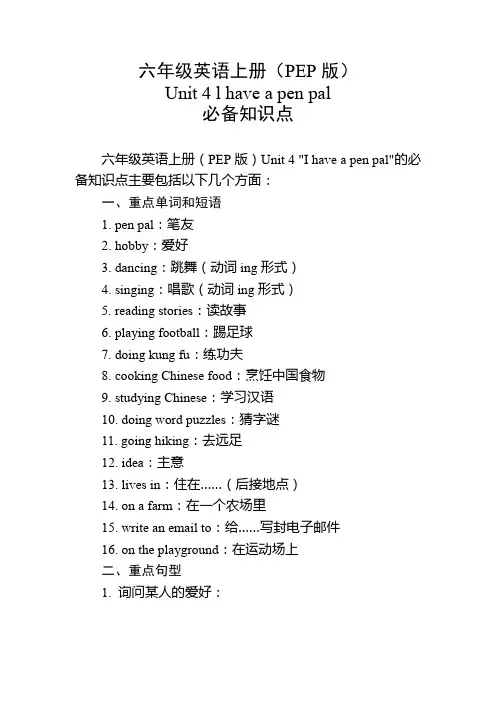
六年级英语上册(PEP版)Unit 4 l have a pen pal必备知识点六年级英语上册(PEP版)Unit 4 "I have a pen pal"的必备知识点主要包括以下几个方面:一、重点单词和短语1. pen pal:笔友2. hobby:爱好3. dancing:跳舞(动词ing形式)4. singing:唱歌(动词ing形式)5. reading stories:读故事6. playing football:踢足球7. doing kung fu:练功夫8. cooking Chinese food:烹饪中国食物9. studying Chinese:学习汉语10. doing word puzzles:猜字谜11. going hiking:去远足12. idea:主意13. lives in:住在……(后接地点)14. on a farm:在一个农场里15. write an email to:给……写封电子邮件16. on the playground:在运动场上二、重点句型1. 询问某人的爱好:What are sb's hobbies? 某人的爱好是什么?(sb's表示某人的,hobbies是hobby的复数形式)He/She likes reading stories and singing. 他/她喜欢读故事和唱歌。
注意:在回答时,如果主语是第三人称单数,like要变为likes,动词要用其ing形式。
2. 一般疑问句:Does he/she live in +某地? 他/她住在某地吗?肯定回答:Yes, he/she does.否定回答:No, he/she doesn't.Does he/she like doing sth.? 他/她喜欢做某事吗?肯定回答:Yes, he/she does.否定回答:No, he/she doesn't.3. 表达想要做某事:Do you want to +动词原形(+其他)? 你想要做某事吗?例如:Do you want to learn about robots? 你想要了解机器人吗?4. 征求意见:Shall we +动词原形(+其他)?我们……好吗?例如:Shall we dance? 我们跳舞好吗?三、语法点1. 动词的ing形式:用于表示正在进行的动作或习惯、爱好等。
Unit 4 重难知识点(复习讲义)六年级英语上册(译林版三起)

Unit 4 Then and now重难点讲解 (含答案)一、词汇讲解1. use 动词,意为“使用”(1) 考点:use sth. to do sth. 用......做✰✰✰✰✰= do sth. with sth.例如:We use water to wash hands.我们用水洗手。
=We wash hands with water. (2) 【拓展】use 和with 都有用的意思,use 是动词,with 是介词,用法不同“和” I played football with my brother last Sunday.with 的用法:“长着” The boy with a big nose is my brother.“拥有” I have a new house with a big garden.“用” Make a sentence with “egg”.✱注:句中有谓语动词时,选介词“with ”表示用,句中无谓语动词时,选动词“use ”。
【小试牛刀1】① Mr White (use) the telephone (call) people.② My father (use) a mobile phone (call) (I) just now.③ Who can make a sentence (use/with) this new word?④ They (use/with) paper to make a T -shirt.【答案】es, to call ed, to call, me 3.with e2. write sb. a letter 写信给某人(1) 考点:write sb. a letter 写信给某人= write (a letter) to sb. ✰✰✰✰✰例如:I often write my e -friends a letter. 我经常写信给我的网友。
人教版小学六年级英语上册Unit4知识点
【导语】学会整合知识点。
把需要学习的信息、掌握的知识分类,做成思维导图或知识点卡⽚,会让你的⼤脑、思维条理清醒,⽅便记忆、温习、掌握。
以下是⽆忧考整理的《⼈教版⼩学六年级英语上册Unit 4知识点》,希望帮助到您。
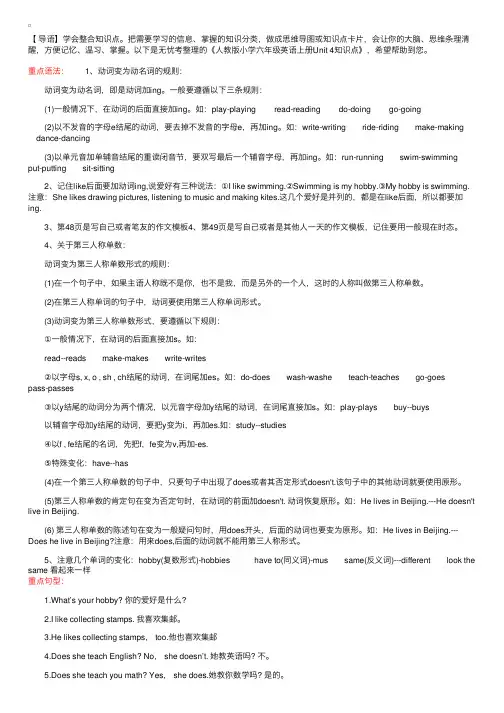
重点语法: 1、动词变为动名词的规则: 动词变为动名词,即是动词加ing。
⼀般要遵循以下三条规则: (1)⼀般情况下,在动词的后⾯直接加ing。
如:play-playing read-reading do-doing go-going (2)以不发⾳的字母e结尾的动词,要去掉不发⾳的字母e,再加ing。
如:write-writing ride-riding make-making dance-dancing (3)以单元⾳加单辅⾳结尾的重读闭⾳节,要双写最后⼀个辅⾳字母,再加ing。
如:run-running swim-swimming put-putting sit-sitting 2、记住like后⾯要加动词ing,说爱好有三种说法:①I like swimming.②Swimming is my hobby.③My hobby is swimming.注意:She likes drawing pictures, listening to music and making kites.这⼏个爱好是并列的,都是在like后⾯,所以都要加ing.3、第48页是写⾃⼰或者笔友的作⽂模板4、第49页是写⾃⼰或者是其他⼈⼀天的作⽂模板,记住要⽤⼀般现在时态。
4、关于第三⼈称单数: 动词变为第三⼈称单数形式的规则: (1)在⼀个句⼦中,如果主语⼈称既不是你,也不是我,⽽是另外的⼀个⼈,这时的⼈称叫做第三⼈称单数。
(2)在第三⼈称单词的句⼦中,动词要使⽤第三⼈称单词形式。
(3)动词变为第三⼈称单数形式,要遵循以下规则: ①⼀般情况下,在动词的后⾯直接加s。
如: read--reads make-makes write-writes ②以字母s, x, o , sh , ch结尾的动词,在词尾加es。
六年级英语Unit4知识点
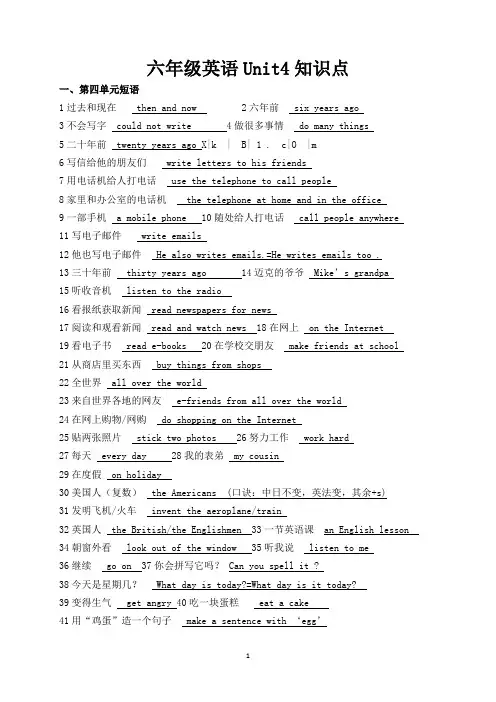
六年级英语Unit4知识点一、第四单元短语1过去和现在 then and now 2六年前 six years ago3不会写字 could not write 4做很多事情 do many things5二十年前 twenty years ago X|k | B| 1 . c|O |m6写信给他的朋友们 write letters to his friends7用电话机给人打电话 use the telephone to call people8家里和办公室的电话机 the telephone at home and in the office 9一部手机 a mobile phone 10随处给人打电话 call people anywhere11写电子邮件 write emails12他也写电子邮件 He also writes emails.=He writes emails too .13三十年前 thirty years ago 14迈克的爷爷 Mike’s grandpa15听收音机 listen to the radio16看报纸获取新闻 read newspapers for news17阅读和观看新闻 read and watch news 18在网上 on the Internet19看电子书 read e-books 20在学校交朋友 make friends at school21从商店里买东西 buy things from shops22全世界 all over the world23来自世界各地的网友 e-friends from all over the world24在网上购物/网购 do shopping on the Internet25贴两张照片 stick two photos 26努力工作 work hard27每天 every day 28我的表弟 my cousin29在度假 on holiday30美国人(复数) the Americans (口诀:中日不变,英法变,其余+s)31发明飞机/火车 invent the aeroplane/train32英国人 the British/the Englishmen 33一节英语课 an English lesson34朝窗外看 look out of the window 35听我说 listen to me36继续 go on 37你会拼写它吗? Can you spell it ?38今天是星期几? What day is today?=What day is it today?39变得生气 get angry 40吃一块蛋糕 eat a cake41用“鸡蛋”造一个句子 make a sentence with ‘egg’42“鸡蛋”在哪儿? Where’s the ‘egg’ ?43等待答案 wait for the answer 44一岁 one year old二、第四单元知识点梳理1、一般过去时情态动词的句型转换:新课标第一网(1)could引导的一般过去时的否定句,在could之后加not:=couldn’tSix years ago, I couldn’t write.(2)could引导的一般过去时的一般问句,将could调至句首:Could Mike read or draw?(3)could引导的特殊问句:特殊疑问句+could引导的一般问句:What could they do ?2、一般过去时和一般现在时的动词形式对比:时间决定时态3、字母组合er的发音:/ə/。
PEP英语六年级上册第四单元语法知识点
PEP英语六年级上册Unit 4 知识汇总1.重点单词●hobby 业余爱好--名词复数形式hobbies(变化规则:辅音+y,变y为i,再加-es)●study 学习--动词第三人称单数形式studies(变化规则:辅音+y,变y为i,再加-es)●puzzle 谜--名词复数形式puzzles(变化规则:以e结尾,加-s)●hike 远足--动词动名词形式hiking(变化规则:以e结尾,去e,再加-ing)2.重点短语2.1(动词-ing形式)read stories -- reading stories 读故事do kung fu -- doing kung fu 练功夫dance -- dancing 跳舞sing -- singing 唱歌play football -- playing football 踢足球play sports -- playing sports 进行体育运动climb mountains -- climbing mountains 爬山listen to music -- listening to music 听音乐watch TV -- watching TV 看电视play the pipa -- playing the pipa 弹琵琶draw cartoons -- drawing cartoons 画漫画fly kites -- flying kites 放风筝sing English songs -- singing English songs 唱英文歌2.2 重点短语(动词的第三人称单数形式)live -- livesdo -- doesstudy Chinese -- studies Chinescook Chines food -- cooks Chinese fooddo word puzzles -- does word puzzlesgo hiking -- goes hiking3.重点语法知识3.1like的用法like 喜欢(动词原形)likes (第三人称单数形式)like doing... 喜欢做...... (表示动词like后接动词的ing形式)例句:陈述句I like doing kung fu and swimming. 我喜欢练功夫和游泳。
六年级上册英语1-4单元必考知识点总结
Unit 3 What are you going to do?
一.词汇 'next week 下周
newsp叩er 报纸
this morning 今天上午
comic book漫画书
Time: (时间)
this afternoon 今天下午 this evening今天晚上
magazine 杂志 dictionary 字典
make kites (making kites )制作风筝 colLect stamps (collecting stamps)集邮
三单
Live (lives)居住,住 teach (teaches)教 go (goes)去 watch (watches)看 read (reads)读
其他show (展览)
(交通工具前加by,表示乘坐但步行要用on foot)
三会一
fifth第五 difference 不同 country 国家 right右边的 Australia澳大利亚 if如果
remember 记住 same相同的 mean意思是
side 边 however 但是 must必须
find找到 every每个所有的 drive驾驶
do (does) pen pal(笔友)
dear (亲爱的)
look(看上去)fun(快乐,乐趣)
with(同…)
三、重点句型:
1 .询问某人的爱好:
---------- What's your hobby?你的爱好是什么?
-----------1 Like collecting stamps.我喜欢集邮 2 .表示征求别人意见:
我坐飞机去。
■ ----------- How does your father go to work? ----------- He goes to work by subway.
Unit4小学英语六年级上册课文翻译知识点
Unit4小学英语六年级上册课文翻译知识点英语学习的两极分化现象,即使在六年级学生中,就已经存在一定程度上的两极分化了。
下面是小偏整理的Unit4小学英语六年级上册课文翻译知识点,感谢您的每一次阅读。
Unit4小学英语六年级上册课文翻译知识点一、主要单词:studies学习(第三人称单数形式)puzzle谜hiking远足二、习惯搭配:readstories读故事dokungfu练功夫flykites放风筝playthepipa 弹琵琶playsports进行体育活动climbmountains爬山listentomusic 听音乐singEnglishsongs唱英文歌onafarm在一个农场里livein...住在···writeanemailto...给···写一封电子邮件ontheplayground在运动场上三、惯用表达式:Metoo.我也是。
Really?真的吗?四、公式化句型:1、询问某人爱好的句型及其答语:问句:Whataresb.’shobbies?···有什么爱好?答语:主语+like/likes+动词-ing形式(+其它).···喜欢···。
Singingdancingreadingstoriesplayingfootballdoingkungfud oingwordpuzzlesgoinghikingwatchingTVdrawingcartoonslisteni ngtomusicgoingfishing2、由do/does引导的一般疑问句及其答语:问句:Do/Does+主语+动词原形+其它?答语:Yes,主语+do/does./No,主语+don’t/doesn’t.五、语法:1、动词变为动名词的规则:动词变为动名词,即是动词加ing。
六年级上册英语第四单元知识点
六年级上册英语第四单元知识点
六年级上册英语第四单元的知识点可能包括以下几个方面:
1. 词汇:掌握与季节、天气和活动相关的词汇,如“spring”,“summer”,“autumn”,“winter”,“rainy”,“sunny”,“warm”,“hot”,“cool”,“cold”,“skate”,“swim”等。
2. 语法:学习并理解一般现在时(Simple Present Tense)的用法,包括动词第三人称单数的变化规则。
3. 句型:学习和掌握描述季节、天气和相关活动的句型,如“What is the weather like in spring?”, “I like swimming in summer.”,以及“We often skate in winter.”。
4. 阅读理解:通过阅读短文或对话,理解并回答关于季节、天气和活动的问题。
5. 写作练习:根据所学知识,写一篇关于自己最喜欢的季节的文章。
6. 听力和口语练习:通过听力材料和课堂上的口语活动,提高听力和口语表达能力。
请注意,这只是一般性的知识点,具体的学习内容可能会根据不同的教材和课程设置有所不同。
在学习过程中,学生应积极参与课堂活动,主动探索和实践所学知识,以提高英语语言能力。