
(完整版)译林版英语七年级下册第二单元知识点
Unit2
1.visitor—visit v./n. on a visit to前往……的拜访
2.like像……prep./喜欢v.她像她爸爸,喜欢做饭。
She like her father, likes cooking.
3.waiter—waitress(女服务员)—waitv.—waiting-room(候车室、候诊室)
4.helpful adj. 他帮我学习英语。
He help me with my English.
(helpless adj.) 她忍不住哭了。
She can’t help crying.
随便吃点水果吧。
Help yourself to some fruit.
缇娜帮助妈妈打扫卫生。
Tina help her mother do some housework.
5.skill表技巧,不可数名词,由much和great修饰。
学习技能:study skills 高超的技巧:great skill
6.problem—有待解决的问题;question—有待回答的问题。
7.something我有重要的事情告诉你:I have something important to tell you.
8.check 支票n./v.+in(报道)/on(检查)/out(查证/结账)/over(仔细检查)
9.broken adj.打破v.break; 玻璃杯易打碎。
Glass breaks easily.
10.someone/ anyone;作主语时,谓语动词三单:有人在讲话。
Someone is talking.
11.fix—修理出差错的东西,使其稳固。
repair—修理复杂且受损严重的如房屋、道路、机器。
12.college(学院)—大学生(a college student)—在大学(at college)—university(综合性大学)
13.lucky adj.—luck n.—luckily adv. good luck to sb./good luck with sth.
14.fire(可n.-火炉、不可n.-火)—生火(make a fire)—着火(be on/catch fire)
15.office n.(办公室)—officer n.(官员)—official adj.(官方的)
16.policeman—police(警察、警方)—policewoman(女警察)--police dog(警犬)
17.job (可数名词)work(不可数名词) a piece of work=a job
18.in future=from now on—今后in the future—将来
19.notice n.公告;墙上有一个公告
v.我注意到你了。
I noticed you. 注意你的生活方式。
Take notice of your lifestyle.
我没注意到他离开了。
I didn’t notice him leaving.
20.i nformation(不可数名词) a piece of information
21.below--above adv.看下面的书。
See the book below.
(不一定垂直)prep.窗户下面有一把椅子。
There is a chair below the window.
22.现在进行时表将来,动词有come、leave、move、arrive
我要离开了。
I’m leaving.
我快要到家了。
I’m arriving home.
23.t here be 将来时there be going to/there will be
今天下午将会有一场足球比赛。
There will be a football match on the playground.
24.b e afraid (that)担心……
be afraid of sth/doing sth害怕做某事
be afraid to do sth不敢做……
25.m ost;代词;大多数学生喜欢体育课。
Most of the student like PE.(most of +定/指代/物代+n.)
副词=very;你来见我太好了。
It’s most kind of you to meet me.
26.be ready to do sth.=be glad/willing to do sth.乐意做某事(get /be ready for为……做好准备)
27.一般将来时:时间状语:next…/tomorrow/this…/in…/soon…
肯定句:我很快就是一名老师了。
I will be a teacher soon.
我将要去洗碗。
I’m going to wash dishes.
否定句:
一般疑问句:
28.e lder(多用于兄弟姐妹的年长,不与than连用,不做表语/older可做表语与定语,与than连用)。
他不应该嘲笑比他年长的人.She shouldn’t laugh at her elder like this.(形物代+elder表比……年长的人) 29.w orry –worried adj.
vt.他的健康叫我担心。
His health worries me.
vi.(+about)我担心他的健康。
I worry about his health.
30.i ll -----He is an ill man.(定语) She is ill.(表语)
sick ---She is takeing care of her sick father.(定语) She feel sick.(表语)
必背词组
in Ninth Street9号街helping hands帮手help with帮助做 a day out一日游help sb do帮助某人做have a meeting开会特殊疑问词+to each other相互match…with与……相配be afraid (that)害怕……different skills不同的技能ask…to do sth.要求做某事need to do sth.需要做different ways不同的方法help sick people帮助生病的人make sb. do sth.让某人做be going to do将要做某事all kinds of所有种类in the future在将来wait for sb to do sth等待某人做某事most/some of them他们中的大部分/一些be good/happy/lucky/ready to do sth. there is something wrong with……出了问题plan/make a plan to do sth.计划做某事(将) plan on doing sth.计划做某事(现在) on the afternoon of 5 March3月5日下午。
Unit2知识点和考点2022-2023学年牛津译林版七年级英语下册

4.There is something wrong with my computer.
(1)something的基本含义做不定代词,意思是某个东西,某件事。
(2)something的核心考点之一考察不定代词与形容词的位置关系。当形容词修饰不定代词时,形容词置于不定代词后面。比如anythinginteresting
11.notice
notice与photo、order、information的区分。notice是通知,photo是照片,order是订单,information是信息。
12.better
better和best、more和most的区分。better意思是较好,更好;best意思是最好的;more是更多的;most是最多的。
【2022年无锡】lie,her mother,eating fruit.
A.likes; likeB.like; likesC.like; like D.likes; likes
答案B
2.They often meet at the community center and share their different skills.
—I don’t mind. ________—whatever you have got.
A.NothingB.AnythingC.SomethingD.Everything
答案B
【2022年南外】5.Next weekend, Uncle John plans to do ________, only stay at home to have a rest.
A. to stay upB. don’t stay upC. doesn’t stay upD. not to stay up
Unit 2 知识点梳理-牛津译林版七年级英语下册
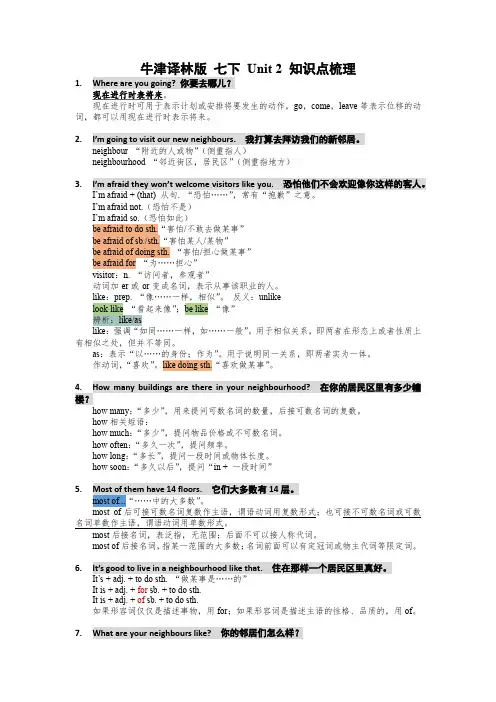
牛津译林版七下Unit 2 知识点梳理1.Where are you going?你要去哪儿?现在进行时表将来。
现在进行时可用于表示计划或安排将要发生的动作,go,come,leave等表示位移的动词,都可以用现在进行时表示将来。
2.I’m going to visit our new neighbours. 我打算去拜访我们的新邻居。
neighbour “附近的人或物”(侧重指人)neighbourhood “邻近街区,居民区”(侧重指地方)3.I’m afraid they won’t welcome visitors like you. 恐怕他们不会欢迎像你这样的客人。
I’m afraid + (that) 从句. “恐怕……”,常有“抱歉”之意。
I’m afraid not.(恐怕不是)I’m afraid so.(恐怕如此)be afraid to do sth.“害怕/不敢去做某事”be afraid of sb./sth.“害怕某人/某物”be afraid of doing sth. “害怕/担心做某事”be afraid for “为……担心”visitor:n. “访问者,参观者”动词加-er或-or变成名词,表示从事该职业的人。
like:prep. “像……一样,相似”。
反义:unlikelook like “看起来像”;be like “像”辨析:like/aslike:强调“如同……一样,如……一般”。
用于相似关系,即两者在形态上或者性质上有相似之处,但并不等同。
as:表示“以……的身份;作为”。
用于说明同一关系,即两者实为一体。
作动词,“喜欢”。
like doing sth.“喜欢做某事”。
4.How many buildings are there in your neighbourhood? 在你的居民区里有多少幢楼?how相关短语:how much:“多少”,提问物品价格或不可数名词。
七下英语第二单元笔记译林版
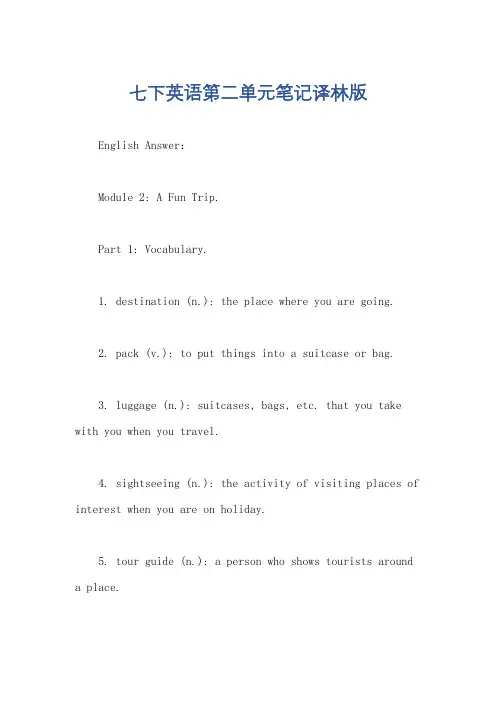
七下英语第二单元笔记译林版English Answer:Module 2: A Fun Trip.Part 1: Vocabulary.1. destination (n.): the place where you are going.2. pack (v.): to put things into a suitcase or bag.3. luggage (n.): suitcases, bags, etc. that you take with you when you travel.4. sightseeing (n.): the activity of visiting places of interest when you are on holiday.5. tour guide (n.): a person who shows tourists arounda place.6. souvenir (n.): an object that you buy when you areon holiday to remind you of the place you visited.Part 2: Grammar.1. Indirect Questions:Indirect questions are used to ask questions without using the question words (who, what, when, where, why, how).The word order in indirect questions is subject + verb + object + if/whether/what/who/when/where/why/how.Example:Direct question: What is your name?Indirect question: I wonder what your name is.2. Relative Clauses:Relative clauses are used to add more informationabout a noun or pronoun.The relative pronouns who, which, that, and whosecan be used to introduce relative clauses.Example:The girl who is wearing a red dress is my sister.3. Adverbs of Frequency:Adverbs of frequency are used to indicate how often something happens.Common adverbs of frequency include: always, usually, often, sometimes, rarely, never.Example:I always brush my teeth in the morning.Part 3: Reading.A Fun Trip.I am going on a fun trip to Beijing next week. Beijing is the capital of China. It is a big and beautiful city with many places of interest. I am going to visit the Great Wall, the Forbidden City, and the Temple of Heaven. I am also going to try some delicious Chinese food. I am so excited about my trip!Part 4: Writing.Write a paragraph about a fun trip you have taken.I have taken many fun trips in my life, but one of my favorites was a trip to Disney World in Orlando, Florida. I went with my family and we stayed for three days. Wevisited all four of the theme parks and rode many rides. My favorite ride was Splash Mountain. It was so much fun getting wet and riding through the log flume. I also enjoyed meeting all of the Disney characters and watching the parades. It was a truly magical experience.中文回答:第二单元,一次有趣的旅行。
Unit2知识点梳理牛津译林版七年级英语下册

7B Unit2 Neighbours 知识点梳理1、拜访我们的新邻居2、在第九大街的城市花园3、开一个“助手”会议4、为一家大公司效力5、在你们社区周围6、使你感觉更好7、在镇中心8、帮助我们解决各种困难9、开/关(电器按钮等)10、一小时后11、买一些盘子和叉子12、帮助病人13、叫某人(不要)做某事14、互相帮助15、忙于某事/做某事16、保持忙碌17、寻求某人帮助18、准备做某事/乐于做某事乐于助人19、帮助老人打扫公寓20、生火21、打扫卫生/读些书22、做某事是幸运的23、远离她的家24、请人修他的自行车25、需要帮助解决他们的问题26、担心某人/某事27、骑自行车去上班28、或多或少29、找人修理像坏自行车之类的东西30、在某人的帮助下31、随身携带一把雨伞32、等某人做某事等我们回电等你的33、自由的、空闲的34、在健康中心35、了解很多有关式样和颜色的知识36、计划外出一天37、后天visit our new neighboursin City Garden in Ninth Streethave a “helping hands” meetingwork for a big panyaround your neighbourhoodmake you feel betterin the town centre/in the centre of the town help us with all kinds of problemsturn on / offin an hourbuy some plates and forkshelp sick peopleask sb. (not) to do sth.help each otherbe busy with sth./ be busy doing sth.keep busyask sb. for helpbe ready to do sthbe ready to helphelp the old people clean the flatsmake a firedo some cleaning/readingbe lucky to do sthfar away from her homeask someone to fix his bicycleneed help with their problemsworry about sth / be worried about sth.go to work by bike= ride a bike to workmore or lessfind someone to fix things like broken bicycles with the help of sb.= with one’s helptake an umbrella with sbwait for sb. to do sthwait for us to call backwait for your callbe free/have free timeat/in the Health Centreknow a lot/much about styles and colours plan a day outthe day after tomorrow38、看下面的信息39、找位电脑工程师检查电脑40、在三月五号下午41、办公室人员42、在一个警察局/邮局43、决定做某事44、再一次,又一次45、没有其他没有其他学生46、他爷爷病得很厉害。
牛津译林版七年级英语下册Unit2知识点专项汇总
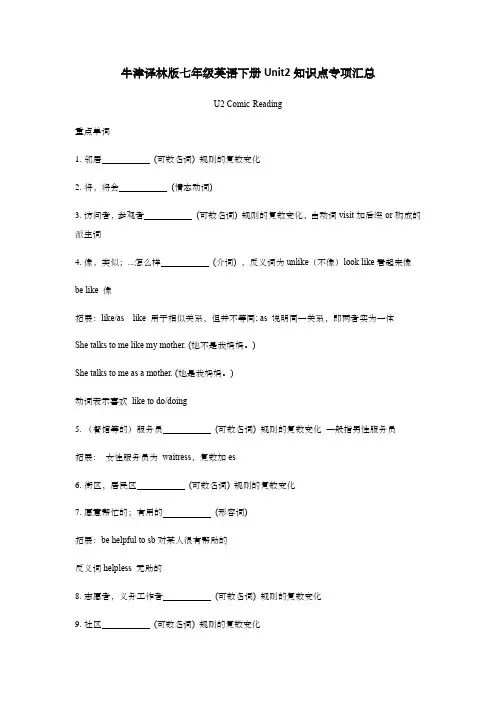
牛津译林版七年级英语下册Unit2知识点专项汇总U2 Comic-Reading重点单词1.邻居(可数名词) 规则的复数变化2.将,将会(情态动词)3.访问者,参观者(可数名词) 规则的复数变化,由动词visit加后缀-or构成的派生词4.像,类似;...怎么样(介词) ,反义词为unlike(不像)look like看起来像be like 像拓展:like/as like 用于相似关系,但并不等同; as 说明同一关系,即两者实为一体She talks to me like my mother. (她不是我妈妈。
)She talks to me as a mother. (她是我妈妈。
)动词表示喜欢like to do/doing5.(餐馆等的)服务员(可数名词) 规则的复数变化一般指男性服务员拓展:女性服务员为waitress,复数加es6.街区,居民区(可数名词) 规则的复数变化7.愿意帮忙的;有用的(形容词)拓展:be helpful to sb对某人很有帮助的反义词helpless 无助的8.志愿者,义务工作者(可数名词) 规则的复数变化9.社区(可数名词) 规则的复数变化10.技能,技巧(可数名词) 规则的复数变化11.问题,难题(可数名词) 规则的复数变化拓展:区分problem/question problem指客观存在、等待解决的的问题或麻烦事,侧重指难题或理科中有关运算的问题,常跟在think about/work out/solve后question 指主观对某事迷惑不解、等待回答的具体问题,侧重指不能断定的或文科中问题,常跟在ask/answer后12.某事,某物(不定代词) 多用于肯定句中,在否定句或疑问句中常用anything,注意作主语时谓语动词用单数形式13.工程师;技师(可数名词) 规则的复数变化,其前不定冠词用an14.检查;核实(动词) check out检查,核实15.损坏了的;破碎的(形容词) 其动词原形为break拓展:形容词性还有骨折的;折断的意思16.某人(不定代词) 多用于肯定句中,与somebody同义,注意作主语时谓语动词用单数形式17.修理(动词)拓展:fix up 修理;安装18.任何人(不定代词) 相当于anybody,常用于疑问句或否定句中,肯定句中用someone或somebody拓展:anyone/any one anyone只能指人,不能和of短语连用any one 既可以指人,也可以指物,可以和of短语连用,表示多数之中的任何一个。
Unit2知识点课件牛津译林版英语七年级下册
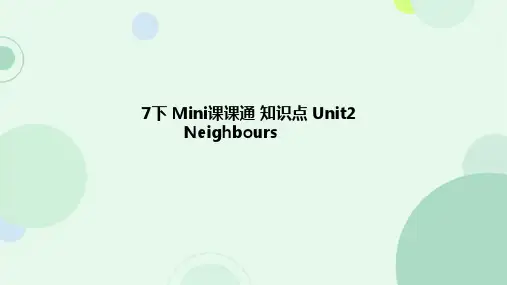
表复数概念,没有单数形式,一般不指具体的人。 不可与a/one 连用;当表示两个及以上的人时, 可用people
ex. Even a person selling vegetables has a QR ex. There're many people/persons in the shop
code.
anything group
/ɡruːp/
/waʊ/
/ˈweɪtə(r)/
/ˈneɪbəhʊd
/
/ˌvɒlənˈtɪə(r)/
/ˈkʌmpəni/ /dɪˈzaɪn
/
be afraid welcome visitors like you help each other most of them at the community centre/center help sb. with sth. all kinds of ask sb. to do sth. be broken college students be ready/willing to do sth. do some shopping
help sb. out 帮助某人克服困难、渡过难关
ex. I like helping my mother with the housework. =I like helping my mother (to) do the housework.
知识点:
2. There's something wrong with sth. "某物坏了、失灵了” =Something is wrong with sth. =Something is not working well. =Something is broken.
牛津译林英语七年级英语下册unit2neighbours知识点归纳
一、知识要点1.Where are you going?你打算去哪里?be going此处为“现在进行时表将来”。
现在进行时表将来主要用于表示按计划或安排将要发生的动作,常有“意图”“安排”或“打算”的含义。
这种现在进行时比较生动,给人一种期待感。
go, come, leave等表示位移的动词,都可以用于现在进行时表将来。
例如:He is going. 他要走了。
I’m coming. 我要来了。
Tom is leaving. 汤姆要走了。
2. I’m going to vi sit our new neighbours.我打算拜访我们的新邻居。
be going to意为“计划,打算”,后接动词原形,用于表将来。
例如:I’m going to wash the car if I have time. 若有时间我想洗洗车。
Where are we going to stay tonight? 我们今晚住哪里?3. I’m afraid they won’t welcome visitors like you.恐怕他们不会欢迎像你一样的拜访者。
(1)welcome作及物动词,意为“欢迎’’,可与介‘词to连用;也可作形容词,意为“受欢迎的"。
如:Welcome you to our school! 欢迎到我们学校来!You’re welcome.不用谢。
(2)句中like是介词,意为“像,相似’’,其反义词是unlike;作动词时,意为“喜欢’’,后可接动名词或不定式作宾语。
如:What is Jim like? 吉姆这个人怎么样?They like playing football on Sunday.他们喜欢在星期天踢足球。
(3)won’t是will与not的缩略形式。
“will+动词原形"也是一般将来时的构成之一。
如:We will take a bus to work.我们将乘公共汽车上班。
牛津译林版七年级英语下册Unit2知识点汇总
牛津译林版七年级英语下册Unit2知识点汇总Neighbours重点单词与短语1.Neighbour n. [英] 邻居=[美] neighbor考点: neighbour 为可数名词,复数形式neighbours.例句: My neighbours are very friendly. 我的邻居们很热情.2.Visitor n. 采访者,参观者考点: visitor 意为”访问者,参观者”,为可数名词,多指交际商务观光或探望的访客. [归纳] 以-or结尾表示人的名词actor 男演员inventor 发明家doctor 医生translator翻译家collector收集者conductor售票员3.Like prep. 像,类似;.......怎么样辨析like,as4.Helpful adj. 愿意帮忙的;有用的固定搭配helpful in doing sth. 做某事很有帮助It’s helpful to do sth. 做某事有帮助V.help help sb. with sth.= help sb. do sth.5. community n. 社区考点community 意为”社区,社团”,为可数名词. 作主语强调整体时,谓语动词用单数;强调”社区的人”时,谓语动词用复数.例句The new arts centre will serve the whole community. 这座新的艺术中心将为整个社区服务.典型例题我们的社区很大. very large.Community 为集合名词.集合名词用来指一群人或一些事物的总称,类似的词还有police,family等.5.Skill n. 技能,技巧固定搭配skill in/at .........方面的技能develop a skill 发展技能Practical skill 实际技能with skill 非常熟练例句Reading and writing are two important skills.阅读和写作是两种重要的技能.6.Problem n. 问题,难题固定搭配have a problem 有问题deal with a problem 处理问题Fix a problem 解决问题cause a problem 引起问题例句There are still some serious problems in this street. 这条街上任然有一些严重的问题.7.Something pron. 某事,某物考点something 多用于肯定句中,作主语时,谓语动词用单数形式. something 还可用于表现说话人希望得到肯定回答的疑问句中.例句There is something wrong with my bike. 我的自行车出了点毛病.Would you like something to eat? 你想吃点什么吗?8.Check vt. 检查;核实固定搭配check in 登记check out 结账退房;调查Check on 检查,查看check off 核对,查对例句Our English teacher often checks our homework. 我们的英语老师经常检查我们的作业.Check 用作及物动词时,可跟名词,代词,从句等作宾语.中考真题I will meet Jane at the station. Please what time she will arrive.A.CountB. chooseC. checkD. catch9.Broken adj. 损坏了的;破碎的考点broken 可用于名词之前作定语或连系动词之后作表语.例句The watch is broken. 这块表坏了.10.Fix vt. 修理固定搭配fix up 修理;装饰fix on 选定,确定联fix v. 安装,使固定;确定辨析fix,repair,mend例句I fix a picture on the wall. 我在墙上装上一幅画.I must have my car repaired. 我必须把我的车修好.11.College n. 学院辨析college, university12.Lucky adj.幸运的固定搭配be lucky to do sth.很幸运做某事be sb.'s lucky day 是某人的掌运反义词:unlucky adj.不幸的联想:luck n. lucky adj. Luckily adv.13.Fire n.火固定搭配make a fire 生火start a fire 放火,纵火set fire to sth. 纵火焚烧某物be on fire 起火put out a fire 灭火fight a fire 救火例句It took firemen several hours to put out the fire.消防员花了好几个小时才把火补灭。
译林版牛津英语七年级下册全册Unit2单元知识点及语法归纳
七年级英语下册知识点总结Unit 2 Neighbours一、重点词组、句型用法一、重点词组、句型用法1. I am afraid they won`t welcome visitors like you.我恐怕他们不会欢迎向你这样的客人。
我恐怕他们不会欢迎向你这样的客人。
be afraid to do sth 害怕去做某事害怕去做某事 be afraid of sth /doing sth.害怕某物/做某事做某事be afraid+(that)从句welcome sb. 欢迎某人迎某人 welcome to sp.欢迎来到某地欢迎来到某地like (prep)像He, _______his elder brother, likes chatting with others. I’m afraid so.恐怕是的。
恐怕是的。
I’m afraid not. 恐怕不是这样的。
恐怕不是这样的。
2.It`s good to live in a neighbourhood like that. 住在那样一个小区很好。
住在那样一个小区很好。
It`s+形容词to do sth3.What are your neighbours like?= How are you neighbours?你的邻居们(性格品质)如何?你的邻居们(性格品质)如何?What be sb/sth like?你认为…怎么样(性格品质)?(用形容词回答)?(用形容词回答)What do/does sb. like?某人喜欢什么?某人喜欢什么?What do/does sb. look like?某人长什么样子(外貌)?4. They often meet at the community centre and share their different skills.different +名词复数名词复数5.Some of them are volunteers.他们中有一些人是志愿者。
牛津译林版七年级下册英语 Unit2 知识点总结-最新
牛津译林版七年级下册英语Unit2 知识点总结一、重难点汇总解析1. welcome sb. 欢迎某人. welcome to sp. 欢迎到某地. You are welcome. 没关系/ 不用谢。
2. like 像. visitors like you 像你这样的拜访者. a new neighbourhood like that 一个像那样的新街区. a bike like yours 像你的一样的一辆自行车3.be afraid of sth. .eg. I am afraid of ghosts. 我害怕鬼。
. be afraid to do…. eg. I am afraid to go out at night. 我害怕在晚上出去。
. be afraid that 从句(委婉语气,表示说话人的担心或看法). I am afraid (that) he won’t come tomorrow afternoon.我恐怕他明天下午不会来。
. I am afraid not. 我恐怕不是(能)。
/ I am afraid so. 我恐怕是这样。
4. in Ninth Street 在第九大街. in your neighbourhood 在你的街区. around your neighbourhood 在你的街区周边5. It’s good to live in a neighbourhood like that.住在像那样的一个街区是很好的。
. It is + adj. + to do …做某事怎么样. eg. It is bad to talk in class. 在课上讲是不好的。
6. help us with all kinds of problems 帮助我们解决各种问题. all kinds of …各种各样的……. different kinds of …不同种类的……. a kind of …一种……7. have a meeting 开会. have a class meeting 开一次班会. have a parents’ meeting 开一次家长会. have a sports meeting 开一次运动会8. There is something wrong with my computer. 我的电脑出了一些毛病。