
北师大版-英语-四年级下册-小学英语北师大版(三年级起点)三年级下册UNIT8作业
北师大版三年级起点小学三年级英语下册全套PPT课件
What are these? They’re beans. What are those? They’re cabbages. I like them all. I like them all.
What are _____? They’re_______. What are _____? They’re _______. I like them all. I like them all.
They’re beans .
They’re cabbages .
They’re carrots .
They’re mushroom.
They’re potatoes . They’re tomatoes .
Homework:
1.听、读课文。
2.和同学一起谈论水果 吧。
Ten little candles dances
北师大版三年级起 点小学三年级英语 下册全套PPT课件
Fruits
fruits
Fruits are good for our health. We should eat more fruits. 水果对健康有益。 我们应该多吃水果。
• 胖娃娃,没手 脚,红尖嘴, 一身毛,背上 一道沟,肚里 好味道。
a peach an
a
nuts
a
an banana
apple orange
Who 's this ?
Mocky Lulu
Aunt Booky
What’s this?
• It’s a peach. • It’s a banana.
What’s this?
• It’s an orange. • It’s a nut.
北师大版小学英语(三年级起点)四年级下册Unit11GreenBerriesLesson2教案
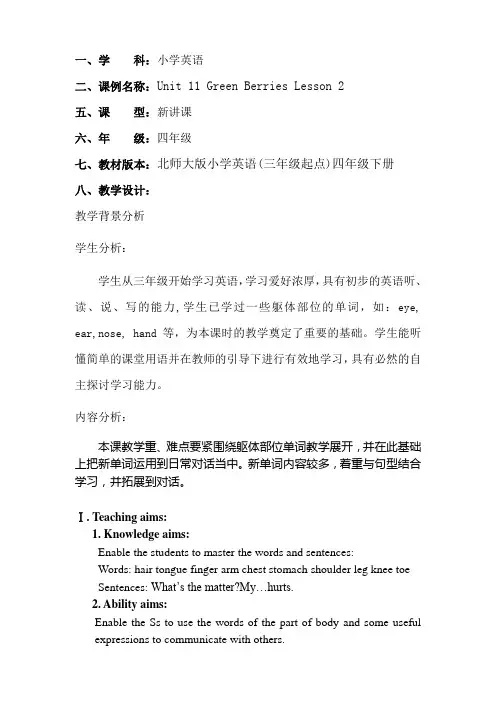
一、学科:小学英语二、课例名称:Unit 11 Green Berries Lesson 2五、课型:新讲课六、年级:四年级七、教材版本:北师大版小学英语(三年级起点)四年级下册八、教学设计:教学背景分析学生分析:学生从三年级开始学习英语,学习爱好浓厚,具有初步的英语听、读、说、写的能力,学生已学过一些躯体部位的单词,如:eye, ear,nose, hand等,为本课时的教学奠定了重要的基础。
学生能听懂简单的课堂用语并在教师的引导下进行有效地学习,具有必然的自主探讨学习能力。
内容分析:本课教学重、难点要紧围绕躯体部位单词教学展开,并在此基础上把新单词运用到日常对话当中。
新单词内容较多,着重与句型结合学习,并拓展到对话。
Ⅰ. Teaching aims:1. Knowledge aims:Enable the students to master the words and sentences:Words: hair tongue finger arm chest stomach shoulder leg knee toeSentences: What’s the matter?My…hurts.2. Ability aims:Enable the Ss to use the words of the part of body and some useful expressions to communicate with others.Develop the Ss’ ability of listening, speaking and reading.3. Moral education aims:(1) Encourage the Ss to have good cooperation with others by meansof group competition and group discussion.(2) Encourage the students to be brave enough to speak Englishmore.Ⅱ. The important and difficult points in this lesson:Teaching Important Points:the words of the part of body:eye ear nose mouth face head hand foot hair tongue finger arm chest stomach shoulder knee toehow to care about others and make a dialog: What’s the matter?My…hurts.Teaching Difficult Points:Enable the students to use the some useful sentences when you see a doctor.Ⅲ. Teaching Methods:Using individual, pair work and group work to let every student be an active part in class.Ⅳ. Teaching Aids:The multimedia, the blackboard and cardsⅤ. Teaching procedures:Step7. homework 1.Make a survey afterclass.Complete the surveyafter class.Doing someextensiveexercises afterclass is good forthe pupils toconsolidate theknowledge inlearning English.2. Homework:1).Finish Read,Trace andMatch in Unit 11.2).Make a dialogue withyour partner.3).Sing the song "Headshoulders knees and toes"to your parents.听力材料Listening ExerciseListen and number.’s the matter?My eye hurts.’s the matter?My arm hurts.’s the matter?My leg hurts.’s the matter?My finger hurts. ’s the matter?My stomach hurts.Students’ notesBlackboard design:Unit 11 Green Berries Lesson2Name(姓名): Class(班级): Learning Contents 学习内容 Words: eye ear nose mouth face head hand foothair tongue arm finger cheststomach leg shoulder knee toe Sentences:What’s the matter?My…hurts. In Class 课堂表现I can get.After Class 课后表现Homework Read,Trace and Match in Unit 11.a dialogue with your partner.the song "Head shoulder knee toe"to your parents. From my partner: You can get.From my parents:You can get .九、教学反思:1. 课堂中我尽可能用英语和来组织教学,有些经常使用课堂指令要求学生听懂明白得并做出相应的反映。
北师大版三年级英语下册第八单元unit

北师大版三年级英语下册第八单元unit English: Unit 8 of the third grade English textbook from Beijing Normal University Press focuses on the theme of animals. It introduces various animals, their habitats, and their characteristics.Chinese: 北师大版三年级英语教材第八单元的主题是动物。
它介绍了各种动物,它们的栖息地以及它们的特点。
English: This unit not only helps students expand their vocabulary related to animals but also enhances their understanding of different habitats and animal behaviors.Chinese: 这个单元不仅帮助学生扩充与动物相关的词汇,还增加了他们对不同栖息地和动物行为的理解。
English: Understanding the characteristics of different animals can also help students develop empathy towards living creatures and respect for nature.Chinese: 了解不同动物的特点还可以帮助学生培养对生物的同理心和对大自然的尊重。
English: By learning about animals and their habitats, students can also gain a deeper appreciation for the diversity of life on Earth.Chinese: 通过学习动物和它们的栖息地,学生还可以更加深刻地欣赏地球上生命的多样性。
最新北师大版(三起)三年级下英语课件-Unit9 Numbers

There are six pandas.
How many monkeys are there? There are ten monkeys.
How many birds are there?
There are five birds.
How many crocodiles are there?
How many pears are there?
Let me see. One two· · · There are eight pears.
How many apples are there?
Let me see. One two· · · There are nine apples.
How many bananas are there?
There is one crocodile.
crocodile
There’s one small crocodile.
crocodile
There’s one big crocodile.
How many crocodiles are there?
How many eggs are there? Five or six?
7
five
2 2 1
8
seven
2 3 2
How many tigers are there?
There are seven tigers.
How many cats are there?
There are eight cats.
How many dogs are there?
There are nine dogs.
There are four pencils.
北师大版英语三年级下册电子课本
北师大版英语三年级下册电子课本北师大版英语三年级下册电子课本查看完整版可微信搜索公众号【5068教学资料】,关注后对话框回复【3】获取三年级语文、三年级数学、三年级英语电子课本资源。
小学三年级英语知识点1.show me your pencil / ruler/ eraser/ crayon/ pen. 让我看看你的铅笔/尺子/橡皮/蜡笔/钢笔。
2.open your pencil--case. 打开你的铅笔盒。
close your book .合上你的书。
show me your sharpener. 让我看看你的卷笔刀。
carry your bag. 背起你的书包。
go to school . 去上学。
3.Touch your head./ nose/ eye/ mouth/ ear. 摸摸你的头/鼻子/眼睛/嘴巴/耳朵。
4.Clap your hands. 拍拍你的手。
Snap your fingers. 打响你的手指。
Wave your arms. 挥挥动你的胳膊。
Cross your legs. 翘翘你的双腿。
Shake your body. 扭扭你的身体。
Stamp your foot. 跺跺你的脚。
5.Show me your red/ blue / green / yellow / purple crayon.给我看看你的红/蓝/绿/黄/紫色蜡笔。
6.Black, black. Stand up. 黑色,黑色,站起来(起立)!Pink , pink. Sit down. 粉红色,粉红色,坐下!Brown, brown. Touch the ground. 棕色,棕色,摸摸地板。
Orange, orange. Touch your head. 橙色,橙色,摸摸你的头。
White, white. Turn around. 白色,白色,转个圈。
7. Act like a cat/ duck/ panda/ monkey/ rabbit/ dog. 模仿小猫/鸭子/熊猫/猴子/兔子/小狗表演。
【北师大版】三年级下册英语全册单元知识汇总
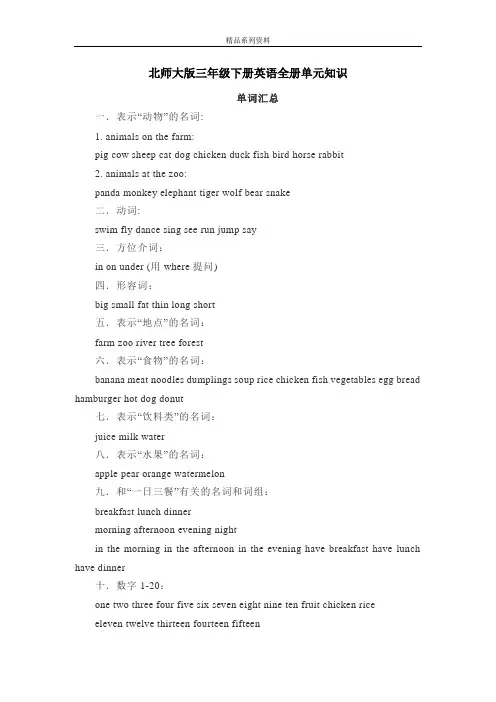
北师大版三年级下册英语全册单元知识单词汇总一.表示“动物”的名词:1. animals on the farm:pig cow sheep cat dog chicken duck fish bird horse rabbit2. animals at the zoo:panda monkey elephant tiger wolf bear snake二.动词:swim fly dance sing see run jump say三.方位介词:in on under (用where提问)四.形容词:big small fat thin long short五.表示“地点”的名词:farm zoo river tree forest六.表示“食物”的名词:banana meat noodles dumplings soup rice chicken fish vegetables egg bread hamburger hot dog donut七.表示“饮料类”的名词:juice milk water八.表示“水果”的名词:apple pear orange watermelon九.和“一日三餐”有关的名词和词组:breakfast lunch dinnermorning afternoon evening nightin the morning in the afternoon in the evening have breakfast have lunch have dinner十.数字1-20:one two three four five six seven eight nine ten fruit chicken riceeleven twelve thirteen fourteen fifteensixteen seventeen eighteen nineteen twenty十一.其他单词和词组:farmer animals where little box grass hungry thirsty table food eat drink then句型汇总What’s this? It’s a sheep.Yes, It is. / No, it isn’t. It’s a sheep.Yes, I can. / N o, I can’t.Yes, it can.No, it can’t.It’s on the box. Is this a chicken? Can you swim? Can a horse run? Can it fly? What animals can fly? Birds can fly. Where is the cat?The elephant is big.The bird is small.The panda is fat.The monkey is thin.Look at the elephant. Its nose is long. Its tail is short.Look at the rabbit. Its ears are long. Its tail is short.How many monkeys are there at the zoo? There are ten monkeys at the zoo. Where does a fish live? In a river.Where does a bird live? In a tree.Where does a panda live? In a forest.Where does a tiger live? In a forest.Monkeys eat bananas.Tigers eat meat.Cats eat fish.Cows eat grass.I’m hungry! I want to eat.I’m thirsty!Let’s eat!Would you like some dumplings, Jenny? Yes, please. Would you like some soup, Jenny?I don’t like fish.Rice is okay.I like dumplings. Dumplings are good.My favourite food is noodles.Good morning!Good afternoon!It’s time for lunch!I like noodles for breakfast.What do you like?I like pears. I’d like a hamburger and some juice, please. Li Ming: Sure! Li Ming: You’re welcome. One yuan. Five yuan. One yuan. What would you like? Jenny: Thanks. Good morning! Good afternoon! Good evening! No, thanks. I want to drink. Good evening! Jenny: Li Ming, may I have a hot dog? How much for one donut? How much is a hot dog? How much are the oranges?语音汇总m mouth swim n dance nosel leg lakes bus snakex box sixh hungry handr ruler riveri nine fivez zoo zeroo hello oldw worker windowu student computerc rice juice cold cowy yellow yo-yo cry fly理解并拼写。
北师大版(三起)三年级下册英语全册教案
北师大版三年级下册英语教案小学英语三年级(下册)全册备课对新课标理解:现在的社会是向着全球化,社会化发展的,将来的地球不管是哪一个角落都是一我们地球林的一个村民,那么语言就成了一个统一交流的媒介,尤其是英语的重要性在这一进程中日益突出。
本次对于课程标准的重新更定是一次符合社会发展进程和基础教育进程的改革。
重点是要改革英语课程的教学,过分重视语法和词汇知识的讲解与传授,忽视对学生实际语言运用能力的培养倾向,强调课程应从学生的学习兴趣、生活体验和认知水平出,倡导学生体验、实践、参与、合作与交流的学习方式和任务型的必学途径,发展学生的综合语言运用能力,使语言学习的过程成为学生形成积极的情感态度,主动思维和大胆实践,提高跨文化意识和形成自主学习能力的过程。
做到这些要求,首先需要的就是学生浓厚的对英语学习的兴趣,那怎么样培养学生学习兴趣就成了一个基础话题,这一问题要面向全体学生,特别是要关注学生的个别差异引起的情感问题。
帮助学生建立成就感和自信心。
在教学中注意创设能引导学生主动参与的教学环境,激发学生的学习积极性。
使每个学生都能得到充分的发展。
在这一过程中教学模式的转变起到了一定的作用,一定要从以老师为中心的教学模式身以学生为中心的教学模式转变。
强调学生的参与和体验,强调采用多种形式的教学活动。
比如可以利用我们学校已有的良好电教资源,听原版录音带练习发音,也可以利用网络找一些贴近课堂学习的情境对话或小动画,以更直接的方式引导学生学习英语,对英语产生浓厚的兴趣。
利用听、说促进学生写单词,写短语,写句子,写对话,不能反其道而行,又造成以往我们说的“哑吧英语”。
总的来说,新课标对发展学生自我主观能动性起到了很积极的作用。
素质教育在其中深有体现。
并且由升学教育向终身教育的转变等等都是很好的突破。
在这一新课标的指导下,希望在英语教学中可以达到更好的效果。
Teaching contents:本册书共六个单元,其中五个单元是精读课文,一个复习单元。
-英语-四年级下册-北师大版(三年级起点)四年级下册Unit 10 Mockey’s store教案英文版 第3课时
Unit 10 Mockey’s storeTeaching aims:Can read and write the words for this unit.Can understand and read the new sentences.Importance and difficulty:Can use the dialogs.Lesson 31.ReviewUse the following game to review vocabulary for this Unit.•Divide the class into two teams. Have them stand in two rows facing the board.•Explain that you will call out a word. The first child in each team must rush to the board and draw a matching picture. The child who finishes drawing the correct picture first wins a point for his or her team. The team with the most points wins the game.•At the end of the game, point to each drawing in turn and have the class say its English name.2.Talk togetherStudent Book page 42•Have the children turn to page 42. Draw their attention to the top of the page. Show your copy of the page. Point to the picture. Explain that Mocky has set up his own store and that Bobby is his first customer in the morning. Ask the children what Bobby and Mocky are saying to each other. Try to elicit, “Good morning.”•Now ask the children what Mocky is holding. Elicit, “A pencil.” Then ask the children what they think Bobby might want to buy.•Tell the children that you are going to read what Mocky and Bobby are saying. Point to the first line. Explain that Mocky is speaking. Read the sentences and have the children repeat the words after you.•Repeat the procedure for the rest of the dialog. Review the meaning of the word selling.•Now point to the picture of the cap. Ask, “What’s this?” Elicit, “It’s a cap.”•Repeat for the other pictures (ball, bag, magazine, watch, purse, and umbrella).3.Listen and numberStudent Book page 42•Have the children open their books at page 42. Show your copy of the page. Point to the first picture and ask what it is. For example, “What’s this?” Elicit, “A new watch.” Repeat for the other pictures. •Explain to the children that they will hear a phrase on the tape, and they must match it to the correct picture.•Play the tape. Have the children point to the matching picture. •Play the tape again, stopping after each phrase. This time the children need to write the correct phrase number in the box next to the matching picture.•Have the children repeat the phrases in a class drill.4.Trace, match, and copyStudent Book page 43•Have the children open their books at page 43. Show your copy of the page. Draw the children’s attention to the watch in the first picture. Ask, “What’s this?” Elicit, “It’s a watch.”•Read the words in the speech bubble. Have the children repeat the words after you. Ask which word is missing. Elicit, “Watch.”•Have the children find the word, trace it, and then copy the word to complete the sentence in the speech bubble.•Repeat the procedure for the other pictures and words.5.Set homeworkStudent Book page 43Tell the children that you want them to color the pictures for homework.。
北师大小学三起点英语三年级下册Unit7 Fruits Lesson4教学设计
北师大小学英语三起点三年级英语知识需要巩固背诵单词和课文,不要粗心大意。
北师大小学英语一年级起点伴你成长快乐学习!Unit7 Lesson4教学设计【内容来源】北师大三起点(2012年版)三下Unit7 Lesson4【主题】Get It Right.【课时】第4课时:Lesson4一、教学目标(Teaching aims)1. 了解b, p在单词首字母中的发音。
2. 指认、认读本课的语音词汇,发音准确。
3. 在四线三格中正确书写单词或词组。
二、教学重难点(Teaching points and difficulties)(一)重点(Points)1. 指认、认读本课的语音词汇,发音准确。
2. 在四线三格中正确书写句子。
(二)难点(Difficulties)区分字母b和p;清辅音p的发音较难。
(此难点为预设难点,教师可根据班里实际情况调整)三、教学准备(Teaching preparation)课件(教师可以在优教平台直接调用或下载)。
四、教学过程Step 1: Warm-up1. 师生相互问候。
2. 教师播放字母歌歌曲,学生跟唱。
Step 2:PresentationPart1: Listen and Repeat.1. 教师出示本部分单词及其图片,学生自己读一遍。
2. 教师播放录音,学生跟读。
3. 学生认真观察单词,说出共同点。
4. 教师引导学生总结:第一行单词中首字母都为b,它们的发音都是/b/;第二行单词中首字母都为p,它们的发音都是/p/。
5. 教师带领学生读单词,如:/b/ /b/ baby(注意学生首字母的发音是否正确)6. 学生自读、开火车读(先读首字母发音,再读单词)。
Step 3: Practice1. Part2: Listen and Write.(1) 学生同桌之间看图说单词。
(2) 教师播放录音,学生认真听,根据单词的读音写出单词的首字母。
(3) 教师再次播放录音,学生跟读,师生核对答案。
北师大小学一起点英语三年级下册《Unit 9 Hot soup》课件 (4)
Listen to the story carefully ,and read after the tape.(认真听,跟着 录音读)
Go!
game:摇骰子
Tips: 1、前后桌六人为一组,每人有一张卡片。 2、轮流摇骰子, 摇的人问:Do you have any ____? 3、其他人根据手中的卡片回答: yes, I do.\No, I don’t.
I’m thirsty. I want some _____.
cola iced tea juice
water
milk
I’m hungry. I want some _____.
hamburger noodles
rice
Hot dog
chicken
Listen to the story carefully ,and read after the tape.(认真听,跟着 录音读)
Go!
Do you have any water?
Do you have any milk?
Do you have any iced tea?
Do you have any juice?
Do yostory carefully ,and read after the tape.(认真听,跟 着录音读)
选择其中你喜欢的一样作业: 1、和同学合作,分角色表演课文。 2、朗读课文。 3、运用“Do you have any _____? \ I want ______”向同学询问是否有某物。
Go!
Let’s chant
Cola, cola, I want some cola. Milk, milk, I’ want some milk. Juice, juice, I want some juice. Iced tea, iced tea, I’m want some iced tea. Thirsty, thirsty. I’m thirsty.