
人教版英语七年级上册教案:Unit5 Section A(1a-2d)
S: …
2. Ask some pairs to act out their conversations.
2.通过单词和图片配对练习巩固单词
学生能够说出相关的单词
do (does), have, tennis, ball, ping-pong, bat, soccer, soccer ball, basketball, let, us, let's go, we, late, has, get
Step2
Ask one student to show the answers and check them.
1.通过实物展示,抛出问题,学生说出相关单词:
do (does), have, tennis, ball, ping-pong, bat, soccer, soccer ball, basketball, let, us, let's go, we, late, has, get
2. Look at the picture in 1a and practice the conversation with
each other in pairs.
S1: Do you have …?
S2: Yes, I do.
S1: Do you have a …?
S2: No, I don’t.
学生是否能够通过反复朗诵课文,用目标词汇和语言创编新的对话
DELC3
深度加工知识
Step5
While-Listening
1. T: Look at the pictures in 2b and name them. What are these?
(Point at the baseball, basketball, soccer ball, volleyball.)
T: Check their answers.
S1: … S2…
1.通过听力练习,达到语言输入的目的。
2.听第一遍完成教材基本要求,听第二遍提高难度,要求学生用本课目标词汇及句型完成回答问题。
通过听力检查学生是否能听懂目标词汇与基本句型
Step4
Post-listening
1. Read the conversations in 1c. (Ask students to repeat.)
T: I’ll play the recorder for the second time. Listen and number the pictures (1-4).
(Students listen for the second time.)
T: Listen to the conversation in 2b. Match the people with the balls.
(Students listen and match. Teacher checks their answer.)
通过听力练习巩固并检测学生所学的
目标词汇及句型是否掌握。
学生能够完成听力练习
Step6
Post-listening
1. T: Let’s look at the picture in 2a. Does Jane have a tennis ball?
Model:
S1: Do you have a basketball?
S2: Yes, I do.
S3: Does she have a basketball?
S4: Yes, she does.
S1: Do you have a soccer ball?
S2:No, I don’t.
S3: Does she have a soccer ball?
S1: No, she doesn't.
T: Does Paul have a soccer ball?
S2: No, he doesn't.
T: Does his brother have a soccer ball?
S2: Yes, he does.
(Ask more students to make a conversation.)
S2: (Help S2 answer) No, she doesn't.
Practice the drill “Do you have a …?”, "Does he/she have a…? " in pairs. You can use your school things and these balls. Look at the model, then practice like this.
T: Yes, you are right. Read after me. B-A-S-K-E-T-A-B-L-L, basketball.
Ss: B-A-S-K-E-T-A-B-L-L, basketball.
(Show the students other objects. Teach the new words“soccer ball, ping-pong ball, volleyball, tennis bat, ping-pong bat” in the same way.)
【通过本单元的学习学生需掌握的综合技能】通过本单元的学习,学会用have对物品的所属进行提问与回答;学会用let’s…句型提建议;能够谈论自己喜欢哪些球类运动,不喜欢哪些球类运动及原因;能够谈论怎样和自己的朋友度过一段愉快的时光。
教学目标
1.语言知识目标:
1)能掌握下列词汇:do (does), have, tennis, ball, ping-pong, bat, soccer, soccer ball, basketball, let, us, let's go, we, late, has, get
computer, ping-pong bat, baseball)
T: Ask and answer the questions as many as you can.
S1: Do you have a … ?
S2: …
S1: …
S2: …
1.学生通过反复模仿原文对话,巩固目标语言。
2.利用所学目标词汇,自己创编新的对话,拓展学生词汇及语言能力。
Ss: They are…
T: There are four children in the conversations. Who are they? Please listen and find the answer.
(Play the recorder for the first time.)
S: …
1.教学重点:
1)通过运用have对物品的所属进行提问以及应答,来掌握一些运动项目的词汇。
2)在询问对方是否有某物的对话中学会使用do和does引导的一般疑问句。
3)学会用祈使句来向对方提出建议。
2.教学难点:
学会使用第三人称单数的一般疑问句Does …?及回答作对话。
建议教法
语音教学——让学生进行模仿操练;词汇教学——采取演示讲解的方式进行教学,让学生进行情景操练、反复使用;口语教学——采取pair work问答式的口语交际活动互相操练练习
Unit5 Section A(1a-2d)教案
【教材版本与册数】新目标人教版七年级上册
【单元名称】Unit5 Do you have a soccer ball?
【课时】Section A 1a-2d(第1课时)
【课型】Listening and Speaking(听说课)
教材分析
【本单元话题】和朋友一起欢度时光
2)学会用have对物品的所属进行提问以及应答,学会使用do和does引导的一般疑问句:
①—Do you have a baseball?
—Yes, I do. /No, I don't.
②—Does she/he have a tennis ball?
—Yes, she/he does./ No, she/he doesn't.
S4: No, she doesn't.
(Students work in pairs.)
巩固目标句型,为听力做准备
学生是否能够运用目标句型
DELC2
获取新知
Step3
While-Listening
T: Look at the four items of 1b in the pictures. Listen to the conversation.
过程
措施(教师活动与学生活动)
目的
持续性评价
DELC1
预备与激活先期知识
Step1
Presentation
1. Present the key vocabulary.
(Show a basketball to the class.)
T: What’s this in English?
S1: It’s a basketball.
③—Do they have a soccer ball?
—Yes, they do./ No, they don't.
3:
利用学生喜爱运动的心理,激发学生学习英语的欲望和兴趣,使他们乐于参与各种英语实践活动。在小组活动中,培养学生团结协作精神。
教学重难点
T: Read the words together twice.
Ss: …
2. Look at the words in 1a and match the words with the things in the picture.
Starter Unit1 Section A(1a-2d)教学设计七年级英语上册(人教版2024)

Starter Unit 1 Hello 课时教学设计第1课时教学设计授课时间:课题Section A (1a-2d)How do greet people?课型新授课(听说课)课时1主备人审核人语篇研读【What】本课语篇是新学期开学,新同学和老师之间互相问候开展对话。
对话中主要进行了问候、询问姓名、如何拼写以及告别等信息。
【Why】新学期开学同学们复习过去所学的同时,能认识教材的主线任务;让学生复习如何打招呼并询问对方姓名,迈出认识新老师、新同学、新朋友的第一步;让学生在不同情境下使用的打招呼交际用语,同时增进老师和学生之间的了解。
【How】通过阅读单元的主题图让学生了解本教材的主线人物和教材板块的设计,其中包括中国学生和外国学生以及学校老师,学生能使用简单的问候语和告别语来完成简单的对话。
学情分析K(Known) 已知W(Want) 想知L(Learned)已学认识26个英文字母的发音以及一些简单的日常用语和单词。
如何有效、快速地记忆新单词,掌握简单的问候语,学会在真实情境中应用,提高听说读写的能力。
掌握了26个字母的准确发音和规范书写方式。
掌握了简单的英语问候语,学会了自我介绍。
教学重难点重点:掌握26个英文字母的准确发音与规范书写;使用Hello/Hi/Good morning等表达去问候他人,介绍自己。
难点:在不同场景下熟练使用所学语言,得体、礼貌地问候他人、介绍自己。
学习目标1.能正确认读、书写教材中七个主线人物的名字,了解教材单元的构成。
2.能听辨并掌握26个英文字母的准确发音与规范书写;理解常见字母缩略词,以及字母排序在日常生活和学习中的常见运用,学好切分字母的音。
3.能创编一段对话,熟练使用“Hello”,“Hi”或“Good morning”等表达问候他人或对他人问候做出应答,介绍自己并询问对方姓名。
评价评估维度评估标准评估方式评估主体First, introduce myself to the class. Then let students introduce each other.Know each other by introducing themselves.conclusion about the greetings.3.Ask Ss to look at the picture. Match the names with the faces.4.Please work in pairs and come to the front and introduce the main character in our textbook.3.Look at the picture and match the names with the faces.Write their own name on the first page of their own book in correct spelling.4.Work in pairs. Come to the front and introduce the main characters in our textbook.Let Ss listen and say the letter. Then practice writing them. Listen and circle the letters they hear.First, listen and say the letters in 2a. Then, watch a short video and learn how to write the letters correctly. Repeat the letters one by one after the video. Finally, listen and circle the letters you hear in 2a.Ask Ss to observe the picture and ask question.Guide Ss to read the conversations quickly and circle some key words and predict the answers. Then play the recording and check the answers.Look at the picture in 2c and make some prediction. Listen to three conversations and fill in the blanks with the correct sentences in the box. Then role play the conversations.Encourage Ss to work with their partners or group members and greet each other. Provide the structure of the conversation.设计意图:帮助学习整体感知对话内容,并培养学生准确找出关键信息的能力。
人教版七年级英语上册教案 Unit 5 第1课时 Section A (1a-1c)
Unit5 Doyouhaveasoccerball?1.单元话题以“介绍自己所拥有的体育用品”或“介绍自己或朋友、家人的运动喜好”展开,情境属于新课标“人与社会”主题范畴中的“文学、艺术与体育”这一主题群,涉及子主题“日常体育活动,重大体育赛事,体育精神”。
2.单元主题体现《中国学生发展核心素养》中的“自主发展”方面,提升学生的“健康生活”这一素养,立足于“自我管理”这一基本要点。
3.能读写本单元重点词汇。
4.掌握“play+球类名词”的用法,能运用正确的形容词描绘喜欢或者厌恶的体育运动。
5.通过听力训练,获取他人拥有某物的相关信息。
6.灵活运用do/does 引导的一般疑问句及含don't/doesn't 的否定句。
7.通过讨论球类用品的拥有情况,培养自己对体育项目的兴趣,热爱校园生活。
续表【课时建议】本单元建议5课时SectionA(1a-1c)(一课时)SectionA(2a-2d)(一课时)SectionA(GrammarFocus-3c)(一课时)SectionB(1a-1d)(一课时)SectionB(2a-SelfCheck)(一课时)词汇短语:主要采用图片及多媒体展示助记法。
基本句子:采用多媒体展示及交际法(利用多媒体展示两人进行交际时的情景)。
语法:就本单元话题“The sporting goods they own”运用一般疑问句谈论物品所属关系,采用freetalk加深印象。
第一课时SectionA (1a-1c)Step1 情景导入【参考案例】T:Lookatthesportsthings.Here,thepingpongballismine.Itbel ongstome.SoIhaveapingpongball.“Have”isan importantverbinthisunit.Nowlistencarefully:Doyouhaveapingpongball?I'maskingyouifyouhaveapingpongball.Ifyouhave,say“Yes,Ido.”;ifnot,say“No,Idon't.”设计意图:通过提问引出本课的语言目标,在师生问答中自然而然导入新课。
(完整word版)最新人教版七年级上册英语精品教案Unit5
Unit 5Do you have a soccer ball?LanguageGoal【语言目标】Be able to talk about ownership.KnowledgeGoals 【知识目标】Key Wordsdo,have,tennis,ball,soccer,volleyball,basketball,let,us,go,we,late,has,get,great,play,sound,interesting,boring,fun,difficult,relaxing,watch,TV,same,love,with,sport,them,only,like,easy,after,class,classmateKey Phrases let’s=let us,watch TV,soccer ballKeySentencesDo you have a ping-pong bat?Yes,I do./No,I don’t。
Do they have a ping-pong ball?Yes,they do。
/No,they don’t.Does she/he have a tennis ball?Yes,she/he does./No,she/he doesn't。
Key Grammar The simple present tenseAbility Goals 【能力目标】Be able to talk about activities and express your own feelings about them。
Moral Goals【情感目标】Form a good habit of loving sports。
Teaching Time【课时】Four periodsPeriod 1Section A(1a-1c)Period 2Section A(2a -3c)Period 3Section B(1a-1d)Period 4Section B (2a-Shelf Check)Period 1 Section A (1a-1c)Teaching important points【教学重点】1.Key words &phrases:do,have,tennis,ball,ping-pong,bat,soccer,soccer ball,volleyball,basketball 2.Key sentences:Do you have a ping-pong bat?Yes,I do.Do you have a ping-pong ball?No,I don't。
Unit5SectionA1a-2d教案(五四制)英语七年级上册
Unit 5 Section A 1a2d教学目标1.笔头掌握以下句型Where did you go on vacation? I went to the mountains.Where did Tina go on vacation? She went to the mountains.Did you go with anyone? Yes, I went with my mother.2.熟练掌握以下词汇:vacation,mountain,specia1,anyone 核心素养实践创新1.劳动意识:一般过去时;复合不定代词 someone,anyone,something,anything等的用法。
2.技术运用:一般过去时动词过去式的不规则变化教学重点复习并掌握动词一般过去式的构成规律;能用一般过去式叙述假期所做的事。
复合不定代词 someone,anyone,something,anything 的用法。
教学难点通过对过去事情的谈论,增进同学的相互了解。
教学过程一、导入新课On my vacationI went to somewhere beautiful.I did something interesting.I met someone friendly.I ate something delicious.I bought something special.形容词修饰不定代词,形容词后置。
二、新课讲解Where did you go on vacation?went to the beachwent to the mountainsvisited the museumstayed at homeFree talkWhere did you go on vacation?went to the park went to the zoostayed at home visited museumswent to the beach went to the mountainsLucyWhere did you go on vacation?I went to the moutains. It was tired but exciting.LilyWhere did you go on vacation?I went to New York City. It was interesting.MaryWhere did you go on vacation?I went to the beach. It was fun.Vacation Activitiesvisit my uncle go fishing go to the mountainsvisit museums stay at home go to the beachgo camping went to New York CityListen. Where did the people go on vacation? Complete the chart.People PlacesGrace New York CityKevin the beachJulie stayed at homeListen again. Check (√) Yes, I did or No, I didn’t for each question.GROUPWORKA: Where did you go on vacation?B: I ……A: Did you go with anyone?B: Yes……/No ……(A:Did you buy anything special? B: Yes,……/No……)Group work(四人小组合作)Show TimeA:Where did you go on vacation?B:I...C:Where did she/he go on vacation?D:She/He...Did Sally go to the mountains?Yes, she did.Did Bob go to the beach?No, he didn't.He visited his uncle.Did they have a great vacation?Yes, they did.三、摘要What have we learned today?(今天学到了什么)A: Where/What did you go on vacation?B: I ....A: How was your vacation?B: It was…A: Did you ...?B: Yes, I did. / No, I didn't .四、作业A: Finish your article then make a survey in your group to talk about your vacation according to the chart belowB: Preview 2d on P34。
Unit5 第1课时(Section A 1a-2d)课件 人教版英语七年级上册
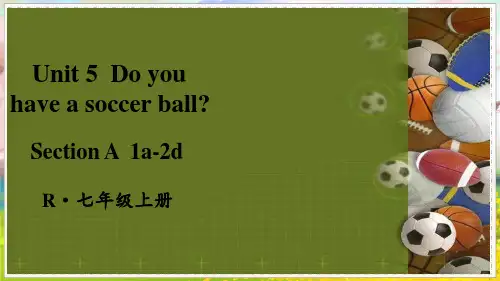
A: _D__o_e_s_ Mike have a basketball? B: Yes, _h_e__d_o_e_s_____.
Exercises
I.单项选择。
1 —Does Jane have a ball?
—Yes, _______D_____
A .I am
B. it is
C. you do
1a
Match the words with the things in the picture.
1.tennis ball __a___
2.ping-pong bat __f__
3.soccer ball __c__ 4.volleyball ___e__
5.basketball __d___
6.baseball bat __b__
Does
2. Do you have a baseball racket?
bat
3. He have a bookcase.
has
4. Do you have a basketball? Yes, you have.
I
Summary
1. —Do you have a ...? —Yes, I do. I have.../ No, I don’t. I don’t have a...
A. Yes, he does.
B. No, he doesn’t.
C. No, I don’t.
Listen again and fill in the blanks.
Conversation 1: Bob: Do you have a soccer ball, Paul? Paul: _N__o_, _I_d_o_n_’_t__. Bob: Does your brother Alan _h_a_v_e_ one? Paul: Yes, he _d_o_e_s__.
七年级-人教版-英语-上册-Unit-5-Section-A-(1a-2d)
__a___ __f___ __c___ __e___ __d___ ___b___
a b
c d
e
f
1b 1b Listen and circle the words you hear.
ping-pong bat
soccer ball
volleyball
ping-pong ball
1c Practice the conversation above with your partner. Then ask and
e.g. My brother goes to school by bike every morning. 我哥哥每天早晨骑自行车去上学。 Let’s go home. 咱们回家吧。
3.We’re late! 我们迟到了! late 在此处作形容词,意为“迟到”,其反义词为 early,意为
“早到的,提前的”。be late for … 意为 “…… 迟到”。
Yes, I do.
Do you have a volleyball? No, I don’t.
—Do you have …? —Yes, … / No, …
1a Match the words with the things in the picture.
1.tennis ball 2.ping-pong bat 3.soccer ball 4.volleyball 5.basketball 6.baseball bat
1.Do you have a ping-pong bat? 你有一副乒兵球拍吗?
(2)do 此处用作助动词,帮助实义动词构成一般疑问句,无实际意义。 do/does 与 not 连用构成 don’t/doesn’t,放在实义动词前构成否定句。 e.g. I don’t like basketball. 我不喜欢篮球。 (3)have 动词,意为“有”,其第三人称单数形式为 has。常用句式 为“某人 + have/has + 某物/某人.”,表示“某人有……”。 e.g. I have a new red car. 我有一辆新的红色小汽车。 She has two rulers. 她有两把尺子。
最新人教版七年级上册英语精品课件Unit 5 Section A (1a-1d)
I _h_a_v_e_ a _b_a__sk__e_t_b_a_l_l and a ping-pong _b_a_t_.
单击此处编母版标题样式
1. Do you have a map? (作肯定回答) 2•. D单Y_eo_•击s_,y第_I此o_d二u_处o级._h编_a_v辑_e_母a_n_版_E文_n_本g_l_i样s_h_式_d_ic_t_io_n__a_ry_?__(_作_否__定__回_答__)__
e.g. I have a good friend. 我有一个好朋友。 She has a new pen. 她有一支新钢笔。
单击此处编母版标题样式
• 单击此处2. 编la辑te母版文本样式
• 第二“级迟到” 是个形容词,常用 be late 的结构。 • e.第g三.• J级a第c四k级 is always late. 杰克总是迟到。
N__o,_I_d_•o_n第_’_t三._级_________________________________ 3. Does Lind• a第四h级ave an eraser? (作肯定回答)
• 第五级
_Y_e_s,_s_h_e _d_oe_s_. ________________________________ 4. Does he have a volleyball? (作否定回答)
• 单击1.此ha处ve编辑母版文本样式
• 作第动二词级,意为“有”,一般指某人拥有某物,侧重于所属关系。其第三人称
• 第三级
单数形式• 是第四h级as。常用句式为:某人 + have/has + 某物,表示“某人有某物”。
• 第五级
注意:在一般现在时中,当主语为第三人称单数形式时,用第三人称单数形 式has。
Unit 5 Section A 1a-1c 课件人教版七年级英语上册
A: __D__oyou____h_aav_e______te_n_n?is ball
B: No,___I_d_o_n_.’tI don't have a ____________ .
tennis ball
A: __D_o_they_____have
_vo_l_l_ey_b__a_ll?. B: No,___th__ey__d_o_n. ’Tt hey don't have a __v_o__ll_e__y_b_a__l_l_.
Work in pairs.
A: Do you have a/an/any…? -Yes, I do. I have a/an/some…. ( No, I don’t. I don’t have a/an/any….)
In order to make the dialogue real, we can add
听力策略: 抓物品关键词
ping-pong bat soccer ball volleyball ping-po
1c
---Do you/we/they have a /an…?
---Yes, I/We/they do./ No, I/We/they don’t.
Look and say
A: Do you have a ______b_a_s_k?etball B: Yes, I do. I have a _________ .basketball
2. Key sentences :
①Do you have a basketball ? Yes , I do. / No, I don’t.
② Do you have a ping-pong ball? Yes, I do./No, I don’t.
2021-2022学年人教版七年级英语上册Unit 5 1-5课时教案
B:Yes,I do.知识点拨▲have(1)have意为“有”,表示某人拥有某物。
have在句子中有两种形式,即have和has。
have用于第一人称(I,we)、第二人称(you)以及第三人称复数(they)和其他复数名词;而has则用于第三人称单数(he,she,it)和单数名词。
如:I have an apple.我有一个苹果。
Mary has an orange.玛丽有一个橙子。
(1)have/has句子的一般疑问句是在句首加助动词do或does,句尾用问号构成。
第三人称单数和单数名词前加does后,句中的谓语动词has应改为have。
作简略回答时,肯定回答为“Yes,主语+do/does.”,否定回答为“No,主语+don't/doesn't.”。
板书设计:T:Oh,what a pity!You don't have a basketball.Do you have a volleyball?S:Yes,I do.T:Nice.Let's play volleyball.S:That sounds good.Step 3畅通Grammar Focus回顾语法重点Read Grammar Focus and practice these sentences.Step 4完成教材3a-3b的任务1.学生将3a方框中的单词填入表格中正确的位置。
2.学生用表格中的单词造句,比一比,看谁写得又快又对。
3.学生用do或does填写3b中的空白补全对话,然后结伴练习对话,邀请几个小组展示。
Step 5完成教材3c的任务学生记住鲍勃房间里的物品,然后合上书模仿3c中的对话,与同伴问答,然后结对练习。
知识点拨▲英语中的人称和数人称汉语主格助动词宾格单数第一人称我Idome 第二人称你you you 第三人称他hedoeshim她she her它it it复数第一人称我们wedous 第二人称你们you you 第三人称他/她/它们they them ▲实义动词的一般疑问句结构(1)当主语是第一人称/第二人称/第三人称复数/复数名词时,句型结构为:Do+主语+动词原形+其他?知识点拨▲let's=let uslet sb. do sth.意为“让某人做某事”。
人教版英语七年级上册 Unit 5 Section A 教案
Unit 5 Do you have a soccer ball ?Section A (1a-2d)Unit 5 Do you have a soccer ball? Section A (Grammar Focus-3c)B: Yes, he does.A: Where is it?B: It's on the table.Step 4 Language Points1.great adj. 美妙的;伟大的great独立成句,常用于口语中,表示说话人的喜悦之情,通常意为“太好了”。
2.play v.参加(比赛或运动); 玩耍1) play在此处是及物动词,后接表示球类运动的名词时,play 与球类运动名词之间不加冠词。
2) play作动词还可意为“玩耍”,play with sb./sth.表示“和某人一起玩/玩……”。
3) play作动词,还可意为“演奏;弹奏”,后接表示乐器的名词时,乐器名词前要加定冠词the。
3. sound v.听起来好像sound在此处作连系动词, 也是感观动词,后常接形容词作表语。
常见的感官动词:Step 5 Exercises & HomeworkExercisesAsk Ss to do the exercises on P30-P32.Ask Ss to make a summary about language points they learned today.Homework1. Preview the new words and phrases in Section B(1a-1d).2. Do the exercises in students’ book.Teaching I didn’t do well in explaining the grammar part. Well, the third singular form of verbs was a little complicated, so the students didn't fully understand it, especially the B-level。