
人教版七年级上册英语 Unit 5 知识点总结
人教版七年级上册英语Unit 5 知识点总结
1. What do I/we/you/they have?(特殊疑问句)
1)You/I/They/ We have …(肯定句)有
2)You/I/They/ We don’t have…(否定句) 没有
3)Do you/they have…?(一般疑问句)有吗
—Yes, I/ we/they do./No, I / we/they don’t .
2. What does he/she/it have? ?(特殊疑问句)
1) He/She/It has…(肯定句)有
2) He/She/It doesn’t have…(否定句)没有
3) Does he/she/it have…?(一般疑问句)有吗
—Yes, he/she/it does./ No, he/she/ it doesn’t
3. 辨析has/have与There be
(1)Has/have 某人或某物有……(表示所属关系)
Eg:I have a brother.我有一个哥哥。
(2)There be 某地有……(不表示所属,就近原则)
Eg:There are some boys in the classroom. 教室里有一些男孩子。
There is an apple and two oranges on the table.桌子上有一个苹果和两个橘子。
4. 辨析get、bring与take
(1)get 表示“从别处取得……”——get ..from…
(2)take表示“把……带到某地去”——take…to…
(3)bring表示“把……带到某地来”——bring…to…
Eg:I get a notebook from my teacher.我从我的老师那里得到了一个笔记本。
Can you take my book to the classroom?
你能把我的书带到教室去吗?(说话人不在教室)
Can you bring my book to the classroom?
你能把我的书带到教室来吗?(说话人在教室)
5. 英语中的人称和数(在一般现在时态中)在英语句子中,谓语动词的形式要与句子主语的人称和数相对应。
比如.主语是第三人称单数,谓语动词变为复数形式;主语为第一、二人称及第三人称复数,谓语动词用原形(单数)。
(1)当主语是第一人称/第二人称/第三人称复数时, 句型结构为:
Do + you/they/we/… + 动词原形 + …?
—Yes, I/we/they/… do.(肯定回答)
—No, I/we/they/…don’t.(否定回答)
(2)当主语为第三人称单数时,句子结构改为:
Does + he / she / it… +动词原形+ …?
—Yes, he /she / it does. (肯定回答)
—No, he /she / it doesn’t.(否定回答)
6. 三人称单数动词变化规则。
人教版七年级英语上册 unit 5 句式讲解及知识梳理
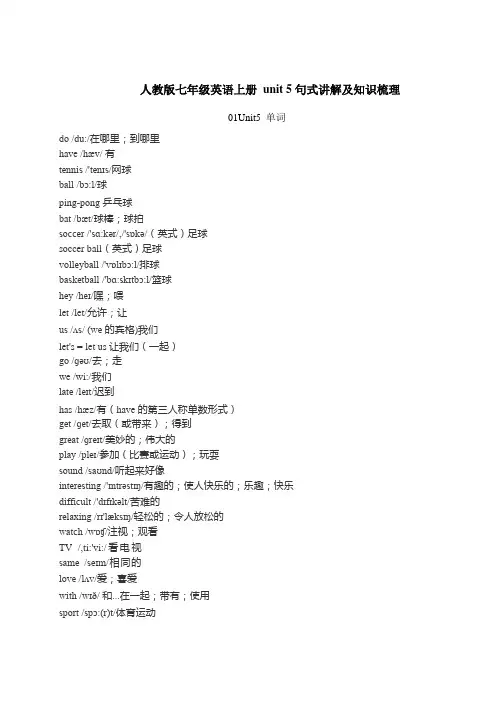
人教版七年级英语上册unit 5 句式讲解及知识梳理01Unit5 单词do /du:/在哪里;到哪里have /hæv/ 有tennis /'tenɪs/网球ball /bɔ:l/球ping-pong 乒乓球bat /bæt/球棒;球拍soccer /'sɑ:kər/,/'sɒkə/(英式)足球soccer ball(英式)足球volleyball /'vɒlɪbɔ:l/排球basketball /'bɑ:skɪtbɔ:l/篮球hey /heɪ/嘿;喂let /let/允许;让us /ʌs/ (we 的宾格)我们let's = let us 让我们(一起)go /ɡəʊ/去;走we /wi:/我们late /leɪt/迟到has /hæz/有(have 的第三人称单数形式)get /ɡet/去取(或带来);得到great /ɡreɪt/美妙的;伟大的play /pleɪ/参加(比赛或运动);玩耍sound /saʊnd/听起来好像interesting /'ɪntrəstɪŋ/有趣的;使人快乐的;乐趣;快乐difficult /'dɪfɪkəlt/苦难的relaxing /rɪ'læksɪŋ/轻松的;令人放松的watch /wɒʧ/注视;观看TV /,ti:'vi:/看电视same /seɪm/相同的love /lʌv/爱;喜爱with /wɪð/ 和...在一起;带有;使用sport /spɔ:(r)t/体育运动them /ðem/ /ð əm/他(她、它)们only /'əʊnlɪ/只;仅like /laɪk/喜欢;喜爱easy /'i:zi/容易的;不费力的after /'ɑ:ftə/在...之后class /klɑ:s/班级;课classmate/'klɑ:smeɪt/同班同学02Unit5 知识梳理Unit5 Do you have a soccer ball?【重点短语】1.have a volleyball 有一个排球2.play volleyball/tennis 打排球/网球3.have a ping-pong/table tennis 有一个乒乓球4.play ping-pong/table tennis 打乒乓球5.with our friends 和我们的朋友一起6.have a football/soccer ball 有一个足球7.play football/soccer 踢足球8.at school 在校,在上学9.play sports 做运动10.play computer games 玩电脑游戏11.watch TV 看电视12.in the same school 在同一所学校13.after class 下课后14.go to school 去上学【重点句型】1.—Do you have a ping-pong bat? 你有一个乒乓球拍吗?—No, I don’t. 不,我没有。
Unit 5 期末复习知识点归纳 人教版七年级英语上册

人教版英语七年级上册第五单元期末复习知识点归纳Unit 5 Do you have a soccer ball?一、一般现在时态1、肯定句的结构。
(1)、主语+be动词(am/is/are)+表语;例如:I am thirteen years old. (2)、主语+谓语动词(实义动词)+宾语;例如:I have a good friend.2、be(am\is\are)动词与实义动词。
be动词,中文意思是“是”,又叫系动词,构成主系表结构。
do类动词,又叫实义动词,用作谓语,构成主谓宾结构。
例如:have\like\play\eat等等。
3、在实义动词组成的句子中,有动词原形和动词第三人称单数的用法区别,我们要着重掌握动词第三人称单数的构成与用法。
(1)、当主语不是第三人称单数形式时,谓语动词用原形。
(2)、当主语是第三人称单数形式时,谓语动词用三单形式。
注意:“原形动词+s/es”构成“第三人称单数形式”,与单数名词变复数名词方法一样,需要牢记以下规则:(1)、一般情况,动词后直接加s;例如:finds 找到、发现 asks 询问(2)、以字母s、x、ch、sh、和o结尾的动词,加es;例如:does做watches 观看 do做 go去(3)、以“辅音字母+ y”结尾的动词,变y为i,加es;例如:study—studies 学习。
(4)、另外一些特殊的就需要记忆:have - has。
4、一般现在时态的肯定句中主语与谓语动词的搭配。
第一人称单数主语:I + am或V原形第三人称单数主语:主语 + is或V第三人称单数形式注意:不可数名词做主语,用法和第三人称单数一样。
复数主语+are或V原形5、一般现在时态肯定句变否定句和一般疑问句的方法肯定句变为否定句:有be动词时,主语+be动词(am/is/are)+表语;例如:I am not thirteen years old.我不是十三岁。
Unit 5 知识归纳人教版英语七年级上册
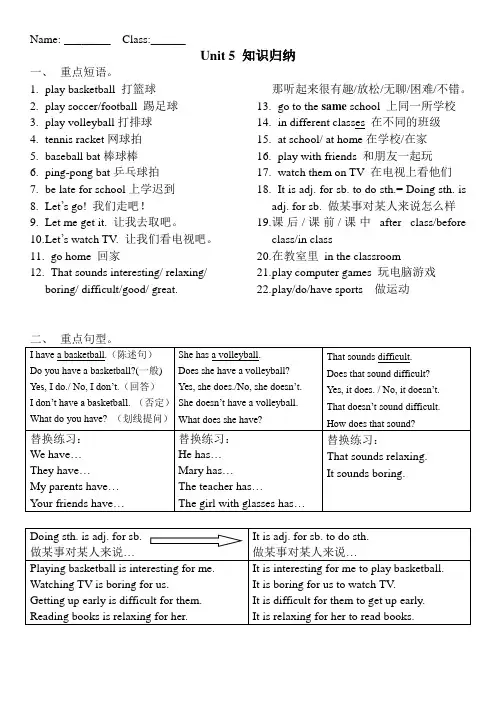
Name: ________ Class:______Unit 5 知识归纳一、重点短语。
1.play basketball 打篮球2.play soccer/football 踢足球3.play volleyball打排球4.tennis racket网球拍5.baseball bat棒球棒6.ping-pong bat乒乓球拍7.be late for school上学迟到8.Let’s go! 我们走吧!9.Let me get it. 让我去取吧。
10.L et’s watch TV. 让我们看电视吧。
11.go home 回家12.That sounds interesting/ relaxing/boring/ difficult/good/ great.那听起来很有趣/放松/无聊/困难/不错。
13.go to the same school 上同一所学校14.in different classes 在不同的班级15.at school/ at home在学校/在家16.play with friends 和朋友一起玩17.watch them on TV 在电视上看他们18.It is adj. for sb. to do sth.= Doing sth. isadj. for sb. 做某事对某人来说怎么样19.课后/课前/课中after class/beforeclass/in class20.在教室里in the classroom21.p lay computer games 玩电脑游戏22.p lay/do/have sports 做运动三、作文范文。
My name is Gina. I like doing sports. It is interesting for me.I have eight tennis balls, two volleyballs and five soccer balls, but I don’t have a baseball. I have a good friend Jack. We are in the same school. He has a ping-pong ball and two ping-pong bats. After school, he can play it with his classmates. He thinks it’s relaxing. He likes basketball very much. But he only watches it on TV. It’s difficult.It’s time for sports. Let’s play soccer. Come on!。
人教版七年级英语上册Unit5短语、句型、知识点总结
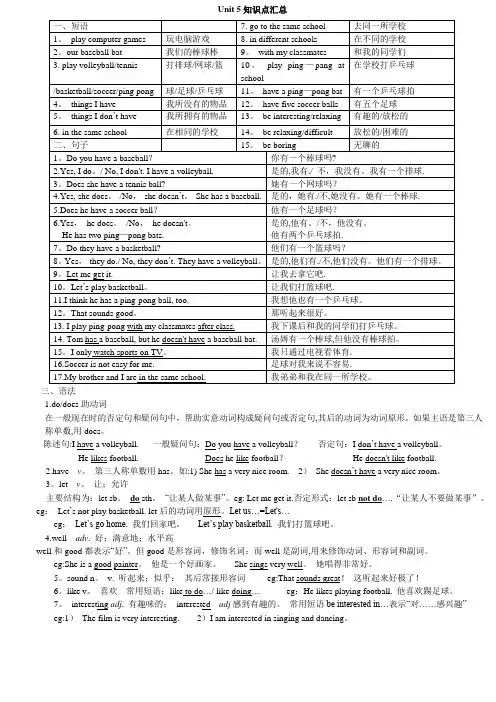
Unit 5知识点汇总三、语法1.do/does助动词在一般现在时的否定句和疑问句中,帮助实意动词构成疑问句或否定句,其后的动词为动词原形。
如果主语是第三人称单数,用does。
陈述句:I have a volleyball. 一般疑问句:Do you have a volleyball?否定句:I don’t have a volleyball。
He likes football. Does he like football?He doesn't like football.2.have v。
第三人称单数用has。
如:1) She has a very nice room. 2)She doesn’t have a very nice room。
3。
let v。
让;允许主要结构为:let sb。
do sth。
“让某人做某事”。
eg: Let me get it.否定形式:let sb not do….“让某人不要做某事”。
eg:Let’s not play basketball. let后的动词用原形。
Let us…=Let's…eg:Let’s go home. 我们回家吧。
Let’s play basketball. 我们打篮球吧。
4.well adv. 好;满意地;水平高well和good都表示“好”。
但good是形容词,修饰名词;而well是副词,用来修饰动词、形容词和副词。
eg:She is a good painter。
他是一个好画家。
She sings very well。
她唱得非常好。
5。
sound n。
v. 听起来;似乎:其后常接形容词eg:That sounds great!这听起来好极了!6。
like v。
喜欢常用短语:like to do…/ like doing…eg:He likes playing football. 他喜欢踢足球。
7。
interesting adj. 有趣味的;interested adj感到有趣的。
人教版七年级上册英语知识点全第五单元unit5知识点

人教版七年级上册英语知识点全第五单元unit5知识点Unit 5谈论物品所属关系。
教学重、难点1、掌握一般现在时中have的用法;2、学会用Let’s...提建议。
1、重点词汇:do、have、tennis、ping-pong bat、soccer、volleyball、basketball、play、interesting、boring、fun、difficult、relaxing、watch、same...2、soccer ball(英式)足球 a tennis bat一个网球拍baseball bat棒球拍be late迟到watch TV看电视on TV在电视上play basketball打篮球play sports做运动或参加体育比赛3、含有实意动词的一般疑问句的结构及答语。
---Do you /they have a...?e.g. Do they have a basketball?---Yes,I/they do./No,I/they don’t.---Does he /she have a...?e.g. Does she have a new schoolbag?---Yes,he/she does./No,he/she doesn’t.()----Do you have lunch at home?----___________.A. Yes, I amB. Yes, I canC. Yes, I doD. Yes, I have4、tennis 和tennis ball的区分:tennis指活动工程称号,即“网球活动”。
tennis ball则指详细的球,有单、复数之分。
e.g. a tennis ball/some tennis balls5、普通目前时中have的用法和与there be句型的辨析;have “有”即某物属于某人,表示所属关系,三单形式为has.e.g. I have a blue jacket and my sister has a yellow one.there be “有”主要指的是某地存在某物。
人教版英语七年级上册Unit5知识点总结

人教版英语七年级上册Unit 5 Do you have a soccer ball?.知识点梳理Section A课文要点全解1.tennis ball 网球辨析:tennis ball 与tennis以上两词都可表示“网球”,但意义却完全不同。
[拓展]本单元学到的表示球类运动的名词还有:Soccer(英式)足球volleyball 排球basketball 篮球Ping-pong 乒乓球baseball 棒球2.soccer ball (英式)足球soccer ball 意为“(英式)足球”。
I have a soccer ball. 我有一个足球。
[拓展]football 也可表示“足球”,在英式英语和美式英语中都有;football在美国指橄榄球,也称为American football。
football 是国际上对足球的普遍称呼,各种国际足球组织的官方称呼中也用football。
3.Do you have a ping-pong bat?你有一个乒乓球拍吗?(1)这是一般现在时的一般疑问句,句中的谓语动词have 是一个实义动词。
在英语中,句子的谓语动词如果是实义动词,变为一般疑问句时,要借助于助动词do/does来提问。
其基本句式为:Do/Does+主语+实义动词原型+其他?主语为第三人称单数时用Does,其他情况用do。
Do和does在这里没有实际意义,只是用来帮助构成一般疑问句。
I know Mr.Wang. 我认识王先生。
Do you know Mr.Wang? 你认识王先生吗?He has a baseball. 他有一个棒球。
Does he have a baseball? 他有一个棒球吗?[拓展]一般疑问句的肯定回答为“Yes, 主语(代词)+do/does.”,否定回答为“No, 主语(代词)+don’t/doesn’t.”。
-Does Tim go to school on foot? 蒂姆步行去上学吗?-Yes, he does./No, he doesn’t. 是的,他步行。
最全面人教版七年级上册英语第五单元知识点归纳总结
Unit 5 Do you have a soccer ball?一、词汇与短语● 重点单词A部分1.have v. 有2.has v. (have的第三人称单数形式)有3.ball n. 球te adj. 迟到5.ping-pong n. 乒乓球6.tennis n. 网球7.soccer n. (英式)足球8.get v. 去取(或带来);得到9.volleyball n. 排球10.great adj. 美妙的;伟大的11.basketball n. 篮球12.play v. 参加(比赛或运动);玩耍13.let v. 允许;让14.sound v. 听起来好像 pron. (we的宾格)我们16.bat n. 球棒;球拍17.go v. 去;走18.hey interj. 嘿;喂19.we pron. 我们20.do (第三人称单数形式does)aux v.&v.用于构成否定句和疑问句;做;干B部分1.interesting adj. 有趣的2.boring adj. 没趣的;令人厌倦的3.fun adj.有趣的;使人快乐的n. 乐趣;快乐4.difficult adj. 困难的5.relaxing adj. 轻松的;令人放松的6.watch v. 注视;观看 n.(= television)电视;电视机8.same adj. 相同的9.love v.&n. 爱;喜爱10.sport n. 体育运动11.with prep. 和……在一起;带有;使用12.only adv. 只;仅13.them pron. (they的宾格) 他(她、它)们14.like v. 喜欢;喜爱15.easy adj. 容易的;不费力的16.after prep.&conj. 在……以后17.class n. 班级;课18.classmate n. 同班同学● 重点短语A部分1.a ping-pong bat 一个乒乓球拍2.a baseball bat 一个棒球棒3.play basketball 打篮球4.sounds good 听起来不错5.be late 迟到6.play tennis 打网球7.play volleyball 打排球8.play soccer 踢足球9.play ping-pong 打乒乓球B部分1.play computer games 玩电脑游戏2.play volleyball 打排球3.go to the same school 上同一所学校4.watch TV 看电视5.sound interesting 听起来很有趣6.at school 在学校7.with them 和他们一起8.with our friends 和我们的朋友9.watch them on TV 在电视上看它们10.after class 下课后11.watch sports 看体育运动12.in the same school 在同一所学校13.play sth. with sb. 和某人玩某物14.love sports 喜爱运动● 重点句子A部分1.--Do you have a ping-pong bat? --No, I don't.你有一个乒乓球拍吗?不,我没有。
人教版七年级上册英语五单元知识点
Unit 5知识点总结:一、单词及短语1. hobby-爱好2. collect-收集3. stamp-邮票4. postcard-明信片5. coin-硬币6. sticker-贴纸7. keychain-钥匙链8. magazine-杂志9. puppet-木偶10. soccer-足球11. ping-pong-乒乓球12. violin-小提琴13. guitar-吉他14. piano-钢琴15. speak-说话16. play-打、玩17. fly-飞18. read-读二、重点语法1.动词的第三人称单数形式在英语中,当主语是第三人称单数时,动词要加上-s或-es。
例如:He often helps his mother with housework.(他经常帮助他妈妈做家务。
)2.句子的否定形式3.一般疑问句和特殊疑问句一般疑问句是用来征询对方对所说的事情是否同意,一般用助动词do/does,be动词is(are, am),情态动词can等构成。
特殊疑问句是用来询问特殊信息的问句。
a.一般疑问句的构成:肯定句:He is a student. ---> 一般疑问句:Is he a student?否定句:He is not a student. ---> 一般疑问句:Isn't he a student?b.特殊疑问句的构成:特殊疑问句的构成比较固定,一般是由动词be, do, does等引导。
例如:What is your hobby?(你的爱好是什么?)What does he collect?(他收集什么?)三、常用句型1. Do you have any hobbies?2. What's your hobby?3. What do you collect?5. Does he like playing soccer?6. How many stamps do you have?7. I like collecting stamps.8. She doesn't have any postcards.9. He collects coins from different countries.10. I play the guitar every day.四、日常交际用语1. -- What's your hobby?(你的爱好是什么?)-- My hobby is collecting stamps.(我的爱好是收集邮票。
七年级英语上册五单元
七年级英语上册五单元
人教版七年级英语上册第五单元主要学习了有关家庭成员的词汇和句型。
以下是本单元的重点内容总结:
1. 家庭成员的英文表达:father(父亲), mother(母亲), brother(兄弟), sister(姐妹), grandfather(祖父), grandmother(祖母), grandfather/grandmother(外祖父/外祖母)。
2. 询问家庭成员的职业:What's your father's job? He is a doctor. / What does your father do? He is a doctor.
3. 询问家庭成员的工作地点:Where does your father work? He works in a hospital. / Where does your father work? He works at a hospital.
4. 询问家庭成员的爱好:What does your father like to do in his free time? He likes to read books. / What are your father's hobbies? He likes reading books.
5. 描述自己的家庭:I have a big family. My father is a doctor and my mother is a teacher. I have two brothers and one sister. My grandfather and grandmother live with us too. We all love spending
time together.。
人教版初中英语七年级上册Unit5笔记汇总
2020年人教版初中英语七年级上册U n i t5笔记汇总1. What do I/we/you/they have?(特殊疑问句)1)You/I/They/ We have …(肯定句)有2)You/I/They/ We don’t have…(否定句) 没有3)Do you/they have…?(一般疑问句)有吗—Yes, I/ we/they do./No, I / we/they don’t .2. What does he/she/it have? ?(特殊疑问句)1) He/She/It has…(肯定句)有2) He/She/It doesn’t have…(否定句)没有3) Does he/she/it have…?(一般疑问句)有吗—Yes, he/she/it does./ No, he/she/ it doesn’t3. 辨析has/have与There be(1)Has/have 某人或某物有……(表示所属关系)Eg:I have a brother.我有一个哥哥。
(2)There be 某地有……(不表示所属,就近原则)Eg:There are some boys in the classroom. 教室里有一些男孩子。
There is an apple and two oranges on the table.桌子上有一个苹果和两个橘子。
4. 辨析get、bring与take(1)get 表示“从别处取得……”——get ..from…(2)take表示“把……带到某地去”——take…to…(3)bring表示“把……带到某地来”——bring…to…Eg:I get a notebook from my teacher.我从我的老师那里得到了一个笔记本。
Can you take my book to the classroom?你能把我的书带到教室去吗?(说话人不在教室)Can you bring my book to the classroom?你能把我的书带到教室来吗?(说话人在教室)5. 英语中的人称和数(在一般现在时态中)在英语句子中,谓语动词的形式要与句子主语的人称和数相对应。