
仁爱英语七年级unit1topic2sectionC
2.教师领读,注意语音语调
3.根据1a,完成1c。
4.完成2。和同伴合作回答问题,然后编对话练习。
5.完成3,观看Miss Wang的姓名卡,补全短文。
活动三:语音练习
1.完成4a。读音标连单词,然后听录音跟读。
2.完成4b。根据4b的音标写出单词。
知识反馈:见学案拓展延伸
教学设计
授课时间
2016年9月19日星期一
教学内容
大课题
Unit 1 Topic 2
Hale Waihona Puke 学时共4学时本节内容
Section C
第3学时
目
标
知识与技能
1.单词
2.句型:
—What’s your telephone number?
—My telephone number/It is 6800-3553.
过程与方法
教学反思
设置情景,小组活动。听,说,读,写相结合。
情感态度价值观
激发学生学习英语的兴趣,积极与同学合作参与课堂活动,大胆实践。
重点
1.学习英语数字0-10。
2.—What’s your telephone number?
—My telephone number/It is …
难点
1.学习英语数字0-10。
2.—What’s your telephone number?
—My telephone number/It is …
教学资源
录音机/多媒体/卡片
教学过程
导入新课:见学案预习导学
合作探究:
活动一:掌握数词在生活中的运用
1.听1b,学习0--10数词。
2.教师领读,学生互读达到会背。
3.看1b图片,练习用英语读出数词,比比谁读的更熟练。
活动二:掌握如何询问对方电话号码
Unit1 Topic3 Section C教案 仁爱版七年级上册英语
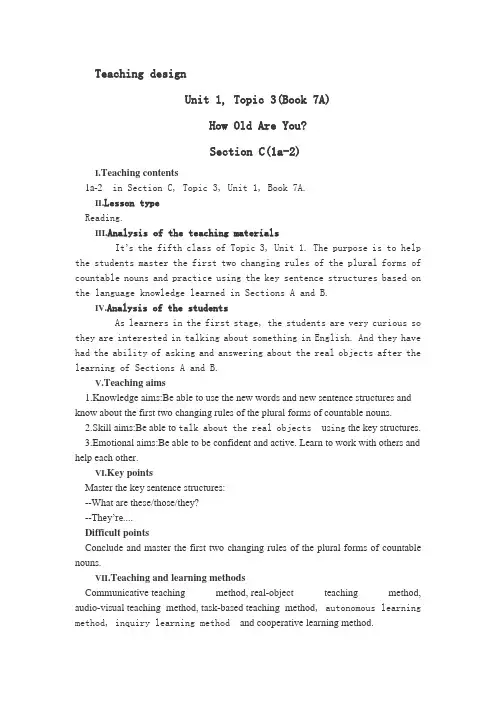
Teaching designUnit 1, Topic 3(Book 7A)How Old Are You?Section C(1a-2)I.Teaching contents1a-2in Section C, Topic 3, Unit 1, Book 7A.II.Lesson typeReading.III.Analysis of the teaching materialsIt’s the fifth class of Topic 3, Unit 1. The purpose is to help the students master the first two changing rules of the plural forms of countable nouns and practice using the key sentence structures based on the language knowledge learned in Sections A and B.IV.Analysis of the studentsAs learners in the first stage, the students are very curious so they are interested in talking about something in English. And they have had the ability of asking and answering about the real objects after the learning of Sections A and B.V.Teaching aims1.Knowledge aims:Be able to use the new words and new sentence structures and know about the first two changing rules of the plural forms of countable nouns.2.Skill aims:Be able to talk about the real objects us ing the key structures.3.Emotional aims:Be able to be confident and active. Learn to work with others and help each other.VI.Key pointsMaster the key sentence structures:--What are these/those/they?--They’re....Difficult pointsConclude and master the first two changing rules of the plural forms of countable nouns.VII.Teaching and learning methodsCommunicative teaching method, real-object teaching method, audio-visual teaching method, task-based teaching method, autonomous learning method, inquiry learning method and cooperative learning method.VIII.Teaching strategies1.Warming up before the class can help students get ready for the class quickly and easily and presenting the objectives of this class can help the students learn with purpose.2.Learn new words using the old sentence patterns and learn new structures using the old words so that the students can master the new knowledge more quickly and easily.3.When learning new words, present the correct phonetic symbols in order to help the students pronounce correctly.4.Chanting while remembering words can not only help students memorize quickly but also make the class atmosphere lively.5.Different levels of reading can help students understand the use of the key structures better and improve their oral English level.6.Discussing, t alking and explaining in groups can not only help students practice their oral English but also inspire their potential in learning.7.The emotional teaching throughout the whole class which tells students to help each other can help the students know that they can not only master the English knowledge but also have the ability of being a useful man when learning English.8.Encouraging students in time by oral praise or a small object in time in class can be useful to the English beginner.9.End the class by a summary so that students can realize what they have mastered and consolidate the memory of numerals.10.Deal with the teaching material s suitably so as to make the teaching and learning clear.IX.Teaching procedures1.Warming up1)Greeting s.2)Sing The Apple Song together with the video in order to get the students to get ready for the class and make the atmosphere more lively.2.Lead-in1)Tell the students there are many apples in the video in order to lead to review the sentence pattern--What’s this/that? --It’s a/an...2)Show the objectives of this class to help the students know what they will do in this class so that they can learn with purpose. Then divide them into groups and announce the class rules--(A red paper apple will be given as a prize after finishing a task. The group which gets the most apples will be the winner.) in order to inspire them to compete or cooperate with their partners so that the class can be more efficient.At the same time, guide the students to help others when necessary and learn the new sentence--Let me help you.3.Pre-reading1)Review the sentence pattern“ --What’s this/that? --It’s a/an...”by showing some pictures in the ppt.2)Learn the new words while reviewing the sentence structures, presenting the phonetic symbols; Learn the new sentence structures“--What are these/those/they?--They are...”with the help of some more pictures or some real objects after mastering more words.The purpose is to help the students get the skill of English language step by step. At the same time, write down the key sentence structures and key words on the blackboard.3)Discuss in groups and c onclude the changing rules of the plural forms of countable nouns after observing the words written on the blackboard.Then share their opinions with other students in groups.4)Chant and remember in groups.4.While-reading1)Autonomous learningAsk the students to r ead 1a quickly to find out the plural forms of countable nouns.Then r ead 1a carefully to put the dialogues into a correct order.2)Cooperative learningDiscuss in groups to check the answers.Then r ead 1a in roles for acting it out.5.Post-reading1)Autonomous learningFinish 1b alone.2)Inquiry learningDiscuss in groups to check the answers. Ask the group leader of each group to explain in detail when someone meets problems.3)Cooperative learningMake up new conversations according to 1a, 1b and 2 by choosing two of the pictures in groups.Then share their conversations in the front.4)Summary and self-check.Sum up the key points learnt in this lesson and help the students to make a self-check in order to know their mastering situation.Then count the red paper apples in each group by practicing the sentence pattern “--What are these/those/they? --They are...”to find out the winner and encourage the students to help each other in their daily. At the same time,present “HELP EACH OTHER, DO BETTER”on the screen to achieve the e motional aims.X.Blackboard design:Unit 1, Topic 3(Book 7A)How Old Are You?Section C(1a-2)XI.Self reflectionTeaching activities are colorful, effective and useful. The students must be active and interested during the whole class and I think the effect must be good.。
仁爱七年级unit1topic2sectionc教学反思

仁爱七年级unit1topic2sectionc教学反思本节课是九年级上册Unit 1 Topic2 Section C的一篇阅读课。
对于九年级的孩子来说,这篇文章较长,理解起来还是有些难度的。
在教学过程中,我依据课程标准,结合仁爱教材特点,对本堂课的内容进行了整合。
并遵循阅读教学的原则,针对初三学生的特点,精心设计了读前、读中、读后三个环节的教学活动。
旨在充分调动了学生的参与意识,让他们通过描述、理解、合作、探究的方式学习和运用语言,调动学生的积极性。
下面我就从三个教学环节逐一进行反思一.读前活动(Pre-reading activities)首先利用图片激活学生已有词汇,已有句型来描述自己看到的图片内容,解决阅读中出现的部分生词,为后面的阅读做铺垫。
通过图片,让学生预测本节课的学习的内容,激起学生学习的兴趣。
二.读中活动(While-reading activities)这部分主要是引导学生学会如何阅读并掌握阅读策略。
第一遍快速阅读(Skimming)read and match,引导学生说出是如何做的?tips:关注首尾句,获取文段的中心句。
第二遍读是scanning(read and answer) 让学生带着问题找含有关键词的句子。
引导学生反思阅读的过程,想一想是怎样找到答案的。
提示学生在阅读的过程中关注中心句,阅读对学生来说最大的兴趣在于文中的信息。
每个人阅读的过程都是获取信息的过程。
第三遍进行careful reading挖空填词。
这一遍阅读是细读,这是寻找细节信息的阅读方法。
通过找出文章细节,学生可以加深对文章的理解。
第四遍是自由读,注意语音语调,问学生是否理解了文章,学生的问题通过学生解决。
第五步是合上书,填写所缺内容。
三.读后活动(Post-reading activities)这是一个对前面所学内容的巧妙输出的过程。
在理解前面文本的基础上,给这篇文章给个题目,并陈述理由。
接着抛出两个发散性的问题,依据所补充的材料,帮助学生充分思考,进而探讨,分享。
仁爱版七年级上册英语优秀教学案例:Unit3Topic2SectionC

1.教师布置一些与学校生活相关的作业,如写一篇关于学校活动的短文,用英语描述自己最喜欢的活动等,让学生在作业中巩固所学知识。
2.要求学生在作业中运用一般现在时,描述自己的学校生活,提பைடு நூலகம்他们的语言运用能力。
3.教师对学生的作业进行认真批改,给予积极反馈,提高他们的学习积极性。
4.针对学生的作业情况,教师进行教学反思,调整教学策略,为下一节课的教学做好准备。
5.教学策略灵活运用:作为一名特级教师,教师在教学过程中灵活运用了多种教学策略,如情景创设、问题导向、小组合作等,调动了学生的学习积极性,激发了他们的学习兴趣,提高了他们的英语素养。同时,教师关注每一个学生的成长和发展,关注他们的学习过程和结果,努力让每一个学生都能在英语学习中获得成功。
五、案例亮点
1.情境创设丰富多样:本案例中,教师通过展示学校各个场所的图片、播放学校生活的录音等多种途径,创设了丰富的学校生活情境,让学生在真实的语言环境中学习英语,提高了他们的交际能力。
2.问题导向激发思考:教师设计了一些富有启发性的问题,引导学生主动思考、探究,激发他们的学习兴趣和求知欲。同时,教师还鼓励学生提出问题,培养他们的问题意识和解决问题的能力。
作为一名特级教师,我深知教学内容与过程的重要性,它不仅是实现教学目标的有效手段,也是提高教学质量的重要保证。在教学过程中,我将根据学生的实际情况,灵活运用各种教学策略,调动学生的学习积极性,激发他们的学习兴趣,让他们在轻松愉快的氛围中学习英语,提高他们的英语素养。同时,我将关注每一个学生的成长和发展,关注他们的学习过程和结果,努力让每一个学生都能在英语学习中获得成功。
(三)学生小组讨论
1.教师设计一些关于学校生活的小组活动,让学生在小组内进行合作、交流、讨论。如讨论学校里的各项活动,并选出最喜欢的一项活动,用英语进行汇报。
Unit2Topic2SectionC课件+2023-2024学年仁爱版英语七年级上册

③听1a听为力某,判断人对(买T)某错(物F)。
buy sb sth= buy sth. for sb 为我爸爸买一件外套
buy my father a coat
= buy a coat for my father
看看这两条裙子。look at the two skirts
看看我。
look at me
看着你们的书。 look at your books
Key points:
与look相关的短语,我们共学了五个。如:
look the same
看上去很像
look different
看上去不像
look at
看…
look like
4.把这些尺子给她 4.give
ruler to her
=give her
ruler
5.把它给Jane
5.give to Jane
6.这个女孩长什么样?6.What
girl look like?
7.你的老师长什么样?7.What
your teacher look like?
8.他们长什么样? 8.What they look like?
want (sb.) to do sth
buy sth. look at in+颜色 look happy
a pair of...
句子:
1. 我想买一件T恤,一顶帽子和一双鞋。 I want to buy a T-shirt, a cap and a pair of shoes. 2. 那件T恤是什么颜色? What color is that T-shirt? 3. 它是红色的。 It's red. 4. 那些鞋子是什么颜色? What color are those shoes?
课文_仁爱初中英语七年级上Unit1Topic1
[00:00.00]UNIT 1 Making New Friends \n [au:]第1单元交新朋友\n[00:05.60]Topic 1 Welcome to China!\n [au:]话题1 欢迎来到中国!\n[00:10.37]Section A\n[au:]A部分\n[00:13.00]1a Look, listen and say\n[au:]1a 看,听和说\n[00:18.71]Good morning!\n[au:]早上好!\n[00:21.08]Good morning!\n[au:]早上好!\n[00:23.63]Welcome to China!\n[au:]欢迎来到中国!\n[00:26.33]Thank you.\n[au:]谢谢你!\n[00:28.73]1b Work alone\n[au:]1b 独立练习\n[00:32.65]Listen and number the names you hear.\n [au:]听并为你所听到的名字排序。
\n[00:37.12]Good morning, I'm Kangkang.\n [au:]早上好,我是康康。
\n[00:40.85]Good morning, I'm Maria.\n[au:]早上好,我是玛丽亚。
\n[00:44.31]Hi! I'm Jane.\n[au:]嗨!我是简。
\n[00:47.23]Hi! I'm Michael.\n[au:]嗨!我是迈克尔。
\n[00:50.18]Welcome to China!\n[au:]欢迎来到中国!\n[00:52.82]Thank you.\n[au:]谢谢你。
\n[00:55.19]2a Listen, say and write\n[au:]2a 听,说和写\n[01:00.05]Aa\n[au:]Aa\n[01:03.12]Bb\n[au:]Bb\n[01:06.14]Cc\n[au:]Cc\n[01:09.23]Dd\n[au:]Dd\n[01:12.28]Ee\n[au:]Ee\n[01:15.28]Ff\n[au:]Ff\n[01:18.12]Gg\n[au:]Gg\n[01:21.00]2b Work alone\n[au:]2b 独立练习\n[01:24.92]Listen and circle the letters you hear.\n[au:]听并将你所听到的字母圈起来。
仁爱版七年级上册英语优秀教学案例:Unit2Topic2SectionC
1.将学生分成小组,每组选择一个主题,如家庭、学校、兴趣爱好等,用一般现在时的被动语态进行交流。
2.每个小组成员负责一部分内容,通过合作完成小组任务,培养团队协作能力。
3.小组成员之间互相评价,给出建设性意见,共同提高。
(四)反思与评价
1.让学生对自己的学习过程进行反思,总结自己在本次课程中学到了什么,有什么收获。
(三)学生小组讨论
1.将学生分成小组,每组选择一个主题,如家庭、学校、兴趣爱好等,用一般现在时的被动语态进行交流。
2.每个小组成员负责一部分内容,通过合作完成小组任务,培养团队协作能力。
3.小组成员之间互相评价,给出建设性意见,共同提高。
(四)总结归纳
1.让学生对自己的学习过程进行反思,总结自己在本次课程中学到了什么,有什么收获。
5.作业小结设计:布置了一道课后练习题和一项写作任务,让学生在实际运用中巩固所学知识,提高了学生的语言运用能力和写作能力。
2.教师对学生的学习情况进行评价,关注他们的进步和优点,给出改进建议。
3.鼓励学生互相评价,发现同伴的优点,学习对方的长处,提高自己的语言运用能力。
(五)作业小结
1.布置一道课后练习题,要求学生运用一般现在时的被动语态描述自己和家人的状态。例如:“My mother is being cooked by my father.”
2.注重培养学生的自信心,鼓励他们大胆开口说英语,克服语言障碍。
3.引导学生关爱他人,学会尊重和理解,培养他们的团队精神和协作能力。
4.通过本节课的学习,使学生学会用英语描述生活中的人和事物,提高他们的生活素养。
5.培养学生积极面对生活挑战的态度,鼓励他们勇敢追求梦想,实现人生价值。
三、教学策略
仁爱版七年级上册英语优秀教学案例:Unit1Topic2SectionC
4.反思与评价:本案例鼓励学生课后撰写反思日记,总结自己在课堂上的收获、存在的问题和改进措施。教师对学生的表现进行及时、全面的评价,关注他们的个体差异,鼓励优点,指出不足,提出改进建议。与家长保持密切沟通,了解学生在家的学习情况,共同关注学生的成长。
2.引导学生通过讨论、探究等方式,解决问题,如:如何用英语表达具体时间、如何理解钟表读数等。
3.鼓励学生提出问题,敢于质疑,培养他们的独立思考能力。
(三)小组合作
1.学生分组:将学生分成若干小组,每组人数适中,保证每个学生都有参与的机会。
2.小组活动:设计具有挑战性和实践性的任务,如:制作一个关于时间的短剧,进行角色扮演等,让小组成员共同完成。
(三)学生小组讨论
1.任务分配:我会将学生分成若干小组,每组人数适中,保证每个学生都有参与的机会。
2.小组活动:我会设计一个具有挑战性和实践性的任务,如:每组编写一个关于时间的短剧,进行角色扮演。让学生在小组内共同讨论、合作完成任务。
(四)总结归纳
1.学生总结:我会邀请每组的学生代表分享他们小组讨论的成果,如:他们是如何用英语表达具体时间、钟表读数以及星期几的。
4.培养学生能够运用所学生单词和句型进行简单的日常交流,如:询问时间、告知时间等。
(二)过程与方法
1.通过创设情境,让学生在实践中感知、体验和运用语言,提高他们的实际运用能力。
2.利用小组合作、角色扮演等方式,培养学生的合作意识和团队协作能力。
3.采用任务型教学法,让学生在完成具体任务的过程中,提高他们的解决问题的能力。
仁爱版英语七年级上册Unit 1 Topic 2《Where are you from》
Unit1 Topic2 SectionD同步检测Ⅰ.判断下列句子的语调,用↑升调,用↓降调符号在句前括号内标出来。
( ) 1. Where is he from ?( ) 2.Are they from England ?( ) 3.Yes,they are .( ) 4.Excuse me .Are you Jane?( )5. I am from China .Ⅱ.单项选择()1. Where you from ? A is B are C am D be ()2. Where she from ? A is B are C am D be ( ) 3. What his name? A is B are C am D be ()4. 下列哪一组字母是“世界贸易组织”A. WWWB. WHOC. WTOD. SOS()5. 下列哪一组字母是“中华人民共和国”A. PCB. PRCC. CEOD. BBCⅢ用括号内所给的单词的适当形式填空1.This is my room. name is Rose. (she )2.This is Kangkang. is from China. Miss Wang is teacher.(he)3.Jane and Kate from England. They very nice. (be)4. Maria and mother from Canada? (be,she)5. Kangkang and I from China. (be)6.Excuse .( I )7.LiuYing from China and Maria Jones from the USA.(be)Ⅳ句型转换。
根据要求完成句子,一空一词。
1. LiuYing is from China. DengYaping is from China ,too. ( 合并成一句话)LiuYing DengYaping from China.2. They are from Japan . (就划线部分提问)are they from ?3.His name is Kangkang. (就划线提问)his name?4. He is from China. (改为一般疑问句)from China.5.He is John. (改成同义句)John.6.Where is John from?(用Canada回答问题.).Unit1 Topic2 SectionD同步检测参考答案Ⅰ.判断下列句子的语调,用↑升调,用↓降调符号在句前括号内标出来。
Unit2+Topic1+Section+C+讲义 仁爱版七年级英语上册
Section C重点讲解【1】I come from England. 我来自英国。
同义句为:I am from England. come from = be from 但是要注意,否定句和疑问句的变化是有区别的:I come from England.I am from England.I don't come from England.I am not from England.—Do you come from England?—Yes, I do. / No, I don't.—Are you from England?—Yes, I am. /No, I'm not.—Where are you from?—Where do you come from?【2】We are in the same school, but in different grades.我们在同一所学校,但是在不同的年级。
same 意思是“相同的”,反义词是 different“不同的”;它们的用法不一样,same 前面通常要加定冠词 the,后面常用可数名词的单数形式:the same grade 同一个年级the same class 同一个班级different 前面不需要加 the,后面常跟可数名词的复数形式:different grades 不同的年级different classes 不同的班级基础巩固Ⅰ.用方框内所给单词的适当形式填空。
1. I have two big in my school bag.2. Mr. and Mrs. King fr om the U. S. A.3. Those English books are in different .4. Zhang Ziyi is favorite actress.5. Look! The boy has big bu t his hands are small.Ⅱ.单项选择。
仁爱版英语七年级上册Unit 1 Topic 1 Section C课件
Your father get home at 7 p.m.
Good evening,… _______ _______
You get up at 7 a.m.
Good morning,
…
_______ _______
3. How are you? 较熟悉的人之间见面时常用的问候语,但并不是想深入交谈 某人的健康状况,只是一种礼貌的问候方式。 常用答语为: Fine./I’m fine. / I’m (very)well. /I’m OK. 意为 “我很好”,并常 用 “Thank you.” 或“Thanks. ”表示感谢。 出于礼貌, 还可用 “How are you?”或 “And you?”问候对方。 这时可以用:I’m fine, too./ Fine, too./ Not (too) bad, thank you.等作答。
Look and copy.
S: Good morning, Mr. ... How are you? T: I’m fine. Thank you. And you? S: I’m fine, too. Goodbye, Mr. ... T: Bye. 1. goodbye/bye interj. 再见
How do you do? 5. my, a, teacher, dad, good, is (.)
My dad is a good teacher.
Ⅲ. 根据对话内容,在每个空白处填上一个适当的单词,使对 话的意思连贯、完整。
A: How are you, Jack? B: I’m fine, thanks. 1.__A__n_d__ you, Lily? A: I’m fine, 2.__t_o_o___. Is this your CD? B: 3.__Y_e_s___, it’s mine (我的). Look!A letter “J” is on it. A: Oh. Here you 4.___a_re___. B: 5._T__h_a_n_k_ you. A: You’re welcome.