
2019秋人教新课标高中英语必修1Unit 5 Nelson Mandela—a moUnit 5 2
Unit 5Learning about LanguageⅠ.把下列每对句子连接成一个含有定语从句的句子1.October 1st, 1949 was the day. He went abroad for further study on that day.__October 1st, 1949 was the day when he went abroad for further study.____2.It happened on a day in November. The weather was very wet and cold that day.__It happened on a day in November when the weather was very wet and cold.____3.The shop isn't far away. I bought the book there.__The shop where I bought the book isn't far away.____4.The place has been turned into a theatre. The villagers fought the enemy there many years ago.__The place where the villagers fought the enemy many years ago has been turned into a theatre.____5.We don't know the reason. They didn't study hard for the reason.__We don't know the reason why they didn't study hard.____Ⅱ.完成句子1.The city __where/in which I grew up____ is very hot and damp in summer.我成长的这个城市在夏天非常湿热。
2.Is this hotel the one __where/at which we will stay____ next week?这是下个星期我们要住的旅馆吗?3.The reason __why he could not go there____ was that he was ill in bed.他不能去那里的原因是他卧病在床。
4.What surprised me most was not what he said but the way __that/in which he said it____.让我最吃惊的不是他说的话而是他说话的方式。
5.This is the book __for which you asked____.这是你要的书。
6.The official __to whom we applied____ for a permit was very careful.我们向他申请许可证的那位官员非常细心。
7.There are occasions __when/on which one must give in____.任何人都有不得不屈服的时候。
8.Beijing is the place __where/in which I was born____.北京是我的出生地。
9.Keep the books in a place __in which/where you can find them easily____.请把书放在你容易找到的地方。
10.Xiamen is regarded as a city __where traditional culture____ is well combined with a modern lifestyle.厦门被认为是一个传统文化和现代生活方式完美结合的城市。
Ⅲ.单句语法填空1.—Are you familiar with the music?—Yes. There was a time __when____ this kind of music was quite popular.解析:考查定语从句。
句意:——你对这段音乐熟悉吗?——是的。
曾经有一段时间这类音乐相当流行。
先行词为time,在定语从句中作状语。
2.(浙江高考,11改编)Scientists have advanced many theories about why human beings cry tears, none of __which____ has been proved.解析:句意:关于人类为什么哭的时候会流泪,科学家已经提出了很多理论,没有一个被证明。
考查定语从句,先行词是theories,指物,定语从句中用“代词+介词+关系代词which”引导。
故填which,指代theories。
3.They will fly to Washington, __where____ they plan to stay for two or three weeks.解析:考查定语从句。
句意:他们将飞往华盛顿,在那里,他们计划待两三个星期。
先行词是Washington,在定语从句中作状语,故用where。
4.Wind power is an ancient source of energy __to____ which we may return in the near future.解析:考查介词+关系代词。
句意:风能是一种古老的能量来源,在不久的将来我们可以重新利用它。
return常与介词to搭配,意为“回到”。
5.Stephen Hawking believes that the earth is unlikely to be the only planet __where____ life has developed gradually.解析:考查定语从句。
句意:史蒂芬·霍金认为,地球可能不是唯一有生命逐渐进化的行星。
where引导的是定语从句,在从句中作状语,相当于on the planet。
6.Is it in this room __where____ the great writer Mo Yan once lived __that____ he finished his famous novel?解析:考查定语从句和强调句。
句意:是在这间伟大作家莫言居住的房间里他完成了这部著名的小说吗?where引导的是定语从句,在从句中作状语;第二个空是强调句中的that。
7.We are now living in a wonderful period __when____ many things can be done on the Internet.解析:考查定语从句。
句意:我们现在生活在一个很多事可以在网上去做的美好时代。
先行词为period,在定语从句中作时间状语,故选when。
8.In 1978 we moved to Bozhou, __where____ my grandparents lived.解析:考查定语从句。
句意:在1978年我们搬到了亳州,我的祖父母住在那里。
where引导的是非限制性定语从句,先行词为Bozhou。
9.Have you ever asked Jenny the reason __that/which____ may explain her absence from school?解析:考查定语从句。
句意:你询问过珍妮她旷课的原因吗?先行词为reason,that/which 引导的是定语从句,且在从句中作主语。
10.What if we meet with a situation __that/which____ none of us are able to deal with?解析:考查定语从句。
句意:要是我们遇到了我们当中没有人能应付的形势怎么办?先行词是situation,是抽象的地点名词,且在从句中作deal with的宾语。
11.(四川高考改编) In our class there are 46 students, __of____ whom half wear glasses.解析:句意:我们班有46名学生,其中一半都戴眼镜。
此处为“介词+关系代词”结构。
根据句意和从句中的搭配half of...可知,应用of表示“其中”之意。
12.(安徽高考改编)Some experts think reading is the fundamental skill upon __which____ school education depends.解析:考查定语从句。
句意:一些专家认为阅读是学校教育所依靠的基本技能。
介词upon 后应该用which引导。
which指代前面的先行词skill。
13.(浙江高考改编)A bank is the place __where____ they lend you an umbrella in fair weather and ask for it back when it begins to rain.解析:考查定语从句。
句意:银行是一个晴天借给你雨伞而雨天又要回雨伞的地方。
空格处在句中作地点状语,所以选择关系副词where。
14.(湖南高考改编)I am looking forward to the day __when____ my daughter can read this book and know my feelings for her.解析:考查定语从句。
从句部分my daughter can read this book and know my feelings for her.缺少状语,所以填关系副词;先行词是the day,所以填when。
15.(全国Ⅱ,改编)When I arrived, Bryan took me to see the house __where____ I would be staying.解析:本题考查定语从句。
句意:当我到达时,Bryan带我去看我将要住的房子。
先行词是house,且从句中缺少地点状语,故用关系副词where引导定语从句。
Ⅳ.阅读理解阅读下列短文,从每题所给的A、B、C和D四个选项中,选出最佳选项。
(2019·梅州市曾宪梓中学高一上期末) Elizabeth Blackwell was born in England in 1821,and moved to New York City when she was ten years old.One day she decided that she wanted to become a doctor.That was nearly impossiblefor a woman in the middle of the nineteenth century.After writing many letters asking for admission(录取) to medical schools,she was finally accepted by a doctor in Philadelphia.She was so determined that she taught school and gave music lessons to get money for the cost of schooling.In 1849,after graduation from medical school.She decided to further her education in Paris.She wanted to be a surgeon(外科医师),but a serious eye problem forced her to give up the idea.Upon returning to the United States,she found it difficult to start her own practice because she was a woman.By 1857 Elizabeth and her sister,also a doctor,along with another woman doctor,managed to open a new hospital,the first for women and children.Besides being the first woman physician and founding her own hospital,she also set up the first medical school for women.文章大意:本文讲的是主人公伊丽莎白是如何当上医生和开办医院的以及她在成为女医生的路上所遭受的困难,可以说她的医生之路是一部励志史,鼓励人们不畏艰难努力实现自己的梦想。
2019秋人教新课标高中英语必修1教学课件:Unit 5 Nelson Mandela—a modern hero Section B
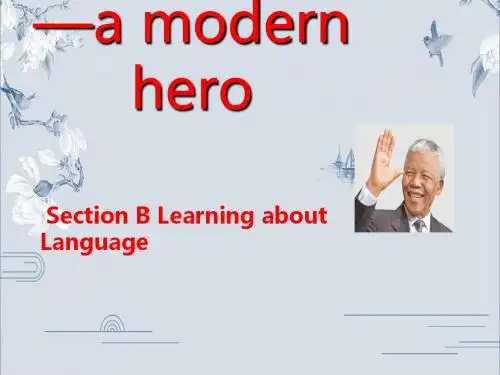
要点一 关系副词引导定语从句
1. when 引导的定语从句
when 表示时间,代替先行词并在定语从 句中作时间状语,其先行词往往是表示时 间的名词,如time,day,week,year 等。
注意:
(1)当先行词是时间名词时,定语从句 既可用when 引导,也可以用that 或which 引导,关键看关系词在从句中作何种成分。
注意:
有些含有介词的固定的动词短语一般不能 将介词分开放在关系代词前,如listen to, look for,care for,hear from,hear of, take care of 等。
(3)“名词/ 代词/ 数词+of + 关系代词” 引导的定语从句通常是非限制性定语从句, 该结构在定语从句中一般作主语。
where 从句缺地点状语,故填 where
(4)Is this the museum
I he
was the
要点三 “介词+ 关系代词”引导的定 语从句
关系副词when,where,why 引导定语从 句时,关系副词也可用“介词+ 关系代词 (which / whom)”代替。
在“介词+ 关系代词”引导的定语从句中, 关系代词只能用which 或whom,不可用 that 或who。先行词指物时用which,先行 词指人时用whom。
we spent together on the farm?
(4)[词汇复现]Finally,we got to a
factory,
many mobile phones
of high quality were produced.
(5)It’s helpful to wphuet children in a situation that/wh threey can see themselvesichdifferentlyw.h (6)This is the houyse
2019年人教版高中英语 必修一 Unit5 《Nelson Mandela a modern hero Warming up preReading》 课件 共30

Guessing great persons
•He was in 1819. • His music was very famous,
for example, Moonlight.
Beethoven
•One who helps others especially when he is ready to sacrifice something to help.
牺牲,奉献
•One who selflessly gives up something to achieve his dream.
Guessing great persons
A. Strangers
B. Friends
C. Father and son
D. Teacher and student
2. What is the main idea of the story? The story is about __________ .
A.the poor life of black people in South Africa.
B.the life of Mandela. C.how Mandela helped black people. D.how Elias met Mandela.
Timeline Elias’ life
scanning
1940 1946 1948 1952 1963
Elias was born.
What did Mandela do to help Elias keep his job? How did Elias feel about it ?
MaAnfdterlaMtoanlddEelaiaosrhgoawniztoedgtehtethAeNcCorYroeucthpLapeaegrsue, swohhaet dcioduEldliasstadyoin? Jaonhdawnhnye?sburg. Elias became mHoeWrjehoaihntoeppdreoiftbuallesambssoouodtnidhaibsslahfucektucproeeu.oldp.leBiencSauosuethhAefrica nheavveer?forget how kind Mandela was. BHlaeckWwpahesyohdpaildpepMcyoautnolddhenleaolpttubvroenctetaouovsriecohlheoenockseneettowhmeitirawkleoeaubdldlearcsk. Thaenylpdctowhuehlmidtenapocethogiepevlteethetheqeujioarbld?srethameyowfamnatekdin. gThbelapcakratsndof towwhnitienpwehoipclhe tehqeuyahl.ad to live were decided by white peoTphWleehy. yTfhwiresatpsblEarcloieaksse ohthuaetpspliadywetoitnhheaetlpopewbanlcosewfwuuhl pwertaehyet,hbeuyt webtrheuiissldewinnatgstsonwloihvt eeanlwlohewereeddtih.deOnnpolotyolitrkheeesntvipdoaildertnsthcoef?ySdoeuctihde Afrtiocaa.nswer violence with violence.
2019秋人教新课标高中英语必修1Unit 5 Nelson Mandela—a moUnit 5 3

Unit 5Using LanguageⅠ.单词拼写1.He had finished the study of four years in Peking University, so he was better e__ducated____ than other young people in his village.解析:句意:他结束了北大的四年学习,比村里的其他年轻人受到了更好的教育。
2.Can you give us your o__pinion____ about this matter?解析:句意:你能不能就此事发表一下你的看法。
3.It was so cold inside the house that she had to wrap herself in a b__lanket____ to keep warm.解析:句意:屋子里很冷,她只好披上毯子取暖。
4.He managed to e__scape____ from the big fire.解析:句意:他成功从大火中逃了出来。
5.A $1,500 __reward____(奖金)has been offered for the return of the necklace.解析:句意:拾到项链归还者获得了1 500美元的奖赏。
Ⅱ.单句语法填空1.You can try __a____ second time if you fail __the____ first time.解析:句意:如果你第一次失败了,你可以再尝试一次。
序数词和不定冠词a连用,表示“再一次,又一次”。
the first time表示“第一次”。
2.A new school was set __up____ in the village last year.解析:句意:去年这个村庄建起了一所新学校。
set up表示“建立;设立;设置”。
3.Only __educated____(educate) people can have a good understanding of the lecture given by the scientist.解析:考查形容词。
高一英语新人教版必修一课件Unit5NelsonMandela-amodernhero-Reading
Youth League.
T
• 5.Nelson Mandela thought violence was a good
way to help black people. F • 6.Elias was willing to blow up government
buildings.
F
What qualities does Mandela have? And why do you think so?
Information about Elias
He was a poor black worker in South Africa.
He had little education, so he could not read or write well
He worked in a gold mine.
He was a black lawyer . He offered guidance to poor Information black people on their legal about Mandela problems. He was generous with his tias before he met Mandela
He needed to get a Elias’ problem because he wanted to passbook
continue doing his work.
The change of Elias’ life after he met Nelson Mandela and what Mandela did.
He needed to get a passbook Elias’ problem so he could live in
高一英语必修1Unit5NelsonMandelaamodernhero新课标人教版
高一英语必修1Unit5 Nelson Mandela a modern hero 新课标人教版高一英语必修1Unit5 Nelson Mandela a modern heroPart One: Teaching Design (第一部分:教学设计)Period 1: A sample plan for reading(ELIAS’ STORY)AimsTo talk about people’s qualitiesTo read about enable people’s life storyTo study The Attributive Clause (where, when, why, prep., which/ whom)To learn to write lettersProceduresI. Warming upWarming up by describingBoys and girls, this morning we’ll take up Unit 5 in which we’ll learn to describepeople. Now let’s describe ourselves first. The questions in the warming up part will help you find out what qualities you have. Then tell me what kind of a person do you think you are. Do you think you have the qualities to be a great person? What qualities do you think we should find in a great person?a.Give the students one minute to answer the questions.b.Ask some students to talk about their own qualities according to their answers.c.Have a discussion with the whole class and help them to sum up the qualities that a great person has.(Suming up: A great person should be determined, hard-working, unselfish, and generous. He should follow his ideas and never lose heart when he is in trouble. He usually gives up something to achieve his goals. He should be willing to do public service work without pay, be active in social activities, gets on well with others, and help others, etc.)Warming up by brainstormingBoys and girls, in Unit 5 we will talk about Nelson Mandela, a great leader who fights for the rights of the black people. When talking about a person, what adjectives can you think of to describe his or her qualities? What are the qualities you should find in a great person?(Adjectives for describing a person: kind, honest, brave, loyal, happy, wise, smart, friendly, warm, cheerful, popular, generous, hard-working, diligent, weak, stupid, lazy, dishonest, mean, tense, cold, unkind, miserable, dull, strong-minded, determined,)Warming up by expressionsBoys and girls, we are going to learn about some great people inUnit 5. Can you name some great people? Now discuss in groups of four:Who do you admire most? What kind of person is he/she? What are the qualities that great people have in common?用心爱心专心 121号编辑 1Sun Yat-sen (November 12, 1866–March 12, 1925) was a Chinese revolutionaryleader and statesman who is considered by many to be the “Father of Modern China”.He had a significant influence in the overthrow of the Qing Dynasty and establishment of the Republic of China. A founder of the Kuomintang, Sun was the first provisional president of the Republic of China in 1912 and de facto leader from 1923 to 1925. He developed a political philosophy known as the Three Principles of the People. Sun is uniquely admired by most Chinese. Yet, his life was one of constant struggle and frequent exile as few of his visions for his country materialized.II. Pre-reading1. Now, look at the six people in the pre-reading part. Can you recognize them? Do you think they are important people? (Yes. Because they have done something really important to benefit the world or a country. ) But do you think all of them are great people?William Tyndale (sometimes spelled Tindale) (ca.1484 - October 6, 1536) was a16th century priest and scholar who translated the Bible into an early form of Modern English. Although numerous partial and complete English translations had been made from the 7th century onward, Tyndale’s was the first to take advantage of the newmedium of print, which allowed for its wide distribution.2.Speaking task: Students read the information of each of the six persons and discuss in pairs to find out whether he is a great person or not according to the criteria they worked out in the previous step.Remind the students to use the following expressions for giving and asking for opinions:I think/ I don’t think…; in my opinion; I’m afraid…; I agree/ don’tagree…; I prefer…; What’s your opinion? Why do you think so? Whatdo youthink of…?A sample dialogue:A: Do you think William Tidal is a great person?B: Yes. I think so. He had a strong belief that all people should be able to read the Bible for themselves. So he translated and printed it into English although he was not allowed to do so. And later he died for his work.A: Yes. I agree. William Tyndale went through a lot of struggles and difficulties and even sacrificed his life to realize his dream. He is a great person that everybody用心爱心专心 121号编辑 2who picks up the Bible must think of. Now, let’s come to Norman Bethune. What do youthink of him?B: ….III. Reading1. Skimming for general ideaSo far we have talked a lot about great people. Do you want to know more about them and learn from them? Well, this morning we are going to read about Nelson Mandela, who was considered as a modern hero. Now open your books to page 34 and read the title of the text. What kind of writing is the text, can you guess? … Yes. A story is usuallya piece of narrative writing. Now skim the text to get the general idea: What does Elias tell about in his story? (He tells about his life, how Mandela helped him and how he supported Mandela.)2.Listening and scanning for detail informationa. Listen to the text again and do Comprehending Ex.... 1.True: 2, 4 False: 1, 3, 5, 6, 7, 8b. Scan the text and do Comprehending Ex. 2.Suggested answers:1940—Elias was born. 1948—Elias left school.1942—Elias was two years old. 1950—Nelson Mandela opened his law firm1944—Elias was four years old. 1952—Elias was 12 and met Nelson Mandela.1946—Elias began school. 1954—Elias was 14 and encouraged by Mandela.3.Questions for further understandingDiscuss the following questions in groups of four:a.How did the white people stop the black people from being treated fairly?b.Why did Elias support Mandela?c.Why did he support violence when he did not agree with it?Suggested answers:Through unfair laws.There are three reasons for this. Firstly, Mandela once helped him and hethought Mandela kind and generous. Secondly, he agreed with Mandela’s politicalideas. For example, he agreed with his explanation of how the black people were not treated fairly. He also sided with him on his view of peaceful fighting. Thirdly,he knew that what Mandela fought for was to make black and white people equal.Because their attempt to attack the law in a peaceful way failed. They had to answer violence with violence.IV. Closing downClosing down by discussinga.What do you learn about Nelson Mandela from ELIAS’ STORY?b.Do you like the way Elias tells his story? Give a reason.Suggested answers:a. I know that Mandela is a great leader who fought for equal rights for the black people all through his life. He organized the ANC Youth League which fought against the government. He is in favor of peaceful fighting. He is kind, helpful, generous, brave, and determined.b. Various answers are possible. For reference: I like the way Elias tells thestory. Elias is a black worker with only a little education, so he uses some simple用心爱心专心 121号编辑 3and short sentences to describe his experiences and his contact with Mandela, and thus makes the whole story more real-like and close to thereaders. The quoted speech in the story objectively reveals Mandela’s political views through which someaspects of Ma ndela’s qualities are shown clearly.Closing down by retellingRetell the story according to the following clues:introduction of Elias’ problem; Mandela’s help; Elias’ support Closing down by an interviewAsk the student to do an interview in pairs. A journalist is interviewing Elias with the following questions:When did you first meet Mandela?Can you tell me more about how he helped you?Can you tell me about the problems that the black people are facing? How do you like his idea of peaceful fighting?What do you think of him?What will you do to support him in the future?Period 2: A sample plan for Learning about Language(The Attributive Clause: where, when, why, prep.,which/ whom)AimsTo help students learn about attributive clause introduced by when, where, why, and prep.+ which/ whomTo help students discover and learn to use some useful words and expressions To help students discover and learn to use some useful structures ProceduresI. Warming upWarming up by discovering useful words and expressionsTurn to page 35 and do exercises No. 1 and 2. Check your answers against your classmates’.II. Learning about grammar1.Reading and thinkingTurn to page 34. Read the text of ELISA’ STORY and find out all the attributive clauses.Think over this question: On what circumstance do we use when/where/ why to introduced an attributive clause? (“Where” is used when the antecedent refers to a place, and “when” is used for time. “Why “ is used when the antecedent is “why”.)For reference:The time when I first met Nelson Mandela was a very difficult period of my life.The school where I studied only tow years was three kilometers away.This was a time when you had got to live in Beijing.The day when Nelson Mandela told me what to do and helped me was one of the happiest days of my life.We have reached a stage where we have almost no rights at all.The parts of town where they lived were places decided by white people.The places where they were sent to live were the poorest areas in South Africa.paring and discoveringTurn to page 36. Do Ex. 1. Then compare the following sentences and find out why用心爱心专心 121号编辑 4we use different words to introduce the attributive clauses while the antecedents are the same.a.The government building where we voted was very grand.b.The government building which/ that we paid a visit to yesterday was very grand.c.The government building in which we voted was very grand.In sentence a), a relative adverb “where” is used because it refers to “in thegovernment building” which serves as the adverbial in the attributive clause. “inwhich” can also be used as in sentence c) because it also means “in the governmentbuilding” in the attributive clause. While in sentence b), a relative pronoun “which”is used as it refers to “the government building” which serves as the object of thepredicate “visited” in the attributive clause.Compare another three sentences:a.The date when I arrived was the 5th August.b.The date which/ that he told me was the 5th August.c.The date on which I arrived was the 5th August.In sentence a), a relative adverb “when” is used because it refers to “on thatdate” which serves as the adverbial in the attributive clause. “in which” can alsobe used as in sentence c) because it also means “on that date” in the attributiveclause. While in sentence b), a relative pronoun “which” is used as it refers to “thedate” serving as the object of the predicate “told” in the attributive clause.Read the following sentence and find outa.The reason why I got a job was because of my hard work.b.The reason that/ which he gave for getting the job was because of his hard work.c.The reason for which I got a job was because of my hard work.In sentence a), a relat ive adverb “why” is used because it refers to “for thisreason” which serves as the adverbial in the attributive clause. “for which” canalso be used as in sentence c) because it also means “for this reason” in theattributive clause. While in sentence b), a relative pronoun“which/that” is usedas it refers to “the reason” serving as the object of thepredicate “gave” in theattributive clause.III. Ready used materials for attributive clauseDefinitions: Attributive clause: An attributive clause is a clause modifying a noun or pronoun in a compound sentence.Antecedent: The word being modified by an attributive clause iscalled the antecedent.Relative: The word that is used to introduce an attributive clauseis called a relative. There are two kinds of relatives, i.e. relative pronouns including which, that, who, whom, whose, as, etc. and relative adverbs including where, when and why, etc.Note: Relatives plays three important roles in an attributive clause, i.e. introducing an attributive clause, replacing the antecedent in meaning, and functioning as a sentence element in the attributive clause.e.g.: The girl who is talking to Mr. Li over there is my sister.In the sentence, The girl is the antecedent and who is used to introduce the attributive clause as the antecedent is a person. It (who) refers to the girl and functions as the subject in the attributive clause.用心爱心专心 121号编辑 5The choice of the relatives is the most difficult in learning the attributive clause. However, there are some rules that can help uschoose the correct relatives. Usually, which relative to choose dependson what the antecedent is and what sentence element the relative functions in the attributive clause as shown in the following chart: Antecedent Relative Sentence elementpeople who that subject objectwhom objectthings which that subject objecttime which that subject objectwhen prep.+ which adverbialplace which that subject objectwhere prep.+ which adverbialreason why prep.+ which adverbialNote: relatives can be omitted if they serves as the objects in the attributive clauses.If a relative functions as the object of a preposition in the attributive clause, the preposition can usually be placed before the relative. In this situation, we use “which” for things and “whom” for people, and they can never be omitted. However, if the preposition and a verb form a set phrase in the attributive clause, they should not be separated:The school (which/ that) he once studied in is very famous.The school in which he once studied is very famous.This is the girl (who/ whom) I went to the Great Wall with.This is the girl with whom I went to the Great Wall.The sentence “This is the watch (which/ that ) you are lookingfor.” can not bechanged into “This is the watch for which you are looking.”because “look for ”is a set phrase.Now turn to page 36 and let’s do Ex.2 and 3.IV. Closing down by doing a quizTo end the period you are going to take a quiz on attributive clause.Choose the best answer:1.The weather turned out to be very good, ____ was more than wecould expect.A. whatB. whichC. thatD. it2.After living in Pairs for fifty years he returned to the smalltown ____ he grew up as a child.A. whichB. whereC. thatD. when3.The house ______ we live is not large.A. whichB. in whichC. on whichD. at which4.Recently I bought an ancient Chinese vase, _____ was very reasonable.A. which price C. the price of which C. its price D. the price of whose5.He lived in London for 3 months, during ____ time he learned some English.A. thisB. whichC. at whichD. some6.I will never forget the day _____ he came to see me.A. thatB. whichC. at whichD. when7.The visitor asked the guide to take his picture _____ stands the famous tower.用心爱心专心 121号编辑 6A that B. where C. which D. there8.The students ____ department Ms King worked ten years ago look down upon women.A. in whichB. in thatC. in whoseD. whose9. I don’t like _____ you speak to her.A. the wayB. the way in thatC. the way whichD. the way of which10. I had neither a raincoat nor an umbrella. _______ I got wet through .A. It’s the reasonB. That’s whyC. There’s whyD. It’s howPeriod 3: A sample lesson plan for Using Language(THE REST OF ELIAS’ STORY)AimsTo help students read the passage THE REST OF ELIAS’ STORYTo help students to use the language by reading, listening, speaking and writingProceduresI. Warming up and listeningSo far we have read a story about Elias. Do you remember why it was difficult for him to get a job? (because he hadn’t a passbook) what isa passbook? Why is it important? Let’s listen to a short passage and find out.Turn to page 37. Read the questions and choose the best answer after listening.Discuss the questions in Ex. 2.II. Guided reading1. Reading and answering questionsAs we know, in order to support Mandela, Elias helped him blow up some government buildings. Can you imagine what would happen to him if he was caught? Actually, he was caught and put into a prison on Robben Island. However, he was lucky enough to get help from Mandela even when he was in prison.Turn to Page 38, read the passage quickly and find out:How did Mandela helped Elias when he was on Robben IslandHow did Mandela help Elias after he came to power?2. Reading and doing exercisesRead the passage again and do the exercise on Page 38.3. Task (a text dialogue)Now we have finished the story about Elias. Next we are going to do a group activity. We will do it in groups of four. Suppose one of you is Elias and works as a tour guide on Robben Island. The other three of you are tourists who are very interested in the island and Mandela’s life and asking the tour guide the following questions. Elias must answer them.Tourist: How did you get to know Nelson Mandela?Elias: It was in 1950. I was working as a miner in Johannesburg butI hadn’ta passbook to live there. So I went to Mandela’s law firm to askfor advice.Tourist: Can you explain to me some of Nelson Mandela’s politica l ideas orbeliefs?Elias: Yes. He found that we black people were not treated asequally as the white people and he would fight for our rights. However, he said that we should fight in a peaceful way. Only when this was not allowed did we decide to answer violencewith violence.Tourist: How did he help you through your life?用心爱心专心 121号编辑 7Elias: First, he helped me to get the correct papers to stay in Johannesburg and keep my job as I mentioned above. Then he taught me to read and write when Iwas in prison. This is very important to me because it enables me to get more job opportunities. Later he gave me my present job.Tourist: What was life like on Robben Island?Elias: Miserable and cruel. The guards and soldiers treated us badly, beat us violently for no reasons and insulted us in different ways.Tourist: How did you manage to study on Robben Island?Elias: We studied during the lunch breaks and the evenings when we should have asleep. We read books under our blankets and used anything we could find to make candles to see the words.Tourist: What kinds of job have you ever done?Elias: A miner, an office worker and now a tour guide.Tourist: What do you think of your present job?Elias: I like it very much. And I am proud to show visitors over the prison,for I helped to make our people free in our own land.III. Guided writing1. Preparation for writingImagine now Mr Mandela is in prison. You are going to write a letter to the President of South Africa asking him to free Nelson Mandela. Do you remember the format of a letter? What should be the main content of this letter? (The reasons for freeing Mandela) How would you try to persuade the president? (You must make your reasons persuasive.) 2. Writing a letterRead the information about Mandela. Discuss with your partner and collect ideas for the letterWriter down the ideas and put them into a good and logical order. Write the letter.IV. Further applying1. Finding informationGo to the library to read or get online to search for more information on Nelson Mandela. Take notes of your finding and do an oral presentation next period. 2. Writing a descriptionWrite a description of Nelson Mandela using the information you have found. V. Closing down by sharingShare your letter with your partners and make necessary changes. Share your letter with the class by reading it aloud.Part 2: Teaching resources(第二部分:教学资源)Section 1: A text structure analysis of ELIAS’ STORYI. Type of writing and summary of the ideaType of writing This is a piece of narrative writing.Main idea of the passage Elias describes how Nelson Mandela helped the black people through his own experienceTopic sentence of 1st The time when I first met Nelson Mandela was paragraph a very difficult period of my life.Topic sentence of 2nd Sadly I did not have this passbook because 用心爱心专心 121号编辑 8paragraph I was not born there and I was worried aboutwhether I would be out of work.Topic sentence of 3rd The day when Nelson Mandela told me what to paragraph do and helped me was one of the happiest day ofmy life.Topic sentence of 4th The last thirty years have seen the greatest paragraph number of laws stopping our rights and progressuntil today we have reached a stage where we havealmost no rights at all.Topic sentence of We first broke the law in a way which was5thparagraph peaceful; when this was not allowed … only thendid we decide to answer violence with violence.II. A tree diagram(with key words of each paragraph placed in each box)informationblack worker of Eliasdifficult period Elias’ life before six leave not pay law firm meeting Mandela Elias’s problem gold mine passbookworried about Elias’ story tell help correct Mandela’s help papers forget joinElias’ life after black people’s no rights votemeeting Mandela problems live job poorestareassupport to Mandela position acnot grow foodceptfight peacefully blow upput in prison realizeequal III. A retold passage of the textElias is a black worker in South Africa. His family was so poor that he had to drop out of school at the age of eight. Later on, he was able to work as a gold miner in Johannesburg. But as he hadn’t got a passbook which was required if one wanted to live in Johannesburg. Hewas worried about being dismissed. However, he was lucky enough to get some help from Nelson Mandela and managed to get the correct papers.After that, he began to know more Mandela and his political ideas. He agreed with Mandela’s viewson the unfair laws against the black people and his idea about peaceful fighting. He also knew that all Mandela wanted to do was tofight for equal rights for the black people. So he supported him heart and soul.Section 2: Background information on Nelson Mandela and othersI. Nelson MandelaNelson Rolihlahla Mandela, (born 18 July 1918), before becoming President of South Africa, was one of its chief anti-apartheid activists, and was also an anti-apartheid saboteur. He is now almost universally considered to be a heroic freedom fighter. He spent his childhood in the Thembu chiefdom before embarking on a career in law.用心爱心专心 121号编辑 9The name Madiba is an honorary title adopted by older male membersof Mandela's clan; however, in South Africa the title is synonymous with Nelson Mandela.II. Courtroom quotes by Nelson Mandela“I have fought against white domination and I have fought against black domination. I have cherished the ideal of a democratic and free society in which all persons live together in harmony and with equal opportunities. It is an ideal which I hope to live for and to achieve. But if needs be, it is an ideal for which I am prepared to die.”“Why is it that in this courtroom I am facing a white magistrate, confrontedby a white prosecutor, escorted by white orderlies? Can anybody honestly and seriously suggest that in this type of atmosphere the scales of justice are evenly balanced? Why is it that no African in the history of this country has ever had the honor of being tried by his own kind, by his own fles h and blood?...I am a black man in a white man’s court. This should not be.”(Finlayson 84).“Out of the experience of an extraordinary human disaster that lasted too long, must be born a society of which all humanity will be proud... We have, at last,achieved our political emancipation. We pledge ourselves to liberate all our people from the continuing bondage of poverty, deprivation, suffering, gender, and other discrimination. Never, never, and never again shall it be that this beautiful landwill again experience the oppression of one by another... The sun shall never set on so glorious a human achievement.”III. ANC and ANC Youth LeagueThe ANC is a national liberation movement. It was formed in 1912 to unite the African people and spearhead the struggle for fundamental political, social and economic change. For nine decades the ANC has led the struggle against racism and oppression, organising mass students resistance, mobilising the international community and taking up the armed struggle against apartheid. Membership of the ANC is open to all South Africans above the age of 18 years, irrespective of race, colour and creed, who accept its principles, policies and programmes.用心爱心专心 121号编辑 10The ANC Youth League was founded in 1944. The league propagated “Africanism” andits motto was “Africa’s cause must triumph.” It was radical and militant. The membersof it rejected the idea of “foreign” leadership and argued that black Africans must provide their own leadership and rely upon themselves.Section 3: Words and expressionsI. Words for warming upqualityn. something typical of a person or material: Kindness is his best quality. She shows qualities of leadership.willingadj. ready (to do sth.): Are you willing to help?activeadj. able or ready to take action: Although he is over 70; he isstill active. An active member of the club is sure to attend every meeting.lose heart灰心,丧失信心I used to work in the garden every week.But I lost heart when all the plants died. Don’t lose hea rt; you still have more chances.lose one’s heart爱上,喜欢上 She lost her heart to him as soon as she saw the handsome soldier.trouble n.麻烦:in trouble 有麻烦,处于困境中;get into trouble 陷入困境;maketrouble 制造麻烦;ask for trouble自找麻烦;have trouble (in) doing sth. 做某事有困难II. Words for Readingadvisev. to tell what one thinks should be done:advise sth.; advise doing sth.; advisesb. to do sth.; advise that sb. (should) do sth.; I advise waiting until the teacher comes. The doctor advised a week’s rest/ taking a week’s rest. I advised (him) thathe should take a rest. I advised him not to drive/ against driving. What do you advise me to do?advicen. opinion given by one person to another on how that other should behave or act: give some advice to sb.; five sb. some advice; follow sb’s advicecontinuevi & vt. go on: continue to do sth/ doing sth; continue (with)sth.; go on doing sth. / with sth. / to do sth. The sports meet continued for 3 days. He continued to用心爱心专心 121号编辑 11study/ studying as if nothing had happened. We must continue our journey until we find water.worryn. & v. to be or make anxious:worry sb.,worry about…; bbe worried about…; Youdon’t have to worry about your health if you keep a balanced diet. Our parents must be worrying because we are coming back late. Her sick students worried me. What he said added to her worries.stagen. a period a in a course of events; the raised floor on which plays are performed in a theater: stage direction; stage director; put sb. on the stage; at an early stage in our historyvotev. & n. to express one’s choice officially from among the possibilities offered ; an act of making a choice or decision on a matter by means of voting: vote for/ against sb. Most students voted for Jim as they thought him capable and honest. Most people voted against the former leader because of rumor about him. I gave my vote to Li Gao. The new leader was elected through a secret vote.positionn. the place where someone or something is or should be; aparticular place or rank in a group: What I know about him was that he is in a high position in the company. Can you tell me the position of your city on the map?acceptv. to take something offered willinglyreceivev. to get: I received some roses from Jack on Valentine s’ Day but I didn’t accept。
英语优秀教案(人教新课标版):必修1(Unit5 Nelson Mandela—a modern h

Motivate students to learn from the good qualities of the great people.
●教学重点
(1)Enable the students to write a letter with the guide.
(2)Improve the students’writing, speaking and listening ability.
S1: Let me try.Although Mr.Mandela was one of the leaders who called on black people to blow up some government buildings,he had no choice but to do that.He said they broke the law in a way which was peaceful.Only when this was not allowed did they decide to answer violence with violence.
T: So you mean the government forced him to break the law, so it is necessary to set him free.Good.Another reason?
S2:In my opinion,it is natural for Mr.Mandela to encourage violence against anti-black law.At that time,there were a lot of laws stopping the blacks’rights and progress.The black people reached a stage where they have almost no rights at all.Black people had no vote and could not choose who ruled them.The parts of town where they were sent to live were decided by white people.They could not get jobs they wanted.The places where they were sent to live were the poorest areas in South Africa.No one could grow food there.As a matter of fact,black people did not like violence.But they knew it was to realize their dream of making black and white people equal.
2019教育人教版高中英语 必修一 Unit5 《Nelson Mandela a modern hero Reading》 课件 共26张PPT数学
…
Homework
1. Memorize the new words and phrases . 2. Do exercise 1,2,3 on page 36.
Thank you!
He met Mandela in 1952 when he was 12 years old. 3. What was Mandela's job? What help did Mandela offer to black people?
3. What was Mandela's job? What help did Mandela offer to black people?
(True or False)
• 1.Elias went to see Nelson Mandela when he
was in trouble.
T
• 2.Elias left school because the school was too
far from his home.
F (line 11)
C Elias left school. D Elias began school.
1963
E Elias was born.
Para 3.
How did Mandela help Elias?
He told Elias how to get the __c_o_r_r_e_c_t_ _p__a_p_e_r_s___, so Elias could stay in Johannesburg. Later Elias ___j_o_in__e_d____ the ANC Youth league.
2019年人教版高中英语 必修一 Unit5 《Nelson Mandela a modern hero Reading》 课件 共38张PPT语文
Who is your hero /heroine?Why?
Who do you admire most?
hardworking lazy friendly cruel warm-hearted mean determined wise active generous easy-going reliable unkind brave selfish stubborn selfless devoted handsome nice honest famous calm lovely
(para 5)
Q1:Which year did Elias help Nelson blow up some government buildings?
In 1963. Q2: Why did Elias support violence when he did not agree with it?
Sun Yat-sen
1.fought against German Nazis and Japanese invaders
2.work as a doctor in China
3.save many Chinese soldiers Norman Bethune
e from Shanghai,China
Because he trusted Nelson Mandela.
1. Fill in the blanks about the truth of the black people.
Black people could not _v_o_t_e_ or _c_h_o_o_s_e__ their leaders. They could not get the _j_o_b_s_ they wanted. The parts of the town in which they had to live were _d_e_c_id__ed__ by white people. The places outside the towns where they were sent to live were the _p_o_o_r_e_s_t_ parts of South Africa. No one could grow _f_o_o_d__ there.
2019年人教版高中英语 必修一 Unit5 《Nelson Mandela ---a modern hero ---Reading》 课件 (共57张PPT)
8. die for 为…而死
1) They di_e_d_f_o_r___ the people; their death is weightier than Mount Tai.
2) Many people d_ie_d__fo_r____ need of food.
3) I’m d_y_in_g__fo_r__ a cup of water.
⑵ 质量比数量更重要。
__Q_u__a_li_t_y__matters more than q__u_a_n_t_i_ty_.
2.active adj.积极的;活跃的
be active in ...在某方面很积极,很活跃
派生:act v.& n.行动 actively adv.积极地;活跃地 activity n.活动 actor n.男演员
13. period n. 学时,课时,一段时间,时期,周期
1) She studied French history for a long p_er_i_o_d_s_ of time.
2) Let’s finish this p_e_r_io_d__ and have a break.
3) We have six p_e_r_io_d_s_of science a week.
⑴ She w__a_s_e_d_u_c_a_t_ed(educate) in England in the 1930s.
⑵ An__e_d_u_c_a_t_o_r_ (educate) must first educate himself.
⑶ She has had a good__e_d_u_c_a_ti_o_n_ (educate).
Unit 5 Nelson Mandela ---a Modern Hero
2019秋人教新课标高中英语必修1教学课件:Unit 5 Nelson Mandela—a modern hero Section A
单句语法填空
(1)Their maroriage was founded love and respect.n found (2)[福建卷]eTd singhua University, (found) in 1911,is home to a great nwuerme ber of outstanding figures.
boss,who so mean to
is
methan
money
that he doesn’t mean upset (donate)
asntaynditno those in need.
g(3)[词汇复f现o ]I’m terribly sorry,but
I didn’t mean r
(upset) your
成短文)
whe
a [金星原创]Elias wans agceupidoanor black
worker. The time 1
he first met
Nelson Mfeesandela was 2
very difficult
period of his life. Nelson Mandela offered
3. What did Elias do to help Mandela?
A. He killed some white officials.
B.
○He broke the traffic laws.
C. He blew up some government
Ⅱ 语法填空(根据课文内容和语法规则完
the bus fareal. When he was worried about
whether he would be out of work because