
最新八年级上册英语第二单元知识点梳理
八年级上册英语第二单元知识点梳理How often do you exercise?【应掌握的词组】1、help with housework 帮助做家务活,2、go shopping 购物,3、on weekends 在周末,4、how often 多久一次,5、hardly ever几乎不,6、once a week 每周一次,7、twice a month每月二次,8、go to the movies去看电影,9、every day 每天,10、use the Internet上网/用网,11、be free有空,12、have dance and piano lessons 上舞蹈钢琴课,13、swing dance摇摆舞14、play tennis 打网球,15、stay up late熬夜,16、at least至少,17、go to bed early 早睡,18、play sports 锻炼身体,19、be good for 对…有好处,20、go camping去野营,21、in one’s free time 在某人的空闲时间,22、no t….at all 根本不,23、the most popular 最流行,24、such as例如,25、go to the dentist去看牙医,26、more than 超过/多于,27、Old habits die hard.旧习惯难改。
28、hard=difficult 困难的,29、less than 少于/不到反义词为more than多于30. help sb. with sth 帮助某人做某事help sb do/ to do sth 帮助某人做某事31. How about…? =What about…? ….怎么样?/ ….好不好?What about doing sth?做某事怎么样?32. want sb. to do sth. 想让某人做某事33. How many + 可数名词复数+ 一般疑问句….有多少…..34. 主语+ find+ that 从句…发现…35. It’s + adj.+ to do sth. 做某事是….的36. spend time with sb. 和某人一起度过时光37. ask sb. about sth. 向某人询问某事38. by doing sth. 通过做某事39. What’s your favorite…..? 你最喜欢的……是什么?40 start doing sth. =start to do sth 开始做某事41. the best way to do sth. 做某事的最好方式【应掌握的句子】1. Mom wants me to get up at 6:00 and play ping-pong with her .want to do sth. 意思是“想要做某事”;want sb. to do sth.意思是“想要某人做某事”。
否定形式为want sb. not to do sth. 意为“不想让某人做某事”。
Do you want to go to the movies with me?你想和我一起去看电影吗?The teacher doesn't want us to eat hamburgers.老师不想让我们吃汉堡包。
2 She says it’s good for my health.be good for...表示“对……有益(有好处)”;其反义为:be bad for...。
(这里for 是介词,后跟名词、代词或动名词)如:It's good for us to do more reading. 多读书对我们有好处。
Reading in bed is bad for your eyes.在床上读书对你的眼睛有害。
3 try to do sth.表示“尽力做某事”,而try doing sth.表示“(用某一办法)试着去做某事”。
如: You’d better try doing the experiment in another way.你最好试试用另一种方法做这个试验。
4、help sb.(to) do sth.帮助某人做某事5、That sounds interesting.这是“主语+系动词+表语”结构的简单句。
sound(听起来),look(看起来),smell (闻起来),taste(尝起来),feel(觉得),seem(好象),grow(变得),get(变得)等词在英语中可用作系动词,后跟形容词作表语。
如:It tastes good. 这味道好。
The music sounds very sweet. 这音乐听起来很入耳。
The smoke grew heavier and heavier. 烟雾变得越来越浓了。
6、help oneself (to sth) 随便吃某物,款待Help yourself to some fruit. 随便吃点水果。
Can′t help doing sth 情不自禁做某事She could’t help crying. 她忍不住哭了。
7、三个表示“也”的词:too用于句末;also用于句中;either用于否定句末尾。
8、be afraid to do sth.害怕做某事。
Be afraid of doing sth害怕做某事。
三、词语辨析1. help with housework 帮助做家务(1)help with sth. 意为“帮助做某事”拓展:help sb. with sth.= help sb. (to)do sth. 帮助某人做某事Eg: I often help him with his English.= I often help him (to) learn English. 我经常帮他学习英语。
(2)housework 意为“家务劳动”。
不可数名词。
1. They have much housework to do.2.辨析:sometimes ,some times ,sometime ,some timesometimes 有时候。
=at times也是“有时”的意思。
提问用how oftensome times 几次几倍。
time作可数名词时可作“次数”解;表示“时间”时是不可数名词。
How many timessometime 某个时候。
常指将来的某个时候。
提问用whensome time 一段时间。
常与for连用。
对它提问用how long 。
口诀记忆:分开“一段时间” ;相聚“某个时候”。
Eg:Sometimes I get up very late. 有时我起床很晚。
I will go to shanghai sometime next week. 下周某个时候我要去上海。
He reads the story some times. 他读这个故事几遍了。
I’ll stay here for some time. 我将会在这儿呆一段时间。
3. hardly ever 几乎不hardly ever相当于hardlyeg:There is hardly any food left. 几乎没有食物剩下。
辨析:hardly 与hardhardly 几乎不,一般位于动词之前。
hard 努力,位于动词之后。
eg:He hardly works. 他几乎不工作。
He works hard. 他工作努力。
4. use the Internet 用互联网(教材第10页)use sth. to do sth. 用某物做某事eg:I use a knife to cut bread. 我用刀切面包。
短语:on the Internet 在网上,surf the Internet 网上冲浪,上网5. What’s your favorite program?你最喜欢的节目是什么?句型:What’s your favorite...?=What... do you li ke best?你最喜欢的......是什么?1.What’s your favorite animal?你最喜欢的动物是什么?6. Are you free next week?你下周有空吗?free 意为“空闲的,有空的”,反义词busy。
be free 意为“闲着,有空”He is free now.他现在有空。
free还可译为“免费的”The tickets are free. 票是免费的。
7. ... next week is quite full for me... …下周对我来说相当忙…拓展:①full 还可译为“满的,充满的”。
I can’t eat any more,I am quite full. 我不能再吃了,我相当饱了。
8. How come? 怎么会?怎么回事?表示某件事情很奇怪,有点想不通;可单独使用,也可引导一个问句,相当于疑问句why, 但how come 开头的特殊疑问句使用的仍然是陈述语序。
How come Tom didn’t come to the party? = Why didn’t Tom come to the pa rty?9.How about...? (=What about...?) 意为“……怎么样?”,用来征求对方的意见。
How about this book? 这本书怎样?How / What about doing sth. ...? 做……怎么样?---What will we do on Sunday?星期天我们什么?---How about visiting the museum?去参观博物馆咋样?1011be good for 意为“对……有益”。
反义词为be bad for “对……有害”。
Vegetables are good for you. 蔬菜对你有好处。
拓展:be good at 擅长... be good at doing sth. 擅长做...12、ask sb. about sth. “询问某人关于某事”13、①. 百分数由percent来表示,构成:基数词+percent 。
Seventy percent of the boys 男生中70%②not... at all 意为“一点儿也不,根本不”。
I don’t know about it at all. 对那件事我一点也不知道。
拓展:not at all = you are welcome 意为“不用谢,不客气”。
八年级上册英语unit2知识点整理

八年级上册英语unit2知识点整理把学问过于用作装饰是虚假;完全依学问上的规则而断事是书生的怪癖。
下面给大家分享一些关于八年级上册英语unit2知识点整理,希望对大家有所帮助。
Unit2单词housework ['ha?sw??k] n.家务劳动hardly ['hɑ?dli] adv.几乎不;简直不;刚刚ever ['ev?(r)] adv.曾经;在任何时候once [w?ns] adv.一次;曾经twice [twa?s] adv.两倍;两次Internet ['?nt?net] n.因特网program ['pr??ɡr?m] n.节目;程序;课程;节目单full [f?l] adj.满的;充满的;完全的swing [sw??] n.摇摆;秋千v.摇摆;旋转maybe ['me?bi] adv.或许;也许;可能swing dance摇摆舞least [li?st] adj.最小的;最少的at least至少hardly ever很少;几乎从不;难得junk n.垃圾;废旧杂物coffee ['k?fi] n.咖啡;咖啡色health [helθ] n.健康;人的身体或精神状态result [r?'z?lt] .结果;后果percent [p?'sent] adj.百分之...的online [??n'la?n] adj.在线的adv.在线地television ['tel?v??n] n.电视机;电视节目although [??l'???] conj.虽然;尽管;然而;可是through [θru?] prep.穿过;凭借;一直到body ['b?di] n.身体mind [ma?nd] .头脑;想法;意见;心思such [s?t?] adj.这样的;如此的together [t?'ɡe??(r)] adv.共同;一起die [da?] v.死;枯竭;消失writer ['ra?t?(r)] n.作者;作家dentist ['dent?st] n.牙科医生magazine ['m?ɡ?zi?n] n.杂志however [ha?'ev?(r)] adv.然而;无论如何;不管多么 than [??n] conj.比almost ['??lm??st] adv.几乎;差不多none [n?n] pron.没有人;没有任何东西,毫无less [les] adj.更少的;较少的point [p??nt] n.看法;要点;重点;小数点;目标;分数 such as例如;诸如junk food n.垃圾食品;无营养食品more than超过;多于;不仅仅;非常less than不到;少于Claire 克莱尔Sue 苏American Teenager 《美国青少年》Unit2知识梳理【重点短语】1.Clean-Up Day 清洁日2. an old people’s home 养老院3. help out with sth. 帮助解决困难4. used to 过去常常......5. care for 关心;照顾6. the look of joy 快乐的表情7. at the age of 在......岁时8.clean up 打扫(或清除)干净9. cheer up (使)变得更高兴;振奋10. give out 分发;散发11. come up with 想出;提出12. make a plan 制订计划13. make some notices 做些公告牌14. try out 试用;试行15. work for 为…工作;为…. 效力16. put up 建造;举起;张贴17. hand out 分发;散发;发给18. call up 打电话;召集19. put off 推迟;延迟20. for e某ample 比如;例如21. raise money 筹钱;募捐22. take after 与......相像;像23. give away 赠送;捐赠24. fi某 up 修理;修补;解决25. be similar to 与……相似26. set up 建立;设立27. disabled people 残疾人28. make a difference 影响;有作用29. be able to 能够30. after-school reading program 课外阅读项目【重点句型】1. The boy could give out food at the food bank.这个男孩可以在食品救济站分发食物。
八年级英语上册“Unit 2”必背知识点
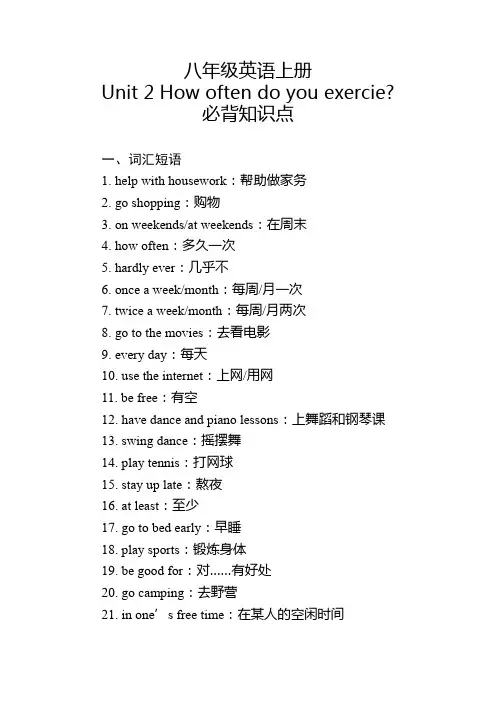
八年级英语上册Unit 2 How often do you exercie?必背知识点一、词汇短语1. help with housework:帮助做家务2. go shopping:购物3. on weekends/at weekends:在周末4. how often:多久一次5. hardly ever:几乎不6. once a week/month:每周/月一次7. twice a week/month:每周/月两次8. go to the movies:去看电影9. every day:每天10. use the internet:上网/用网11. be free:有空12. have dance and piano lessons:上舞蹈和钢琴课13. swing dance:摇摆舞14. play tennis:打网球15. stay up late:熬夜16. at least:至少17. go to bed early:早睡18. play sports:锻炼身体19. be good for:对……有好处20. go camping:去野营21. in one’s free time:在某人的空闲时间22. not…at all:根本不23. the most popular:最流行24. such as:例如25. go to the dentist:去看牙医26. old habits die hard:旧习惯难改27. less than:少于/不到二、语法结构1. 频率副词:always, usually, often, sometimes, never 等,用于描述动作发生的频率。
2. “次数”的表达方法:一次once,两次twice,三次或三次以上用基数词+times,如three times,five times。
3. how often 引导的特殊疑问句:用于询问动作发生的频率,回答常含有频率词组或短语。
2023年八年级上册英语第二单元知识点最新版
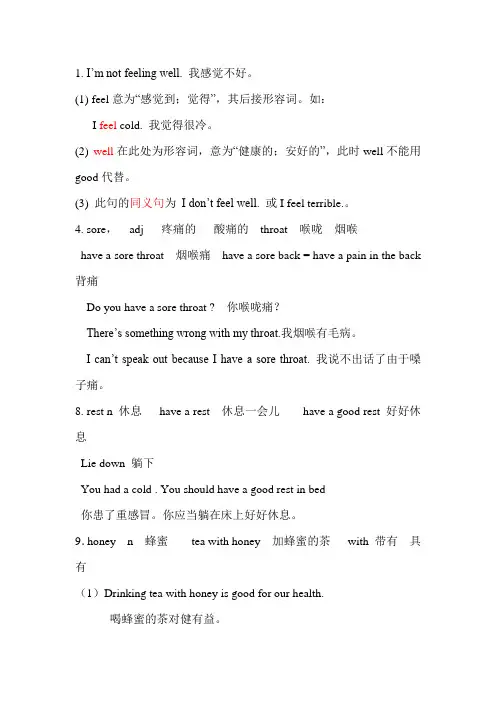
1. I’m not feeling well. 我感觉不好。
(1) feel意为“感觉到;觉得”,其后接形容词。
如:I feel cold. 我觉得很冷。
(2) well在此处为形容词,意为“健康的;安好的”,此时well不能用good代替。
(3) 此句的同义句为I don’t feel well. 或I feel terrible.。
4. sore,adj 疼痛的酸痛的throat 喉咙烟喉have a sore throat 烟喉痛have a sore back = have a pain in the back 背痛Do you have a sore throat ? 你喉咙痛?There’s something wrong with my throat.我烟喉有毛病。
I can’t speak out because I have a sore throat. 我说不出话了由于嗓子痛。
8. rest n 休息have a rest 休息一会儿have a good rest 好好休息Lie down 躺下You had a cold . You should have a good rest in bed你患了重感冒。
你应当躺在床上好好休息。
9.honey n 蜂蜜tea with honey 加蜂蜜的茶with 带有具有(1)Drinking tea with honey is good for our health.喝蜂蜜的茶对健有益。
(2)Would you like some dumpling with meat in them?你想吃肉馅铰子吗?1.illness n 疾病身体不适ill adj 病的(1)Taking this medicine twice a day after meals is good for your illness.饭后一天吃两次这副药对你的疾病有益。
八上英语二单元知识点总结

八上英语二单元知识点总结一、单元概述本单元是八上英语第二单元,主要围绕“家庭成员与描述家庭成员特征”这一主题展开。
本单元重点学习了家庭成员的名词,以及描述人物外貌、性格、爱好等方面的形容词和短语。
同时,也涉及到了如何用英语表达家庭成员之间的关系和情感。
二、知识点总结1. 家庭成员名词(1)father/mother 父亲/母亲(2)brother/sister 兄弟/姐妹(3)grandfather/grandmother 祖父/祖母(4)aunt/uncle 阿姨/叔叔(5)cousin 堂兄弟/堂姐妹(6)parent 父母这些名词通常用作主语,表示家庭成员的身份和关系。
同时,这些名词也可以用作宾语、表语等,用于描述人物的特征和情感。
2. 描述家庭成员特征的形容词和短语(1)描述外貌:tall/short 高的/矮的;thin/fat 瘦的/胖的;blonde/brown 金发/棕发;beautiful/ugly 美丽的/丑陋的。
(2)描述性格:kind/strict 友好的/严格的;hard-working/lazy 勤奋的/懒散的;humorous/serious 有幽默感的/严肃的。
(3)描述爱好:sports fan 运动迷;music lover 音乐爱好者;movie buff 电影迷;reading enthusiast 读书爱好者。
这些形容词和短语可以用来修饰家庭成员,表达他们的个性特点和兴趣爱好。
同时,也可以用来描述人物的整体形象和特点。
3. 表达家庭成员之间的关系和情感(1)family members love each other 家庭成员之间互相关爱。
(2)father and mother are my best friends 父亲和母亲是我最好的朋友。
(3)I miss my grandparents very much 我非常想念我的祖父母。
(4)I am proud of my family 我为我的家庭感到自豪。
八年级上册英语第2单元知识点
八年级上册英语第2单元知识点一、重点单词。
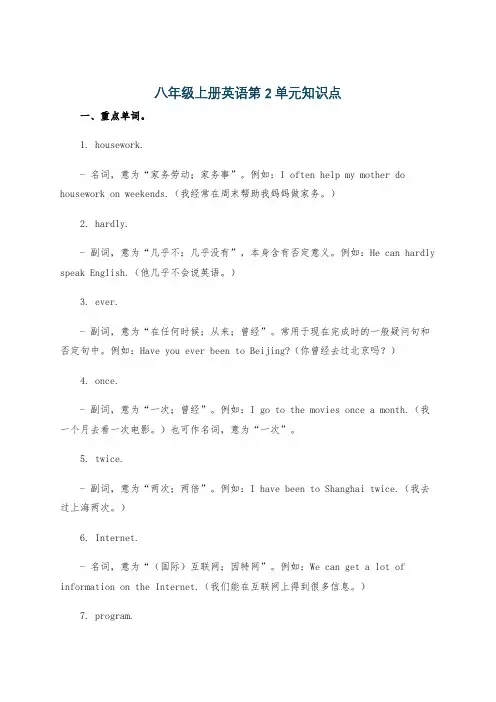
1. housework.- 名词,意为“家务劳动;家务事”。
例如:I often help my mother do housework on weekends.(我经常在周末帮助我妈妈做家务。
)2. hardly.- 副词,意为“几乎不;几乎没有”,本身含有否定意义。
例如:He can hardly speak English.(他几乎不会说英语。
)3. ever.- 副词,意为“在任何时候;从来;曾经”。
常用于现在完成时的一般疑问句和否定句中。
例如:Have you ever been to Beijing?(你曾经去过北京吗?)4. once.- 副词,意为“一次;曾经”。
例如:I go to the movies once a month.(我一个月去看一次电影。
)也可作名词,意为“一次”。
5. twice.- 副词,意为“两次;两倍”。
例如:I have been to Shanghai twice.(我去过上海两次。
)6. Internet.- 名词,意为“(国际)互联网;因特网”。
例如:We can get a lot of information on the Internet.(我们能在互联网上得到很多信息。
)7. program.8. full.- 形容词,意为“忙的;满的;充满的”。
be full of = be filled with,意为“充满……”。
例如:The glass is full of water.(杯子里装满了水。
)9. maybe.- 副词,意为“大概;或许;可能”,一般用于句首。
例如:Maybe he is at home.(也许他在家。
)注意与may be(可能是,作谓语)的区别,如:He may be at home.(他可能在家。
)10. least.- 形容词或副词(little的最高级),意为“最小;最少;最轻微”。
人教版八年级英语上册Unit2知识点汇总总结

人教版八年级英语上册Unit2知识点汇总总结01.重点短语1. help with housework 帮着做家务2. use the Internet 使用互联网3. go to the movies 去看电影4. my favorite TV program ( s)我最喜欢的电视节目5. how often 多久一次6. have dance and piano lessons 上舞蹈与钢琴课7. swing dance 摇摆舞 swung ( swing 的过去式)8. hardly ever 几乎从不9. play tennis with friends 与朋友打网球10. stay up late 熬夜11. eat a healthy breakfast 吃一顿健康的早餐12. play sports 进行体育运动13. at least / at most twice a week 一周至少/最多两次14. be good for my health 有利于我的健康 healthy ( health 的形容词形式)15. eat junk food 吃垃圾食品16. drink coffee 喝咖啡 drank ( drink 的过去式)17. No.5 High School students 第5中学学生18. in one’s free time 在某人的空余时间19. ask them about their free time activities 询问他们关于他们的业余活动20. not … at all 根本不…21. go online 上网22. be surprised that ..感到惊讶23. use it for fun 为了取乐而使用它24. the answers to the questions 这些问题的答案25. one to three times a week 一周一到三次26. two percent of the students 2%的学生27. the best way to do sth.做某事的最好方式28. such as 例如29. spend time with your friends 与你的朋友共度时光spent ( spend 的过去式)30. spend time on sth./ in doing sth.花时间在某事上/做某事31. play together 一起玩32. watch TV for over 2 hours 看两个多小时电视33. go to the dentist 去看牙医34. a 16-year-old high school student 一名16岁的中学生35. have a lot of good habits 有许多好习惯36. more / less than two hours 多/少于两小时37. go to the dentist for teeth cleaning 去牙医处清洁牙齿38. go to the shopping center 去购物中心02.重点句子语法聚焦1. --What do you usually do on weekends?你在周末通常做什么?--I always exercise.我总是锻炼。
八年级英语上unit2 知识点
八年级英语上unit2 知识点八年级英语上Unit 2知识点Unit 2的主要内容是关于家庭和亲戚的话题。
在这个单元,我们将学习如何询问关于家庭和亲戚的问题,并用正确的时态和语法来回答这些问题。
下面是本单元中需要掌握的关键知识点。
1. 家庭与亲戚的词汇在学习关于家庭和亲戚的话题时,我们需要先掌握一些基本的词汇。
(1) 家庭成员:father(父亲)、 mother(母亲)、 parents(父母)、 brother(兄弟)、 sister(姐妹)、 son(儿子)、daughter(女儿)、 grandparents(祖父母)、 grandchildren(孙子孙女)等。
(2) 亲戚关系:uncle(叔叔)、 aunt(阿姨)、 cousin(堂兄弟/姐妹)、 nephew(侄子)、 niece(侄女)、 brother-in-law (姐夫/妹夫)、 sister-in-law(嫂子/弟妹)等。
2. 询问关于家庭和亲戚的问题在英语中询问关于家庭和亲戚的问题有几种方式。
(1) Who is your father? (你的父亲是谁?)(2) Do you have any brothers or sisters? (你有兄弟姐妹吗?)(3) How many people are there in your family? (你家有几口人?)(4) What do your parents do? (你父母是做什么工作的?)(5) Do you get along well with your siblings? (你和你的兄弟姐妹相处得好吗?)3. 时态与语法在回答关于家庭和亲戚的问题时,我们需要注意使用正确的时态和语法。
(1) 现在时态:使用现在时态来描述目前的家庭和亲戚状况。
例如:- My father is a doctor.(我父亲是一名医生。
)- I have one brother and two sisters.(我有一个兄弟和两个姐妹。
(完整版)八年级上册英语第二单元知识点梳理
八年级上册英语第二单元知识点梳理How ofte n do you exercise?【应掌握的词组】1、help with housework 帮助做家务活,2、go shopping 购物,3、on weekends 在周末,4、how often 多久一次,5、hardly ever 几乎不,6、once a week 每周一次,7、twice a mo nth 每月二次,8、go to the movies去看电影,9、every day 每天,10、use the In terne 上网/用网,11、be free 有空,12、have dance and pia no less on上舞蹈钢琴课,13、swi ng da nee 摇摆舞14、play tennis 打网球,15、stay up late 熬夜,16、at least至少,17、go to bed early 早睡,18、play sports 锻炼身体,19、be good for 对…有好处,20、go camping去野营,21、in one ' s free tir在某人的空闲时间,22、not….at all根本不,23、the most popular 最流行,24、such as例如,25、go to the dentist去看牙医,26、more than 超过/多于,27、Old habits die hard.10习惯难改。
28、hard=difficult 困难的,29> less than少于/不到反义词为more than多于30. help sb. with sth 帮助某人做某事help sb do/ to do sth帮助某人做某事31. How about …? =What about •…?.怎么样? / …好不好?What about doi ng sth做某事怎么样?32. want sb. to do sth.想让某人做某事33. How many +可数名词复数+ 一般疑问句….有多少…..34. 主语+ find+ that从句…发现…35. It ' s + adj.+ to do sth故某事是….的36. spend time with sb. 和某人一起度过时光37. ask sb. about sth.向某人询问某事38. by doi ng sth. 通过做某事39. What ' s your favorite 你最喜欢的 ... 是什么?40 start doing sth. =start to do sth 开始做某事41. the best way to do sth.做某事的最好方式【应掌握的句子】1. Mom wants me to get up at 6:00 and play pin g-p ong with her .want to do sth.意思是想要做某事”;want sb. to do sth意思是想要某人做某事”。
人教版八年级英语上册第二单元必背课文、单词、重点短语与语法梳理汇总
八年级英语上册第二单元必背课文、单词、重点短语与语法梳理汇总一、必背课文2b 文章部分《What Do No. 5 High School Students Do in Their Free Time?》Last month we asked our students about their free time activities. Our questions were about exercise, use of the Internet and watching TV. Here are the results.We found that only fifteen percent of our students exercise every day. Forty -five percent exercise four to six times a week. Twenty percent exercise only one to three times a week. And twenty percent do not exercise at all!We all know that many students often go online, but we were surprised that ninety percent of them use the Internet every day. The other ten percent use it at least three or four times a week. Most students use it for fun and not for homework.The answers to our questions about watching TV were also interesting. Only two percent of the students watch TV one to three times a week. Thirteen percent watch TV four to six times a week. And eighty - five percent watch TV every day! Although many students like to watch sports, game shows are the most popular.It is good to relax by using the Internet or watching TV, but we think the best way to relax is through exercise. It is healthy for the mind and the body. Exercise such as playing sports is fun, and you can spend time with your friends and family as you play together. And remember, “old habits die hard.” So start exercising before it's too late!这篇文章是对学生课余活动调查结果的呈现,有以下重点:-频率副词的使用:如“every day”“four to six times a week”“one to three times a week”等,生动地展示了不同活动的开展频率。
八年级上册英语unit2知识点归纳
八年级上册英语unit2知识点归纳八年级上册英语Unit 2知识点归纳八年级上册英语的Unit 2是关于“School life”的话题,主要是介绍学校和学校生活的相关词汇和常用语。
本文将整理Unit 2中的主要知识点,以便于学生更好地掌握英语知识,提高英语水平。
一、学校地点(Location)1. Class/ Classroom: 教室2. Library: 图书馆3. Computer room: 计算机房4. Science lab: 科学实验室5. Music room: 音乐室6. Office: 办公室7. Playground: 操场二、学校时间(Time)1. Class time: 上课时间2. Break time: 休息时间3. Lunch time: 午饭时间4. After-school program: 放学后活动三、学校相关人员(People)1. Teacher: 教师2. Student: 学生3. Principal: 校长4. Office staff: 办公人员5. Janitor: 门卫四、学校课程(Curriculum)1. Subject: 科目2. Math: 数学3. Science: 科学4. Social studies: 社会科学5. English: 英语6. Art: 艺术7. Music: 音乐8. PE(Physical education): 体育五、学校生活(School life)1. Attend school/ Go to school: 上学2. Take a bus/ Walk to school: 坐校车/ 步行3. Eat lunch/ Buy lunch: 吃午饭/ 买午饭4. Study for an exam: 为考试学习5. Join a club/ Sports team: 参加俱乐部/ 运动队6. Do homework/ Studying: 做作业/ 学习7. Use a computer: 使用电脑六、常用口语(Common expressions)1. What time is it? : 现在几点了?2. Good morning/ afternoon/ evening: 早上/ 下午/ 晚上好3. How are you? : 你好吗?4. What class do you have now? : 你现在有什么课?5. I’m sorry/ Excuse me: 对不起/ 打扰一下6. Can you help me please? : 你能帮我一下吗?7. Thank you: 谢谢8. Goodbye: 再见总结:本文所归纳的知识点为八年级上册英语Unit 2的内容,主要是围绕“School life”话题展开的。