
Unit 2 What time do you go to school?导学案
Unit2 What time do you go to school?(Section A) 1a-1c导学案
一、教师寄语:Time waits for no man. 时不待人
二、学习目标:
1、知识与能力目标:
1) 熟练读出书写本节课的表示活动的单词。
2) 学会询问时间的句型, 熟练的谈论表示时间的话题。
2、过程与方法目标:全员参与,小组合作,并在班内展示。
Unit2 What time do you go to school?(Section A) 2d-3c导学案
一、教师寄语:The shortest answer is doing. 最简短的回答就是行动。
二、学习目标:
1、知识与能力目标:1) 能够进行听力训练,培养听力。
2) 学习表示频率的副词,能用英语表达正确的时间。
2、过程与方法目标:全员参与,小组合作,并在班内展示。
Unit2 What time do you go to school?Section B (1a-2a)导学案
一、教师寄语:I feel strongly that I can make it. 我坚信我一定能成功。
二、学习目标:
1、知识与能力目标:1) 继续学习用英语正确表达时间.
2) 熟练的谈论表示时间的话题.
2、过程与方法目标:全员参与,小组合作,并在班内展示。
Unit2 What time do you go to school?Section B ((2b-check)导学案一、教师寄语:
If you want your dreams to come true,don't sleep要想梦想成真,别偷懒
二、学习目标:
1、知识与能力目标:1、巩固本单元重点词汇及短语.
2、时间的表达法及频率副词的准确应用.
2、过程与方法目标:全员参与,小组合作,并在班内展示。
3、情感目标:通过询问和谈论彼此的作息习惯,培养良好的学习习惯。
Unit+2+What+time+do+you+go+to+school+单词讲解英语七年级下册

Unit 2 What time do you go to school ?单词讲解1. up adv. 向上, get up 起床2. dress v. 穿衣服dress-dressed-dressing-dresses(单三) get dressed穿衣服n.连衣裙dress-dresses 复数pl.3. brush v.刷;刷净brush-brushed-brushes(单三) brush sb’s teeth 刷牙n.刷子brush-brushes 复数pl.4. tooth n.牙齿-teeth复数pl.5. shower v. 淋浴;take a shower洗淋浴n.淋浴器6. usually adv.通常地;一般地7. never adv.从不;绝不频率副词always总是100%> usually 通常80% >often 经常60%> sometimes40%>never 频率副词的位置:be后, She is always kind to us.其他v.前,Gina always asks.8. early adv. 早(的)Miss Li has the habit of getting up early and going to bed early.9. job n.工作;职业C eg. Scot has an interesting job.有一份有趣的工作。
10. work v. n.工作U 前无a/anv. eg. As a student we must work hard.作为一名学生,我们必须努力学习。
11. station n.电台;车站radio station广电台;bus station 公交车站railway station火车站12. night n.晚上;夜晚at night在晚上13. funny adj.奇怪的;滑稽可笑的14. exercise 锻炼;练习exercise-exercised-exercising-exercisesv. exercise=do/play sports eg. Swimming is good exercise.游泳是有益的运动。
unit2 what time do you go to school- 七年级英语下册同步必背知
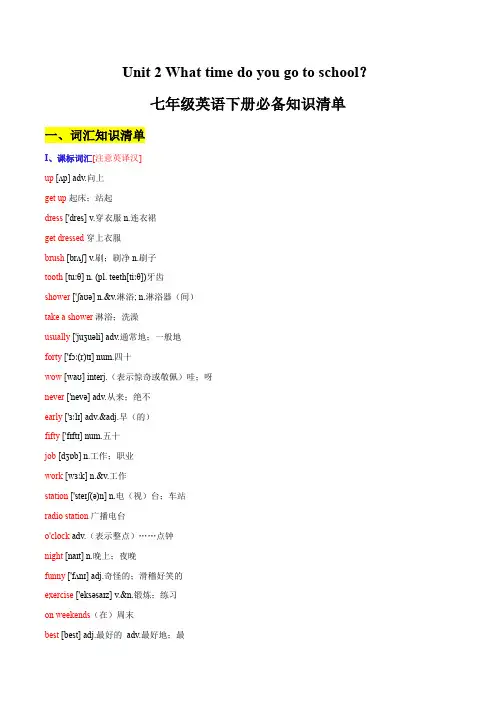
Unit 2 What time do you go to school?七年级英语下册必备知识清单一、词汇知识清单I、课标词汇[注意英译汉]up [ʌp] adv.向上get up起床;站起dress ['dres] v.穿衣服n.连衣裙get dressed穿上衣服brush [brʌʃ] v.刷;刷净n.刷子tooth [tuːθ] n. (pl. teeth[tiːθ])牙齿shower ['ʃaʊə] n.&v.淋浴; n.淋浴器(间)take a shower淋浴;洗澡usually ['juʒuəli] adv.通常地;一般地forty ['fɔː(r)tɪ] num.四十wow [waʊ] interj.(表示惊奇或敬佩)哇;呀never ['nevə] adv.从来;绝不early ['ɜːlɪ] adv.&adj.早(的)fifty ['fɪftɪ] num.五十job [dʒɒb] n.工作;职业work [wɜːk] n.&v.工作station ['steɪʃ(ə)n] n.电(视)台;车站radio station广播电台o'clock adv.(表示整点)……点钟night [naɪt] n.晚上;夜晚funny ['fʌnɪ] adj.奇怪的;滑稽好笑的exercise ['eksəsaɪz] v.&n.锻炼;练习on weekends(在)周末best [best] adj.最好的adv.最好地;最group [gruːp] n.组;群half [hɑːf] n.&pron.一半;半数past [pɑːst] prep.晚于;过(时间)adj.过去的quarter ['kwɔːtə] n.一刻钟;四分之一homework ['həʊmwɜːk] n.家庭作业do (one’s) homework做作业run [rʌn] v.跑;奔clean. [kliːn] v.打扫;弄干净;adj.干净的walk [wɔːk] n.&v.行走;步行take a walk散步;走一走quickly ['kwɪklɪ] adv.很快地either ['aɪðə] adv.或者;也(用在否定词组后)either…or…要么……要么……;或者……或者……lot [lɒt] pron.大量;许多lots of大量;许多sometimes [ˈsʌmtaɪmz] adv.有时taste [teɪst] v.有…的味道;品尝;n..味道;life [laɪf] n.(pl. lives [laɪvz])生活;生命II、语法词汇知其变[注意词性变化]1.dress['dres] v.穿衣服--- adj.dressed穿好衣服的;穿着……衣服的---n.dresser梳妆台;化妆师2.brush [brʌʃ] v.刷;刷净n.刷子---ing形式brushing---pl.brushes3.tooth [tuːθ] n.牙齿--- pl.teethually ['juʒuəli] adv.通常地;一般地ual通常的,平常的5.work [wɜːk] n.&v.工作---3pl.works---ing形式working6.funny ['fʌnɪ] adj.奇怪的;滑稽好笑的---n.fun乐趣,享受7.exercise ['eksəsaɪz] v.&n.锻炼;练习---3pl.exercises---ing形式exercising8.best [best] adj.最好的adv.最好地;最---(原级)adj.good好的,优良的---(原级)adv.well有益的;合理的9.half [hɑːf] n.&pron.一半;半数---pl.halves10.quarter ['kwɔːtə] n.一刻钟;四分之一---pl.quarters11.run [rʌn] v.跑;奔---ing形式running---n.runner跑步者12.clean. [kliːn] v.打扫;弄干净;adj.干净的---ing形式cleaning---n.cleaner清洁工;清洁剂13.walk [wɔːk] n.&v.行走;步行---ing形式walking---n.walker步行者14.quickly ['kwɪklɪ] adv.很快地---adj.quick迅速的,快的15.sometimes [ˈsʌmtaɪmz] adv.有时---adv.sometime某个时候16.life [laɪf] n.生活;生命---pl.livesIII、重点短语知搭配[注意固定短语的英汉互译]get up起床get dressed穿上衣服take a shower洗淋浴radio station广播台on weekends在周末what time什么时间go to school去上学do one’s homework做某人的家庭作业take a walk散步either…or…要么……要么……;或者……或者……lots of…= a lot of很多;大量brush (my) teeth刷(我的)牙get to到达go home回家eat breakfast吃早餐go to work去上班get home到家go to bed上床睡觉at night在晚上be late for迟到IV、核心单词知用法[注意固定短语、句型和词块]Section A1. What time do you usually get up? 你通常什么时候起床?(P. 7)When do you go to work? 你的朋友们什么时候锻炼?(P. 8)(1)what time意为“何时;什么时候”。
人教版七下 Unit 2 What time do you go to school?知识点总结
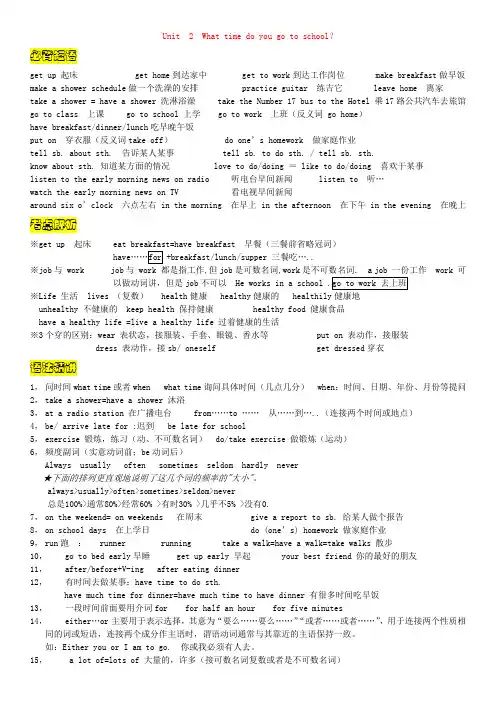
Unit 2 What time do you go to school?必背短语get up 起床 get home到达家中 get to work到达工作岗位 make breakfast做早饭make a shower schedule做一个洗澡的安排 practice guitar 练吉它 leave home 离家take a shower = have a shower 洗淋浴澡 take the Number 17 bus to the Hotel 乘17路公共汽车去旅馆go to class 上课 go to school 上学 go to work 上班(反义词 go home)have breakfast/dinner/lunch吃早晚午饭put on 穿衣服(反义词take off) do one’s homework 做家庭作业tell sb. about sth. 告诉某人某事 tell sb. to do sth. / tell sb. sth.know about sth. 知道某方面的情况 love to do/doing = like to do/doing 喜欢干某事listen to the early morning news on radio 听电台早间新闻 listen to 听…watch the early morning news on TV 看电视早间新闻around six o’clock 六点左右 in the morning 在早上 in the afternoon 在下午 in the evening 在晚上考点解析※get up 起床 eat breakfast=have breakfast 早餐(三餐前省略冠词)have三餐吃…..※job与 work job与 work 都是指工作,但job是可数名词,work是不可数名词. a job 一份工作 work 可以做动词讲,但是job不可以※Life 生活 lives (复数) health健康 healthy健康的 healthily健康地unhealthy 不健康的 keep health 保持健康 healthy food 健康食品have a healthy life =live a healthy life 过着健康的生活※3个穿的区别:wear 表状态,接服装、手套、眼镜、香水等 put on 表动作,接服装dress 表动作,接sb/ oneself get dressed穿衣语法精讲1,问时间what time或者when what time询问具体时间(几点几分) when:时间、日期、年份、月份等提问2,take a shower=have a shower 沐浴3,at a radio station 在广播电台 from……to ……从……到…..(连接两个时间或地点)4,be/ arrive late for :迟到 be late for school5,exercise 锻炼,练习(动、不可数名词) do/take exercise 做锻炼(运动)6,频度副词(实意动词前;be动词后)Always usually often sometimes seldom hardly never★下面的排列更直观地说明了这几个词的频率的"大小"。
Unit 2 What time do you go to school
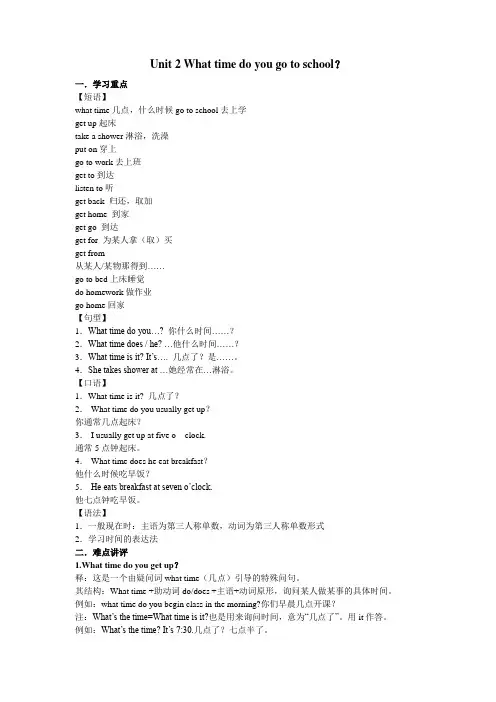
Unit 2 What time do you go to school?一.学习重点【短语】what time几点,什么时候go to school去上学get up起床take a shower淋浴,洗澡put on穿上go to work去上班get to到达listen to听get back 归还,取加get home 到家get go 到达get for 为某人拿(取)买get from从某人/某物那得到……go to bed上床睡觉do homework做作业go home回家【句型】1.What time do you…? 你什么时间……?2.What time does / he? …他什么时间……?3.What time is it? It’s…. 几点了?是……。
4.She takes shower at …她经常在…淋浴。
【口语】1.What time is it? 几点了?2.-What time do you usually get up?你通常几点起床?3.-I usually get up at five o clock.通常5点钟起床。
4.-What time does he eat breakfast?他什么时候吃早饭?5.-He eats breakfast at seven o’clock.他七点钟吃早饭。
【语法】1.一般现在时:主语为第三人称单数,动词为第三人称单数形式2.学习时间的表达法二.难点讲评1.What time do you get up?释:这是一个由疑问词what time(几点)引导的特殊问句。
其结构:What time +助动词do/does +主语+动词原形,询问某人做某事的具体时间。
例如:what time do you begin class in the morning?你们早晨几点开课?注:What’s the time=What time is it?也是用来询问时间,意为“几点了”。
人教版七年级下册英语:Unit 2 What time do you go to school知识点讲解及练习题目及答案

Unit 2 What time do you go to school?单元复习题重点知识点讲解1. what time与whenwhat time翻译为“几点”问的是具体的时间,一般回答要具体到小时。
What time do you go to school?I go to school at half past seven o’clock.回答具体到点钟,且注意在几点前边的介词用at。
when也是对时间的提问,但与what time的区别是:用when提问,回答既可以是具体的时间,也可以是不具体的时间,如:in the morning,last year,in 1998等范围大的时间。
向对方询问具体时间时,即几点几分,只能用what time,不能用when。
询问年份、月份、日期时,只能用when,不能用what time。
2. 英语时间的表达(1)整点时间可表示为“钟点数+o’clock”或直接读钟点数,省去o’clock。
如:It’s ten o’clock a. m.现在是上午十点整。
(2)非整点时间可直接采取读数法。
如:It’s eight-thirty. 是八点三十分。
注意时间的表达方式:用数词。
点与分钟之间用连字如:注:英语时刻的表达法:顺读法和逆读法。
顺读法:钟点数+分钟数。
4:25→four twenty-five,6:58→six fifty-eight,7:00→seven o’clock 说明:这种表达不论分钟数是多少,均可使用。
逆读法:分钟为+介词to/past+钟点数,可分两种情况:1)分钟为不超过半小时,用分钟数+past (/pa:st/过+钟点数。
4:23→t wenty-three past four,5:19→nineteen past five.2)分钟数超过了半小时,用(所差的)分钟的+to+(下一个)钟点为。
10:58→two to eleven 7:31→twenty-nine to eight在逆读法中分钟数逢“五”逢“十”可省略minute(s)。
人教版七年级英语下册复习课件Unit2 What time do you go to school(24张PPT)
Activity get up
7:30
have breakfast
8:00--11:00 12:00
14:00--17:00
do homework have lunch play football with friends
18:00
have supper
19:00--21:00 21:30
watch TV at home go to bed
work 是
,表示“工作,劳动”,抽象概念。
指日常生活工作中各类体力脑力劳动。也可作动词。
go to work after work
eg : He found a job in Beijing.
He has a lot of work to do every day.
My father works in a hospital.
It’s nine fourtryt.y.
I go to school at seven o’clock.
我在七点钟去上学。
go to school
去上学
at seven o’clock
在七点钟
at + 时间点 :在....... (点)
I go to school at seven o’clock. (对划线部分提问)
逆读法: 借助介词past或to 。 (1) 分钟数为30, ….点半:
6:30 half past six 5:30 half past five (2) 分钟数不到30, …点过…分: 6:05 five past six 6:10 ten past six 6:15 a quarter past six (3)分钟数超过30, 差…分…点:(60— 分钟)+to+(小时+1) 6:45 a quarter to seven 6:50 ten to seven
Unit 2 What time do you go to school 导学案(含答案)
❶ at作介词,无论表示时间点还是空间点,at都用于“小而具体”的名词前,比如时间表达“在几点”,地点表达“在哪儿”。
eg:at the moment此时此刻at nine o'clock在9点at noon在中午
❷ in的本意是“在……之内”,表示时间的时候,指的是在一个比较长的时间段之内,表示地点的时候,表示在地点名词内部。
【辨析】:work与job
work
不可数名词
泛指抽象意义的工作。
job
可数名词
指具体的某种工作或职业。
eg:My brother has a job(n. ). He is a worker(n. ) and works(v. ) in a factory. He likes his work(n. ) very much.我哥哥有一份工作。他是一名工人,在一家工厂工作。他非常喜欢他的工作。
7.because we have a shower schedule.
____________________________________________________________________
8.He works at a radio station.
____________________________________________________________________
5.What time do you usually take a shower, Rick?
____________________________________________________________________
Unit2 What time do you go to school 教案1
Unit2 What time do you go to school?第一课时Teaching goals:Ss master the basic words about daily activities.Ss know how to express time briefly.Ss can talk about rountines.Train Ss’s interests in taking part in the activities.Teaching Important Points:the study of verb phrases (talk about daily abilities)the new sentence pattern”What time do you usually……?”and its answer to its time.Teaching Difficult Points:Ask and say times.( how to express time)Teaching Aids:book tape PPT chalk blackboardBlackboard Design:get up What time do you usually…..?go to school I usually…..atget dressed When do you……?brush teeth I…..at…….eat breakfasttake a showerTeaching Procedures:Step1: show the daily activities verb by PPT (pictures)(get up go to school get dressed brush teeth eat breakfast )Teacher---lead readStudents-----select to readStep2: check the wordsFinish 1a in the book( Match the activities with the pictures )Pair check class checkStep3: 1. Finish 1b, listen and match the times with the actions. Draw lines from the clocks to the picture.2. lead the sentence by these pictures“ What time do you usually take a shower/?I usually take a shower at six forty.3. practice it with deskmateAsk 3 groups to check.Step4: let Ss learn how to express time3 situations then exercisesStep5: 1.a summary by PPTAsk some students to conclude what they learnt in this class.2. Do a survey( homework )Reflection:第二课时Teaching goals:Ss master the usage of frequency wordsSs can put the frequency words to use.Train Ss’ listening ability.Teaching Important Points:Do 2a and 2b in the book to select important information.the usage of frequency wordsTeaching Difficult Points:Let Ss use the frequency words to make some sentences of their own.. Teaching Aids:book tape PPT chalk blackboardBlackboard Design:Frequency words: always usually often seldom never Teaching Procedures:Step1: review what we have learnt last class1.check the daily activities phrases (write it on the paper)2.practice the sentence” What time do you usually….?”Step2: Do the Listening1.2a: Listen to the conversation and complete the sentences.2.Listen again. Complete the shower schedule for Jim’sfamily. (group check)3.Listen and repeat after the tape.Boys: A Girls: B then exchange to read4.Now talk about yourself. (group work)A: What time do you usually get up?B: I usually get up at six thirty.C: I never get up so early.Step3: How many frequency words have you heard?Lead always often usually sometimes seldom neverUse figure to show its exact meanings by PPTThen do exercisesStep4: HomeworkWrite about something you always do, something you usually do,and something you never do.Reflection:第三课时Teaching goals:Ss master the words about morning, afternoon and evening.Ss know the difference between am and pmTrain Ss have a reasonable plan for their day.Teaching Important Points:the difference between am and pmTeaching Difficult Points:Do the listening (1b and 1c)Teaching Aids:book tape PPT chalk blackboardBlackboard Design:Morning afternoon eveningTeaching Procedures:Step1: 1.a guessing game (human being)2.review how to express time and the frequency words.Step2: 1.How can you show the difference between two o’clock in the morning and two o’clock in the afternoonLead in a.m. and p.m. related to three periods in a day2 Do 1a in P10. Match the activities with the time of a day. Step3: Do the listening1.Listen and circle the activities you hear.2.Listen again. Write the times next to the activities youcircled in 1c.3.Listen and repeat.(boys and girls)4.ask and answer questions about Tom.When does Tom usually get up///?He usually gets up at half past five///.Reflection:第四课时Teaching goals:Ss can express what their daily rountine.Ss should master the language points given by PPTTrain Ss to develop a healthy life style.Teaching Important points:Ss can read the Tony and Mary’s daily life in 2b.SS can understand the language points in 2bTeaching Diffficult Points:Let Ss number the sentences to make a story.Ss can write down their own daily rountine.Teaching Aids:book tape PPT chalk blackboardBlackboard Design:What time / when …e.g. When do you go to school?What time do you go to school?listen to hear look at see look for findTeaching Procedures:Step1: Finish 2a: Check the activities you think are healthy..Step2: Look at a series of pictures of Tony’s daily life by PPT.Let ss have a brief understanding of the passage.Step3: 1. Finish 2b( circle the healthy activities.)2.Write down the unhealthy habits of each person. Then thinkof healthy activities for them.3.Learn important language points:get…make/eat/haveget home lunchget to school dinnerget to work supperget upget readyStep4: Exercise3a. Number the sentences in order to make a storyStep5: WritingWrite about your own daily rountine based on the passage.Step6: Homework:Finish self check after class. Reflection:。
Unit2WhattimedoyougotoschoolSectionA(1a-2d)课件(完整版)
答案: 4. brush teeth 5. take a shower 6. eat breakfast
Ⅱ. 句型展示
1. 你通常几点起床?
do you
?
2. 他在一家广播电台工作。
He
a radio
.
3. 那个时间吃早饭真有意思!
That’s a
breakfast!
答案: 1. What time; usually get up 2. works at; station
②We have an English class on Monday morning. (对画线部分 提问)
do you
an English class?
答案: ①What time ②When; have
2. He works at a radio station. 他在一家广播电台工作。 【自主领悟】work在此作不及物动词, 意为“工作”, 其后常接 地点状语或时间状语。例如: My father works in a factory. 我爸爸在一家工厂工作。
Unit 2 What time do you go to school? Section A(1a-2d)
Ⅰ. 选词配图 get dressed go to school brush teeth eat breakfast get up take a shower
答案: 1. get up 2. go to school 3. get dressed
C. go to the work D. go to home
4. —Do you get a
?
—Yes, I
in a hotel.
A. work; work B. job; job
Unit 2 What time do you go to school英语人教版七年级下册精品课件
Lead in: Can you read the times?
What time is it , please?
It’s two o five . It’s five past two.
What time is it , please?
It’s three ten . It’s ten past three .
What time does Rick eat He eats breakfast at seven
breakfast?
o’clock.
When does Scott go to
work?
When do your friends
exercise?
what time和when都 可用来提问时间, 他 们的用法有何异同?
Unit 2 What time do you go to
school?
Section A Grammar Focus3c
Objects:
To learn to ask and answer What time questions. To learn to ask about and say times. To learn to use adverbs of frequency.
巧记:频度副词在句中的位置
➢ 频度副词很重要,句中位置要记牢; ➢ 放在实义动词前,助、be、情态动词后; ➢ sometimes最活跃,句首、句中、句末均可找。
拓展
➢ 对频度副词提问,用how often, 意为“多久一次”。
例:——你姐姐多久打一次篮球? ——她从不打篮球。 —How often does your sister play basketball? —She never plays basketball.