
人教版七年级英语下册第三单元知识点总结材料
知识点讲解一、重点词组及短语:1. ________ ________ ________学校规章制度2. _______/ _______ _______ ________遵守规章制度;_______ ______ _______违反规章制度3. _______ _______ _______ ________ = _______ _______ _______ ________ 上课迟到4. _______ ________饭厅,餐厅5. _______ ________ 在课堂上6. _______ ________ 准时(_______ ________及时)7. _______ _______ _______ ________ 在教室里吃东西8.. _______ _______ _______ 戴帽子 9. _______ _______…听…10. ________ ________校服 11. ________ ________穿制服12. ________ ________ 我明白了 13. ________ ________do 不得不做14. _______/ _______ _______保持安静16. _______(_______)_______ 制订规则 18. _______ ______ _______在上学期间19. _______ ______ _______在校期间的晚上20. _______ _______ _______ = _______ _______ _______ ________练习弹钢琴[practice doing …练习做…]21. _______ ________外出 22. _______ ________看望朋友23. _______ _______ ________ = _______ _______ _______打扫房间24. _______ _______ ________ 洗餐具25. _______ _______ / _______ _______太多的(可数/不可数 )26. _______ _______ ________ = _______ _______ _______铺床27. _______ _______ ________ 去睡觉_______ _______ _______在床上28. _______ _______ (sb/sth/doing sth)考虑(某人/某物/做某事)29. _______ _______ _______ sb ________sth 对某人要求严格30. _______ _______ _______ ________学(做某事)31. _______ _______ _______ = _______ _______不要说话。
二、知识点解析1..Ms./Mrs./Miss.Ms.:“女士”,用于婚姻状况不明或不想区分婚否的女子的姓前。
Mrs.:“夫人”,用于已婚女子姓前。
Miss.:“小姐”用于未婚女子姓前,还常用于年轻的女教师的姓前,可译为“老师”。
2. in time和on time区别_______ _______ “及时”,指没有迟到,时间还充裕;_______ _______ “准时,按时”,指按规定的时刻不早不晚。
He always go to school_______ time.他总是按时上学。
Fireman reached the house on fire _______ time.消防员及时赶到那幢失火的房子。
3.hear、listen和soundhear"听说""听"的内容;listen"听"侧重于"听"这一动作;sound"听起来"I'm sorry to ____ that you are ill. It ____ like fun. 听起来挺有趣。
That _______ great. 那听着真很好。
_______ _______ me carefully. 认真听我说。
The children like to_______ _______ music. 孩子们喜欢听音乐。
4.辨析take,bringtake“带走,拿走”指把东西从说话地带到别的地方;bring“带来”指把东西从别处带到说话地。
Can you help me to____ the books to the classroom?你能帮我把这些书带到教室里去吗?_______ your homework here tomorrow,please.请你明天把作业带到这儿来。
5.be strict with sb “对某人严厉” be strict in (doing) sth “对某事要求严格”Mr. White is very strict _______ us. 怀特先生对我们要求很严格。
We should be strict _______ ourselves. 我们应该对自己要求严格。
Our boss is strict _______ our work. 我们的老板对我们的工作要求严格。
6.remember“记得,记住”, forget“忘记,忘了”,remember____ sth记得已做某事(已做); remember ___ __ sth 记得要做某事(还没做)I remember seeing him once.我记得见过他一次。
Remember to post the letter for me.记得给我寄这封信。
7.help “帮助”,help sb ___ ______ sth帮助某人做某事;help还可作名词,表示“帮助”,是不可数。
help sb _______ sth(n.)帮助某人做某事;help oneself to+n.请随便用…I often help him with his lessons.我常帮他学功课。
Please help yourselves to some fruit.请随便吃些水果。
【典型例题】I have ________skirts and this one is ________large for me, so you can take it if you like.A. too many; too muchB. too much; much tooC. too many; much too【典型例题】I don’t like her, ________. A.also B.too C.either D.to10. _______ _______= _______ _______ _______ _______玩得开心,过得愉快11.No talking ! "禁止交谈。
"no后面加上名词或动名词doing也表示不要做某事。
与don't +do的用法相似。
Eg: _______wet umbrellas! /_______put wet umbrellas here!_______food! _______ eat food here!_______smoking! _______smoke here!三、重点语法1.情态动词have to 的用法:意思是"必须、不得不"侧重于客观上的必要和外界的权威。
●结构:主语+have to+动词原形+其他●一般现在时:主语是第三人称单数时用has to,其它时候用have to(过去时:无论人称和单复数都用had to.Eg:We_______ _______ wear sneakers for gym class.Tom _______ _______ practice the guitar every day. 汤姆每天必须练习弹吉它。
●否定形式:主语+don't have to+动词原形+●一般现在时:主语是第三人称单数时用doesn't have to,其它时候用don't have to.(过去时: 无论人称和单复数都用didn't have to)Eg:Nick _______ _______ _______ wear a uniform. 尼克不必穿制服。
We_______ _______ _______ do our homework at once. 我们不必马上完成作业。
●疑问句:Do 、Does或Did+主语+have to +动词原形+其他Eg:---Do you have to stay at home on weekends?---_____,_____ _____ / ______,_____ ______【典型例题】Lucy has to wear sports shoes for gym class.(该为否定句)Lucy ________ ________ _______ wear sports shoes for gym class.2.情态动词must的用法:must表示说话人的主观看法,及主观上的必要性,还用于命令或愿望。
只用于现在时,无人称和单数的变化。
在表示过去、将来和完成时,用have to的相应形式来代替must.●在表示有做某一个动作的必要和义务,它的意思是“必须,应该”。
Eg:You must finish your homework fist.你必须先完成作业。
●表示有很大把握的判断或者推测,意思是“一定,准是”。
Eg:The tall man must be your father.那个高个子男人一定是你的爸爸。
●以must开头的一般疑问句,它的否定回答用needn’t(不必要),不用mustn’t(不允许),mustn’t常用于否定句中表示“不允许,禁止”。
Eg:---Must I go there on foot?我必须得走过去吗?---No,you needn’t.不,你不需要。
You mustn’t park your car here.你的车不允许停在这儿。
【典型例题】It’s very warm outside.You ________wear the coat.A.have toB.hadn’tC.don’t have toD.mustn’t3.情态动词can的用法:●表示能力:"会""能"Eg:Can you play the guitar?Judy can speak a little Chinese. 朱蒂会说一点中文。
+Unit+3+单元语法知识突破+2023-2024学年人教版七年级英语下册+

人教版英语七年级下册第三单元语法知识突破人教版英语各个单元主要是围绕话题,展开语法,接下来,我们就以人教版英语七年级下册第三单元为例,给大家总结一下。
1、关于疑问词how.(1)、疑问词how可以用于询问对方的感受。
例如:How are you?你好吗?回答,I'm fine, thank you. 我很好,谢谢。
又如:How is your weekend? 你的周末过得怎样?回答:It is great.很好。
(2)、疑问词how还可以用于询问方式,例如:How do you get to school? 你怎样去上学?回答:I take a bus to school. 我乘坐公共汽车去上学。
又如:How do you learn English well?你怎样把英语学好?回答:I read it every morning.我每天早上都在读。
(3)、how还可以用于引导感叹句,例如:How beautiful a girl she is! 多么漂亮的女孩啊!2、关于交通方式的表达。
(1)、动词短语:take a\\an\ the+交通工具名称。
例如:take the train乘火车;take a bus 乘坐公共汽车;take the subway乘地铁。
表示“骑”用ride,例如:ride a bike骑自行车;ride a horse骑马。
drive表示“开车”,例如:drive a car。
表达“走路”,用“walk”。
(2)、介词短语:by+交通工具名称。
例如by train乘火车;by bus乘坐公共汽车;by subway 乘地铁;by plane,乘坐飞机;by bike骑自行车。
特别提醒:“走路”用on foot。
练习巩固:改为同义句。
I usually take the school bus to school. = I usually go to school ________ ________.My cousin Jim walks to school. = My cousin Jim goes to school _______ _________.His father drives his car to work. = His father goes to work ______ ________.参考答案:(1)、by bus (2)、on foot (3)、by car注意:表达交通方式的句型结构如下:(1)、主语+表示交通方式的动词短语+to + 地点;例如:I take the plane to Beijing.我乘坐飞机去北京。
人教版七年级英语下册-Unit 3:知识点复习总结+单元测试(word版,含答案)
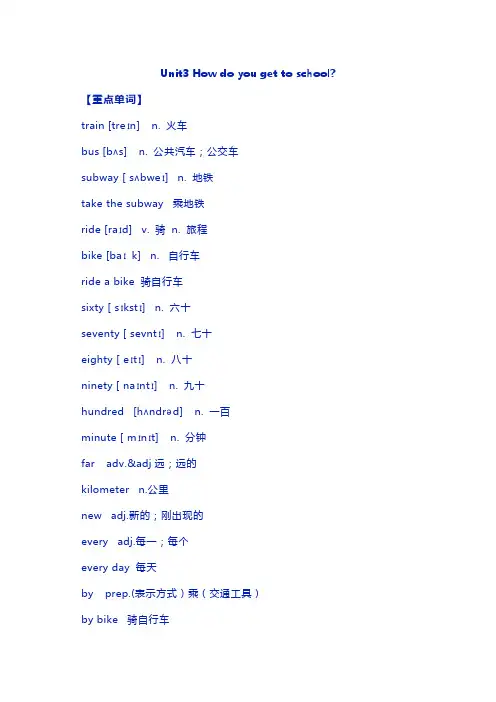
Unit3 How do you get to school?【重点单词】train [treɪn] n. 火车bus [bʌs] n. 公共汽车;公交车subway [ sʌbweɪ] n. 地铁take the subway 乘地铁ride [raɪd] v. 骑n. 旅程bike [baɪk] n. 自行车ride a bike 骑自行车sixty [ sɪkstɪ] n. 六十seventy [ sevntɪ] n. 七十eighty [ eɪtɪ] n. 八十ninety [ naɪntɪ] n. 九十hundred [hʌndrəd] n. 一百minute [ mɪnɪt] n. 分钟far adv.&adj远;远的kilometer n.公里new adj.新的;刚出现的every adj.每一;每个every day 每天by prep.(表示方式)乘(交通工具)by bike 骑自行车drive v.开车car n.小汽车;轿车live v.居住;生活stop n.车站;停止think of 认为cross v.横过;越过river n.河;江many adj.&pron.许多village n.村庄;村镇between prep.介于…之间between…and…在……和……之间bridge n.桥boat n.小船Ropeway n.索道year n.年;岁afraid adj.害怕;惧怕like prep.像;怎么样leave v.离开dream n.梦想;睡梦v.做梦true adj.真的;符合事实的come true 实现;成为现实【重点短语】1. get to school 到达学校2. take the train 乘火车3. take the subway 乘地铁4. ride a bike 骑自行车5. how do you get to school 怎么到达学校6. one hundred and five 1057. how far 多远8. how long 多长时间9. it takes sb some time to do sth 它花费某人多长时间做某事10. ride the bike to school 骑自行车到学校11. walk to , drive to ,fly to…步行去…;开车去…;坐飞机去….12. every day 每天13. I’m not sure 我不敢确信14. about= around 大约15. 10 kilometers 十公里16. good exercise 好的锻炼17. drive his car to work 开车去上班18. in his father’s car 坐父亲的车19. need about 10 minutes to get to school 需要十分钟的时间到达学校20. what do you think of…=how do you like…你觉得怎么样21. cross the river 过河22. It is easy to get to school. 到达学校很容易。
人教版七年级下册英语3单元知识点总结与练习题
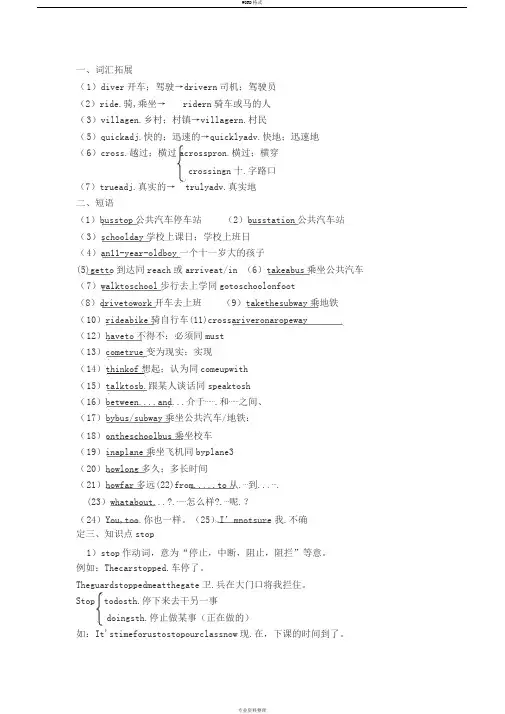
一、词汇拓展(1)diver开车;驾驶→drivern司机;驾驶员(2)ride.骑,乘坐→ridern骑车或马的人(3)villagen.乡村;村镇→villagern.村民(5)quickadj.快的;迅速的→quicklyadv.快地;迅速地(6)cross.越过;横过acrosspron.横过;横穿crossingn十.字路口(7)trueadj.真实的→trulyadv.真实地二、短语(1)busstop公共汽车停车站(2)busstation公共汽车站(3)schoolday学校上课日;学校上班日(4)an11-year-oldboy一个十一岁大的孩子(5)getto到达同reach或arriveat/in (6)takeabus乘坐公共汽车(7)walktoschool步行去上学同gotoschoolonfoot(8)drivetowork开车去上班(9)takethesubway乘地铁(10)rideabike骑自行车(11)crossariveronaropeway(12)haveto不得不;必须同must(13)cometrue变为现实;实现(14)thinkof想起;认为同comeupwith(15)talktosb.跟某人谈话同speaktosh(16)between....and...介于⋯⋯.和⋯⋯之间、(17)bybus/subway乘坐公共汽车/地铁:(18)ontheschoolbus乘坐校车(19)inaplane乘坐飞机同byplane3(20)howlong多久;多长时间(21)howfar多远(22)from.....to从.⋯到...⋯.(23)whatabout...?.⋯⋯怎么样?.⋯呢.?(24)You,too.你也一样。
(25)I’mnotsure我.不确定三、知识点stop1)stop作动词,意为“停止,中断,阻止,阻拦”等意。
例如:Thecarstopped.车停了。
人教版七年级英语下unit3howdoyougettoschool知识点归纳
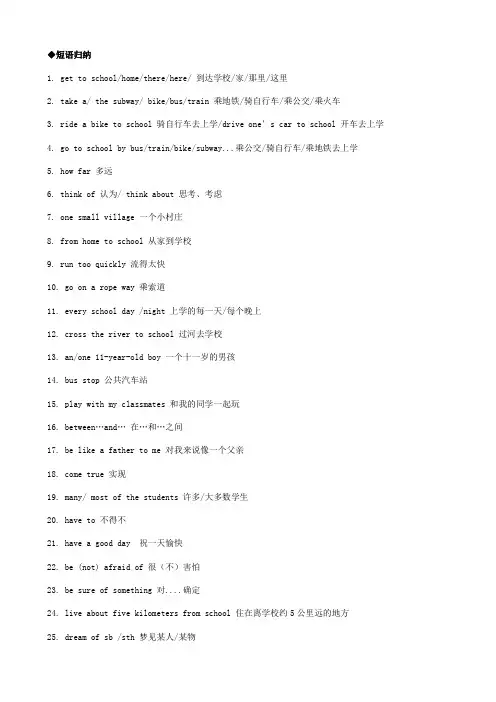
◆短语归纳1. get to school/home/there/here/ 到达学校/家/那里/这里2. take a/ the subway/ bike/bus/train 乘地铁/骑自行车/乘公交/乘火车3. ride a bike to school 骑自行车去上学/drive one’s car to school 开车去上学4. go to school by bus/train/bike/subway...乘公交/骑自行车/乘地铁去上学5. how far 多远6. think of 认为/ think about 思考、考虑7. one small village 一个小村庄8. from home to school 从家到学校9. run too quickly 流得太快10. go on a rope way 乘索道11. every school day /night 上学的每一天/每个晚上12. cross the river to school 过河去学校13. an/one 11-year-old boy 一个十一岁的男孩14. bus stop 公共汽车站15. play with my classmates 和我的同学一起玩16. between…and… 在…和…之间17. be like a father to me 对我来说像一个父亲18. come true 实现19. many/ most of the students 许多/大多数学生20. have to 不得不21. have a good day 祝一天愉快22. be (not) afraid of 很(不)害怕23. be sure of something 对....确定24. live about five kilometers from school 住在离学校约5公里远的地方25. dream of sb /sth 梦见某人/某物26. pen pal 笔友◆用法集萃1. take…to…= go to…by… 乘…去…2. How do/does sb get to…? 某人是怎样到…的?3. How far is it from…to…? 从…到…有多远?4. It takes sb. some time to do sth. 做某事花费某人多长时间。
七年级下册英语第三单元知识点汇总
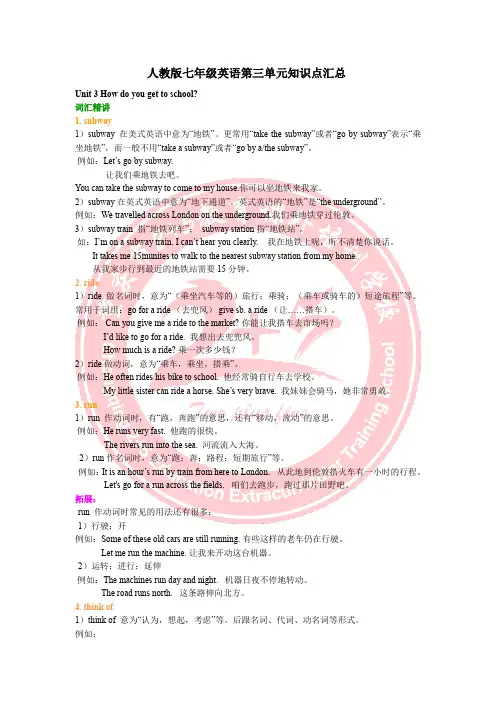
人教版七年级英语第三单元知识点汇总Unit3 How do you get to school?词汇精讲1. subway1)subway 在美式英语中意为“地铁”。
更常用“take the subway”或者“go by subway”表示“乘坐地铁”,而一般不用“take a subway”或者“go by a/the subway”。
例如:Let’s go by subway.让我们乘地铁去吧。
You can take the subway to come to my house.你可以坐地铁来我家。
2)subway在英式英语中意为“地下通道”。
英式英语的“地铁”是“the underground”。
例如:We travelled across London on the underground.我们乘地铁穿过伦敦。
3)subway train 指“地铁列车”;subway station指“地铁站”。
如:I’m on a subway train.I can’t hear you clearly. 我在地铁上呢,听不清楚你说话。
It takes me 15munites to walk to the nearest subway station from my home.从我家步行到最近的地铁站需要15分钟。
2. ride1)ride 做名词时,意为“(乘坐汽车等的)旅行;乘骑;(乘车或骑车的)短途旅程”等。
常用于词组:go for a ride(去兜风)give sb. a ride(让……搭车)。
例如:Can you give me a ride to the market?你能让我搭车去市场吗?I’d like to go for a ride. 我想出去兜兜风。
How much is a ride?乘一次多少钱?2)ride做动词,意为“乘车,乘坐,搭乘”。
例如:He often rides his bike to school. 他经常骑自行车去学校。
最全面人教版七年级下册英语第三单元知识点归纳总结
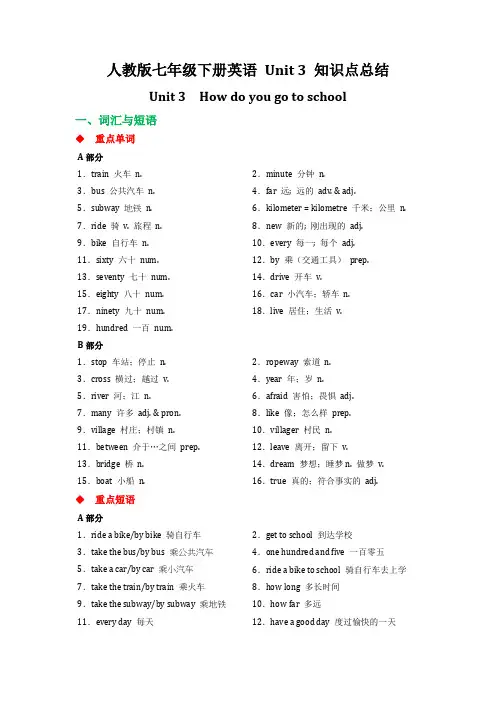
人教版七年级下册英语Unit 3 知识点总结Unit 3 How do you go to school一、词汇与短语◆重点单词A部分1.train 火车n.2.minute 分钟n.3.bus 公共汽车n.4.far 远; 远的adv. & adj. 5.subway 地铁n.6.kilometer = kilometre 千米;公里n. 7.ride 骑v. 旅程n.8.new 新的; 刚出现的adj.9.bike 自行车n.10.every 每一; 每个adj.11.sixty 六十num.12.by 乘(交通工具)prep. 13.seventy 七十num.14.drive 开车v.15.eighty 八十num.16.car 小汽车;轿车n.17.ninety 九十num.18.live 居住;生活v. 19.hundred 一百num.B部分1.stop 车站;停止n.2.ropeway 索道n.3.cross 横过;越过v.4.year 年;岁n.5.river 河;江n.6.afraid 害怕;畏惧adj.7.many 许多adj. & pron.8.like 像;怎么样prep.9.village 村庄;村镇n.10.villager 村民n.11.between 介于…之间prep.12.leave 离开;留下v.13.bridge 桥n.14.dream 梦想;睡梦n. 做梦v. 15.boat 小船n.16.true 真的;符合事实的adj.◆重点短语A部分1.ride a bike/by bike 骑自行车2.get to school 到达学校3.take the bus/by bus 乘公共汽车4.one hundred and five 一百零五5.take a car/by car 乘小汽车6.ride a bike to school 骑自行车去上学7.take the train/by train 乘火车8.how long 多长时间9.take the subway/by subway 乘地铁10.how far 多远11.every day 每天12.have a good day 度过愉快的一天B部分1.think of 认为;想起2.subway station 地铁站3.bus station 公共汽车站4.train station 火车站5.bus stop公共汽车站台6.between…and…在…和…之间7.come true 实现;成为现实8.go on a ropeway 滑索道9.an/one 11-year-old boy 一个十一岁的男孩◆重点句子A部分1.How far is it from your home to school? 从你家到学校有多远?2.— How long does it take you to get to school? 你到学校花费多长时间?— About 15 minutes by bike. 骑车需要大约15分钟。
人教版新目标英语七年级下册Unit3知识点总结
Unit 3 How do you get to school?单元话题:本单元主要讨论出行方式。
要求学生能够描述自己或他人的出行方式,并能听懂以出行方式为话题的听力材料,读懂以出行方式为话题的文章,并以书面形式描述自己或他人的出行方式。
重点词组:1.get to school 到达学校2. take the subway 乘地铁3. ride a bike 骑自行车4. how far 多远5. from home to school 从家到学校6. every day 每天7. ride the bus 乘公共汽车8. by bike 骑自行车9. bus stop 公共汽车站10. think of 认为11 between … and … 在…和…之间12. one/ an 11-year-old boy 一个11岁的男孩13. play with … 和…玩14. come true 实现15. have to 不得不16.Thanks for + n. / v.-ing 感谢你(做)某事重点讲解:how far: 指多远,用来询问距离的远近。
如:How far is it from your home to school?how long: 意为“多久,多长时间”,用以询问某个动作所持续的时间,其谓语动词用延续性动词;还可以用来询问物体的长度。
如:How long does it take you to get to school?between...and: 在……和……之间。
如:I sit between Tom and Helen. come true: 实现。
如:I think my dream can come true.重点句型:1. How do you get to school?2. How far is your from home to your school?3. But he is not afraid because he loves school.4. How long does it take you to get to school?这个句子中的take意为“花费”,一般指“花时间”,通常用于句型“It takes sb. some time(一段时间)to d o sth.”,意为“花费某人多长时间做某事”。
人教版七年级英语下册Unit3_单元要点梳理总结
Unit3 单元要点梳理总结重点短语1.学校旅行school trip2.去散步go for a walk3.挤牛奶milk a cow4.骑马ride a horse5.喂鸡feed chickens6.与农民交谈talk with a farmer7.照相take photos 8.问一些问题ask some questions9.种苹果grow apples 10.带某人逛/参观某地show sb. around11.学到许多learn a lot 12.摘草莓pick some strawberries13.上周last week 14.在乡村in the countrysidevisit my grandparents 16.去钓鱼go fishing15.拜访我的祖父母17.去爬山climb the mountains 18.参观博物馆visit a museum19. 画画draw pictures 20.去学校旅行go on a school trip21.礼品店gift shop 22.为某人买某物buy sth for sb.23.总得来说all in all 24.对……感兴趣be interested in...25.一点儿也不not...at all重点句型1.你见到奶牛了吗?Did you see any cows?2.我见到了而且见到了很多很多。
Yes, I did. I saw quite a lot.3.卡罗尔拍照片了吗?Did Carol take any photos?4.是的,她拍了。
Yes, she did.5.你好,Eric,上周旅游怎么样?Hi, Eric, How was your trip last week?6.精彩极了,我还去乡下看望了爷爷奶奶。
It was excellent. I visited my grandparents in thecountryside.7.我们玩得非常开心!We had so much fun!8.我也拍了好多精彩照片。
人教版七年级英语下册第三单元知识点总结
人教版英语七年级下册第三单元知识点知识点讲解一、重点词组及短语:1. ________ ________ ________学校规章制度2. _______/ _______ _______ ________遵守规章制度;_______ ______ _______违反规章制度3. _______ _______ _______ ________ = _______ _______ _______ ________ 上课迟到4. _______ ________饭厅,餐厅5. _______ ________ 在课堂上6. _______ ________ 准时(_______ ________及时)7. _______ _______ _______ ________ 在教室里吃东西8.. _______ _______ _______ 戴帽子 9. _______ _______…听…10. ________ ________校服 11. ________ ________穿制服12. ________ ________ 我明白了 13. ________ ________do 不得不做14. _______/ _______ _______保持安静16. _______(_______)_______ 制订规则 18. _______ ______ _______在上学期间19. _______ ______ _______在校期间的晚上20. _______ _______ _______ = _______ _______ _______ ________练习弹钢琴[practice doing …练习做…]21. _______ ________外出 22. _______ ________看望朋友23. _______ _______ ________ = _______ _______ _______打扫房间24. _______ _______ ________ 洗餐具25. _______ _______ / _______ _______太多的(可数/不可数 )26. _______ _______ ________ = _______ _______ _______铺床27. _______ _______ ________ 去睡觉_______ _______ _______在床上28. _______ _______ (sb/sth/doing sth)考虑(某人/某物/做某事)29. _______ _______ _______ sb ________sth 对某人要求严格30. _______ _______ _______ ________学(做某事)31. _______ _______ _______ = _______ _______不要说话。
(完整版)七年级英语下册第三单元知识总结
七年级下册第三单元知识总结1.乘坐交通工具的方式:①take +a/an/the+交通工具(放句中)特殊的是自行车不能用take②by+交通工具(放句尾)③in/on+a/an/the+交通工具(放句尾)例如:我每天乘坐公共汽车去上班。
用以上三种表达方式是:I go to work by bus.I take a/the bus to work.I go to work on a bus.She goes to school by car.She takes a/the car toschool.She goes to school in a car.2.特殊的是ride a bike 而不能说take abikedrive a car 也可以是take acarHe rides a bike to school.He goes to school by bike.He rides to school.可以省略bikeHe drives to school.可以省略carride除了动词骑之外,还有名词一段路程的意思go for a ride去兜风give me a ride 让我搭个便车get sb. a ride打顺车half an hour's ride半小时的路程The bus ride takes me about20 minutes. 公共汽车之旅花费我20分钟。
3.步行到学校Walk to school=go to schoolon footon foot放到句末4.对交通方式提问用how如:I go to school by bike.对by bike提问用 How doyou go to school?5.三个到达:get to/arrive in/at/reach只有reach后面不加介词arrive in+大地点arrive at+小地点6.train ①火车②训练7.take a walk=have a walk 散步go out for a walk出去散步8.What about =how aboutdoing sth?做某事怎么样呢?因为about是介词,后面用动词ing9.hundred百 thousand 千million 百万当前面加数字时它们都不加s当前面没有数字,后面加of时他们加s如:hundreds of 成百上千的thousands of成千上万的10.本单元有一个最重要的句型:It takes sb.+时间+to do sth.sb.用宾格 take译为花费例如:It takes me ten minutes to goto school on foot.翻译的时候从后往前面翻译:步行去学校花费我十分钟对以上句子中的ten minutes提问是本单元的第二个重点句型:How long does it take you togo to school on foot?译为:步行到学校需要花费你多久?对这个句型的回答一般用How long,但是因为在原句型中时间前面没有for,所以回答时不用for比较以下两个句子:How long does it take you togo to school on foot?Ten minutes.How far is it from your hometo school?Ten minutes' walk.译为:10分钟的路程。