
牛津译林版高中英语选修七Unit 2《Fit for life》全单元教案
~at对……叫,斥责~out咆哮地说,吼出
8.trial: n.试验;考验;审讯;审判
a public~公审a~flight试飞a~match预赛
bring a person to / up for~将……付诸审判
on~试验性的(地);试验结果;在审判中
I’d like to have your ~ for cookies.你能不能告诉我制作小甜饼的方法。
6.physician: n.医师,内科医师
physics: n.物理学physical:物理学的,自然科学的,身体的,物质的,自然界的physicality:肉体性physicist: n.物理学家
2.thin v. :to make sth thinner
e.g (1)It is reported that aspirin can thin blood and help reduce the risk of heart attacks
(2)War and disease are the two main causes of thinning population.
~and error尝试错误的做事方法
9. length: n.长度;长;
~of一根;一段
at~最后;终于;充分地;详细地
at full~伸展全身in~在长度上
a~(depth) of +数词:长度/深度…
110. contemporary: n.同时代的人
He and I were~ies at school.我和他是同期同学。
4.note v.注意到;写下来
take notes/a note of记笔记;take note of注意到,留意到;compare notes with sb与某人交流
make notes of=make note of记录
5.recipe: n. [C] [医]处方;烹饪法;(糕点等的)制作方法,诀窍(与for)连用
1.open up打开;开发;开始
拓展:be open to对、、、开放的;易受、、、的;in the open (air)在户外,在野外;keep one’s eyes open留心;
注意:lay open摊开(书等);throw open突然打开;大开;open fire on/upon at向、、、开火
Ss read the new words and expressions.
They opened the country up to trade他们开放国家,以进行贸易。
(1)When you search for information on the Internet, you’d better note its sources.课题课时源自9-1New words 1
主备人
王艳
授课时间
2008.3
教学目标
1.Enable the Ss to read the new words and expressions correctly and freely.
2.Get the Ss to grasp the usages of some important new words and expressions.
(2)You’d better note the time of reading each paragraph so that you can improve your reading ability.
他认为成功的唯一诀窍在于勤奋。
He thinks the one~for success lies in hard-work.
Step2 Pronunciation
Ask all the Ss to read the new words and expressions by themselves. Then make some Ss read them before the whole class. Ask others to correct their mistakes. Then teach the Ss to read some difficult words and expressions.
(3)Add more water to the mixture to thin it.
3.purify v. :to make sth pure or clean
pure (adj)清洁的,纯净的pure water纯净水
Stopping pollution surely helps purify the air in the city
adj.当代的;同时代的be~with与…同时期的
~literature当代文学~after按…命名
name it讲出来by the~of…==~d…以…名字by~名叫;凭名;用名make a~出名;成名to one’s~属于自己under the~of…用…名字first~名last~姓in the~of以…名义
教学重、难点
How to make the Ss master the important words and their common uses.
教、学具
A projector, a blackboard and some slides.
预习要求
教师活动内容、方式
学生活动内容、方式
旁注
Step1 Greeting
It’s 2,010 kilometers long. == It’s 2,010 kilometers in length.它长2010千米。
111.mass: adj.群众的;大规模的;集中的;
vt.使……集合vi.聚集
a~of (~es of )许多;大量;大部分(后接可数名
词或不可数名词)
in the~== as a whole总体上;大致上
Ask the Ss to keep the uses of the words in mind. Try to find the common uses of some words to be mentioned in the next period.
Unit-2-Fit-for-life-教案
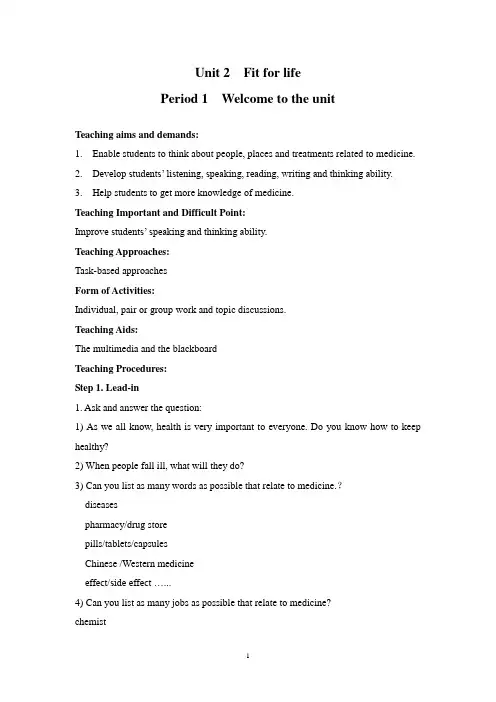
Unit 2 Fit for lifePeriod 1 Welcome to the unitTeaching aims and demands:1.Enable students to think about people, places and treatments related to medicine.2.Develop students’ listening, speaking, reading, writing and thinking ability.3.Help students to get more knowledge of medicine.Teaching Important and Difficult Point:Improve students’ speaking and thinking ability.Teaching Approaches:Task-based approachesForm of Activities:Individual, pair or group work and topic discussions.Teaching Aids:The multimedia and the blackboardTeaching Procedures:Step 1. Lead-in1. Ask and answer the question:1) As we all know, health is very important to everyone. Do you know how to keep healthy?2) When people fall ill, what will they do?3) Can you list as many words as possible that relate to medicine.?diseasespharmacy/drug storepills/tablets/capsulesChinese /Western medicineeffect/side effect …...4) Can you list as many jobs as possible that relate to medicine?chemisteye doctor/opticiandentistphysiciansurgeon……Step 2. Picture talkingA guessing game:1. a person who prepares and sells medicine2. a person who examines people’s eyes to see if they need to wear glasses3. a person who takes care of people’s teeth4. a person who has general skill to treat physical problems5. a person who performs medical operations6. a person who helps doctors to look after patientsWork in groups and discuss the four pictures on the screen.Picture 11.Show a picture of a chemist’s selling medicines on the screen.2.Questions:1)What is the man in white?2)What qualities does a person need to be a chemist?Picture 21. Show a picture of acupuncture treatment on the screen.2. Questions:1)What is on the woman’s ear?2)What can acupuncture do?Picture 31.Show a picture of an operation in an operating theatre on the screen.2.Questions:1)What are the doctors and nurses doing?2)What happens during an operation?Picture 41.Show a picture a doctor testing a girl’s eyes of agriculture on the screen.2.Questions:1)What is the student doing?2)Do you have good eyesight? How can you protect your eyes?Step 3 Discussion1.Have you ever seen a doctor? If so, what happened?2. Have you ever received medical treatments? What was it like?3. Would you like to do any of the jobs shown in the pictures? Why or why not? Step 4 Further discussion1. Do you think medicine only has good effects? Why?2. What do you know about its side effects?Step 5 Homework1. Surf the internet for more information about medicine.2. Write a short passage about your experience of receiving medical treatments.Period 2-3ReadingTwo life-saving medicinesTeaching aims and demands:1.Enable the students to master the usage of new words and phrases2.Enable the students to know development of the two medicines .3.To help the students to improve their reading , speaking abilityTeaching important and difficult points:1.Help the students to improve their listening ,reading and speaking ability.2.Help the students master the reading strategy .rm them of more about the two medicines.Teaching aids:the multimedia and the blackboardTeaching methods:listening and speaking pair work and group workTeaching procedures:Step 1.Lead-in:A free talk with students:⑴.Have you ever taken aspirin and penicillin?⑵.How much do you know about the two medicines?⑶.What other illnesses do they cure?Step 2.Fast readingRead the passage again and answer the following questions:1. What are the two medicines mentioned in the article?(Aspirin and penicillin)2. When was penicillin first discovered? (In 1928.)3. What award did Fleming, Florey and Chain share? (The Nobel Prize.)Step 3. Detailed readingAsk the students to read the passage again carefully and answer the detailed questions 1. When did people find that drinking a special tea could reduce fever and pain? (About 2,500 years ago)2. When was aspirin first made? ( In 1897)3. What other things can ASA help with besides reducing fever and pain?(It can also help reduce the risk of heart attacks by thinning blood, prevent a stroke, reduce the risk of colon cancer, increase the length of people’s lives and help with diabetes.)4. Where did Alexander Fleming find penicillin?(In the mould that killed bacteria)5. What illnesses can penicillin be used to treat?(It can be used to treat bacteria illnesses and other illnesses including pneumonia.)6. What difficulties did Fleming have in developing penicillin as a drug?(First he was unable to find a procedure to make penicillin pure enough to work as a medicine. Second, it was difficult to produce penicillin in the ample quantities needed to be effective.)Step 4. Further reading and fill in the form.Step 5. Learning reading strategyAsk the students to read the Reading Strategy of the article and ask them to focus on the three major skills of understanding medical terms.Step 6 Practice(1)Suppose you are aspirin or penicillin, tell us your development and what influence do you have on our lives according to the passage.(2)Suppose you are Fleming, describe how you found penicillin.Step 7 Discussion:⑴.What would the world be like if the two medicines had not been discovered ?⑵.Do you believe that ‘wonder drug’ will be invented to treat diseases like AIDs in the future?Period 4 Language points1. possess vt.拥有,具有如:The province possesses rich mineral resources.该省拥有丰富的矿藏。
最新牛津译林版高中英语选修七unit 2《fit for life》全单元教案.doc

3.purify v. :to make sth pure or clean
pure (adj)清洁的,纯净的pure water纯净水
Stopping pollution surely helps purify the air in the city
7. bark: n.[C]树皮,吠声vt. / vi.吠,咆哮,剥树皮
~at对……叫,斥责~out咆哮地说,吼出
8.trial: n.试验;考验;审讯;审判
a public~公审a~flight试飞a~match预赛
bring a person to / up for~将……付诸审判
on~试验性的(地);试验结果;在审判中
It’s 2,010 kilometers long. == It’s 2,010 kilometers in length.它长2010千米。
鲁迅和胡适是同一时代的人。Luxun was~with
Hushi.
We~d him chairman. == We~d him as (for)
chairman.我们任命他为主席。
adj.当代的;同时代的be~with与…同时期的
~literature当代文学~after按…命名
name it讲出来by the~of…==~d…以…名字by~名叫;凭名;用名make a~出名;成名to one’s~属于自己under the~of…用…名字first~名last~姓in the~of以…名义
课题
课时
9-1
New words 1
主备人
王艳
授课时间
2008.3
译林牛津模块7Unit2Fitforlife单元教案(译林牛津版高二英语选修七教案教学设计)

译林牛津模块7Unit2Fitforlife单元教案(译林牛津版高二英语选修七教案教学设计)Teaching Aims For Unit 2:Read an article about two important medicines and another article about Chinese acupuncture to learn about the relationship between medicine and health. Also develop the reading skills and strategy about scientific articles: Understanding medical terms.Listen to a TV report on short-sightedness among Chinese teenagers to develop the listening skills: how to listen for current situationsTalk about medicines and interview a doctor to train the oral English and communicative skillsWrite a script for a radio program training the writing skills Explore Chinese medicine in order to prepare and present an oral report on a Chinese medicine and meanwhile develop Ss’ research and cooperation abilitiesThe first period for Welcome to the unit & ReadingTeaching Procedures:Step 1: Talking and speaking in oral EnglishNowadays, it seems that man cannot live without medicines, i.e, they are very important to keep us healthy.Refer to Page 17 (Welcome to the Unit ): Look at the following pictures and discuss the people, the places and the treatments shown in the pictures.Present some questions for Ss to think about the four pictures and arrange their thoughts according to the three questions. In 4 minutes or more, after Ss have talked the pictures enough and then let some Ss express their opinion concerning one or two or the whole of the three questions like the followingexample:I think …. First, …; Second, …; In a word, in my opinion,….Step 2: Presentation for readingSince medicines are very important, sometimes they can save our lives, today let’s learn about two life-saving medicines: (Turn to page 18: Reading)Step 3: Fast readingSkim the text: Find out the main idea and the structure by letting Ss reading the title and the subtitles: What’s the main idea of the newspaper article?Do Part A: Read the text quickly and answer these questions: (Answer: Q1: Line 5 & 34; Q2:Line 16; Q3: Line 57)Step 4: Scanning and skipping readingDo part C1 & Part C2If necessary, it is necessary to explain some difficult or complex sentences concerning the answers to Parts C1 & C2.Step 5: Reading comprehensionTake out Newspaper(Student English Times No 29 Page B1) and lest Ss do “Close reading” ---- Into the text.Step 6: Paraphrase for some sentences long and difficult to understandTeaching reading strategy: how to understanding medical terms:Take out Newspaper(Student English Times No 29 Page B1) and let Ss consider Paraphrase. By paraphrasing sentences, help Ss to understand and guess medical terms. Teachers decide on own situations and pick up other cases to analyse.Step 7: DiscussionFinish Part F(Page 21) if your time is available.Group Ss in 5 or 6 and let them choose one of the questionsand prepare it. Then let them present and express their ideas or opinions.Homework1. Finish Part D & Part E.2. Newspaper (Student English Times No 29 Page B1): Finish “Structure imitation”.The second period for Language points for ReadingTeaching Procedures:Step 1: Review:Check the homework.Step 2: Paraphrase and analysis for some important sentences involving some key language points or grammar cases.1. If you open up any medicine cupboard in the world, there is a high probability that you will find aspirin and penicillin.There is a possibility that……Because he works so hard, there is a high probability that he will pass the language exam.2. The date that aspirin was invented is given by medical historians as 1897, but in fact, 3,500 years ago, some recipes recommended drinking a tea made from the dried leaves of a particular plant to reduce body pains.recommend 推荐、议,后常接名词、代词、动名词或宾语从句做宾语。
英语:unit 2《fit for life》教案- reading(译林牛津版选修7)
Step 1 Lead in If one person coughed badly and had a headache, what may have happened to him? He may have caught a cold. What advice can you give to him/her? (Discussion) Use the sentencepattern: I advise him to
Ask the students to do the exercises about C2 (帮学生巩固一下所学内容。) Step 6 discussion What do you think the world would be like if therewereno medicines? (suffer from pain, loselives….) Step 6 conclusion It seems that medicine is very important. The world would be in a mess if there were no medicines. But can werely on them too much and use them without caution?
让学生回答板书:
Development of aspirin
Develop from: early findings (contained in the leaves and barks)→powder form→tablet. They drank the tea andthe juice in orderto reduce body pains and fever Ask the students to read the second paragraph and try to find what happened In 1953: first introduced theidea that Aspirin could reduce the risk of hearts by thinning blood. In 1971: proved to bea blood-thinning medicine In 1977: used to prevent a stroke In 1988(11years later):reduce therisk of colon cancer
牛津译林版英语高二下册Module 7《Unit 2 Fit for life》word教案

Unit 2 Fit for lifeWelcome to the UnitTeaching a ims:After this class, the students will be able to:1. learn more words about doctors;2. have general idea of the history of acupuncture;3. practise their spoken English.Teaching procedures:Step 1 Lead-in1. H ow can we keep fit?2. W hat will people do when they fell ill?3. Guessing game: What are the doctor s?Step 2 P ictures talking.In what way do doctors give patients treatment?S tep 3 Discussion1. Do you know any person related to invention or discovery of medicine?2. Can you imagine a day without any medicine in this world?S tep4 HomeworkS earch for more information about the history of medicine.ReadingP eriod oneTeaching a ims:After this class, the students will be able to:1. gain the gist through first and second reading;2. practice students’listening ability;3. improve students’ thinking ability through discussion;4. understand some medical terms.Teaching procedures:Step 1 lead-in1. Fill in the blanksA good _________ tastes bitter.Laugh is the best ____ in the worldThere is no ______ against death.2. QuestionsWhat medicines have you ever taken? And what do you know about them?How much do you know about the two medicines?Who invented the two medicines?What illnesses can the two medicines be used to treat?Step 2 First readingWhen was aspirin first sold as a tablet?What did Fleming, Florey and Chain share?Step 3 ListeningListen to the article and try to answer the questions in C1 on page 20.S tep4 Second readingDevelopment of aspirin:Development of Penicillin:Effects of aspirin:Effects of penicillin:S tep5 DiscussionDo you believe that “wonder drugs”will be invented to treat diseases like AIDS in the future?S tep 6 Reading strategyHow can we understand medical terms?Words coming from the same stem:Words that are compound words:Words with irregular plural forms:S tep7 ConsolidationFill in the blanks with proper words according to the reading material.S tep8 HomeworkReview the w hole article, underline the phrases and words you don’t know.ReadingP eriod twoTeaching a ims:After this class, the students will be able to:1. consolidate the gist of the article;2. learn some phrases such as focus on, open up, take place, etc;3. learn some words such as trial, thin(vt), note, etc.Teaching procedures:Step 1 ConsolidationFill in the blanks with correct the words.S tep 2 Useful phrasesfocus on, open up, take place, save one’s life, be made from, in powder form, carry out a study, be considered to be, manage to do, due to, dream come true, heart attack.Step 3 Difficult language pointsW ords:trial, thin(vt), risk, note, application, massS entence structure:1. However, it was not until World War II that two other scientists managed to use new chemical techniques to purify it.2. I t was over a decade before someone else turned penicillin into the great drug of the 20th century.S tep 4 Group discussionL et students discuss with partners about making up a story with the words and phrase we have just learned.S tep5 PresentationAsk students to present their story in front of the class.S tep6 HomeworkWord powerTeaching a ims:After this class, the students will be able to:1. Learn more words about common diseases such as chicken pots, influenza, cancer, etc.2. Learn some words about the ways we use medicine such as powders, liquid, cream and so on.3. Learn some words about the hospital department such as reception, ward, X-ray room, etc.Teaching procedures:Step1 Lead-inCan you tell the names of the diseases?Step2 Word gameWhat are the names of diseases according to the definition?S tep3 Diary entry readingTake notes down about the diseases mentioned in the entry.S tep4 Match gameM atch the words with pictures, learn some words about different ways we use medicine.S earch information about the history of medicine.S tep5 H ospital departmentI dentify the functions of each department in hospitalWord powerTeaching a ims:After this class, the students will be able to:1. Learn more words about common diseases such as chicken pots, influenza, cancer, etc.2. Learn some words about the ways we use medicine such as powders, liquid, cream and so on.3. Learn some words about the hospital department such as reception, ward, X-ray room, etc.Teaching procedures:Step1 Lead-inCan you tell the names of the diseases?Step2 Word gameWhat are the names of diseases according to the definition?S tep3 Diary entry readingTake notes down about the diseases mentioned in the entry.S tep4 Match gameM atch the words with pictures, learn some words about different ways we use medicine.S earch information about the history of medicine.S tep5 H ospital departmentI dentify the functions of each department in hospitalProjectTeaching aims:After learning this period, the students will be able to1. learn about two search services and what should be taken into consideration whileresearching on the Internet;2. use the Internet to do research on a topic by using the information andinstructions in the text;3. make a poster explaining how they have searched and what they have found.Step 1 Lead-in(PPT)Begin the class by asking students in what ways they get information. After the discussion, arouse students’ thinking by asking them, “What is the fastest growing source of information in the world today?”(PPT)Step 2 Skimming (PPT)Allow the students two or three minutes to go through the text quickly to find the answers to the questions on the screen: “When using the Internet to do research, you should keep some steps in mind…”(PPT)Answer:Step one: choosing a search serviceStep two: how to searchStep three: using your informationStep 3 Careful reading for detailed information (PPT)1. Step One: choosing a search service1)Ask the students the following questions:What are the two search services mentioned in the guide?What do they both give us?Can you set some examples of search engines?Answers:Search engines and subject directories.They both give us direct links.Google, Yahoo, Lycos and Excite.(2)True or false questions:Search engines are a type of computer program.Search engines present evaluated contents because the information has been checked by a person.You need to be patient when using subject directories because the links go to the full articles or pages.The links of the search engines are not classified by subject.Subject directories not only present correct information, but also are up to date.Answers:T F F T F2. Step two: how to search1)There are several things to take into consideration when you are searching…Answer:Information gets old.People put information on the Internet.The way you type your key words makes a difference.2)Find the right answer:(1)Where will many sites state the date?A. In the middle of the page.B. At the bottom of the page.C. At the front of the page.D. Usually on the right side.(2)According to the passage, why do we usually need to check the source of the information we find?A. Because the date is too old.B. Because we can’t surf on personal web pages.C. Because not everyone will proofread their own writing and correct errors thatthey made.D. Because we are afraid of virus.(3)Which of the following web pages is much better for doing research on the Internet?A. Personal web pages.B. Pages managed by organizations and companies you trust.C. Government pages.D. B,C and D.(4)According to the passage, if you want to learn about swimming but you don’t want any information about swimming, you should type______.A. sports swimmingB. “sports”- “swimming”C. “sports”+ “swimming”D. sports-swimming(5)If you are not sure about the information, you can consult other web pages to confirm the information, which is called______.A. cross-checkingB. proofreadingC. reviewD. careful readingAnswers:BCDBA3)Step three: using your informationFill in the blanks:To copy the words just as you found them is not only cheating, but also not legal.So remember to:Write an _______of the information you have found.Use your own _______and making your own __________about what it means.________a list of the ______ you got your information from.Answers:outline; words; decisions; Attach; sitesStep 4 Language points (PPT)A. Important phrases:1. do research on2. keep in mind3. be classified by4. be related to5. make a decision6. be divided into7. a bunch of8. up to date9.take into consideration10.as a general rule11. be careful about12. make a difference13. search for14. belong to15. make a list of16. follow these tipsB. Key words:1. keep ... in mind (= remember sth firmly)e.g. It’s a good idea. I will keep it in mind.Translation:你要牢记,你是否努力会影响你的成绩。
高中英语 Unit2 Fit for life Welcome to the unit教学设计 牛津译林版选修7
祝您学习进步,生活愉快,万事如意,金榜题名!要相信一分耕耘一分收获,努力吧朋友!Unit2 Fit for life Welcome to the unit教学设计单元:Unit 2 Fit for life板块:Welcom e to the UnitThoughts on the design:本节课以说、读为主,是一节导入课。
导入课教学应当遵循循序渐进的原则,按照学生温故知新—探索新知识—使用新知识—巩固新知识的客观规律进行设计,从简至难,话题逐渐引入本单元话题。
引入正文之前给予学生一定的词汇支撑,让学生有词汇可用,有内容表达,引入话题之后,通过活动设置帮助学生围绕话题进行充分讨论。
话题要逐渐升华,通过问题设置、作业布置引导学生进行深层次的思考。
Teaching aims:After this cl ass, the students will be able to:1. learn more words about doctors;2. have g eneral idea of the history of acupuncture;3. practise their spoken English.Teaching procedures:Step 1 Lead-in1. How can we keep fit?2. What will people do when they fell ill?3. Guessing game: What are the doctors?Step 2 Pictures talking.In what way do doctors g ive patients treatment?Step 3 Discussion1. Do you know any person relate d to invention or discovery of m edicine?2. Can y ou imag ine a day without any medicine in this world?Step4 HomeworkSearch for more inf ormation about the history of medicine.Explanation本节课分5个步骤安排:step 1 热身,引入话题;steps 2- 3介绍话题信息,学习话题中的语言知识,通过完成任务培养学生说、读方面的能力;steps 4拓展性任务,培养学生认识问题、思考问题的能力和搜寻信息的能力。
牛津译林版高中英语模块7 Unit 2 Fit for life Words 教学设计 2
Unit 2 Fit for life Words 教学设计21. They are very common among children. (P22) 他们在孩子中相当普遍。
commonadj. 1) the same in a lot of places or for a lot of people:It’s quite common to see couples who dress alike.The surname ‘Smith’ is very common in Britain.2) belonging to or shared by two or more people or things:A common goal/interest/practiceEnglish has some features common to many languages.common knowledge: a fact that everyone knows:[+ that] It's common knowledge that they live together.commonlyadv. often or usually:Elbow injuries are commonly found among tennis players.n. 1) have sth. in common: to share interests,experiences or other characteristics with someone or sth.:We don't really have much in common.2) in common with sb./sth.: in the same way as someone or sth.:In common with many mothers,she feels torn between her family and her work.2. It develops when something goes wrong with the replacement of cells. (P22) 当细胞的代谢发生问题的时候就会恶化了。
牛津译林版高中英语选修7Unit 2Fit for life Reading教案1
Unit2 Fit for lifeAims and requirements1.Read an article about two important medicines and another article about Chinese acupuncture.2.Listen to a TV report on short-sightedness among Chinese teenagers.3.Talk about medicines and interview a doctor.4.Write a script for a radio program.5.Prepare and present an oral report on a Chinese medicine.The second period Reading(1)Step1 Lead-inHave you ever taken medicines? What medicines have you ever taken? And what do you know about them?Step2 SkimmingRead the passage quickly and answer the three questions in part on P18Step3 ScanningRead the passage a second time and complete Parts C1 and C2.Step4 ListeningListen to the tape and finish the exercises in the Unit RevisionStep5 DiscussionDiscuss the questions in Part F on P21Step6 ConsolidationFinish the exercises in Parts D and EHomework1.Read the passage carefully and underline the useful phrases and important sentences(10m’)2. Finish the exercises in A1 and A2 on P110.(10m’)The third period Reading (2)Language points1.open up: (1) to show sth. that was hidden or not previously known:eg. 这次辩论能够揭露这些国家之间的明显差异.The debate could open up sharp differences between the countries.(2) to make a space larger or less enclosed:eg. We're going to open up our kitchen by knocking down a couple of walls.(3) to start to talk more about yourself and your feelings:eg. I've never opened up to anyone like I do to you.2.probability: noun [C or U] --the likelihood of something happeningor being true:获胜的可能性有多大? _______________________________________很可能她会来这儿. _______________________________________probable adj. --likely to be true or likely to happeneg. The probable cause of death was heart failure.注意比较:probable adj. 很可能的,与likely意思相近,有时可以互换;possible的语气稍弱。
牛津译林版高中英语选修七《Unit 2 Fit for life 》Word power 教案 2
牛津译林版高中英语选修七Unit.2 word 教案 I .Key Phrases of this unit:➢ focus on 集中于(某事物) ➢ open up 打开➢ carry out 执行;实施;完成 ➢ give up 放弃➢ mass production 大量生产 ➢ see through 看透;识破 ➢ be made from 由、、、做成,用、、、做成 ➢ try out 试验➢ put off 推迟;推延 ➢ put up with 忍受➢ look down up 轻视;看不起 ➢ make out 分清;认出来 ➢ be unable to 不能,不会 ➢ in addition 除、、、之外;另外 ➢ in large quantities 大量地 ➢ come true 成为现实;实现 ➢be used to 被用于;习惯于➢ figure out 计算出;解决;合计(为) ➢ be made from 由、、、制成 ➢ be funfamental to 对、、、是必要的;对、、、是根本的➢ thousands of 成千上万的 ➢ have influence on 对、、、产生影响 ➢ go away 走;开离开;消失➢ leave behind 忘带;留下;超过 ➢ save one ’s life 救某人的命 ➢ make the arrange of 作安排 ➢ talk over (彻底而严肃地)商议,商量,讨论➢ set up 设置,树立,建立,设立,创办 ➢ go wrong 犯错;弄错,走错了路;出了毛病,坏掉➢ take measures to do sth 采取措施做某事nguage points1.open up 打开;开发;开始They opened the country up to trade 他们开放国家,以进行贸易。
单项填空1.The restaurant _____ all ,without distinction of colour.A .opens up B.is open to C .opens with D.throws open 2.---Would you like to go out? ---Yes ,I like playing ______ .A.in the open airy openC.into the openD.in open 3.Don ’t open fire _____ him without permission. A.at B.in C.of D. with2.There is a probabilility/possibility that +从句 “很有可能/有可能、、、”He worked deep into night last night.There is a probability that he will be late for work today.昨晚他工作到深夜,今天他很可能会上班迟到。
牛津译林版高中英语模块7 Unit 2 Fit for life Words 教学设计 1
Unit 2 Fit for life Words 教学设计11. If we need an operation. A special room called an operating theatre is used. (P17)如果我们需要做手术的话,就使用一个特殊的被成为手术室的房间。
Operatev. [I] to cut a body open for medical reasons in order to repair, remove or replace a diseased or damaged part:If the growth gets any bigger they’ll have to operate.Are they going to operate on him?v. [I or T] to (cause to) work, be in caution or have an effect:How do you operate the remote control unit?Does the company operate a pension scheme?operationn. [C] when a doctor cuts a body for medical reasons in order to repair,remove or replace a diseased or damaged part:a major/minor/routine operationan abdominal/cataract/transplant operationHe's got to have an operation on his shoulder.[+ to infinitive] We will know in a couple of days if the operation to restore her sight was successful.n. [U] the fact of operating or being active:There are several reactors of the type in operation (= working) at the moment.We expect the new scheme for assessing claims to come into operation (= start working) early next year.operatorn. [C] 1) someone whose job is to use and control a machine or vehicle:a computer operator2) a company that does a particular type of business:a tour operator3) a person who helps to connect people on a telephone system2. Have you ever seen a doctor?If so,what happened?(P17) 你到医生那儿看过病吗?如果看过,是发生了什么问题?everadv. 1) at any time:Nothing ever happens here in the evenings.Have you ever been to London?He hardly ever (= almost never) washes the dishes and he rarely,if ever,(= probably never) does any cleaning.The smell is worse than ever.I thought she was famous,but none of my friends have ever heard of her.2) continually:He is ever repeating the same old story.3) used for emphasizing an adjective:Yesterday the company announced its first ever fall in profits.4) for all time:I like the house but I don't imagine I'll live there forever.5) continually since that time:He's been depressed ever since he got divorced.。