
牛津译林版高中英语模块2:Unit1 Grammar and usage
We use for + a period of time, since + a point in time.
He has just gone out.(= He went out a few minutes ago.) I have just heard the news. (= Now I know the news.)
Present perfect tense& Present prefect continuous tense
Lead-in
Look at the following sentences and try to explain why the tense is used in these sentences.
Note: We use the present perfect tense when the exact time of an action is not clear or important.
We use it with time expressions such as: already ever for just lately never recently since yet
I have not seen Justin since last Friday night.
Note: We also use the present perfect tense to talk about something that started in the past and is still happening now.
2. They moved to the south in 1990 and have lived there since then.
3. Eric left home last year and has just come back.
4. They bought this house three years ago and they have lived here since then.
Look at the sentences and find the difference: Tom has rung up three times this morning.
Now it is still in the morning.
Tom rang up three times this
morning.
Now it is not still in the morning.
Note:
Actions occurring in an incomplete period might be indicated by today or this morning/afternoon/ evening/ week/ month/ year/ century or all day/night/week, all the time, always etc.
I haven’t seen your for ages. He has just gone out. It has been very cold lately. She has already finished her homework. He hasn’t seen her since the meeting.
Note: We use the present perfect tense to talk about actions that were completed only a short time ago.
They say that they have been to America many times.
Note: We can also use the present perfect tense for repeated actions, that is, we use the present perfect tense with the time expressions once/twice/three times…
Justin has disappeared, so Kelly is very sad.
Note: We use the present perfect tense to talk about things that happened in the recent past, but are connected to the present.
1. The form of the present perfect tense:
We form the present perfect tense with have/has and the past participle of the verb.
have (has) +过去分词
2. The uses of the present perfect tense:
1. We have studied English for about five years.
2. They have lived there since 1990. 3. She hasn’t finished her homework yet. 4. Eric has just come back. 5. How long have you been here?
Point out what tense or tenses are used in the sentences and the reasons why they are used.
1. We have studied English for about five years. We began to study it five years ago.
牛津译林版英语必修二Unit1Grammarandusage2教案

牛津高中英语教学设计单元:Unit 1 Tales of the unexplained板块:GrammarTeaching aims:Learn the differences between the present perfect tense and the present perfect continuous tense.Teaching important points:1. Learn how to form and use the present perfect tense.2. Understand when the present perfect continuous tense is used in sentences.Teaching methods:Explaining and practicing.Teaching aids:the multi-media.Teaching procedures:Step 1 Compare the two tenses1. We use the present perfect tense to talk about an action completed in the recent past, and the present perfect continuous tense for an action that started in the past and is still happening.现在完成时和现在完成进行时都表示动作从过去开始,但现在完成时可表示事件或动作刚结束,而现在完成进行时则强调动作仍在继续。
Li Jia has read a book about Stonehenge. (表示她已经读完了。
)Li Jia has been reading a book about Stonehenge. (表示她仍在读。
)2. We can use the present perfect tense for repeated actions, and the present perfect continuous tense for non-stop actions.We usually use the present perfect tense to ask questions beginning with how many/much, and the present perfect continuous tense to ask questions beginning with how long.现在完成时可表示反复发生的动作,提问时用how many / how much。
Grammar+and+usage Integrated+skills英汉互译讲义高中英语牛津译林版
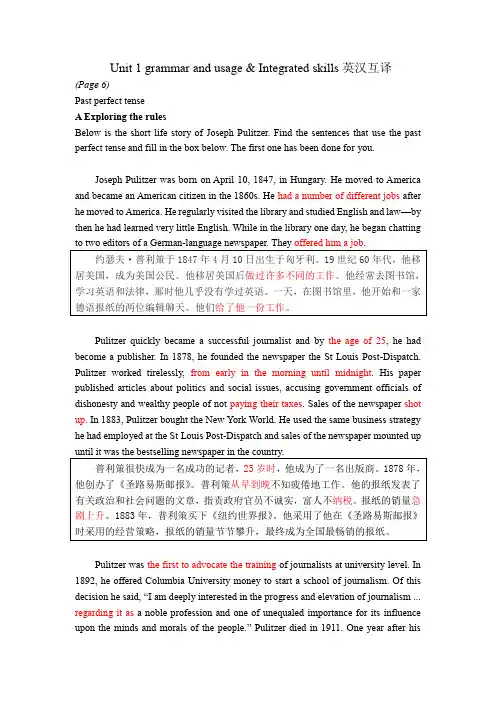
Unit 1 grammar and usage & Integrated skills英汉互译(Page 6)Past perfect tenseA Exploring the rulesBelow is the short life story of Joseph Pulitzer. Find the sentences that use the past perfect tense and fill in the box below. The first one has been done for you.Joseph Pulitzer was born on April 10, 1847, in Hungary. He moved to America and became an American citizen in the 1860s. He had a number of different jobs after he moved to America. He regularly visited the library and studied English and law—by then he had learned very little English. While in the library one day, he began chatting约瑟夫·普利策于1847年4月10日出生于匈牙利。
19世纪60年代,他移居美国,成为美国公民。
他移居美国后做过许多不同的工作。
他经常去图书馆,学习英语和法律,那时他几乎没有学过英语。
一天,在图书馆里,他开始和一家德语报纸的两位编辑聊天。
他们给了他一份工作。
Pulitzer quickly became a successful journalist and by the age of 25, he had become a publisher. In 1878, he founded the newspaper the St Louis Post-Dispatch. Pulitzer worked tirelessly, from early in the morning until midnight. His paper published articles about politics and social issues, accusing government officials of dishonesty and wealthy people of not paying their taxes. Sales of the newspaper shot up. In 1883, Pulitzer bought the New York World. He used the same business strategy he had employed at the St Louis Post-Dispatch and sales of the newspaper mounted up普利策很快成为一名成功的记者,25岁时,他成为了一名出版商。
Unit 1 The mass media 教学设计-高中英语牛津译林版(2020)选择性必修第二册
本单元的主题语境是“人与社会”,话题为“大众传媒”。
本单元的教学旨在引导学生正确认识并理解大众传媒的形式和内涵,以及它们对日常生活和社会发展的影响和作用,并帮助学生学会合理使用各种大众传媒工具。
本节课的两个语篇分别介绍了美国新闻工作者、出版家普利策的生平故事和普利策奖,共一课时。
详细分析如下:What:本版块是关于“过去完成时”的语法学习,主要通过阅读两个语篇引导学生感知、理解和正确使用过去完成时。
首个语篇介绍了美国新闻工作者、出版家普利策的生平事迹。
通过语篇情境的分析,引导学生观察、探究过去完成时的概念和使用的一般规则。
第二个语篇主要介绍了普利策奖的相关信息。
学生可以在阅读文本的基础上,通过动词的适当形式填空,运用实践目标语法规则,感受动词时态在具体语境中的变化。
Why: 本版块旨在围绕单元话题,引导学生分析语篇中含有的目标语法知识,在情境中学习理解、运用过去完成时,并最终在新的具体语境中实现知识的迁移创新,进行创造性的表达。
本版块的学习有助于引导学生学会在不同的语篇中正确使用过去完成时。
同时,本版块语篇对普利策的生平故事及普利策奖的介绍,也有助于学生理解新闻工作者和新闻业对人们生活和社会发展的重要作用。
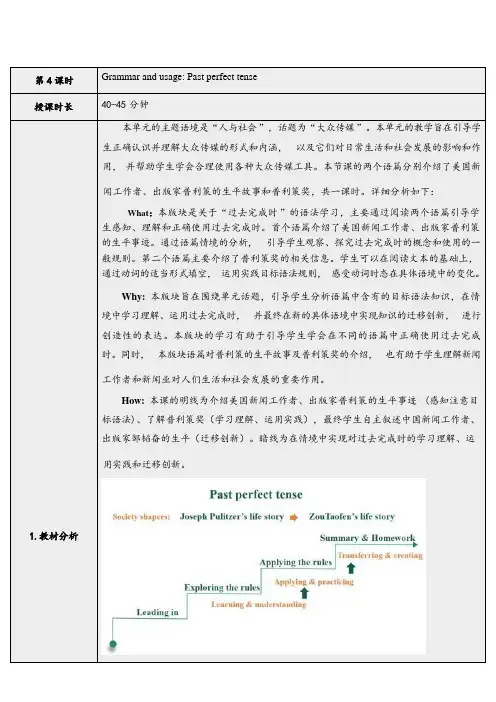
How: 本课的明线为介绍美国新闻工作者、出版家普利策的生平事迹(感知注意目标语法)、了解普利策奖(学习理解、运用实践),最终学生自主叙述中国新闻工作者、出版家邹韬奋的生平(迁移创新)。
暗线为在情境中实现对过去完成时的学习理解、运用实践和迁移创新。
6.教学流程图7.教学过程教学目标教学活动与步骤评价要点核心素养提升点设计意图激活学生已知,感知文本话题。
(学习理解:感知)Step 1 Lead-inT leads Ss to review what theyhave learnt about how to be agood journalist and then talkabout the following questions:·What famous prizes arethere in the world foroutstanding journalists?·What had Joseph Pulitzerdone that contributed tothe birth of the PulitzerPrizes?学生能够完成上节课的作业,并讨论新闻界的“诺贝尔奖”—普利策奖相关话题。
牛津译林版(2020)高一英语必修第二册 unit Grammar and usage 课件

Applying the rules
Lots of new and modern facilities (h2a)v_e_b_e_e_n_p_u_t____ (put) in place. Some of the exercise machairneebs e(i3n)g_t_e_st_e_d________ (test) by a group of energetic young people now. A whole new range ohfavceoubreseens d(e4s)ig_n_e_d_____________ (design) for people of all ages, including tai chi and boxing! I tried out the boxing class and I loved it! The coach, who was a boxing champion, was patient and professional. At the end of the one-hour class, I was sweating all over but felt relaxed.
Working out the rules
• We use the passive voice in the present continuous tense to talk about something that is being done right now. The verb form is “ (1) is/are/am being done”.
• We use the passive voice in the present perfect tense to talk about something that has been done. The verb form is “ (2) has/have been don”e.
译林牛津版高中英语M2 U1 Grammar and usage 教学课件 (共20张PPT)
3.现在完成时的基本用法
用法一: “完成用法”
❖ 强调过去发生的动作对现在造成的影响或结 果.
❖ 常用状语有:already, yet, never, ever, just, before ...
e.g. -- Are you free? --I have just finished my homework. I am free.
2.强调这个动作对现在造成的影响或
产生的结果.
过去分词的构成
(P78-79)
❖ 一类为规则动词,另一类为不规则动词。 ❖ 规则动词的变化为其一般过去时,而不规则
动词的变化有特定的形式,只能一一记忆。
E.g. break, write , know
❖ break – broke – broken ❖ write- wrote-written ❖ know- knew-known
in the past 5 years. have been built
4. 短暂性动词与延续性动词
短暂性动词: 表示短暂的运动状态(瞬间完成或延续时间很短的
动词). (e.g. start, begin, come, go, leave, arrive, die ...)
延续性动词: 表示持续的行为或状态的动词,能和表示一段时间的
3). They haven’t completed it yet.
4). A friend’s told me about a nice fish restaurant.
❖1.构成: have\has + done\been(过去
分词)
❖2.含义:
1.表示从过去开始一直持续到现在的 动作,这个动作已经完成;
4. have/has gone to have/has been to have/has been in
Unit 1 Grammar and usage 课件高中英语牛津译林版(2020)必修第二册

主语的单复
主语为单:
可数名单;不可数名;不定代词(something、somebody等) 作主语 从句、非谓语作主语 时间、金钱、度量等概念 书名,剧名,国名。 以-ics结尾的表示学科名称的名词作主语。 以-s结尾的海峡、山脉、群岛作主语时。
固定用法:
many a (许多)
more than
ห้องสมุดไป่ตู้
A large amount of grain has been eaten by birds.
The family are all fond of football. The family is the smallest unit of society. All possible means have been tried. Every possible means has been tried. All have arrived here now. All was silent.万籁俱寂。 Part of his story was not true. The man who is speaking at the meeting is our chairman. Those who have seen the film please put up(举起;提高) your hands.
one(不止 一个)
the whole
each
every
every…… and every
either
no……and no……
neither
each……a nd each
many a……and many a……
Rice is mainly grown in the south of China. What he said has been recorded. The milk in the fridge is fresh. To read English aloud every morning does you a lot of good.
牛津译林版英语必修一Unit2Grammarandusage1教案
牛津高中英语教学设计单元:Unit 2 Growing pains板块:Grammar and usageThoughts on the design:本节课是以读、写为主的语法教学课。
语法教学的方法各有不同,本节课的设计除了语言知识的传输外,还着眼于培养学生对于学习策略的掌握。
本节课按照“呈现—思考—归纳—巩固”的模式,在语言知识的传授过程中,强调让学生独立思考并归纳语言规则,从而掌握独立的学习策略。
此外,本节课在内容的选择上参考了05-08年各地高考题,对教学内容作了适当增补。
Teaching aims:After learning this session, the students will be able to grasp the basic rules for attributive clauses —“prep.+which/whom”used to begin attributive clauses. Besides, the students will be able to learn the studying strategy for language learning.Teaching procedures:Step 1Review what the students have learned in the previous unit —relative pronouns —with a blank-filling exercise.Fill in the blanks with relative pronouns.1. This is the story __________ we wrote for our storytelling contest. (which/that)2. The book __________ I borrowed from the library is very interesting. (which/that)3. He likes the birthday gifts _________ his friends gave him. (which/that)4. The girl _________ you have just seen is very good at English. (who/whom/that)5. I don’t know the name of the teacher _________ I met in the computer room. (who/whom/that) After finishing the exercise, ask the students to think about the grammatical principles in the sentences, and then make a conclusion as follows: The relative pronouns serve as the objects of the __________. (verbs)[Explanation]第一和第二步是对第一单元中学习的关系代词引导定语从句的复习。
译林牛津高一模块二第一单元语言点详析
译林牛津高一模块二第一单元语言点详析Unit 1 Tales of the unexplainedPart 1 Words1.puzzle vt 使迷惑, 使为难What puzzled me most was that he hadn’t shown up all the day.No maths problem can puzzle himpuzzled/puzzlingI was very puzzled at the puzzling news.n . 难题谜;困惑;迷惑The students are doing a word puzzle.The police are in a puzzle about the case.2.search v 搜索,搜寻The police searched the forest for the lost child.I’v searched my memory ,but I can’t remember that man’s name.He who would search for pearls must dive below.They searched him but found nothing.nI’m at present in search of a new house.So far ,they have been unluckily in their search for gold and have no money at all.3.witness vt亲眼看见,目睹,见证He witnessed the accident.We witnessed great changes in the city.n 目击者证人证据These facts are a witness to his carelessness.He was one of the witnesses of the accident.4researchvNowadays the scientists are busy researching into/on our surroundings.The doctors researched into/on the cause of his death ,but no luck.ndo /make carry out research into /on sth5.case n 案子,案件;事情;箱子in this case 如果这样in that case 如果那样in case 以防万一in no case 决不in any case 无论如何6. charge1)n 负责责任After his father died ,he took charge of the firm ,and now he is in charge of the firm ;that’s to say ,the firm is in the charge of him.2) n /vt 收费,要价You can visit the exhibition free of charge.How much do you charge me for the use of telephone?3) 控告使担责任The court charged him with murder.7 murder vt /n 谋杀凶杀He was charged with an attempted murder.He was murdered on a cold evening.He murdered the whole work .n murderer 杀人者凶手8 convince vt使相信;信服;说服He convinced me that I should study law.He convinced me of his honesty.convinced /convincingPeople became convinced that they should prevent rivers from being polluted.You should give convincing evidence to make yourself convinced.9 disappoint vtWe shouldn’t do anything that will disappoint our parents.What disappointed me most was that I couldn’t go home .disappointed/disappointingHe was disappointed at the news that our team was defeated.The weather is disappointing.He is a disappointing man; nobody would like to stay with him.10. lately =recently多用于否定和疑问句]近来, 最近I haven't seen him lately.Have you been there lately ?注意:be late for school (adj)get up late (adv)11.mystery n 神秘Yesterday I read a story of mystery.Many problems that used to be mysteries to people are now solved.mysterious adj. 神秘的12.support vt 支撑,支持;搀扶;赡养She supports her husband on the money she earns from teaching.He has a large family to support.Don’t worry ! I support you .Which football team do you support?nDuring that election ,he won much support.13. exist viOne cannot exist without air.人没有空气就不能生存。
整合英语-高中-必修2-牛津译林版-Unit 1全套课件:U1_Grammar and usage
A. There; that
B. It; what
C. There; whether
D. It; whether
3. A computer can only do ____you have instructed it to do.
A. how B. after C. what D. when 4. Can you tell me ______?
C. did they live
D. did they live in
6. To get the job started, ____I need is from here.
A. only what
B. all what
C. all that
D. only that
7. In some countries ________is called “equality” doesn’t really mean equal rights for all people.
4. Explain to students what apposition means.
• 1) The news that he failed in the exam surprised his parents.
• 2) Word came that we would have two days off next week.
高中英语牛津译林版必修第二册 unit1 grammar and usage课件
two hours
11
• When not only … but also … is used as the subject of a sentence, or there be is followed by two or more nouns as the subject of a sentence, the verb agrees with the noun closest to it. Such paired conjunctions include: either…or…; neither…nor…; not…but… eg Not his parents but she doesn’t want to go there. Neither you nor I am right. Not only the students but also the teacher likes this holiday. There is a pen and several pencils in the box.
5
Building the jungle environment on the computer was no easy job. It took more than 800 artists over a year to work on the project. The Jungle Book lasts for about two hours but there is enough tension and humour to hold your attention during the whole film. Two hours seems very short when you’re having so much fun!