
七年级仁爱英语 上册 Unit 3 Topic 3 Section B
May I take your order, sir?
(1) take one’s order意为“记下某人点的菜”。 如:The waiter comes over to take my order. (2) sir 意为“先生,阁下”,是对不相识的男 士、男上司、男性长辈或从事某一职务的男 士的尊称,一般不与姓连用。如对方是女性, 则用madam。
It’s time to have lunch.
The three pigs usually have fish and jiaozi for dinner.
What do you usually have for dinner?
—What do you usually have for breakfast/lunch/dinner?
Complete the conversation and then act it out.
A. Would you like some vegetables? B. OK. Something to drink? C. May I take your order? D. Oh ... All right. E. What do you usually have for lunch?
And …
a glass of apple juice
something to drink
chicken with vegetables
something to eat
A: May I take your order, sir? Fish with vegetables and B: ______ _____, rice please. A: Would you like something to drink? B: Yes. A glass of _________, apple juice please. A: OK. Thank you.
—He usually has milk and bread for breakfast/lunch/dinner.
A: What do you often B: I often have
have in the morning /evening/at noon? milk/jiaozi/chicken for breakfast/dinner/ lunch.
What do you usually have for breakfast?
People usually have milk for breakfast.
It’s time to have lunch. The cat usually has fish for lunch.
What do you usually have for lunch?
A: May I take your order? B: Let me see… A: Would you like …? B: Yes, … A: …something to drink?
B: …
Make a survey after class and report it in next class.
1. Review the lesson. 2. Write a report, and report it in class next day.
Name Breakfast Lunch Dinner
Student 1
Student 2 Student 3 Student 4
Student 5
Student 6
1. Go on learning countable nouns and uncountable nouns. 2. Useful expressions: What do you usually have for breakfast? May I take your order? Would you like something to drink?
—I usually have… for breakfast/lunch/dinner. have 在此处是“吃,喝”的意思。如:
have … for breakfast/lunch/dinner 早饭/午饭/晚饭吃(喝)……
—What does Michael usually have for breakfast/lunch/dinner?
Rabbit: Monkey: Rabbit: Monkey: Rabbit: Monkey: Rabbit: Monkey: Rabbit: _______________________ C Let me see. Mm ... _______________________ A No, thanks. _______________________ E Bananas. Well, I’d like seven bananas. _______________________ B Banana juice, please. _______________________ D
可数名词:
不可数名词:
I’d like some fish, chicken and vegetables. Apple juice ,please.
What would you like? Would you like something to drink?
It’s time to have breakfast. Zhang Bozhi usually has milk for breakfast.
(录音 P73-1a)
Michael usually has Байду номын сангаас_____ milk and _______ bread for breakfast. He usually has chicken with vegetables ________ __________ rice for lunch. and some ______ He has _______ jiaozi for supper.
Match after 1a.
(录音P73-1a)
Breakfast
Lunch
Dinner
Name
Item Food Drink Food Drink
Breakfast
Lunch
Dinner
You may begin like this: This is my friend, Li Hua . He usually has … for breakfast.
9.3 Unit 3 Topic 3 Section B(课件)仁爱版九年级英语上册

03 课堂小结
3
We learn:
We can:
Use the structure of wh- /how + to do.
But he `forget _w_h_a_t_t_im__e_t_o__m_e_e_t_t_h_e_m_ .
3. There are `many` kind f `toothpaste.
He can’t `decide w__h_ic_h__o_n_e__to__b_u_y___.
4. He `ha lot of` work to do. He is `wondering _w_h_e_t_h_e_r_t_o_g_o__to__t_h_e_p_a_r_t.y
Li Ming dare not answer questions in class because he is
afraid of making __m_is_t_a_k_e_s__. “Think about your answer,
breath
smile
take a deep _______ and _______” is Kangkang’s answer.
doesn’t know how to improve reading ability
/ə'bɪləti/ n. 能力
Task 2. Listen to 1a and fill in the blanks. Then check the sentences which use wh-/how+ to do.
仁爱版英语七年级上册Unit3Topic3SectionB教学设计

三、教学重难点和教学设想
(一)教学重难点
1.重点:本节课的重点在于让学生掌握描述家庭成员职责和家庭日常活动的词汇及句型,如:clean the room, make the bed等,并能运用一般现在时描述家庭成员的日常行为。
2.能够运用一般现在时描述日常生活中的习惯性行为,并能够运用频率副词always, usually, often, sometimes等。
3.能够理解并运用本节课所学的日常对话,进行真实情境下的角色扮演和交流。
4.能够通过观察、模仿和实践,掌握正确的发音和语调,提高英语口语表达能力。
(二)过程与方法
3.通过提问方式,让学生回顾已学的频率副词(always, usually, often, sometimes),为新课中描述家庭成员行为习惯做好词汇准备。
4.结合图片和学生的回答,自然导入新课主题:描述家庭成员的职责和日常活动。
(二)讲授新知
在这一环节中,我将按照以下步骤为学生讲解新课内容:
1.呈现本节课的主要词汇和句型,如:clean the room, make the bed, do the dishes, sweep the floor等,让学生跟读、模仿,并注意纠正发音。
在本章节的学习过程中,学生将通过以下方法提升自己的英语能力:
1.通过小组合作,讨论家庭成员的分工,培养学生合作学习的能力。
2.通过听力训练,提高学生获取信息、理解对话的能力,培养学生良好的听力习惯。
3.通过角色扮演,让学生在实际语境中运用所学知识,提高学生的口语表达能力。
仁爱版英语七年级上Unit3Topic3SectionB
And dinner? jiaozi .It’s favorite food.I like Chinese food very much.
我们一起完成下列问题
A: May I take your order? B: __1__with vegetables and some Fish. A: Would you like __2___ B: Yes.A glass of apple __3___ A: Ok.Thank you
(录音1)
2b
Rabbit: Monkey: Rabbit: Monkey: Rabbit: Monkey: Rabbit: Monkey: Rabbit:
Pair work
_______________________ Let me see. Mm ... _______________________ No, thanks. _______________________ Bananas. Well, I’d like seven bananas. _______________________ Banana juice, please. _______________________
1. favorite food, Chinese food
Something to eat, have breakfast have lunch, have dinner
1. What do you usually have for breakfast?
May I take your order? Would you like something to drink? a glass of apple juice, please.
something to drink
仁爱版七年级上册英语优秀教学案例:Unit3Topic3SectionA
1.分组合作学习:将学生分成若干小组,组织他们进行合作学习,培养他们的团队协作能力和沟通能力。
2.小组讨论:设计各种讨论话题,让学生在小组内进行讨论,促进他们之间的思想交流和共享。
3.小组展示:组织小组进行展示,让他们有机会展示自己的学习成果,提高他们的表达能力和自信心。
(四)反思与评价
仁爱版七年级上册英语优秀教学案例:Unit3Topic3SectionA
一、案例背景
本案例背景以仁爱版七年级上册英语Unit3Topic3SectionA为例,本节课主要围绕“询问时间和日期”展开教学,通过本节课的学习,让学生能够掌握询问和表达日常时间和日期的词汇和句型,如“What time is it?”“It’s 1:30.”“What day is it today?”“Today is Tuesday.”等。同时,让学生能够运用所学知识进行简单的日常交流,提高他们的实际应用能力。
3.对话教学:通过展示和模仿对话,让学生熟悉和理解日常时间和日期的表达方式,培养他们的口语交流能力。
(三)学生小组讨论
1.分组讨论:将学生分成若干小组,让他们围绕本节课的主题进行讨论,鼓励他们提出问题、分享观点和交流思想。
2.任务设计:设计一些与时间和日期相关的任务,让学生在小组内进行合作完成,如制作一个简单的日程表、编写一个关于时间的短剧等。
1.学生自我反思:鼓励学生在课后进行自我反思,总结自己在课堂上的学习情况和收获,找出自己的不足之处,制定改进措施。
2.同伴评价:组织学生进行同伴评价,让他们互相评价对方的学习表现和进步,促进彼此之间的学习和成长。
3.教师评价:教师对学生的学习情况进行全面评价,关注他们的知识掌握程度、技能运用能力和情感态度,及时给予反馈和鼓励。
仁爱版七年级上册英语笔记 Unit3 Topic3-Unit4 Topic1知识点总结
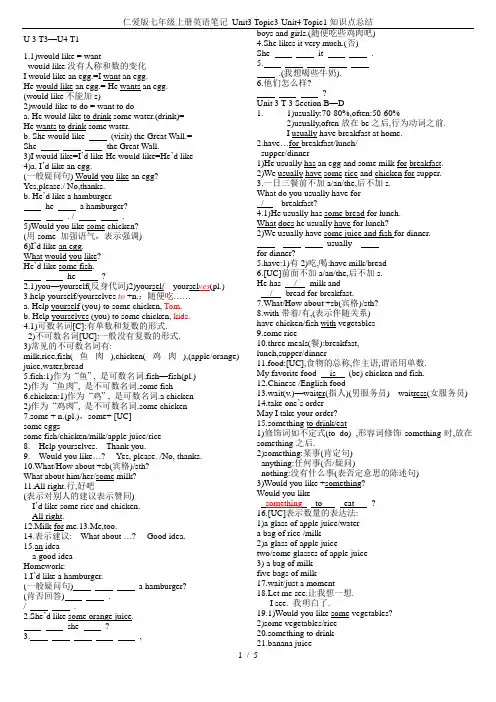
U 3 T3—U4 T11.1)would like = wantwould like没有人称和数的变化I would like an egg.=I want an egg.He would like an egg.= He wants an egg.(would like不能加s)2)would like to do = want to doa. He would like to drink some water.(drink)=He wants to drink some water.b. She would like (visit) the Great Wall.=She the Great Wall.3)I would like=I’d like He would like=He’d like4)a. I’d like an egg.(一般疑问句) Would you like an egg?Yes,please./ No,thanks.b. He’d like a hamburger.he a hamburger?. / .5)Would you like some chicken?(用some 加强语气,表示强调)6)I’d like an egg.What would you like?He’d like some fish.he ?2.1)you—yourself(反身代词)2)yoursel f---yoursel ves(pl.)3.help yourself/yourselves to +n.:随便吃……a. Help yourself (you) to some chicken, Tom.b. Help yourselves (you) to some chicken, kids.4.1)可数名词[C]:有单数和复数的形式.2)不可数名词[UC]:一般没有复数的形式.3)常见的不可数名词有:milk,rice,fish(鱼肉),chicken(鸡肉),(apple/orange) juice,water,bread5.fish:1)作为“鱼” , 是可数名词.fish—fish(pl.)2)作为“鱼肉”, 是不可数名词.some fish6.chicken:1)作为“鸡” , 是可数名词.a chicken2)作为“鸡肉”, 是不可数名词.some chicken7.some + n.(pl.),some+ [UC]some eggssome fish/chicken/milk/apple juice/rice8.---Help yourselves.---Thank you.9.---Would you like…? ---Yes, please. /No, thanks.10.What/How about +sb(宾格)/sth?What about him/her/some milk?11.All right.行,好吧(表示对别人的建议表示赞同)---I’d like some rice and chicken.---All right.k for me.13.Me,too.14.表示建议:---What about …? ---Good idea.15.an ideaa good ideaHomework:1.I’d like a hamburger.(一般疑问句) a hamburger?(肯否回答) ./ .2.She’d like some orange juice.she ?3. , boys and girls.(随便吃些鸡肉吧)4.She likes it very much.(否)She it .5..(我想喝些牛奶).6.他们怎么样??Unit 3 T 3 Section B—D1.1)usually:70-80%,often:50-60%2)usually,often放在be之后,行为动词之前.I usually have breakfast at home.2.have…for breakfast/lunch/supper/dinner1)He usually has an egg and some milk for breakfast.2)We usually have some rice and chicken for supper.3.一日三餐前不加a/an/the,后不加s.What do you usually have for/ breakfast?4.1)He usually has some bread for lunch.What does he usually have for lunch?2)We usually have some juice and fish for dinner.usuallyfor dinner?5.have:1)有2)吃,喝:have milk/bread6.[UC]前面不加a/an/the,后不加s.He has / milk and/ bread for breakfast.7.What/How about +sb(宾格)/sth?8.with带着/有,(表示伴随关系)have chicken/fish with vegetables9.some rice10.three meals(餐):breakfast,lunch,supper/dinner11.food:[UC],食物的总称,作主语,谓语用单数.My favorite food is (be) chicken and fish.12.Chinese /English food13.wait(v.)—waiter(指人)(男服务员)---waitress(女服务员)14.take one’s orderMay I take your order?15.something to drink/eat1)修饰词如不定式(to do) ,形容词修饰something时,放在something之后.2)something:某事(肯定句)anything:任何事(否/疑问)nothing:没有什么事(表否定意思的陈述句)3)Would you like +something?Would you likesomething to eat ?16.[UC]表示数量的表达法:1)a glass of apple juice/watera bag of rice /milk2)a glass of apple juice---two/some glasses of apple juice3) a bag of milk---five bags of milk17.wait/just a moment18.Let me see.让我想一想.I see. 我明白了.19.1)Would you like some vegetables?2)some vegetables/rice20.something to drink21.banana juice----Section C1.eat out2.eat---eating(现在分词)3.would like to doWould you like to have (have) dinner with me?4.have / breakfast/lunch/supper/dinner5.with sb(宾格)6.Would you like to have lunch with him?7.Yes, I’d like/love to.(to不能省略)8.1)May/can I help you?=What can I do for you?2)情态动词may/can/could+动原May I help (help) you?9.sir—madam(对应词)10.What would you liketo eat (eat)?11.Why not+动原? =Why don’t you +动原?Why not study (study) with me? = Why don’t you study with me?12.表示建议:1)What about…? 2)Why not…?肯定回答:Good idea.13.Here you are.14.---Would you like sth to drink?---Yes,please./No,thanks.Section D1.in+地点: in China2.many+n(pl.)many friends3.1)all,bothall指三者或三者以上“都”both指两者“都”2)all,both放在be之后,行为动词之前They are all students.We all like school.4.be kind to sbThe teacher is kind to us.5.have dinner with them6.such as +若干例子7.Sichuan food8.be glad to do sthObama is glad to visit (visit) the Great Wall.9.1)here,there是介词,前不加介词.2)be here/thereI’m glad to be (be) here.10.let sb do sthLet me (I) see (see).Homework:1.他晚饭通常吃什么?he usually?2.你可以点菜了吗??3.Tom,为什么不随便吃些汉堡包呢,?,Tom?4.你想喝些什么东西吗?来两杯香蕉汁.Would you like?.5.She’s glad (be) there.6.I’d like (work) with you.7.Would you like something(say)?8.Why not (tell) him about it.= him about it.9.他对我很友善.He .10.I usually have some rice for lunch.usually for lunch?1.---Do you like…?---Yes, I like …very much/a lot/a little.(No, I don’t like …at all.)Section D1.at / homeHe has a dog at home.2.it’s, its(它是)(它的)a cat. name’s Mimi.3.Tommy =Tom4.Zhou Lan likes it a lot.= Zhou Lan likes it very much.(否)Zhou Lan doesn’t like it at all.5.some,anyShe has some pets.(否)She doesn’t have any pets.(疑问)Does she have any pets?6.1)人称代词:主格---宾格I—me,you-you,he-him,she-her,it-itwe-us,they-them2)形物代—名物代my-mine,your-yours,his-his,her-hers,its-its,our-ours,their-theirsThis is a girl. name is Lily. is twelve. We like .(Her,She,her)Unit 4 T1 Section A1.What can I do for you?=Can/May I help you?2.madam---sir(对应词)3.want to do = would like to do1)She wants to have milk and bread.=She would like to have milk and bread.2)Would you like a glass of apple juice?=Do you want a glass of apple juice?3)Would she like some vegetables?=Does she want any vegetables?4.clothes:衣服的总称,复数名词,作主语时,谓语用复数形式。
仁爱版七年级英语上册Unit3Topic3WhatwouldyouliketodrinkC优质教案(2)
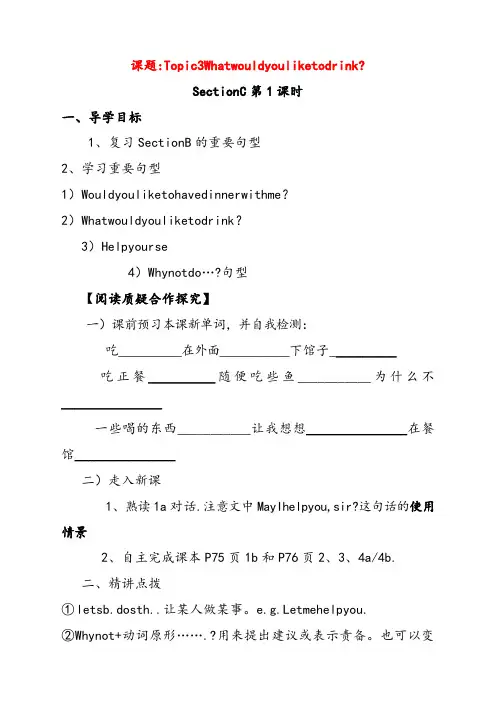
课题:Topic3Whatwouldyouliketodrink?SectionC第1课时一、导学目标1、复习SectionB的重要句型2、学习重要句型1)Wouldyouliketohavedinnerwithme?2)Whatwouldyouliketodrink?3)Helpyourse4)Whynotdo…?句型【阅读质疑合作探究】一)课前预习本课新单词,并自我检测:吃__________在外面___________下馆子__________吃正餐__________随便吃些鱼___________为什么不_______________一些喝的东西___________让我想想_______________在餐馆_______________二)走入新课1、熟读1a对话.注意文中MayIhelpyou,sir?这句话的使用情景2、自主完成课本P75页1b和P76页2、3、4a/4b.二、精讲点拨①letsb.dosth..让某人做某事。
e.g.Letmehelpyou.②Whynot+动词原形…….?用来提出建议或表示责备。
也可以变成Whydon’tyou+动词原形…….?e.g.Whydon’tyouhavesomejuice?注意:在whynotdosth.?=whydon’tyoudosth.?这两个句型中,因都表示建议、请求等委婉语气,故含有some时不能换成any.【多元互动合作探究】1、Heworkson a farm.(对划线部分提问)he ?2、I’dlikesome apples.(同上)like?3、Wouldyouliketodrinksomewater.(做否定回答)No,4、I’dlikesomecakes.(改为一般疑问句)you cakes?5、Whydon’tyouhavesomefish?(改为同义句)Why havesomefish?6、Janelikesapples.(对划线部分提问)_____________Jane_______?【训练检测目标探究】A.根据句意及首字母提示填词。
仁爱版英语七年级上册Unit2Topic3SectionB说课稿
(二)新知讲授
在新知讲授阶段,我将采取以下步骤来逐步呈现知识点:
1.首先,我会介绍本节课将要学习的食物名称,通过图片和发音示例帮助学生记忆。
2.接着,我会教授一般现在时态的疑问句和回答,使用简单的例句和清晰的解释,确保学生理解。
(2)能够运用所学的句型和词汇进行简单的交流,表达自己的喜好。
(3)能够正确书写本节课所学的单词和句子。
2.过程与方法:
(1)通过听、说、读、写的实践活动,培养学生的英语基本技能。
(2)引导学生运用合作、探究的学习方式,提高学生的学习兴趣和自主学习能力。
(3)通过课堂互动,培养学生良好的课堂参与意识和团队合作精神。
(三)互动方式
我计划以下设计师生互动和生生互动的环节:
1.师生互动:在课堂上,我将通过提问、回答和反馈等方式与学生互动,确保学生能够理解和掌握所学内容。
2.小组讨论:学生将被分成小组,就特定的话题进行讨论,共同完成任务,促进生生之间的互动和合作。
3.角色扮演:学生将模拟真实的交流场景,进行角色扮演,提高他们的交际能力和语言运用能力。
3.学习习惯:学生可能已经养成了初步的学习习惯,但还需要进一步培养良好的时间管理和自主学习的能力。
(二)学习障碍
在学习本节课之前,学生可能已经掌握了基本的英语字母和简单的日常用语。然而,以下学习障碍可能存在:
1.前置知识或技能:学生可能对食物名称的英语表达不熟悉,对一般现在时态的疑问句和回答的理解和运用也可能不够熟练。
1.任务型教学法:通过设定具体的交流任务,让学生在实际语境中使用目标语言,提高他们的语言实践能力。
2.情境教学法:创造真实的语言环境,让学生在模拟的日常生活场景中学习,增强学习的趣味性和实用性。
仁爱英语七年上册Unit 3 Topic 1Section B说课稿
Unit 3 Topic 1 Do you like English? Section BGood morning, everyone! My name is Liu Lu. Today, I’d like to talk about my teaching idea about Section B, Topic 1 of Unit 3 in Grade Seven, Project English. The main content of this topic is “Does he/she …?〞I have decided to say the topic from four parts.Part One: Analysis of the Teaching Material1. Status and Function1)To attain “four skills〞request of listening, speaking, reading and writing.2)To help the student learn how to get a pen pals.3)To raise learning interests of students and to improve their spoken English.2. Teaching Aims and DemandsA.Knowledge objects1)Learn some new words and phrases:live, say, visit, great, wall, the Great Wall2)To learn and master the sentence patterns about the simple present tense.--- Does he/she …?--- Yes, he/she does. / No. he/she doesn’t.--- What does he/she say…?--- He/She wants to …B.Ability objects1)To improve the students` abilities of listening, speaking, reading and writing.2)To train the students` ability of working in pairs.3)To develop the students` abilities of communication by learning the usefulstructures.C.Moral objects1)Make the students have successful feeling and achievement.2)Make the students be interested in English study.3)Encourage the students to be more creative.3. Teaching Keys and Difficult Points1)Be able to express words, phrases and sentences in English.2)Let students learn the usage and pronunciation rules of the –(e)s form of verbs inthe simple present tense.3)Let students learn to use simple sentence patterns to talk about pen pals and therelevant information.4. Teaching AidsTape recorder, Power point, one letter, BlackboardPart Two: Teaching Methods and Studying Ways1. Teaching Methods1)Communicative teaching methods;2)Audio-visual teaching methods;3)Task-based teaching methods.Purpose of my designing: I want to make the students the real masters in class while the teacher acts as director. I also hope to combine the language structures with the language functions and let the students receive some moral education while they are learning the English language.2. Studying Ways1) Teach the students how to be successful language learners.2) Make situation and provide meaningful duty, encourage the students to study the text by themselves.Part Three: Teaching ProcedureTask1 Warm-up and Lead-in1. Write down some key words on the blackboard, and ask students to make a dialog out according to these words. If the student can do it well, I will offer him/her a little gift.Key words: could, come from, pen pal. helpPurpose of my designing: In order to review the words and sentence patterns in Section A, at the same time, it will raise learning interests of students.2. Take out a letter to lead to the new lesson. Learn and master the new word “live〞. T: This is a letter. It’s from my friend, Sam. He is my pen pal. Now he lives in England.Purpose of my designing: In order to make the real situation, it is good for the students absorb the new knowledge easily.Task2 Presentation1. Listen to 1a by tape recorder and answer the following questions:1) Does Sam speak Chinese?2) Does Sam live in China now?3) Where does Sam want to visit? (Help students to answer.)Purpose of my designing: To make the students’ get the general idea of the text and also cultivate their ability to study independently.2. Show the picture of the Great Wall and quotes the sentence from the letter by PPT. Learn and master the new words and phrase “say〞, “visit〞, “great〞, “wall〞and “the Great Wall〞. For example:T: Please look at PPT. In the letter, he says he wants to visit the Great Wall. Purpose of my designing: After seeing the photos about the new words, the students can learn them quickly and easily.Task3 Consolidation and Practice1. Listen to 1a again by tape recorder and follow the tape by imitating the pronunciation and intonation. And then ask some students to act it out in pairs. Finish 1a.Purpose of my designing: To help students to get the general idea of the text and practice their abilities of reading.2. Let students discuss with their partner, and complete the conversation in 1b and check the answers. Finish 1b.Purpose of my designing: To cultivate students’abilities of communicating withothers.3. Summarize the sentence patterns by PPT and ask students to master the usage of the –(e)s form of verbs in interrogatives sentences of the simple present tense.1) --- Does he speak Chinese?--- No, he doesn’t.2) --- Does he live in England?--- Yes, he does.3) --- What does he say in the letter?--- He wants to visit the Great Wall.Purpose of my designing: To help students get the main content of this lesson.4. Listen to 2 and ask some students to read the questions and answers aloud. Then check the answer.Purpose of my designing: Let the students have the chance to practice the reading and speaking ability.5. Let students listen to 3 and follow the tape. I will write down the following verbs on the blackboard and compare them with their original forms.speaks →speakknows →knowhelps →helpwants →wantlives →liveAnd then I divide all the students into some groups, and ask every group to make a dialog by using the verbs as follows in the simple present sentence like 4. Finish 3 and 4.“have〞“like〞“want〞“know〞“speak〞“visit〞“help〞and “live〞Purpose of my designing: To develop students’ abilities of communicating with others. And also let students master the usage and pronunciation rules of the –(e)s form of verb in the simple present tense.Task4 Project and Homework1. Make a survey. Ask students to complete a table on the screen about their good friends according their basic information.Purpose of my designing: To develop the students2. HomeworkWrite a passage about the friend with the new sentence learnt this lesson.Purpose of my designing: To improve students’ ability of writing.Part 4 Blackboard DesigningPurpose of my designing: It is good for the students to review the knowledge in this lesson.OK. That’s all. Thanks for your attention.。
仁爱英语七年级上册Unit 1 Topic 3 Section B
Wang Junfeng: Thank you. ___________
Liu Jiajia: Maria: Liu Jiajia: Maria: Liu Jiajia: Maria:
What’s that in English, Maria? It’s a map. Can you spell it , please? Yes, M-A-P, map. Thanks. ___________ ___________ You’re welcome.
Sum up
1. Patterns :
What’s this/that in English?
It’s a/an … How do you spell it? / Can you spell it? Is this/that a/an …? Yes, it is. / No, it isn’t.
2. New words: a/an, spell, can, please
Unit 1 Topic 3 How old are you? Section B
Teaching aims:
1.掌握生词English, eraser, map等正确读音,拼写及用法。
2.句型: 1)What’s this /that in English? 这个/那个用英语怎么说? 2) How do you spell it? 怎样拼写它? 3) Can you spell it,please?请问你能拼写它吗? 4) Is this/that a toy? 这个/那个是一个玩具吗?
注意:问句中的this或that(指物)回答的时候一律用it代替。 3.不定冠词a/an 的用法 1) a 用在以辅音音素开头的单词前。 2). an 用在以元音音素开头的单词前
新课标背景下信息技术融合初中英语听说教学创新案例——以仁爱版初中英语七年级上册Unit3_Topic
ENGLISH ON CAMPUS2023年34期总第682期新课标背景下信息技术融合初中英语听说教学创新案例——以仁爱版初中英语七年级上册Unit3 Topic3 Section B“Food and meals”为例摘 要:理解性技能中的“听”与表达性技能中的“说”,是学生应熟练掌握的英语语言技能。
近年来,不少地方的中考英语口语考试采用“人机对话”测评方式,取代了以往“人人对话”的传统测评方式。
随着信息技术与英语教学的不断融合与渗透,如何更好地利用信息技术开展初中英语听说教学,优化听说教学策略,提高听说教学效率,规范听说测评方式,是广大专家学者、一线教师关注的问题。
本文以仁爱版初中英语七年级上册Unit3 Topic3 Section B“Food and meals”为例,探讨信息技术与初中英语听说教学深度融合的方法与路径。
关键词:人机对话;信息技术;初中英语听说教学作者简介:黄颖婷(1993.08-),女,福建漳州人,福建省漳州第一中学,中学二级教师。
一、引言《义务教育英语课程标准(2022年版)》(以下简称“新课标”)指出,重视教育信息化背景下英语课程教与学方式的变革,充分发挥现代信息技术对英语课程教与学的支持与服务功能。
新课标鼓励教师合理利用、创新使用数字技术和在线教学平台,开展线上线下融合教学,为满足学生个性化学习需要提供支撑,促进义务教育均衡发展。
作为英语学科语言的重要组成部分,听说能力是语言输入和产出的主要方式。
理解性技能中的“听”和表达性技能中的“说”,相互关联、相互影响、相互作用,在发展学生语言能力和思维能力,培养学生跨文化交际能力,引领学生树立国际视野、涵养家国情怀,落实学科核心素养培养等方面,起着至关重要的作用。
二、英语听说教学现状分析进入21世纪以来,信息时代逐渐向智能时代过渡。
在教育教学领域,人工智能技术支撑教育教学质量的提升,图像识别、语音识别、人机交互、智慧课堂等技术不断引入英语课堂教学和评价,英语教师面临着前所未有的挑战。