
牛津译林版八年级英语下册现在完成时用法及综合练习(20200707215709)
现在完成时用法及综合练习现在完成时的构成:助动词have(has)+ 过去分词,1.表示过去发生或完成的某一动作对现在造成的影响或结果。
例如:I have just cleaned my clothes. 我刚洗过衣服。
(“洗衣服”是发生在过去的动作,对现在造成的结果是“衣服干净了”)现在完成时常用的时间状语有:already (”已经”用于肯定句的中间和末尾处)never (“从不”用于中间处)ever (”曾经”用于疑问句和肯定句的中间处)just(“刚刚”用于中间处)还”用于否定yet(“已经”用于疑问句的末尾处/ “句的末尾处)或不加任何的时间状语,但不能和表示过去的时间状语连用.现在完成时与一般过去时的用法比较现在完成时表示过去的动作一直延续到现在甚至会继续下去或表示过去的动作对现在造成的影响;一般过去时表示动作发生的时间在过去。
试比较:The plane has arrived . 飞机已经来了。
(说明现在的情况:飞机在这儿)The plane arrived a quarter ago. 飞机是一刻中以前来的。
(强调动作发生的时间在过去)I have taught here for fifteen years. 我在这儿已经教了十五年。
(表示十五年前的动作一直延续到现在,还可能会继续。
)I taught here for a year. 我过去在这儿教过一年。
(表示“我“现在已经不在这儿任教了)练习:I.翻译下列句子:1. 你曾经吃过鱼和薯条吗?2. 我刚刚丢了我的物理书。
3. 我以前从来没去过那个农场。
4. 他已经吃过午饭了。
5. 你已经看过这部电影了吗?6. 我哥哥还没回来。
7. 我上星期看过这部电影。
8. 在1992年他住在这里。
II.用过去时或现在完成时填空:1. “_________ you __________ (have) lunch ?”“Yes.”“I ____________ (have) it at 12:00.”“When ________ you __________ (have) it?”2. “_________ you __________ (write) a letter to your aunt yet?”“Yes, I ___________. I ________________ (write) one last week.”“Not yet.”3. “_________ he ___________ (finish) his homework?”“Yes, just once.”4. “_________ they ever __________ (be) abroad?”5. Your father _________ just ___________ (finish) his work.6. Your father _________ (finish) his work just now.7. Last term I __________ (learn) many English words.8. They ____________ (not read) the interesting books yet.9. He _____________ never ____________ (go) to the science museum.10. ____________ you ever ____________ (drink) coke?“Yes, I __________ .”11. “____________ you _____________ (buy) a dictionary? ““ I ________ (buy) it in a bookstore.”“Where __________ you ____________ (buy) it?”“ Yesterday.”“When ___________ you _____________ (buy) it?”Since 和for 的用法表示过去已经开始持续到现在的动作或状态常用的时间状语有:for, since, how long, so far,these days等。
Since+过去点的时间,for+一段时间(数词+量词),此划线部分用how long提问。
一、since短语或从句表示过去的动作延续至今,since之后的时间为一点。
如:Mr. Smith has worked here since 1984. 1984年以来,史密斯先生一直在这工作。
He’s learned about 5,000 English words since he went to college. 他上大学以来大约学了五千个英语单词。
二、for短语表示动作延续多长时间,for的宾语为时间段。
如:We have known each other for twenty years. 我们认识有二十年了。
I haven’t seen her for a long time.我好久没有见到她了。
练习:用since和for填空1) ______ two years2) _______ two years ago3) _______ last month 4)______ 19995) _______ yesterday6) _______ 4 o’clock7) ______ 4 hours8) _______ an hour ago9) _______ we were children10) _____ lunch time11) ______ she left here1. He has lived in Nanjing ________ the year before last.2. I’ve known him __________ we were children.3. Our teacher has studied Japanese _________ three years.4. She has been away from the city ___________ about ten years.5. It’s about ten years __________ she left the city.2.短暂性转换延续性①arrive at/in sw. get to/reach sw. come/go/move to sw.→be in sw./at school/at home/on the farm/be here/be there1) He got to Beijing five minutes ago.He ________ _________ _________ Beijing for _________ _________.2) I moved to the USA last year.I ________ ________ __________ the USA since __________ __________.3) I went home yesterday.I _______ ________ _________ home for _________ __________.4) They came here last week.They _________ _________ here since _________ __________.②come/go back, return → be back come/go out → be out1) He came out two years ago.He _________ __________ _________ for __________ __________.2) We return to Fuzhou yesterday.We ________ ________ _________ to Fuzhou since __________.③become → be1) I became a teacher in 2000.I ________ __________ a teacher for _________ _________.2) The river became dirty last year.The river _________ _________ dirty for _________ __________.④close → be closed open → be open1) The shop closed two hours ago.The shop ________ _________ _________ for _________ _________.2) The door opened at six in the morning.The door ________ ________ ________ for six hours.⑤get up → be up die → be deadleave sw. → be away from sw.fall asleep/get tot sleep → be asleepfinish/end → be over marry → be married1) I got up two hours ago.I ________ ________ ________ since ________ ________.2) He left Fuzhou just now.He _______ ________ ________ _________ Fuzhou for five minutes.3) My grandpa died in 2002.My grandpa _______ _______ ________for _______ ________.4) The meeting finished at six.The meeting ________ ______ ______ for six hours.5) I got to sleep two hours ago.I ________ _________ _________ since _________ __________.6) They married in 1990.They ________ _________ __________since _________.⑥start/begin to do sth. → do sth.begin → be on1) I began to teach at this school in 1995.I ____ ____ at this school since ____.2) The film began two minutes ago.The film ____ ____ ____ for ____ ____.⑦borrow → keep lose → not have buy → have put on → wearcatch/get a cold → have a cold get to know → know1) They borrowed it last week.They _________ _________ it since __________ __________.2) I bought a pen two hours ago.I _________ _________ a pen for ________ __________.3) I got to know him last year.I _________ __________ him since __________ __________.4) I put on my glasses three years ago.I __________ __________ my glasses for _________ _________.⑧have/has gone to → have been in1) He has gone to Beijing. He ____ ____ _____ Beijing for two days.⑨join the league/the Party/the army→ be a league/a Party member/a soldier→ be a member of the league/the Party→ be in the league/the Party/the army1) He joined the league in 2002.He ________ _________ a _________ _________ for two years.He ________ __________ a __________ ___________ the __________ for two years.He ____________ ___________ ___________ the league for two years.2) My brother joined the army two years ago.My brother __________ __________ a ___________ for ___________ ___________.My brother ___________ ___________ in ____________ ___________ for two years.3.汉译英1)这本字典我已买了三年了。
(精品英语:牛津译林版八年级下册语法大全

英语:牛津译林版八年级下册语法大全(UNIT1)现在完成时的重点和难点一、现在完成时的"完成用法"和"未完成用法"1.现在完成时的"完成用法"现在完成时的"完成用法"指的是动作发生在过去某一时刻并已结束,但该动作对现在产生了影响,与现在情况具有因果关系。
例如:He has turned off the light.他已把灯关了。
(动作结束于过去,但说明的是现在的情况--灯现在不亮了。
)现在完成时"完成用法"的特点是动作不延续,因此,该时态只能与表示不定的过去时间状语(如:already,yet,before,recently等)、频度时间状语(如:never,ever,once等)、包括现在时刻在内的时间状语(如:this morning / month /year...,today等)连用。
例如: Have you found your pen yet?你已找到你的钢笔了吗?2.现在完成时的"未完成用法"现在完成时的"未完成用法"指的是动作开始于过去某一时刻,一直延续到现在,或可能还要继续下去。
例如:He has lived here since 1978.自从1978年以来,他一直住在这儿。
(动作起始于1978年,一直住到现在,可能还要继续住下去。
)I have been in the army for more than 5 years.我在部队已经呆了五年多了。
(动作开始于5年前,一直延续至今,有可能还要继续下去。
)此种用法的句中常需一个表示一段时间的状语(由since或for引导),或表示与现在时刻相连的时间状语(如:up to now,so far到目前为止)等。
例如:I have heard nothing from him up to now.到目前为止我没有他的任何消息。
牛津译林版英语八年级下册Grammar:现在完成时及巩固训练(word版含答案)

八年级下册Grammar:现在完成时1、定义:1)现在完成时通常表示过去发生或已经完成的某一动作对现在造成的影响和结果。
说My daughter has just gone out. 我女儿刚出去。
She has arrived, we can start now.她到了,我们可以开始了。
2)表示始于过去并持续到现在的动作或状态,往往和包括现在在内的表示一段时间的状语连用,如recently, already, just, for…, since…,yet等。
如:I haven’t heard from her these days. 这些日子我没有收到她的信。
We haven’t seen you recently. 最近我们没有见到你。
They have been away for two years. 他们离开已经两年了。
She has been with us since Monday.3)现在完成时还可以用来表示过去的一个时间到现在这段时间内重复发生的动作. We have had four texts this semester.2、结构:1.肯定句:主语+have/has+动词的过去分词+其他2.否定句:主语+have/has+not+动词的过去分词+其他3.一般疑问句:have/has+主语+动词的过去分词+其他Yes, 主语+have/has. No, 主语+have/has+not4.特殊疑问句:特殊疑问词+have/has+主语+动词的过去分词+其他3、常和现在完成时一起连用的时间状语注意:.现在完成时不能单独与准确时间连用,(表示过去的时间状语)如yesterday(morning、afternoon),last(morning、afternoon)等,除非与for, since连用. (1)现在完成时往往同表示不确定的过去时间状语连用如already(肯定), yet(否定,疑问), just, before, recently, still, just, already, yet, ever, never, before, twice(重复性时间), for+短时间, since+点时间, so far, how long 提问的疑问句中.......He has already obtained a scholarship.I haven't seen much of him recently.We have seen that film before.Have they found the missing child yet ?(2)现在完成时常常与表示频度的时间状语连用,如ever, never, twice, several times等:Have you ever been to BeijingI have never heard Bunny say anything against her.I have used this pen only three times. It is still good.George has met that gentleman several times.(3)现在完成时还往往可以同包括现在时间在内的时间状语连用,如up to these few days/weeks/months/years, just, up to present(now), so far等:Peter has written six papers so far.Up to the present everything has been successful.3、当现在完成时与表示短时间的时间状语连用时,谓语动词必须使用延续性动词。
牛津译林版八年级英语下册:现在完成时讲解和练习(有答案)
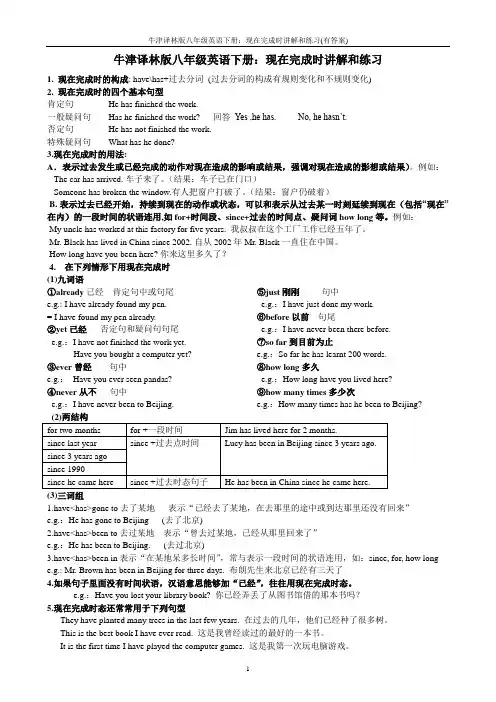
牛津译林版八年级英语下册:现在完成时讲解和练习1. 现在完成时的构成: have\has+过去分词(过去分词的构成有规则变化和不规则变化)2. 现在完成时的四个基本句型肯定句He has finished the work.一般疑问句Has he finished the work? 回答Yes ,he has. No, he hasn’t.否定句He has not finished the work.特殊疑问句What has he done?3.现在完成时的用法:A.表示过去发生或已经完成的动作对现在造成的影响或结果,强调对现在造成的影想或结果)。
例如:The car has arrived. 车子来了。
(结果:车子已在门口)Someone has broken the window.有人把窗户打破了。
(结果:窗户仍破着)B. 表示过去已经开始,持续到现在的动作或状态,可以和表示从过去某一时刻延续到现在(包括“现在”在内)的一段时间的状语连用,如for+时间段、since+过去的时间点、疑问词how long等。
例如:My uncle has worked at this factory for five years. 我叔叔在这个工厂工作已经五年了。
Mr. Black has lived in China since 2002. 自从2002年Mr. Black 一直住在中国。
How long have you been here? 你来这里多久了?4. 在下列情形下用现在完成时(1)九词语①already已经肯定句中或句尾e.g.: I have already found my pen.= I have found my pen already.②yet已经否定句和疑问句句尾e.g.:I have not finished the work yet.Have you bought a computer yet?③ever曾经句中e.g.:Have you ever seen pandas?④never从不句中e.g.:I have never been to Beijing. ⑤just刚刚句中e.g.:I have just done my work.⑥before以前句尾e.g.:I have never been there before.⑦so far到目前为止e.g.:So far he has learnt 200 words.⑧how long多久e.g.:How long have you lived here?⑨how many times多少次e.g.:How many times has he been to Beijing?(3)三词组1.have<has>gone to去了某地表示“已经去了某地,在去那里的途中或到达那里还没有回来”e.g.:He has gone to Beijing (去了北京)2.have<has>been to去过某地表示“曾去过某地,已经从那里回来了”e.g.:He has been to Beijing. (去过北京)3.have<has>been in 表示“在某地呆多长时间”,常与表示一段时间的状语连用,如:since, for, how longe.g.: Mr. Brown has been in Beijing for three days. 布朗先生来北京已经有三天了4.如果句子里面没有时间状语,汉语意思能够加“已经”,往往用现在完成时态。
Unit1-Unit3语法现在完成时讲义牛津译林版八年级英语下册

牛津译林版8B Unit 1 Unit 3 语法现在完成时讲义一、现在完成时的定义1.现在完成时表示从过去持续到现在的动作或状态;2.表示已经完成但是对现在有一定影响的动作;3.用来表示迄今为止动作发生的次数。
二、现在完成时的句式1.肯定句:主语+ have/has + 动词的过去分词+ 其他.2.否定句:主语+ have/has + not + 动词的过去分词+ 其他.3.一般疑问句:Have/Has + 主语+ 动词的过去分词+ 其他?肯定回答:Yes, 主语+ have/has.否定回答:No, 主语+ haven’t/hasn’t.4.特殊疑问句:特殊疑问词+ have/has + 主语+ 动词的过去分词+ 其他?三、现在完成时的用法1.表示从过去某一时间开始一直延续到现在,也有可能继续进行下去的动作或状态。
→和表示一段时间的状语连用。
Eg:for + 一段时间;since + 时间点。
2.表示过去某个动作对现在产生的影响或结果。
3.表示过去发生的动作到现在为止发生的次数。
→和表示次数的词连用。
Eg:once,twice,three times...四、现在完成时的时间状语1.already:“已经”,常用于肯定句,通常置于have/has与过去分词中间,有时也置于句末。
2.yet:“仍,还”,常用于否定句和疑问句,通常置于句末。
3.ever:“曾经”,用于疑问句,通常置于have/has与过去分词中间。
4.never:“未曾,从未”,用于否定句,通常置于have/has与过去分词中间。
5.recently:“最近”,可以用于肯定句、否定句和疑问句中,通常置于句末。
6.just:“刚刚”。
→注意:区别just now“刚才”(用于一般过去时)。
7.so far:“迄今为止”。
8.for + 一段时间:“长达……”。
9.since + 过去的时间点/一般过去时/一段时间+ago:“自从……以来”。
牛津译林版英语八年级下册 Unit1 Grammar:现在完成时概括讲解及巩固提高训练
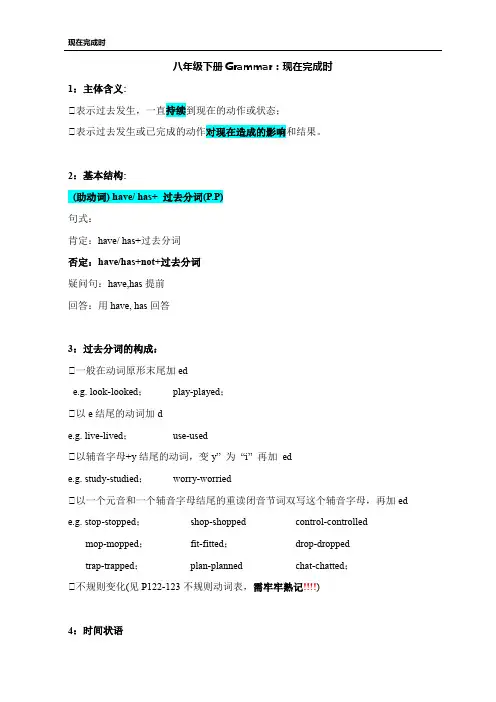
八年级下册Grammar:现在完成时1:主体含义:①表示过去发生,一直持续到现在的动作或状态;①表示过去发生或已完成的动作对现在造成的影响和结果。
2:基本结构:(助动词) have/ has+ 过去分词(P.P)句式:肯定:have/ has+过去分词否定:have/has+not+过去分词疑问句:have,has提前回答:用have, has回答3:过去分词的构成:①一般在动词原形末尾加ede.g. look-looked;play-played;①以e结尾的动词加de.g. live-lived;use-used①以辅音字母+y结尾的动词,变y” 为“i” 再加ede.g. study-studied;worry-worried①以一个元音和一个辅音字母结尾的重读闭音节词双写这个辅音字母,再加ede.g. stop-stopped;shop-shopped control-controlledmop-mopped;fit-fitted;drop-droppedtrap-trapped;plan-planned chat-chatted;①不规则变化(见P122-123不规则动词表,需牢牢熟记!!!!)4:时间状语①already(肯定句句中或句末,“已经”)yet (否定句/疑问句,“还没有、已经”)ever (疑问句,“曾经”)never(否定句,“从不”)just(肯定句,“刚刚”)recently(肯定句/否定句/疑问句,“最近”)over the years(在这些年)*so far(迄今为止)=by now=till now=up to now (到目前为止)before (以前)once /twice / many times/How many times+问句*over /in/during the last /past....... years/days(在过去的...年/天中)①和表示从过去某一时刻延续到现在的一段时间的状语连用。
牛津译林版英语八下_Units 1-3 现在完成时语法讲解和练习
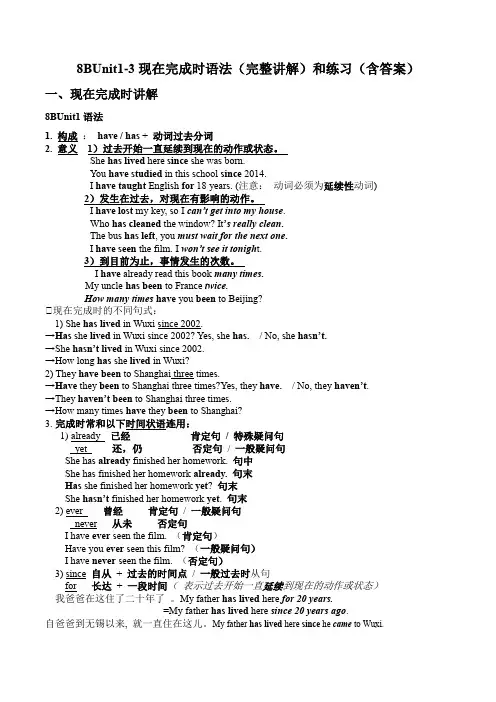
8BUnit1-3现在完成时语法(完整讲解)和练习(含答案)一、现在完成时讲解8BUnit1语法1. 构成:have / has + 动词过去分词2. 意义1)过去开始一直延续到现在的动作或状态。
She has lived here since she was born.You have studied in this school since 2014.I have taught English for 18 years. (注意:动词必须为延续性动词)2)发生在过去,对现在有影响的动作。
I have lost my key, so I can’t get into my house.Who has cleaned the window? It’s really clean.The bus has left, you must wait for the next one.I have seen the film. I won’t see it tonigh t.3)到目前为止,事情发生的次数。
I have already read this book many times.My uncle has been to France twice.How many times have you been to Beijing?★现在完成时的不同句式:1) She has lived in Wuxi since 2002.→Has she lived in Wuxi since 2002? Yes, she has./ No, she hasn’t.→She hasn’t lived in Wuxi since 2002.→How long has she lived in Wuxi?2) They have been to Shanghai three times.→Have they been to Shanghai three times?Yes, they have./ No, they haven’t.→They haven’t been to Shanghai three times.→How many times have they been to Shanghai?3.完成时常和以下时间状语连用:1)already 已经肯定句/ 特殊疑问句yet 还,仍否定句/ 一般疑问句She has already finished her homework. 句中She has finished her homework already.句末Has she finished her homework yet? 句末She hasn’t finished her homework yet. 句末2) ever 曾经肯定句/ 一般疑问句never 从未否定句I have ever seen the film. (肯定句)Have you ever seen this film? (一般疑问句)I have never seen the film. (否定句)3) since 自从+ 过去的时间点/ 一般过去时从句for 长达+ 一段时间(表示过去开始一直延续到现在的动作或状态)我爸爸在这住了二十年了。
译林版英语八年级下册第一单元现在完成时讲解及练习
译林版英语八年级下册第一单元现在完成时讲解及练习8B Unit 1Past and Present(第一课时)Grammar I )研究目的】初步认识和了解现在完成时的构成和用法。
课前准备】一、查字典,写出下列单词的意思,并且熟记他们。
(★★★)1、already _____________2、yet ________________3、just ___________________4、ever _________________5、never _____________6、before _________________7、since three years ago _______________8、for three years ______________二、写出下列动词的过去式和过去分词,同时也要熟记。
1、teach_______ ________2、bring _______ ________3、get _______ ________t4、know _______ ________5、grow_______ ________6、find_______ ________7、hold _______ ________8、show_______ ________9、keep_______ ________10、leave_______ ________11、lose_______ ________12、run_______ ________13、swim_______ ________14、drive_______ ________ 15、begin_______ ________三、尝试着阅读下面的知识链接,看看是否可以理解。
知识链接】现在完成时的“完成用法”和“未完成用法”一、现在完成时的结构:助动词have / has +动词的过去分词( Past Participle )其中have / has为助动词,因而它的否定和疑问句形式全部由have / has进行变化。
牛津译林英语八年级下册全册语法复习
牛津译林英语八年级下册全册语法复习牛津译林英语八年级下册全册语法复8B Unit1现在完成时的用法现在完成时有三种用法:1.表示过去发生的动作和现在有联系,即该动作对现在有影响。
例如:Have you had your lunch。
你吃过午饭了吗?Yes。
I have。
I've just had it。
是的,我吃了,我刚吃过。
(现在我不饿了)I have already posted those photos。
我已经邮寄了那些照片。
(那些照片现在已不在我这里了)2.表示从过去某一时间开始一直持续到现在(包括“现在”在内)的动作,并且表示一段时间的状语连用,谓语动词多用延续性动词。
例如:I've known him for 3 years。
我认识他已经3年了。
They have lived here since 1996.自从1996年以来他们一直住在这里。
3.表示到现在为止多次发生的动作。
例如:XXX twice。
这部电影他已经看过两遍了。
My XXX has told me the story several times。
我爷爷已经把这个故事给我讲了好几遍。
现在完成时的构成现在完成时的构成为:肯定句:主语 + have/has + 动词的过去分词 + 其他。
否定句:主语 XXX 动词的过去分词 + 其他。
一般疑问句:Have/Has + 主语+ 动词的过去分词+ 其他?肯定回答:Yes,主语 + have/has。
否定回答:No,主语 + XXX't。
需要注意的是,主语是第三人称单数时用has,其他人称用have。
例如:XXX has heard from his XXX。
XXX这个月已收到了他爸爸的两次来信。
We have already cleaned our classroom。
我们已经打扫了教室。
现在完成时的标志词现在完成时的标志词包括:already,yet,ever,recently,just,before(用于句末),so far,for + 一段时间,since + 过去时间或一般过去时的句子。
现在完成时课件2022-2023学年牛津译林版八年级英语下册
4 综合练习
定义及结构
past
now
Yesterday , we cleaned the classroom.
Now , the classroom is clean because we have cleaned it.
用法1 强调过去发生的动作对现在产生的结果或影响
in the past/last few years 在最近的几年里
just 刚刚
twice
so far
/其他倍数
到目前为止 两次、几次
练一练
根据句意填空: 1. I have __a__lr_e__a_d_y__/_ju__s_t___ finished my homework. 2. He has not begun to work _y_e_t__. 3. I have __ju__s_t_ finished my lunch. 4. Have you _e_v_e__r been to the park? No, n__e_v_e__r. 5. Have you seen the movie _y_e_t__? 6. She has learned 3000 English words _s_o__f_a__r_.
不规则变化的动词过去式和过去分词
原形
过去式
过去分词
become take lie(躺) sleep
lay(放) put cost ...
became took lay slept
laid put cost
become taken lain slept
laid put cost
类型 ABA ABC ABC ABB ABB AAA AAA
牛津译林初中英语八年级下unit1 语法现在完成时
7. — Eddie, _h_a_v_e_ you _s_e_e_n_ my food? — Yes, I_’v_e_ just _e_a_te_n_ it. — What? You_’v_e__e_a_te_n_ my food? Why?
现在完成时的构成 1. 现在完成时的肯定句句型
主语(第一, 二人称单, 复数)+ have
(第三人称复数)
+ have + 过去
(第三人称单数)
+ has 分词
e.g. I have finished my homework. He has written six poems. They have seen that film.
过去分词的构成
规则动词的过去分词的构成 1. 大多数的动词的过去分词是规则的,只
需在动词后加-ed;例如: 2. work→worked listen→listened
jump→jumped visit→visited 3. 2.在以-e结尾的动词后只加-d;例如:
close→closed like→liked agree→agreed move→moved
2. 现在完成时的否定句句型 主语 + have / has + not + 过去分词 + ……
e.g. I have not seen the movie yet. He hasn’t come here yet. hasn’t = has not haven’t = have not
3. 现在完成时的一般疑问句句型