
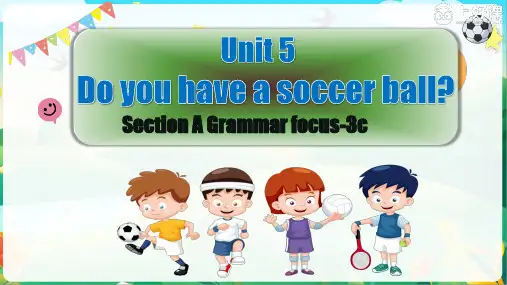
新人教版七年级英语上 Unit5 Section A Grammar Focus-3c
Drill
A: Does she have a TV ? an apple?
B: Yes, she does. B: No, she doesn’t.
Drill
a basketball ? A: Does he have a soccer ball? he does. No, he doesn’t. B: Yes,
conversations with your partner. 用do或does填空,然后与
Does A: ______ John have a soccer ball? Do A: ______ you have B: No, he ______. doesn't a baseball? A: ______ he have a Does do ping-pong bat? B: Yes, I ______. does A: Great! I have a B: Yes, he ______. I think he has a pingbat. Let's play! pong ball, too. A: Hmm…let's ask.
A: ______ your friends have a basketball? B: Yes, they ______. They have two basketballs A: Well, let's play basketball. B: That sounds good.
3b
Fill in the blanks with do or does. Then practice the 同伴练习对话。
A: ______ your friends have a basketball? B: Yes, they ______. They have two basketballs A: Well, let's play basketball. B: That sounds good.
3b
Fill in the blanks with do or does. Then practice the 同伴练习对话。
新人教版七年级英语上册
Unit 5
Do you have a soccer ball? Section A Grammar Focus-3c
by Yang Hongguo Luoxi Middle School
Revise
Lead-in
Do you have a soccer ball?
Yes, I do.
don't = do not doesn’t = does not
Have have, I have . Have have, you have . Yes,Yes, I do . No,No, I don’t !
Has has , he has . Has has ,she has . Has has, he has. Has has, she has. Yes, Yes, he does. Yes, Yes, she does. No, No, he doesn’t. No, No, she doesn’t.
3b
Fill in the blanks with do or does. Then practice the 同伴练习对话。
conversations with your partner. 用do或does填空,然后与
A: ______ John have a soccer ball? A: ______ you have B: No, he ______. a baseball? A: ______ he have a ping-pong bat? B: Yes, I ______. A: Great! I have a B: Yes, he ______. I think he has a pingbat. Let's play! pong ball, too. A: Hmm…let's ask.
conversations with your partner. 用do或does填空,然后与
Does A: ______ John have a soccer ball? Do A: ______ you have B: No, he ______. doesn't a baseball? A: ______ he have a do ping-pong bat? B: Yes, I ______. A: Great! I have a B: Yes, he ______. I think he has a pingbat. Let's play! pong ball, too. A: Hmm…let's ask.
Does she have a tennis Yes, she does. / No, she doesn’t. She ball? has a baseball. Does he have a soccer Yes, he does. / No, he doesn't. He ball? has two ping-pong bats. Do they have a basketball? Yes, they do. / No, they don’t. They have a volleyball.
Write each word in the correct place in the chart. 将 方框中的单词填入表格中正确的位置。
3a
do
does
I we
he she
they it
you Eric
Write each word in the correct place in the chart. 将 方框中的单词填入表格中正确的位置。
A: ______ your friends have a basketball? B: Yes, they ______. They have two basketballs A: Well, let's play basketball. B: That sounds good.
3b
Fill in the blanks with do or does. Then practice the 同伴练习对话。
Lead-in
No,he doesn’t.
Does he have a tennis racket?
Do you have a baseball? Do you have apingpong bat?
Yes, I do. / No, I don't. I have a volleyball. Yes, I do. / No, I don't .I have a ping-gong ball.
conversations with your partner. 用do或does填空,然后与
Does A: ______ John have a soccer ball? Do A: ______ you have B: No, he ______. a baseball? A: ______ he have a do ping-pong bat? B: Yes, I ______. A: Great! I have a B: Yes, he ______. I think he has a pingbat. Let's play! pong ball, too. A: Hmm…let's ask.
A: ______ your friends have a basketball? B: Yes, they ______. They have two basketballs A: Well, let's play basketball. B: That sounds good.
3b
Fill in the blanks with do or does. Then practice the 同伴练习对话。
conversations with your partner. 用do或does填空,然后与
A: ______ John have a soccer ball? Do A: ______ you have B: No, he ______. a baseball? A: ______ he have a ping-pong bat? B: Yes, I ______. A: Great! I have a B: Yes, he ______. I think he has a pingbat. Let's play! pong ball, too. A: Hmm…let's ask.
A: ______ your friends have a basketball? B: Yes, they ______. They have two basketballs A: Well, let's play basketball. B: That sounds good.
3b
Fill in the blanks with do or does. Then practice the 同伴练习对话。
A: ______ your friends have a basketball? B: Yes, they ______. They have two basketballs A: Well, let's play basketball. B: That sounds good.
3b
Fill in the blanks with do or does. Then practice the 同伴练习对话。
A: ______ your friends have a basketball? B: Yes, they ______. They have two basketballs A: Well, let's play basketball. B: That sounds good.
合集下载
Unit5SectionA(GrammarFocus-3c)课件人教版七年级英语上册
Yes, I do./No, I don’t. I have a volleyball.
Do you have a ping-pong bat?
Yes, I do./No, I don’t. I have a ping-pong ball.
Does she have a tennis ball?
Yes, she does./No, she doesn’t. She has a baseball.
Do you
baseball
do
don’t
volleyball
____ ____ have a ______________?
Yes, I __./No, I _____. I have a _________.
do
don’t
ping-pong ball
Do you
ping-pong bat
Do
don’t
Does
does
Does
doesn’t
Do
don’t
读句子, 观察并总结do、does分别在什么时候使用。
have的用法
他有足球吗?
do/does: 助动词, 无实际意义, 只是帮助构成句式
动词have意为: _________ , 表示物品所属关系。
(1) I have a tennis ball.(2) David has eight basketballs.(3) I don't have a baseball.(4) - Do you have a baseball bat? - Yes, I do.(5) - Does he have a football? - No, he doesn't.
Do you have a ping-pong bat?
Yes, I do./No, I don’t. I have a ping-pong ball.
Does she have a tennis ball?
Yes, she does./No, she doesn’t. She has a baseball.
Do you
baseball
do
don’t
volleyball
____ ____ have a ______________?
Yes, I __./No, I _____. I have a _________.
do
don’t
ping-pong ball
Do you
ping-pong bat
Do
don’t
Does
does
Does
doesn’t
Do
don’t
读句子, 观察并总结do、does分别在什么时候使用。
have的用法
他有足球吗?
do/does: 助动词, 无实际意义, 只是帮助构成句式
动词have意为: _________ , 表示物品所属关系。
(1) I have a tennis ball.(2) David has eight basketballs.(3) I don't have a baseball.(4) - Do you have a baseball bat? - Yes, I do.(5) - Does he have a football? - No, he doesn't.
人教版英语七年级上册Unit5 SectionA Grammar Focus课件
You cWanhdaotsathb.out our friJeonindas?club!
Ability
Club
I (can / can') play the guitar/piano/ violin. □the music club
I (can/can't) sing well.
I (can/can't) swim.
Music club Science club Chess club Sport club Art club
Circle can or can’t with your own information and tick the club(s) you want
to join. Then share with us.
Ru□leth1e:sport club
I (can /can't) run fast. I (can/can't) play chess.
We use _c_a_n_ to talk about abilitEy.mma (M□eathneicnhges)s club
I (canI/ccaann't)pplaaiyntmwuelsli.c, so I want toTh□e nthTeeeganargtticvFlueeb(i 否定) form
I can’t swim. She can’t play any musical instruments.
Negative sentence :主语+can’t+动词原形(+其他).
否定句
I can play the guitar, but I can’t play the violin.
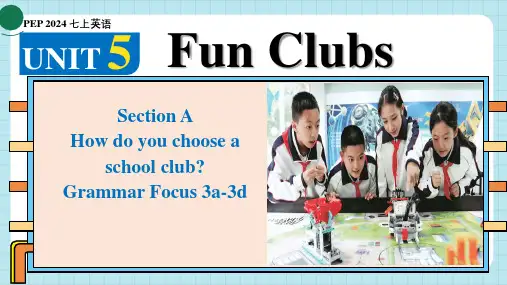
新人教版英语七上Unit 5 Section A Grammar Focus 课件

Warm up
Grammar
Grammar
Grammar
2 情态动词 can 表请求
情态动词 + V(原)
情感态度
没有人__称___和__数__的变化
_Ca_n__F_e_if_ei_ draw with us?
Yes, _s_h_e_c_a_n__.
菲菲可以和我们一起画画吗?
C_a_n__I___ draw with you?
Talk about the abilities according to the pictures.
Grammar
◆ She can ___s_w_i_m______. ◆ Can she __s_w_i_m_______?
✔ ◆ Yes, _s_h_e_c_a_n__. ✘ ◆ No, _sh_e__c_an_’_t__.
Grammar
◆ He can _t_a_k_e_p_h_o_to_s___. ◆ Can he _t_a_k_e_p_h_o_t_o_s__?
✔ ◆ Yes, ___h_e_c_a_n_. ✘ ◆ No, __h_e_c_a_n_’t__.
Warm up
Grammar
Grammar
Talk about the abilities according to the pictures.
I can run fast, but I can’t swim.
Emma can sing well, but she can’t play any musical instrument.
✎ can 后的动词形式有何特点? 没有变化,原形
✎ can 随人称变化而变化吗?
不随人称而变化
人教版七年级英语上册 Unit 5 Section A(Grammar Focus-3c)课件
have
情景导入
Ask and answer
A: Do you have a basketball? B: Yes, I do. / No, I don’t.
A: Does she have a soccer ball? B: Yes, she does. / No, she doesn’t.
Read Grammar Focus and complete these sentences.
2) have/has句子的一般疑问句是在句首加助动词 do或does,句尾用问号构成。除第三人称单数前用 does外,其他都用do。第三人称单数前加does后, 句中的谓语动词has应改为have。作简略回答时, 肯定回答为:“Yes, 主语 + do/does.” ,否定 回答为:“No, 主语 + don’t/doesn’t. ” 。
(篮球)
with
Mike
and
7. Don’t bleat_e____ (迟到) again, Sun Wei. 8. Ms Sun is gare_a_t_____ (伟大的) teacher. 9. My sister alwapylsay_s_____ (玩耍) with
our lovely cat. 10. There are (有) twovonlelwey_b_a_l_l_s_____ (排球)
语法自查
自学互研
句型转换,每空一词。 1.Lily has a white schoolbag.(改为一般问句) _D_o_e_s Lilyh_a_v_e_ a schoolbag? 2.I have some photos.(对画线部分提问) _W_h_a_t ____doyou have? 3.Does he have a sister?(作否定回答) _N_o__,__h_e_ ______.He has a brother. 4.We hdavoessno’met new books.(用she改写句子) __S_h_e ____ some new books. 5.haTshey have an English friend.(改为否定句) They d_o_n_’_ t____ an English friend.
情景导入
Ask and answer
A: Do you have a basketball? B: Yes, I do. / No, I don’t.
A: Does she have a soccer ball? B: Yes, she does. / No, she doesn’t.
Read Grammar Focus and complete these sentences.
2) have/has句子的一般疑问句是在句首加助动词 do或does,句尾用问号构成。除第三人称单数前用 does外,其他都用do。第三人称单数前加does后, 句中的谓语动词has应改为have。作简略回答时, 肯定回答为:“Yes, 主语 + do/does.” ,否定 回答为:“No, 主语 + don’t/doesn’t. ” 。
(篮球)
with
Mike
and
7. Don’t bleat_e____ (迟到) again, Sun Wei. 8. Ms Sun is gare_a_t_____ (伟大的) teacher. 9. My sister alwapylsay_s_____ (玩耍) with
our lovely cat. 10. There are (有) twovonlelwey_b_a_l_l_s_____ (排球)
语法自查
自学互研
句型转换,每空一词。 1.Lily has a white schoolbag.(改为一般问句) _D_o_e_s Lilyh_a_v_e_ a schoolbag? 2.I have some photos.(对画线部分提问) _W_h_a_t ____doyou have? 3.Does he have a sister?(作否定回答) _N_o__,__h_e_ ______.He has a brother. 4.We hdavoessno’met new books.(用she改写句子) __S_h_e ____ some new books. 5.haTshey have an English friend.(改为否定句) They d_o_n_’_ t____ an English friend.
Unit 5 Section A Grammar Focus七年级英语上册课件(人教版新目标)
我有一个网球。
大卫有八个篮球。
我没有棒球。
有,拥有
你有棒球拍吗?
在肯定句式中,当主语是第三人称单数时,动词用单三形式(has)。
否定式(don't = do not)
疑问句句式
是的,我有。
不,他没有。
肯定回答: Yes, 主语 + do/does.否定回答: No, 主语 + don't/doesn't.
New words
greatplaysound
adj. 美妙的;伟大的v. 参加(比赛或运动);玩耍v.听起来好像
Do you have a baseball?
Yes, I do./No, I don’t. I have a volleyball.
Do you have a ping-pong bat?
主语+doesn't have+其他.
一般疑问句结构及答语
—Do+主语+have+其他?—Yes, 主语+do./No, 主语+don't.
—Does+主语+have+其他?—Yes, 主语+does./No, 主语+doesn't.
用have / has填空。1.A dog _____ four legs. A bird ____ two legs.2.Our school _____ a library.3.We ____ 37 chairs in our classroom.4.My sister ____ a nice toy car.5. --- Do Tom and his brother _____ a big bedroom? --- Yes, they do.
She doesn’t have a volleyball.
大卫有八个篮球。
我没有棒球。
有,拥有
你有棒球拍吗?
在肯定句式中,当主语是第三人称单数时,动词用单三形式(has)。
否定式(don't = do not)
疑问句句式
是的,我有。
不,他没有。
肯定回答: Yes, 主语 + do/does.否定回答: No, 主语 + don't/doesn't.
New words
greatplaysound
adj. 美妙的;伟大的v. 参加(比赛或运动);玩耍v.听起来好像
Do you have a baseball?
Yes, I do./No, I don’t. I have a volleyball.
Do you have a ping-pong bat?
主语+doesn't have+其他.
一般疑问句结构及答语
—Do+主语+have+其他?—Yes, 主语+do./No, 主语+don't.
—Does+主语+have+其他?—Yes, 主语+does./No, 主语+doesn't.
用have / has填空。1.A dog _____ four legs. A bird ____ two legs.2.Our school _____ a library.3.We ____ 37 chairs in our classroom.4.My sister ____ a nice toy car.5. --- Do Tom and his brother _____ a big bedroom? --- Yes, they do.
She doesn’t have a volleyball.
Unit5SectionA(GrammarFocus-3c)课件人教版英语七年级上册

football橄榄球
Grammar Focus When do we use do/does?
Do I/we have a baseball? Yes, you/we do./No, you/we don’t. Do you have a baseball? Yes, I do./No, I don’t.I have a ping-pong ball.
Do you have a ping-pong Yes, we do./No, we don’t. We have a ping-
bat?
pong ball.
Does she have a tennis Yes, she does./No, she doesn’t. She has a
ball?
baseball.
1)第一、第二人称单复数,以及第三人称复数作主语时,用do
构成一般疑问句,回答用do或don’t.
2)第三人称单数作主语时,用does构成一般疑问句,回答用does
或doesn’t
Grammar Focus When do we use have/has?
Do I/we have a baseball? Yes, you/we do./No, you/we don’t. Do you have a baseball? Yes, I do./No, I don’t.I have a ping-pong ball.
3c Let’s play a game.小游戏
A: Does he have a soccer ball? B: Yes, he does./ No, he doesn’t.
volleyball basketball baseball bat baseball eraser tape player jacket hat picture dictionary
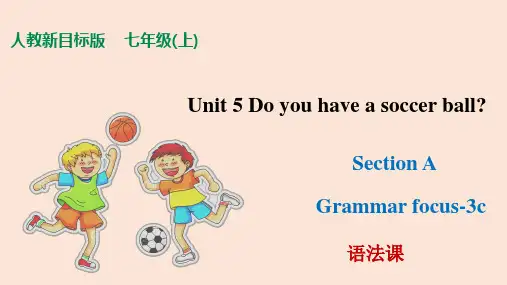
初中英语人教版七年级上册《Unit5 SectionA(Grammar Focus-3c)》课件
Do you have Yes, I do. No, I don’t. a basketball? I have a … I don’t have a…
Thank you!
You’re welcome.
Goodbye!
Task2
2.及物动词,意为“打;踢”p__la_y__,其后接表示球类运动 的名词时,结构为_p_l_a_y_+_球___。 及物动词,意为“弹奏”,其后接表示乐器的名词时,结 构为_p_l_a_y_+_t_h_e_+_乐__器__。 不及物动词,意为“玩耍”,常用短语:和某人一起玩 __p_la_y__w_i_th__s_b.; 玩某物__p_la_y__w_i_th__s_th_.__。
句式转换 He have a soccer ball.
否定句:H__e_d_o_e_s_n_’_t_h_a_v_e__a_s_o_c_c_e_r_b_a_l.l 一样疑问句:D_o_e_s_h_e__h_a_v_e_a__s_o_cc_e_r__b_a_ll?
肯定回答:Y__es_,_h_e__d_o_e_s.
A: __D_o_ your friends have a basketball? B: Yes, they _d_o__. They have two basketballs. A: Well, let’s play basketball. B: That sounds good.
Remember the things in Bob’s room. Then close your books and ask and answer questions with a partner.
_Y__es____, __t_h_e_y__ _d__o_. 4. Does Mr. Smith have a brother? (作否定回答)
2024年人教版七年级英语上册 Unit 5 Grammar Focus (3a-3d)-(课件)
Emma
能够
Ability能力
A Shool Show
疑问 否定 句 句
肯定 句
Ability 能力
I he she you it they we
Can Can Could Yes, No,
Key Structure
can can could
dance.
dance?
can/cocuanld. . can’t/ccaonu’ltd. n’t.
Emma Mary Peter
A Shool Show
Find something wrong.
In our club, Oliver and Mary can ssiinnggs. Mary can dance, abnudt she can’t dance very well. Lisa can dance well, but she ccaann’ptlpaylayanaynymmusuicsaiclailsnistnrutrmumenetns.tsC. aCnan Peter ppllaayys the guitar? Yes, he can, but Alice can’t. Alice can do Chinese kung fu. It’s so cool!
No,he can’t.
He _c_a_n_’t do kung fu. _B_u_t he _cg_au_nz_hp_el_na_gy_at_hn_ed_ the violin.
Yes, she can.
She _c_a_n_d_o__k_u_n_g_f_u_. Bg_uu_zt_hs_eh_ne_g_coa_rn_’_t_p_l_ay__t_he_ the violin.
人教版七年级英语上册Unit5第三课时SectionA Grammar Focus—3d课件
Unit 5 Fun Clubs
第三课时 Section A Grammar Focus—3d
基础过关练
Ⅰ.用所给词的适当形式填空 1.(新独家原创)Mike is from France and he can speak French (France). 2.—I'd like to go climbing (climb) this afternoon. Would you
B:Because I like singing very much. A:18. Can you sing ? B:Yes, I can. I often sing when I'm free. A:How many songs can you sing? B:About 30. What club do you want to join? 19. How about the dancing club ? A:That sounds boring. In fact, I don't like dancing. I like playing chess.
10.The girl can dance. (对画线部分提问) What can the girldo ?
Ⅲ.根据汉语意思完成句子,每空一词 11.(人与自我·学校生活)在我们班,百分之十五的学生会下国 际象棋。 In our class, fifteen percent of the students can play chess . 12.李伟会打乒乓球吗? Can Li Wei play ping-pong? 13.那个男孩不会游泳,但他想加入游泳社团。 The boy can’t swim , but he wants to join the swimming club.
第三课时 Section A Grammar Focus—3d
基础过关练
Ⅰ.用所给词的适当形式填空 1.(新独家原创)Mike is from France and he can speak French (France). 2.—I'd like to go climbing (climb) this afternoon. Would you
B:Because I like singing very much. A:18. Can you sing ? B:Yes, I can. I often sing when I'm free. A:How many songs can you sing? B:About 30. What club do you want to join? 19. How about the dancing club ? A:That sounds boring. In fact, I don't like dancing. I like playing chess.
10.The girl can dance. (对画线部分提问) What can the girldo ?
Ⅲ.根据汉语意思完成句子,每空一词 11.(人与自我·学校生活)在我们班,百分之十五的学生会下国 际象棋。 In our class, fifteen percent of the students can play chess . 12.李伟会打乒乓球吗? Can Li Wei play ping-pong? 13.那个男孩不会游泳,但他想加入游泳社团。 The boy can’t swim , but he wants to join the swimming club.
人教版英语七年级上册Unit5SectionA(GrammarFocus~3c)教学设计
4.教师创设情境,示范一般现在时的句子,让学生跟读、模仿,提高口语表达能力。
(三)学生小组讨论(500字)
1.教师将学生分成小组,每组讨论一个话题,如:“My daily routine”或“Hobbies and interests”。
2.小组内成员用一般现在时互相提问、回答,描述自己和组员的日常习惯和兴趣爱好。
b.针对预习过程中置要求:
1.学生应在规定时间内独立完成作业,确保作业质量。
2.家长应督促孩子按时完成作业,关注孩子的学习进度,积极配合教师的教学工作。
3.教师应及时批改作业,给予评价和反馈,关注学生的进步和不足之处,以便在后续教学中进行有针对性的指导。
人教版英语七年级上册Unit5SectionA(GrammarFocus~3c)教学设计
一、教学目标
(一)知识与技能
1.学生能够理解并掌握本节课所学的语法知识点,包括一般现在时的肯定句、否定句以及一般疑问句的构成及用法。
2.学生能够运用所学词汇(如: do, does, don't, doesn't, what, how, always, sometimes, often, usually, never等)和句型描述自己和他人日常习惯和行为,并能用一般现在时进行正确的提问和回答。
2.词汇运用:本节课涉及的词汇(如: do, does, don't, doesn't, what, how, always, sometimes, often, usually, never等)在实际语境中的运用是教学的另一个重点,学生需要学会如何将这些词汇融入日常交流中。
3.口语表达:提高学生使用一般现在时进行口语表达的能力,使其能够流畅、准确地描述自己和他人日常习惯和行为。
(三)学生小组讨论(500字)
1.教师将学生分成小组,每组讨论一个话题,如:“My daily routine”或“Hobbies and interests”。
2.小组内成员用一般现在时互相提问、回答,描述自己和组员的日常习惯和兴趣爱好。
b.针对预习过程中置要求:
1.学生应在规定时间内独立完成作业,确保作业质量。
2.家长应督促孩子按时完成作业,关注孩子的学习进度,积极配合教师的教学工作。
3.教师应及时批改作业,给予评价和反馈,关注学生的进步和不足之处,以便在后续教学中进行有针对性的指导。
人教版英语七年级上册Unit5SectionA(GrammarFocus~3c)教学设计
一、教学目标
(一)知识与技能
1.学生能够理解并掌握本节课所学的语法知识点,包括一般现在时的肯定句、否定句以及一般疑问句的构成及用法。
2.学生能够运用所学词汇(如: do, does, don't, doesn't, what, how, always, sometimes, often, usually, never等)和句型描述自己和他人日常习惯和行为,并能用一般现在时进行正确的提问和回答。
2.词汇运用:本节课涉及的词汇(如: do, does, don't, doesn't, what, how, always, sometimes, often, usually, never等)在实际语境中的运用是教学的另一个重点,学生需要学会如何将这些词汇融入日常交流中。
3.口语表达:提高学生使用一般现在时进行口语表达的能力,使其能够流畅、准确地描述自己和他人日常习惯和行为。