
初二英语上册(外研版)Module 4 Planes, ships and trains 知识点总结
初二英语上册(外研版)Module 4 Planes, ships and trains知识点总结一、重点词汇accident·原文再现There was a road accident…路上出了交通事故…·基本用法accident n. 交通事故;意外事件。
如:The accident is so terrible.这起交通事故真可怕。
·知识拓展--相关短语by accident 意为“偶然”。
如:I only found it by accident.我只是碰巧找到的。
except·原文再现But nobody was late, except me.但除了我,没有别人迟到。
·基本用法except prep. 除…之外,可用于句首。
Everyone went to the movies except me.除我以外,大家都去看了电影。
·知识拓展--词义辨析:besides/except/except for这三个介词或者短语都可以表示“除了…”的意思,区别如下:1. except仅表示“除了…”,排除在外。
She can do everything except cook.除了做饭之外她什么都会。
He had considered everything except the weather.他什么都想过,唯独没考虑到天气。
2. besides表示“除了…还有…”的意思,表示包含在内。
Besides milk and cheese, we need vegetables.除了牛奶和干酪外,我们还需要蔬菜。
Besides football, I like playing basketball and table tennis.除了足球以外,我还喜欢打篮球和乒乓球。
3. except for表示“除了…”,except for后接的词同句子中的整体词(主语)不是同类的,指从整体中除去一个细节,一个方面;而except后接的词同整体词(主语)一般是同类,指在同类的整体中除去一个部分。
Except for one old lady, the bus was empty.公共汽车上要不是坐了一位老太太就是空的。
choice·原文再现That's a good choice, but it's a bit dangerous.那是好的选择,但是有点儿危险。
·基本用法choice n. 选择,挑选,have no choice but to...意为:别无选择,只能....He had no choice but to take the job.他别无选择,只得接受那项工作。
·知识拓展--相关单词choose v. 选择He will choose banking as his career.他将选择银行业做为职业。
classmate·原文再现But most of my classmates ride bikes, and it's quite safe.但是我很多同学骑自行车,而且也非常安全。
·基本用法classmate n. 同班同学He is my classmate of junior middle school.他是我初中时的同班同学。
far from·原文再现He lives the farthest from school, so he takes the underground.他住的离学校最远,因此他坐地铁去。
·基本用法far from 意为“远离…”,其后可接表示地点的名词、代词或副词,强调距离之长。
The bus stop is not far from the hospital.公共汽车站离医院很近。
close·原文再现Her home is the closest to school, so she walks.她家离学校最近,所以她走路。
·基本用法close adj. 紧密的,亲近的 be/get close to意为:接近...Don't get close to the burning building, or you'll get hurt.不要靠近起火的大楼,否则你会受伤的。
close adv. 接近地 close to 意为:挨近...Peter lives close to our school.彼得住在学校附近。
crowded·原文再现But it's so crowded!但是太挤了!·基本用法crowded adj. 拥挤的be crowded with... 意为:挤满...He jumped on the crowded bus.他跳上了拥挤的公共汽车。
The room was crowded with guests.房间里挤满了客人。
·知识拓展--相关单词crowd n. 人群She pushed her way through the big crowd.她挤着穿过了那一大堆人群。
all the time·原文再现You can ride your bike to school, but remember to be careful all the time.你可以骑自行车去学校,但记得要一直小心。
·基本用法all the time 一直,总是I have been busy all the time.我一直很忙。
You can't be with your baby all the time.你不能总守在你的宝宝身边。
journey·原文再现How long does the journey take and what is the best way to travel?旅程花费多长时间,最佳旅行方式是什么?·基本用法1. journey n. 旅行;旅程The journey was not as nice as we had expected.旅途不像我们预想的那样好。
2. journey v. 旅行He wished to journey round the world.他希望周游世界。
·知识拓展--词义辨析:journey/tour/travel/trip/voyage1. journey指从一地到另一地,通常指陆地上的远距离“旅行”,有时也可以表示经常走的或长或短的“路程”。
I took a journey from Beijing to Shanghai last year.我去年从北京到上海旅行。
2. voyage主要指远距离的水上旅行,也可以指空中旅行,意思为“航海、航空、航行”等。
She usually gets seasick during the voyage.她通常在海上会晕船。
3. trip 一般指时间短、距离近的“旅行、远足”,也可以指长途旅行。
在非正式用语中可代替journey。
只作名词。
I will be on a trip to / journey to the south next summer holiday.明年暑假我将去南方旅行。
4. tour 着重指旅行线路比较曲折,常表示“(周游各地的)参观、访问、(巡回)旅游、视察、购物、演出”等意思。
可作动词和名词。
I will tour the world in the future.将来我要环游世界。
5. travel作“旅行、游历”解,一般表示从一地到另一地旅行这一总的概念。
At present, many people are fond of travel in their spare time.现在,很多人喜欢空余时间去旅行。
book·原文再现Book your ticket before you book your hotel.在订旅馆前订票。
·基本用法1. book v. 预定(过去式: booked 过去分词: booked 现在分词: booking 第三人称单数: books)I'll book you on a direct flight to London.我将为你预订直飞伦敦的航班。
2. book n. 书,其复数形式为:books。
park·原文再现Remember that parking in Amsterdam is very expensive…记住在阿姆斯特丹停车收费是很贵的…·基本用法1. park v. 停放(车);泊(车)(过去式:parked 过去分词:parked 现在分词:parking 第三人称单数:parks)You are not allowed to park here.此处不准停车。
2. park n. 公园outside·原文再现…so stay outside the city centre……因此停留在远离市中心的地方…·基本用法1. outside prep. 在…之外I find this purse in the street outside my house.我在我的房屋外边的街上发现了这个钱包。
2. outside adv. 在外面He stood outside the whole night.他在外面站了一整夜。
3. outside n. 外面The outside of it looks all right.它的外观还可以。
4. outside adj. 外部的You must protect yourself from outside threats.您必须保护自己免受外部的威胁。
·知识拓展--反义词inside 里面的;在里面however·原文再现However, it will not cost as much as going by train.然而,它的花费不如坐火车多。
·基本用法however adv. 然而;可是,其用法如下:1. 表示转折,尤其用于谈及一个既成事实时,表示转折,其意为“可是”“仍然”等。
可放在句首、句中或句末,通常用逗号与句子其他成分隔开。
如:My father, however, did not agree.但是,我父亲不同意。
My room is small; however, it’s comfortable.我的房间很小,但却很舒服。
2013新版外研社八年级上英语(初二上)module4planes,shipsand trains课文含课后作业

Module 4 Planes , ships and trainsUnit 1 He lives the farthest from school.Betty: I was late for school today.Mum: Why ? What happened ?Betty: I took the bus. There was a road accident, and the traffic was very heavy. But nobody was late, except me. Maybe I should go to school by taxi.Mum: It’s the most comfortable way, but it’s also the most expensive.Betty: Then what about going by bike ?Mum: That’s a good choice, but it’s a bit dangerous. There’s so much traffic.Betty: But most of my classmates ride bikes, and it’s quite safe. Don’t worry. I’ll be careful.Mum: How does Tony go to school ?Betty: He lives the farthest from school, so he takes the underground.Mum: And what about Lingling?Betty: Her home is the closest to school, so she walks.Mum: How about Daming ?Betty: He goes by bus too, the same as me. But its so crowded! And the traffic is heavy.Mum: All right. You can ride your bike to school, but remember to be careful all the time.Now complete the table.Betty Tony Lingling Daming ways to go toschoolComplete the sentences with the correct form of the words in the box. close comfortable good for1.Lingling lives the _______ to school, so she always walks.2.The ______ way to go to school is by taxi.3.Tony lives the __________ from school.4.For Betty, going to school by bike is the ________ choice.Complete the sentences with the words or expression in the box.1.All the students take the bus to school _________ Sam.2.The ______ train in the world is Shanghai airport train.3.I saw a(n) _______ on my way to school yesterday.4.I do not take the bus to school because it is usually very _________.Read the passage and number the ways of travelling from the most expensive to the least expensive.Question : What is the best way to travel from London to Amsterdam?I am planning to travel from London to Amsterdam. How long does the journey take and what is the best way to travel? Could you please tell me about the trains or ships to get there ? The more information ,the better . Thanks.Best answer: There are four ways to travel.A journey by train is more relaxing than by coach, but a lot more expensive. When you go by train, buy your ticket a long time before you travel. It is usually cheaper.You can go by car and by ship across the North Sea. This is the most comfortable way to travel but also the most expensive . Book your ticket before you book your hotel. Remember that parking in Amsterdam is very expensive, so stay outside the city centre and travel in by bus or by train.The third choice is by coach. This is usually the cheapest , but in summer the coaches sometimes get crowded! And it takes you about twelve hours to get there. However , it will not cost as much as going by train.Finally , you can fly. It is the fastest and the second cheapest , but you may have to wait for hours at the airport because of bad weather.Well , I hope this helps! Have a great trip!Complete the tabel.Ways of travelling Good points (好的观点) Bad points(不好的观点)Train more relaxing than by coachCar and shipCoachPlaneComplete the passage with the words in the box.choice cost However journey outsideThere are four ways to travel from London to Amsterdam. The first _______ is by train because the _____ takes only by four hours. _______, it is quite expensive. Going by car and by ship, or by coach does not_______ as much as going by train. When you go by car and by ship, remember that parking in Amsterdam is not cheap, so it is best way _______the city centre and travel in by bus or by train.Unit3 Language in useplete the sentences with the correct form of the words in brackets.1.This bus takes the _________ (long) time because it is the _________(slow).2. The new train travels the ____________(fast) of all the trains in the world.3.The ____________(cheap) way to go there is by coach.4. I am in a hurry. What is the +_______ (fast) way to get there?5. The fastest way to travel is by plane, but it is also the _________(expensive).plete the conversation with the sentences in the box.a.By plane,but you have to go to the airport by taxi and that takes time too.b.The cheapest way is going by coach, but it is not very comfortable.c.The most comfortable way is going by train, but is takes more time than going by plane.d.There are three ways: by plane, by train and by coach.Customer: How can I get to Beijing from here?Tourist guide: ___________.C: Which is the fastest way?T: _______.C:Which is the cheapest way ?T: ________.C: Which way is the most comfortable ?T:__________.。
Module+4+Planes讲义 外研版八年级英语上册
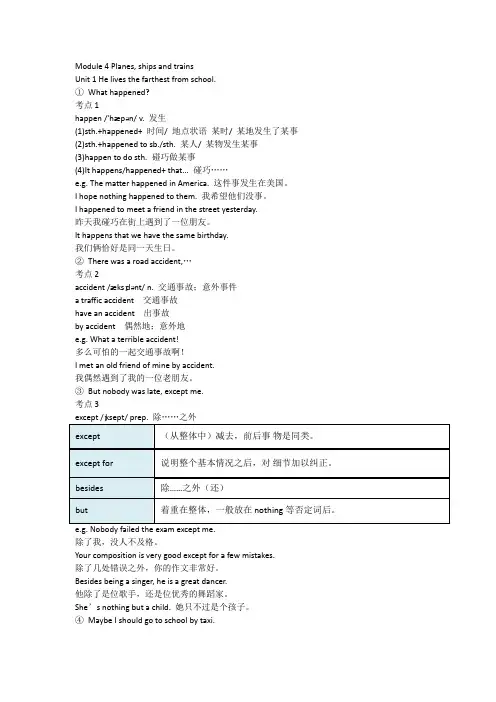
Module 4 Planes, ships and trainsUnit 1 He lives the farthest from school.①What happened?考点1happen /'hæpən/ v. 发生(1)sth.+happened+ 时间/ 地点状语某时/ 某地发生了某事(2)sth.+happened to sb./sth. 某人/ 某物发生某事(3)happen to do sth. 碰巧做某事(4)It happens/happened+ that... 碰巧……e.g. The matter happened in America. 这件事发生在美国。
I hope nothing happened to them. 我希望他们没事。
I happened to meet a friend in the street yesterday.昨天我碰巧在街上遇到了一位朋友。
It happens that we have the same birthday.我们俩恰好是同一天生日。
②There was a road accident,…考点2accident /æksɪdənt/ n. 交通事故;意外事件a traffic accident 交通事故have an accident 出事故by accident 偶然地;意外地e.g. What a terrible accident!多么可怕的一起交通事故啊!I met an old friend of mine by accident.我偶然遇到了我的一位老朋友。
③But nobody was late, except me.考点3except (从整体中)减去,前后事物是同类。
except for 说明整个基本情况之后,对细节加以纠正。
besides 除……之外(还)but 着重在整体,一般放在 nothing 等否定词后。
外研版英语八年级上册 Module 4 Planes, ships and trains

A. 书本 B. 购买 √C. 预定
2. Remember that parking in Amsterdam
is very expensive.
A. 公园 B√. 停车 C. 乘车
3. …it will not cost as much as going by train.
A. cost more than… B√. cost less than…
by bus
by taxi by car
by ship
by train by bicycle by plane walk /on foot
Presentation
Words
/rəʊd/
路;(尤指) 公路 n.
road
/'æksIdənt/ 交通事故;意外事件 n. accident
/Ik'sept/
Shanghai airport train. 3 I saw a(n) accident on my way to school yesterday. 4 I do not take the bus to school because it is usually
very crowded.
L1ine.tRg’rosoleusppeslea; ywthhe iccohnvegrrsoatuiopn 2. Rodleopelsaytthhee cboensvetr.sation
Daming
by bus/take the bus
What can we learn from the answers?
Consolidation
Complete the sentences with the correct form of the words in the box.
外研版-英语-八上-外研八上Module4 Planes, ships and知识讲解及练习
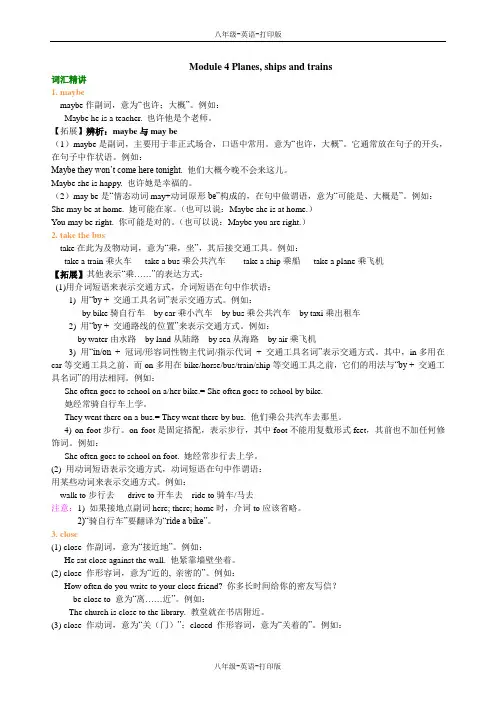
Module 4 Planes, ships and trains词汇精讲1. maybemaybe作副词,意为“也许;大概”。
例如:Maybe he is a teacher. 也许他是个老师。
【拓展】辨析:maybe与may be(1)maybe是副词,主要用于非正式场合,口语中常用。
意为“也许,大概”。
它通常放在句子的开头,在句子中作状语。
例如:Maybe they won’t come here tonight. 他们大概今晚不会来这儿。
Maybe she is happy. 也许她是幸福的。
(2)may be是“情态动词may+动词原形be”构成的,在句中做谓语,意为“可能是、大概是”。
例如:She may be at home. 她可能在家。
(也可以说:Maybe she is at home.)You may be right. 你可能是对的。
(也可以说:Maybe you are right.)2. take the bustake在此为及物动词,意为“乘,坐”,其后接交通工具。
例如:take a train乘火车take a bus乘公共汽车take a ship乘船take a plane乘飞机【拓展】其他表示“乘……”的表达方式:(1)用介词短语来表示交通方式,介词短语在句中作状语:1) 用“by + 交通工具名词”表示交通方式。
例如:by bike骑自行车by car乘小汽车by bus乘公共汽车by taxi乘出租车2) 用“by + 交通路线的位置”来表示交通方式。
例如:by water由水路by land从陆路by sea从海路by air乘飞机3) 用“in/on + 冠词/形容词性物主代词/指示代词+ 交通工具名词”表示交通方式。
其中,in多用在car等交通工具之前,而on多用在bike/horse/bus/train/ship等交通工具之前,它们的用法与“by + 交通工具名词”的用法相同。
外研版八年级上册英语Module 4 Planes ships and trains知识点复习总结

初二英语上册(外研版)Module 4 Planes, ships and trains知识点总结一、重点词汇·原文再现There was a road accident…路上出了交通事故…·基本用法accident n. 交通事故;意外事件。
如:The accident is so terrible.这起交通事故真可怕。
·知识拓展--相关短语by accident 意为“偶然”。
如:I only found it by accident.我只是碰巧找到的。
·原文再现But nobody was late, except me.但除了我,没有别人迟到。
·基本用法except prep. 除…之外,可用于句首。
Everyone went to the movies except me.除我以外,大家都去看了电影。
·知识拓展--词义辨析:besides/except/except for这三个介词或者短语都可以表示“除了…”的意思,区别如下:1. except仅表示“除了…”,排除在外。
She can do everything except cook.除了做饭之外她什么都会。
He had considered everything except the weather.他什么都想过,唯独没考虑到天气。
2. besides表示“除了…还有…”的意思,表示包含在内。
Besides milk and cheese, we need vegetables.除了牛奶和干酪外,我们还需要蔬菜。
Besides football, I like playing basketball and table tennis.除了足球以外,我还喜欢打篮球和乒乓球。
3. except for表示“除了…”,except for后接的词同句子中的整体词(主语)不是同类的,指从整体中除去一个细节,一个方面;而except后接的词同整体词(主语)一般是同类,指在同类的整体中除去一个部分。
外研版英语(新标准)八年级上册Module 4 Planes, ships and trains Unit 1 教案

Module 4 Planes, ships and trains一、学习目标:A.单词和短语:road, accident, except, far, far away, crowded, choice, classmate, all the time, journey, book, outside, close, park, however, costB.交际用语:1. What happened?2. Don’t worry.3. —Who lives the closest to school?— Lingling lives closest.4. — What is the most comfortable way to go to school for Betty?— By taxi.5. —What’s the most expensive way to go to school?— Going by taxi is the most expensive.6. How do you get there?7. What’s the cheapest way?8. What’s the best way to get there?9. —What’s the cheapest way to travel from London to Paris?— The cheapest way is by coach.10. It’s the most comfortable way, but it’s the most expensive.11. He lives farthest from school.12. It is the fastest and the second cheapest.13. The more information, the better.二. 教学目标1. Function: Describing and comparing modes of transportation.2. Structure: Superlative adjectives and adverbs (-est, most); irregular superlatives.3. Skills: 1) Listening and understanding familiar topics (transportation)2) Comparing modes of transportation.3) Reading and finding specific transportation4) Writing a short passage comparing modes of transportation.4. Around the world: The longest railway5. Task: Making a holiday plan for a family trip to a city in China.三、重点及难点:Superlative adjectives and adverbs (-est, most); irregular superlatives.四、教学设计:Unit 1 He lives the farthest from school.ⅠTeaching modelListening and speakingⅡTeaching methodPWP approachⅢTeaching aims1. Key vocabulary: road, accident, except, far, far away, crowded, choice,classmate, close, all the time2. Key structures: superlative adjectives and adverbs (-est, most); irregularsuperlatives.3. Key sentences:1) What happened?2) Don’t worry.3) — Who lives the closest to school?— Lingling lives closest.4) — What is the most comfortable way to go to school for Betty?— By taxi.5) —What’s the most expensive way to go to school?— Going by taxi is the most expensive.ⅣTeaching aidsTape recorder, OHP, videoⅤTeaching StepsStep 1 Warming-up1. Work in pairs. Show some pictures and ask “How do you often go to school?”2. Look and say something about the pictures.3. Introduce the new words.4. Learn the new words.5. Read the new words.Step 2 Look and match.1. Ask the students to read the words in Activity 1.2. Look at the pictures in Activity 1 carefully.3. Now match the words with the pictures.5. Check the answers with the students.Keys: 1. train 2. ship 3. taxi 4. underground 5. busStep 3 Look, listen and match.1. Ask the students to read the words in Activity2.2. Play the recording and ask the students to listen to the recording carefully. T: Listen and match the words in the box with the pictures in Activity 1. You need to use one word more than once.3. Check the answers with the students.Step 4 Listen and read.1. Show some pictures, and ask the students to talk about them.2. Ask the students to read the conversation silently.3. Play the recording and ask the students to listen the conversation, and then answer the questions.1) How does Lingling go to school? Why?2) How do you think Betty will go to school?4. Read the conversation.5. Act it out.Step 5 Complete the table.1. Ask the students to read the conversation again.2. Now complete the table.3. Check the answers.Keys: by bus (by bike) by underground walks / on foot by bus Step 6 Complete the sentences.1. Ask the students to read the words in the box in Activity 4.2. Read the sentences.1) The _________________ way to go to school is by taxi.2) Tony lives the __________ from school.3) Lingling’s home is the _________ to school, so she always walks.4) For Betty, going to school by bike is the ______ choice.3. Complete the sentences with the correct words from the box.4. Check the answers:Keys: 1. most comfortable 2. farthest 3. closest 4. bestStep 7 Complete the sentences.1. Ask the students to read the words or expression in the box in Activity 5.2. Read through the sentences.1) All the students take the bus to school ___________ Sam.2) The ___________ train in the world is the Shanghai airport train.3) I saw a(n) __________ on the way to school yesterday.4) I do not take the bus to school because it is usually very ___________.3. Complete the sentences with the correct words from the box.4. Check the answers:Keys: 1. except 2. most modern 3. accident 4. crowdedStep 8 Pronunciation and speaking.1. Play the recording once without stopping.2. Play the recording again and ask the whole class to repeat.1) —Who lives the closest to school?— Lingling lives closest.2) — What is the most comfortable way to go to school for Betty?— By taxi.3. Ask the students to listen and mark the intonation.4. Now listen again and repeat.Step 9 Work in pairs.1. Ask the students to read the words or expression in the box in Activity 7.2. Read the example with the class.—What’s the most expensive way to go to school?— Going by taxi is the most expensive.3. Work in pairs.Step 10 Language points1. Maybe I should go to school by taxi. 或许我应该坐出租车去上学。
外研版英语八年级上册Module 4 unit 1 课文
Unit 1 He lives the farthest from school.
他住的离学校最远。
I was late for school today. 今天我上学迟到了。
Why? What happened? 为什么?发生什么事了?
那么骑自行车去怎么样? (what about+ving)
That’s a good choice, but it’s a bit dangerous.
那是个不错的选择,但有点危险。
There’s so much traffic. 交通那么拥挤。
But most of my classmates ride bikes, and it’s quite safe.
但我的大部分同学都骑自行车,而且相l be careful.
不用担心,我会小心的。 (I’ll= I will)
How does Tony go to school? 托尼怎么去上学?
He lives the farthest from school, so he takes the underground.
I took the bus.
我坐公共汽车。 (take 过去式:took)
There was a road accident, and the traffic was very heavy.
路上出了交通事故,且交通很拥挤。
But nobody was late, except me. 但除了我,没有别人迟到。
好的。你可以骑自行车去学校,但记着始终 要小心。
The end
How about Daming? 大明呢?
外研版八年级英语上册 Module 4 Planes ships and trains .课文预习讲
Module4 课文预习讲解What is the best way to travel?I am planning to travel _____ London (1) Amsterdam. How long does the journey (2) and what is (3) to travel? Could you please tell me about the trains or ships to get there? ______ information, (4) . Thanks!A journey by train is more relaxing than by coach, but (5) expensive. When you go by train, buy your ticket a long time before you travel. It is usually cheaper.You can go by car and by ship across the North Sea. This is the most comfortable way to travel but also the most expensive. (6) your ticket before you book your hotel. Remember that (7) in Amsterdam is very expensive, so stay outside the city centre and travel in by bus or by train.The third (8) is by coach. This is usually the cheapest, but in summer, the coaches sometimes (9) ! And it takes you about twelve hours to get there. However, it will not cost (10) going by train.Finally, you can fly. It is the fastest and the second cheapest, but you may (11) wait for hours at the airport (12) bad weather.Well, I hope this helps! Have a great trip!( ) 1. A. both ; and B. to ; from C. from ; to D. either ; or ( ) 2. A. take B. spend C. pay D. cost( ) 3. A. the good idea B. the best way C. the meaning of D. the advice ( ) 4. A. The much; the good B. The most; the bestC. The more; the betterD. The little; the few( ) 5. A. more much B. much many C. a lot more D. more a little ( ) 6. A. Borrow B. Find C. Look for D. Book ( ) 7. A. Parking B. Driving C. Travelling D. Eating ( ) 8. A. subject B. choice C. plan D. traffic ( ) 9. A. are dirty B. are emptyC. get crowdedD. make trouble( ) 10. A. as much as B. more less C. much more as D. as more as( ) 11. A. be able to B. have to C. should D. must( ) 12. A. in order of B. because of C. so that D. such that相关短语①be busy doing sth = be busy with sth:忙于做某事②happen to sb:“某人发生了某事”③happen to do sth:“某人碰巧发生了某事”④on one’s way to……(地点):在某人去…地方的路上(on one’s way home / the way to….)⑤the way + to do sth:做某事的方法,方式(the way to go 出行方式)⑥stop doing sth:停止做某事⑦stop to do sth:停下来去做别的事⑧plan to do sth:计划去做某事⑨get crowded:变得拥挤⑩make a plan / make plans + to do sth:制定计划去做某事⑪have no choice but to……:别无选择,只能……⑫choose to do sth:选择去做某事⑬because of……:介词短语,后接名词或动名词。
外研版八年级英语上册课件-Module 4 Planes, ships and trains
Homework
Look at the table about sports.Write sentences comparing any two sports. Eg: Football is the most popular of the sports.
popular dangerous exciting
walk
ferry
taxi
train
bike
bus
plane
New wordsar from crowded
n. 路;(尤指)公路 n. 交通事故;意外事件 prep. 除……之外 adj. 远的;遥远的 adv. 远;遥远
远离 adj. 拥挤的;人数过多的
(2) sb. spend 钱或时间 on sth. sb. spend钱或时间 (in) doing sth.
(3) sth. cost 钱. sth. cost sb. 钱.(主语是物)
Read and complete the table.
Ways of travelling
Good / Bad points
Pay attention to
Train
more relaxing, but more expensive than by coach
buy your ticket a long time before you travel
tiring expensive relaxing
football *****
*** ***** *****
* **
cycling *** * *** *** *** ****
running *** * **** **** *
*****
2019年外研版八年级上册英语教案:Module4Planes,shipsandtrains
(三)实践活动(用时10分钟)
1.分组讨论:学生们将分成若干小组,每组讨论一个与旅行计划相关的实际问题,如如何从学校到达北京某景点。
2.实验操作:为了加深理解,我们将进行一个简单的角色扮演活动。学生们模拟在旅行社预订行程,练习使用所学词汇和时态。
1. Unit 1: Will you take the train to visit the Great Wall?
-交通工具词汇:plane, ship, train, bus, underground, taxi
-将来时态:will +动词原形
2. Unit 2: Which is the way to the Forbidden City?
-通过学习,学生能够运用目标词汇和句型进行旅行规划讨论。
2.文化意识:增强学生对国内外交通方式及文化的了解,培养跨文化交际意识。
-学生能够了解不同国家和地区的交通特点,尊重并包容文化差异。
3.思维品质:通过情景对话和小组讨论,锻炼学生的逻辑思维和批判性思维,提高问题解决能力。
-学生能在实际场景中灵活运用所学知识,进行有效沟通和问题解决。
-询问和描述路线的句型:Which way is...? How can I get to...?
-交通指示词汇:turn left, turn right, go straight
3. Unit 3: Language in use
-实际运用所学的交通工具和路线描述词汇、句型进行情景对话
-了解不同国家和地区的交通文化差异