
译林版高中英语必修二Uint3 Extended reading 教案(雅礼版)
Possible answer:
The Spring Festival means different things to different people. While to me, it’ll always be a season to share my love with my most beloved ones -- now my parents and maybe my kids in the future.
It implies the fast development of modern transportation in China. It also highlights the great development and changes happening in our country.
Read para.5and answer the questions: What does home mean in Luo Yan’s eyes?
on the train
in the house
in the house
outside the house
Action
chatted excitedly; thought about their sweet home
Luo Yan lifts the cover of a large bowl to breathe in the rich smell; Bofeng happily takes a bite of the chicken.
stay up late; watch the Spring Festival Gala; eat snacks; chat with each other; make dumplings
set off firecrackers; watch the colorful fireworks
Feeling
Possible answer:
It’s a chance for family members to spend time together and enjoy each other’s company, especially for those who are away from home and cannot see their family members often. By observing these traditions, they want to make up for the time they have lost and express their deep love to each other.
教学目标:
By the end of this section, students will be able to:
1. grasp the content of the article and write a summary;
2. know more about the customs of the Chinese New Year;
excited
happy
worried and hopeful
cheerful and proud
Step4Thinking
Read para. 3and answer the questions:What has changed about Luo’s journey back to his hometown? What does this change imply?
Step3Detailed Reading
Read the feature article again and complete the chart.
Time
on the way back home
during the dinner
after dinner
close to midnight
Place
Answer: They are heading back to their hometowns, which are far away from the cities where they live.
With Spring Festival coming, they are eager to be reunited with their family members and millions of people will join the stream of coming home.
(1)Examples of“On +n. /doing”
(2)Collocations of“On +n. /doing”
3. Phrase study: while/when + doing/ done
Introduce the meaning of“while/when + doing/ done”through different situations, first the context of the speech and then other situations.
(1)Examples of“set off”
(2)Collocations of“set off”
6.Phrasestudy: light up
Introduce the meaning of“light up”through different situations, first the context of the speech and then other situations.
Unit 3 Festivals and customs
Extendedreading
内容分析:
【What】本板块围绕单元话题,以“珍贵的年夜饭”创设情境。语篇描述了主人公携妻儿回老家与父母欢度春节的一幕幕欢乐场景——现代化的交通工具让年轻人回家看望父母的距离似乎不再那么遥远;剪窗花、贴春联、挂年画,传统的民俗活动把过年喜气洋洋的氛围渲染;看春晚、吃饺子、送祝福,全家三代同堂、团团圆圆,凸显了节日背后“家”的观念;放鞭炮、燃烟花、道心愿,举国同庆中国年。从个人到小家庭再到祖国这个大家庭,语篇很好地诠释了“家是最小国,国是千万家”的理念。
(2)Collocations of consider
5.Phrasestudy: set off
Introduce the meaning of“set off”through different situations, first the context of the speech and then other situations.
Possible answer:
Home is where all family members are together.
Read para.6and answer the questions: What is the special meaning of these traditions on such an occasion?
3. understand the deep meaning of the fnese New Year's Eve.
教学重难点:
1.know more about the customs of the Chinese New Year;
2.understand the deep meaning of the family dinner on the Chinese New Year's Eve.
Purchase goods.
Make traditional foods.
People in new clothes visit relatives and friends.
Send red packets to kids.
Hold all kinds of celebrations.
Step5Discussion
【Why】语篇通过对主人公一家欢度春节的情景描述,形象地展现了新时代中国人的生活、观念、思想、情怀,以及传统与现代的交融。
【How】该语篇是一篇专题文章,通过对一个普通中国家庭回家过年的情景描述,以叙事的方式介绍了中国家庭辞旧迎新的一系列传统活动,表达了作者对春节团圆所承载的文化意义与家国观念的推崇之情,以及对传承中华民族精神根脉的期待。
Step6Language Points
【设计意图:掌握文中重点词汇】
1. Word study: bite
Introduce the meaning of bite through different situations, first the context of the speech and then other situations.
(1)Examples of bite
(2)Collocations of bite
2. Phrase study: On +n. /doing
Introduce the meaning of“On +n. /doing”through different situations, first the context of the speech and then other situations.
Step 2Fast Reading
Luo Yan and his family also come back home to celebrate the Spring Festival. Let’s learn a precious family dinner in Luo’s family.
Listen and answer the question: How is the article organized?
译林版高中英语必修二Uint2 Extended reading 教案(雅礼版)
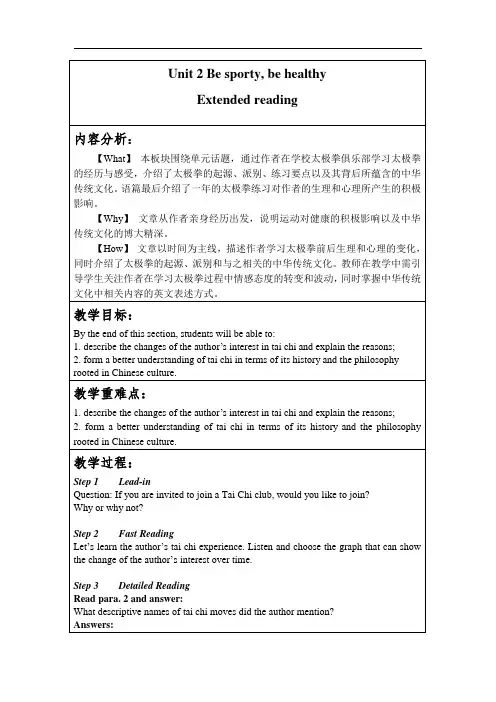
Step 1Lead-in
Question: If you are invited to join a Tai Chi club, would you like to join?
Why or why not?
Step 2Fast Reading
Let’s learn the author’s tai chi experience. Listen and choose the graph that can show the change of the author’s interest over time.
Needle at the bottom of the sea海底针
Single whip单鞭
Grasp the bird’s tail左揽雀尾
Read para. 3 and answer:
What are the two different explanations for the origin of tai chi?
教学重难点:
1. describe the changes of the author’s interest in tai chi and explain the reasons;
2. form a better understanding of tai chi in terms of its history and the philosophy rooted in Chinese culture.
Golden rooster standing on one leg金鸡独立
What other moves of tai chi do you know?
Possible answers:
译林版高中英语选必二Unit3 Extended reading 教案
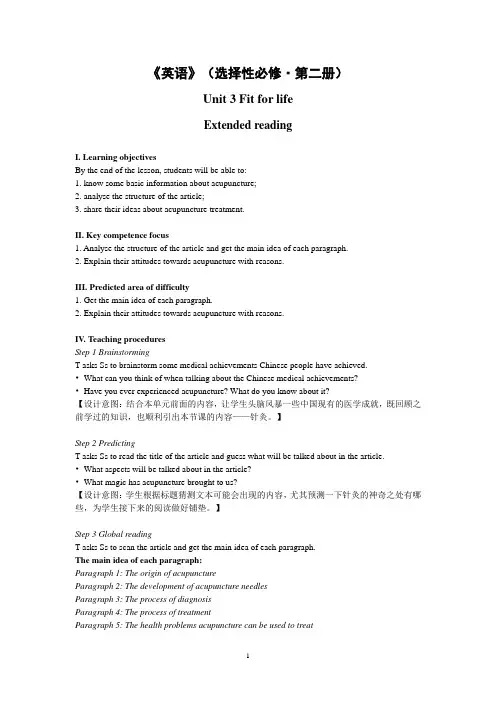
《英语》(选择性必修·第二册)Unit 3 Fit for lifeExtended readingI. Learning objectivesBy the end of the lesson, students will be able to:1. know some basic information about acupuncture;2. analyse the structure of the article;3. share their ideas about acupuncture treatment.II. Key competence focus1. Analyse the structure of the article and get the main idea of each paragraph.2. Explain their attitudes towards acupuncture with reasons.III. Predicted area of difficulty1. Get the main idea of each paragraph.2. Explain their attitudes towards acupuncture with reasons.IV. Teaching proceduresStep 1 BrainstormingT asks Ss to brainstorm some medical achievements Chinese people have achieved.•What can you think of when talking about the Chinese medical achievements?•Have you ever experienced acupuncture? What do you know about it?【设计意图:结合本单元前面的内容,让学生头脑风暴一些中国现有的医学成就,既回顾之前学过的知识,也顺利引出本节课的内容——针灸。
高中教育英语必修第二册译林版《4.3 Extended reading, Project》教学课件
⑯pull...over把……拉过来 pull in(火车)进站 pull down拉下;拆毁 put off(车)驶向路边短暂停车 pull through(从重病或重伤中)恢复健康 ⑰put all of one's effort on尽全力 make every effort to do sth.尽一切努力做某事 ⑱alongside/əˌlɒŋ'saɪd/adv.在……旁边;与……一起 ⑲right oneself摆正自己的身子 ⑳accomplish/ə'kʌmplɪʃ/vt.完成 ㉑reach for伸手去拿……
3.What kind of person was the fisherman? B
A.Discouraged and impatient. B.Determined and friendly. C.Ridiculous and optimistic. D.Hardworking and generous.
[4]句中strain是先行词,that he could是定语从句,从句中could后省 略了gather。
But when he put all of his effort on⑰, starting it well out before the fish came alongside⑱ and pulling with all his strength[5], the fish pulled part way over and then righted himself⑲ and swam away.
Sea, one of his most important novels, tells the story of a fisherman named
Unit 3 Extended Reading 课件高中英语牛津译林版(2020)必修第二册

Take notes quickly!
How often do Luo’s family reunite?
The Luo family's journey back to their hometown was a long and tiring one just a few years ago.However, the high-speed train has made it much more convenient for them to go back home. During the five-hour trip,they chatted excitedly with each other, their minds full of thoughts about their sweet home.
六岁的博峰都快一年没见爷爷奶奶了,他满心喜悦和激动。的确,一家人再没有 比团团圆圆更高兴的事了。虽然外面天寒地冻,他们幸福的脸庞却让屋内的空气暖 洋洋的,欢声笑语处处可闻。罗言一家三口已经在大城市定居,离家乡很远。不过, 他们每年都回老家过春节,以实现他们“三代同堂”的梦想。
重点词汇 be full of 充满 ; 洋洋得意,自以为是 whole family 全家人 ; 家庭成员,全家 fill the air 弥漫 big city 大城市 far away from 远离 ; 离…很远 ; 隐居 Spring Festival 春节 dream of 梦想 ; 梦见
Take notes quickly!
After dinner, the hours until midnight go slowly by. The whole family are going to stay up late on the Chinese New Year's Eve. They gather around the television to watch the Spring Festival Gala, while eating snacks, chatting with each other and making dumplings that they will eat at the very start of the new year. In the warmth and comfort of the room, Luo Yan talks about his plan for the future. “I hope we won't have to be separated again," he says, looking at his ageing parents. “My parents are getting old, and we should spend more time with them. We'll come back more frequently and we're also considering taking them to the city to live with us. After all, home is where all family members are together."
高中英语牛津译林版必修第二册 Unit 3 Extended reading 课件

10
Reading
2. Why do Chinese people decorate the house on such an ห้องสมุดไป่ตู้ccasion?
11
Reading
3. What is the special meaning of doing these activities like watching TV, eating snacks, and making dumplings together on such an occasion? Can you make up other sentences to describe what home is for you? Home is where ______________________. Home is a place _____________________.
dinner
eating future
chatting
strength
togetherness
5
Reading
1. What does the passage talk about? The passage talks about the celebration of Chinese New Year of Luo Yan’s family.
3
语 篇 理 解 精读演练 萃取文本精华
译林版高中英语必修二Uint3 Reading (I) 教案(雅礼版)
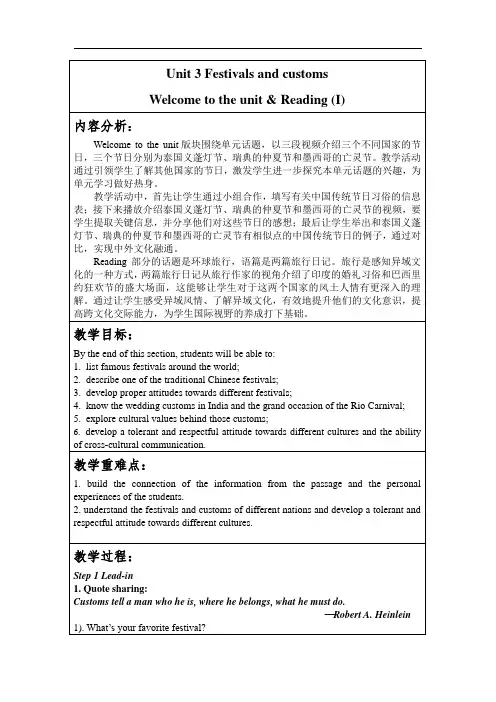
【设计意图:要求学生展开思考,讨论生活中和商业市场营销相关的节日,分析其意义和是否过于商业化,帮助学生展开批判性思维。】
3. Why did Alex go to a street party?
To experience the spirit of the Rio Carnival for himself.
4. What did Alex see and smell as he passed the street stands?
3.develop proper attitudes towards different festivals;
4.know the wedding customs in India and the grand occasion of the Rio Carnival;
5.explore cultural values behind those customs;
I look for her in vain.
When all at once I turn my head,
I find her there where lantern light is dimly shed.
Explain the meaning of the poem to the students.
How can you learn foreign customs and traditions?
Describe a festival you have experienced. What happened? What was it like?
高中英语译林版《必修第二册》教案讲义:Unit 3 Festivals and customs
SectionⅢExtended reading,Project,Assessment&Further studyⅠ.核心词汇1.______n.前夜,前夕2.______n.瓷,瓷器3.______n.盘子,碟子;板块;车牌4.______n.种类,类别v t.整理;分类;妥善处理5.______n.猪肉6.______n.(咬下的)一口;咬;咬伤v.咬,叮7.______n.对联,对句8.______n.午夜,子夜9.______n.点心,小吃10.______n.鞭炮,爆竹11.______n.烟火,烟花12.______n.灯笼,提灯13.______n.谜,谜语14.______n.柳,柳树15.______v i.渐渐出现16.______n.眼泪,泪珠v t.&v i.撕裂,撕碎17.______n.袖子Ⅱ.拓展词汇1.____adj.宝贵的,珍贵的;珍奇的;珍稀的→____ad v.昂贵地;仔细地;珍贵地2.____v t.选择,挑选→____n.选择,挑选;选集3.____v i.&v t.定居;结束;解决;决定→____n.解决,处理4.____adj.方便的,省事的,便利的,实用的→____n.方便,便利;厕所;便利的事物5.____adj.整洁的,整齐的;有条理的→____n.干净;整洁→____ad v.整洁地;熟练地;灵巧地6.____v t.代表;为……代言;体现→____n.代表,表现→____adj.典型的,有代表性的;n.代表;典型7.____n.机会,运气;巨款;命运→____adj.幸运的;侥幸的;吉祥的→____ad v.幸运地Ⅲ.重点短语1.______覆盖着,铺满了2.______吸入3.______某人一到达4.______熬夜5.______毕竟6.______使爆炸7.______点亮……8.______把……挂起来/晾起来9.______大小合适的Ⅳ.重点句型1.的确,全家人聚在一起是再幸福不过的了。
译林版高中英语必修三Uint2 Extended reading 教案(雅礼版)
Unit 2 Natural disastersExtended Reading◆内容分析:本板块的语篇节选改编自《庞贝城的末日》。
小说描述了维苏威火山爆发前庞贝这座城市的繁荣景象、火山爆发时的巨大破坏力,以及人们在面对突如其来的灾害时的反应。
作者用丰富的想象描摹了灾难中人们的行为习惯,用文字展现了灾难发生时他们的恐惧与混乱。
◆教学目标:By the end of this section, students will be able to:1.understand the adaptation of the novel about Pompeii;2.grasp the main idea of the adaptation;3.know the destructive power of natural disaster.◆教学重难点:1.To guide students to understanding the article;2.Help students grasp the main idea of the adaptation;3.Help students understand some key words and expressions.◆教学过程:Step 1 Lead-inWatch a video and answer the questions:●What happened in the video?●What did the incident result in?●How would you describe the feelings of people there?●What would you do if you were on the scene?Let's read Edward Bulwer-Lytton and his novel The Last Days of Pompeii.Step 2 IntroductionRead the introduction to Edward Bulwer-Lytton and his novel. Answer the two questions.1. When and how was the city of Pompeii destroyed?Pompeii was destroyed by the eruption of Mount Vesuvius in the year 79.2. What is the Pompeii like today?It's the ancient city as it was and today it is an international tourist destination.Step 3 Fast-readingListen and answer the question: How is the article organized?A.In the order of time.B.With the change of places.C.With the development of feelings.D.All above.The right answer is A.Figure out the structure by the order of time.Part 1: para. 1Before the volcanic eruptionPart 2: paras. 2-4During the volcanic eruptionPart 3: para. 5After the volcanic eruptionStep 4 Careful readingRead para. 1 and answer the questions.●What scenes are presented in the city of Pompeii?Its little shops, tiny palaces, forum, wine bars and theatre.●What words would you use to describe Pompeii?Read paras. 2-4 and rearrange the sentences about the scene of the volcanic eruption in right order.a. The fire moved and changed in colour with every moment.b. The mountain-cloud rolled near, dark and rapid, like a river. It threw out a shower of ashes and huge pieces of burning stone!c. A huge cloud shot from the peak of the volcano, looking like a huge tree of fire.d. The earth began to shake and the sound of falling roofs could be heard.e. The earthquake came.c→a→d→b→eQ: How does the author create a sense of fear and confusion during the volcanic eruption?Possible answer:In paragraph 3, the author uses the phrase “the cries of women”, “the earth shaking” and "a shower of ashes" to let the reader hear, feel and see what is happening in Pompeii at that moment.Similes help the reader visualize what is happening: "the mountain-cloud seemed to roll towards them, dark and rapid, like a river".In paragraph 4, verb-ing forms like "running, pressing, pushing" create feelings of confusion because they show that these actions are happening at the same time. Fear is created with phrases like "wife was separated from husband, or parent from child" showing that in the darkness, everyone in Pompeii risked being separated—no one was safe.Read para. 5 and answer the question.Q: What was the city like after it was unearthed?Possible answer: Its walls were fresh as if painted yesterday; not a single colour changed on the rich pattern of its floors. In its forum, the half-finished columns seemed as if just left by the workman's hand.Then show some pictures of these structures.Step 5 ThinkingQ: Compare the first and last paragraph. What effect do they create? What does the author want to remind us?Possible answer: They create a strong comparison between Pompeii's lively past and lifeless present. By doing so, the author wants to remind us that in the flowing river of time, human's life is just a ripple and in the face of Mother Nature's power, human beings are small and weak.Step 6 DiscussionQ: People in Pompeii were not aware of the signs before the volcano erupted, and the city was destroyed. Do you think that we will be better able to protect ourselves from natural disasters in the future? Why or why not?Possible answer: Option 1Yes, I believe we will be better able to protect ourselves from natural disasters in the future. The development of science and technology will improve the ability to predict the arrival of natural disasters and help us be better organized and prepared for disasters.Option 2No. No matter how advanced science and technology may be in the future, natural disasters will always challenge us because most of them are unpredictable. Human technical skill will never match the power of nature so our ability to protect ourselves will always be limited and this means that we will always be victims of natural disasters in some way.Language Points:1. ... a talented writer who left his mark on the English language. (Lines 1-2)mark n. & v.provide some related words and expressions about “mark”.2. Trading ships bringing imports to the city or carrying exports overseas, along with golden pleasure boats for the rich, were crowded ... (Lines 9-11)imports & exports 进口/ 出口带im/in前缀的单词往往有“向内”的意思,而ex-前缀则相反如:include & exclude (包含/排斥,排除)implicit & explicit (含蓄的,暗示的/直率的,明确的)impose & expose (强加,征税/揭露,暴露在外)internal & external (内部的/外部的,表面的)along with 连同;随着;以及;和……一起;除……以外(还)eg. So long as what you do is right, I'll go along with you.当together with连接前后两个主语时,谓语应该根据前面主语的人称和数来决定,此类短语还有but、except、besides、including、like、with、as well as、as much as、no less than、along with、in addition to、combined with、rather than等。
2024-2025学年高一英语必修第二册(译林版)UNIT3Extendedreading教学课件
Reading
Go through the feature article again and summarize it orally with the help of the chart on Page 40.
Time On the way back home
During the After dinner dinner
Appreciation
Are there any differences between the way you celebrate Spring Festival now and the way in the past? What do you think of these changes?
Exchange your ideas with your partners.
Homework
Write an essay on the changes of activities in which the Chinese people celebrate the Chinese New Year and your attitudes towards these changes.
Homework
1. Read this article aloud.
谢谢
2. Finish the workbook.
Reading
3. What is the change in Luo’s journey back home? It used to be a long and tiring one while now it takes only 5 hours to reach his home town.
4. What does this change imply? It implies the high speed of development in modern transportation of China. It also implies how powerful our country is.
Unit 2 Extended reading 教案 高中英语新牛津译林版选择性必修第三册(2023
Unit 2 Extended reading 教案高中英语新牛津译林版选择性必修第三册(2023本教案的编写旨在实现以下目标和意义:引导学生深入理解《Unit 2 Extended reading》这一课文的内容和主题;帮助学生提升阅读理解能力,包括扩大词汇量、培养阅读策略等;培养学生的批判性思维和分析能力,将所学知识应用于实际情境中;激发学生的研究兴趣和主动性,培养他们对英语研究的持续动力;培养学生的合作和沟通能力,通过小组讨论和合作实践提升研究效果。
通过这些目标和意义的实现,我们希望能够帮助学生全面发展他们的英语研究能力,提高他们的研究成绩,并为他们未来的研究和生活打下坚实的基础。
本单元的延伸阅读教案旨在帮助学生达到以下语言和技能目标:提高学生的阅读理解能力,通过阅读不同类型的文本,培养学生的阅读技巧和策略;增加学生的词汇量并提高词汇运用能力,以便他们能够更好地理解和表达文章中的内容;培养学生分析、推理和判断能力,通过理解和解释文章中的观点和论点,培养学生的批判性思维;培养学生的写作能力,让他们能够用正确的语法和词汇表达自己的观点和意见;提高学生的研究策略和自主研究能力,让他们能够独立阅读和理解课外材料。
通过本教案的研究,学生将能够更全面地掌握本单元的主题和内容,并提高他们的语言和技能水平。
注意:本教案的具体内容和活动设计应根据教师的实际教学需要和学生的研究情况进行调整和改进。
本教案旨在延伸学生的阅读能力,提供多样化的教学资源和活动。
教学内容如下:阅读材料:选择一篇具有挑战性和启发性的英文文献作为阅读材料,如一篇科学研究报告、一篇社会问题分析文章或一篇名人演讲稿。
阅读理解:通过阅读材料,引导学生进行深入的阅读理解。
教师可以设计不同类型的问题,包括细节理解、主题把握、作者观点等,以检验学生的阅读能力和思考能力。
词汇拓展:针对阅读材料中的生词和短语,进行词汇拓展活动。
教师可以设计词汇表,引导学生研究并灵活运用相关词汇。