
牛津译林版七年级英语上册Unit1知识点复习归纳
牛津译林版七年级英语上册Unit1知识点复习归纳一.单词牢记及拓展1.e-dog [ _d_g ] 电子狗(electronic 电子的+ dog 狗= 电子狗)2.master [ m_st_ ] 主人;大师3.grade [ gr_d ] 年级注:在英语中表示几年几班的时候,语序与中文要颠倒。
例如:3年级4班Class 4,Grade 3 同时注意大小写4.student [ st_d_nt ] 学生5.reading [ r_d__ ] 阅读(动词read + ing = 名词)6.classmate [ kl__sm__t ] 同班同学7.slim [ sl_m ] 苗条的8.over [ __v__ ] 穿过,在...... 正上方与under 在......正下方相对9.classroom [ kl__sr__m ] 教室(class 上课+ room 房间= 上课的地方,即教室)10.dancing [ d_ns___ ] 跳舞,舞蹈(动词dance + ing = 名词)11.swimming [ sw_m___ ] 游泳(动词swim + ing = 名词)12.age [ ____ ] 年龄at the age of... .......岁13.looks [ l_ks ] 外貌( look 用肉眼看,看起来+ s = 外表,外貌)14.cute [ k__t ] 可爱的;讨人喜欢的15.hobby [ h_b_ ] 业余爱好复数形式:hobbies16.glad [ gl_d ] 高兴的同义词:happy,excited be glad to do sth. 很高兴/乐意做某事17.everyone [ _vr_w_n] 每人,人人(every 每个+ one =everyone)18.glasses [ gl__s __ __ ] (复)眼镜( glass 玻璃+ es = 两块玻璃构成眼镜)二.重点词组1.look after/take care of 照顾;照看2.love e-dogs/reading/sports 喜欢电子狗/阅读/运动3.good morning/afternoon/evening 早上/中午/晚上好4.welcome to class 1, grade 7 欢迎来到七年级一班welcome home 欢迎回家5.a new student at Sunshine Middle School 阳光中学的一名新学生6.12 years old 12岁7.my new classmates 我的新同班同学8.play football 踢足球9.after school 放学后e from/be from 来自11.be good at/do well in (doing )sth 擅长于做某事12.have long/short hair 有着长/短发13.over there 在那边over the desk 在课桌的正上方14.chinese/English/Maths teacher 语文/英语/数学老师15.live with my family in Beijing 和我的家人一起住在北京16.wear glasses 戴眼镜17.like all the lessons 喜欢所有的课程18.be nice/kind/friendly to sb. 对某人友好的19.have an e-dog 有一只电子狗三.重点句型1.What’s your name? 你叫什么名字?2.My name is Hobo./I am Hobo. 我叫霍波。
3.How to look after your e-dog. 怎样照顾你的电子狗。
4.Nice to meet you./Glad to meet you. 见到你很高兴。
Nice to meet you too./Glad to meet you too. 见到你我也很高兴。
5.Now let’s meet my new classmates. 现在让我们来会见一下我的新同班同学。
6.Hi, Kitty. This is my cousin Andy. Andy, this is my new classmate Kitty.你好,基蒂,这是我的表哥安迪。
安迪,这是我的新同学基蒂。
7.She is tall and slim. 她既高又瘦。
8.Oh, I see. 喔,我明白了。
9.I come from Nanjing, but now I live with my family in Beijing.我是南京人,但是我现在和家人住在北京。
四.语法解析1.喜欢做某事Like/love to do/doing sth.Enjoy doing sth.Be fond of doing sth.用动词的适当形式填空:1.Amy likes ______ in the library.(read)2.My mother loves ______ very much.(shop)3.( )My mother loves _______ at weekends,but my father likes ______ at home.A.shop;stayB.shopping;to stayC.shopping;stayD.shoping;staying2.几岁(表年龄)的多种表达例如:我12岁了。
I’m 12 years old.I’m a boy of 12.I’m a 12-year-old boy.I’m at the age of 12.句型转换:1.The boy in black T-shirt is 13 years old._______________________________________________(对划线部分提问).The boy in black T-shirt is _____ ______ ______ _____ ______.3.Put on/ wear / inPut on “穿、戴”,指穿的动作,后接要穿、戴的东西,其反义词为:take off 脱下例如:It’s cold today. Put on your coat, please.Wear “穿、戴”,指穿的状态例如:Many girls wear skirts in summer.Sandy wears glasses.In “穿着” 介词,后接衣服,也可接衣服,既可作定语,也可作表语。
例如:The girl in red is Kitty’s sister.The woman is in blue.用适当的词填空:*_______ your coat. It’s cold today.*The man always _____ a black hat.*She felt a bit cold and found she was only _____ her sweater. She left home in such a hurry that she forgot ______ her thick coat.4.Let us do sth. 征求对方意见,对方不加入Let’s do sth.包括了征求其意见的对方,表示大家一起做某事。
例如:Let us play basketball. (请你)让我们打篮球吧。
Let’s play basketball. 咱们打篮球吧。
5.Play football 踢足球(球类运动不加冠词the)Play the piano (弹奏乐器要加冠词the)6.表地点时in/at 的区别in通常指大地方,比如:洲、国家、城市等;虽然是小地方,但说话人住在那里的情况下,也可用in。
商店、学校、机关等,若看做一个地点时用at,看做一个场所时用in。
例如:I met him at the post-office.I am working in the post-office.at通常指小地方,如车站、码头、村子、农场、工厂、学校等。
用于门牌号码前。
例如:I arrived at the post-office at 9 o’clock in the morning.He lives at 11 Zhongshan Road.on表示地点,一般指与面或线接触,意为“在……上;在……旁”。
如:The picture was hanging on the wall.随堂练:1. I’m _______ China.2.I’ll meet my uncle _______ the airport _____five past one.3. There’s a picture __________ the wall.4.John is _____the hospital.5.There is a bird ___ the tree.6.There are many apples _____ in the tree.7.I put a cup of tea ____ the table.8.I saw a cat ___ the corner of the street.7.欢迎来到某地:welcome to sp. 但表示欢迎回家时,用welcome home.欢迎某人:welcome sb.8. 含be动词的一般现在时be动词是系动词的一种,表示“……是……”的意思。
现在式有am,is,are三种。
这三种动词的原形是be,所以它们称为be动词。
8.1 be动词的现在式be动词的现在式有am,is,are三种,分别接在不同人称的主语之后:8.2 be动词句型的构成肯定句:主语+ be动词(am/is/are)...例如:I am a doctor.我是一名医生。
Mary is at work.玛丽在工作。
He is very brilliant.他非常聪明。
否定句:主语+ be动词(am/is/are)+ not...例如:We aren't her classmates.我们不是她的同班同学。
I'm not Tom.我不是汤姆。
(I'm是I am的缩写,读作/aim/。
)It's not / It isn’t a cat,but a dog.这不是猫,而是狗。
注:be动词否定句的缩写方式:is not的缩写是isn't,读作/′iznt/;are not的缩写是aren't,读作/a:nt/;I am~的否定句是I am not~,缩写为I'm not~;am not不缩写在一起。
牛津译林版七年级英语上册Unit1归纳知识点汇总
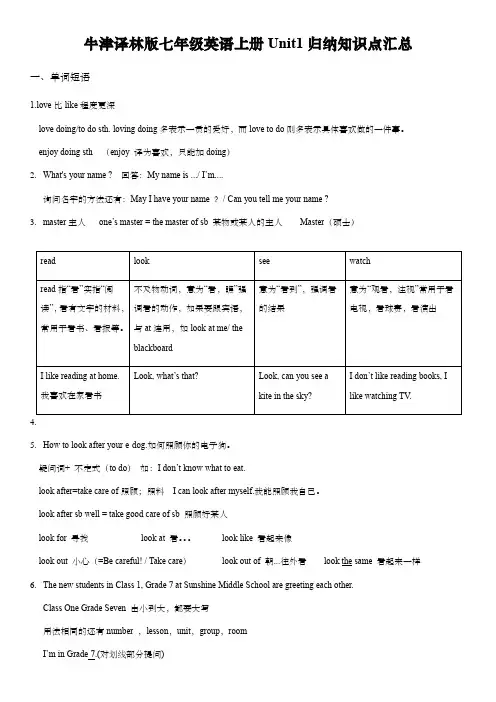
牛津译林版七年级英语上册Unit1归纳知识点汇总一、单词短语1.love比like程度更深love doing/to do sth. loving doing多表示一贯的爱好,而love to do则多表示具体喜欢做的一件事。
enjoy doing sth (enjoy 译为喜欢,只能加doing)2.What's your name ? 回答:My name is .../ I’m....询问名字的方法还有:May I have your name ?/ Can you tell me your name ?3.master主人one’s master = the master of sb 某物或某人的主人Master(硕士)4.5.How to look after your e-dog.如何照顾你的电子狗。
疑问词+ 不定式(to do)如:I don’t know what to eat.look after=take care of照顾;照料I can look after myself.我能照顾我自己。
look after sb well = take good care of sb 照顾好某人look for 寻找look at 看。
look like 看起来像look out 小心(=Be careful! / Take care)look out of 朝...往外看look the same 看起来一样6.The new students in Class 1, Grade 7 at Sunshine Middle School are greeting each other.Class One Grade Seven 由小到大,都要大写用法相同的还有number ,lesson,unit,group,roomI’m in Grade 7.(对划线部分提问)What/ Which grade are you in?Our school has six grades.我们学校有6个年级。
Unit1知识点梳理2023-2024学年牛津译林版英语七年级上册
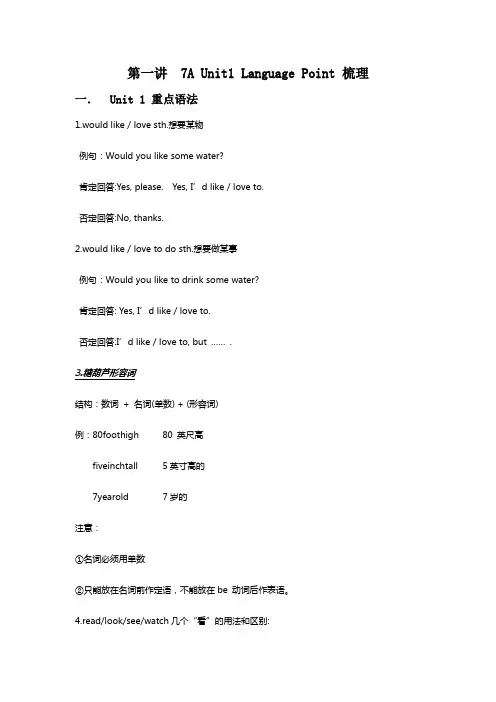
第一讲 7A Unit1 Language Point 梳理一.Unit 1 重点语法1.would like / love sth.想要某物例句:Would you like some water?肯定回答:Yes, please. Yes, I’d like / love to.否定回答:No, thanks.2.would like / love to do sth.想要做某事例句:Would you like to drink some water?肯定回答: Yes, I’d like / love to.否定回答:I’d like / love to, but …… .3.糖葫芦形容词结构:数词+ 名词(单数) + (形容词)例:80foothigh 80 英尺高fiveinchtall 5英寸高的7yearold 7岁的注意:①名词必须用单数②只能放在名词前作定语,不能放在be 动词后作表语。
4.read/look/see/watch几个“看”的用法和区别:look 强调看的动作①系动词。
译作看起来,后接形容词。
She looks happy.②不及物动词。
译作看,词组:look at…,用副词修饰。
Tom looked at me angrily.see 及物动词,译作看到,无进行时态,强调看的结果。
watch 及物动词,译作观看,注视。
强调观看正在进行中的,发生变化的活动过程,常用于看电视、看球赛、看演出等。
read 及物动词,译作阅读。
强调看文字内容的东西,常用于看书、看报纸、看杂志等。
5.疑问代词what、which、who 及疑问副词how、when 、where可以和动词不定式连用。
what to do 做什么which to do 做哪个who to do 如何做how to do 谁做when to do 什么时候做where to do 在哪里做6.“疑问词+ to do” 结构经常放在know,learn,see ,ask等动词后做宾语。
初中英语牛津译林版七年级英语上册知识点第一单元
Unit 1 T opic1 1 Our country has developed rapidly.一·词组。
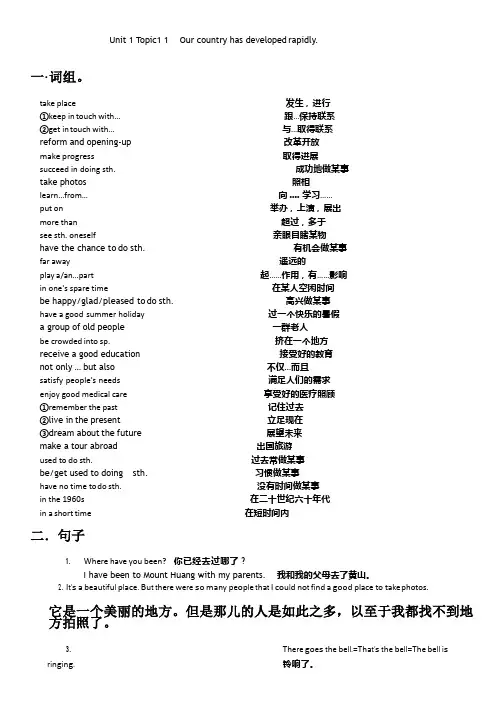
take place 发生,进行①keep in touch with…跟…保持联系②get in touch with…与…取得联系reform and opening-up 改革开放make progress 取得进展succeed in doing sth. 成功地做某事take photos 照相learn…from…向 .... 学习……put on 举办,上演,展出more than 超过,多于see sth. oneself 亲眼目睹某物have the chance to do sth. 有机会做某事far away 遥远的play a/an…part起……作用,有……影响in one's spare time 在某人空闲时间be happy/glad/pleased to do sth. 高兴做某事have a good summer holiday 过一个快乐的暑假a group of old people 一群老人be crowded into sp. 挤在一个地方receive a good education 接受好的教育not only … but also 不仅…而且satisfy people's needs 满足人们的需求enjoy good medical care 享受好的医疗照顾①remember the past 记住过去②live in the present 立足现在③dream about the future 展望未来make a tour abroad 出国旅游used to do sth. 过去常做某事be/get used to doing sth. 习惯做某事have no time to d o sth. 没有时间做某事in the 1960s 在二十世纪六十年代in a short time 在短时间内二.句子1.Where have you been? 你已经去过哪了?I have been to Mount Huang with my parents. 我和我的父母去了黄山。
Unit1重要知识点牛津译林版英语七年级上册

U11.love/like/enjoy doing sth 热爱/喜欢/享受做某事love/like to do sth2.a/the master of.... ....的主人3.Now,read this book. 祈使句,表达命令,请求,劝告,警告,禁止等。
否定:Don't+祈使句4.readreading 动名词Reading Club 阅读俱乐部5.look after=take care oflook after....well=take good care of.... 照顾好...look at 看向see(看到实质内容)look for 寻找look out of.... 向...外看look up查阅6.the first day第一天7.wele to spl.欢迎来到某地wele to Class1(One),Grade7(Seven)in Class1,Grade7➡对班级/年级提问:What/Which class/grade +be+主语+in?8.年龄表达方式:主语+be+数词+year(s)old. I am 12 years old.=主语+be+数词=I am 12.=主语+be+at the age of+数词=I am at the age of 12.对年龄提问:How old+be+主语? How old are you?=What’s sb’s age? =What’s your age? xxyearold ....岁的 a 12yearold girl 一位12岁的小女孩9.play+球类运动play footballplay the+乐器名词play the piano10.after class/school/lunch....11.be from=e from 来自Where +be+主语+from?=Where+助动词+主语+e from?12.be good at (doing ) sth=do well in (doing) sth 擅长做某事(=do sth well)13.★Be动词的一般现在时14.at the age of... 在...岁时15.go walking➡go+ving=go for a walkgo swimming=go for a swim16.glad/nice to meet you. ➡It's glad/nice to meet you.It’s+adj.+to do sth做某事....17.I see.我明白了。
牛津译林版七年级上册英语Unit1知识点总结
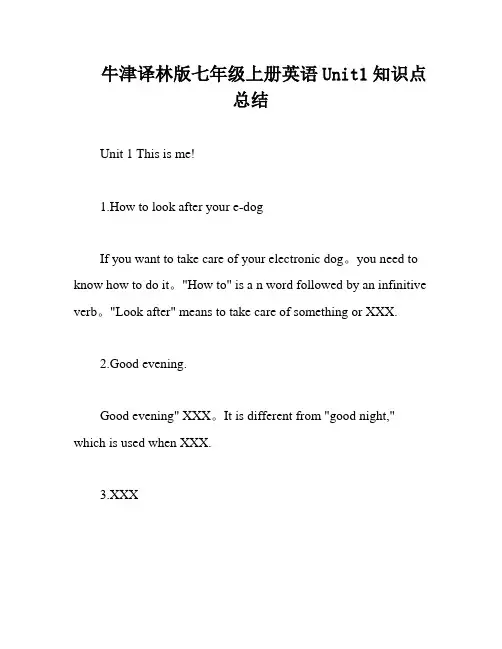
牛津译林版七年级上册英语Unit1知识点总结Unit 1 This is me!1.How to look after your e-dogIf you want to take care of your electronic dog。
you need to know how to do it。
"How to" is a n word followed by an infinitive verb。
"Look after" means to take care of something or XXX.2.Good evening.Good evening" XXX。
It is different from "good night," which is used when XXX.3.XXXIf you enjoy playing football after school。
you can say that you love it。
"Love/like doing something" XXX。
while "love/like to do something" emphasizes a one-time n.For example。
"She loves watching TV。
but today she loves to listen to music." "Love" can be used as a verb to mean "like" or "enjoy," as in "He loves his parents" or "She loves music." It can also be used as a noun to mean "n" or "beloved," as in "a mother's love for her children" or "fall in love with XXX."nally。
牛津译林版七年级上册英语Unit1知识点汇总
牛津译林版七年级上册英语Unit1知识点汇总7A Unit 1 This is me!一.【精选短语】1. how to look after your e-dog如何照顾你的电子狗(1)疑问词+动词不定式(2)look after=take care of 照顾,照料2. Good evening.晚上好。
(晚上见面问候语)→比较:Good night.晚安。
(晚上分别时用语)3. love playing football after school喜爱放学后踢足球【知识链接】Love/like doing sth.喜欢做某事,强调习惯上的喜欢;Love/like to do sth.强调的是某一次的行为。
e.g. She loves watching TV, but today she loves to listen to music. Love的用法⑴vt.喜爱e.g. ①He loves his parents. (不能用like代替love)②She loves music.她爱好音乐。
⑵vt.热爱e.g. We love our motherland.我们热爱祖国。
⑶n.爱;挚爱a mother’s love for her children母亲对孩子的爱②fall in love with sb爱上…,e.g. He fell in love with her.③我们可在书信的结尾处看到例如Love Mary这样的署名,意思是With my love, Mary,一方面表示情感,一方面表示道别。
【用法拓展】lovely美丽的;可爱的e.g. lovely hair秀发,a lovely girl美丽的少女4. be good at sth/doing sth=do well in sth/doing sth擅长;在某方面表现好【知识链接】⑴He is good at telling funny jokes.⑵She always does well in English.5. wear glasses戴眼镜→ wear后接服装、装饰品等,表示“穿、戴”。
牛津译林版七年级英语上册全册知识点汇总(Unit1-8)
牛津译林版七年级英语上册全册知识点汇总(Unit1-8)Unit 1 This is me!知识点归纳汇总Words & Phrases:(结合音标记忆)master/'mɑːstə/、bicycle/'baɪsɪkl/、Excuse/ɪkˈskju:s; ɪkˈskju:z/、hobby/'hɒbɪ/、welcome/ˈwelkəm/、swimming/'swɪmɪŋ/、music/'mjuːzɪk/、polite/pə'laɪt/、chinese/tʃaɪˈniːz/、badminton /'bædmɪnt(ə)n/、cousin/'kʌz(ə)n/enjoy doing、work hard、be good at doing、like to do/doing、look up/after/like/out、help sb do sth、want to do sth、come from、be from、love doing、take sb for a walk、be born in sp、fly a kite with sb、walk to sp = go to sp on foot.Common phonetic:(常见音标)other/'ʌðə/ boat/bəʊt/ phone/fəʊn/ old/əʊld/bread/bred/ great/greɪt/ heavy/'hevɪ/ head/hed/that /ðæt; ðət/ thing /θɪŋ/ these/ðiːz/ those/ðəʊz/dog/dɒg/ shop/ʃɒp/ short /ʃɔːt/ long /lɒŋ/Sentences:1、What is your father ? 提问职业。
牛津译林版七年级英语上册Unit-1单元知识点归纳
牛津译林版七年级英语上册Unit 1 This is me一.Comic strip- Reading(一)重点短语、交际用语1.read this book 读这本书2. look after 照顾,照看3. play football 踢足球4. after school 放学后5. be from 来自......6. be good at 擅长7. good morning 早上好,上午好8. good afternoon 下午好9. good evening 晚上好10. What's your name? 你叫什么名字?11. Nice to meet you. 见到你很高兴。
12. Nice to meet you too. 见到你也很高兴。
(二) 语言知识梳理1. Oh, I love e-dogs. 哦,我喜爱电子狗。
【知识点1】love 的用法句中的love 是实义动词,表示“喜爱,热爱,喜欢”,love 有强烈的感情色彩,相当于like...very much, 其后可以直接接名词、代词、动名词或动词不定式做宾语。
例如:We should love the students. (接名词)我们应该关爱学生。
Do you love me, mom? (接代词)妈妈,你爱我吗?My friend Bill loves to listen to music. (接不定式)= My friend Bill loves listening to music. (接动名词)我的朋友比尔喜爱听音乐。
【知识拓展】love 做名词的用法love 本身也可做名词,表示“爱”。
例如:My mother's love for me is very deep. 妈妈对我的爱是很深的。
【知识点2】e-dog 的含义e-dog 做名词,是由electronic, dog 两个单词合并而成的,electronic 可译为“电子的”。
译林版牛津初中英语七年级上册全册各单元短语、句型归纳整理
译林版牛津初中英语七年级上册全册各单元短语、句型归纳整理Unit 1 This is me!短语:1.look after sb。
- take care of someone2.some of the new students - a few of the new studentsone of + plural countable noun - one of the。
many of + plural countable noun - many of the。
much of + uncountable noun - much of the。
3.love doing。
- enjoy doing。
like doing。
- like to do。
enjoy doing。
- love to do。
4.let sb。
do sth。
- allow someone to do something5.make sb。
do sth。
- force someone to do somethingThe verb "let" and "make" are followed by the base form of the verb with "to" as the object complement.6.like sports - enjoy sports7.after class - after the classin class - during the class8.be good at (doing)。
- be skilled at (doing)。
9.meet my new friends - meet my new classmates10.over there - in that n11.tell sb。
about sth。
- inform someone about something12.Oh。
牛津译林版七年级英语上册Unit1单元知识点总结
牛津译林版七年级英语上册7A Unit1 This is me!知识点总结Welcome to the unitP.61. Oh, I love e-dogs.(=electronic dogs 电子狗)write an e-mail / emails to his friends2. Are you my master?The Chinese people have become masters of their country. (主人)A Master of Arts (Sciences) 文科(理科)硕士3.How to Look After Your E-dog?(1). Look! Lily is looking after her brother.(=take care of 照料;look after…well =take good care of)(2). Can you tell me how to get to our school? 疑问词加动词不定式作宾语等4. Introduce yourself to your classmates.introduce themselves to each other; introduce me to themP.75. greet each other (v. 打招呼)Please give my best greetings to your parents. (n. 问候)6. Good evening. 晚上好。
Good night. 晚安。
7. Nice to meet you. 很高兴见到你。
(常见的打招呼用语,用Nice to meet you too.来回应。
)ReadingP.81. Welcome to Class 1, Grade 7! We are in the same grade. (年级)注意什么时候大写,什么时候小写Welcome back/ home.中的back和home是副词,所以前面没有介词。