
(人教版)中考英语总复习语法:专题8-动词的时态、语态(101页)
(2)过去完成时与现在完成时的主要区别是时间参 照点不同: 过去完成时的时间参照点是某个“过去的” 时间;现在完成时的时间参照点是“现在”。因此现在 完成时中的很多规则,也适用于过去完成时。 When I got to the cinema, the film had been on. 当我到达电影院时,电影已经开始了。
以辅音字母+y结尾的动词, 把y变为i再加-ed
以一个元音字母加一个辅音 字母结尾的重读闭音节词, 双写结尾字母再加-ed
study→studied carry→carried stop→stopped drop→dropped prefer→preferred
3.一般将来时 (1)表示将来某个时间要发生的动作或存在的状 态,其构成形式:“will/shall+动词原形”。常与表 示将来的时间状语tomorrow,next week,in+一段时 间等连用。 当主语是第一人称I或we时,问句中一般用shall。
③表单纯性的将来,与人的主观愿望和判断无关 时。 If it's made of wood, it will float on water. 这要是木材做的,它能浮在水面上。 (4)当主句为一般将来时态时,在if,as soon as, until, when等引导的状语从句中用一般现在时代替一 般将来时。 I will call you as soon as I get there. 我一到那儿就给你打电话。
特殊情况:have→has,am/are→is 考查热点:如果主句为一般将来时,if,unless等 引导的条件状语从句和when,until,as soon as等引导 的时间状语从句常用一般现在时表示将来。 What about going climbing if it doesn't rain tomorrow? 如果明天不下雨,去爬山怎么样?
②表示过去经常反复发生的动作,常与always, usually,often, never,sometimes等表示频度的时间状 语连用。 When I was a child, I often played football in the street. 当我是个孩子的时候,我经常在街上踢足球。 注:表示过去经常发生或反复发生的动作,也可 用used to或would+动词原形。 I used to go to the library every Sunday. 我以前每周日都去图书馆。
②表示主语具备的性格或能力。 He likes apples. 他喜欢苹果。 ③表示客观事实、普遍真理或格言警句。 The sun rises in the east. 太阳从东边升起。
(2)动词第三人称单数形式的变化规则:
构 成 例 词 一般情况下,在动词原 run→runs 形后加-s
like→likes
teach→teaches 以ch, sh, s, o, x结尾的动 wash→washes 词,在词尾加-es go→goes pass→passes 以辅音字母加y结尾的动 study→studies 词,先将y变i再加-es try→tries 以元音字母加y结尾的动 stay→stays 词,在词尾加-s play→plays
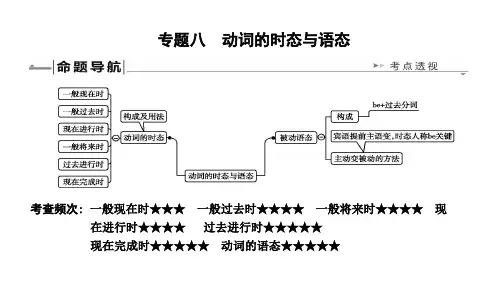
专题八
动词的时态、语态
考点一 1.一般现在时 (1)基本用法:
动词的时态
①表示经常性、习惯性的动作或存在的状态;常 与表示频度的时间状语always,often,usually, sometimes,once a week,every day等连用。 He always helps others. 他总是帮助别人。
(3)have been to,have gone to,have been in 的用 法区别: have been to 表示“过去曾去过某地”,说话时 已从该地回来或已从该地去了其他地方,总之,现在 已不在该地;have gone to则表示“已去了某地”,说 话时不在说话地点,或在去某地的途中,或已到了某 地,总之现在还未回来;have been in表示“已在某地 待了多久”,后面跟副词时不用in。
(3)注意区别: 一般过去时表示在过去某个时间“发 生了的动作”或“存在的状态”, 而过去进行时则强调 在过去某一时刻或某一段时间“正在进行的动作”。 Mary wrote a letter to her friend last night. 玛丽昨晚给她的朋友写了封信。(表明信写完了) Mary was writing a letter to her friend last night. 玛丽昨晚一直在给她的朋友写信。 (只表明“一直 在写”,不清楚“是否写完”,也许信还没有写完)
7.过去完成时 (1)过去完成时表示在过去某一时间或动作之前已 经发生或完成了的动作。它表示动作所发生的时间是 “过去的过去”,常用“助动词had+动词过去分词” 构成。 By the time she got up,her brother had already gone into the bathroom. 她起床的时候,她的弟弟就已经进了盥洗室。
(5)动词的现在进行时表将来。 常见的动词有go, come, leave, stay, start等。 Joe is leaving for London. 乔就要动身去伦敦。
(6)be about to do 结构表示客观、马上就要发生 的事,一般不与具体的时间状语连用。 be to do结构表示按职责、义务和要求必须去做或 即将发生的动作。 The plane is about to take off. 飞机就要起飞了。 Jenny is to be married next month. 珍妮下个月结 婚。
(3)现在分词的变化规则:
构 成 在动词原形后加-ing 以不发音字母e结尾的动词,去掉e 再加-ing 例 词 read—reading live—living write—writing
以重读闭音节ቤተ መጻሕፍቲ ባይዱ尾且末尾只有一个 sit—sitting 辅音字母的动词,双写该辅音字母 begin—beginning 后再加-ing die—dying 少数几个以ie结尾的动词,要变ie lie—lying 为y,再加-ing tie—tying
—Where is Mrs. Smith? 史密斯夫人在哪儿? —She isn't here.She has gone to England. 她不在这儿。她去了英国。
(4)现在完成时与一般过去时的区别: 现在完成时强调过去某一动作与现在的关系,对 现在造成的影响、结果等,不与表示过去的时间状语 连用;一般过去时只表示过去的事实,不表示与现在 的关系,可与表示过去的时间状语连用。
2.一般过去时 (1)一般过去时的用法: ①表示过去某个时间或某一段时间内发生的动作 或存在的状态,常与表示过去的时间状语连用,如 ago,yesterday,last week,the day before yesterday, long long ago, once upon a time等。 I bought the book last week.我上周买的这本书。
8.过去将来时 (1)过去将来时表示从过去某一时刻看将来要发生 的动作或存在的状态。常用在间接引语、宾语从句 中。 He said he would buy some fruit.他说他要买些水 果。
(2)表示曾经打算或准备要做的动作,用 were/was going to+动词原形。如: I thought it was going to rain soon. 我想马上就要下雨了。 They were going to start a new job when I saw them 作。 then.当我见到他们时,他们正打算开始新的工
(3)下列几种情况只可用shall/will表将来,而不可 用be going to结构。 ①表示有礼貌地询问对方是否愿意或表示客气的 邀请或命令时。 Will you please lend me your pen? 请把你的钢笔借我用一下,好吗? ②表示意愿时。 We will help him if he asks us. 如果他愿意,我们会帮助他。
6.现在完成时 (1)构成形式:have/has+动词的过去分词。 (2)用法: ①表示过去发生或已经完成的动作对现在 造成的影响或结果。 I have already read the book. It's really good. 我已经读过这本书了,它太好了。
②表示从过去某时开始一直延续到现在的动作或 状态。 常与表示一段时间的for短语、since短语或从句等 连用时,应注意句中的谓语动词须是延续性的。
4.现在进行时 (1)表示现在或现阶段正在发生或持续的动作。与 现在进行时连用的时间状语及提示语有: now,these days, right now, at present, at this moment ,look, listen等。 I am watching TV now. 我现在在看电视。 (2)构成形式:am/is/are+动词的ing 形式。
(2)构成形式:was/were+动词ing形式。 注:(1)以when引导的时间状语从句中,从句动作 用一般过去时,主句用过去进行时。表示一个动作发 生时,另一个动作正在进行。如: When he called me, I was having dinner. 他给我打电话时,我正在吃晚饭。
(2)以while引导的时间状语从句中,从句与主句的 动作在过去某一时刻同时进行, while常译为“当„„ 时候;在„„期间”。
(3)常与过去完成时连用的时间状语有:by (the end of) +过去的时间,for+时间段,since+时间点,when 引导的时间状语从句(从句中谓语动词用过去时)等。 By the end of the match,they had kicked two goals and we had kicked four. 到比赛结束时,他们已踢进两个球,我们进了四个 球。
新人教版中考英语复习课件:动词的时态与语态
nobody was in.
—Oh, I
a meeting.(2018本溪)
A.was having
B.am having
C.will have
D.have had
现在完成时态
1.现在完成时的构成 现在完成时的构成为:have/has+动词的过去分词
2.现在完成时的用法: (1)表示已完成的动作对现在产生的影响或造成的结果。常与just,already, yet,before,ever,never,recently等连用。 I have already seen the movie. 我已经看过那部电影了。 (2) 表示从过去某个时刻开始一直持续到现在的动作或存在的状态或将一直 继续的动作或状态。常与for+一段时间,since+时间点连用,动词为延续性 动词。 We have lived here for ten years. 我们住在这里10年了。
被动语态
使用被动语态的情况
被动语态由“助动词be+及物动词的过去分词”构成。被动语态常用于以下场合: (1)不知道或没有必要说明动作的执行者是谁。如:
My bike was stolen yesterday.昨天我的自行车被偷了。(并不知道是谁偷 了自行车) A knife is used for cutting things. 刀子是用来切东西的。(不必说明刀子被谁用) (2)强调动作的执行者时,使用“by+执行者”。如: The pen was used by my father. 这支钢笔是我父亲使用过的。
(3)与always,usually,forever等词连用,表示赞扬、厌恶或不满等情绪。如: He is always helping others.We all like him. 他总是帮助别人。我们都喜欢他。
2023年英语中考语法总复习—8.动词时态和语态
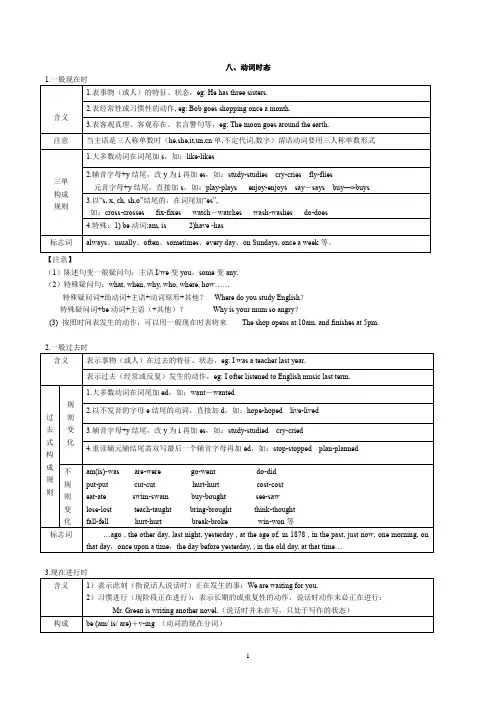
八、动词时态【注意】(1)陈述句变一般疑问句:主语I/we变you,some变any.(2)特殊疑问句:what, when, why, who, where, how……特殊疑问词+助动词+主语+动词原形+其他?Where do you study English?特殊疑问词+be动词+主语(+其他)?Why is your mum so angry?(3) 按照时间表发生的动作,可以用一般现在时表将来The shop opens at 10am. and finishes at 5pm.【注意】(1)always也可用于现在进行时,表示一种强烈的感情色彩,译为“总是”He is always telling lies.(2)某些特殊动词不能用于现在进行时。
① have当“有”讲时,不能用现在进行时。
I have two books now.②“belong to” The two people belong to me now.③表示“心理活动/状态/感觉”的词I want a dog now.① be going to主要用于:主观判断(1)表示事先经过考虑、安排好打算要做的事情:I’m going to play the violin.(2)表示根据目前某种迹象判断,某事非常有可能发生(有迹象表明要发生的事)。
Look!There come the dark clouds. It is going to rain.② will主要用于:(1)客观上将来势必发生的事情, 未经事先考虑, 临时决定的They will go to visit the factory tomorrow.(2)表示不以人的意志为转移的自然发展的未来的事:Today is Saturday. Tomorrow will be Sunday.(3)表意愿。
问对方是否愿意做某事或表示客气地邀请或命令:Will you please turn on the radio?(1) have/has been to “去过已回”She has been to Japan twice.have/has gone to. “去了未回”Where is your twin sister? She has gone to Japan.have/has been in “待在某地” She has been in Japan for 2 years. (2) 动词从词义上可以分为延续性和非延续性两种。
中考复习-动词时态 初中九年级英语教学PPT课件 人教版

A. came
B. is coming
C. was coming es
1.发生时间 2.时态结构
未来,还没发生的事
主语+will+动词原形+其他
将要做某事
主语+be(am/is/are) going to+动词原形+其他 打算做某事,根据现象进行推断
3.时态标志 1.tomorrow,next...,in the future,in +时间段
3.两个动作同时发生 长动作:过去进行时 短动作:一般过去时 when-- 长/短 while--长
两个长动作用while
1.当老师进门时我们在说话。 2.当我们在说话时老师进门了。 3.当我们在说话时,小明在写作业。
When the teacher came in ,we were talking.
2.There be 句型: There is/are oing to be There will be
打死不能改
3.主将从现
1.He has gone to Paris.He ______back in three days. A.will come es C. has come D.came
2. There ______ a heavy rain in Beijing tomorrow.
A. is
B. will be
C. is going to have D.will have
3.When he _____here,I________ you.
A. will come, will tell B. comes, tell
camping on the Fenghuang mountain.
(完整版)初中英语八大时态语态总复习时态讲解.docx

初中英语八大时态语态总复习时态讲解一般现在时态【展示平台】1 一般现在时态用来表示经常,反复,习惯性发生的动作或存在的状态,常与表示频率的副词 sometimes(有时) , often(经常), usually(通常), always (总是)等连用。
时间状语in the morning/ afternoon/ evening(在上午/下午 / 晚上) , every day/ week/ month/ year(每天/周/月/年, at noon/night (在中午 / 夜里) , on Monday/Tuesday (在星期一 / 二)等也可用在一般现在时态中。
如:Bruce usually walks to school.We have two P.E classes every week.布鲁斯通常步行去上学。
我们每周上两节体育课。
2 表示现在的特征或状态。
如:She is always ready to help others.He is 13 years old. 他 13 岁了。
她总是乐于助人。
3表示事实或客观真理,或在谚语中,也用一般现在时。
如:The sun rises in the east and sets in the west every day.太阳每天东升西落。
When there is a will, there is a way.有志者,事竟成。
4一般现在时的基本句型1)肯定句:①主语+动词原形+其他②主语(第三人称单数)+ 动词 -s+ 其他如: They live in China.他们住在中国。
He likes eating apples.他喜欢吃苹果。
2)否定句:①主语+don’t+动词原形+其他②主语(第三人称单数) +doesn’t+ 动词原形如: They don ’t live in China.他们不住在中国。
He doesn’t like eating apples.他不喜欢吃苹果。
人教版初中英语中考时态复习(全国通用)英语八种时态讲解及练习

10. I will go there when I _____(have, will have, has) time tomorrow. 11. He won’t come to the party unless he _____(be, will be, am, is, are) invited. 12. I’ll wait here until my mother ____(come, comes, will come) back. 13. Please return the book to the library as soon as you ______(finish, finishes, will finish) reading it. 14. Once you _____(see, sees, will see) him, you will never forget him.
1.I ____(write, am writing, is writing, are writing) a letter now. 2.Look, it _____(begin, is beginning, am beginning, are beginning) to rain. 3.They ____(study, is studying, am studying, are studying) medicine at the Medical Institute of Chengde these days. 24.He _____(teach, am teaching, is teaching, are teaching) an English lesson at this time.
现在进行时
作谓语的动词用来表示动作(情况) 发生时间的各种形式称为时态。
动词的时态和语态-PPT课件

9. The boys __w_e_r_e_p_l_a_y_in_g___ (play) basketball from 5:00 to 6:00 yesterday.Βιβλιοθήκη .19练习
.
20
用所给动词的正确形式填空: 1. She _l_e_ft__ (leave) the office two
hours ago. 2. As son as she arrived home, the girl
discovered that she _h_a_d__t_a_k_e_n__ (take) her friends book by mistake. 3. Who _c_o_m__e_s__ (come) to school earliest in your class every morning? 4. Great changes _h_a_v_e_t_a_k_e_n_p__la_c_e__ (take place) in this city since 1979. 5. By the time he was twelve, Edison _h_a_d__b_e_g_u_n_ (begin.) to sell newspape21rs.
I’ll go to see you when I have time. I’ll go to see you if I have time tomorrow. 2. 某些动词,如:stand, continue, wish, love, like, hate, feel, find, think等常用一般现在时态
人教版中考英语复习动词的时态课件(36张)
Exercise
1. Grandpa ______A_ glasses when he reads.(河
北)
A.wears
B. wore
C. has worn
D. was wearing
2. We each __B____WeChat nowadays,even the old people.(黑龙江龙东)
4.否定形式:
①was/were+not; ② didn’t +动词原形 He finished his homework. He didn’t finish his homework.
5.一般疑问句:
①was或were放于句首; ② Did +…+动词原形……? I swept the floor just now.(一般疑问句) Did you sweep the floor just now?
•注意:动词have的第三人称单数是has.
• 写出下列动词的单数第三人称形式。 • 1.cook_______ 2.watch________ • 3.build_________ 4.have________ • 5.wash________ 6. enjoy ______ • 7. go _________ 8 receive ______ • 9 cry______ 10. close ________ • 11. drive _______12. choose ______ • 13. play _______14. reach ________
如:I am 15.
Are you 15?
• 例如: • The earth turns round the sun.
(宇宙不变的真理) • I get up at six every morning.
中考专题复习---动词的时态和语态ppt课件
times a day , etc
.
6
一般现在时用法
习惯活动 I get up at six every morning.
现在情况
They are very busy. He needs help.
客观事实 主将从现
The moon moves around the earth.
We’ll go there if it doesn’t rain. He’ll call you when he arrives. -
概念:表示将来某个时间要发生的动 作或存在的状态
构成形式 :1. will/shall+do
2. am/is/are going to+do
3. am/is/are + doing
常用时间状语 :
tomorrow, in three days,this…,
next…, soon, etc. .
18
一般将来时用法 将来状态 There will be rain tomorrow. 将来活动 What are you going to do next
weekend?
主将从现 I will call you as soon as I get
there tomorrow morning.
现进表将 The bus is coming.
.
19
一般将来时的注意点:
Look at the dark clouds, it _is__g_o_in_g__to_rain. Tomorrow ___w_i_ll__ be April Fool’s Day.
C. wrote D. was writing
2. _W__h_il_e_Jim was making a paper plane ,
中考英语(人教版)动词的时态和语态 (共114张PPT)
考点二 一般过去时 1.概念、句式结构及常用的时间状语 (1)概念:一般过去时表示过去某个时间所发生的动作 或存在的状态。
(2)句式结构(肯定句)有以下四种:
句式结构
例句
was/were+表语 She was a beautiful girl ten years ago. Her father was on business.
句式结构
例句
am/is/are+表语
She is a beautiful girl. Her father is always on business.
there is/are
There is a schoolbag on the desk. There are five people in my family.
(3)常用的时间状语有:yesterday(昨天), the day before yesterday(前天), last week(上星期), last month(上个月), last year(去年), two days ago(两天前), three years ago(三年 前), in 2001(在 2001 年), just now(刚才)等。
(3)描述客观真理、客观存在或科学事实等。 The light travels faster than the sound. 光比声音传播得快。 The sun rises in the east.太阳从东方升起。
注意 在宾语从句中,即使主句是一般过去时,但 从句表示客观真理、客观存在或科学事实时,从句依然用 一般现在时。
(根据汉语意思完成句子。) 如果我找到他的电话号码,我会告诉你。 If I find his phone number, I will tell you.
2024年人教版中考英语动词的时态课件
→A nice present is often given to him at Christmas by us.
在圣诞节我们经常给他一个漂亮 的礼物。
(4)短语是整体:勿忘介词或 副词。
如:We can't laugh at him.→He can't be laughed at by us. 我们不能嘲 笑他。
过去完成时 (一)过去完成时的概念 过去完成时表示一个动作或状态 在过去某一时间或动作之前已经完 成或结束。
(二)过去完成时的构成:had +Vpp.(过去分词)
如:He told me he had read the
book three days before. 他告诉我他三天前就已读过这本
书了。 (三)过去完成时的用法 1. 宾语从句中如果主句用过去
→My wallet was seen to drop by a girl when she passed by.
一个女孩经过的时候看见我的钱包 掉了。
The boss made the little boy do heavy work.
→The little boy was made to do heavy work by the boss.
be going to do
will/shall be done be going to be done
They will plant trees tomorrow.
现在 完成时
have/has done
have/has been done
Jim has finished the work.