
Unit 5 Visiting the Moon 教案1(牛津深圳版七年级上册)
《Chapter5 Beyond time and space(1)》The first period: words preparation and scanningTeaching aims:1.To improve the Ss’ reading skills.2.To learn some new words and learn to use them.Teaching Difficulties:Design general reading tasks and specific reading tasks to help students to fully understand the new words and improve their scanning skills.Teaching focuses:1.Help students to master the new words.2.help the students to read a passage with some new words in it.Teaching aids: some paper and multi-media.Teaching procedures:Step1 Lead-in:Begin the class like this:T: “What beautiful planet s! Do you want to go there?”Ss: “Yes”.T: “Who can go there?”Ss: “…”T: “ They can go there"T: “Astronauts can go to other planets.Notes: an astronaut: a spaceman/spacewomanT: “Now another question for you, how did astronauts arrive in other planets?”T: They can arrive there by spaceships.Notes: spaceship( space + ship ): a vehicle that travels in space.T: They also can go there by rockets.T: “ How did astronauts take photos?T: They take photos by using telescopes.Notes: a telescope ( tele-= distant; -scope=instrument)A telescope makes distant things seem near.Step2 word studyThe teacher introduces all the characters of the story at first. (pictures) King—captain Lam—pilotPeters—navigator Gork—monster some kangroosNotes;captain:pilot:navigator:monster:kangaroo:step3 pre-readingExercise1:P58 section B Look and thinkThe teacher gives some explanation to the students.“Captain King often tells his friends stories of his space adventures.”space:adventure:page:introduction:sad:earth:probably:be in trouble:afraid:dangerous:Then ask students to look at the picture on page 59 and finish the exercises on page 58.At last the teacher checks answers.Step4 More words and phrases:(The teacher can introduce a relative storyor topic to introduce more new words andphrases to students)Towards evening:Land on:Bring us to a cave:Go through:Get out of:Suddenly:Roar:Alien:Press a button:steel bars:0ver the head:appear from the ground:name oneself:in pieces:turn to someone:in peace:trust me:step5 Homework:Oxford English Comprehensive Exercise Book on page54 section A and BThe second period: while-readingTeaching aims:1Improve the Ss’ reading skills2 Consolidate the new words and learn to use them3 Go over the time references, prepositions of location, determiners and indefinite pronounsTeaching Difficulties:Design general reading tasks and specific reading tasks to help students to fully understand the new words and the text and improve their reading skills. Teaching focuses:1. Help students to master the new words.2. Help the students to read a passage with some new words in it.3.Help the Ss to fully understand the text.Teaching aids: some paper, a tape recorder and multi-media.Teaching procedures:Step1 Lead-in:Talk about the picture on page 59.Step2: listeningListen to the tape recorder, then answer the following questions:Where are they?What is the monster going to do?Why did the captain call himself “Nobody”?Step3: ReadingRead the following passage and then finish the tasksTask1: Page 60 Part C1 group work (group of twos )After the teacher has explained the text, ask the students to finish:Task2: Page 61Part D1group work (group of twos)Task3: Page 60 Part D2group work (group of fours)Read the text again and finish task4.Task4: Page 74 Part E group work (group of twos )Step4 Post-readingRead the text on page 70—More practiceStep5 HomeworkOxford English Comprehensive Exercise Book on page61 section A, B and CThe third period: language learningTeaching aims:Help students to fully understand the text.Teaching Difficulties:Fully understanding of the textTeaching focuses:Words, phrases and sentence patterns appeared in the textTeaching aids: some paper and multi-media.Teaching procedures:Step 1 Retell the storyAsk the student to retell the story by giving the following words: Towards evening—landed on—found a cave—suddenly—the door—opened—a monster came in—roared—wanted to kill—pressed—we—in troubleStep2 Language points1.Towards evening, we landed on an unknown planet.towards (prep.) close to a certain point in timetowards five o’clockChildren in China are always excited towards Chinese New Year.Towards evening是"将近傍晚,天快黑时”的意思。
在这里towards是“(时间)近……,……左右”的意思。
land (v.): reach a place in a plane or a shipland (on)是“着陆,靠岸”的意思。
land 的反义词是take off(起飞)We don’t know exactly when mankind will land on the Mars.The plane landed at Heathrow Airport.m, our pilot, brought us to a cave. We went through it.pilot (n.) a person who steers a ship or a flies a planeThe pilot landed the plane safely.cave (n.) a large opening in a mountain or under the groundWe found a cave in the mountain.go through (phrasal v.) go from one end of something to the otherIt took us a long time to go through the big forest.3.Everything inside was huge. = Everything inside was big.4.Maybe he is friendly. = He may be friendly.5.kangaroo (pl. kangaroos) : a large Australian animal with a pocket on itsfrontThe kangaroo is the symbol of Australia.6.Then Gork saw us and roared. = Gork was very angry when he saw us.7.alien (n.) a person from another country or a creature from another worldAt noon today, a spaceship full of aliens landed in Shenzhen Park.8.Tomorrow you are going to die. = You won’t be alive tomorrow.(We can use be going to with a verb when we intend to plan for somethingto happen in the future, or when we think something will probably happenin the future.)There is going to be a basketball game tomorrow.I am going to be busy this week.He is not going to see a film.9.Then he pressed the button on the wall.press (v.) push something with great forcebutton (n.): an electrical switch on a machineWill you please press the lift button for me?I pressed the power button, and the computer started.10. Steel bars appeared from the ground around us and closed over our heads.steel (n.): metal made mainly of ironThe bank has a steel door to keep out thieves.bar (n.): a piece of something with a square shapeI bought two bars of soap yesterday.appear (v.) come in sightA taxi appeared around the corner.11. Why did you call yourself “Nobody”? = What did you name yourself ‘Nobody ’for?12 reply (v.) give an answer(to)‘I will do my best to finish the job,’ he replied firmly.13 I turned to Gork and said, ‘We come in peace, Mr Gork.’turn to sb.是“转向某人”的意思。
VisitingtheMoon教案牛津深圳版

d. We will meet astronauts in space. → We like meeting astronauts in space.
2.句型转换题
题目:将下列句子转换为一般现在时的句型。
答案:
a. I will go to the moon next year. → I like going to the moon.
b. They will visit Mars in 2030. → They like visiting Mars.
8.鼓励学生探索太空探索与人类生活的联系,如太空技术在日常生活中的应用、太空探索对人类价值观的影响等,培养学生的批判性思维能力。
作业布置与反馈
1.作业布置:
(1)词汇练习:要求学生复习本节课所学的太空相关词汇,通过造句或编写小故事的方式,运用所学的词汇。
(2)句型练习:要求学生运用一般现在时句型描述太空旅行的情况,可以是自己的经历、想象或观察到的现象。
2.鼓励学生进行课后自主学习和探究,如搜索更多关于太空探索的资讯、观看太空相关的纪录片、参与线上太空探索模拟游戏等。
3.引导学生思考太空探索对人类的意义,如科学技术的进步、人类对宇宙的理解、太空资源的开采等。
4.鼓励学生探讨太空探索所面临的挑战和解决方案,如太空垃圾的处理、太空旅行的安全性、太空殖民的可行性等。
e. He is going to study the stars. → He likes studying the stars.
3.礼貌用语应用题
牛津深圳版英语七年级上册Unit5VistingtheMoon单元整体教学设计
3.能够运用一般现在时和一般过去时描述月球的特点和探索活动,提高学生的语法运用能力。
4.培养学生运用英语进行科学探究的能力,激发学生对科学知识的兴趣。
(二)过程与方法
1.通过小组合作、讨论、分享等方式,培养学生合作学习的能力,提高学生的英语口语表达能力。
-对于基础薄弱的学生,重点巩固一般现在时和一般过去时的基本用法,确保他们能够熟练运用。
-对于基础较好的学生,引导他们运用复杂句型和高级词汇进行口语表达,提高他们的语言运用能力。
3.合作学习,提高口语表达能力:组织丰富多样的课堂活动,如角色扮演、小组讨论等,让学生在实际语境中运用所学知识,提高口语表达能力。
-学生观看图片和视频,思考问题,进行初步讨论。
-教师邀请学生分享自己的看法,引导学生关注月球探索的重要性。
3.教学目标:通过导入环节,让学生初步了解月球探索的背景,激发学生对新课的学习兴趣。
(二)讲授新知
1.教学内容:本节课主要学习一般现在时和一般过去时的用法,以及与月球探索相关的词汇和句型。
2.教学过程:
2.利用多媒体资源,如图片、视频等,帮助学生形象地理解月球的相关知识,提高学生的信息获取和筛选能力。
3.设计丰富的课堂活动,如角色扮演、模拟探险等,让学生在实际情境中运用所学知识,提高学生的实践操作能力。
4.引导学生运用思维导图、列表等方式进行知识梳理,提高学生的思维能力和自主学习能力。
(三)情感态度与价值观
4.学生对多媒体资源具有较强的兴趣,有利于激发他们的学习积极性。
5.学生在情感态度上,对未知事物充满好奇,有利于引导他们探索月球相关知识。
针对以上学情,教师在教学过程中应关注个体差异,充分调动学生的积极性,提高他们的英语综合运用能力,同时注重培养学生的合作意识和探究精神。
Unit5VisitingtheMoon讲义牛津深圳版七年级英语上册
Unit 5 Visiting the MoonGetting ready1.Read a student’s diary about a trip to space.①diary n 日记diaries (复数)keep a diary 写日记② space n 太空;空间space station 太空站space travel 太空旅行make space for 为....腾出空间2.Plan a trip to the Space Museum.plan v 计划plan to do sth 计划做某事n 计划make a plan = make plans 制定计划Reading1.There can be more than one answer.more than 多于;超过用于数词前,相当于over,反义短语less than意为“少于;不到”There were more than 50 people on stage inone scene.By now, more than 50 people have died in theearthquake.2.Nervous.nervous[形容词]紧张的be/feel nervous about/of sth. 对...感到紧张eg:Whenever I see you, I feel nervous.I'm always nervous about tests.[拓展]nervously副词紧张不安地—I'm so because the interview is ing.—Don't worry! Maybe listening to some soft music is helpful.A. shyB. activeC. nervous3.The spaceship will leave .leave[动词]离开My father leaves home at 8 a.m. every day.[拓展]①leave[动词]留下,遗忘She sometimes leaves her schoolbag on the bus.②leave[动词]为了使保留,让…处于(某种状态或某地等)常用结构:leave+宾语十宾语补足语。
牛津深圳版英语七年级上册Unit5VistingtheMoon单元整体优秀教学案例
5.学生能够运用所学知识,撰写一篇关于太空探索的短文,提高写作能力。
(二)过程与方法
1.学生通过观察、思考、实践等方式,主动探究太空探索的相关知识,培养独立思考和解决问题的能力。
2.学生通过合作学习、讨论交流等方式,提高团队协作能力,培养良好的人际沟通和合作精神。
2.教师可以要求学生在作业中运用所学单词、短语、句型等,巩固和加深对知识的理解和运用。
3.教师可以对学生的作业进行评价和反馈,给予他们及时的指导和鼓励,帮助他们提高学习效果和自信心。
五、案例亮点
1.情景创设丰富多样:本案例通过展示太空图片、视频资料,设计太空探索场景等方式,为学生营造了一个生动有趣的太空探索情境。这种情境创设不仅激发了学生的学习兴趣和好奇心,还帮助他们更好地理解和记忆太空探索的相关知识。
2.教师可以提出一些太空探索相关的问题,如“你们对太空有什么了解?”,“你们最感兴趣的太空探索话题是什么?”等,激发学生的思考和参与欲望。
3.教师可以利用多媒体技术,创建一个虚拟的太空探索环境,让学生在互动中感受太空的神秘和魅力,为后续学习做好铺垫。
(二)讲授新知
1.教师可以按照教材的顺序,讲解本节课的重点单词和短语,如“visit, moon, space, rocket, launch”等,同时给出例句,让学生理解和运用。
2.教师可以对本节课的重点单词、短语、句型、语法等进行归纳和总结,让学生有一个清晰的学习框架。
3.教师可以对本节课的学习内容和过程进行回顾,引导学生反思自己的学习方法和策略,提高他们的自我认知和自我调整能力。
(五)作业小结
1.教师可以布置一些与太空探索相关的作业,如写一篇关于太空探索的短文,制作一个太空探索的PPT等,让学生在实践中运用所学知识。
最新牛津深圳版七年级英语上册Unit5 visiting the moon教案
7A Unit5 Visiting the Moon知识点归纳重点单词: diary, space, spaceship, spacesuit, nervous, leave, gravity, able, float, tie, ourselves, without, weak, bre athe, if, camera, work, garden, rock, postcard, machine, return.重点短语 more than, be able to, have to, so that, take photos, as…as…, that is, such as.课文重点句子解析Reading1.How will Jerry travel?How may Jerry feel about the trip?travel, trip, journey的用法辨析: 三者区别如下1). travel 泛指一般意义的旅行 是不可数名词。
如 He is fond of travel (= travelling). 他喜欢旅行。
Travel is much cheaper than it used to be. 现在旅行比过去便宜多了。
注 有时可用复数形式 主要指时间较长的各处旅行 此时通常有物主代词修饰 但是尽管用了复数形式 却不能与many 或数词连用。
如 He’s gone off on his travels again. 他又外出旅行了。
另外 travel 通常只是泛指旅行 而不特指某次具体的旅行 所以通常不说 How was your travel?2). journey 通常指远距离的陆地旅行 并且不一定要返回到出发地(即通常指单程)。
如I wish you a pleasant journey. 祝你一路顺风。
He made a journey to Beijing. 他去北京旅行了。
深圳优质课教案 深圳牛津版七年级英语7A U5 Visiting the moon Language教学设计
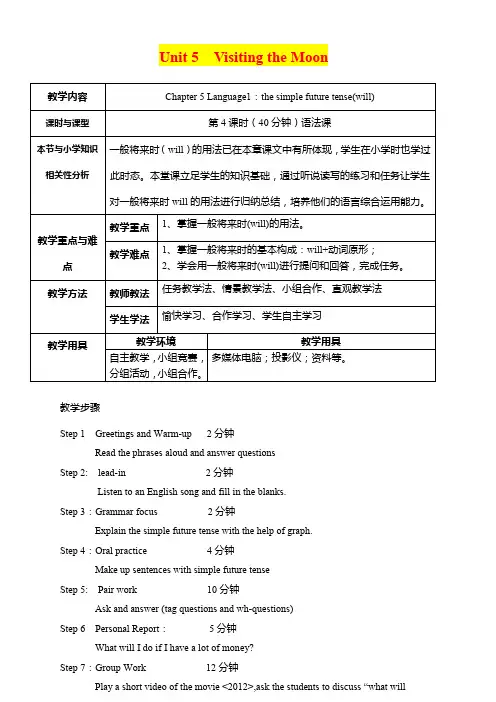
Unit 5 Visiting the Moon教学步骤Step 1 Greetings and Warm-up 2分钟Read the phrases aloud and answer questionsStep 2: lead-in 2分钟Listen to an English song and fill in the blanks.Step 3:Grammar focus 2分钟Explain the simple future tense with the help of graph.Step 4:Oral practice 4分钟Make up sentences with simple future tenseStep 5: Pair work 10分钟Ask and answer (tag questions and wh-questions)Step 6 Personal Report:5分钟What will I do if I have a lot of money?Step 7:Group Work 12分钟Play a short video of the movie <2012>,ask the students to discuss “what willyou do if it is true?” Make a report.Step 8:Sum-up 2分钟1.一般将来时表示在将来某一时间将要发生的动作或存在的状态,也可表示将来某一段时间内经常发生的动作或存在的状态。
2.结构:will +动词原形否定形式:will not/won’t +动词原形一般疑问句:Will sb. do sth.?回答:Yes,… will./No, …won’t.特殊疑问句:特殊疑问词+一般疑问句Step 9: Homework 1分钟。
牛津深圳版英语七上Uint 5《visiting》the moon grammar教学设计
牛津深圳版英语七上Uint 5《visiting》the moon grammar教学设计一. 教材分析《牛津深圳版英语七上Unit 5 the Moon》主要介绍了月球的基本知识以及人类对月球的探索历程。
本节课主要通过一个关于参观月球的故事,让学生掌握一般过去时的被动语态和特殊疑问词组“How did…”的用法。
教材内容丰富,插图生动有趣,激发了学生学习英语的兴趣。
二. 学情分析七年级的学生对新鲜事物充满好奇,具有强烈的探索欲望。
他们已经掌握了一般过去时的基本用法,但对被动语态和特殊疑问词组的运用还不够熟练。
因此,在教学过程中,需要引导学生通过观察、思考、实践来掌握这些语法知识。
三. 教学目标1.知识目标:–能理解并运用一般过去时的被动语态。
–能正确使用特殊疑问词组“How did…”进行提问。
–了解月球的基本知识和人类对月球的探索历程。
2.能力目标:–能用英语描述月球的特点和人类的探索历程。
–能通过合作、讨论等方式提高语言运用能力。
3.情感目标:–培养学生的团队合作精神,激发他们对科学的热爱和探索精神。
四. 教学重难点•一般过去时的被动语态。
•特殊疑问词组“How did…”的用法。
•一般过去时被动语态的运用。
•如何在实际语境中正确使用特殊疑问词组。
五. 教学方法1.情境教学法:通过设定月球参观的情境,让学生在实际语境中感知和运用语法知识。
2.任务型教学法:通过完成各种任务,让学生在实践中掌握语法知识。
3.合作学习法:引导学生进行小组合作、讨论,提高学生的语言运用能力和团队合作精神。
六. 教学准备1.教学课件:制作与教材内容相关的课件,包括图片、动画、视频等。
2.教学道具:准备一些与月球相关的道具,如月球地图、月球岩石等。
3.教学资源:收集一些关于月球的资料,如月球探索的历史、月球的科技应用等。
七. 教学过程1.导入(5分钟)–利用多媒体展示月球的美丽景色,引导学生谈论对月球的向往。
–提问:“If you could visit the moon, what would you like to do?”,激发学生的想象力。
牛津深圳版英语七上Uint 5《visiting》the moon reading教学设计
牛津深圳版英语七上Uint 5《visiting》the moon reading教学设计一. 教材分析本单元的主题是“Visiting the Moon”,主要让学生通过阅读了解月球的基本情况,以及人类对月球的探索历程。
文章以第一人称的视角,描述了作者乘坐宇宙飞船访问月球的过程。
文章语言生动有趣,贴近学生的生活,能够激发学生对科学的兴趣和对英语学习的热情。
二. 学情分析七年级的学生已经掌握了基本的英语语法和词汇,但对于一些关于科学的词汇和表达可能还比较陌生。
因此,在教学过程中,需要帮助学生理解文章中的科学知识,并能够运用所学的词汇和语法进行表达。
三. 教学目标1.知识目标:学生能够掌握文章中的核心词汇和短语,如“lunarmodule”、“zero gravity”等;学生能够理解文章的主旨大意,了解月球的基本情况和人类对月球的探索历程。
2.能力目标:学生能够通过阅读获取信息,提高阅读理解能力;学生能够运用所学的词汇和语法进行表达,提高口语和写作能力。
3.情感目标:学生能够激发对科学的兴趣和对英语学习的热情。
四. 教学重难点1.重点:学生能够掌握文章中的核心词汇和短语;学生能够理解文章的主旨大意。
2.难点:学生能够理解文章中的科学知识,如月球的构成、地球和月球的关系等;学生能够运用所学的词汇和语法进行表达。
五. 教学方法1.任务型教学法:通过设定各种任务,让学生在完成任务的过程中,运用所学的词汇和语法进行表达,提高口语和写作能力。
2.情境教学法:通过模拟宇宙飞船访问月球的情境,让学生在情境中学习,提高学习兴趣。
3.小组合作学习:通过小组讨论和合作,让学生共同完成学习任务,提高团队协作能力。
六. 教学准备1.教师准备:准备好文章的PPT,以及相关的教学材料和道具。
2.学生准备:学生预习文章,查阅不懂的词汇和短语。
七. 教学过程1.导入(5分钟)教师通过提问方式引导学生思考:你们对月球有什么了解?人类有没有登上过月球?激发学生对月球的好奇心,导入新课。
和单元练习牛津深圳版(广州沈阳)七年级英语上册Unit5VisitingtheMoon教学设计
(四)课堂练习
1.设计各种类型的练习题,如选择题、填空题、改错题等,让学生巩固所学知识。
2.让学生进行口语练习,如角色扮演、情景对话等,提高他们的口语表达能力。
3.布置一篇关于月球旅行的写作任务,要求学生运用本单元所学的词汇、句型和时态,充分发挥想象力。
此外,学生们在听说读写方面的能力参差不齐,部分学生存在听力、口语表达困难,而另一部分学生在阅读和写作方面表现较好。因此,在教学过程中,教师应充分考虑到学生的个体差异,因材施教,设计不同难度的教学活动,使每位学生都能在课堂上得到锻炼和提升。
在情感态度方面,学生们对团队合作和探究学习充满热情,但部分学生可能在学习过程中缺乏自信,容易产生挫败感。因此,教师需要关注学生的情感需求,适时给予鼓励和表扬,帮助他们建立自信心,激发学习动力。
-培养学生的信息搜集和整理能力。
-加强学生的口语表达和公众演讲能力。
6.家长参与作业:鼓励家长与孩子一起讨论月球旅行的可能性,并记录下讨论过程中的亮点,以便在课堂上分享。
-增进家校合作,让家长了解孩子的学习内容。
-激发学生对太空探索的持续兴趣。
6.结合课文内容,引导学生关注太空探索过程中的环境保护和可持续发展,通过讨论、辩论等形式,培养学生的思辨能力和环保意识。
7.创设互动、轻松的课堂氛围,鼓励学生积极参与,敢于表达,克服学习中的困难,建立自信心。
8.定期进行课后跟踪辅导,了解学生的学习进度和需求,及时调整教学策略,以提高教学效果。
四、教学内容与过程
3.重点:引导学生关注太空探索过程中的环境保护和可持续发展。
难点:如何将这一主题与学生的实际生活相结合,使他们在情感态度上产生共鸣。
最新牛津深圳版初中英语七年级上册Module 3 Travels 5 visiting the moon 公开课教学设计 (1)
Module 1 ChangeUnit 5 In the future一. 教学内容:Module 1 Change Unit 5 In the future(一)课标词汇(二)重点短语(三)重点句型(四)用副词“perhaps”表达将来的可能(五)如何表达自己的观点二、知识总结与归纳(一)课标词汇1. room2. understand3. either4. pill5. sign (二)重点短语1. enough room2. understand each other3. have no place to live4. cities under the sea5. think so6. take pills only7. in twenty years’ time 8. hope so9. everyone on the earth 10. a space station11. a time box12. in the future13. write down14. people in different countries15. al l the pieces of paper 16. be able to(三)重点句型1. What may happen in the future?2. I hope so.3.I hope not.4. I (don’t)think so.5. The people in different countries will be able to understand each other better.(四)用副词“perhaps”表达将来的可能perhaps adv.也许、可能Perhaps he will come tomorrow.Perhaps there will be more people.Perhaps there may not be enough food.(五)如何表达自己的观点I think so. / I agree. 表示同意别人的观点I don’t think so. / I don’t agree. 表示不同意别人的观点[来源:学。