
外研版七年级下册英语课件Module 11 Unit 2
use in different countries and places.
Stand Touch
Look at people
2. Is it all right to stand close to people in the Middle East? Yes, it is all right to stand close to people in the Middle East.
3. Do the British like touching people? No, they don’t.
Patterns: Here are some ways to welcome them. How about touching people?
Review
Words and expressions
finger n. 手指 foot n. (pl. feet) 脚,足 knee n. 膝盖 leg n. 腿
11
Unit 2 Here are some ways to
welcome them.
➢To learn the key words and useful phrases in this passage.
➢To know the different body languages in different countries.
Do you look at people when you talk? In some places, it isn’t polite to look at people when you talk, but in other countries it isn’t polite to look somewhere else. In Britain and the US, people usually look at each other when they talk.
And how do you say goodbye? That’s easy, wave to say goodbye. But be careful! In Greece, it’s not at all polite! In fact, it’s very rude!
1. Is body language the same in different countries? No, it isn’t the same.
not at all 一点也不 polite adj. 礼貌的
somewhere adv. 某处;某个地方 wave v. 挥(手);招(手);摆(手) fact n. 事实;细节
in fact 事实上 rude adj. 粗鲁的;无礼的
New words
点击查看 动画词汇
下一页 foot
New words
点击查看 动画词汇
head
下一页
New words
点击查看 动画词汇
body
下一页
New words点击查看 Biblioteka 画词汇hold下一页
点击查看 动画词汇
move
下一页
1 Match the words with the parts of the
body. finger
mouth
eye
knee
leg
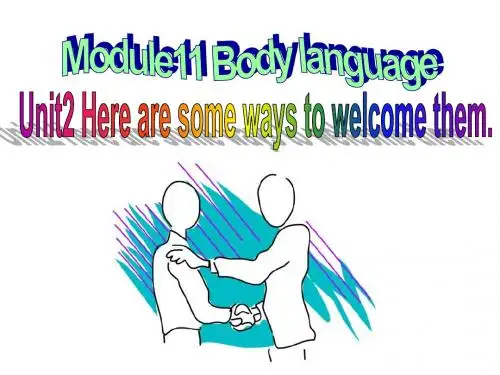
How about touching people? Chinese girls often walk arm in arm with their friends. South Americans sometimes hold your arm when they talk to you, so you can’t move away! But in Britain may people don’t like other people to touch them at all.
Words: finger, foot, knee, mouth foreign, body, personal, leg polite, somewhere, hold, move, rude
Phrases: arm in arm, move away not at all, in fact, close to
foot
Reading and vocabulary
2 Firstly, listen to the passage.
Then, read the passage and answer the questions.
点击查看 下一页
Body language around the world By Wang Lingling
4. Do Americans look at people when they talk? Yes, they do.
5. Do people in Greece wave goodbye? No, they don’t. It’s not polite.
3 Check ( ) the body language you can
Our new foreign students are going to arrive very soon, and here are some ways to welcome them. How close do you stand when you talk to a friend? You can stand close to people in the Middle East but don’t stand too close to North Americans! Give them more personal space.
mouth n. 嘴,口 body n. 身体,躯干
foreign adj. 外国的 North American 北美人
personal adj. 个人的 arm n. 臂;手臂
arm in arm 臂挽臂地 South American 南美人
hold v. (held) 握着;使不动 move v. 移动 Britain 不列颠;英国
合集下载
外研版英语七年级下Module11 Unit2课件(共41张ppt)

How about touching people? Chinese girls often walk arm in arm with their friends. South Americans sometimes hold your arm when they talk to you, so you can’t move away! But in Britain may people don’t like other people to touch them at all.
shoulder to shoulder 肩并肩
2. South Americans sometimes hold your arm when they talk to you… 南美人有时在和你说话的时候会抓着你的手臂…… hold 握住,抓住,过去式是held。 The mother held the baby in her arm. 那位母亲把婴儿抱在怀里。 你能帮我拿着这些书吗?
7. one of the two long parts of your body between your shoulders and your hands
Words: finger, foot, knee, mouth foreign, body, personal, leg polite, somewhere, hold, move, rude
Phrases: arm in arm, move away not at all, in fact, close to
someone
personal
polite
rude
wave fact
课时重点回顾
全世界 肢体语言
中东 私人空间 臂挽臂地 移开/移走 一点也不
外研英语七年级下册Module11Unit2 (共23张PPT)
知识提升
三、根据课本Act.2内容,完成下列思维导图, 然后口头复述课文。
ways close
look at goodbye
Make a list of class rules for new students in your school. (imperative sentences)
Stand up when you answer a question in class. Don’t be late for class. Be polite to the teacher. Don’t eat food in class.
目录 agraph 2 in group.
The word “space” in Para.2 means in Chinese. A.太空 B.房间 C.空间 D.宇宙
Is it all right to stand close to people in the Middle East? Yes, It is .
情感态度:了解世界不同的风俗习惯,学会互相尊重 培养跨文化价值素养
eye finger foot knee leg mouth
目录 contents
课文导读
Britain
Middle East China
North America
South America
Para.1 Do you look at people when you talk?
Module 11 Body language
Unit 2 Here are some ways
to welcome them.
目录 contents
目标展示 课文导学 课文理解 知识提升 4
外研版七年级英语下册Module11 Unit2 课件

When we got to the park, it began to rain. 我们到达公园时,就开始下雨 了。
在谈到火车、汽车等或乘客等到站时,通常用 get in。 如:
The bus gets in at five thirty. 汽车五点半到站。
arrive 和 get 之后均可接 here, there, home 之类 的表地点的副词作状语。如:
There are many places of interest(名胜) in Paris .
Place de la Concorde in Paris协和广场
Arc De Triomphe 凯旋门
Cathedral of Notre Dame 巴黎圣母院
Versailles凡尔赛宫
the Seine River 塞纳河
6. When did they go to the Eiffel Tower? They went to the Eiffel Tower at about three o’clock.
7. How did they get to the Eiffel Tower? They went there by underground.
我想跳舞是个很好的恶消闲方式。 relaxed adj. 感到放松 (跟人有关) He was relaxed when he returned from his vacation last Sunday.
上星期天他度假回来感到很放松。
C
relaxing
relaxe
relaxed
Can you sell me some coffee? v. (sold) 卖;出售
Read Part 1 and answer the questions.
在谈到火车、汽车等或乘客等到站时,通常用 get in。 如:
The bus gets in at five thirty. 汽车五点半到站。
arrive 和 get 之后均可接 here, there, home 之类 的表地点的副词作状语。如:
There are many places of interest(名胜) in Paris .
Place de la Concorde in Paris协和广场
Arc De Triomphe 凯旋门
Cathedral of Notre Dame 巴黎圣母院
Versailles凡尔赛宫
the Seine River 塞纳河
6. When did they go to the Eiffel Tower? They went to the Eiffel Tower at about three o’clock.
7. How did they get to the Eiffel Tower? They went there by underground.
我想跳舞是个很好的恶消闲方式。 relaxed adj. 感到放松 (跟人有关) He was relaxed when he returned from his vacation last Sunday.
上星期天他度假回来感到很放松。
C
relaxing
relaxe
relaxed
Can you sell me some coffee? v. (sold) 卖;出售
Read Part 1 and answer the questions.
Module 11 Unit 2 课件 初中英语外研版七年级下册(29张PPT)
3.根据你的个人情况,回答下面的问题。 (1)Are you late for class? (2)Do you eat food in class? (3)Do you sleep in class? (4)Do you listen to the teacher carefully? (5)Do you talk in class?
听读练习 1.以小组的形式选出正确的问答语,并进行问答练习。 教师将 全班同学分为A、B两组,对不同地方的身体语言进行问答训练。 Group A: (1)Can you stand close to people in the Middle East? (2)Who sometimes hold your arm when they talk to you? (3)How do you say goodbye?
七年级·英语·外研版·下册
Unit 2 Here are some ways to welcome them.
◎课时重点: 1.熟练运用表示身体部位的单词,能对由不同助动词引导的 一般疑问句作出正确的回答。 2.了解祈使句的构成及其否定句的变化方法。
预习导学
一、填一填 1.全世界 around the world 2.靠近 close to 3.个人空间 personal space 4.……怎么样 how about... 5.臂挽臂地走路 walk arm in arm 6.移开 move away
A:Do the British like touching people? B:No, they don't. A:Do Americans look at people when they talk? B:Yes, they do. A:Do people in Greece wave to say goodbye? B:No, they don't.
外研英语七年级下册Module11Unit 2(共16张PPT)

South America
√
Don't Stand close stand too
close
Touch each other
Don't touch each other
Look at people when talking
Don't wave to say goodbye
Britain
√√
US Greece
Module 11 Body language Unit2 Here are some ways
to welcome them.
What body languages did you do just now?
Game time!
1.Two students each group.
2.One will do body language, the other will guess.
When do we use body language?
Fast reading!
Read the passage quickly and finish Activity 1 in handouts.
Careful reading!
Read the passage aloud ,finish the table in handouts.
哑人),body language is quite
important.
Homework 1.Finish Activity4 on P69. 2.Retell the passage again. 3.Finish your class rules and
make it better.
1.Stand up when you answer a question in class. 2.Be polite to the teacher. 3.Don’t be late for class. 4.Don’t eat food in class.
外研英语七年级下册Module11Unit2(共23张PPT)
body language from us. In(2) _B__ri_t_a_in_ ,people don’t like to touch other people, but in South America they like to(3)
_h_o_l_d_on to you so you can’t(4) _m_o__v_eaway. Remember to give(5)s_o_m__e_o_n_e from North America lots of(6) _p_e_r_s_o_n_al space. In some countries it isn’t(7) _p_o_l_it_e_ to look at people when you talk. And it isn’t polite to(8)__w_a_v_e_ goodbye in Greece. In(9) __fa_c_t__,it’s quite(10) _r_u_d_e_ !
2._________ in class.
3._________ to the teachers.
4._________ carefully in class.
5.______ when you ask or answer a question.
Don’t: 1.Don’t ______for class. 2.Don’t ______ in class. 3.Don’t ______ others in class. 4.Don’t ________.
Give them more personal space. We can’t stand too close to them.
Read Paragraph 3 and choose the right answers
_h_o_l_d_on to you so you can’t(4) _m_o__v_eaway. Remember to give(5)s_o_m__e_o_n_e from North America lots of(6) _p_e_r_s_o_n_al space. In some countries it isn’t(7) _p_o_l_it_e_ to look at people when you talk. And it isn’t polite to(8)__w_a_v_e_ goodbye in Greece. In(9) __fa_c_t__,it’s quite(10) _r_u_d_e_ !
2._________ in class.
3._________ to the teachers.
4._________ carefully in class.
5.______ when you ask or answer a question.
Don’t: 1.Don’t ______for class. 2.Don’t ______ in class. 3.Don’t ______ others in class. 4.Don’t ________.
Give them more personal space. We can’t stand too close to them.
Read Paragraph 3 and choose the right answers
外研版七年级下册 Module11 Unit 2 课件 (共63张PPT)
1. Match the words (Activity 1).
1. eye 2. mouth 3. finger 4. knee 5. leg 6. foot
foreign adj.
North American
South American
Greece the Middle East
They walk_a_r_m__i_n__a_r_m_.
In America
kiss / hug
In Russia
kiss 3 times
In New Zealand
touch noses
In Japan
bow
In India
put hands together and nod head
In Thailand
put hands together and bow
2. Read and write.
Paragraph 5: the way of _s_a_y_i_n_g_g_o_o_d_b_y_e_
And how do you say goodbye? That’s easy, wave to say goodbye. But be careful! In Greece, it’s not at all polite! In fact, it’s very rude!
4. Read and check (Activity 3).
Britain Middle East South America
US
look at people when talking
4. Read and check (Activity 3).
Britain Middle East South America
外研英语七年级下册Module11Unit2(共58张PPT)
a friend? P3 How about touching people? P4 Do you look at people when you talk?
P5 How do you say goodbye? What’s the main idea of the passage?
Body language around the world
And how do you say goodbye? That’s easy, wave to say goodbye. But be来自Key sentences
P1 Here are some ways to welcome them. P2 How close do you stand when you talk
In Thailand, people greet each other by putting their hands together and bowing.
“kiss” the top of a woman’s hand in some western countries
Can you say the part of your body?
In France, it is the custom to shake hands with people in the office every morning.
bow to each other in Japan
a traditional Maori greeting, touch noses
friend? You can stand close to people in
the Middle East but don’t stand too close to
P5 How do you say goodbye? What’s the main idea of the passage?
Body language around the world
And how do you say goodbye? That’s easy, wave to say goodbye. But be来自Key sentences
P1 Here are some ways to welcome them. P2 How close do you stand when you talk
In Thailand, people greet each other by putting their hands together and bowing.
“kiss” the top of a woman’s hand in some western countries
Can you say the part of your body?
In France, it is the custom to shake hands with people in the office every morning.
bow to each other in Japan
a traditional Maori greeting, touch noses
friend? You can stand close to people in
the Middle East but don’t stand too close to
外研版英语七年级下 Module11 Unit 2(共19张PPT)
Find topic sentence for each paragraph
Our new foreign students are going to don’t like other people to touch them at
1 arrive very soon, and here are some ways
Para
the US
Look at each other
Para
Greece
Don’t wave to say goodbye
Careful reading Why don’t people stand too close to North Americans ?
Don’t stand too close.
Don’t stand too close
Walk arm in arm Hold arm and can’t move away when they talk to you
Britain Don’t like other people to touch them
Look at each other
to a friend?You can stand close to
countries it isn’t polite to look
people in the Middle East but don’t stand somewhere else. In Britain and the US,
too close to North Americans! Give them people usually look at each other when
Ⅻ
Tips : It’s polite to do…..
七年级英语下册Module11Unit2精品课件2外研版
1. Reach:
2. 38-year-old:
3. Last:
4. Land:
5. Send:
第十六页,共30页。
Para.3: The background
Questions: 1. Where was he born? 2. When did he join the Chinese Air
Force? 3. How long did he train for? Language points: 1. Join: 2. Later: 3. For:
第一页,共30页。
Module 11 Unit 2
He trained for five years
第二页,共30页。
Revision:
Talk about the hero in your heart
1. their
life
2. why they’re famous.
3. what they did
flight on TV. 5. He showed the Chinese national flag. 6. He trained for five years.
第二十四页,共30页。
When did /was (were)…?
Where …?
Who …? What …? Why …?
How …?
Questions:
1.When did he return to Earth? Last Thursday
Language p“oiCnhtisn:a’s first astronaut.”
1.2A.W go:hat was Yangliwei 2.caA lfleewd: ?