
牛津译林版七年级英语上册知识点第四单元
Unit 4 Topic1 When was it invented?Ⅰ.词组归纳:be(not) allowed to do sth. (没有)被允许做某事show sth. to sb.=show sb. sth. 把某物展示给某人看①be made by sb. 被……(某人)制作②be made of 用……制造的(可看出原材料)③be made from 用……制造的(不可看出原材料)④be made in 在…….(地点)制造⑤be made into 被制成…….send sth. to sp. 、sb. 发送某物给某人\某地realize…=make … come true 实现…spend sometime/some money (in)doing sth. 花费时间\金钱做某事spend sometime/some money on sth. 在。
上花费时间\金钱some knowledge about sth. 一些关于…….的知识8.①be used to do sth =be used for doing sth. 被用做某事②be/get used to doing sth. 习惯于做某事used to do sth. 过去常常做某事③be used as…某物被用作……./被作为。
使用9.It is said that…据说……10.during one’s life 在某人的一生中11.go this way 走这边12.make tents 搭帐篷e about 产生15.a few simple steps 一点简单的步骤16.be discouraged by 被……阻挡17.brainstorm for ideas 集思广益18.make a detailed drawing 画下具体的图画19.share sth. with sb. 和某人分享某物21.the rest of the time 剩余的时间22.a man-made satellite 一颗人造卫星23.the shape of the earth 地球的形状Ⅱ重点句子:1.The radio was invented by Guglielmo Marconi in 1895. 收音机是在 1895 年马可尼发明的.2.When was the digital camera developed? 数码相机是什么时候研发的?It was developed in the 1970s. 它发展于 20 世纪 70 年代.3.Where was it developed? 它在哪发展的?It was developed in Japan. 它在日本得以发展.4.What is a rocket used for? 火箭被用来做什么?It is used for sending satellites or spaceships into space.它被用作发射卫星或宇宙飞船到太空.5.I wish I could go into space some day. 我希望有一天我能去太空.6.I hope your dream will come true. 我希望你梦想成真.7.It’s said that he invented more than two thousand things during his life.据说他一生中发明了两千多项东西.8.Inventing is interesting and exciting and everyone can be an inventor.发明是有趣且激动人心的,每个人都能成为发明家.Ⅲ. 语法 (被动语态)①构成法:1.一般现在时的被动语态构成:is / am / are + 及物动词的过去分词Our classroom is cleaned every day.2.一般过去时的被动语态构成:was / were + 及物动词的过去分词A new shop was built last year.3.现在完成时的被动语态构成:has / have + been +及物动词的过去分词Many man-made satellites have been sent up into space by many countries.4.一般将来时的被动语态构成:will/shall+ be + 及物动词的过去分词A new hospital will be built in our city.5.含有情态动词的被动语态构成:情态动词+ be + 及物动词的过去分词Young trees must be watered often.6.现在进行时的被动语态构成:am / is / are + being +及物动词的过去分词Eg : They are planting trees over there. →Trees are being planted over there bythem.7.不定式的被动语态:to + be + 及物动词的过去分词There are two books to be read. →There are twenty more trees to be planted.②注意事项:不及物动词无被动语态.2.感官动词或使役动词使用省略 to 的动词不定式,主动语态中不带 to ,但变为被动语态时,须加上 to 。
感官动词有 smell, sound, taste, fell 等。
使役动词有 let, make,have, help, hear, see, watch, notice, look, listen.Eg:A girl saw my wallet drop when she passed by. →My wallet was seen to drop by a girl when she passed by.3.如果是接双宾语的动词改为被动语态时,直接宾语(物)作主语,那么动词后要用介词,这个介词是由与其搭配的动词决定。
Eg:He gave me a book.→A book was given to me by him.Get+过去分词也可以构成被动语态,用这种结构的句子侧重于动作的结果而不是动作本身。
Eg: The man got hurt on his way home. 那个男人在回家的路上受伤了。
How did the glass get broken? 杯子怎么破了Unit 4 Topic 2 I’m excited about the things that will be discovered in the future.一、短语will be shown 将上映life in space 太空生活sound exciting 听起来令人激动travel by spaceship 乘宇宙飞船旅行live on Mars 住在火星上under the sea 在海底be displayed on soft screens 被展示在软显示屏上see sth. with one’s own eyes 亲眼目睹。
hear the news on TV 听到电视里的新闻take part in=join in 参加(活动,比赛,游戏)grow up 长大master some basic skills 掌握一些基本的技能perform ballet on the stage 在舞台上表演芭蕾prefer A to B 比起 B 更喜欢 Aby chance 偶然in the universe 在宇宙中be named after。
被以。
命名53% as wide as 宽的 53%two-fifths as strong as 五分之二的强at a distance of …以。
的距离in the night sky 在夜空中be covered by 。
被覆盖between...and... 在......和之间It takes some time to do sth. 去做某事花费了多少时间search for sb./sth. 寻找某人或某物search sb./sth/sp. 搜查某人/某物/某地dry fruits 风干水果It has been+time+since+句子自从做某事已经过去多久了land on 登陆go well 进展顺利living conditions 生活条件what’s worse 更糟的是water supplies 水供给limit the use of water 限制用水量every six weeks 每六周another seven hundred days 另外 700 天be worth doing sth. 值得做某事the solar system 太阳系send a message 发消息in outer space 在外太空二. 重点句型We will be able to do anything that can be done on the earth.我们将能做任何可以在地球上做的事情。
I won’t believe there are aliens until I see them with my own eyes.直到我亲眼看见才相信有外星人存在。
Mars is named after Mars, the Roman god of war.火星是以罗马战神的名字命名。
Mars’ diameter is 53% as wide as that of the earth.火星的直径是地球的 53%宽。
Mars goes around the sun at a distance of about 228 million kilometers.火星在相距 228,000,000 千米的距离围绕太阳运行。
A person who weighs 90 kilos on earth weighs only 36 kilos on Mars.一个在地球上重 90 千克的人在火星上重 36 千克。
It took a spaceship about eight months to reach Mars from the earth.从火星到地球花费宇宙飞船大约八个月的时间。
三、语法:一般将来时被动语态基本形式:一般将来时的被动语态表示“……将要被……”1.will / shall + be + done2.be going to + be + done构成:学习一般将来时的被动语态,首先应掌握其各种结构形式。
牛津译林版七年级英语上册Unit4知识点讲解

牛津译林版七年级英语上册7A Unit4 重点词组、难点解析、语法复习【词组总汇】1. wake up 醒来2. it’s time for+名词是做某事的时间了,该做某事了It’s time to do3. go to sleep 去睡觉4. how to have fun 如何玩得开心5. get up 起床6. after-school activities 课外活动7. do morning exercises 做早操8. have lessons 上课9. eat breakfast/lunch/supper 吃早/中/晚餐10. go home 回家11. do one’s homework做家庭作业12. watch TV 看电视13. go to bed 上床睡觉14. write to sb 写信给某人15. school life 学校生活16. lots of/a lot of 许多;大量17. at lunchtime 在午餐时间18. chat with each other 彼此聊天chat with sb 和某人聊天/闲谈19. be nice to sb 对某人好20. every morning 每天早晨21. every day 每天22. every Tuesday 每周星期四23. after school 在放学后24. a member of ……中一员25. the Swimming Club 游泳兴趣小组26. have a good time 玩的开心27. email sb 给某人发电子邮件28. play games 玩游戏,进行比赛29. twice a week 一周两次30. have fun 娱乐,乐趣;开心P.27-3031. listen to the radio 听收音机32. make a model plane 制作模型飞机33. read newspapers 看报read books 看书34. write emails 写邮件35. watch football matches 看球赛36. watch too much TV 看电视太多37. listen to music 听音乐38. listen to the teacher 听老师讲39. walk a dog 遛狗40. a piece of good news 一则好消息41. in the school football team 在学校足球队42. all the time 一直43. know (a lot) about…对……了解(很多)44. read comic books 看连环漫画书45. on the volleyball court 在排球场46. from...to…从……到……47. meet up with sb. 约见某人48. do their homework 做他们的作业49. under a big tree 在大树下50. go to one’s dancing lesson 去上舞蹈课51. have (no) time to do sth. 有(没有)时间做某事52. have a lot of new friends 有许多新朋友53. teach us English 教我们英语54. talk about…谈论关于……55. at home 在家56. say hello to…向……问好P.31-3757. the Class 1,Grade 7 students 七年级一班学生58. go on a trip 旅行,旅游have one’s trip59. look at the posters 看海报60. more than 多于;超过61. twice a week 一星期两次62. the China Space Museum 中国航空博物馆63. the China Science and Technology Museum 中国科技博物馆64. next Monday 下周一65. each student 每个学生66. thank you for doing sth 为做某事而谢谢你67. organize the class trip 组织班级旅游68. I would like to+动词原形愿意干某事;想要干某事69. the price for………的价格70. be open/be closed 开着、关着71. look forward to…期盼;盼望72. enjoy…very much 非常喜爱……73.need to do sth 需要做……74. borrow a pen 借一支钢笔75. be busy doing 忙于做某事76. be good for 有益于77. help sb do sth 帮助某人做某事78. get ready for 准备……79. learn more about 更多了解……80. the answer to ………的答案81. the Computer Club 电脑兴趣小组【难点解析】1. Is it time for breakfast? 是吃早餐的时间了吗?it’s time for+名词,“是做某事的时间了,该做某事了”=it’s time to+动词原形.例如:It’s time for class.是上课的时间了。
Unit4知识点 牛津译林版英语七年级上册

7AU4知识点New words and expressions:1.wake up.He wakes up at six o’clock.1.He wakes her up at seven o’clock.2/Shall we go fishing this afternoon?OK/Good idea! That’s all right. (No,let’s go shopping.3.He seldom goes out.He’s never late for school.4.She has breakfast/lunch/dinner.5.I need to go home early6.have a good rest7.have fun/have a good (great) time (in) doing sth.I have fun playing football8.have lessons/have an English lesson.9.after-school activities10.do one’s homeworkHe does his homework/We do our homework.He doesn’t do his homework./Does he do his homework?11.go to bed. He goes to bed at 9/He gets up at six .12.be late for He is late for school/the meeting.13.The meeting/Our school starts at 8 o’clock.14.a quarter past six/seven half past eight15.at six in th emorning/afternoon16.play football first.17.chat with him/her chat with each other18.learn from each other/ help each other19wish best wishes wish you successWish your team good luck.20.would like to go shopping.Would you like to go shopping this afternoo ?21.save my life---save their lives.22.go to the museum.23twice a week/once a year. How often does he go home?24.go on a picnic=go on picnics25.dislike playing games27.get ready for th eparty/th emeeting.28.learn a lot about the worldLanguage points: 1.It’s time for breakfast=It’s time to have breakfast2.Shall we go running/walking in the hill?3.I seldom go out /play games.4.After sleep I sleep.5.nad a good rest/He needs some milk.6.I don’t know how to have fun/what to do /how to do it/where to go7.What time do you strat lessons?8enjoy myself/enjoy working in Beijing/living in Shanghai.9.talk about playing games.10.from Monday to Friday—five days a week.11.Our lessons begin at 8:15.12.My favourite subject is English/sport is swimming.13.a lot of friends—lots of /many14.They are all nice(kind) to us---All of them are nice to us.15.a Reading Club16.read books/borrow books from the library.17.I also like playing volleyball.18.I’m in the school volleyball team=I’m a member of the school team.19.on Wednesday afternoon20.in the evening/in March/in winter/in 2202/in 2012.321.on Saturday/on 1 July/on Sunday morning/on Children’s Dayon a cold morningo/ on the afternoon of September 122.at seven o’clock/at 6 years old/at Christmas23.Thanks for your e-mail/giving me a pen/helping us with our English.24.tell you about my life/tell us about your school.25.I’m good at playing football=I play footballwell.26.He often plays football in the playground.27.She doesn’t have lunch time to play tennisShe has atime to sing.28.She’s a member of th eswimming team.She usually swims after school.29.He never plays basketball.30.He goes to her dancing lessons.31.She always dances for half an hour.32.She sometimes goes roller skating.33.Saturday ,7 November.34.Welcome to our schol/our school football match.35.There’s a volleyball match between A and B.36.He goes there by bus.37.I hope everyone can come and watch the game.38Wish our team good luck.39.What do you like to do at weekends?40.How often do you visit the Great Wall.Twice a month41.Morning exercises are good fo rus.42.Reading in th esun is bad for your eyes.43.have too much homework to do.44.so I can’t play basketball well.45.It helps me get ready for the day.48.I don’t like singing.49.It’s fun/interesting.。
牛津译林版七年级英语上册Unit4知识点总结与练习
4.You must do your_______(家庭作业)in the evening.
5.Sandy and Amy are my_______(最好的)friends.
6.Simon likes_______(聊天)with his friends after lunch.
21.practice playing the piano
22.on Wednesday afternoon
23.have fun/ enjoy oneself/ have a good time
24.Our school day/ School/ Our school starts at 8 o’clock..
Integrated Skills
1.问题的答案
2.7班和9班间的一场排球赛
3.在本周六晚上
4.祝我们队好运。
5.我希望成为一名歌手。
6.我希望她能和我一起去野餐。
7.他拜访博物馆一周一次。
8.做早操帮助我们为一天做好准备。
9.了解很多关于这个世界
10.有太多回家作业
11.有太多历史练习题
12.对他们有益/有害
_________________________________________________________________
【课堂巩固】
根据句意及汉语提示完成单词
1.I like climb the_______(小山).What about you?
2.They_______(通常)go shopping at the weekend.
牛津译林版七年级英语上册Unit4-重点词组、难点解析、语法知识点复习

牛津译林版七年级英语上册Unit4 重点词组、难点解析、语法知识点复习【词组总汇】1.wake up 醒来2.it’s time for+名词是做某事的时间了, 该做某事了It’s time to do3.go to sleep 去睡觉4.how to have fun 如何玩得开心5.get up 起床6.after-school activities 课外活动7.do morning exercises 做早操8.have lessons 上课9.eat breakfast/lunch/supper 吃早/中/晚餐10.go home 回家11.do one’s homework 做家庭作业12.watch TV 看电视13.go to bed 上床睡觉14.write to sb 写信给某人15.school life 学校生活16.lots of/a lot of 许多;大量17.at lunchtime 在午餐时间18.chat with each other 彼此聊天chat with sb 和某人聊天/闲谈19.be nice to sb 对某人好20.every morning 每天早晨21.every day 每天22.every Tuesday 每周星期四23.after school 在放学后24.a member of ……中一员25.the Swimming Club 游泳兴趣小组26.have a good time 玩的开心27.email sb 给某人发电子邮件28.play games 玩游戏, 进行比赛29.twice a week 一周两次30.have fun 娱乐,乐趣;开心P.27-3031.listen to the radio 听收音机32.make a model plane 制作模型飞机33.read newspapers 看报read books 看书34.write emails 写邮件35.watch football matches 看球赛36.watch too much TV 看电视太多37.listen to music 听音乐38.listen to the teacher 听老师讲39.walk a dog 遛狗40.a piece of good news 一则好消息41.in the school football team 在学校足球队42.all the time 一直43.know (a lot) about…对……了解(很多)44.read comic books 看连环漫画书45.on the volleyball court 在排球场46.from...to…从……到……47.meet up with sb. 约见某人48.do their homework 做他们的作业49.under a big tree 在大树下50.go to one’s dancing lesson 去上舞蹈课51.have (no) time to do sth. 有(没有)时间做某事52.have a lot of new friends 有许多新朋友53.teach us English 教我们英语54.talk about…谈论关于……55.at home 在家56.say hello to…向……问好P.31-3757.the Class 1,Grade 7 students 七年级一班学生58.go on a trip 旅行, 旅游have one’s trip59.look at the posters 看海报60.more than 多于;超过61.twice a week 一星期两次62.the China Space Museum 中国航空博物馆63.the China Science and Technology Museum 中国科技博物馆64.next Monday 下周一65.each student 每个学生66.thank you for doing sth 为做某事而谢谢你anize the class trip 组织班级旅游68.I would like to+动词原形愿意干某事;想要干某事69.the price for………的价格70.be open/be closed 开着、关着71.look forward to…期盼;盼望72.enjoy…very much 非常喜爱……73.need to do sth 需要做……74.borrow a pen 借一支钢笔75.be busy doing 忙于做某事76.be good for 有益于77.help sb do sth 帮助某人做某事78.get ready for 准备……79.learn more about 更多了解……80.the answer to ………的答案81.the Computer Club 电脑兴趣小组【难点解析】1.Is it time for breakfast? 是吃早餐的时间了吗?it’s time for+名词, “是做某事的时间了, 该做某事了”=it’s time to+动词原形.例如:It’s time for class.是上课的时间了。
译林牛津初中英语7年级上册第四单元Unit4知识点汇总
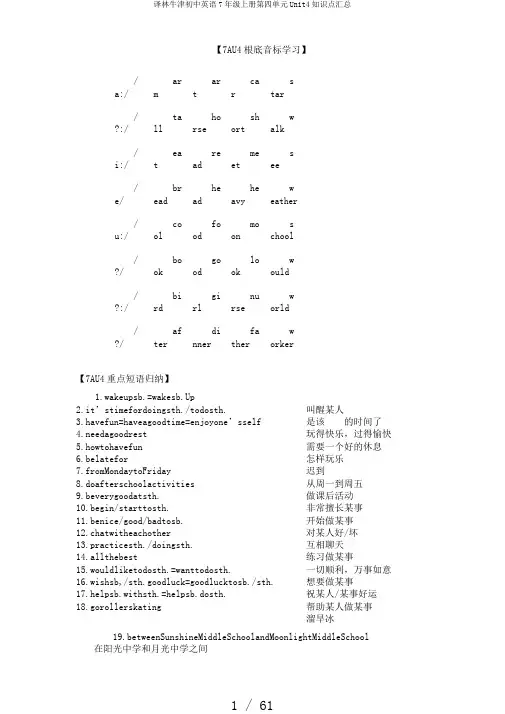
【7AU4根底音标学习】/ a:/armartcarstar/ ?:/tallhorseshortwalk/ i:/eatreadmeetsee/ e/breadheadheavyweather/ u:/coolfoodmoonschool/ ?/bookgoodlookwould/ ?:/birdgirlnurseworld/ ?/afterdinnerfatherworker【7AU4重点短语归纳】1.wakeupsb.=wakesb.Up2.it’stimefordoingsth./todosth.3.havefun=haveagoodtime=enjoyone’sself4.needagoodrest5.howtohavefun6.belatefor7.fromMondaytoFriday8.doafterschoolactivities9.beverygoodatsth.10.begin/starttosth.11.benice/good/badtosb.12.chatwitheachother13.practicesth./doingsth.14.allthebest15.wouldliketodosth.=wanttodosth.16.wishsb,/sth.goodluck=goodlucktosb./sth.17.helpsb.withsth.=helpsb.dosth.18.gorollerskating 叫醒某人是该的时间了玩得快乐,过得愉快需要一个好的休息怎样玩乐迟到从周一到周五做课后活动非常擅长某事开始做某事对某人好/坏互相聊天练习做某事一切顺利,万事如意想要做某事祝某人/某事好运帮助某人做某事溜旱冰19.betweenSunshineMiddleSchoolandMoonlightMiddleSchool 在阳光中学和月光中学之间20.SunshineSportsCentre21.at/onweekends=at/ontheweekends22.first=atfirst=firstatall23.visitthemuseums24.twiceamonth25.goonapicnic=haveapicnic26.onceaweek27.goonaclass/autumntrip28.begood/badforsb.29.getreadyforsth.30.learnalotaboutsth.=knowmuchaboutsth.阳光体育中心在周末首先参观博物馆一个月两次去野营一个星期一次去班级/秋天之旅对某人有利/害为某事做好准备知道很多有关某事【7AU4重点语法点拨】时间介词(at,in,on) 的用法at1〕时间的一点、时刻等。
新牛津译林版英语七年级上册第四单元单词短语和句子
新牛津译林版英语七年级上册第四单元单词短语和句子7A 第四单元单词、短语和句子单词n.汉堡包adj.饥饿的n.能量adv.从不;决不n.碗n.蔬菜vt.讨厌;恨n.胡萝卜adj.健康的;有益健康的n.跳舞者;舞蹈演员adj.重要的vt.&n.需要adj.容易的,简单的adj.疲劳的,累的vt.保持adj.健康的,结实的adv.很少,不常adj.甜的;n.糖果prep.像,像......一样prep.在……之间n.一餐饭n.糖n.水果n.牛奶n.面包n.(猪、牛、羊等的)肉vi.&vt.学习adj.拔尖的,头等的;n.顶,顶部n.篮球adv.&adj.快vt.&vi.改变;变化vi.计划,打算n.果汁,蔬菜汁n.健康n.人adj.小心的,仔细的n.水adj.圆的n.柠檬n.芒果n.西红柿n.牛肉n.猪肉n.卷心菜adj.自由的,空闲的在……前面n.故事n.土豆,马铃薯n.([复数]shelves)架子n.([复数]knives)刀;餐刀n.绵羊n.小包;(一)包n.盐n.茶n.千克,公斤vt.买n.祖父;外祖父n.瓶子n.面条少于n.饼干n.分数;点vi.躺、卧;说谎vi.觉得,感到1n.运气n.超级市场,超市vt.搬运,运输;携带n.花生n.汤prep.没有,不n.清单n.日常饮食n.零食n.可口可乐n.能量n.长沙发n.数量n.生活方式溜旱冰n.纸盒;牛奶盒;糖果盒int.哇,哇塞n.问卷n.祝贺n.搭档,合作伙伴adv.总体上说n.卡,拉里路(热量单位)n.维他命,维生素短语重点词组1. 想要成为一名舞蹈者_________________2. 变累______________________________3. 改变饮食___________________________4. 早饭吃一些面包____________________5. 一名顶尖学生_______________________6. 快餐______________________________7. 冰淇淋_____________________________8. 一点也不__________________________9. 吸收、摄取_________________________ 10.保持苗条_________________________11.每周两次_________________________ 12.计划做某事_________________________三、句型结构1. It’s important for a dancer to be healthy. (it 作为形式主语,用动词不定式作真正的主语)e.g. 1) 对于我们而言学好英语很必要。
牛津译林版七年级英语上册Unit4单元知识点总结
牛津译林版七年级英语上册Unit4Welcome to the unit1.Well, after breakfast I want to go to sleep, ...哦,早饭后我想睡觉……(1)after breakfast意为“早饭之后”,after 是介词,“在……之后”。
相关词组:after school放学之后;after class课后;after sb.跟在某人之后(2)go to sleep意为“入睡,睡着”,强调入睡的动作,这里的sleep是名词。
辨析:go to sleep, fall sleep 与go to bed①Go to sleep意为“入睡,睡着”,强调从醒着到熟睡的过程,是自然入睡。
②fall sleep意为“睡着”,强调“突然入睡”的意思。
③go to bed意为“上床睡觉”,强调上床睡觉这个动作,是否睡着不管。
2.You want to keep a diary too. 你也想记日记。
keep a diary 意为“记日记”,一般不用write a diary。
但如果是“做记录”,则可以用。
如:He is writing a diary for teaching. 他正在做教学记录。
Reading1.We always chat with each other or play games.我们总是相互聊天或做游戏。
(1)chat意为“闲谈,聊天”,既可作不及物动词,也可作名词。
作动词后带宾语时必须加介词with辨析:chat with 侧重于“闲聊”,而talk with/to 侧重于“谈话”,有时含有上级对下级,长辈对晚辈谈话的含义。
如:Our English teacher likes talking with us.我们的英语老师喜欢找我们谈话。
(2)each other意为“彼此,相互”,是相互代词,强调两者之间的“相互”,其名词所有格为each other's 。
Unit4知识点课件牛津译林版七年级英语上册
知识点:
1. 用于泛指一天的上午、下午、傍晚等。 ex. in the morning/afternoon/evening
2. 用于某个较长的时间,如年、月、季节等 ex. in 1997 in March in spring
知识点:
1. 用于星期、日期(包括该天的各部分)前 ex. on Sundays/weekdays
/ˈpræktɪs
/
quarter past
/ˈkwɔːtə(r)/
first each other
each other
practise
+doing sth./sth./pron.
wish would
life wish luck
museum
twice
picnic
twice, three times, four times...
go out need(to have) a good rest have breakfast/lunch/dinner have fun/ have a good time
do morning exercises have lessons do after-school activities go home
用how often提问
seldom never
ex. I sometimes watch TV in the evening. My father has lunch in the factory sometimes. The boys never eat chocolate and the girls seldom eat it. He often goes out for a walk after supper.
Unit4知识点梳理2023-2024学年牛津译林版英语七年级上册
第三讲7AUnit4 Language Point 复习1.How often和How many times的区别①How often do you watch TV?I watch TV every day.How many times do you watch TV a week?I watch TV seven times a week.2.How often和How many times的区别②How often do you watch TV?How many times do you watch TV a week?How often= How many times +时间范围1. will he leave here?He will leave here in a month.A. How oftenB. How longC. How soonD. How many times2. does he watch TV.Once a week.A. How oftenB. How manyC. How longD. How soon3. I don't know he will get here.A. how longB. how soonC. how oftenD. how4. does he take this medicine?Twice a day.A. How soonB. How longC. How muchD. How often5. can you finish this work?A. How oftenB. How manyC. How longD. How soon6. have you been at this factory?I have been here since 1993A. how longB. how soonC. how oftenD. how many7. does your sister write to your parents?A. How soonB. How longC. How muchD. How often8. does it take you to finish you homework every day?.A. How oftenB. How manyC. How longD. How soon9. will he stay here?A. how longB. how soonC. how oftenD. how many10. did the meeting last?About half an hour.A. How soonB. How longC. How farD. How often3.Reading is fun.阅读是有趣的事。
Unit4知识点梳理牛津译林版七年级英语上册
牛津译林版七上Unit 4 知识点梳理1.Wake up, Eddie. 醒醒,埃迪。
wake up:“醒来”。
“唤醒某人”:如果所接宾语是人称代词,只能放在wake和up中间;如果所接宾语是名词,放在up、前后均可。
awake:adj.“醒着的”。
2.Is it time fro breakfast? 到吃早饭的时间了吗?It’s time for sth.“是做某事的时间了。
”= It’s time to do sth.It’s time for sb. to do sth.“该是某人做某事的时候了。
”3.Shall we go walking in the hills? 我们去山上散步好吗?Shall we...? “我们……好吗?”(表示征求或提出建议。
)4.I seldom go out. 我很少外出。
seldom:adv.“很少,不常,难得”(位于行为动词之前,助动词、情态动词或连系动词之后),表示否定。
go out:“出去”。
5....and then I have lunch. ……然后吃午饭。
have lunch:“吃午饭”。
→have breakfast “吃早饭”;have dinner/supper “吃晚饭”。
have:v.“吃;喝”;“有”;“举办,举行”;“度过,经历”。
三单:has。
6.After lunch, I always need a good rest. 午饭后,我总是需要好好休息。
need:v.“需要”。
need sth. “需要某物”;need to do sth. “需要做某事”;need sb. to do sth. “需要某人做某事”;sth. need(s) doing “需要”。
情态动词,“需要”,后接动词原形,常用于否定句和疑问句。
rest:n.“休息,歇息”(= break)。
have a (good) rest “(好好)休息”。
作动词,“休息”。