
高中英语人教版必修3unit2教案
教案院系:闽南师范大学外国语言文学系年级班级:2015级学科教学(英语)学生姓名:***时间:2016年6月Unit 2 Healthy eatingTeaching material:人教版高中英语必修三Unit 2Teaching type: Warming-up & readingTeaching duration: 45minsI. Teaching aims1.Knowledge aimsLet students learn the knowledge of balanced diet and nutrition2.Ability aims①Enable students to talk about their eating.②Understand the text and answer the following questions.3.Emotional aims①Enable the students to learn how to talk about their eating.②Develop students’ sense of cooperative learningII. Teaching focus1.Let students identify different groups of foods and learn something about healthyand unhealthy eating.2.Let students learn different reading skills.III. Teaching difficulties1.Understand the real meaning of healthy eating.2.Develop students’ reading ability.IV. Teaching methods1.Three-stage model: pre-reading, while-reading, post-reading2.Situational teaching3.Task-based language teaching, cooperative and autonomous learningV. Teaching aids:Blackboard, PPT, multimediaVI. Teaching proceduresStep1 Lead-in (time:5mins)Teacher show some pictures on the screen and talk about unhealthy eating.T: Look at the screen, have you eaten hamburger, French fries and pizza?Ss: Yes. Sometimes we eat them. They are delicious.T: Do you think it’s good for your healthy? Why?Ss: No. Because fast food contains a lot of fat and sugar.T: Yes. You are right. Now let’s think about how many kinds of food we usually eat?Ss: Three kinds of food.T: Yes, they are energy-giving food, body-building food and protective food.Step 2 Pre-reading (time:3mins)T: Now look at the screen, I will give you a food list, and I hope you can tell me which food can be put in which column?S1:Rice, noodles, nuts and butter can be put in energy-giving food.T: Very good. You did a good job. How about the second column?S2: Meat, tofu, fish and milk can be put in body-building food..T: Wow, you are right. How about the last column?S3: Apple, bean, lemon and grape. They are fruit and vegetables.T: Excellent. You are so clever.Step 3 While-Reading (time:20mins)1. Fast reading (time:5mins)Students will be given 3 minutes to read the whole passage. Then teacher will ask students two questions:T: How many restaurants does this passage mention?What are they?S1: Two, they are Wang Peng’s restaurant and Yong Hui’s restaurant.T: Very good. What happen to Wang Peng’s restaurant?S1: His restaurant usually full of people, but not today. So he was very worried.T: Yes, quite good.2. Careful reading (time:15 mins)(1)The test can be divided into three parts. Listen to the tape and find out the main idea of each part. (time:8mins)Part 1 (para 1): Wang Peng was worried because his restaurant was not as full as before.Part 2 (para 2-3): Wang Peng followed to a newly opened restaurant which was very popular.Part 3 (para 4): Feeling worried, he did some research to win his customers back.(2) Discuss with your partners, and find out the weakness and strength of both restaurants. (time:7mins)T: I will give four minutes to read the passage, and after that you should find out the weakness and strength of both restaurants.S1: Wang Peng’s restaurant serves too much energy-giving food and body-building food, but no protective food.T: You are smart. People who often eat Wang Peng’s in restaurant will become fat. How about Yong Hui’s restaurant?S2: Yong Hui’s restaurant serves too much protective food, but no energy-giving food and body-building food. People will become tired.T: Great!Step 4 Post-reading (time:10mins)Let students finish the following exercise.1、True or false.(1). Usually Wang Peng’s restaurant was full of people. ( T )(2). Yong Hui could make people thin in two weeks by giving them a good diet. (F)(3). Wang Peng’s custom ers often became fat after eating in his restaurant. (T)(4). Yong H ui’s menu gave them energy foods. (F)(5). Wang Peng admired Yong H ui’s restaurant when he saw the menu. (F)(6). Wang Peng decided to copy Yong H ui’s menu. (F)2. Choose the best answer according to the text.(1)、When Wang Peng thought “Nothing could be better”, he means __A__A. His food and drinks were the best.B. His food and drinks were the worst.C. His food should have been improved.D. He could do nothing with his food and drinks.(2)、Why did Wang Peng go into the newly-opened restaurant? __B__A. Because he was angry.B. Because he was curious.C. Because he wanted to blame its owner.D. Because he wanted to ask for advice.(3)、What is Wang Peng’s impression on Yong Hui’s restaurant? __D__A. All the customers in it were very slim.B. It was too small and too noisy.C. The food in it was very nice and better than that in his.D. There was so limited food but the price was much higher.(4)、We can infer from the last sentence that ___C__A. Wang Peng would learn from Yong HuiB. Yong Hui would learn from Wang PengC. The competition had began and would continueD. The two restaurants would give up the competitionStep 5 Summary(time:7mins)Teacher let students read the passage again, and then ask them to summarize the whole passage:Wang Peng felt frustrated because his customers didn’t come to eat at his restaurant. He followed Li Chang into a newly-opened small restaurant. Wang Peng entered and was shown a menu by a thin lady named Yong Hui. On the menu, there were only rice, raw vegetables, fruit and water. After leaving the restaurant, he decided to do some research. Soon he found that Yong Hui’s restaurant did not serve energy-giving foods and the customers would become tired quickly. So he put up a new sign which said his restaurant would serve foods providing all-day energy. The competition between the two restaurants was on.VII. Blackboard layoutUnit 2 Healthy eatingThree kinds :1. energy-giving food;2. body-building food;VIII. Homework1. Retell this story to your parents or your partners.2. Write a composition about your eating habits.。
高中英语人教版必修三教学案:Unit 2 Section 3 含答案
[语法初识][语法剖析]情况下可用should代替,但比should语气重。
I'm his teacher. I ought to take care of him.我是他的老师,我应该照顾他。
I should help her because she is in trouble.她有困难了,我应该帮助她。
2.“应该”,表示劝告、建议或命令。
should和ought to可通用,但在疑问句中常用should。
ought to的否定式为oughtn't to或ought not to。
You ought to be more careful when you cross the road next time.下次过马路时,你应该更小心些。
Should I open the window?我可以打开窗户吗?3.“应该”,表示推测。
可与should换用。
It is already 9 o'clock; he ought to be in his office now.已经9点了,现在他应该在他办公室了。
This is where the oil ought to/should be.这里应该就是石油存在的地方。
即时演练1用ought to完成句子①他不应该缺席这么重要的会议。
He oughtn't/ought_not_to_be absent from such an important meeting.②——我明天该动身吗?——是的,你应该。
—Ought_I_to_leave tomorrow?—Yes, you_ought_to.③你应该比你哥哥学习更努力。
You ought_to_work_harder than your brother.1.作情态动词(1)need作情态动词时,只能用于疑问句、否定句或条件句中,意为“需要”。
—Need I come tomorrow?—Yes, you must./ No, you needn't.——我明天需要来吗?——是的,你必须来。
2021-2022学年高中英语人教版必修三教学案:Unit 2 Section 1 Word版含答案
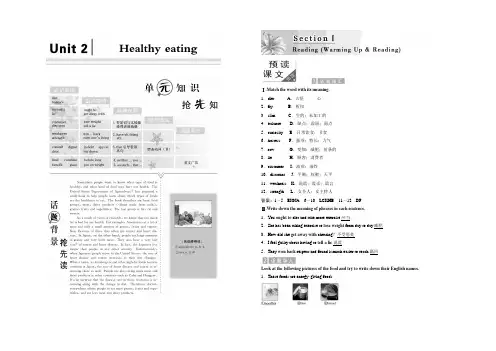
Ⅰ.Match the word with its meaning.1.diet A.古怪心2.fry B.折扣3.slim C.生的;未加工的4.balance D.缺点;虚弱;弱点5.curiosity E.日常饮食;节食6.hostess F.强项;特长;力气7.raw G.变细;减肥;苗条的8.lie H.顾客;消费者9.customer I.油煎;油炸10.discount J.平衡;权衡;天平11.weakness K.说谎;谎话;谎言12.strength L.女仆人;女主持人答案:1~5EIGJA6~10LCKHB11~12DFⅡ.Write down the meaning of phrases in each sentence.1.You ought to diet and take more exercise.应当2.She has been taking exercise to lose weight from day to day.减肥3.How did she get away with cheating?不受惩处4.I feel guilty about having to tell a lie.说谎5.They won back respect and found it much easier to teach.赢回Look at the following pictures of the food and try to write down their English names. 1.These foods are energygiving foods.2.These foods are bodybuilding foods.3.These foods are protective foods.Ⅰ.Fast-reading1.Read the text quickly and match each part with its main idea.Para. 1A.Wang Peng did some research and wanted to win his customers back.Para. 2 B.Wang Peng found out the reason why his restaurant was empty.Para. 3 C.Wang Peng wondered why customers didn't eat in his restaurant as usual.答案:Paras.1~3CBA2.According to the exercise above, try to write down the main idea of the text.Wang Peng's restaurant became_empty because a new one had taken his regular customers away, and he wanted to improve it to win_his_customers_back.Ⅱ.Careful-readingRead the text carefully and choose the best answer.1.What can we learn from Wang Peng's research in the library?A.Wang Peng's restaurant offered a balanced diet.B.Yong Hui's restaurant offered a balanced diet.C.Both of the restaurants offered a balanced diet.D.Neither of the two restaurants offered a healthy diet.2.Which of the following did NOT appear on Yong Hui's menu?A.Cabbage.B.Cola.C.Water. D.Apples.3.We can infer from Wang Peng's research in the library that a balanced diet should contain________.A.much fat that can give energyB.no fat but rich fibres to keep fitC.only raw vegetables, fruits and water to keep slimD.enough energygiving food and the food that contains enough fibre4.Why did many people go to Yong Hui's restaurant?A.Because the food was very cheap.B.Because the food was very delicious.C.Because the food helped them lose weight.D.Because the food made them keep energetic.5.How did Wang Peng feel at the end of the story?A.Disappointed. B.Hopeful.C.Excited. D.Discouraged.答案:1~5DBDCBⅢ.Study-readingAnalyze the following difficult sentences in the text.1.Something terrible must have happened if Li Chang was not coming to eat in his restaurant as he always did.[尝试翻译]要是李昌不像平常那样到他的餐馆吃饭,那确定是发生了什么糟糕的事情。
高中英语必修3Unit+2+Healthy+eating7+教案+
那个商店老板试图通过打折来赢回顾客。(win back, discount)
如果你不为自己的错误道歉的话,他们是不会放过你的。(get away with)
就在我等朋友时,突然发现有个男人在离我不远处正瞪眼看着我。(spy; glare at)
课题:Unit Two Healthy eating 课型:Reading &Writing
每日一言:First wealth is health. 健康是人生的第一财富
班级: 姓名: 日期:
学习目标
I will get the main idea of each paragraph by skipping the passage.
_________________________________________________________
_________________________________________________________
展示环节:
Display in class.
1. Members from each group stand in front of the whole class and read their writings to the rest students.
I can understand the passage by means of scanning and careful reading.
I’m able to write an advertisement for a certain restaurant with the languages given.
人教版高中《英语》必修3 unit 2 “Healthy Eating” 教学设计
2020年42期总第534期ENGLISH ON CAMPUS人教版高中《英语》必修3unit 2 “Healthy Eating” 教学设计文/莫兴竹一、教学内容分析人教版高中《英语》必修3 unit 2 “Healthy Eating” 的中心话题是“健康饮食”。
教材通过讲述王鹏和雍慧餐馆为顾客提供不同的食物,且二者都存在片面性,都不属于健康的膳食。
最后两人决定合作,将菜单升级,提供给顾客既有能量又有纤维的均衡饮食。
本单元第一部分Warming up,主要让学生通过学习,了解到食物的分类——不同事物给人体提供不同的营养。
Pre-reading部分,要求学生围绕几个问题进行讨论,最后能够理解健康均衡的饮食应该包括哪些食物,款待朋友,应该选择什么样的特色菜以及根据图片和文章标题,对Reading部分的内容进行猜测。
通过学习,学生能够理解王鹏和雍慧的菜单都存在片面性,都不属于健康均衡的饮食,进而在Using Language进行听力和阅读语篇的训练。
Learning about Language 部分由 “词汇学习”和“语法学习”两部分组成。
本单元的最后一个任务是主题写作,要求学生为家庭制作晚餐食谱,分析食谱包含的食物是否能够提供均衡营养,学以致用。
二、学情分析本节课的教学对象是高一年级的学生,他们已经具备一定的英语基础知识,能运用逻辑思维能力解决问题,对“健康饮食”这一话题也不陌生,能够激发他们的学习兴趣,但是对于本单元涉及的大多数专业词汇,学生还是存在问题。
基于此,小组合作学习方式是高一英语课堂的常用形式。
三、教学目标和教学重点及难点1.教学目标。
(1)掌握本单元的核心词汇和短语以及情态动词的功能和用法;(2)根据食物的分类,了解食物的不同功能;(3)能够谈论什么是健康、均衡的饮食;(4)引导学生关注合理饮食、饮食习惯、饮食结构、饮食文化等。
2.教学重点及难点。
(1)掌握本单元的核心词汇和语法结构;(2)了解不同食物对人体的作用并形成健康饮食的意识;(3)学生能够正确使用阅读策略,理解、分析课文;(4)能针对自己遇到的实际问题,发表自己的意见和建议。
Unit+2+Morals+and+Virtues+单词教案 高中英语人教版(2019)必修第三册
高一英语必修二Unit 1Period:1 Type: vocabulary 2 主备人必修三Unit 2 Morals and VirtuesTeaching aims:1)To learn these words’ usage: appoint /elect / tend/ assist2)To use them freely.Teaching importance:To understand their usages clearly.Teaching difficulty:To use them in different context correctly .Teaching procedures:1. Lead in: Read these words about appoint /elect / tend/ assist2. Learning aims1)To learn these words’ usage: appoint /elect / tend/ assist2)To use them freely.3.Study and think independently1) To read the Task 8,9,10,11 (p28-29).2)To find all the knowledge points about appoint /elect / tend/ assist3) To find the key and difficult points.4) To find the points you don't understand.4. Self-learning guidance1) To finish the form-changed exercises.(导学案P28-29)2) To mark the check points.3) To check the answers.5. Questions and advice1)Share answers and correct the mistakes.2)Discuss the difficulties and help students solve some questions if necessary.6. SummaryTo retell and recite the usages of these words.7.Blackboard designappoint vt. 任命;委派appoint sb.(as / to be ) 任命某人为......appoint sb to do sth 委派某人做某事elect vt. 选举;推选elect to do sth. 决定/选择做某事elect sb. to be /as... 选某人为tend vt.照顾;照料;护理vi.倾向;趋于tend to do sth. 倾向于做某事tend to sb 照看/护理某人tend to/towards sth 倾向于某事物assist vt. 帮助;协助assist sb. with sth 帮助某人某事assist sb. to do sth 帮助某人做某事8.TestRecite and check usages of the two words.9.HomeworkFinish the correction of the book by themselves.10.Teaching reflection(教学反思)高一英语必修二Unit 1 2022 Period:1 Type: vocabulary 2 主备人必修三Unit 2 Morals and VirtuesTeaching aims:1)To learn these words’ usage: appoint /elect / tend/ assist2)To use them freely.Teaching importance:To understand their usages clearly.Teaching difficulty:To use them in different context correctly .Teaching procedures:1. Lead in: Read these words about appoint /elect / tend/ assist2. Learning aims1)To learn these words’ usage: appoint /elect / tend/ assist2)To use them freely.3.Study and think independently1) To read the Task 8,9,10,11 (p28-29).2)To find all the knowledge points about appoint /elect / tend/ assist3) To find the key and difficult points.4) To find the points you don't understand.4. Self-learning guidance1) To finish the form-changed exercises.(导学案P28-29)2) To mark the check points.3) To check the answers.5. Questions and advice1)Share answers and correct the mistakes.2)Discuss the difficulties and help students solve some questions if necessary.6. SummaryTo retell and recite the usages of these words.8.Blackboard designappoint vt. 任命;委派appoint sb.(as / to be ) 任命某人为......appoint sb to do sth 委派某人做某事elect vt. 选举;推选elect to do sth. 决定/选择做某事elect sb. to be /as... 选某人为tend vt.照顾;照料;护理vi.倾向;趋于tend to do sth. 倾向于做某事tend to sb 照看/护理某人tend to/towards sth 倾向于某事物assist vt. 帮助;协助assist sb. with sth 帮助某人某事assist sb. to do sth 帮助某人做某事10.TestRecite and check usages of the two words. 11.HomeworkFinish the correction of the book by themselves.10.Teaching reflection(教学反思)。
2019新人教高中英语选择性必修三Unit 2--Reading and Thinking公开课教案
2019新人教高中英语选择性必修三Unit2 Healthy LifestyleReading and Thinking公开课教案Teaching aims:1.Enable students to discover the elements of the habit cycle and understand how the habit cycle works.2.Guide students to figure out the textual pattern of the passage and judge the writing purpose and intended readers of the passage.3.Help students to express their own ideas on the given topics by creative thinking.Teaching key and difficult points:1.Apply different approaches of discourse analysis to deepen the understanding of the text and language usage.2.Explore and understand the habit cycle and how to develop good health habits using the habit cycle.Teaching procedures:StepⅠLead-inT:Show some pictures to the students and ask them questions.Ss:Reflection on their habits.Guided questions:1.What kind of lifestyle do you lead?2.Do you have any unhealthy and bad habits?What are they?3.Are bad habits easy to change?Why or why not?Suggested answers:1.I lead a healthy/an unhealthy lifestyle.2.Unhealthy habits include,eating junk food,playing too much on your computer or phone,not doing enough exercise and staying up late etc3.Bad habits are hard to change because we are usually doing something we really like,but we are doing it too much.StepⅠTextual Pattern AnalysisT:Get everyone to figure out the discourse pattern of the whole passage and paragraphs as well.Ss;Dig into the whole passage and find out the elements of the habit cycle and how the habit cycle works.Guided questions:1.What can we guess from the title?2.What’s the main idea of each paragraph?3.How many parts are there in the text?What’s the relationship between them?4.How is the text developed?5.What is the conclusion of this part?Suggested answers:1.It’s an exposition mainly talking about the habits of healthy lifestyle.2.Para.1:Why bad teenage habits should be changed.Para.2:What a habit is.Para.3:The cycle of how habits are formed.Para.4:How to change a bad habit and create good ones.Para.5:Changing habits gradually.Para.6:No easy way to change bad habits.3.The article can be divided into three parts. The first paragraph serves as part one putting forward the problems; the second to the sixth paragraphs belonging to part two provides the solutions to the problems; the sixth paragraph is the third part, which evaluates the solutions.4.The article is organized in a way that the problem is first posed and then the solution is given.5.It’s never easy to change bad habits, but the teenagers have time and power to make it.StepⅠ Pragmatic AnalysisT:Let students analyse the pragmatic value of the text through different angles.Ss:Analyse the text and supply evidence presented in the passage.Guided questions:1.What is the purpose of writing the passage?2.Who is the passage written for?3.How does the writer explain his opinion in this passage?Suggested answers:1.The writing purpose is to tell the teenagers to live a healthy life full of good habits.2.This passage is designed for teenagers.3.By giving examples,giving definition and using direct quotes.Step Ⅰ Topic Related LexisT:Help students look for the lexical chain under the guide of the given topic.Ss:Look for related phrases in the text and make a list of lexis.Guided question:Can you find some words and phrases related to the topics?Suggested answers:Topic 1:to talk about why bad habits should be changedform bad habits;lead to;become involved in;alcohol abuse;physical and mental problems;recognise bad habits.Topic 2:to provide solutions to bad habitshabit cycle;examine our bad habit cycles;replace...with...;show some discipline;take small steps;break bad habits.Topic 3:to encourage the teenagers to change bad habitsdecide on some changes;have the power to do sth.;build a healthy and happy life.StepⅠCritical thinkingT:Encourage students to share their own opinions about how to replace the bad habits with the good ones using the role-playing activity.Ss:Put forward their comments, ideas on the basis of having a good understanding of this passage.StepⅠ Role-PlaySuppose you were Li Hua, and your classmate Jack is addicted to online games. You are very worried and anxious. Please write a letter to Jack and give him some advice on how to change the bad habit.Suggested answer:Dear Jack,Knowing that you are addicted to online games,I’m rather worried and anxious.Thus,I’m writing to give you some advice to change the bad habit.First of all,you should be aware of the harm of online addiction.The bad habit,if left unchecked,can lead to physical and mental problems.To change the bad habit,you’d better examine your bad habit cycle first and then replace the negative routine with something more positive.So,when you feel bored again,rather than play computer games,you can listen to some of your favourite music instead,which will make you feel relaxed.Besides,it’s impossible to break bad habits quickly.Actually,the most successful way to change is to show some discipline and repeatedly take many steps.All in all,I do believe you have the power to build a healthy and happy life full of good habits!Yours,Li Hua StepⅠ Summarize语法短文填空。
高中英语 Unit 2(Healthy Eating)教案人教版必修三 教案
Unit 2Healthy Eating1.Topics:Problems with diet ;Balanced diet and nutrition2.Words and expressions3.Functions:1)Suggestions and adviceYou must /must not… ; What should I do?I think you ought to …; I suppose you had better…Perhaps you should…Do you think you could give me some advice?2)Seeing doctorsWhat’s the matter? What’s wrong?What seems to be the trouble?How long have you been like this?3)Agreement and disagreement.I don’t agree. Of cause not. I don’t think so.All right. T hat’s a good idea.No problem. Certainly /sureYes, I think so. I’m afraid not.4. Grammar: The use of ought toYou ought to cook fresh vegetables and meat without too much fat If you want to stay slim.You ought not to eat the same kind of food at every meal.Period 1.Step 1. warming up1. Do you eat a healthy diet? What kind of food do you usually have for meals? Are the food you usually eat healthy food or unhealthy food?(Discuss in pairs)2. Name some healthy food and unhealthy food.healthy food unhealthy food.All vegetables: cabbages, Fatty food: French friesPeppers tomatoes potatoes cream roast pork/lambAll fruits: apples, grapes sugary food:chocolateStrawberries bananas pears sweets/honey ice-creamDairy products:Milk cheese salty food:can biscuitSeafood: shrimp cookiesTofu eggs3. Do you know that the food you eat helps you grow in different ways? Some will make you fat/tall/thin.Look at the charm below,and see which kind of food they.FOOD TO GIVE YOU ENERGY FOOD TO GROW BONESAND MUSCLE Foods that fiber fordigestion and healthFast energy food Slow energy food Body-building food Protective foodsRice sugarNoodles potatoesSpaghetti breadCorn dumplings Butter creamOils ham nutsFried bread stickFried cake/chips Dairy products:Milk cheeseMeat eggs tofuSeafood shrimp All vegetables(eg.beans, Cucumbers,mushrooms,peas, Cabbage,…)all fruit(pears Apples, peaches, oranges,…)Questions:1.Which of these groups of food do you like best?2.Which of them do you eat most often?3.Do you think we should eat each kind of food?3.What will happen if you do not eat a balanced diet?Too much fatty/sugary/salty food will cause many diseases and get too fat.Only protective food will feel weak ,no energy and get too thin.Step 2. Pre-reading1. Discuss the questions in the chart.(Which food contains more…)2. Order the following food from which contains most fat to which contains less.Answer: ice-cream, eggs, chicken, rice, peachesStep 3 Fast reading and answer the following questions1. What does Wang Pengwei’s restaurant serve?2. What about Yong Hui’s restaurant?Step 4 Intensive reading and find the answers to prehending.Period 2 Language pointsStep 1.Lead-in: Listen to the tape to get a better understanding.Step nguage points1.Wang Pengwei sat in his empty restaurant feeling very frustrated.feeling very frustrated 现在分词在句中作伴随状语eg.She sat on the chair reading a newspaper.(表伴随)Walking in the street, she met her old friend. (表时间)Seeing no body at home, she decided to eat outside.(表原因)The child fell, striking his head against the ground. (表结果)2.His restaurant ought to be full of people.Ought to 1) to show a moral duty 表示一种道义上的责任,应该Eg.She ought to look after her child better.You ought to study hard to get a high mark.2)ought to have done 表示本应该…,而却没有…Eg.You ought to have e yesterday.3.He thought of his mutton kebabs, fatty pork cooked in the hottest oil. 过去分词短语作后置定语,表被动。
高中英语《必修3 unit2 Healthyeating》优质课教案、教学设计
Book 3 Unit 2 Healthy Eating 复习学案【目标引领】一、课标要求1.知识与技能目标:Master some important phrases and sentence patterns.2.过程与方法目标:Encourage the students to cooperate with each other.3.情感态度与价值观目标:Develop a correct attitude towards healthy eating二、复习目标. Master some phra 三、复习范围必修三unit2【真题再现】例1(全国卷II)Mr. Stevenson is great to work for- Ireally couldn't ask for a boss.A. better B. good C. best D. still better2 (2014 山西高考设计说明]通图呈现在脑海【自主探究——构建网络】写出课文中的短语考点一:复习课文,填写正确的英文表达1.健康的饮食2.提供能量的食物3.强健体魄的食物4.保健食物5.平衡的饮食6.感到沮丧7.烤猪肉8.炒饭9 .应该1 0.减肥1 1.生蔬菜1 2.对…感到吃惊1 3.对…感到厌烦1 4.说谎1 5 做坏事而逃脱惩罚1 6.保持健康1 7.赢回1 8.好奇心考点二:根据课文内容补全句子1.“Nothing could be better” he thought 他想“再也没有比这些更好的了“ nothingcould be better 意为:此处是与连用表示.2.W ang Peng sat in his empty restaurant veryfeeling very frustrated 现在分词在句中作3.By now his restaurant be full of people.(情态动词运用)[设计说明]根据学生的课前复习, 以检查学生的复习情况比如让学生对单词, 短语甚至一些重点句子的复习更能让学生加深印象和熟练的掌握知识点的运用。
Unit2 Healthy Lifestyle整体教学设计说课-高中英语人教版2019选择性必修三
语音:理解说话者通过不同语调表达的 真实意图,能在口语中正确使用语调表 达情感,进行交流。 词汇:掌握相关的主题词汇并在语境中 恰当运用这些词汇。 语法:理解并正确运用不定式做主语 语篇: 问题解决式语篇结构
语言技能
利用standout sentences 概括段落大意。 运用关于习惯循环的主题词汇分析自己及 别人的习惯问题;能够写一篇描述自己在 改变不良习惯的经历。
单元前置学情分析
学生健康生活习惯的课前学情调查 班级
姓名
Q1:How much do you know about healthy lifestyle? Q2: Do you think a good living habit is the key to healthy lifestyle?Why? Q3:Can you list some of your living habits? Q4:Can you recognize some of them are bad habits?list them.
5
Reading for writing
书信
该语篇呈现了两封读者来信,是两位学生参加某杂志社举办的“健康生活方式选择”主 题夏令营后,分享自身感想和体会的信件
20、21
6
Assessing Your
Progress Why: Nhomakorabea本测试单元阅重读点文词汇本与的核话心题语法是项“目健的检康测的生活方式”,
22
惯的经历投稿发表到校报上。
语篇
课型
课时
与单元目标对应的课时目标
Opening page Using language :Activity 1 (Look at the pictures)补充材料:Online posts
高一英语人教版必修三Unit2MoralsAndVirtues61教案
学生结合个人理解探讨如下问题:
In what ways do you think Confucian thought still influences education and society in China?
Do you think that your life would change if you understood and practised ren every day?
2.理解儒家“仁义礼智信”的思想内涵;(重点)
3.结合个人观点谈论对儒家思想的理解及其对现代人和社会的影响。(难点)
教学过程(表格描述)
教学环节
主要教学活动
设置意图
Warm-up
教师对孔子及儒家思想的背景知识进行补充介绍。
WhowasConfucius?
What is Confucianism?
What are the Five Constant Virtues?
Where does ren come from?
Is there one single concept that we can take as a guide for all actions in our lives?
强化语言知识和文化知识的内化;启发学生深入思考视频信息,为后续语言活动实践做铺垫。
教 案
教学基本信息
课题
高一英语(人教版)–必修三Unit2Morals and Virtues(6)
学科
英语
学段:高中
年级
高一
教材
书名:普通高中教科书英语必修第二册出版社:人民教育出版社出版日期:2019年6月
教学目标及教学重点、难点
在备课学习结束时,学生能够: