
英语-原因、结果、目的状语从句讲解+练习
中考英语-原因、结果、目的状语从句讲解+练习状语从句总结一、原因状语从句(1)原因状语从句通常由because, since, as, for引导。
(2)because表示直接原因,语气最强。
because引导的原因状语从句多放在主句之后。
回答由why提出的问题,只能用because。
此外,because和so不能同用在一个句子里。
例如:------Why aren’t going there?------Because I don’t want to.since引导原因状语从句,相当于now that,意思是“因为……,既然……,鉴于……”。
例如:Since the rain has stopped,let’s go for a walk. 既然雨停了,我们出去散散步吧。
as和since语气较弱,一般用来表示明显的原因。
由as和since引导的原因状语从居多放在句首。
例如:As he has no car, he can’t get there easily.Since we have no money, we can’t buy it.(3)for表示所说的理由是一种补充说明,for引导的从句一般不放在句子的开头。
如:I decided to stop and have lunch, for I was feeling quite hungry.练习:I was late for class yesterday _______ there was something wrong with my bike.He took off his coat _______ he felt hot.you can’t answer the question, I’ll ask someone else.二、结果状语从句(1)结果状语从句由so…that, such…that, so that引导。
(2)so…that语such...that可以互换。
在由so...that引导的结果状语从句中,so是副词,与形容词连用。
其结构是: “...so + 形容词(副词)+ that + 从句”。
例如:He was so glad that he couldn’t say a word.Mother lives so far away that we hardly ever(几乎不,从来不) see her.在由such…that引导的结果状语从句中,such是形容词,它修饰的可以是单数或复数可数名词,也可以是不可数名词;其结构是: “...such +a / an + 形容词+名词+ that + 从句”。
例如:It was such a hot day that nobody wanted to do anything.He had such long arms that he could almost touch the ceiling.(天花板)有时上述两种结构是可以互换的。
例如:It was such a wonderful film that all of us wanted to see it again.=The film was so wonderful that all of us wanted to see it again.(3)如果名词前由many, much, little, few等词修饰时,只能用so, 不用such。
例如:Soon there were so many deer that they ate up all the wild roses.He has so little time that he can’t go to the cinema with you.(4)如果主从句的主语相同,并且从句是否定的形式,可以用too...to...句型转化。
例如:He was so excited that he couldn't go to sleep that night. = He was too excited to go to sleep.(5)如果主从句的主语相同,但从句是肯定的形式,可以用adj.+ enough替换。
例如:He is so old that he could go to school. = He is old enough to go to school.他够大了,可以去上学。
练习:It is ___ hot in the room ___ we have to go out for a walk.It was a wonderful movie all of us wanted to see it again.There were little water in the bottle the bird couldn’t reach it..三、目的状语从句(1)目的状语从句通常由 so that, in order that(为了,以便)引导。
例如:We started early so that we could catch the first train.We used the computer in order that we might save time.(2)so that可引导目的状语从句,此时可用to或in order to替换,将其改为简单句。
例如:He got up early so that he could get to school on time.=He got up early(in order) to get to school on time.(3)so that既可引导目的状语从句,又可引导结果状语从句。
区别这两种从句的办法有两个:1)目的状语从句里往往带有情态动词can, could, may, might等。
2)从意思上看,目的状语从句往往表示的目的很明确。
例如: Speak clearly so that they may understand you. (目的状语从句)Jack is badly ill so that he has to rest. (结果状语从句)练习: I hurried I wouldn't be late for class.We should go by bus ___ we can get there earlier.May I sit nearer I can see more clearly?(4) 补充:) eg. He got up early so as to catch the early train.…(否定结构) eg. He got up early so as not to miss the early train.eg. He got up early in order to catch the early train.so that 以便;为了他阅读更多书,以便他能知道更多知识。
我们努力学习是为了我们能有一个好的未来我起得早是为了能赶上早一点的班车。
请打开窗户以便我们能呼吸新鲜空气。
你现在一定要走是为了不迟到。
小男孩节省每一个硬币是为了他能在母亲节给他妈妈买一份礼物。
她在网上购买了一部手机以便她能打电话。
说得清楚些,使得他们能听懂你的意思.拿近一些,好让我看得更清楚些。
我们现在就准备好,等父亲一来我们就可以走了。
so...that... 如此(太)……以致……我太累了,以致我一吃完晚饭就去睡觉了。
她太漂亮了以致很多人喜欢她。
咖啡太热了以致于我现在不能喝。
她如此年轻以致她不能照顾好她自己。
男孩跑得太快了以致我不能追上他。
他太饿了以致他不能说一个字。
男人太强壮了以致他可以抬起这个重箱子。
箱子太轻了以致他能背起它。
他病得很厉害,今天无法上学。
这个小孩以前经常撒谎,以至于现在没有人相信他。
她很伤心以至于她伤心地哭了。
那门太小了,以至于这只熊走不进去。
Translate answersso that 以便;为了他阅读更多书,以便他能知道更多知识。
He reads more books so that he can lean more knowledge.我们努力学习是为了我们能有一个好的未来We study hard so that we can have a good future.我起得早是为了能赶上早一点的班车。
I got up early so that I could catch the early bus.请打开窗户以便我们能呼吸新鲜空气。
Please open the window so that we can breathe fresh air.你现在一定要走是为了不迟到。
You must go now so that you won't be late.小男孩节省每一个硬币是为了他能在母亲节给他妈妈买一份礼物。
The little boy saved every coin so that he could buy his mother a present on Mother's day.她在网上购买了一部手机以便她能打电话。
I’ll give you all the facts so that you can judge for your self.说得清楚些,使得他们能听懂你的意思. Speak clearly, so that they may understand you.拿近一些,好让我看得更清楚些。
Bring it nearer so that I may see it better.我们现在就准备好,等父亲一来我们就可以走了。
Let's get ready now so that we can leave when Father comes.so...that... 如此(太)……以致……我太累了,以致我一吃完晚饭就去睡觉了。
I was so tired that I went to bed as soon as I had supper.她太漂亮了以致很多人喜欢她。
She is so beautiful that many people like her.咖啡太热了以致于我现在不能喝。
He coffee is so hot that I can't drink now.她如此年轻以致她不能照顾好她自己。
She is so young that she can't look after herself.男孩跑得太快了以致我不能追上他。
原因、结果、目的状语从句讲解和练习(答案)(完美排版)

原因、结果、目的状语从句讲解和练习(答案)(完美排版)Lesson 55-59: Summary of Adverbial ClausesXXX Reason1.Adverbial clauses of XXX by because。
since。
as。
or for.2.Because expresses a direct reason and has XXX。
It is usually placed after the main XXX "why," only because can be used。
Moreover。
because and so cannot be used in the same sentence.For example: "Why aren't you going there?" "Because I don't want to."3.XXX means "because" or "now that."For example: "Since the rain has ped。
let's go for a walk."4.As and since have a XXX by as and since are often XXX.For example: "As he has no car。
he can't get there easily."Since we have no money。
we can't buy it."5.For XXX for what is being said。
It is XXX.For example: "I decided to。
and have lunch。
中考英语备课指导:状语从句之原因、结果、目的状语从句:知识点+习题 ( 无答案)

中考状语从句之原因、结果、目的状语从句:知识点+习题 ( 无答案)原因、结果、目的状语从句一、原因状语从句(1)原因状语从句通常由because, since, as, for 引导。
(2)because 表示直接原因,语气最强。
because 引导的原因状语从句多放在主句之后。
回答由why 提出的问题,只能用b eca us e。
此外,because 和so 不能同用在一个句子里。
例如:------Why aren't going there?------Because I don't want to.→ since 引导原因状语从句,相当于now t h at,意思是“因为……,既然……,鉴于……”。
例如:Since the rain has stopped,let's go for a walk. 既然雨停了,我们出去散散步吧。
→ as 和since 语气较弱,一般用来表示明显的原因。
由as 和since 引导的原因状语从居多放在句首。
例如:As he has no car, he can't get there easily. Since we have no money, we can't buy it.(3)for 表示所说的理由是一种补充说明,for 引导的从句一般不放在句子的开头。
如:I decided to stop and have lunch, for I was feeling quite hungry.练习:I was late for class yesterday there was something wrong with my bike. He took off his coathe felt hot.you can't answer the question, I'll ask someone else.二、结果状语从句(1)结果状语从句由so…that, such…that, so that 引导。
最新中考状语从句之原因、结果、目的状语从句:知识点+习

中考状语从句之原因、结果、目的状语从句:知识点+习题 ( 无答案)原因、结果、目的状语从句一、原因状语从句(1)原因状语从句通常由because, since, as, for 引导。
(2)because 表示直接原因,语气最强。
because 引导的原因状语从句多放在主句之后。
回答由why 提出的问题,只能用b eca us e。
此外,because 和so 不能同用在一个句子里。
例如:------Why aren't going there?------Because I don't want to.→ since 引导原因状语从句,相当于now t h at,意思是“因为……,既然……,鉴于……”。
例如:Since the rain has stopped,let's go for a walk. 既然雨停了,我们出去散散步吧。
→ as 和since 语气较弱,一般用来表示明显的原因。
由as 和since 引导的原因状语从居多放在句首。
例如:As he has no car, he can't get there easily. Since wehave no money, we can't buy it.(3)for 表示所说的理由是一种补充说明,for 引导的从句一般不放在句子的开头。
如:I decided to stop and have lunch, for I was feeling quite hungry.练习:I was late for class yesterday there was something wrong with my bike. He tookoff his coat he felt hot.you can't answer the question, I'll ask someone else.二、结果状语从句(1)结果状语从句由so…that, such…that, so that 引导。
中考状语从句之原因、结果、目的状语从句:知识点+习题 ( 无答案) (5)

中考状语从句之原因、结果、目的状语从句:知识点+习题 ( 无答案)原因、结果、目的状语从句一、原因状语从句(1)原因状语从句通常由because, since, as, for 引导。
(2)because 表示直接原因,语气最强。
because 引导的原因状语从句多放在主句之后。
回答由why 提出的问题,只能用b eca us e。
此外,because 和so 不能同用在一个句子里。
例如:------Why aren't going there?------Because I don't want to.→ since 引导原因状语从句,相当于now t h at,意思是“因为……,既然……,鉴于……”。
例如:Since the rain has stopped,let's go for a walk. 既然雨停了,我们出去散散步吧。
→ as 和since 语气较弱,一般用来表示明显的原因。
由as 和since 引导的原因状语从居多放在句首。
例如:As he has no car, he can't get there easily. Since we have no money, we can't buy it.(3)for 表示所说的理由是一种补充说明,for 引导的从句一般不放在句子的开头。
如:I decided to stop and have lunch, for I was feeling quite hungry.练习:I was late for class yesterday there was something wrong with my bike. He took off his coathe felt hot.you can't answer the question, I'll ask someone else.二、结果状语从句(1)结果状语从句由so…that, such…that, so that 引导。
状语从句课件讲解和练习
2 on / upon doing / on upon one’s +n
On arriving at the station, the thief was arrested. On his arrival in Paris, he was recognized as a famous person.
1 as 引导的让步从句要倒装,句型为: 形容词/ 副词/ 名词 不带冠词 / 动词 原形 +主语+谓语 Young as he is, he knows a lot. Much as I like it, I can’t afford it. Farmer as he is, he is well-educated. Try as I might, I couldn’t lift the stone. 2 although不倒装, though可倒装也可不 倒装, as 必须倒装
We didn’t go home _____ we finished the work. A. since B. until C. because D. though
It was not ______ she took off her dark glasses ______ I realized she was a famous film star. A. when; that B. until; that C. until; when D. when; then
另外, when/while还作并列连词,连接并列分句, while表示 “而,可是”如: I like reading while my wife enjoys watching TV. when表示 “就在这时” 在下列结构中,表示某 件事正在发生或刚刚发生,另一动作同时发生。
高中英语状语从句用法解析(含练习和答案)

高中英语状语从句用法解析英语语法状语从句类型综述状语从句主要用来修饰主句或主句的谓语。
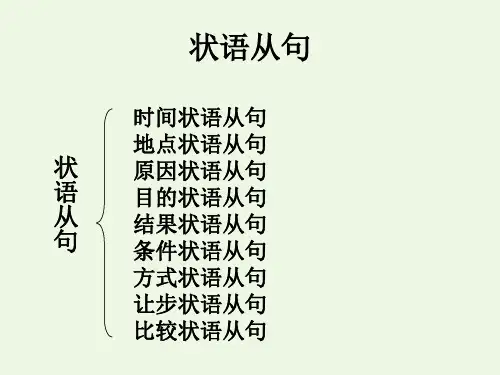
一般可分为九大类,分别表示时间、地点、原因、目的、结果、条件、让步、比较和方式。
尽管种类较多,但由于状语从句与汉语结构和用法相似,所以理解和掌握它并不难。
状语从句的关键是要掌握引导不同状语从句的常用连接词和特殊的连接词即考点。
现分别列举如下:1.时间状语从句常用引导词:when, as, while, as soon as, while, before, after, since , till, until特殊引导词:the minute, the moment, the second, every time, the day,the instant, immediately , directly, no sooner … than, hardly …when, scarcely … whenI didn’t realize how special my mother was until I became an adult.While John was watching TV, his wife was cooking.The children ran away from the orchard(果园) the moment they saw the guard.No sooner had I arrived home than it began to rain.Every time I listen to your advice, I get into trouble.2.地点状语从句常用引导词:where特殊引导词:wherever, anywhere, everywhereGenerally, air will be heavily polluted where there are factories.Wherever you go, you should work hard.3.原因状语从句常用引导词:because, since, as, since特殊引导词:seeing that, now that, in that, considering that, given that, considering that, inasmuch as, insomuch asMy friends dislike me because I’m handsome and successful.Now that everybody has come, let’s begin our conference.The higher income tax is harmful in that it may discourage people from trying to earn more.Considering that he is no more than 12 years old, his height of 1.80 m is quite remarkable.4.目的状语从句常用引导词:so that, in order that特殊引导词:lest, in case, for fear that,in the hope that, for the purpose that, to the end thatThe boss asked the secretary to hurry up with the letters so that he could sign them.The teacher raised his voice on purpose that the students in the back could hear more clearly.5.结果状语从句常用引导词:so … that, so… that, such … that,特殊引导词:such that, to the degree that, to the extent that, to such a degree that,He got up so early that he caught the first bus.It’s such a good chance that we must not miss it.To such an degree was he excited that he couldn’t sleep last night.6.条件状语从句常用引导词:if, unless,特殊引导词:as/so long as, only if, providing/provided that, suppose that, in case that, on condition thatWe’ll start our project if the president agrees.You will certainly succeed so long as you keep on trying.Provided that there is no opposition, we shall hold the meeting here.7.让步状语从句常用引导词:though, although, even if, even though特殊引导词:as(用在让步状语从句中必须要倒装),while ( 一般用在句首),no matter …,in spite of the fact that, while, whatever, whoever, wherever, whenever, however, whicheverMu ch as I respect him, I can’t agree to his proposal.尽管我很尊敬他,我却不同意他的建议。
原因状语从句和结果状语从句知识点综合讲解及习题专练(附答案)
原因状语从句和结果状语从句知识点综合讲解及习题专练(附答案)一. 状语从句:1.定义:用作状语的句子,相当于副词的用法。
2.分类:时间状语从句;原因状语从句;条件状语从家;结果状语从句;让步状语从句等。
二.原因状语从句:1. as引导原因状语从句,意为“因为”。
e.g. As he was too young, he couldn't join the army.As I did not know how to get there, I had to ask the way.2. because引导原因状语从句,意为“因为”。
注意:because +句子;because of + 名词/名词短语e.g. Tom went to school late because he got up late.Mary didn’t go to school because he was ill in hospital.3. since和for引导的原因状语从句,都意为“因为”。
e.g. Don’t criticize him like that since he is only a child.For my best friend will come to visit me, I must stay here.三.结果状语从句:1. so意为“因此”,引导结果状语从句;注意because不能与so连用。
e.g. Tom got a cold so he should go to see the doctor.They study French at a young age, so they can speak it fluently now.2. so …that…或者such (…) that…引导的结果状语从句,意为“如此……以至于……;结果是……”。
(1) so +形容词/副词+that从句(2) so+形容词+ a / an +单数名词+that从句= such+ a / an + (形容词)+单数名词+that从句(3) such + (形容词)+复数名词/ 不可数名词+ that从句e.g. She is so lovely a girl that we love her very much.She is such a lovely girl that we love her very much.四. 目的状语从句:so that…,in order that…等常用来引导目的状语从句,意为“为了,以便”。
中考英语-原因、结果、目的状语从句讲解+练习 (3)
中考英语-原因、结果、目的状语从句讲解+练习状语从句总结一、原因状语从句(1)原因状语从句通常由because, since, as, for引导。
(2)because表示直接原因,语气最强。
because引导的原因状语从句多放在主句之后。
回答由why提出的问题,只能用because。
此外,because和so不能同用在一个句子里。
例如:------Why aren’t going there?------Because I don’t want to.since引导原因状语从句,相当于now that,意思是“因为……,既然……,鉴于……”。
例如:Since the rain has stopped,let’s go for a walk. 既然雨停了,我们出去散散步吧。
as和since语气较弱,一般用来表示明显的原因。
由as和since引导的原因状语从居多放在句首。
例如:As he has no car, he can’t get there easily.Since we have no money, we can’t buy it.(3)for表示所说的理由是一种补充说明,for引导的从句一般不放在句子的开头。
如:I decided to stop and have lunch, for I was feeling quite hungry.练习:I was late for class yesterday _______ there was something wrong with my bike.He took off his coat _______ he felt hot.you can’t answer the question, I’ll ask someone else.二、结果状语从句(1)结果状语从句由so…that, such…that, so that引导。
(2)so…that语such...that可以互换。
英语语法专题目的和结果状语从句(讲解+练习,无答案)
中考语法专题目的和结果状语从句(讲解+练习,无答案)目的和结果状语从句一、目的状语从句用从句来表示主句行为或事件发生的目的,这个从句就是目的状语从句。
常用引导词:so that, in order that 两者可互换Mulan dressed like a man so that she could join the army. 为了能够参军,木兰穿戴成男人的样子。
I got up very early in order that I could get to school on time. 为了能按时到校,我很早就起床了。
从以上例句可看出,目的状语从句有一个特点:从句中一般都含有表示可能性的词语,比如could。
其他还有will, would, can等。
二、结果状语从句用从句来表示主句行为或事件发生的结果,这个从句就是结果状语从句。
常用引导词:so that, so ... that, such ... that1、so that意为“结果是……”,从句中一般不出现表示可能性的情态动词;通常用逗号与主句隔开;He got up late, so that he didn’t catch the early bus. 他起晚了,结果没赶上早班车。
2、so + adj./adv. + that从句,意为“如此……以致于……”;Iwas so careless that I forgot something important. 我真是粗心,以致忘了重要的事情。
He speaks so fast that I cannot understand him. 他说话太快了,以致我不能理解他的意思。
3、such ... that ... 意为“如此……以致于……”,常见结构如下:(1)such + adj.+ n. 复数形式+that从句;(2)such +adj. +不可数n. + that从句;(3)such +a/an +adj.+ n. 单数形式+ that从句 = so + adj. + a/an + 单数名词 + that从句He had such long arms that he could almost touch the ceiling. 他胳膊那么长,几乎能摸到天花板。
状语从句讲解及练习题50题-有答案
状语从句1.在主从复合句中修饰主句中的动词,形容词,副词等的从句叫状语从句。
可分为,时间状语从句,地点状语从句,原因,目的,结果,条件,让步,比较和方式状语从句。
2.时间状语从句起时间状语作用的句子;可放在句首,句中和句尾常用引导词:when,while, as, after, before, since, till, until, the moment, hardly ⋯when , no sooner ⋯than when, while, as 的用法1)when 用法最广,常可代替while 和as, 在while 引导的从句中,动词只能是延续性的When the fire broke out, all the students were sleeping soundly.The telephone rang while I was taking a bath.2)当两个表示时间延续的动作同时发生而又有对比意味的时候,用while ,在这样的复合句中,主句从句的时态通常是相同的。
Father was preparing a report while I was playing PC games.3)常用as 的情况:一边⋯一边;表示随着短暂动作的发生,另一行为伴随发生As he talked on, he got more and more excited.until 和till 的用法表示“一直到⋯”时,主句和从句都用肯定式;I will wait until/ till the concert is over. 表示“直到⋯才⋯”是,主句用否定,从句用肯定式。
They can't go untilSunday.since 的用法since 引导的从句中,如果是持续性动词,往往理解为某一状态的终止。
He has written to me frequently since he was ill. 自从他病好以来,他常写信给我。