
大学英语四六级听力(1)
大学英语四、六级听力
Ⅰ. 四、六级听力题型比例与具体情况
比例:35%
时长:35分钟
构成:短对话:1-15,8个短对话
短文听力:16-25题,3篇短文
复合式听写:26-35题,1篇文章
Ⅱ. 听力策略与技巧
1. 预测策略
M: What have you bought, Jane
W: I've bought a five-pound bag of potatoes and a loaf of bread.
Q: Where has Jane been
A. She's been to a restaurant.
B. She's been to a bakery.
C. She's been to a grocery store.
D. She's been to a bank.
2. 词汇策略
听的过程难免会碰见生词
3. 记笔记策略
记录关键词或重要信息,运用缩写,符号等培养记笔记风格。
4. 语法策略
利用语法知识更好地理解说话者的意思
5. 推理策略
激活与话题或场景相关的背景知识及常识,通过说话者的语调、语气推断出对话的场景和人物关系或说话者的态度、看法。
6. 意义策略
不需要听懂每一个词,注重听懂大意。
7. 建立听觉形象策略
所听的内容,使其情景化,变成图像。
Ⅲ. 不同题型的应试技巧
1. 短对话(Short Conversations)
11.A) She expected more people at her party.
B) She enjoys entertaining small children.
C) She threw a surprise party for her friend.
D) She has always enjoyed great popularity.
1
14.A) Make a profitable investment.
B) Buy a new washing machine.
C) Get parts for the machine from Japan.
D) Have the old washing machine fixed.
15.A) He is pleased with his exciting new job.
B) He finds the huge workload unbearable.
C) He finds his office much too big for him.
D) He is not so excited about his new position.
15题原文:
W: I heard about your promotion. You must be thrilled.
M: Not really. The new office is huge, but the workload has doubled.
四、六级短对话中常见的问题有以下几种:
1. What do we learn from the conversation?
2. What does the man/ woman mean/ imply?
3. What is the speaker most probably going to do ?/ What does sb. suggest sb. else do sth.?
4. What do we learn about sth./ sb. / What does sb. say about sb./ sth. / How does sb. find sth?
5. Where does the conversation most probably take place?
6. What are the speakers talking about / What contribute to sth.?
7. Who is the man/ woman?
8. Why did/ didn't the man/ woman do sth.?
2. 长对话(Long Conversations)
19.A) To make a business report to the woman.
B) To be interviewed for a job in the woman's company.
C) To resign from his position in the woman's company.
D) To exchange stock market information with the woman.
20.A) He is head of a small trading company.
B) He works in an international insurance company.
C) He leads a team of brokers in a big company.
D) He is a public relations officer in a small company.
21.A) The woman thinks Mr. Saunders is asking for more than they can offer.
B) Mr. Saunders will share one third of the woman's responsibilities.
C) Mr. Saunders believes that he deserves more paid vacations.
D) The woman seems to be satisfied with Mr. Saunders's past experience.
3. 听力篇章理解(Passage Listening)
预览选择项的时候,可以参照做长对话的方法,通过对几道题各个选项之间相关联的信息进行分析之后,大致可以推断出将要听到的听力材料的主要内容。
短文听力训练方法
2
注意下面的误区
1)鸵鸟式听法
2)多而不精
3)不愿对着文字材料大声读
4)训练时间安排不当
4. 复合式听写 (Compound Dictation)
听力理解部分,原复合式听写调整为单词及词组听写,短文长度及难度不变,要求考生在听懂短文的基础上,用所听到的原文填写空缺的单词或词组,共10题。
短文播放三遍。
预祝大家在考试中取得好的成绩!!
Good luck to all of you!!
Thank you.
3。
大学英语四级听力模拟试题(1)及答案
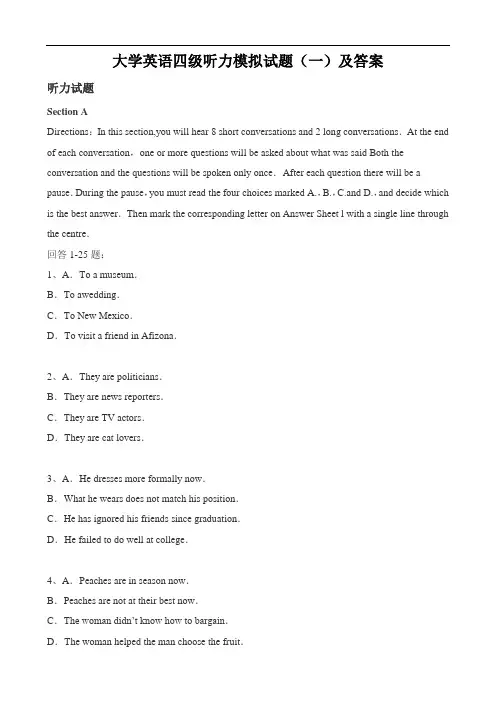
大学英语四级听力模拟试题(一)及答案听力试题Section ADirections:In this section,you will hear 8 short conversations and 2 long conversations.At the end of each conversation,one or more questions will be asked about what was said Both the conversation and the questions will be spoken only once.After each question there will be a pause.During the pause,you must read the four choices marked A.,B.,C.and D.,and decide which is the best answer.Then mark the corresponding letter on Answer Sheet l with a single line through the centre.回答1-25题:1、A.To a museum.B.To awedding.C.To New Mexico.D.To visit a friend in Afizona.2、A.They are politicians.B.They are news reporters.C.They are TV actors.D.They are cat lovers.3、A.He dresses more formally now.B.What he wears does not match his position.C.He has ignored his friends since graduation.D.He failed to do well at college.4、A.Peaches are in season now.B.Peaches are not at their best now.C.The woman didn’t know how to bargain.D.The woman helped the man choose the fruit.5、A.It will reduce government revenues.B.It will stimulate business activities.C.It will mainly benefit the wealthy.D.It will cut the stockholders’dividends.6、A.Taking a picture of Prof.Brown.B.Commenting on an oil-painting.C.Hosting a TV program.D.Staging a performance.7、A.Fixing some furniture.B.Repairing the toy train.C.Reading the instructions.D.Assembling the bookcase.8、A.$240.B.$200.C.$300.D.$120.9、听录音,回答以下问题:A.1999.B.1990.C.1969.D.1996.10、A.The Frontier.B.The lakes and Winter Wonderland.C.The Canadian border.D.The Appalachian mountains.11、A.North.B.Northeast.C.MidwestD.West.12、A.It is the north side ofthe US.B.It is in Canada.C.It is in the east part ofthe US.D.Itis onthewest edge ofthe US.听录音,回答以下问题:13、A.Transferring to another department.B.Studying accounting at a university.C.Thinking about doing a different job.D.Making preparation for her wedding.14、A.She has finally got a promotion and a pay raise.B.She has got a satisfactory job in another company.C.She could at last leave the accounting department.D.She managed to keep her position in the company.15、A.He and Andrea have proved to be a perfect match.B.He changed his mind about marriage unexpectedly.C.He declared that he would remain single all his life.D.He would marry Andrea even without meeting her.Section BDirections:In this section,you will hear 3 short passages.At the end of each passage,you will hear some questions.Both the passage and the questions will be spoken only once.After you hear a question,you must choose the best answer from the four choices marked A.,B.,C. and D.Then mark the corresponding letter on Answer Sheet 1 with a single line through the centre.Passage One听录音,回答以下问题:16、A.To win over the majority ofpassengers from airlines in twenty years.B.To reform railroad management in western European countries.C.To electrify the railway lines between major European cities.D.To set up an express train network throughout Europe.17、A.Major European airlines will go bankrupt.B.Europeans will pay much less for traveling.C.Traveling time by train between major European cities will be cutby half.D.Trains will become the safest and most efficient means of travel in Europe.18、A.Train travel will prove much more comfortable than air travel.B.Passengers will feel much safer on board a train than on a plane.C.Rail transport will be environmentally friendlier than air transport.D.Traveling by train may be as quick as,or even quicker than,by air.19、A.In 1981.B.In 1989.C.In 1990.D.In 2000.Passage Two听录音,回答以下问题:20、A.Customers may get addicted to the smells.B.Customers may be misled by the smells.C.It hides the defects of certain goods.D.It gives rise to unfair competition.21、A.Flexible.B.CriticA..C.Supportive.D.Cautious.22、A.The flower scent stimulated people’s desire to buy.B.Stronger smells had greater effects on consumers.C.Most shoppers hated the smell in the shoe store.D.84%of the customers were unaware of the smells.Passage Three听录音,回答以下问题:23、A.It may produce an increasing number of idle youngsters.B.It may affect the quA.ity of higher education in America.C.It may cause many schools to go out of operation.D.It may lead to a lack of properly educated workers.24、A.It iS less serious in cities than in rural areas.B.It affects both junior and senior high schools.C.It results from a worsening economic climate.D.It is a new chA.lenge facing American educators.25、A.A lowing them to choose their favorite teachers.B.Creating a more relaxed learning environment.C.Rewarding excellent academic performance.D.Helping them to develop better study habits.Section CDireetions:In this section.you will hear a passage three times.When the passage is readfor thefirst time,you shouM listen carefully for its general idea.When the passage is readfor the second time,you are required to fill in the blanks with the exact words you have lust heard.Finally,when the passage is readfor the third time,you should check what you have written.根据下列材料,请回答:The economy is one of the most important and urgent issues for Nicholas Sarkozy,France’s new President.He focused on change during his(26)__________ campaign,but trade unions are expected to strongly(27)__________ some of the changes he is planning.There’s no doubting the scA.e o f the economic problems(28)__________ Nicholas Sarkozy.France’s(29)__________ rate hasn’t fallen below 8 percent in a quarter of a century and its economic growth rate during 2006 was the slowest of any(30)__________ in the European Union,except PortugA..But the new President has(31)__________ change.He wants to make it easier for businesses to hire and fire workers.Anyone who(32)__________ a job offer will lose their unemployment benefit.The civil service will be slimmed down to help fund big tax cuts for both businesses and individuals.And any time the French work above the thirty-five hour week will be completely tax free.These measures won 7t go down well with trade unions—who in the past have organized campaigns of open defiance to force French presidents with plans for painful reform to back down.But Mr.Sarkozy has made it an election pledge that unions will(33)__________ be able to bring the country to a standstill.Workers in key areas like public transport will facenew(34)__________ to provide minimum levels of service even during strikes.The unions may not like it—but the new President’s entire programme of reform(35)__________ his winning any stand off.26、请回答(26)题__________.27、请回答(27)题__________.28、请回答(28)题__________.29、请回答(29)题__________.30、请回答(30)题__________.31、请回答(31)题__________.32、请回答(32)题__________.33、请回答(33)题__________.34、请回答(34)题__________.35、请回答(35)题__________.听力答案Test 11-5.BBABC 6-10.CDDAB 11-15.CCCAB16-20.DCDAB 21-25.CADBC 26.election 27.disagree with 28.facing 29.unemployment 30.nation 31.promised 32.rejects33.no longer 34.requirements 35.depends on。
大学英语四级考试——听力篇(一

大学英语四级考试——听力篇(一)听的能力的提高,对于外语学习有着至关重要的作用。
大学四级英语测试注重对考生听力理解能力的培养和检测,要求考生们领会英语语义,对听到的语音信号进行加工;使自身对英语的背景知识、语境和语言知识的了解相互作用,对听力材料不断进行吸收,最终形成语言理解。
【改革目标】高等教育英语教学改革的三个方面是:一、修改原有教学大纲,制订新的《大学英语课程教学要求》,将原有的以阅读理解为主转变到以听力为主、全面提高英语综合应用能力;二、改革现有教学模式;三、改革大学英语教学检测和评价体系,建立适应时代要求的大学英语评价体系,该项测试突出培养和检测学生以英语听说能力为主的综合应用能力。
改革就是要改掉“哑巴英语”,就是要解决听不懂、说不出的问题。
【综合要求】要达到大学四级听力的水平,《大学英语课程教学要求(试行)》提出了明确的要求:◆能听懂英语授课;◆能听懂日常谈话和一般性题材的讲座;◆能基本听懂慢速英语节目,语速为每分钟130词左右,能掌握其中心大意,抓住要点;◆能运用基本的听力技巧帮助理解。
【题型变化】大学英语四级考试题型改革后,听力部分改动较大,主要的变化有以下几个方面:听力的分值由原来的20%提升为35%,其中听力对话占15%,包括短对话和长对话,测试题型为多项选择;听力短文占20%,包括选择题型的短文和复合式听写。
【题型构成】➢Section A部分由两种题型构成:短对话和长对话。
短对话部分由原来的10题减至8题,占分值的8%。
增加了两篇长对话,每篇3至4题,共7题,分值比例为7%。
Section B部分仍然为短文题,即我们俗称的passage,共3篇,每篇设3~4个题目,共10题,分值比例10%。
Section C部分为复合式听写:其中词汇听写由原来的7个增加至8个,句子听写仍保持3句不变,复合式听写部分总共占分值的10%。
总的来说,题目的总量增加了,做题时间增长了,无形中增加了对同学在做题目时精力集中程度的考验。
2016年12月大学英语六级考试真题听力原文及参考答案(第1套)

2016年12月大学英语六级考试真题(第1套)参考答案Part IV TranslationWith the improvement of living standards, travelling is occupying an increasingly important position in the lives of Chinese people. In the past, they spent most of their time making a living, with few opportunities to go travelling. This situation, however, has changed in the wave of the rapid development of Chinese tourism industry in recent years. The booming economy and the rising affluent middle class have provoked an unprecedented upsurge in tourism. Apart from domestic travel, outbound travel is becoming more and more popular among Chinese tourist. During China’s National Day holiday in 2016, the total tourism consumption exceeded 400 billion RMN. The WTO estimates that China will become the world’s biggest spender on travel by 2020, with the fastest growing expenditures on outbound travel in the next few years.Part II Listening Comprehension听力原文Section AQuestions 1 to 4 are based on the conversation you have just heard.W: Professor Henderson, could you give us a brief overview of what you do, where you work and your main area of research?M: Well, the center for climate research where I work links science and climate change to issues around economics and policy. Some of our research is to do with the likely impacts of climate change and all of the associated risks.W: And how strong is the evidence that climate change is happening that it’s really something we need to be worried about?M: Well, most of the science of climate change, particularly that to do with global warming, is simply fact. But other aspects of the science are less certain or at least more disputed. And so we're rarely talking about risk. What the economics tells us is that it's probably cheaper to avoid climate change -- to avoid the risk -- than it is to deal with the likely consequences.W: So what are we doing? What can we do about it?M: Well, I would argue that we need to develop the science specifically to understand the likely impacts of climate change in different contexts. As I said, we need to understand the best ways of avoiding climate change. And this will involve a huge transition to low carbon energy systems. And the transition is a tremendous priority. And for this to happen, we may need action on a global scale. From a political perspective, we need to understand the terms on which major countries like China and the USA might sign up to a global agreement, because at the moment we don't have that consensus.W: Right.M: And we also need to plan ahead so that we are in a position to deal with the likely levels of climate change, which are already inevitable. And even more so, too, for the levels that are likely if we don’t get those global agreements.1. What does Professor Henderson say about his main area of research?2. What does Professor Henderson say about climate change?3. What does Professor Henderson say is a top priority in combating climate change?4. What does Professor Henderson advise us to do to better deal with climate change?Questions 5 to 8 are based on the conversation you have just heard.W: I have many business English students. When I teach the classroom, we often end up talking about things like success and what leads to success. And it’s interesting that many of them mentioned the element of luck.M: Right.W: Luck is important to success, but since you have seen that fantastic video on the Ted Talk's website by Richard St. John…he doesn't mention luck at all.M: Well, I'm a firm believer that people can make their own luck. I mean what people regard as luck you can actually create to a degree.W: Sure. I think a lot of why people consider luck is attributed to how you respond to the opportunities that come your way.M: Yes. Very good point.W: Seizing the opportunities. But was there any point in the video that you thought was particularly interesting?M: Yes, actually there was. Something very impressive to me is many people think that luck is important and that natural talent is something you must have in order to be successful. And in the video we saw, the point about getting good at something is not about having some natural talent, it's all about practice, practice, practice.W: Definitely yeah, natural talent helps us in some way, but at the end of the day you really do need to work hard and get really, really good at what you do.M: Sure.W: I thought one interesting thing in the video was the idea of passion being so important, and there're people who really love what they do. Of course, you’re going to want to work harder and put the time and effort into it. And the funny thing is that if you love what you do and are really passionate about it and work really hard, then money kind of comes automatically.5. What are the speakers mainly talking about?6. What is the woman's view of luck?7. What is the chief point the Ted Talk's video makes?8. What does the woman think is the funny thing in the Ted Talk's video?Section BQuestions 9 to 12 are based on the passage you have just heard.Devils Tower, the first national monument in America, could almost be mistaken for the stump of an enormous tree. Its sheer rock sides sweep up from a broad base until they cut off abruptly at the flat summit. Rising more than 1,000 feet in the middle of the gently rolling plains of Wyoming, the massive column of rock looks as though it was dropped down into this location from a different time and place.In a sense, it was. Devils Tower is a relic of the past. When the molten rock of the earth’s core forced its way to the surface to form the throat of a volcano. As the centuries passed, the rock cooled and hardened, shrinking and cracking into long columns, born in fire and fury, Devil’s Tower was then shaped by the slow, gentle work of wind and water. The outer layers of the volcano were worn away, until the hard core stood completely exposed.Small wonder that an Indian legend described Devils Tower as being formed by supernatural powers. The legend says that when seven girls were attacked by bears, they took refuge on top of a small rock, and they appealed to the Rock God for help. The god caused the rock to grow and to lift the girls far above the ground, while its sides were scored by the claws of the angry bears. Even today, says the legend, the girls can be seen above the towering rock. As seven shining stars in the night sky.9. What does the Devils Tower look like?10. What cause the volcano’s outer layers to wear away?11. What does the Indian legend say about the Devils Tower?12. How did the Rock God help the seven girls in the Indian legend?Questions 13 to 15 are based on the passage you have just heard.It’s no accident that most gas stations have convenience stores attached. Few of us can fill up the tank without buying a few snacks, cigarettes,soft drinks or other items we can live without. “I deserve it.” That’s what hard-working men and women say to justify their lavish vacations, big stereo systems or regular restaurant meals. They do deserve such indulgences. However, they also deserve a home of their own--a secure retirement and freedom from worrying about unpaid bills.No one should have to live with what a Texas mother described as constant stress, tension, even fear about money. Sadly, the pleasure that comes from extravagances often disappears long before the bills do. The video camera that one single mother bought for a special occasion, for example, is not much fun now. She’s figured out that it will take her another three years to pay it off at $30 a month. And the New Yorkers who spent a bundle on an outdoor hot tub now admit they rarely use it, “because we can't afford to heat it in winter.” The solution--set priorities, add up the annual cost of each item, then consider what else she could buy with the same money. That will help you decide which items are really worth it. One Chicago woman, for example, discovered that daily lunches with coworkers cost her $2,000 a year; she decided to take lunch to work instead. “I now put $20 a week into my vacation fund, and another 20 into retirement savings,” she says. “Those mean more to me than lunch.”13. What does the speaker say about drivers who stop at gas stations?14. What does the speaker say about extravagances?15. What does a speaker want to show by the example of the Chicago woman?Section CQuestions 16 to 18 are based on the recording you have just heard.Let’s say you start to brain storm a list of all the emotions you’ve ever experienced. Just for fun, try it now.What’s on your list? Chances are, you included things like: happy, sad, excited, angry, afraid, grateful, proud, scared, confused, stressed, relaxed and amazed. Now sort your list into two categories--positive emotions and negative emotions.Feeling both positive and negative emotions is a natural part of being human. We might use the word “negative” to describe more difficult emotions, but it does not mean those emotions are bad or we shouldn’t have them. Still, most people were probably rather feel a positive emotion than a negative one. It’s likely you prefer to feel happy instead of sad or confident instead of insecure.What matters is how our emotions are balanced--how much of each type of the emotion positive or negative we experience.Negative emotions warn us of threats or challenges that we may need to deal with. For example, fear can alert us to possible danger. It’s a signal that we might need to protect ourselves. Angry feelings warn us that someone is stepping on our toes, crossing a boundary, or violating our trust. Anger can be a signal that we might have to act on our own behalf.Negative emotions focus our awareness. They help us to zero in on a problem so we can deal with it. But too many negative emotions can make us feel overwhelmed, anxious, exhausted or stressed out. When negative emotions are out of balance, problems might seem too big to handle.The more we dwell on our negative emotions, the more negative we begin to feel. Focusing on negativity just keeps it going. Positive emotions balance out negative ones, but they have other powerful benefits, too.Instead of narrowing our focus, like negative emotions do, positive emotions affect our brains in ways that increase our awareness, attention and memory. They help us take in more information, hold several ideas in mind at once and understand how different ideas relate to each other. When positive emotions open us up to new possibilities, we are more able to learn and build on our skills. That leads to doing better on tasks and tests.People who have plenty of positive emotions in their everyday lives tend to be happier, healthier, learn better and get along well with others.16. What does the speaker say about negative emotions?17. What happens to people whose negative emotions are out of balance?18. How do positive emotions affect us?Questions 19 to 22 are based on the recording yon have just heard.In the past few months, I've been travelling for weeks at a time with only one suitcase of clothes. One day, I was invited to an important event, and I wanted to wear something special for it. I looked through my suitcase but couldn't find anything to wear. I was lucky to be at the technology conference then, and I had access to 3D printers. So I quickly designed a skirt on my computer, and I loaded the file on the printer. It just printed the pieces overnight. The next morning, I just took all the pieces, assembled them together in my hotel room, and this is actually the skirt that I'm wearing right now.So it wasn't the first time that I printed clothes. For my senior collection at fashion design school, I decided to try and 3D print an entire fashion collection from my home. The problem was that I barely knew anything about 3D printing, and I had only nine months to figure out how to print five fashionable looks.I always felt most creative when I worked from home. I love experimenting with new materials, and I always tried to develop new techniques to make the most unique textiles for my fashion projects.One summer break, I came here to New York for an internship at a fashion house in Chinatown. We worked on two incredible dresses that were 3D printed. They were amazing -- like you can see here. But I had a few problems with them. They were made from hard plastics and that's why they were very breakable. The models couldn't sit in them, and they even got scratched from the plastics under their arms.So now, the main challenge was to find the right material for printing clothes with, I mean the material you feed the printer with. The breakthrough came when I was introduced to Filaflex, which is a new kind of printing material. It's strong, yet very flexible. And with it, I was able toprint the first garment, a red jacket that had the word "freedom" embedded into it. And actually, you can easily download this jacket, and change the word to something else, for example, your name or your sweetheart's name.So I think in the future, materials will evolve, and they will look and feel like fabrics we know today, like cotton or silk.19. What does the speaker say about the skirt she is wearing now?20. When did the speaker start experimenting with 3D printing?21. What was the problem with the material the speaker worked on at a New York fashion house?22. What does the speaker say about Filaflex?Questions 23 to 25 are based on the recording you have just heard.Welcome to the third lecture in our series on the future of small businesses in Europe. The purpose of today's lecture, as you have seen from the title and the abstract, is to examine in more detail the problems facing small and medium-sized enterprises which arise at least in part from having to adapt to rapid advances in technology. And I want to look at these both from a financial and from a personnel point of view and to offer a few hopefully effective solutions.Here we have three of the most important problems facing small businesses that I want to look at today.First, keeping up with the pace of technological change, recruiting high quality staff in a time of skills shortages in IT as a whole and in a highly competitive market, and the issue of retaining staff once they've been recruited and trained. Now all of these problems involve significant costs for all businesses. But they're a particularly challenging issue for small and medium-sized enterprises. And those costs will vary depending on the size and scale of the businesses.So let's come to the first issue on our list which is keeping pace with developments in technology. Now we all know that the technology industry is intensely competitive with new products being launched all year round, as the various companies strive to compete with each other rather than say once a year or every couple of years. And this is a real headache for smaller businesses. So let's imagine we have a small company which is doing OK. It's just about making a profit, and it spends most of its income on overheads. So for a company in this situation, keeping up to date with the latest technology, even if it's only for the benefit of key staff, this can be hugely expensive.So in my view, some creative thinking needs to come in here to find ways to help companies in this situation to stay ahead in the game. But at the same time to remain technologically competitive.Well there's the possibility that small groups of companies with similar requirements, but not directly competing with each other, they could share the cost of upgrading in much the same way as let's say, an Internet operates within larger organizations. In fact, cost sharing could be a very practical solution, especially in times of financial difficulty. If there's downward pressure on costs, because of a need for investment in other areas, I would argue that this is a perfectly feasible solution.23. What does the speaker say about the problems facing small and medium sized enterprises?24. Why does the speaker's say about the technology industry?25. What is a practical solution to the problems of small and medium-sized businesses?。
2016年6月大学英语四级听力题目答案及原文第1套【精选文档】

2016年6月大学英语四级真题(第1套)Part I Writing(30 minutes)Directions: For this part,you are allowed 30 minutes to write a letter to express your thanks to your parents or any family members upon making memorable achievement. You should write at least 120 words but no more than 180 words.Part ⅡListening Comprehension(25 minutes)Section ADirections: In this section, you will hear three news reports. At the end of each news report,you will hear two or three questions。
Both the news report and the questions will be spoken only once. After you hear a question, you must choose the best answer from the four choices marked A),B), C) and D). Then mark the corresponding letter on Answer Sheet 1 with a single line through the centre。
Questions 1 and 2 are based on the news report you have just heard。
1。
A)The International Labor Organization's key objective。
2024年6月大学英语四级考试听力原文(第1套)
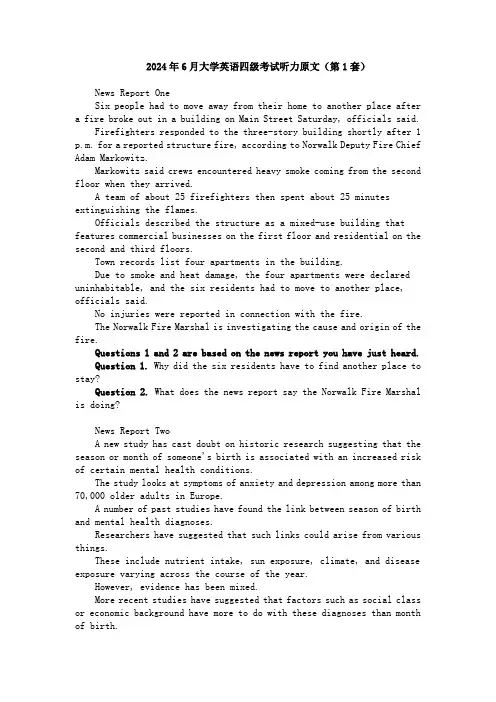
2024年6月大学英语四级考试听力原文(第1套)News Report OneSix people had to move away from their home to another place after a fire broke out in a building on Main Street Saturday, officials said.Firefighters responded to the three-story building shortly after 1 p.m. for a reported structure fire, according to Norwalk Deputy Fire Chief Adam Markowitz.Markowitz said crews encountered heavy smoke coming from the second floor when they arrived.A team of about 25 firefighters then spent about 25 minutes extinguishing the flames.Officials described the structure as a mixed-use building that features commercial businesses on the first floor and residential on the second and third floors.Town records list four apartments in the building.Due to smoke and heat damage, the four apartments were declared uninhabitable, and the six residents had to move to another place, officials said.No injuries were reported in connection with the fire.The Norwalk Fire Marshal is investigating the cause and origin of the fire.Questions 1 and 2 are based on the news report you have just heard.Question 1. Why did the six residents have to find another place to stay?Question 2. What does the news report say the Norwalk Fire Marshal is doing?News Report TwoA new study has cast doubt on historic research suggesting that the season or month of someone's birth is associated with an increased risk of certain mental health conditions.The study looks at symptoms of anxiety and depression among more than 70,000 older adults in Europe.A number of past studies have found the link between season of birth and mental health diagnoses.Researchers have suggested that such links could arise from various things.These include nutrient intake, sun exposure, climate, and disease exposure varying across the course of the year.However, evidence has been mixed.More recent studies have suggested that factors such as social class or economic background have more to do with these diagnoses than month of birth.Overall, the new study found no significant relationship between participants' month of birth and symptoms of depression or anxiety.There was some variability in some countries.In Poland, depressive symptoms fluctuated a little depending on birth month.In the Czech Republic, the same was true of anxiety symptoms.But on the whole, there was no systematic pattern.Questions 3 and 4 are based on the news report you have just heard.Question 3. What have a number of past studies found about season of birth?Question 4. What did the new study find about the relationship between participants' month of birth and symptoms of depression?New Report ThreeGenetic researchers in China have made a clone of a star police dog.The clone was born in a laboratory in Beijing in December.Tests show that the clone and her mother are almost identical genetically.The mother dog helped solve multiple murders and many other crimes.The clone has already performed better than traditionally bred dogs on several tests.If the clone continues to perform as well as expected, it could mean a huge reduction in the training time for police dogs, which usually takes about five years.The ultimate goal of scientists is to produce clones of talented police dogs that can be trained in months instead of years.However, this goal is not yet possible due to the current costs of the technology.This is not the first time a clone has been made of a star police dog.In South Korea, six clones began working with the police in 2008.Questions 5 to 7 are based on the news report you have just heard.Question 5. What do the researchers' tests show about the cloned dog?Question 6. What is the scientists' purpose in cloning police dogs?Question 7. Why does the news report say the scientists' goal is not yet possible?Conversation OneTom, did you see the article online about the new TV series based on the book The Three Body Problem?A colleague mentioned the book, but I've been so busy writing my thesis that 1 haven't been able to read for pleasure in months.Well, sounds like if you're going to read anything for fun, this is the book.It's written by a Chinese science fiction writer.I can't remember his name, but he's written three books in all, and The Three Body Problem is the first in the series.I don't want to say too much and spoil it for you, but it's definitely got some amazing technological and sociological concepts in it.It does sound like it would suit my taste, but if they are making a TV series based on it now, I don't know if I should read the book or watch the show first.I think it's better to read the book first.It's rare for the show or movie to be better than the book.And then, you just end up ruining the book for yourself, if the show isn't very good.When is the show supposed to start?I'm a bit overwhelmed with the amount of data I still need to collect to finish my thesis.But I still need to relax sometimes.I can't remember exactly.It's pretty soon, and it's going to be quite long.There are 24 episodes.Well, maybe you could download an electronic copy of the book and try to read it before the show starts.That's a good idea.And then, maybe we can watch the series together.Thanks for the tip, Alice.W: No problem.Questions 8 to 11 are based on the conversation you have just heard.Question 8. How did the man get to know about the book The Three Body Problem?Question 9. What does the woman say she can't remember about the book's author?Question 10. What does the man have to do to finish his thesis?Question 11. What will the man most probably do first after the conversation?Conversation TwoHello, good afternoon.I have an inquiry to make.It's about the vegetarian food festival you are holding on the 19th of August at the Newcastle City Hall.Yes, of course. My name's Philip How can I help you?It says on your website that you are still looking for vendors, and I grow organic vegetables on my farm, as well as doing my own home baking.Would I be able to sell both the vegetables and items baked from them at the festival?That's exactly the type of thing we are looking for.We're getting close to the deadline, however.Do you prefer to fill out an application on the web, or to print it out and fill it in by hand and then post it back to us?Remember that you will have to have all your certificates to hand when you are filling out the forms, as the standards are high and they'll be carefully checked before anyone will be able to sell their produce at the event.I should be fine with doing it on your website, and I already have all my certificates, as we run a small farm shop too.But can you give me your details anyway?Sure. Please address it to the Organic Organization, Vendor Applications, 112 Queens Road, Newcastle, Northumbria.The postcode is NU 29 3LJ.Remember that the closing date is next Tuesday, the 28th of June.That's absolutely wonderful.Thank you so much for your help. Goodbye.Questions 12 to 15 are based on the conversation you have just heard.Question 12.Why does the woman call the man?Question 13. What is the man still looking for?Question 14. What does the man say they are getting close to?Question 15. What does the man finally ask the woman to remember?Passage OneSupporters call it "wild camping"; opponents call it "illegal camping".What both sides accept is that there has been a boom in the past few months, with increasing numbers of visitors pitching their tents on any bit of land they fancy in the UK.In part, this reflects the fact that official campsites have been wholly or partially closed, or are overflowing in a summer when fewer people are going abroad.It is also cheap, at a time when many are worried about what the economic future holds.But it may also be an expression of a desire for going outdoors- a response to the months of lockdown.Most of the coverage of the boom in wild camping has been negative.Camping in public parks has now been banned for August and the early part of September because campers dump litter, human waste, and even their tents on the grassland.Similar action has been taken even in Scotland, where camping is usually permitted on most of its open land.Clearly there have to be rules.It would make sense that wild campers need to ask for permission to camp from landowners, especially outside Scotland, where the law is farmore restrictive.It would be common sense for people to use small tents and leave no trace of their visit.They have been attracted by a patch of land this close to wilderness, and it is their responsibility to keep it that way.Questions 16 to 18 are based on the passage you have just heard.Question 16. Why has wild camping become popular in the UK?Question 17. Why is camping banned for part of the summer in public parks?Question 18. What does the speaker suggest campers do?Passage TwoImagine boating down the Amazon River, minding your own business calmly keeping an eye out for alarmingly large snakes- and a curious pink dolphin appears to swim alongside.While this may seem like a mythical creature, pink dolphins do exist in the Amazon region.The Amazon river dolphin is a giant among its species.It can measure up to 2 meters long and weigh around 204 kilograms.Size isn't the only thing that sets the Amazon river dolphin apart.Thriving in South American rivers and temporary lakes caused by seasonal flooding, this freshwater dolphin is sometimes shockingly pink.Although born gray, males of the species are easily identified as they enter adulthood by a decisive pink shade.Their unusual coloring is believed to be the result of scar tissue from dolphin fights-- whether play-fighting or a serious bid for a mate.The deeper the pink, the more attractive the males are believed to be, and the older the male, the more pink it will have.There's also a theory that this color helps the dolphins more readily blend in with their surroundings.During heavy rains, rivers along the Amazon rainforest turn a pink shade, and with it male dolphins are harder to detect.The Amazon wetland system, fed by the Amazon River, is a crucial place for pink dolphins to breed, and since 2018 has been granted internationally protected status.Questions 19 to 21 are based on the passage you have just heard.Question 19. What does the passage say about pink dolphins?Question 20. What is the unusual coloring of pink dolphins believed to originate in?Question 21. What has become of the Amazon wetland system since 2018?Passage ThreeIn a new Merrill Lynch/Age Wave survey, a full 70% of the early adults said they received financial support from their parents in the past yearand 58% said they couldn't afford their current lifestyles without it.The most common types of financial support include cell phone plans, food, school costs and car expenses.Parental financial support of early adults, said Ken Dychtwald, CEO of Age Wave, is "the new normal".But 64% of the young adults surveyed said parents' financial support to children age 25 to 34 is "a bad thing", because it makes those kids dependent.By contrast, only 29% thought supporting men and women age 18 to 24 is bad; the remaining 71% thought that assistance "helps the adult children get ahead".Dychtwald believes the young women and men surveyed were saying that by 25 younger adults ought to be financially independent.In fact, the respondents said, financial independence defines adulthood."Financial independence is something they were struggling with and challenged by. And it scared them a bit," Dychtwald said.One big reason they're struggling is attributed to college loans, of which the average amounts to $37,000.Many of the parents have taken on college loans for the kids, too, sometimes at the expense of their own finances.In the survey, 60% of early adults define financial success as being debt-fee.Whether that's likely, or even possible, anytime soon, is anyone's guess.Questions 22 to 25 are based on the passage you have just heard.Question 22. What do we learn from a new survey by Merrill Lynch/Age Wave?Question 23. Why did most young adults in the survey say financial support to children aged 25 to 34 is a bad thing?Question 24. What did the respondents in the survey say regarding financial independence?Question 25. What is one big reason young adults are struggling?。
2016年12月大学英语六级考试真题(第1套)听力原文
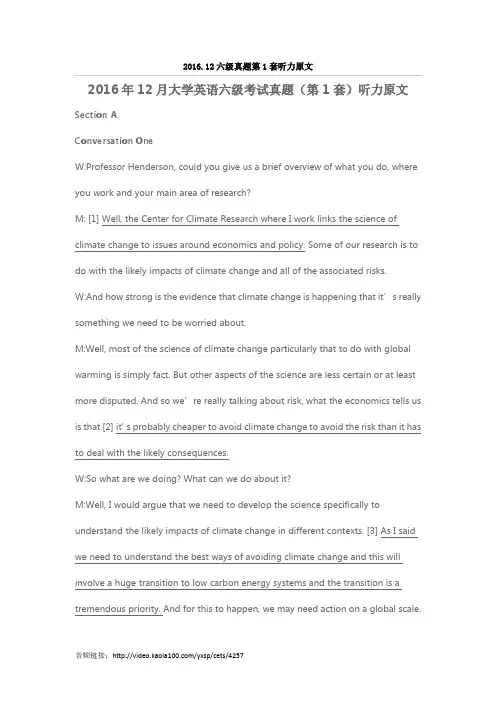
2016.12六级真题第1套听力原文2016年12月大学英语六级考试真题(第1套)听力原文Section AConversation OneW:Professor Henderson, could you give us a brief overview of what you do, where you work and your main area of research?M: [1] Well, the Center for Climate Research where I work links the science of climate change to issues around economics and policy. Some of our research is to do with the likely impacts of climate change and all of the associated risks.W:And how strong is the evidence that climate change is happening that it’s really something we need to be worried about.M:Well, most of the science of climate change particularly that to do with global warming is simply fact. But other aspects of the science are less certain or at least more disputed. And so we’re really talking about risk, what the economics tells us is that [2] it’s probably cheaper to avoid climate change to avoid the risk than it has to deal with the likely consequences.W:So what are we doing? What can we do about it?M:Well, I would argue that we need to develop the science specifically to understand the likely impacts of climate change in different contexts. [3] As I said we need to understand the best ways of avoiding climate change and this will involve a huge transition to low carbon energy systems and the transition is a tremendous priority. And for this to happen, we may need action on a global scale.From a political perspective, we need to understand the terms on which major countries like China and the USA might sign up to a global agreement because at the moment we don’t have that consensus.W:Right.M: [4] And we also need to plan ahead so that we’re in a position to deal with the likely levels of climate change which are already inevitable and even more so,too, for the levels that are likely if we don’t get those global agreements. Questions 1 to 4 are based on the conversation you have just heard.1.What does Professor Henderson say about his main area of research?2.What does Professor Henderson say about climate change?3.What does Professor Henderson say is a top priority in combating climate change?4.What does Professor Henderson advise us to do to better deal with climate change?Conversation TwoW:I have many business English students. [5] When I teach the classroom, we often end up talking about things like success and what leads to success. And it’s interesting that many of them mention the element of luck.M:Right.W:Luck is important to success. But since you’ve seen that fantastic video on the TED Talks website by Richard St. John, he doesn’t mention luck at all.M:Well, I’m a firm believer that people can make their own luck. I mean what people regard as luck, you can actually create, to a degree.W:Sure. [6] I think a lot of what people consider luck is attributed to how you respond to the opportunities that come your way.M:Yes. Very good point.W:Seizing the opportunities. But was there any point in the video that you thought was particularly interesting?M:Yes. Actually there was. Something very impressive to me as many people think that luck is important and that natural talent is something you must have in order to be successful. [7] And in the video we saw, the point about getting good at something is not about having some natural talent. It’s all about practice, practice, practice.W:Definitely, yeah. Natural talent helps in some way but at the end of the day you really do need to work hard and get really really good at what you do.M:Sure.W:I thought one interesting thing in the video was the idea of passion being so important and that people who really love what they do, of course you’re going to want to work harder and put the time and effort into it. [8] And the funny thing is that if you love what you do and are really passionate about it and work really hard, the money kind of comes automatically.Questions 5 to 8 are based on the conversation you have just heard.5.What are the speakers mainly talking about?6.What is the woman’s view of luck?7.What is the chief point the TED Talks video makes?8.What does the woman think is the funny thing in the TED Talks video?Section BPassage One[9] Devil’s Tower, the first national monument in America, could almost be mistaken for the stump of an enormous tree. Its sheer rock size sweeps up from a broad base until they cut off abruptly at the flat summit. Rising more than 1,000 feet in the middle of the gently rolling plains at Wyoming. The massive column of rock looks as though it was dropped down into this location from a different time and place. In a sense it was, Devil’s Tower is a relic of the past—when the melted rock of the earth’s core forced its way to the surface to form the throat of a volcano. As the centuries passed, the rock cooled and hardened, shrinking and cracking into long columns. [10] Born in fire and fury, Devil’s Tower was then shaped by the slow, gentle work of wind and water. The outer layers of the volcano were worn away until the hard core stood completely exposed. [11] Small wonder then an Indian legend described Devil’s Tower as being formed by supernatural powers. [12] The legend says that when seven girls were attacked by bears, they took refuge on top of a small rock, and appealed to the rock god for help.The god caused the rock to grow and to lift the girls far above the ground, while its sides were scored by the claws of the angry bears. Even today, says the legend, the girls can be seen above the tower in rock as seven shining stars in the night’s sky.Questions 9 to 12 are based on the passage you have just heard.9.What does Devil’s Tower look like?10.What caused the volcano’s outer layer to wear away?11.What does the Indian legend say about Devil’s Tower?12.How did the rock god help the seven girls in the Indian legend?Passage Two[13] It’s no accident that most gas stations have convenient stores attached. Few of us can fill up the tank without buying a few snacks, cigarettes, soft drinks or other items we can live without. “I deserve it!”That’s what hard-working men and women say to justify their lavish vacations, big stereo systems or regular restaurant meals. They do deserve such indulgences. However, they also deserve a home of their own, a secure retirement and freedom from worrying about unpaid bills.No one should have to live with what a taxes mother described as constant stress tension even fear about the money. [14] Sadly, the pleasure that comes from extravagancies often disappears long before the bills do. The video camera that one single mother bought for a special occasion, for example, is not much fun now. She’s figured out that it will take her another three years to pay it off a 30 dollars a month.And the New Yorkers who spent a bundle on an outdoor hot tub, now admit that they rarely use it because we can’t afford to heat it in winter. The solution, said priorities, add up the annual cost of each item, then consider what else she could buy with the same money. That will help you to decide which item is really worth it.[15] One Chicago woman, for example, discovered the daily lunches withco-workers cost her 2,000 dollars a year. She decided to take lunch to work instead. “I now put 20 dollars a week into my vacation fund, and another 20 into retirement savings,”she says, “those mean more to me than lunch.”Questions 13 to 15 are based on the passage you have just heard.13.What does the speaker say about drivers who stop at gas stations?14.What does the speaker say about extravagancies?15.What does the speaker want to show by the example of the Chicago woman? Section CRecording OneLet’s say you start to brain storm a list of all the emotions you ever experienced. Just for fun, try it now.What’s on your list? Chances are, you included things like happy, sad, excited, angry, afraid, grateful, proud, scared, confused, stressed, relaxed and amazed. Now sort your list into two categories: positive emotions and negative emotions.[16] Feeling both positive and negative emotions is a natural part of being human. We might use the word “negative”to describe more difficult emotions but it does not mean those emotions are bad or we shouldn’t have them. Still, most people were probably rather feel a positive emotion than a negative one. It’s likely you prefer to feel happy instead of sad or confident instead of insecure.What matters is how our emotions are balanced. How much of each type of the emotion positive or negative we experience.Negative emotions warn us of threats or challenges that we may need to deal with. For example, fear can alert us to possible danger. It’s a signal that we might need to protect ourselves. Angry feelings warn us that someone is stepping on our toes, crossing a boundary or violating our trust. Anger can be a signal that we might have to act on our own behalf.Negative emotions focus our awareness. They help us to zero in on a problem so we can deal with it. [17] But too many negative emotions can make us feel overwhelmed, anxious, exhausted or stressed out. When negative emotions are out of balance, problems might seem too big to handle.The more we dwell on our negative emotions, the more negative we begin to feel. Focusing on negativity just keeps it going.[18] Positive emotions balance out negative ones, but they have other powerful benefits, too. Instead of narrowing our focus, like negative emotions do, positive emotions affect our brains in ways that increase our awareness, attention and memory. They help us take in more information, hold several ideas in mind at once and understand how different ideas relate to each other.When positive emotions open us up to new possibilities, we are more able to learn and build on our skills. That leads to doing better on tasks and tests.People who have plenty of positive emotions in their everyday lives tend to be happier, healthier, learn better and get along well with others.Questions 16 to 18 are based on the recording you have just heard.16.What does the speaker say about negative emotions?17.What happens to people whose negative emotions are out of balance?18.How do positive emotions affect us?Recording TwoIn the past few months, I’ve been travelling for weeks at a time with only one suitcase of clothes. One day, I was invited to an important event, and I wanted to wear something special for it. I looked through my suitcase but couldn’t find anything to wear. I was lucky to be at the technology conference then, and I had access to 3D printers. [19] So I quickly designed a skirt on my computer, and I loaded the file on the printer. It just printed the pieces overnight. The next morning, I just took all the pieces, assembled them together in my hotel room, and this is actually the skirt that I’m wearing right now.So it wasn’t the first time that I printed clothes. [20] For my senior collection at fashion design school, I decided to try and 3D print an entire fashion collection from my home. The problem was that I barely knew anything about 3D printing, and I had only nine months to figure out how to print five fashionable looks.I always felt most creative when I worked from home. I love experimenting with new materials, and I always tried to develop new techniques to make the most unique textiles for my fashion projects.One summer break, I came here to New York for an internship at a fashion house in Chinatown. We worked on two incredible dresses that were 3D printed. They were amazing—like you can see here. [21] But I had a few problems with them. They were made from hard plastics and that’s why they were very breakable. Themodels couldn’t sit in them, and they even got scratched from the plastics under their arms.So now, the main challenge was to find the right material for printing clothes with, I mean the material you feed the printer with. [22] The breakthrough came when I was introduced to Filaflex, which is a new kind of printing material. It’s strong, yet very flexible. And with it, I was able to print the first garment, a red jacket that had the word “freedom”embedded into it. And actually, you can easily download this jacket, and change the word to something else. For example, your name or your sweetheart’s name.So I think in the future, materials will evolve, and they will look and feel like fabrics we know today, like cotton or silk.Questions 19 to 22 are based on the recording you have just heard.19.What does the speaker say about the skirt she is wearing now?20.When did the speaker start experimenting with 3D printing?21.What was the problem with the material the speaker worked on at a New York fashion house?22.What does the speaker say about Filaflex?Recording ThreeWelcome to the third lecture in our series on the future of small businesses in Europe. [23] The purpose of today’s lecture, as you have seen from the title and the abstract, is to examine in more detail the problems facing small and medium-sized enterprises which arise at least in part from having to adapt to rapid advances intechnology. And I want to look at these both from a financial and from a personnel point of view and to offer a few hopefully effective solutions.Here we have three of the most important problems facing small businesses that I want to look at today. First, keeping up with the pace of technological change, recruiting high quality staff at a time of skills shortages in IT as a whole and in a highly competitive market, and the issue of retaining staff once they’ve been recruited and trained. Now, all of these problems involve significant costs for all businesses. But there are particularly challenging issue for small and medium-sized enterprises. And those costs would vary depending on the size and scale of the businesses.So let’s come to the first issue on our list which is keeping pace with developments in technology. [24] Now we all know that the technology industry is intensely competitive with new products being launched all year round as the various companies strive to compete with each other, rather than, say once a year or every couple of years. And this is a real headache for smaller businesses. So, let’s imagine we have a small company which is doing OK. It’s just about making a profit and it spends most of its income on the overheads. So for a company in this situation, keeping up to date with the latest technology, even if it’s only for the benefit of key staff, this can be hugely expensive.So in my view, some creative thinking needs to come in here to find ways to help companies in this situation to stay ahead in the game, but at the same time, to remain technologically competitive.Well, there’s a possibility that small groups of companies with similar requirements but not directly competing with each other, they could share the cost of upgrading in much the same way as, let’s say, an intranet operates within large organizations. [25] In fact, cost sharing could be a very practical solution, especially in times of financial difficulty. If there’s a downward pressure on costs, because of a need for investment in other areas, I would argue that this is a perfectly feasible solution.Questions 23 to 25 are based on the recording you have just heard.23.What does the speaker say about the problem facing small and medium-sized enterprises?24.What does the speaker say about the technology industry?25.What is a practical solution to the problems of small and medium-sized businesses?音频链接:/yxsp/cets/4257。
英语四六级听力经典训练方法推荐(1)
英语四六级听力经典训练方法推荐(1)一、听说训练中应注意几个问题一般英语学习者,在全面提高英语的前提下,要提高听、说能力,应首先注意以下三点:1.注意区分和模仿正确的语音、语调在英语里有不少读音相近,但意思却截然不同的词汇,象cure(治愈)和 kill(杀死),menu(菜单)和manure(肥料)等。
设想如果有一个医生想说:"I’ll cure you。
"(我要治好你的病。
) 却因发音不好,说成:"I’ll kill you。
"(我要杀死你。
)那病人会吓成什么样子。
又比如,有人对你说:“ I am thirty。
My wife is thirty, too.”而你听到的却是:“I am dirty. My wife is dirty,too.”你一定会莫名其妙。
实际上,所差之处就是一个音素。
因此,我们从一开始就要注意区分和模仿正确的语音,语调。
在这个基础上提高听、说,才能收到良好效果。
2.创造一定的听、说环境听、说是一种语言交流,没有一个外语环境或一定的听、说条件,只靠单枪匹马很难收效。
当然,现代科学为我们提供了录音机这一工具,我们可以把课文,对话和中外成品磁带录制下来反复听和模仿。
还可以把自己的口头作文和复述录下来,仔细审听,发现问题,及时纠正。
但是,在自然条件下,听与说是不能分的。
一个人听的过程实际是另一个人说的过程。
如果有条件的话,最好能把自学的伙伴组织起来,定期开展会话活动,或利用社会上,公园中提供的“外语角”等条件,既练了说,又练了听,在实际的语言环境中练习,才能取得长足的进步。
3.要有不怕听错,说错,不断苦练的精神练习听、说的学习者,特别是成年人,往往必听错、说错,不敢主支张口练习。
然而,语言是一种习惯,没有反复的操练和实践难以产生熟练的技巧。
会话重在达意,只要达到交流思想的目的,这种听、说实践就应该说是基本成功的。
出了错,注意总结经验,自学改正就是了。
大学英语六级考试听力及答案(第1套)--纯净版
2016年12月英语六级听力及答案(第1套)试卷1Section AQuestions 1 to 4 are based on the conversation you have just heard.1.A) It tries to predict the possible trends of global climate change.B) It studies the impacts of global climate change on people’s lives.C) It links the science of climate change to economic and policy issues.D) It focuses on the efforts countries can make to deal with global warming.2.A) It will take a long time before a consensus is reached on its impact.B) It would be more costly to deal with its consequences than to avoid it.C) It is the most pressing issue confronting all countries.D) It is bound to cause endless disputes among nations.3.A) The transition to low-carbon energy systems.B) The cooperation among world major powers.C) The signing of a global agreement.D) The raising of people’s awareness.4.A) Carry out more research on it.B) Plan well in advance.C) Cut down energy consumption.D) Adopt new technology.Questions 5 to 8 are based on the conversation you have just heard.5.A) When luck plays a role.B) What determines success.C) Whether practice makes perfect.D) How important natural talent is.6.A) It knocks at your door only once in a while.B) It is something that no one can possibly create.C) It comes naturally out of one’s self-confidence.D) It means being good at seizing opportunities.7.A) Luck rarely contributes to a person’s success.B) One must have natural talent to be successful.C) One should always be ready to seize opportunities.D) Practice is essential to becoming good at something.8.A) Putting time and effort into fun things is profitable.B) People who love what they do care little about money.C) Being passionate about work can make one wealthy.D) People in need of money work hard automatically. Section BQuestions 9 to 12 are based on the passage you have just heard.9.A) The stump of a giant tree.B) A huge piece of rock.C) The peak of a mountain.D) A tall chimney.10.A) Human activity.B) Wind and water.C) Chemical processes.D) Fire and fury.11.A) It is a historical monument.B) It was built in ancient times.C) It is Indians’sacred place for worship.D) It was created by supernatural powers.12.A) By sheltering them in a cave.B) By killing the attacking bears.C) By lifting them well above the ground.D) By taking them to the top of a mountain.Questions 13 to 15 are based on the passage you have just heard.13.A)They will buy something from the convenience stores.B) They will take advantage of the time to rest a while.C) They will have their vehicles washed or serviced.D) They will pick up some souvenirs or gift items.14.A) They can bring only temporary pleasures.B) They are meant for the extremely wealthy.C) They should be done away with altogether.D) They may eventually drive one to bankruptcy.15.A) A good way to socialize is to have daily lunch with one’s colleagues.B) Retirement savings should come first in one’s family budgeting.C) A vacation will be affordable if one saves 20 dollars a week.D) Small daily savings can make a big difference in one’s life. Section CQuestions 16 to 18 are based on the recording you have just heard.16.A) They should be done away with.B) They are necessary in our lives.C) They enrich our experience.D) They are harmful to health.17.A) They feel stressed out even without any challenges in life.B) They feel too overwhelmed to deal with life’s problems.C) They are anxious to free themselves from life’s troubles.D) They are exhausted even without doing any heavy work.18.A) They expand our mind.B) They prolong our lives.C) They narrow our focus.D) They lessen our burdens.Questions 19 to 22 are based on the conversation you have just heard.19.A) It is not easily breakable.B) It came from a 3D printer.C) It represents the latest style.D) It was made by a fashion designer.20.A) When she had just graduated from her college.B) When she attended a conference in New YorkC) When she was studying at a fashion design school.D) When she attended a fashion show nine months ago.21.A) It was difficult to print.B) It was hard to come by.C) It was hard and breakable.D) It was extremely expensive.22.A)It is the latest model of a 3D printer.B)It is a plastic widely used in 3D printing.C)It gives fashion designers room for imagination.D)It marks a breakthrough in printing material.Questions 23 to 25 are based on the recording you have just heard.23.A)They arise from the advances in technology.B)They have not been examined in detail so far.C)They are easy to solve with modern technology.D)They can’t be solved without government support.24.A)It is attractive to entrepreneurs.B)It demands huge investment.C)It focuses on new products.D)It is intensely competitive.25.A)Cooperation with big companies.B)Recruiting more qualified staff.C)In-service training of IT personnel.D)Sharing of costs with each other.参考答案1. [C] It links the science of climate change to economic and policy issues.2. [B] It would be more costly to deal with its consequences than to avoid it.3. [A] The transition to low-carbon energy systems.4. [C] Plan well in advance.5. [B] What determines success.6. [D] It means being good at seizing opportunities.7. [D] Practice is essential to becoming good at something.8. [C] Being passionate about work can make one wealthy.Section B9. [A] To stump of a giant tree.10. [B] Wind and water.11. [D] It was created by supernatural powers.12. [C] By lifting them well above the ground.13. [A] They will buy something from the convenience stores.14. [A] They can bring only temporary pleasures.15. [D] Small daily savings an make a big difference in one's life. Section C16. [B] They are necessary in our lives.17. [B] They feel too overwhelmed to deal with life's problem.18. [A] They expand our mind.19. [B] It came from a 3D printer.20. [C] When she was studying at a fashion design school.21. [C] It was hard and breakable.22. [D] It marks a breakthrough in printing material.23. [A] They arise from the advances in technology.24. [D] It is intensively competitive.25. [D] Sharing of costs with each other.。
2020年12月英语四级听力原文和答案(第一套)
2020年12月英语四级听力原文和答案(第一套)2020年12月英语四级听力原文(第一套)News report 1( 1 ) A poisonous fish which has a sting strong enough to kill a human is invading the Mediterranean, warn the scientist.The International Union for the Conservation of Nature has raised concerns after the poisonous fish was spotted in the waters around Turkey, Cyprus and the eastern Mediterranean.Native to the South Pacific and Indian Ocean, the potentially deadly fish has poisonous barbs and an painful sting capable of killing people.Although fatalities are rare, the stings can cause extreme pain, and stop people breathing.The fish, also known as the Devil Firefish, is a highly invasive a species, ( 2 ) and environmentalists fear its arrival could endanger other types of marine life.After being spotted in the Med, a marine scientist says: "The fish is spreading, and that's a cause for concern.”Q1: What is reported in the news?A ) A deadly fish has been spotted in the Mediterranean waters.B ) Invasive species are driving away certain native species.C ) The Mediterranean is a natural habitat of Devil Firefish.D ) Many people have been attacked by Devil Firefish.Q2: What is the environmentalist concern about the spread of devil fire fish in the Mediterranean?A ) It could add to greenhouse emissions.B ) It could disrupt the food chains there.C ) It could pose a threat to other marine species.D ) It could badly pollute the surrounding waters.News Report 2(3-1)Almost half the center of Paris will be accessible only by foot or bicycle this Sunday to mark World-Car-Free Day. ( 4 ) This is in response to rising air pollution that made Paris the most polluted city in the world for a brief time. Mayor Ann Ethogo promoted the first World-Car-Free Day last year. Ethogo also has supported a Pairs-briefs-Day on the first Sunday of every month. Paris clears traffic from eight lanes of the main road. (3-2)About 400 miles of streets will be closed to cars. It is expected to bring significant reduction in pollution levels. Last year's Car-FreeDay showed a 40% drop in pollution levels in some parts of the city. According to an independent air pollution monitor, reports the guardian and sound levels dropped by 50% in the city center.Q3: What will happen on World-Car-Free-Day in Paris?A ) Cars will not be allowed to enter the city.B ) About half of its city center will be closed to cars.C ) Buses will be the only vehicles allowed on its streets.D ) Pedestrians will have free access to the city.Q4: What motivated the mayor of Paris to promote the first World-Car-Free Day in her city?A ) The rising air pollution in Paris.B ) The worsening global warming.C ) The ever-growing cost of petrol.D ) The unbearable traffic noise.News Report 3( 5 ) A Philippine fisherman was feeling down on his luck when a house fire forced him to clear out his possessions and change locations. Then, a good luck charm that he kept under his bed changed his life. The unidentified man fished out a giant pearl from the ocean when his anchor got stuck on the rock while sailing off a coastal island in the Philippines 10 years ago. ( 6 ) When he was forced to sell it, ( 7 ) the shocked tourist agent at Puerto Francesca told him that the 77-pound giant pearl that he had kept hidden in his run-down wooden house was the biggest pile in the world, which was valued at 76 million pounds. The pearl of Allah, which is currently on display in a New York Museum, only weighs 14 pounds. That is 5 times smaller than the pearl that the fisherman just handed in. The monstrous pearl, measured at 1 foot wide and 2.2 feet long, is going to be verified by local experts and international authorities before hopefully going on display to attract more tourists in the little town.Question 5. What happened to the Philippine fisherman one day?A ) Many of his possessions were stolen.B ) His house was burnt down in a fire.C ) His fishing boat got wrecked on a rock.D ) His good luck charm sank into the sea.Question 6. What was the fisherman forced to do?A ) Change his fishing locations.B ) Find a job in a travel agency.C ) Spend a few nights on a small island.D ) Sell the pearl he had kept for years.Question 7. What did the fisherman learn from the tourist agent?A ) A New York museum...B ) The largest pearl in the world...C ) His monstrous pearl was extremely valuable.D ) His pearl could be displayed in a museum.Conversation 1W: Mr. Smith, it's a pleasure meeting you.M: Nice to meet you,too. What can I do for you?W: Well, I'm here to show you what our firm can do for you. ( 8 )Astra Consultant has branches in over 50 countries, offering different business services. We are a global company with 75 years of history and our clients include some of the world's largest companies.M: Thank you, Mrs. Houston. I know Astro Consultant is a famous company, but you said you would show me what you could do for me. Well, what exactly can your firm do for my company?W: We advise businesses on all matters—from market analysis to legal issues. Anything of business like yours could need, our firm offers expert advice. Could I ask you, Mr. Smith, to tell me a little about your company and the challenges you face? That way, I could better respond as to how we can help you.M: OK, sure. ( 9 ) This is a family business started by my grandfather in 1950. We employed just over 100 people. We manufacture an export stone for buildings and other constructions. Our clients usually want a special kind of stone cut in a special design. That's what we do in our factory. ( 10 ) Our main challenge is that our national currency is rising and we're losing competitive advantage to stone producers in India.W: I see. that's very interesting. ( 11 ) I would suggest that you let us first conduct a financialanalysis of your company, together with an analysis of your competitors in India. That way we could offer the best advice on different ways forward for you.Q8. What do we learn about the woman's company?A ) It boast a fairly long history.B ) It produces construction materials.C ) It has 75 offices around the world.D ) It has over 50 business partners.Q9. What does the man say about his own company?A ) It has about 50 employees.B ) It was started by his father.C ) It has a family business.D ) It is over 100 years old.Q10. What is the main problem with the man's company?A ) Shortage of raw material supply.B ) Legal disputes in many countries.C ) Outdated product design.D ) Loss of competitive edge.Q11. What does the woman suggest doing to help the man’s company?A ) Conducting a financial analysis for it.B ) Providing training for its staff members.C ) Seeking new ways to increase its exports.D ) Introducing innovative marketing strategies.Conversation 2W: Wow, Congratulations, Simon. (12-1)The place looks absolutely amazing.M: Really? You think so?W: Of course,(12-2)I love it! It looks like you had a professional interior designer. But you didn't, did you?M: No. I did it all by myself—with a little help from my brother Greg. He's actually in the construction business, which was really helpful.W: (12-3)I honestly am impressed. I knew I could probably repaint the walls in my house over a weekend or something, but not a full renovation. Where did you get your ideas? I wouldn't know where to start.M: ( 13 ) Well, for a while now, I've been regularly buying home design magazines every now and then, and say the picture I liked. Believe it or not, I had a full notebook of magazine pages. Since my overall style was quite minimal, I thought and hoped the whole renovation wouldn't be too difficult. And sure enough, with Greg's help,it was very achievable.W: Was it very expensive? I imagine a project like this could be.M: ( 14 ) Actually, it was surprisingly affordable. I managed to sell a lot of my old furniture, and put that extra money towards the new material. Greg was also able to get some discount of materials from a recent project he was working on as well.W: Great. If you don't mind, I'd like to pick your brain a bit more. Jonathan and I are thinking of renovating our sitting room, not the whole house—not yet anyway. ( 15 ) And we'd love to get some inspiration from your experience. Are you free to come over for a coffee early next week?Question 12. What do we learn about the woman from the conversation?A ) She is a real expert at house decorations.B ) She is well informed about the design business.C ) She is attracted by the color of the sitting room.D ) She is really impressed by the man’s house.Question 13. Where did the man get his ideas for the project?A ) From his younger brother Greg.B ) From home design magazines.C ) From a construction businessman.D ) From a professional interior designer.Question 14. What did the man say about the project he recently completed?A ) The effort was worthwhile.B ) The style was fashionable.C ) The cost was affordable.D ) The effect was unexpected.Question 15. Why does the woman invite the man to her house next week?A ) She’d like him to talk with Jonathan about a new project.B ) She wants him to share his renovation experience with her.C ) She wants to discuss the house decoration budget with him.D ) She’d like to show him around her newly-renovated house.Passage 1( 16 ) Removing foreign objects from ears and noses costs England almost£3 million a year, a study suggests. Children were responsible for the vast majority of cases. 95% of objects removed from noses, and 85% from ears. Every year, an average of 1,218 nose,and 2,479 ear removals took place between 2010 and 2016. ( 17 ) According to England's hospital episodes statistics, children aged 1 to 4 were the most likely to need help from doctors for a foreign object in their nose. 5 to 9 -year-olds come to the hospital with something in their ears the most.Jewelry items accounted for up to 40% of cases in both the ears and noses of children. Paper and plastic toys for the items removed next most from noses. Cotton buds, and pencils were also found in years.( 18 ) According to the study, the occurrence of foreign objects in children is generally attributed to curiosity. Children have an impulse to explore their noses and ears. This results in the accidental entry of foreign objects. Any ear, nose and throat surgeon has many weird stories about wonderful objects found in the noses and ears of children and adults. Batteries can pose a particular danger. In all cases, prevention is better than cure. This is why many toys contain warnings about small parts. Recognizing problems early and seeking medical attention is important.Question16 What does England spend an annual£3 million on?A ) Providing routine care for small childrenB ) Paying hospital bills for emergency cases.C ) Doing research on ear, nose and throat diseases.D ) Removing objects from patients’ noses and ears.Question17 What do we learn from England's hospital episodes statistics?A ) Many children like to smell things they find or play with.B ) Many children like to put foreign objects in their mouth.C ) Five-to nine-year-olds are the most likely to put things in their ears.D ) Children aged one to four are often more curious than older children.Question18 What is generally believed to account for children putting things in their ears or noses?A ) They tend to act out of impulse.B ) They want to attract attentions.C ) They are unaware of the potential risks.D ) They are curious about these body parts.Passage 2( 21 ) Good morning. Today, I would like to talk to you about my charity Re-bicycle.But before that, let me introduce someone. This is Layla Rahimi. She was so scared when she first moved to new Zealand. Does she struggled to leave the house? I would spend days working up the courage to walk to the supermarket for basic supplies. ( 19 ) After a few months of being quite down and unhappy, she was invited to join a local bike club. At this time, Re-bicycle got involved and gave Layla a second-hand bicycle. Within weeks, her depression had begun to ease as she cycled. The bicycle totally changed her life, giving her hope and a true feeling of freedom. ( 20 ) To date, Re-bicycle has donated more than 200 bikes to those in need and is now expanding bike-riding lessons as a demand source. With a bike, new comers here can travel farther but for almost no cost. The 3 hours a day they used to spend walking to and from English language lessons has been reduced to just 1hour.( 21 ) Our bike riding lessons are so successful that we are urgently looking for more volunteers, learning to ride a bike is almost always more difficult for an adult. And this can take days and weeks rather than hours. So if any of you have some free time during the weekend, please come join us at Re-bicycle and make a difference in someone’s life.Question 19. What did Re-bicycle do to help Layla Rahimi?A ) It paid for her English lessons.B ) It gave her a used bicycle.C ) It delivered her daily necessities.D ) It provided her with physical therapy.Question 20. What is Re-bicycle doing to help those in need?A ) Expanding bike-riding lessons.B ) Asking local people for donations.C ) Providing free public transport.D ) Offering walking tours to visitors.Question 21. What do we learn from the passage about Re-bicycle?A ) It is a language school.B ) It is a charity organization.C ) It is a counseling center.D ) It is a sports club.Passage 3Thanks to the international space station, ( 22 ) we know quite a bit about the effects of low gravity on the human body, but NASA scientists want to learn more.To that end, they have been studying how other species deal with low gravity, specifically focusing on mice. The results are both interesting and humorous. The scientists first sent some mice and especially designed cage to the international space station.The cage allowed them to study the behavior of the mice remotely from earth, via video.As you’ll notice in the video, ( 23 ) the mice definitely seem uncomfortable at the beginning of the experiment.They move around clumsily, drifting within the small confines of the cage and do their best to figure out which way is up, but without success. However, it’s not long before the mice begin to catch on.They adapt remarkably well to their new environment, and even use the lack of gravity to their advantage as they push themselves around the cage. That’s when things really get wild. ( 24 ) The 11th day of the experiment shows the mice are not just dealing with the gravity change, but actually seem to be enjoying it. Several of the mice are observed running around the cage walls. The scientists wanted to see whether the mice would continue doing the same kinds of activities they were observed doing on earth.( 25 ) The study showed that the mice kept much of the routines intact, including cleaning themselves and eating when hungry.Question 22 : What do NASA scientists want to learn about?A ) How mice imitate human behavior in space.B ) How low gravity affects the human body.C ) How mice interact in a new environment.D ) How animals deal with lack of gravity.Question 23: What does the passage say about the mice at the beginning of the experiment?A ) They were not used to the low-gravity environment.B ) They found it difficult to figure out where they were.C )They found the space in the cage too small to stay in.D ) They were not sensitive to the changed environment.Question 24: What was observed about the mice on the 11th day of the experiment?A ) They tried everything possible to escape from the cage.B ) They continued to behave as they did in the beginning.C ) They already felt at home in the new environment.D ) They had found a lot more activities to engage in.Question 25: What did the scientists find about the mice from the experiment?A ) They repeated their activities every day.B ) They behaved as if they were on Earth.C ) They begin to eat less after some time.D ) They changed their routines in space.答案1-7 ACBABDC8-15 ACDADBCB16-25 DCDBABDDCB。
大学英语四六级听力材料
大学英语四六级听力材料下面是给大家整理的大学英语四六级听力材料的相关知识,供大家参阅!大学英语四六级听力材料1The Importance of SoundHearing can soothe and comfort.The snapping of logs in the fireplace, the gossipy whisper of a broom, the inquisitive wheeze of a drawer opening — all are savored sounds that make us feel at home.In a well-loved home, every chair produced a different, recognizable creak, every window a different click, groan or squeak.The kitchen by itself is a source of many pleasing sounds.Every place, every event has a sound dimension.The sense of hearing can perhaps be restored to modern man if he better understands its worth and how it works.Most people would be surprised to discover how far the sense can be pushed by cultivation.At a friend's house recently, my wife opened her purse and some coins spilled out, one after another, onto the floor.“Three quarters, two dimes, a nickel and three pennies, said our host as he came in from the next room.And as an afterthought: “One of the quarters is silver.He was right, down to the last penny.“How did you do it? we asked.“Try it yourself. he said.We did, and with a little practice we found it easy.Curiously, evidence indicates that people need sound.When we are lost in thought, we involuntarily drum with our fingers or tap with a pencil — a reminder that we are still surrounded by a world outside ourselves.Just cutting down reflected sound can produce someodd results.The nearest thing on earth to the silence of outer space, for exa mple, is the “anechoic chamber at the Bell Telephone Laboratories in Burray Hills, N.J., which is lined with material that absorbs 99.98% of all reflected sound.Men who have remained in the room for more than an hour report that they feel nervous and out of touch with reality.。