
牛津译林版-英语-五年级上册-Unit 3 Our animal friends 教学设计
Unit 3 Our animal friends
教案设计
一. 教学目标(Teaching aims)
1. 本课主要谈论的是关于介绍动物的话题。
能听懂、会说、会写所学动物的英语名称,并能用所学的动物的英语名称做游戏。
在实际生活中,能够识别各种动物,并能用英语说出动物名称。
2.能用英语表达自己见过什么动物、喜欢什么动物,并能用英语描述某种动物的特点。
3.培养学生的观察力,注意力等综合能力,激发学生积极思维,挖掘学生运用语言的创造能力,同时培养学生喜爱动物、保护动物的美德。
4.词句:cat, dog, animal, this, together, friends…
This is …
Her/his name is …
We are …
二. 教学重、难点(Key points and difficult points)
1.熟练掌握本课的词句。
2.学会用句子This is …表达自己看到什么动物,用句子We are friends表达我们是朋友的句型。
3.培养学生“爱护动物”,“保护动物”的美德。
三. 教学过程(Teaching processes)
(一)复习导入
1.老师可以和学生一起唱歌,最好是上节课所学的那首歌。
2.全班同学一起朗诵上节课所学的内容。
(二)新授
1.师生对话:
T: There are two kinds of animals in our daily life, what are they?
S: I don’t know.
T: Ok, Let's guess. They are our friends and do lots for us.
S: Is it a cat?
T: Yes, you are right. How about other one?
S: I think it’s a dog.
T: Okay, very good.
2.通过多媒体,图片或课本给学生呈现猫和狗的画面,画面上有许多猫狗老师依次指着画面上的每一种动物问What is it? 帮助学生回答This is/ that is …) 反复练习,直至会说。
3.阅读课文,看怎么介绍动物
(三)巩固练习
1.老师和学生一起做游戏:模仿动作,猜单词,进行奖励。
2. T: What’s this?
S: This is …
We are friends.
T: What’s that?
S: That is …
We play together.
3.说出所喜欢的动物,并描述其特征。
4.读课文,理解含义。
四. 作业( Homework )
1.听录音,重复所学每种动物的英文名称。
2.将自己的动物朋友介绍给父母。
牛津译林版(三起)五年级上册《Unit_3》小学英语-有答案-同步练习卷(3)

牛津译林版(三起)五年级上册《Unit 3 Our animal friends》同步练习卷(3)一.根据所给汉语完成句子.1. 我有两个动物朋友.I have two________ friends.2. 它没有腿和手臂.It has no________ and________.3. 它有大耳朵和短尾巴.It has a big ear and a________.4. 我的动物朋友是黄色和绿色的.My animal friend is________ and________.5. 我们学校有许多男孩.There________ many________ in our school.6. 它会说话和飞.It can________ and________.二.选择填空Are there any dogs in the picture? ___()A.There are some.B.Yes, there is.C.Yes, there is one.D.No, there are.What's your favourite animal?()A.dogB.bananaC.applekThere aren't ____ birds in the tree.()A.anyB.someC.manyD.muchDo you have an animal friend?____________________.()A.Yes, I do.B.No, I do.C.Yes, you do.D.No, you don't.Does she have an animal friend?A.haveB.hasC.doesD.doesn't三、句型转换There is a dog near the house.(变复数)________I like rabbits.(变否定)________He has a parrot.(变一般问句)________Do they have an animal friend?(作肯定回答)________Does he have an animal friend?(作否定回答)________参考答案与试题解析牛津译林版(三起)五年级上册《Unit 3 Our animal friends》同步练习卷(3)一.根据所给汉语完成句子.1.【答案】animal【考点】汉译英【解析】I have two aninmal friends.【解答】本题考查汉译英.根据中英文题干可知,空白处填动物的英文表达.动物译为animal.故答案为:animal.2.【答案】legs,arms【考点】汉译英【解析】It has no legs and arms.【解答】本题考查汉译英.根据中英文题干可知,空白处填"腿"和"手臂"的英文表达.腿译为leg,复数为legs.手臂译为arm,复数为arms.故答案为:legs;arms.3.【答案】short tail【考点】汉译英【解析】It has a big ear and a short tail.【解答】考查汉译英.由题,比较中英文可知,缺少"短尾巴"的翻译,a后面用名词单数,短的short,尾巴tail.故填:short tail.4.【答案】yellow,green【考点】My animal friend is yellow and green.【解答】本题主要考查汉语词汇的英文表达.将题干进行英汉对比,可知所缺单词为:黄色的;绿色的.黄色的翻译为:yellow;绿色的翻译为:green.故填:yellow;green.5.【答案】are,boys【考点】汉译英【解析】There are many boys in our school.【解答】本题主要考查汉语词汇的英文表达.题干可知句子是there be句型.将题干进行英汉对比,可知所缺单词为:be动词;男孩."许多男孩"说明男孩是复数形式,翻译为:boys,复数形式,所以be动词用are.故填:are;boys.6.【答案】talk,fly【考点】汉译英【解析】它会说话和飞.【解答】考查汉译英.比较中英文可知,空格处缺少"说话"和"飞",can后面用动词原形,and前后的动词形式一致.说话talk,飞fly,故答案为:talk,fly.二.选择填空【答案】C【考点】一般疑问句【解析】图片中有小狗吗?是的,有一只.【解答】本题主要考查一般疑问句.题干可知句子是there be句型的一般疑问句.be动词来提问,be动词来作答.肯定回答为:Yes,there+be动词;否定回答为:No,there be not.排除AD选项;由BC选项可知,答语想要回答,是的,有一个,所以C选项符合题意.B中is要改为are.故选:C.【答案】名词【解析】你最喜欢什么动物?狗.【解答】考查名词.A.dog狗.B.banana香蕉.C.apple苹果.D.milk牛奶.根据animal"动物"可知,应该是"狗".故选:A.【答案】A【考点】形容词【解析】在树上没有鸟.【解答】本题考查形容词.根据句意,原句是否定句,在否定句中用any修饰可数名词复数.故选:A.【答案】A【考点】一般疑问句【解析】你有一名动物朋友吗?是的,我有.【解答】本题主要考查一般疑问句.do来提问,说明句子是一般疑问句,用do或者don't来作答.主语为you,答句主语为I.肯定回答为:Yes,I do;否定回答为:No,I don't.故选:A.【答案】C【考点】一般疑问句【解析】她有一名动物朋友吗?是的,她有.【解答】本题主要考查一般疑问句.does提问,说明句子是一般疑问句,does提问,用does或者doesn't作答.yes说明是肯定回答,所以C选项符合题意.故选:C.三、句型转换【答案】There are dogs near the house.【考点】转为单复数句家那儿有一条狗.家那儿有很多狗.【解答】本题考查转为单复数句.is的复数用are.a dog的复数用dogs.其他成分不变故答案为:There are dogs near the house.【答案】I don't like rabbits.【考点】肯定句转否定句【解析】我喜欢兔子.我不喜欢兔子.【解答】考查肯定句转否定句.原句是一般现在时的陈述句,句子中有谓语动词原形like,变否定句用助动词do,其后加not即可,do not可缩写为don't,放于主语后,动词原形前,其余部分顺序不变.故答案为:I don't like rabbits.【答案】Doeshehaveaparrot?【考点】一般疑问句【解析】他有一只鹦鹉.他有一只鹦鹉吗?【解答】考查一般疑问句.原句是一般现在时的陈述句,句子中有谓语动词的第三人称单数has,变一般疑问用助动词Does引导,放于句首,其余部分按顺序放在Does后,has还原为have,句末加问号.原句改为的一般疑问句就是:Does he have a parrot?故答案为:Does he have a parrot?【答案】Yes,they do.【考点】一般疑问句【解析】他们有动物朋友吗?是的,他们有.【解答】本题主要考查一般疑问句.do来提问,说明句子是一般疑问句,用do或者don't作答,主语为they,题干要求做肯定回答,所以根据一般疑问句的答语结构,肯定回答为:Yes,they do.故填:Yes,they do.【答案】No,he doesn't.【解析】他有一位动物朋友吗?不,他没有.【解答】本题主要考查一般疑问句.问句可知句子是一般疑问句.does来提问,does或者doesn't来作答,主语为he,要求作否定回答,所以答语为:No,he doesn't.故填:No,he doesn't.。
牛津译林版英语五年级上册Unit3 Our animal friends(第一课时)课件

It is yellow and white, it has two legs and two wings.it has a big mouth and a long tail.it can talk and fly.
What can they do?
I have two animal friends,. One is red and the other is black. They have big eyes and big bodies. They have no legs or arms, but they have big tails. They can swim.
has______, it has_______, it can___________.
Let’s make good friends with animals,let’s protect
them!让我们和动物成为好朋友,
让我们保护好它们!
1. Can use “have” and “has”,one is…and the other is…
Read the text silently(part2 and part3),and complete this.
Take out your pencils and underline some key words and prases.(拿出铅
笔,边读边画出关键单词和短语)
I have an animal friend. It is white. It has four legs and a short tail. It has big ears. It can run and jump.
小学五年级英语【译林牛津版】上册课件-【Unit 3 Cartoon time】
二、单项选择。
1. Give _____ pen.
A. me your
B. I you
C. I your
2. My friend Lily _____ a new dress, but I ____.
A. have; don’t B. has; don’t C. has; doesn’t
3. — What can it _____ ? — It can _____.
3. What happens then? Can you add an ending
to the story?
What does
Does Sam’s
Crab say to
finger hurt?
Sam?
Do they become friends?
Do they have a good time on the beach?
4. What can you learn from the story?
To make friends with animals, we should know its features and habits! 要和动物们交朋友,我们应该了解它们的特 征和生活习性哦!
Summary
1 Key words: give finger
My animal friend is ...
It is ... colour 颜色
It has no... but it has... It also has...
feature 特征
It can... ability 能力
Let’s retell
Retell with the help of the pictures and key words.
苏教版牛津译林版小学英语五年级上册Unit3教案
课件、展台
教 学 过 程
师 生 活 动
二 次 备 课
Step1. Warm up & Lead in
1.T: Good afternoon, boys and girls. Do you like songs? Let’s enjoya song:Head shoulders knees and toes.
五年级英语集体备课
主 备 人
备课时间
课 型
教学内容
Unit3Our animal friends
教 学
目 标
1.能理解文章内容,用正确的语音语调朗读短文,并初步复述。
2. 正确运用日常交际用语I have animal friends.... Ithas/They have ….
Step 1: Revision
1.T: Good morning, class. In the last class, we have learned the text.
What is the name of the story? Can you describe your animal friends?
T: Who are their friends? Listen and match.
Ss: Listen and match.
Check. Nancy has two fish.
T: Canyou say it in another way?
引导学生逐幅图校对,尝试用不同表达。
Ss: Nancy likes two fish.
T: Doesit have a short tail?
Ss: No, it doesn’t.
T: Does it have long ears?
Unit3(知识清单)五年级英语上册(译林版三起)

【知识清单】译林版英语五年级上册Unit3Unit 3 Our animal friends一、重点词汇【四会】1.no 没有,无2. leg 腿3. arm 手臂4.foot 脚,足5.give 给【三会】1.body 身体2. or 也不,也没有3. wing 翅膀4.rabbit 兔子5. finger 手指二、短语:1.two feet 两只脚2. big eyes 大眼睛3. no legs 没有腿4. big ears 大耳朵5. long ears 长耳朵6. ten legs 十条腿7. animal friends 动物朋友8. big tails 大尾巴9. two wings 两只翅膀10. a long tail 一条长尾巴11. its body 它的身体12. your fingers 你的手指13. four legs 四条腿14. red eyes 红眼睛15. a new friend 一位新朋友16. big arms 大手臂17. big bodies 大身体18. a short tail 一条短尾巴19. a big mouth 一张大嘴巴20. don't shout 不要大喊21. give it a cake 给它一块蛋糕22. one ..., the other ... 一个···,另一个···.三、经典句型1. A: Do you have an animal friend? 你有一个动物朋友吗?B: Yes, I do. 是的,我有.2.A: Does he have an animal friend? 他有一个动物朋友吗?B: No, he doesn’t,不, 他没有。
3.You can see pandas in China. 你可以在中国看见大熊猫.4.He doesn't like sunny weather. 他不喜欢晴朗的天气.5.One is red and the other is black. 一个是红色的,另一个是黑色的.6.They have no legs or arms. 它们没有腿,也没有手臂.7.My animal friend is yellow and green. 我的动物朋友是黄绿相间的.8.It can run and jump. 它会奔跑和跳跃.9.It can talk and fly. 它会说话和飞翔。
2023年译林版英语五年级上册unit3Ouranimalfriends单元测题带参考答案一
选择正确的字母或字母组合将单词补充完整,并写出汉语意思。
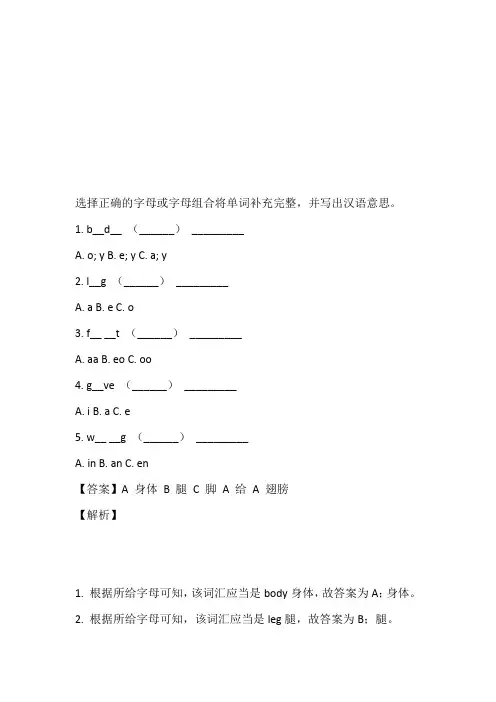
1. b__d__ (______)_________A. o; yB. e; yC. a; y2. l__g (______)_________A. aB. eC. o3. f__ __t (______)_________A. aaB. eoC. oo4. g__ve (______)_________A. iB. aC. e5. w__ __g (______)_________A. inB. anC. en【答案】A 身体B 腿C 脚A 给A 翅膀【解析】1. 根据所给字母可知,该词汇应当是body身体,故答案为A;身体。
2. 根据所给字母可知,该词汇应当是leg腿,故答案为B;腿。
3. 根据所给字母可知,该词汇应当是foot脚,故答案为C;脚。
4. 根据所给字母可知,该词汇应当是give给,故答案为A;给。
5. 根据所给字母可知,该词汇应当是wing翅膀,故答案为A;翅膀。
找出与所给例词画线部分发音相同的单词。
【1】bus ( )A.duckB.studentC.put【2】like ( )A.thisB.niceC.family【3】mouth ( )A.brownB.coatC.soup【4】leg ( )A.bedB.uncleC.bear【5】cousin ( )A.cinemaB.danceC.coffee【答案】【1】A【2】B【3】A【4】A【5】C【解析】【1】bus / ʌ / 公交车;A. duck / ʌ / 鸭子;B. student / juː / 学生;C. put / ʊ / 放。
A与所给例词画线部分发音相同,故选A。
【2】like / aɪ / 喜欢;A. this / ɪ / 这个;B. nice / aɪ / 好的;C. family/ ɪ / 家庭。
B与所给例词画线部分发音相同,故选B。
【3】mouth / aʊ / 嘴巴;A. brown / aʊ / 棕色的;B. coat / əʊ / 小船;C. soup / u: / 汤。
五年级英语上册素材-Unit3 Our animal friends课文翻译 译林版(三起)
Unit3 Our animal friendsPages26-27 Story time①I have two animal friends.我有两个动物朋友。
One is red and the other is black.They have big eyes and big bodies. 一个是红色的,另一个是绿色的。
They have no legs or arms, but they have big tails. They can swim. 它们没有腿和翅膀,但是它们有大尾巴。
它们会游泳。
②I have an animal friend.It is white. it has four legs and a short tail. 我有一个动物朋友。
它是白色的。
它有四条腿和一个短尾巴。
It has big ears.It can run and jump.它有一个大耳朵。
它会跑和跳。
③My animal friend is white. It has red eyes and long ears.我的动物朋友是白色的。
它有红眼睛和长耳朵。
It has four legs and a short tail .It can run.它有四条腿和一个短尾巴。
它会跑。
④My animal friend is yellow and green.我的动物朋友是黄绿相间的。
It has two legs and two wings.它有两条腿和两个翅膀。
It has a big mouth and a long tail.它有一个大嘴巴和一个长尾巴。
It can talk and fly.它会说话和飞。
单词an arm 一节手臂a body 一个身体a foot 一只脚a leg 一条腿a tail 一条尾巴a wing 一个翅膀Pages 31 Sound timeUbus公共汽车duck鸭子summer夏天sun太阳umbrella伞Rubber duck likes the rain,橡皮鸭喜欢下雨But he doesn't like sunny weather. 但他不喜欢晴朗的天气So when the summer sun comes out, 所以当夏天的太阳出来时,He carries an umbrella!他带着雨伞!Pages 31 Culture timeYou can see pandas in China.你可以在中国看到熊猫。
Unit 3 Our animal friends(教案)牛津译林版英语五年级上册
Unit3 our animal friends第3课时(Culture time and Cartoon time)教案教学目标:1、能够听懂、会说、会读卡通故事中出现的词汇::fingers, hard, give,2. 能够流利地表达It has .. .. We have....的意思;3. 了解中国和主要英语国家的特有动物4 能够听懂、会说、会读日常用语:Ouch!5. 能够整体理解并简单表演卡通对话教学重难点:1.学生能正确理解、朗读Cartoon time中的故事,能读懂其中的趣味之处,能在教师的指导下表演故事;2. 能正确并熟练地运用本课词句简单介绍动物。
教具准备:单词卡片,ppt教后反思:本课的对话练习是一个重点和亮点,教师在对话教学中应围绕对话中的语言点,尽可能创设真实的交际情景,或者给一些提示语,增强语言实践的真实感,充分体现“以学生为中心”的教学理念。
教师应设计有效的课堂教学活动,采用“先听说,后读写;先整体,后局部”的方法,引导学生进行发散思维,最大限度的发挥学生的主体性。
在训练学生听说技能的同时,教师应注重培养学生灵活掌握知识、自然真实地进行交际的能力。
但同时也有很多不足之处。
再设计culture time 时,我仅局限于课本上的四个国家特有的动物,没有给学生思考的空间,让他们在挖掘其他国家的标志性动物。
疏忽了学生的主体地位。
在教授Cartoon time时,我问了个问题“why does the crab hurt Sam’s fingers?”这个问题没有学生回答,我直接给出了答案,没有引导学生进一步的思考,其实这只是Crab交友的一种方式,并不是伤害Sam。
在这方面没有充分发挥学生的主动性。
下次要多加改进。
2024年五年级英语上册Unit3Ouranimalfriends第5课时教学设计牛津译林版
一、导入新课(用时5分钟)
同学们,今天我们将要学习的是《Our animal friends》这一章节。在开始之前,我想先问大家一个问题:“你们最喜欢的动物是谁?”这个问题与我们将要学习的内容密切相关。通过这个问题,我希望能够引起大家的兴趣和好奇心,让我们一同探索动物的奥秘。
二、新课讲授(用时10分钟)
2.引导与启发:在讨论过程中,我将作为一个引导者,帮助学生发现问题、分析问题并解决问题。我会提出一些开放性的问题来启发他们的思考。
3.成果分享:每个小组将选择一名代表来分享他们的讨论成果。这些成果将被记录在黑板上或投影仪上,以便全班都能看到。
五、总结回顾(用时5分钟)
今天的学习,我们了解了动物的基本概念、特点和作用。同时,我们也通过实践活动和小组讨论加深了对动物的理解。我希望大家能够掌握这些知识点,并在日常生活中灵活运用。最后,如果有任何疑问或不明白的地方,请随时向我提问。
(4)对话练习:组织学生进行角色扮演,模拟实际情境,练习问答和介绍动物的对话。
(5)文化教育:通过讲解、展示等方式,介绍动物的文化背景和寓意,培养学生的文化意识。
(6)总结与作业:让学生用英语总结本节课所学内容,并布置相关作业,巩固所学知识。
3. 教学媒体和资源
(1)PPT:制作精美的PPT,展示动物图片、词汇、例句等,清晰地展示教学内容,方便学生理解和记忆。
(3)请同学们用英语介绍以下动物的文化背景和寓意:panda, tiger, elephant。
(4)请同学们用英语进行一个简单的对话,其中一个角色是动物,另一个角色是人类。例如:
A: What's your name?
B: I'm a cat.
A: What can you do?
译林版英语Unit3 知识点梳理
五年级上册英语Unit3 知识点归纳一、词组:1. our animal friends 我们的动物朋友2. one … the other…一个…,另一个……3.big eyes 大眼睛4. big bodies 大身体5. have no legs 没有腿6. an animal friend 一个动物朋友7. a short tail 一条长尾巴8.red eyes 红眼睛9.long ears 长耳朵10.a big mouth 一个大嘴巴11. sunny weather 晴朗的天气12. come out 出来13. in the US 在美国14. in Canada 在加拿大15. in Australia 在澳大利亚16. give it a cake = give a cake to it 把蛋糕给它17.on the farm 在农场18. draw an animal 画一个动物二、句型:1. I have two animal friends. One is red, the other is black.One is a cat, the other is a dog.我有二个动物朋友。
一条是红色的,另一条是黑色的。
2. They have no legs or arms, but they have big tails.它们既没有腿也没有手臂,但是它们有大尾巴。
3. It has four legs and a short tail. 它有四条腿和一条短尾巴。
4.My animal friend is yellow and green.我的动物朋友是黄绿相间的。
5.It has two feet.它有两只脚。
6. What animals do you have? I have some fish. 你有什么动物?我有一些鱼。
7. What animals does Su Hai have? She has a parrot. 苏海有什么动物?她有一只鹦鹉。