
牛津沪教版六上英语Unit 5 Animals in danger 教案
Module 2 RelationshipsUnit 5 Animals in danger 教案一、教学目标1. 认知目标:学习掌握新词汇:thousand,hundred,wild,way,die,learn,send,掌握句型:In the past, there were …, but now there are ….,以及过去式与现在时的区别。
2. 能力目标:能运用所学句型与同学谈论濒临灭绝的野生动物。
3. 情感目标:让学生通过对课文内容的学习掌握,增强学习的信心,调动学生的学习兴趣。
二、教学重难点1. 重点能运用所学句型与同学谈论濒临灭绝的野生动物。
2. 难点句型:In the past, there were …, but now there are ….,以及过去式与现在时的区别的理解掌握。
三、教学用具多媒体教学设备、单词卡片、图片。
四、教学设计Step 1 warming1. 师生互相问好,教师询问大家喜欢去动物园吗?最喜欢的动物是什么呢?是否了解这些动物呢?2. 教师向学生们说说自己最喜欢的动物以及此种动物的一些特点与现状。
Step 2 Revision and Presentation1. 教师告诉学生我们这节课就要学学如何用英语表达一些动物的生存现状,了解一些濒临灭绝动物的现状。
2. 教师请学生谈谈自己最喜欢的动物。
3. 教师出示单词卡片进行新单词教学,带读并配合肢体动作让同学们印象深刻。
4. 教师播放课文内容录音,请同学们认真听一遍,争取做到理解内容。
Step 3 Practice1. 分小组讨论练习,两人一组,相互介绍一些动物的生存现状。
A: My favourite animal is panda, in the past, there were many pandas, but now there are onlyabout one thousand six hundred pandas in the wild.B: My favourite animal is blue whale, in the past, there were many blue whales, but now there areonly about ten thousand in the wild.2. Let’s learn and sing a song: All animals bright and beautiful.Step 4 Summary教师根据本课时所学内容进行回忆总结,并请同学们谈谈本节课印象最深刻的环节。
Step 5 Homework1. 学生抄写本课所学单词,一个五遍。
2.用所学句型与父母或朋友进行交谈,并向父母朋友宣传保护濒危动物的重要性。
牛津沪教版英语六年级上册全册知识点汇总Module 1Getting to know each other一、核心词汇1.表示时间名词:month 一个月的时间;月份yesterday 昨天2.形容词:cute 可爱的pretty 漂亮的handsome 英俊的;帅气的famous 著名的;出名的healthy 健康的;有益于健康的unhealthy 不健康的;损害健康的3.动词:catch 逮住;捕捉spend 度过pick 采摘4.食物名词:hamburger 汉堡包fruit 水果pie 馅饼pizza 比萨饼cola 可乐sandwich三明治vegetable 蔬菜chicken 鸡肉chocolate 巧克力5.表示动物名词:turtle 乌龟fly 苍蝇6.其他:during 在……期间everyone 每个人;所有人countryside 乡村;农村7.核心词组:grow up长大;成长junior high school 初级中学(be)born 出生summer holiday 暑假the Great Wall 长城the Palace Museum 故宫博物院Tian’an men Square 天安门广场go swimming 去游泳go to the museum 去博物馆go to the cinema 去电影院junior high school 初级中学do myhomework 做我的家庭作业watch TV看电视visit my friends 拜访我的朋友a little 少量的fish and chips 炸鱼薯条二、了解词汇1.一些动词及过去式:go(去)—went do(做)—didhave/has(有)—had watch(观看)—watchedvisit(访问;探望)—visited am/is(是)—was are(是)—were2.一些食物名词:egg 鸡蛋bread 面包noodles 面条dumplings 饺子3.其他:menu菜单三、核心句型1.Her hair was short and her eyes were big. 她那时头发很短而且眼睛很大。
解读:这个句子是描写过去某段时间的人物特征,因此系动词要用它的过去式。
当主语是第三人称单数时,系动词要用is的过去式was;反之就用are的过去式were,后面直接跟描写人物外貌特征的形容词。
举一反三:My hair was short then. 我的头发那时很短。
My hands were small then. 我的手那时很小。
My sister was short then. 我的妹妹那时很矮。
2.Justin was born in the river. 小贾斯汀在河里出生。
解读:这个句子是描写某人出生在某地的句子,因为每个人的出生都是过去的事情,因此系动词要用它的过去式。
当主语是第三人称单数时系动词要用is的过去式was;反之就用are的过去式were,后面直接跟出生的地点。
如果需要说明出生年、月、日的时候,就用介词on后跟月份加日期的基数词最后写年份。
举一反三:I was born in Zhanjiang. 我出生在湛江。
My father was born in Beijing on Nov.4,1978.我的爸爸于1978年11月4日出生在北京。
3.— How was your summer holiday?你的暑假过得怎么样?— It was wonderful.它很精彩。
解读:这个句子是询问过去过得怎么样的句型及回答,因为是询问过去的事情,因此系动词要用它的过去式。
how意为“怎样;如何”。
was是is/am的过去式。
答语中的系动词也要使用过去式。
举一反三:— How was your birthday?你的生日过得怎么样?— It was beautiful. 太精彩了。
— How was your weekend?你的周末过得怎么样?— It was nice. 很好。
4.We went to the Great Wall. 我们去了长城。
解读:这个句子是描写某人过去去过某地的句型。
因为是描写过去的事情,因此动词要用它的过去式,went 是go 的过去式。
举一反三:My father went to the zoo last Sunday. 上周日我的爸爸去了动物园。
My sister went to Hainan with my uncle.我的妹妹跟我的叔叔去了海南。
5.Everyone had a good time. 大家玩得都很开心。
解读:这个句子是描写过去每个人玩得很愉快的句型,因此动词要用过去式。
此处had是has的过去式。
everyone作主语时,与单数谓语动词连用。
举一反三:Everyone works very seriously. 每个人工作都很认真。
My sister had a good time. 我的妹妹玩得很高兴。
6.— What did you have for breakfast this morning?你今天早上早餐吃的什么? — I had some bread and milk. 我吃了一些面包和牛奶。
解读:这个句子是询问对方过去一日三餐吃了什么的句型及回答,因为是询问过去的事情,因此助动词do要用它的过去式did,没有人称和数的变化。
what意为“什么”。
答语中的系动词也要使用过去式。
问句中三餐用介词for来连接,意为“当成;作为”。
举一反三:— What did your father have for lunch?你爸爸午餐吃了什么?— He had some chicken and vegetables.他吃了一些鸡肉和蔬菜。
— What did you have for dinner?你晚餐吃了什么?— I had some noodles. 我吃了一些面条。
四、了解句型1.Ben was about six months old.本那时大约六个月大。
解读:这是一个描写某人过去大约年龄的句子。
2.That’s not healthy. 那是不健康的。
解读:这是一个描写某物是不健康的句型。
3.I didn’t have breakfast this morning.我今天早上没有吃早餐。
解读:这是一个描写某人在某段时间没有吃三餐的句型。
Module 2Relationships一、核心词汇1.家庭成员:son 儿子daughter 女儿2.动物类:owl 猫头鹰rhino 犀牛3.数词:thousand 一千hundred 一百4.形容词:noisy 吵闹的other 其他的wild 野生的5.动词:dig 挖(土);掘(洞)die 死;死亡learn 学习send 安排去;寄;送6.名词:neighbour 邻居country 国家hobby 爱好e-friend 网友wild 野生环境7.代词:yourself 你自己8.其他:team(游戏或动作的)队grade 年级9.词组:make noise 制造噪音take care of照顾;照料go for a walk 去散步Drive away 赶走in danger 面临危险in the past 在过去South China tiger 华南虎Blue whale 蓝鲸would like(表示愿意、喜欢)二、了解词汇1.动词词组:be from 来自play chess 下国际象棋play table tennis 打乒乓球play with 和……一起玩talk about 谈论have an idea 有一个主意dig a hole挖了一个洞have a good sleep 睡得很好go out 出去Have fun 玩得开心2. 介词词组:in the morning 在早上in the forest 在森林里under the tree 在树下in holes 在洞里at night 在晚上in the wild 在野生环境里in the blue sky 在蓝天中under the sea 在海底in different countries在不同的国家3.其他:last weekend 上周末every night 每晚 a lot of 很多三、核心句型1.— Did you play with Sam last weekend?上周末你和萨姆一起玩了吗?— Yes, I did. 是的,我和萨姆一起玩了。
Module2Unit5、Animals,in,danger教案4
Module 2 Unit 5 Animals in danger教案1教学目标知识能力目标:能听说读写词汇thousand / hundred / wild能听说认读短语:blue whale / south china tiger/indanger/in the past过程与方法:通过看一看。
说一说,写一写的活动能灵活运用句型in the past,there were many...,but now there are only...来描述动物数量的变化,并通过对比学习一般过去时和一般现在时的构成和用法。
情感态度价值观:提高保护野生动物的意识。
2学情分析通过1,2单元的学习,学生初步明白一般过去时的概念,知道过去式的形式,并能在正确的语境中表达,本节课让学生抓住词汇in the past和now对比学习使用一般过去式。
3重点难点重点:词汇:thousand / hundred / wild短语:blue whale / south china tiger/in danger/in the past句型:in the past, there were many...,but now there are only...难点:there be 句型在过去时中的使用,知识拓展部分what can we do to help the animals?的合理想象。
4教学过程活动1【导入】教学过程Step1:lead inT:before our class let’s learn a new phrase” in danger”<板书>Do you ever have th is sad feeling? Let’s see some pictures of dangerous(show some pictures)活动2【讲授】教学过程Step 2: presentation (show a picture of a panda)T: what’s this? Do you know it? Can you say something about it?S1: it’s a panda.S2: it lives in Sichuang.S3: it’s white and black.S4: it likes eating bamboos.T: but today must tell you this lovely animals are in danger, ok, now pay attention to listening and find the difficulties.Ss:(first listening)find difficulties” thousand, hundred, wild”(教师点拨:thousand 和hundred 的发音及用法,举例子)Eg:1 thousand---------10 thousand1 hundred-----------9 hundredSs:(second listening)find the danger information.In the past, there were many pandas, but now there are only about one thousand and six hundred pandas in the wild.Ss;(third listening)read after the radio and read by themselves againT:in the same way learn the south china tiger and blue whale(教师点拨;south china tiger 和blue whale 的发音)活动3【活动】教学过程Group show;G1:in the past, there were many pandas, but now there are 1600 pandas.G2:......G3:.....<教师点拨:there be句型在一般过去时中的变化,am /is-was.. are-were>活动4【练习】教学过程Step3: practice and consolidation.After listening then fill a form after that have a performance.Eg: in the past, there were ......but now there are......pandaSouth china tigerBlue whaleIn the pastnow活动5【作业】教学过程Step5:homework1.find an animal that is in danger and talk or write about it.(必做)2.Finish workbook pages 27 and 29(必做)3.Find more way to protect animals(选做)。
牛津上海版(深圳)六上Unit5《Animalsindanger》(第二课时)word教案
牛津深圳版英语六年级上册教学设计Step 1(1)on onesway to 在某人去...的路上(当to后跟介词时,to要省略。
) 在Tom去学校的路上,他发现了一只小猫。
On Tom's way to school, he finds a little cat. 在她回家的路上,她遇到了一个同学。
On her way home she meets a classmate. (2)take care of 照顾take care of =look after你应该照顾好她。
You should take care of her well.=You should look after her well. 他把弟弟照顾的很好。
He takes care of his little brother well.=He looks after his little brother well.(3) go for a walk 散步go for a walk=have a walk他经常晚饭后去散步。
He usually goes for a walk after supper. 她常常和父母一起去散步。
She ofte n has a walk with her pare nts.(4)be happy tobe happy to do sth 咼兴做某事他很咼兴去帮助别人。
He is very happy to help others. 我们很咼兴去保护动物。
We are very happy to protect ani mals. Step 2课堂练习将下列句子翻译成英语。
(1)在他回家的路上,他看到一些人正在踢足球。
(2)我们应该照顾好我们的父母。
(3)Tom经常在公园里散步。
(4)我很高兴帮我妈妈去购物。
Step 2 Ask and an swer(1)What did Joe do ?(2)Why did Joe take care of Elsa ?川.(1)学生根据例句。
六年级英语上册 Unit 5 Animals in danger教案 牛津上海版
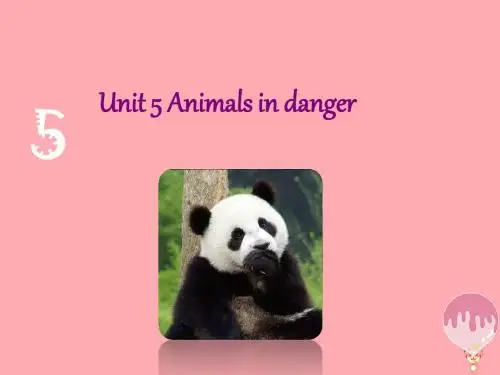
Steller’s sea cows(大海牛) lived near the shore. They liked swimming in cold sea water. They were black.
We must stop killing these animals for food, for their skin, or just for sport.
We cannot see some kinds of wild animals now.
Aurochs(欧洲野牛)lived in Europe. They were big and heavy. They looked like cows.
Dodos(渡渡鸟) lived on a little island. They were big birds with small wings. They were cute.
Talk about an animal:
This animal is in danger. In the past, there were … But now there are … They live … They have/had … We can … to save them.
What can we do to save the animals in danger?
These animals do not have enough food or clean water. We must help protect their homes.
These animals lost their homes because people cut down trees in the forests. We must help save the trees and forests.
沪教版小学六年级英语上Unit 5 Animals in danger 教案
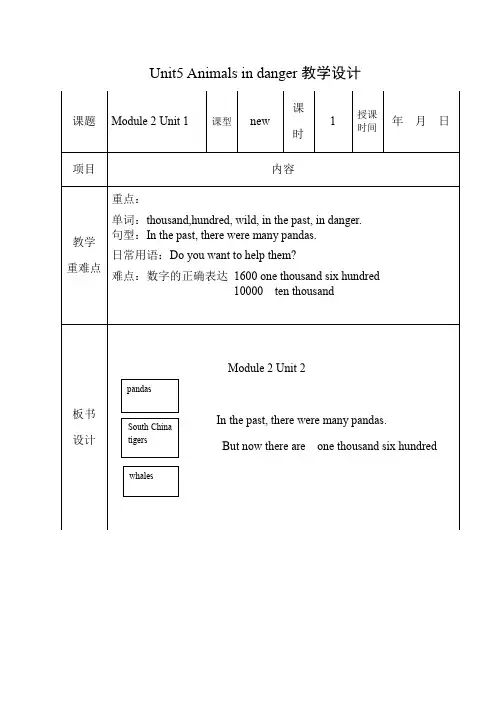
many
many
many
Now
1,600
30
10,000
In the past,there were…,but now there are only about…
Listen to the tape,and fill in the blanks.
Play the tape again,let them repeat.
S2: I can hear“tiger”.
…
Yes.Do youknowmany animals are in danger in the world.Some animals are less and less.(T draw a graph on the Bb) They are in danger. We should protect them.
Let Ss talk about the difference.Eg:
There were three students in the classroom. Now there are five students in the classroom. There was a table in front of the blackboard. Now there is no table in the class.….
Thousand neans ten hundred.
Read this two words.And say the rs.
100 tigers, 1000 South China tigers, 10000 whales
Pandas
South China tigers
Blue whales
六年级英语上册Unit5《Animalsindanger》(第2课时)教案牛津上海版(深圳用)
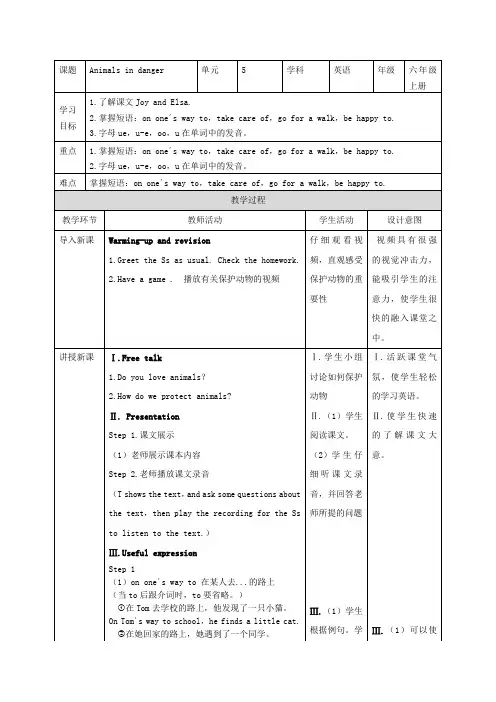
Ⅰ.Fr ee talk1.Do you love animals?2.How do we protect animals?Ⅱ. PresentationStep 1.课文展示(1)老师展示课本内容Step 2.老师播放课文录音(T shows the text,and ask some questions about the text,then play the recording for the Ss to listen to the text.)Ⅲ.Useful expressionStep 1(1)on one´s way to 在某人去...的路上(当to后跟介词时,to要省略。
)①在Tom去学校的路上,他发现了一只小猫。
On Tom´s way to school,he finds a little cat.②在她回家的路上,她遇到了一个同学。
On her way home,she meets a classmate. (2)take care of 照顾take care of =look after①你应该照顾好她。
You should take care of her well.=You should look after her well.②他把弟弟照顾的很好。
He takes care of his little brother well.=He looks after his little brother well. (3)go for a walk 散步go for a walk=have a walk①他经常晚饭后去散步。
He usually goes for a walk after supper.②她常常和父母一起去散步。
She often has a walk with her parents.(4)be happy tobe happy to do sth 高兴做某事①他很高兴去帮助别人。
牛津沪教版六上英语Unit 5 Animals in danger 教学设计 2

Unit 5 Animals in danger 教学设计2教学目标1. 认知目标:学习掌握新词汇:thousand, hundred, wild, way, die, learn, send,掌握句型:In the past, there were …, but now there are ….,以及过去式与现在时的区别。
2. 能力目标:能运用所学句型与同学谈论濒临灭绝的野生动物。
3. 情感目标:让学生通过对课文内容的学习掌握,增强学习的信心,调动学生的学习兴趣。
教学重难点1. 重点能运用所学句型与同学谈论濒临灭绝的野生动物。
2. 难点句型:In the past, there were …, but now there are ….,以及过去式与现在时的区别的理解掌握。
教学用具多媒体教学设备、单词卡片、图片教学过程Step 1 warming1. 师生互相问好,教师询问大家喜欢去动物园吗?最喜欢的动物是什么呢?是否了解这些动物呢?2. 教师向学生们说说自己最喜欢的动物以及此种动物的一些特点与现状。
Step 2 Revision and Presentation1. 教师告诉学生我们这节课就要学学如何用英语表达一些动物的生存现状,了解一些濒临灭绝动物的现状。
2. 教师请学生谈谈自己最喜欢的动物。
3. 教师出示单词卡片进行新单词教学,带读并配合肢体动作让同学们印象深刻。
4. 教师播放课文内容录音,请同学们认真听一遍,争取做到理解内容。
Step 3 Practice1. 分小组讨论练习,两人一组,相互介绍一些动物的生存现状。
A: My favourite animal is panda, in the past, there were many pandas, but now there are onlyabout one thousand six hundred pandas in the wild.B: My favourite animal is blue whale, in the past, there were many blue whales, but now there areonly about ten thousand in the wild.2. Let’s learn and sing a song: All animals bright and beautiful.Step 4 Summary教师根据本课时所学内容进行回忆总结,并请同学们谈谈本节课印象最深刻的环节。
牛津上海版(三起)六年级上册英语 Module 2 Unit 5 Animals in danger【第一课时】教学设计
Introduce the new friend to Ss. Thenget on the internet. Ask Ss to try to answer the questions.【What is WAP? What do people do in WAP?】
变化;
◇教学难点
正确使用一般过去时和一般现在时对事物的今昔变化进行综合描述。
教学基本策略及设计思路
本课教学设计关注了英语学科的工具性和人文性双重性质,秉着面向全体学
生、关注差异的原则,结合单元整体设计的理念,整体设计了目标,充分挖掘了教材内容,再构了文本,并充分考虑语言学习的渐进性和特殊性,关注学生的参与、体验和感知,努力创设真实的情境和真实的语用任务,让学生在用英语描述事物的过程中理解和运用语言。同时优化了评价方式,也为学生提供了更多的交流平台和展示机会,以培养其综合语言运用能力。
学情分析
对于六年级学生来说,他们已经具有相当的英语基础,学习能力较强,能通过教师的讲解和小组学习,基本掌握本课核心语言,并能较为流利地用英语表达自己的观点。大多数学生保持着学习英语的兴趣,能认真听讲,积极发言。所以本课教学的关键在于继续激发学生学习英语的兴趣,调动学生学习英语的积极性,把了解学生的兴趣、动机作为突破点,分析学生已有的知识水平和能力水平,从学生的心理特点、认知规律和生活经验出发,并根据教材提供的主题进行设计,进行文本再构,引导学生积极思考和积极发言,从而创造以学生为中心的课堂学习氛围,全面培养学生听、说、读、写及综合运用语言的能力。
II.
Presentation
&Learning
1. Watch and think
Show some photos of
上教版六年级英语上册M2 Unit 5 Animals in danger第二模块第五单元优秀教案
M2 U5 Animals in danger上海教育出版社《英语》六年级上册性。
Summary andhomework(3 minutes)总结板书,提出思想主题升华。
Let’s help the animalsand make a wonderfulworld.学生读句子,树立“保护动物”的意识。
对学生进行思想教育,使学生情感在语言习得的过程中得到升华。
布置作业。
Do a survey.(P34濒危动物调查)学生了解作业要求。
将课堂所学内容延伸到课外,进一步加强学生的自主学习能力。
板书设计M2U5 Animals in dangerIn the past, there were…But now, there are…教师的课后反思这节课的教学中我围绕着一条教学主线Animals in danger,开展各项语言学习活动,并通过它进行发散与拓展。
采用任务型教学,从听说入手,创设情景,设计调查与游戏,激发学生学习兴趣;所设计的活动面向全体学生,由易到难,让学生在愉快的氛围中从不同程度得到提升,最终实现语用的目的。
这节课我首先通过谈话、让学生讲述暑假经历,以教师的日记激活学生已有的背景知识,温故知新。
然后让学生猜数字,引发悬念,习得含有百和千的数字读法。
启发学生的创造性思维,生成自己的语言素材。
运用有关动物的一段视频恰当导入, 激发学生的求知欲和学习兴趣,同时引出本课主题:濒危动物。
在课文的讲授中,通过听录音、填表格、读课文、问答等形式,将课文学习与语言技能进行整合,对学生进行综合语言技能训练以及学习策略的渗透。
课后操练,我让学生根据表格制作濒危动物档案,不仅强化了本课重点,还突破了难点。
最后让学生一起动脑、动手,想一想、写一写保护濒危动物的方法,做到思想目标的提升。
本课的作业是做濒危动物调查报告, 使本课的英语学习延伸到学生对事物的探索中,实现语篇学习的目标, 鼓励学生将所阅读的内容与自己的经历、知识、兴趣和观点相联系,最终实现学生综合语言能力的提高。
上教版六年级英语上册M2Unit5Animalsindanger第二模块第五单元优秀教案.pdf
M2 U5 Animals in danger上海教育出版社《英语》六年级上册课题:上海教育出版社《英语》六年上册 M2 U5 A nimals in danger 课时:第一课时教材分析本课是上海教育出版社《英语》小学六年级第一学期6A第二模块第五单元的第一课时。
这一单元的主题是Animals in danger,主要话题是运用句型“In the past, there were…,but now there are…”对濒危动物的现状进行简单的问答与表述。
本课重点是训练学生复习使用there be句型及其过去式结合数字来描述濒危动物的现状,使学生了解野生动物现状并升华到树立保护动物的意识。
主要动物类词汇在前几册中均有出现,生词较少。
本节课内容贴近学生们的生活,是学生们喜欢的话题,教材通过各种各样的场景为学生提供了真实的语境,从而感知语言,在真正的生活中运用语言进行交流,有利于学生综合语言运用能力的发展。
学情分析本课的教学对象是小学六年级的学生。
无论是听说能力,还是单词与句型的积累,他们大部分都有较好的基础,如句型There is/are学生们已耳熟能详,对于根据提示写句子,学生已经有了较强的能力,本节课是在基于学生原有基础上进一步增强描述图片和构建新语言的综合语言运用能力。
同时,他们已经具有了一定的自学能力和语言组织能力,而本课生词较少,通过课前的谈话和问答的形式,可以知道学生对于词汇的掌握情况,很多学生已经熟练掌握了本课词语,但是在灵活应用上还有欠缺。
另外,学生对学习本课有关野生动物的知识有着浓厚的兴趣,因而会积极参与到教学活动中来。
尽管如此,仍会有一小部分的学生英语基础相对薄弱,主要表现在英语写作能力上有待加强。
教学目标1.知识目标:⑴能准确拼写本课的词汇hundred, thousand, wild。
⑵掌握句型In the past, there were…,but now there are…,并能灵活运用。
六年级英语上册Unit5Animalsindanger第1课时教案牛津上海版深圳用
Animals in dangerC.hundredofD.A and BStep 3 Ask and answer(1)In the past ,how many pandas were there ? (2)How many pandas are there now ?(3)In the past ,how many South China tigers were there ?(4)How many South China tigers are there now ? (5)How many blue whales are there now ? Step 3 Circle the correct answers.Step 4科普《世界自然爱护联盟》对受危物种的分级 绝灭(Ex ):指野生状态下已经绝迹,但人工饲养或放养的尚有残存,如麋鹿。
国内绝迹(Ex ):指国内野生状态的已经绝迹,国外尚有野生的,如高鼻羚羊。
濒危(E ):野生种群数量已降低到面临灭亡或绝迹的临界程度,且致危因素仍在接着,如朱鹮、华南虎。
易危(V ):野生种群数量明显下降,如不实行有效爱护措施,势必沦为"濒危"者,或因接近某"濒危"级别,而必需予以爱护以确保"濒危"种的生存,如金猫、云豹。
稀有(R ):从分类订名以来,总共只有为数有限的发觉纪录者,如沟牙鼯鼠。
内容完成此题学生依据课文内容完成此题学生牢记科普学问检测学生对课文的驾驭程度,达到课文、单词和语法同步学习的目的。
检测学生对课文的驾驭程度扩高校生的视野,更好的了解爱护濒危动物的重要性。
不足(I):状况不甚明显,但有迹象表明可能属于或疑为濒危或趋危者,如普氏原羚、假吸血蝠。
Step 5Do you know these animal?African elephant 非洲象非洲象属是象科的一个属,于1825年由乔治·库维叶男爵(Baron Georges Cuvier)命名。