
译林 8A8上 Unit5 wild animals Grammar
不定式有 to do 和 do,
多加 to do 少数加 do,
下列动词后省去 to ,
“三看”“两听” “一感觉”,
see, watch, look at hear , listen to
外加三个“小使役”, let, make , have 保你永远不忘记!
go (go) on a trip tomorrow. 6. Let’s ____ not to play 7. The policeman told the boys __________ (not play) football in the street. to drink 8. Would you like something ________ (drink)? Don’t be (not be) late for class again. 9. _________ to travel 10. I plan ________(travel) around the world in the summertime.
1 Stop to talk, and get ready for the Maths class. talking 2 He often hears the girl sings in the next room. sing 3 It takes him half an hour getting there by bus. to get
1. The elephant is going towards the water. may need(need) a bath. It ___________ 2. The little boy is crying when he saw the tigers. may be(be) afraid of them. He ________ 3. I cannot go near the lions and tigers. hurt (hurt) me. They may __________ 4. The baby panda is not drinking its mum’s milk. may not be (not be) hungry. It _____________ 5. The monkeys are jumping around. They may _______________ be playing (be playing) with each other. 6. The horse is standing with its eyes closed. be sleeping It may ______________ (be sleeping).
feel
to do remember __________ sth. 记得要做某事
doing remember __________ sth. 记得做过某事
to do forget _________ sth. 忘记要做某事
doing sth. 忘记做过某事 forget _________ (forgot)
1. 2. 3. 4. 5. 6. 7. 8. 9. 10.
11. call her Xi Wang 12. be born 13. the weight of 14. start/begin to do 15. for the first time not… any more/no more16. 17. in the beginning 18. learn to do sth face serious problems 19. 20. live on
II. 完成句子。 1. 他可能认识你。 may know you. He _________ 2. 他们可能下周去长城。 may go to the Great Wall next week. They _________ 3. 我们同意马上离开。 to leave at once. We agreed ________ 4. Laura计划到中国一些名胜之地旅游。 plans to visit some places of Laura ____________ interest in China. 5. 你愿意和他一起工作吗? like to work with him? Would you _____________
B Using verbs + to-infinitives
1.某些及物动词后接动词不定式作宾 语, 常用的此类动词有: agree to do sth. 同意做 begin to do sth. 开始做 decide to do sth. 决定做 fail to do sth. 做某事失败 forget to do sth. 忘记做 hope to do sth. 希望做
No.3 may be doing可能正在做…
他们正在打牌。 They are playing cards.
may be
他们可能正在打牌。
They may be playing cards.
note 1:may—情态动词之一,后加V原, 表示可能性,通常只用于肯定句和否定句, 相当于perhaps(也许),maybe(也许)。
Free talk Wild animals may become dishes on the table any time. I may die without them.
What may happen?
may+动原
It may rain.
It may snow.
may+动原
She may be on the playground.
We don’t use ‘to’ after these verbs.
let sb. do sth. The teacher lets him read ____(read)loudly.
1. let
laugh (laugh). 2. make The joke makes me_______ make sb. do sth. carry( carry )water. 3. see I often see him _____ see sb. do. sth. sing( sing) 4. hear Do you hear birds _____
learn to do sth. plan to do sth. prepare to do sth. remember to do. try to do sth. want to do.
学着做 计划做 准备做 记得做 尝试做 想要做
need to do seem to do / be start to do would like to do can’t wait to do try one’s best to do
No.1 may+v原(do) No.2 may + be原
No.3 may be doing可能正在做…
note 2:may的否定形式是
may not + v原 / be原
He may like collecting stamps.(改为否定句) He may not like collecting stamps.
No.1 may+v原
他喜欢集邮。
He likes collecting stamps. may
他可能喜欢集邮。
He may like collecting stamps.
No.2 may + be原
野生动物是自由快乐的。 Wild animals are free and happy.
may be 野生动物可能是自由快乐的。 Wild animals may be free and happy.
She may be in the Reading Room.
What are they doing now?
read play chess
They may be reading. They may be playing chess.
may+动原
What are they do homework doing now? have lunch
2. to do 做宾语补足语
ask sb. to do tell sb. to do invite sb. to do want sb. to do would like sb. to do need sb to do teach sb. to do advise sb. to do
3.有的动词后跟不带to的不定式作宾补, 如: hear sb. do watch / see sb. do notice sb. do make sb. do 让/使某人做某事 let sb. do 让某人做某事 help sb. do
however bamboo forests smaller and smaller as a result have a place to live be in danger take action to do sth right away help sb do sth panda reserve(s)
They may be doing homework. They may be having lunch.
It may snow. She may be on the playground. They may be doing homework.
Tip 1
1. 当我们猜测某件事发生的可能性时, 也许 、_______ 可能 . 常用may表示______
Wild animals may be free and happy.(改为否定) Wild animals may be free and happy.
Unit5 Wild animals Grammar (I)教案-八年级上册

译林版八年级上册Unit5 Grammar (I)Wild animals 教学设计一课题:八年级英语8A Unit5 Grammar(I)第一课时二教材简介情态动词是初中学生要掌握的一种动词形式,在学习了第四单元的should 和had better的用法后,对情态动词的用法有了一定的了解,本单元继续学习情态动词may的用法,也是对情态动词学习的延续。
本单元学习用may来表示可能性,并对课文中出现的may的用法进行归纳总结。
在Welcome to the unit 和Reading部分的学习后,学生初步了解了关于野生动物的知识,谈论野生动物所面临的危险,,如果不保护野生动物可能会怎样,自然导入到Grammar部分的学习,学习完本部分之后为后面的听力技能以及Task的学习又做了准备和铺垫工作,所以Grammar的学习在本单元种起着承上启下的作用。
三目标预设1知识目标:closed, may表示可能性的用法2能力目标:熟练掌握并能正确使用may来表示可能性3情感目标:教育学生爱护野生动物,通过学习增强学生保护野生动物的意识四教学重难点教学重点:(1)正确使用may来表示可能性。
(2)增强学生保护野生动物的意识教学难点:正确使用may来表示可能性。
五设计理念在新课改背景下,本节课着重培养学生的学习积极性和主动性,突出学生的主体地位,运用任务型教学法和情景交际法实施教学活动,倡导学生主动参与,乐于研究,培养学生获取新知识,交流与合作,发展学生在实际生活中运用语言能力为目标。
在学生归纳总结之后,老师及时予以指引、帮助和补充,而不再是传统教学模式下教师一讲到底的满堂灌模式,在注重学生知识能力发展的同时,也增强了学生爱护野生动物和保护野生动物的意识。
六设计思路本节课为第五单元语法的第一节课,在前面了解了一些关于野生动物的知识后,谈论野生动物所面临的危险,如果不保护野生动物可能会怎样,复习的同时导入新课知识。
最新牛津译林版初二英语上册8A Unit 5 Wild animals Grammar 八年级PPT课件

The things you want to take with.
The way you decide to get there.
The activities you hope to do there. The time you want to stay there.
Mr Yang’s plan
The I plan person to go out you with plan my to go family. there with. I want to take camera and some The things youawant to take with. food. The I decide way to you godecide there by to get bus.there.
Unit 5 Wild animals Grammar
Revision
1. Why do people call the panda “Xi Wang”? 2. What will happen to the pandas if the bamboo forests disappear?
Revision
We often use to-infinitives after these verbs. agree learn like wish choose plan start try decide prepare begin remember hope want fail fob+to-infinitives” in the passage.
Exercises
Dad: Do you know anything special about wild animals? Amy: Yes, Dad. For example, dolphins are clever. They learn to work out (learn, work out) easy can _________________ Maths problems. Dad: What do you know about bats? to fly Amy: Bats can’t see, but they never fail ____________(fail, fly) the right way with the help of their mouth and ears. Dad: Did you know that bees never get lost? remember to come back Amy: Yes. Bees always_________________________ (remember, come back) the same way as they go. Dad: What do you know about squirrels? begin to save (begin, save) some food Amy: They always ______________ before winter comes. Dad: Yes, but sometimes they forget where to find the food.
牛津译林版八年级上册Unit 5《Wild animals》(Grammar 1)教学设计
牛津译林版八年级上册Unit 5《Wild animals》(Grammar 1)教学设计一. 教材分析《牛津译林版八年级上册Unit 5(Grammar 1)》的主要内容是野生动物的介绍和一般现在时的运用。
本节课的主要目的是让学生掌握一般现在时的用法,并能够运用一般现在时描述野生动物的特点。
教材通过介绍野生动物,引发学生对动物保护的思考,培养学生的环保意识。
二. 学情分析八年级的学生已经掌握了基本的英语语法知识,对一般现在时有一定的了解。
但部分学生对一般现在时的运用还存在困难,需要通过大量的练习来巩固。
此外,学生对野生动物的了解有限,需要通过课堂学习来拓展知识。
三. 教学目标1.知识目标:让学生掌握一般现在时的用法,能够用一般现在时描述野生动物的特点。
2.能力目标:培养学生运用英语进行交流的能力,提高学生的口语表达能力。
3.情感目标:培养学生关爱野生动物,保护环境的意识。
四. 教学重难点1.教学重点:一般现在时的用法,能够用一般现在时描述野生动物的特点。
2.教学难点:一般现在时的句子结构,正确的时态运用。
五. 教学方法1.情境教学法:通过设定相关情境,让学生在实际语境中运用一般现在时。
2.任务型教学法:通过完成任务,让学生在实践中掌握一般现在时的用法。
3.小组合作学习:通过小组讨论,培养学生团队合作精神,提高口语表达能力。
六. 教学准备1.教学课件:制作相关的课件,辅助教学。
2.教学素材:收集一些关于野生动物的图片和视频,用于教学。
3.练习题:准备一些关于一般现在时的练习题,用于巩固所学知识。
七. 教学过程1.导入(5分钟)通过展示一些野生动物的图片,引导学生谈论自己喜欢的动物,从而引入本节课的主题。
2.呈现(10分钟)介绍一般现在时的概念和用法,用课件展示一般现在时的句子结构。
同时,通过举例说明一般现在时如何描述野生动物的特点。
3.操练(15分钟)让学生分组,每组选择一种野生动物,用一般现在时描述该动物的特点。
牛津译林版八年级上册Unit 5《Wild animals》(Grammar 2)教学设计
牛津译林版八年级上册Unit 5《Wild animals》(Grammar 2)教学设计一. 教材分析本课选自牛津译林版八年级上册Unit 5《Wild animals》(Grammar 2),主要讨论了关于野生动物的保护问题。
本课主要让学生掌握一般现在时态的被动语态,并且能够运用本课的生词和句型进行讨论和表达。
通过本课的学习,学生能够提高自己的语言运用能力,增强对野生动物保护的意识。
二. 学情分析学生在之前的学习中已经掌握了一般现在时态,对本课的主题也有一定的了解。
但部分学生在语言运用上还存在一定的困难,特别是在被动语态的运用上。
因此,在教学过程中,需要关注学生的个体差异,因材施教,使每位学生都能在课堂上得到锻炼和提高。
三. 教学目标1.知识目标:–掌握一般现在时态的被动语态结构:am/is/are done;–掌握本课的生词和短语,并能熟练运用。
2.能力目标:–能够运用一般现在时态的被动语态进行讨论和表达;–提高学生的语言运用能力和团队合作能力。
3.情感目标:–增强学生对野生动物保护的意识;–培养学生热爱大自然,保护生态环境的情感。
四. 教学重难点•一般现在时态的被动语态结构;•本课的生词和短语。
•一般现在时态的被动语态在实际情境中的运用;•对本课主题的深入理解和讨论。
五. 教学方法1.情境教学法:通过设置各种情境,让学生在实际语境中运用所学知识;2.任务型教学法:通过完成各种任务,提高学生的语言运用能力;3.合作学习法:鼓励学生分组讨论,培养学生的团队合作精神。
六. 教学准备2.PPT;3.练习题。
七. 教学过程1.导入(5分钟)利用图片或视频引导学生谈论野生动物,激发学生的学习兴趣,导入本课主题。
2.呈现(10分钟)通过PPT展示本课的生词和短语,让学生进行认读和学习。
3.操练(10分钟)让学生进行小组活动,用所学的生词和短语编写对话,并进行表演。
4.巩固(10分钟)设计一些练习题,让学生进行抢答,巩固所学知识。
牛津译林版英语八上Unit 5《Wild animals》(Grammar)教学设计
牛津译林版英语八上Unit 5《Wild animals》(Grammar)教学设计一. 教材分析牛津译林版英语八上Unit 5《Wild animals》主要介绍了一些野生动物,包括老虎、狮子、熊、大象等。
本单元主要让学生掌握一般现在时的被动语态和一般过去时的被动语态,以及如何运用这些时态描述野生动物的特点和习性。
此外,本单元还包括一些关于野生动物的保护和濒危问题,旨在提高学生的环保意识。
二. 学情分析学生在学习本单元前,已经掌握了动词的现在时态和过去时态,以及一些基本的野生动物知识。
但部分学生对英语语法的学习仍有一定难度,尤其是对被动语态的运用。
因此,在教学过程中,需要关注学生的个体差异,针对不同学生的学习需求进行引导和帮助。
三. 教学目标1.能熟练运用一般现在时和一般过去时的被动语态描述野生动物的特点和习性。
2.能听懂、会说、会读、会写与野生动物相关的词汇和句子。
3.提高学生的环保意识,增强对野生动物的保护意识。
4.培养学生的合作能力和观察能力。
四. 教学重难点1.一般现在时和一般过去时的被动语态的运用。
2.野生动物相关词汇的掌握和运用。
3.对文本内容的理解和运用。
五. 教学方法1.任务型教学法:通过设定各种任务,让学生在实践中学习和运用语言。
2.情境教学法:创设各种情境,让学生在真实的环境中学习和运用语言。
3.合作学习法:鼓励学生分组合作,共同完成任务,培养团队精神。
4.观察法:引导学生观察野生动物的特点和习性,提高观察能力。
六. 教学准备1.教材、课件和教学资源。
2.野生动物的图片、视频等素材。
3.练习题和测试题。
4.分组合作的任务单。
七. 教学过程1.导入(5分钟)利用图片、视频等素材,引导学生谈论他们所知道的野生动物,激发学生的学习兴趣。
2.呈现(10分钟)展示教材中的图片和文字,引导学生观察和描述野生动物的特点和习性。
同时,引入一般现在时和一般过去时的被动语态。
3.操练(15分钟)分组进行角色扮演,让学生运用所学的被动语态描述野生动物的特点和习性。
牛津译林版英语八年级上册Unit 5 Wild animalsGrammar 习题课件
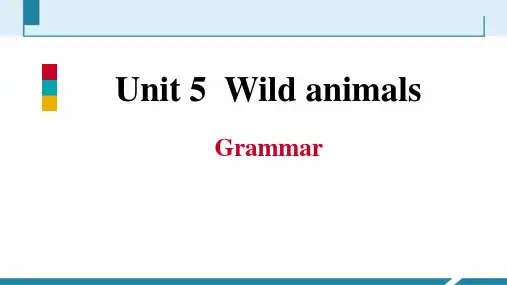
3 .At four months old, she started to go outside for the first time. 4 .When she was six months old, she began to eat bamboo. 5 .When she was 20 months old, she learnt to look after herself.
3 .Linda's wallet is the same colour ___C_____ mine, but my wallet's
style is quite different ________ hers.
A .from; as
B .as; as
C .as; from
D .from; from
表命令; may意为“或许”,表推测; will意为“将要”,表将来。根据句意
“妈妈,我已经签收了这个盒子,里面是什么? ”“我不确定,它________
是你舅舅寄来的礼物。 ”由答语第一句知,应答者并不确定盒子里的东西是
什么,因此这里表“推测”。故选C。
2 .2017 ·上海—___B_____ I park my car here for a while? —No, you mustn't. Do you see the sign “NO PARKING”?
saved 。
________
I'm saving for a new bike.我正攒钱想买辆新自行车。
[拓展] save作及物________动词,还可译为“挽救” 。 ___s_a_v_e_o_n'_es_l_if__e ___ 表示“挽救某人的生命” 。 Doctors were unable to save him.医生未能把他救活。
最新初中八年级上册牛津译林版8A Unit5 Wild animals Grammar课件(14页)精品PPT课件
1.Why should we protect wild animals?
Because they are our friends.
While-tBiblioteka sk:1.Learn Part B and finish the exercises by yourself.
I wanted to see wild animals there. wild animals are our friends. the dolphin show was long.
Because ————————————————————————— 4.Why must we protect wild animals? Because —————————————————————————
Task2:Read the passage and answer some questions. because of
用法相似:if,until ,as soon as ,when, after,before. arrive 1.Please let me know as soon as you ______(arrive) here tomorrow. won’t go (not go) to bed until his father comes 2.He _________ back. finishes 3.He will go back home when he _______ (finish) the work. arrived 4.He came to see me as soon as he _______ (arrive) here yesterday. go 5.He didn’t _______(not go) to bed until his father came back. grew (grow) into 6.When the duck grew up, it _______ a beatiful swan.
牛津译林版8A Unit5 Wild animals Grammar课件(共18张PPT)
Task Three Do the exercises.
Have a try and let’s see who can do it best.
用括号内所给动词的正确形式填空。 to have (have) a 1. They are preparing _______ sports meeting. to go 2. Jim agreed ______(go) to the West Lake. 3. It’s easy _________(play) softball. to play feel (feel) sad? 4. What made you______ to ride (ride) a 5. Mr White learned ________ horse last year?
let/make help sb. spend what / how /where be ready/willing
let/make sb. do sth. help sb. (to ) do sth. spend … doing sth. what / how /where to do (sth.) be ready/willing to do sth.
做某事
2.所学的更多动词的用法
like forget remember have fun have a good time finish Thank you for … enjoy practise keep (on) look forward to It’s time … It’s time for …
like to do /doing sth. forget to do /doing sth. remember to do /doing sth. have fun doing sth. have a good time doing sth. finish doing sth. Thank you for doing … enjoy doing sth. practise doing sth. keep (on) doing sth. look forward to doing sth. It’s time to do sth. It’s time for sth./doing sth.
《Wild-animals》Grammar
1. The elephant is going towards the water.
It may need
(need) a bath.
2. The little boy is crying because he saw the tigers.
We also use ‘can’ or ‘could’ to say that something is possible.
1. I left my key at school. I couldn’t open the door.
2. It will be warm tomorrow, so we can wear T-shirts.
Make up new sentences with “may”
UstiWhngaet‘casalosnmo’ /eut‘schoeinu‘lgcda’inst’opootras‘lsckiobaulbelod.u’ ttopossasyibility
We use ‘can’ or ‘could’ to say that something is possible. ‘Could’ talks about a smaller chance than ‘can’.
If we do nothing, soon there may be none left. In the future, pandas may not have a place to live or food to eat. He is busy today. He may not come to the party. If we do nothing, soon there may be none left.
牛津译林版英语八年级上册《Wild animals》Grammar
We can use verbs and ‘to’-infinitives together.
Translate some phrases:
动词不定式: verbs + ‘to’-infinitives • 想要做某事 want to do sth. • 希望做某事 hope to do sth. • 计划做某事 plan to do sth. • 同意做某事 agree to do sth. • 决定做某事 decide to do sth. • 学习做某事 learn to do sth. • 选择做某事 choose to do sth. • 准备做某事 prepare to do sth.
every morning?
不定式有 to do 和 do, 多数加 to do 少数加 do, 下列动词后省去 to , “三看”“两听” “一感觉”, see, watch, look at hear , listen to feel
外加三个“小使役”, let, make , have
保你永远不忘记!
We use ‘to’-infinitives __a_f_t_e_r___(before,after)
verbs such as ‘want’ and ‘plan’.
We also use ‘to’ -infinitives after these words.
would like /need / wait/ to do sth. begin/start/forget/remember to do sth. try / try one’s best to do sth. tell sb. (not) to do sth. ask sb. (not) to do sth. wish sb. (not) to do sth. teach sb. to do sth / invite sb. to do sth. help sb. (to ) do sth. It’s + adj+ to do sth. be able / be willing / be ready to do sth how/what/ where… + 乘飞机去, 但花钱太多,最后我们决定乘火车去,我们参观 了许多著名的名胜古迹,我们玩得很开心。