
刘玉彩 外研版初三英语下册Module 1教案
Reading
该单元共设计了4个活动。Activity1看短语猜测文章内容,读文章给句子排序。文章介绍了Lin的第一次坐火车旅行的经历。Activity 2根据文章选择最佳答案,注意文章的ห้องสมุดไป่ตู้节。Activity 3两两活动,根据文章回答问题,加深对文章的理解。
Step3Listening and speaking
Ask students to listen andanswer the questionsin activity2.
Listening
Check the answers with the class.Then play the tape again and ask the students to complete the table in activity 3.
2.Say how you were travelling.
3.Say what happened before you left.
4.Say who was travelling with you.
5.Say what happened.
6.Say how the story finished.
Step8 Test
Step 1 Greeting
Step 2 Revision
Encourage students toact out the dialogue in Unit 1.
Step 3 Warming up and leading in
找一Mjg3Mjg4NDA0.html
In this procedure, try to make students understandthe new words.Encourage the students to make a conversation in pairs.
Bike car subway coach
taxi train airplane ship
许多乘客无法够到救生艇。
3. I’ve got a long way to go.我要坐很长时间的火车。
have a long way to go通常表示“(为达到某个目标)仍有许多事要做”。
例如:Li Lin has still got a long way to go before she becomes a successful teacher.
Show the following pictures and talk about trips by train with students.
A:Have you ever taken the train?
B:Of course.
T:Look at the pictures. Have you ever met such a situation?How do you feel about taking the train? How about the environmentonthe train? Are there so many people?
3.Finish off the workbook exercises 11-13.
Step 1 Greeting
Step 2 Revision
Ask some students to retell the story in Unit 2.
Step 3 Language practice
Ask students to doActivities 1 and 2.
Homework
1.Learn the new words by heart.
2.Act out the conversation in groups.
3.Finish off the workbook exercises 1-7.
第二课时Unit 2 You’re sitting in my seat.
Q2: Was Lin right to ask the young man to move?
Q3: What do you think of the young man’s behaviour?
Q4: What do you usually do if you see someone standing on a bus or a train?
Step5Pairwork
Ask students to listen to and say theconversationin activity8and then read the conversation in activity9again, paying attention to the intonations.
Step5Pairwork
Work in pairs to talk about the answers to the following questions.
Q1: How does Lin feel about this trip? Why?
Do you think you will ever have the same feelings about a trip?
Step6Language notes
1.Now it was in front of him, to set off soon.
火车现在就在他前面,马上就要开了。
这里的set off表示“出发,起程,动身”。例如:
They wanted to set off early in order to get there on time.
Writing
Activity 4写下自己旅行途中的难忘经历,从而练习关于旅行文章的写作。
Unit 3对定冠词与不定冠词及“谈论旅行”的功能项目进行综合训练。
Activity 1用a, an, the填空。Activity 2选择符合句子的最佳答案。Activity3根据实际情况完成句子。Activity 4看图完成表格,要求学生能看懂飞机票。Activity 5听录音完成表格。Activity 6根据表格回答问题。Activity 7阅读短文完成表格,写出文中介绍飞机的优缺点。Activity 8再次阅读Activity 7的短文把数字与事件连线。
Around the world介绍了飞行员Charles Lindbergh第一次飞渡大西洋的经历。
Module task要求学生描述一次旅行经历。
四、教学方法
Unit 1通过听、读、说训练,初步学习谈论旅行的方法。
Unit 2通过读、写训练,学习谈论旅行途中的经历。
Unit 3对定冠词与不定冠词及“谈论旅行”的功能项目进行综合训练。
4、写一些学生假期期间发生的有意义的事,以及旅行方面的文章
三、教材分析
本模块以“Travel”为话题,以学习谈论自己或他人的旅行为主线,介绍了旅行中发生的事件。通过模块学习,学生将重点掌握定冠词与不定冠词的用法,并能运用所学知识介绍自己或他人的旅行经历。
Unit 1通过听、读、说训练,初步学习谈论旅行的方法。
Vocabulary and listening
Activity 1要求利用所给的词回答问题,学习或复习一些交通工具的表达方式。Activity 2利用所给词汇听录音回答关于旅游的问题。Activity 3再听一遍填写表格。Activity 4听读一段Lingling, Betty, Daming谈论各自旅行的对话,学习关于旅行的一些表达方式。Activity 5根据对话完成表格,听对话录音核对答案。Activity 6根据对话内容回答问题,要求对对话深入理解。Activity 7根据对话内容完成句子,注意because, so and although, but的用法。
要成为一名成功的教师,李林仍有许多路要走。
Step7 Writing
Ask the students to write about something that happened during a trip you have made.
1.Say when and where
/html/2009/9-5/r142015666.shtml
Homework
1.Learn the new words by heart.
2.Retell the story in your own words.
全国中小学“教学中的互联网搜索”优秀教学案例评选
教案设计
外研版初三英语下册Module 1
一、教案背景
1,面向学生:□中学□小学2,学科:英语
2,课时:3
3,学生课前准备:
一、预习课文,了解旅行中发生的事件
二、完成课后习题,了解定冠词与不定冠词的用法
二、教学课题
1、听人们谈论旅行
2、谈论假期和旅行
3、读一些关于假期的对话,了解一些关于旅行计划和经历的文章
Speaking
After finishing the listening exercises,let the students practice speaking.
Step4Listening and reading
In this procedure, let the students read the conversation and do Activity 6 and 7.
…
Step 4 Listening and reading
Listening
Play the recordingto check the answers.
Reading
Now read the passage quietly and carefully again and find out the answers in activity 2.
外研版九年级英语下册Module 1 Travel Unit 1表格式教案
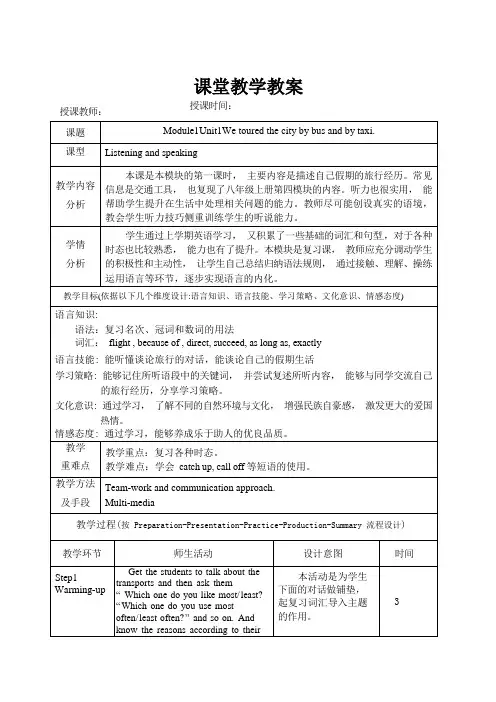
3
answers.
Step2Listenand answer
Step3Listeningand reading
Step4
Reading
Step5Pronunciatio
nand
speaking
Step6Talking
Readthenewwordstogether,knowingtheirmeanings.Listento thetapeandfindouttheanswersto thequestionsinActivity2,thenask threestudentstoanswerthem,and checkiftheyarerightornot.
学情
分析
学生通过上学期英语学习, 又积累了一些基础的词汇和句型 ,对于各种时态也比较熟悉, 能力也有了提升。本模块是复习课, 教师应充分调动学生的积极性和主动性, 让学生自己总结归纳语法规则, 通过接触、理解、操练运用语言等环节,逐步实现语言的内化。
教学目标(依据以下几个维度设计:语言知识、语言技能、学习策略、文化意识、情感态度)
1. Listen to the tape, and complete thetableaccordingto the tape. Then askstudentstoread the answers to theclassandcheck.
2.Answerthequestions. Then readthedialogueingroups.
授课教师:
课堂教学教案
授课时间:
课题
Module1Unit1Wetouredthecitybybusandbytaxi.
外研版英语九年级下册:Module 1 Unit 3 Language in use . 教案设计

Unit 3 Language in useTarget languageKey vocabularystep do harm to at the end of too…to…1.Key structuresWhere were you going?Why were you going there?What did you do/see on the trip?Language skillEnable the students to talk about a trip they have made.Enable the students to write about a trip.Teaching methodsIndividual work and group workTeaching important/difficult pointsHow to write about a trip.Teaching aidsA computer, a recorder and a projector.Teaching procedures and waysStep 1 GreetingStep 2 RevisionAsk some students to retell the story in Unit 2.T: Who can retell the story in front of the class? Be brave!Ss:…T: You are excellent!Step 3 Language practiceAsk students to do Activities 1 and 2.First introduce “definite article and indefinite article” to students. After explaining the grammar point, ask the students to repeat the usages of definite and indefinite articles. T: Now, it’s time to check how you master it? Please do Activity One and Two.Then check the answers by asking some students to read the complete sentences. Sample answers to Activity 2:1, in hospital 2. school 3. the school 4. The flowers 5. in time6. a few7. the most8. the Tuners9. king 10. the Great Wall Step 4 Listening and speakingT: Did you notice the flight tickets when you took a plane? Now look at the tickets and try to complete the chart in Activity 4!If the students have some difficulties to finish the task individually, the teacher should allow them to discuss in groups.The sample answers to Activity 4:Name of the airplane: Air ChinaFlight number: 1327Leave from: BeijingCoach Company: National ExpressDeparture time: 8:40 amArrival time: 9:40 amT:Before your travel, you may choose the best way to travel. Now listen to the recording and complete the notes about the flight plans in Activity 5.Check the answers together.Play the recording again and ask students to make the choice. “Which option has the longer flight? Which is cheaper?”T: Now, look at the notes you have made in Activity 5. Work in pairs and discuss the questions: ““Which option has the longer flight? Which is cheaper?”A few minutes later, let some pairs read out their answers.Step 5 ReadingIn this procedure, the students are asked to read the passage and complete the chart in Activity 7.T: In Activity 7, you can read an article about the plane named Concorde. First, read it by yourself to get the main idea and second work in groups and discuss to complete the chart.Check the answers with the whole class.The sample answers to Activity 7:T: You did very well. Team work is very important. Read the passage again and match the numbers and facts they refer to in Activity 8.The sample answers to Activity 8:3 the number of passengers on one flight27 the numbers of hours to fly from London or Paris to New York100 the number of years Concorde flew113 the number of people who died in a crashStep 6 Around the worldAround the worldT: Read the passage “The first plane to fly across the Atlantic Ocean”. First, fill in the banks to get some general information:The name of the pilot: Charles LindberghThe name of the plane: Spirit of St. LouisThe weight of the plane: 975 kilosThe height of the plane: 3 metersT:Read the passage for the second time to write down what happened in the following years:In 1919, a pilot named Charles Lindbergh from St. Louis, USA decided to try to fly from Paris to New York.In April 1927, his plane was completed.In May 1927, he took off from New York.Step 7 Module taskAsk students to describe a trip and then present the passage to the class.T : We have learned a passage about a trip and we also have practiced writing about a trip. Now, you have a second chance to practice writing about it. Pay attention to in what aspects you should write about it.Where were you going ?Why were you going there ?What did you do/see on the trip ?The sample passage:In 2002, I went to Hong Kong by plane with my family to go sightseeing. Because it was the first time that I had taken the plane, I felt dizzy and uncomfortable. I didn’t want to eat anything but only wanted to vomit. While I was not feeling well, the airhostess came to me and gave me a plastic bag, a cup of water and a towel. After I vomited, she took the dirty bag away and asked me to have a good rest. I was very thankful to her. On the trip, although I was uncomfortable, I was very happy.Homework1. Ask students to do the rest activities in the workbook.2. Ask students to summarize what we have learnt in this module and preview thenext.。
外研版九年级英语下册教案:Module 1 Unit 1 教案
Module 1 Travel一、学习目标:A. 单词和短语:flight, because of, direct, pilot, succeed, as long as, school-leaver, exactly, take care, sir, officer, stupid, take off, jacketB. 交际用语:1. Not bad!2. It was great fun!3. How about you?4. We’d be tter get back to work.5. We’ll hav e a great time!6.— What did you do during the winter holiday?— I went to see my grandparents in Xi’an.7. The train was full of people and I had to stand for three hours!8. But the pilot succeeded in landing on time.9. Ther e’s nothing to worry about as long as y ou work hard.10. Please have your tickets ready.11. Oh, it’s a lo ng story12. He went to stay with his family in the UK.13. Why is travel so difficult in winter?14. We flew direct to Hong Kong.15. We took a tour by coach to the Summer Palace.16. Then we took a boat to Lantau Island and went to Disneyland.17. This is Seat 12A, but you should be in Car 9. This is Car 8.二、教学目标[来源:]1. Function: Talking about travel.2. Structure: Revision: nouns; articles; numbers.3. Skills: 1) Listening for specific information; taking notes..2) Talking about familiar topics (holidays)3) Predicting; reading for specific information .4) Writing a short play about a trip.4. Around the world: The first pilot to fly alone across the Atlantic Ocean.5. Task: Writing and acting out a short play.三、重点及难点:Grammar: Revision: nouns; articles; numbers.四、教学设计:Unit 1 We toured the city by bus and by taxi.Ⅰ Teaching modelListening and speakingⅡ Teaching methodCommunicative approachⅢ Teaching aims1. To understand the conversations conversat ion with regard to “travel”.2. To talk abou t one’s holiday and new term..Ⅳ Teaching Objectives1. Key vocabulary: flight, because of, direct, pilot, succeed, as long as,school-leaver, exactly21教育名师原创作品2. Key structures: Sentence structureⅤ Teaching aidsTape recorder, OHP, videoⅥ Teaching StepsStep 1 Warming up1. Show some pictures to talk.1) — How do you go to school / work?— I go to school by ______.2) — How do you most like to travel by?— I most like to travel by _________.2. Enjoy and talk something about the pictures.3. Show some pictures to introduce the new words.4. Learn the new words.5. Read the words after the teacher.Step 2 Complete the sentences.1. Ask the students to read through the sentences in Activity 1.1) I most like to travel by _____________.2) I least like to travel by _____________.3) I travel most often by ______________.4) I travel least often by ______________.2. Complete the sentences so they are true for you.3. Ask the students to check their answer with a partner.4. Call back the answers from the whole class and check the answers. Step 3 Listening practice.1. Ask the students to read through the sentences in Activity2.1) The flight takes about __________ hours.2) Time difference: __________ hours.3) Flight number: __________4) From _________ to _________5) Leave at (new time): _________6) Arrive at (new time): _________Keys: 10, 8, CA938, London, Beijing, 11:30, 5:30 p.m.2-1-c-n-j-y2. Play the tape and ask the students to listen to the tape carefully.3. Listen and complete the notes.4. Ask the students to check their answer with a partner.5. Call back the answers from the whole class and check the answers. Step 4 Listen and read.1. Ask the students to listen and read the conversation silently.【来源:21cnj*y.co*m】When you listen to the recording, try to note down the key information.Your notes will then help you retell the main information.2. Now complete the table.Holiday activitiesLingling went to see her grandparents in Henan Province by trainTonyDamingBetty4. Ask the students to check their answer with a partner.5. Call back the answers from the whole class and check the answers. Keys:went to stay with his family in the UK by plane.flew to Hong Kong and visited Lantau Island Disneyland.toured Beijing by bus and by taxi and took a tour by coach to the Summer Palace.Step 5 Answer the questions.1. Ask the students to read through the questions in Activity 4.1) When do you think the conversation takes place?2) According to Lingling, why is travel so difficult in winter?3) What are Daming and Betty looking forward to at the end of the term?2. Answer the questions.3. Ask the students to check their answer with a partner.Keys:1. The conversation takes place in winter.2. Travel is difficult because of the Spring Festival.3. They are looking forward to the school-leavers’ party.Step 6 Choose the correct answer.1. Ask the students to read through the words in the box in Activity 5. direct exactly pilot succeed2. Choose the correct answer.1. When you fly direct, you ______.a) arrive without stopping at another placeb) stop at another place before you arrive2. When you say “Exactly”, it means ______.a) you do not agreeb) you completely agree3. The pilot of plane ______.a) flies itb) gives you food and drink during the flight4. If you succeed in doing something, you ______.a) manage to do itb) nearly do it3. Ask the students to check their answer with a partner.Keys: 1. a 2. b 3. a 4. aStep 7 Everyday EnglishNot bad!It was great fun!How about you?We’d bette r get back to work.We’ll have a great time!Step 8 Pronunciation and speaking: Listen and mark the pauses.1. Play the recording once without stopping.2. Play the recording again and ask the whole class to repeat. Lingling: How about you, Betty?[来源:]Betty: We had quit a good time in Beijing. We toured the city by bus and by taxi. Last weekend, we took a tour by coach to the Summer Place and went for a long walk around the lake.Lingling: That sounds gr eat! But now, we’d better get back t o work . We’re going to have a big e xam at the end of the term.3. Ask the students to listen and mark the pauses.4. Now listen again and repeat.Step 9 Work in groups.Talk about your winter holiday.1. Ask and answer about what you did during the winter holiday.— What did you do during the winter holiday?— I went to see m y grandparents in Xi’an.2. Talk about what happened during the trip.The train was full of people and I had to stand for three hours!Step 10 Language points[来源:ZXXK]1. But the pilot succeeded in landing on time. 不过飞行员成功地按时着陆了。
2023年外研版九年级英语下册Module 1 Travel 教案
Module 1 Travel 教案一、学习目标:A. 单词和短语:flight, because of, direct, pilot, succeed, as long as, school-leaver, exactly, take care, sir, officer, stupid, take off, jacketB. 交际用语:1. Not bad!2. It was great fun!3. How about you?4. We’d better get back to work.5. We’ll have a great time!6.—What did you do during the winter holiday?—I went to see my grandparents in Xi’an.7. The train was full of people and I had to stand for three hours!8. But the pilot succeeded in landing on time.9. There’s nothing to worry about as long as you work hard.10. Please have your tickets ready.11. Oh, it’s a long story12. He went to stay with his family in the UK.13. Why is travel so difficult in winter?14. We flew direct to Hong Kong.15. We took a tour by coach to the Summer Palace.16. Then we took a boat to Lantau Island and went to Disneyland.17. This is Seat 12A, but you should be in Car 9. This is Car 8.二、教学目标1. Function: Talking about travel.2. Structure: Revision: nouns; articles; numbers.3. Skills: 1) Listening for specific information; taking notes..2) Talking about familiar topics (holidays)3) Predicting; reading for specific information .4) Writing a short play about a trip.4. Around the world: The first pilot to fly alone across the Atlantic Ocean.5. Task: Writing and acting out a short play.三、重点及难点:Grammar: Revision: nouns; articles; numbers.四、教学设计:Unit 1 We toured the city by bus and by taxi.ⅠTeaching modelListening and speakingⅡTeaching methodCommunicative approachⅢ Teaching aims1. To understand the conversations conversation with regard to “travel”.2. To talk about one’s holiday and new term..Ⅳ Teaching Objectives1. Key vocabulary: flight, because of, direct, pilot, succeed, as long as, school-leaver,exactly2. Key structures:Sentence structureⅤ Teaching aidsTape recorder, OHP, videoⅥTeaching StepsStep 1 Warming up1. Show some pictures to talk.1) — How do you go to school / work?— I go to school by ______.2) — How do you most like to travel by?— I most like to travel by _________.2. Enjoy and talk something about the pictures.3. Show some pictures to introduce the new words.4. Learn the new words.5. Read the words after the teacher.Step 2 Complete the sentences.1. Ask the students to read through the sentences in Activity 1.1) I most like to travel by _____________.2) I least like to travel by _____________.3) I travel most often by ______________.4) I travel least often by ______________.2. Complete the sentences so they are true for you.3. Ask the students to check their answer with a partner.4. Call back the answers from the whole class and check the answers.Step 3 Listening practice.1. Ask the students to read through the sentences in Activity2.1) The flight takes about __________ hours.2) Time difference: __________ hours.3) Flight number: __________4) From _________ to _________5) Leave at (new time): _________6) Arrive at (new time): _________Keys: 10, 8, CA938, London, Beijing, 11:30, 5:30 p.m.2. Play the tape and ask the students to listen to the tape carefully.3. Listen and complete the notes.4. Ask the students to check their answer with a partner.5. Call back the answers from the whole class and check the answers.Step 4 Listen and read.1. Ask the students to listen and read the conversation silentlyWhen you listen to the recording, try to note down the key information. Your notes will then help you retell the main information.2. Now complete the table.Holiday activitiesLingling went to see her grandparents in Henan Province by trainTonyDamingBetty4. Ask the students to check their answer with a partner.5. Call back the answers from the whole class and check the answers.Keys:went to stay with his family in the UK by plane.flew to Hong Kong and visited Lantau Island Disneyland.toured Beij ing by bus and by taxi and took a tour by coach to the Summer Palace. Step 5 Answer the questions.1. Ask the students to read through the questions in Activity 4.1) When do you think the conversation takes place?2) According to Lingling, why is travel so difficult in winter?3) What are Daming and Betty looking forward to at the end of the term?2. Answer the questions.3. Ask the students to check their answer with a partner.4. Call back the answers from the whole class and check the answers.Keys:1. The conversation takes place in winter.2. Travel is difficult because of the Spring Festival.3. They are looking forward to the school-leavers’ party.Step 6 Choose the correct answer.1. Ask the students to read through the words in the box in Activity 5.direct exactly pilot succeed2. Choose the correct answer.1. When you fly direct, you ______.a) arrive without stopping at another placeb) stop at another place before you arrive2. When you say “Exactly”, it means ______.a) you do not agreeb) you completely agree3. The pilot of plane ______.a) flies itb) gives you food and drink during the flight4. If you succeed in doing something, you ______.a) manage to do itb) nearly do it3. Ask the students to check their answer with a partner.4. Call back the answers from the whole class and check the answers.Keys: 1. a 2. b 3. a 4. aStep 7 Everyday EnglishNot bad!It was great fun!How about you?We’d better get back to work.We’ll have a great time!Step 8 Pronunciation and speaking: Listen and mark the pauses.1. Play the recording once without stopping.2. Play the recording again and ask the whole class to repeat.Lingling: How about you, Betty?Betty: We had quit a good time in Beijing. We toured the city by bus and by taxi. Last weekend, we took a tour by coach to the Summer Place and went for a long walk around the lake.Lingling: That sounds great! But now, we’d better get back to work . We’re going to have a big exam at the end of the term.3. Ask the students to listen and mark the pauses.4. Now listen again and repeat.Step 9 Work in groups.Talk about your winter holiday.1. Ask and answer about what you did during the winter holiday.—What did you do during the winter holiday?—I went to see my grandparents in Xi’an.2. Talk about what happened during the trip.The train was full of people and I had to stand for three hours!Step 10 Language points1. But the pilot succeeded in landing on time. 不过飞行员成功地按时着陆了。
外研版九年级下册英语《module 1 unit 3 language in use》教学设计
外研版九年级下册英语《module 1 unit 3 language in use》教学设计一. 教材分析外研版九年级下册英语《Module 1 Unit 3 Language in Use》主要讲述了日常生活中的交际用语和表达方式。
本节课的主要内容包括如何询问时间、天气以及如何表达喜好等。
通过对本节课的学习,学生能够掌握相关的交际用语,提高日常英语口语表达能力。
二. 学情分析九年级的学生已经具备了一定的英语基础,能够理解和运用简单的日常交际用语。
但是,对于一些特定的表达方式和交际场景,学生可能还不太熟悉。
因此,在教学过程中,需要结合学生的实际情况,逐步引导他们掌握和运用本节课的知识点。
三. 教学目标1.知识目标:学生能够掌握询问时间、天气以及表达喜好的相关交际用语。
2.能力目标:学生能够在日常生活中运用所学知识进行简单的交流。
3.情感目标:培养学生对英语学习的兴趣,提高他们的自信心。
四. 教学重难点1.重点:学生能够掌握并运用询问时间、天气以及表达喜好的交际用语。
2.难点:如何引导学生灵活运用所学知识进行实际交流。
五. 教学方法1.任务型教学法:通过设定具体的交际任务,引导学生参与课堂活动,提高他们的实际运用能力。
2.情境教学法:创设真实的交际情境,让学生在实际语境中学习和运用英语。
3.互动式教学法:鼓励学生积极参与课堂互动,提高他们的口语表达能力。
六. 教学准备1.教学素材:准备相关的交际场景图片、视频等教学资源。
2.教学工具:多媒体设备、黑板、粉笔等。
3.教学设计:提前规划好课堂活动的具体内容和步骤。
七. 教学过程1.导入(5分钟)通过展示一幅日常生活场景的图片,引导学生思考在日常生活中是如何询问时间、天气以及表达喜好的。
激发学生的学习兴趣,为接下来的课堂活动做铺垫。
2.呈现(10分钟)教师运用PPT展示本节课的主要知识点,包括询问时间、天气以及表达喜好的交际用语。
同时,结合例句和情景,让学生理解和掌握这些表达方式的用法。
外研版初中九年级下册英语精品教案 Module 1 Unit 1
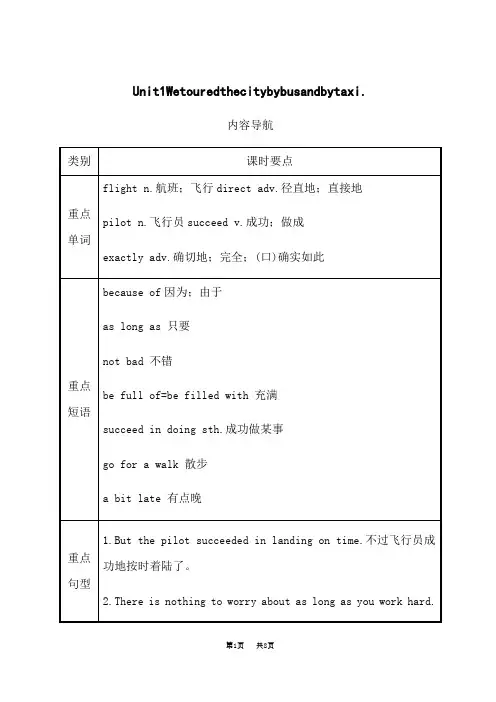
Unit1Wetouredthecitybybusandbytaxi.内容导航教学过程预习指导:一、方法指导1.学生自主预习本单元中新的单词和短语,注意单词的发音和意思。
2.了解本单元话题,搜集相关资料,预习Activity 3中的对话。
二、预习检测Ⅰ.根据句意及汉语提示完成单词。
1.Jack succeeded (成功) in passing the exam at last.2.She drove directly (直接地) to the school after work.3.I’d like to learn about my flight (航班) from London to Tokyo.4.I want to be a pilot (飞行员) in the future.5.I can’t remember when exactly (确切地) she left the city. Ⅱ.根据句意用所给词的适当形式填空。
1.Mike succeeded in getting (get) to the top of the mountain.2.You’d better not go (not go) there by bike because it’s far away.3.They’re looking forward to meeting (meet) you.4.Chang An Avenue is one of the busiest (busy) streets in Beijing.5.There’s something to buy (buy) here as long as you have enough money.课堂教学:Step1情景导入Teacher shows some pictures of the way that people travel and guides students to talk.T:How do you go to school?Ss:I go to school by car/bike/bus... .T:How do you most like to travel by?Ss:I most like to travel by car/boat/plane... .Step2听前准备1.学习新的单词及短语。
【最新】外研版九年级英语下册Module1 Unit1教学设计
Module1 Unit1教学设计一、课程标准:能够谈论自己的度假经历;分享自己的快乐与苦恼。
二、教学目标:知识目标:掌握相关单词、短语,知识点。
能力目标:能听懂对话内容并掌握听力技巧;能够谈论自己的度假经历。
情感态度:能够分享自己的快乐与苦恼。
三、教学重点难点:本单元单词,短语和知识点的用法;四、使用说明与学法指导:1. 大声诵读课文,勾画相关基础知识。
2. 在充分自学的前提下,认真完成学案。
3. 将预习中不能解决的问题标注出来,在课堂中解决。
探究案一.新课导入Let students work in pairs and talk about your favourite type of transportation and why.二.听力训练(多层听)(一)Listen and complete the notes.1. The flight takes about _______ hours.2. Time difference: _______ hours3. Flight number: _________4. From ________ to _________5. Leave at (new time): _________6. Arrive at (new time): _________(二)Listen and answer answer.What are Lingling, Betty and Daming talking about?They are talking about the winter vocation.(三)Listen and choose the best answer.1. Travel is very difficult in winter because .A. it’s too cold to travelB. the Spring Festival makes winter the busiest seasonC. People are too busy2. Tony is coming back by today.A. shipB. planeC. train3. Daming and Betty are looking forward to at the end of the term.A. a big examB. the school-leavers’ partyC. visiting the Summer Palace (四)Listen and fill in the blanks.Lingling: Welcome back, everyone!Betty: Hi, Lingling! How was your holiday?Lingling: Not bad! I went to see my grandparents in Henan Province. The train wasfull of people, and I had to stand for over thre hours_.Betty: Bad luck. Where’s Tony?Daming: He went to stay with his family in the UK. He’s flying back today. But the flight was late.Betty: Why was travel so difficult in winter?Lingling: Well, it’s the busiest season in China because of the Spring Festival.Where did you go, Daming?Daming: We flew direct to Hong Kong-and the plane left a bit late too! It was great fun!三.对话处理听后读:Read and Complete the table.(完成课本activity3)疯狂记忆:如果谁能说出转盘中人物的假期经历,就能得到相应星星。
外研版九年级下Module1Trave1Unit1We toured the city by bus and by taxi.教学案
第一部分学习要求:学习目标:1、知识和技能目标1).话题:Travel2)词汇:学会正确使用本单元单词。
3)语法:掌握名词、冠词、数次的用法。
4)功能:能够谈论旅行。
2、技能目标:1.能够听懂谈论旅行经历的对话。
2. 能够谈论自己的假期经历。
3、学习策略:记笔记的方式,记录重点内容,帮助记忆和表达。
4、情感、态度和价值观:与同伴分享旅行的感受。
5.文化意识;通过学习,发扬乐于助人、团结合作的精神。
学习重点:掌握名词、冠词、数次的用法学习难点:掌握名词、冠词、数次的用法。
学法指导:1.课前通过自学单词和预习课文,解决学案中的问题。
2.课上通过合作探究、展示交流,解决重难点。
3.课后自我总结归纳。
第二部分学习过程:一、课前预习导学:(一)根据汉语写单词:航班_________________直接 _____________飞行员 _________________ 成功 ____________毕业生 _____________确实. _____________(二)根据汉语写短语:时差__________________________ 因为__________________________ 按时______________________乘船去某地___________________________ 乘公交车游览城市_______________________ 学期末______________乘长途汽车去某地参观______________________只要______________名言警句:Read ten thousand books, travel ten thousand miles. 读万卷书,行万里路.毕业典礼_______________________ 期待_______________________ (三)读本单元课文,把你认为重要的句子和不理解的句子写在下面,你能划出重要或不理解的地方吗?——————————————————————————————————————————————————————————————————————————————————————————————————————————————————————————————————————————————————————————————————————————————————————————————————————————————————————————————————————————————————————————————————————————————二、课堂学习研讨I. A.1.2II. A.3三、当堂训练巩固I.A.4II.A5.6.7.学生小结:名言警句:Read ten thousand books, travel ten thousand miles. 读万卷书,行万里路.教师小结:四、课后拓展延伸【I, II,为必做,III为选做】I.完成小测卷本单元练习题II.句子翻译.1.火车挤满了人,我不得不站了三个多小时._________________________________________________________2.因为春节,它是中国最繁忙的季节.._________________________________________________________3.飞行员成功的按时着陆了。
外研版英语(新标准)九年级下册《Module 1 Travel》教学设计
3.语法:复习名词、冠词及数词。
语言技能目标:
听:能听懂关于旅行的对话及听懂航班信息。
说:能讨论关于假期的生活。
读:能读懂假期旅行中遇到小插曲的短剧,能根据相关信息预测文章内容。
写:能根据你的旅途经历编写一个短剧。
情感目标:渗透正确的价值观,培养助人为乐的优秀品德。
学习策略:
自学策略:能够记住所听语段中的关键词,并尝试复述所听内容。
合作学习策略:能够与同学交流自己的旅行经历;分享学习策略。
文化意识:
了解不同的自然环境与文化,增强民族自豪感。
教学重点及难点
重点:
1.掌握课文内容相关的词汇句型。
2.掌握名词、冠词及数词。
难点:
能听懂并记录航班信息。
能叙述假期旅行中的经历。
能用一个短剧描述旅行中发生的事。
本活动分为3小步:
1.模仿文中的重点句型,要求学生准确地模仿其语音语调;
2.跟读句型全文,以获得对整篇对话的整体感;
3.分角色模仿,旨在培养学生的听说能力及创新能力。
Step6:
Usefulexpressions:
归纳总结本课的重要词汇。
学生根据所给汉语说出英语词组。
齐声朗读英文词汇两遍。
通过归纳对话中的重点词汇,让教学做到点面结合,学生对词汇及全文的理解会更深透。
教材及年级名称
《英语》(新标准)九年级下册
模块名称
Module1 Travel
教材分析
本模块以“旅行”为中心话题,主要的语言实践活动都围绕此话题而设计。教师要为学生提供自主学习和相互交流的机会,以及充分表现和自我发展的空间。
本模块第一单元的内容是描述假期经历。在描述旅行经历时,让学生讨论自己喜欢的和不喜欢的旅行工具,既为将要学习的对话做好了铺垫,也复习了八年级上册第四模块的内容。因此,本活动起到承上启下的作用。在听力部分,要求学生记录航班信息,这是非常实用的技巧,能帮助学生提升处理实际问题的能力。
外研版九年级英语下册教案Module1
外研版九年级英语下册教案Module1外研版九年级英语下册教案Module1一、文章概述本文主要介绍了外研版九年级英语下册Module1的相关内容,包括教学重点、难点、教学方法和课堂活动等方面。
通过对文章的阅读,读者可以对外研版九年级英语下册Module1的整体教学方案有一个全面的了解和掌握。
二、教学重点本模块的教学重点是让学生掌握以下知识和技能:1、掌握英语动词过去式的规则变化和不规则变化,包括动词的过去式、过去分词和现在分词形式。
2、学会使用“since”和“for”等词语来表达时间的流逝和持续的时间。
3、熟悉英语中的各类从句,包括主语从句、宾语从句、定语从句和状语从句。
4、了解英语中常用的修辞手法,如比喻、拟人、夸张等。
三、教学难点本模块的教学难点在于:1、有些动词的过去式不规则变化难以记忆,需要学生多加练习和巩固。
2、对于初学者来说,“since”和“for”的用法容易混淆,需要教师在课堂上进行详细讲解和示范。
3、从句是英语语法中的一个难点,需要学生有较好的语法基础和逻辑思维能力。
四、教学方法为了更好地实现教学目标,教师可以采用以下教学方法:1、示范讲解:对于重要的语法点和词汇,教师可以进行示范性的讲解和操练,帮助学生理解和掌握。
2、课堂互动:通过课堂互动,如提问、讨论、展示等方式,激发学生的学习兴趣和参与度,提高教学效果。
3、情境教学:通过创设情境,让学生在实际运用中学习和掌握语言知识,如角色扮演、场景模拟等。
4、课外拓展:教师可以布置一些课外拓展活动,如阅读英文原著、观看英文电影、参加英语角等,增加学生的语言输入和输出机会。
五、课堂活动为了提高学生的参与度和学习效果,教师可以设计以下课堂活动:1、小组讨论:将学生分成若干小组,针对某个话题或问题进行讨论,然后进行展示和交流。
2、快速问答:教师提出一些问题,让学生快速回答,锻炼学生的反应能力和口语表达能力。
3、故事接龙:让学生通过故事接龙的方式,运用所学的语法点和词汇编故事,锻炼学生的想象力和语言组织能力。