
杜甫草堂英语导游词
杜甫草堂英语导游词杜甫是唐朝最有名的诗人之一,杜甫草堂曾是杜甫的居所。
杜甫草堂位于成都西郊,屋外河流、古式建筑、亭台楼阁和古树是它的标志。
下面为大家准备了杜甫草堂的英语导游词,欢迎阅读。
Du Fu(712~770)Thatched Cottage used to be the former home of Du Fu, one of the greatest poets in the Tang Dynasty. Located in the western suburbs of Chengdu, the spot is marked by a stream, ancient style architecture, pavilion pagodas and age -old trees.The cottage consists of six important parts, They are the Front Gate, the Lobby, the Hall of poem History, the Water Pavilion, the Gongbu Shrine and the Thatched Cottage.At the time of the Tang Dynasty, Du Fu's poetry first came to be recognized. Readers of many different periods have considered Du Fu to be the greatest poet of the Chinese tradition. Such general agreement can partially be explained by the immense variety of his work, which holds up quite well to different tastes and historical changes in fashion. Like Shakespeare in English tradition, Du Fu's poetry came to be so deeply bound up with the constitution of literary value that generation after generation of poets and critics rediscovered themselves and their interests in some aspect of the poet'Chinese critics from the Song Dynasty referred to Du Fu as the"poet-historian". Both before and after the An Lushan Revolt, Du Fu witnessed a typical political and social situation; the mon people still lived in poverty while the emperor and his top officials enjoyed a foolishly luxurious life. He posed many poems such as "Song of the War Chariots", "Three Officials",and "Three Departures"。
His poems expressed his dissatisfaction with the government and his great pity for the mon people. Du Fu used his poems to ment on current events and historical images. Du Fu became the historian by creating his responses to particular situations.Du Fu was talented. When he was young, he wanted to get a good job in the government. Unfortunately Du Fu was refused several times. He was in his fifties when he began to serve as a minor official in Changan (Xi'an). Gongbu was his official title and probably he was in charge of the lical industry. Du Fu was not a skilled survivor in government politics. He was dismissed in the form of a transfer to the post of personnel administrator in Huazhou and so left Changan. Du Fu soon gave up this minor post in disgust and set off with his family to Qinzhou in the Northwest. After a short stay he moved on again and in 759 he arrived in Chengdu. He set up a modestcottage with some money he borrowed from his friend who served as a local governor. In the cottage he had a simple and peaceful life for three years, writing about 240porms. Mostly inspired by the cottage, the stream nearby and the scenery in Chengdu. These poems give the impression that he was happier in Chengdu than any other time in his life. The poems of this period sound relaxed and happy. Here are some of them.In Chengdu the flutes and the stringsYou hear them so loud even in the daytimeThe melody fades in the river windAnd half in the towering clouds above usOh it should never be played hereIt belongs to the emperor's hravenWe thank you for what is not oursBut the emperor will be hearing it alsoTwo yellow orioles sing in the tenser green willowA line of herons crosses the blue skyWhen you open the west-facing windowThe snow is framed in the summit of the mountainAnd the ships that will sail east for Dong WuThey lie at anchor in the sun-filled doorwayA good rain knows its seasonIt brings thins to life right in springIt enters the night, unseen with the breezeIt moistens things gently and without soundDu Fu left Chrngdu after 762 and wandered in the southern provinces and eventually died of illness in 770. After his death, the people if Chrngdu built a shrine on the site of his garden to honor him. Since then, it brcame the custom to visit on the seventh day of the lunar month(around the middle of February). An ancient couplet still hangs on the top of the front door. It reads:"锦江春风公占却,草堂人日我归来。
"It was written by a scholar of the Qing Dynasty, whose name was He Shaoji. The couplet means that Du Fu owned the Jingjiang river and the spring breeze; on the seventh day of the first lunar month did I e to visit his cottage. The original cottage no longer exists and the buildings within the cottage pound. South west of the city, have been repaired and added to thirteen times since the eighth century. The Gongbu Shrine is at the center of the six important sites in the cottage pound……It is a small hall in the eastern section of the grounds, dedicated to the memory of Du Fu. It contains a statue of du fu flanked by ghose of two other poets; Huang Tingjian(1045-1105)on the right and Lu You (1125-1210)on the left. Thesee two poets were both from the SongDynasty and oupied an important place in the traditional Chinese literature history. Huang Ting jian, from Xiu Shui in which affected his official posts. Later when his opposition party was in power, he was dismissed from his major official post and banished to Yizhou. Huang was one of the followers of Su Shi. He sincerely studied Du Fu's poetry and intentionally car during theearly song Dynasty. Lu You, from Shaoxing in Zhejiang held a suession of mionor of ficial posts but was unable to affect any of the political reforms he advocated. Im 1172, he began to serve in the army on the Sichuan -Shaanxi border. It is known that sometime later he was dismissed from a post im jiangxi for distributing government grain to relieve famine. Lu You was a prolific poet and more than nine thousand poems have survived. Both Huang ting jian and Lu You are noted for their ardent patriotism. Here are some of their poems : Looking all round, a fine sight of hills and waters I found:Leaning on the Tower railing, I could enjoy what was sweet: The fragrance of water chestnuts and lotus stretching far The soft breeze and bright moon which were bothFree and made tower cool ;(Huang tingjian, Tr, Guo Zhuzhang)Erect hedge and implant fence to shield and sustain these new bamboo,They are meticulously cultivated and their dark green color is reflected in ripples.The blowing of the cool breeze tells the early ing of autumn,And I am not aware of the blazing sun in the sky at such high noon.I hear the rustling sound when the sheath is shedding from the sprouts.And see the dense fluttering shadows of these newly grown young bamboos.Once I retire from my position, here will be the place to which I often e,And carry with me along a pillow and a mat that are made of bamboo.(Lu You, Tr. Cui Wenkai)In the traditional Chinese literature history, there were thousands of poets, Why were these two poets selected to aompany Du Fu ?there are three reasons:Firstly, they made greart achievements in studying Du Fu's poetry. Secondly, they used to live in Sichuan, and enjoyed their stay, thirdly, Du FU'sstatue might have been lonely in the gongbu Shrine without any aompaniment. so when people placed the statues together, they ghought that the three poets might have time to talk about their poetry. the Shrine of the Three Sages is named from the above -mentioned story.Inside the shrine are two valuable stone tablets from the Qing Dynasty, on which the whole picture of the thatched Cottage has been engraved. the tablets showus the design and development of the cottage dated bace to the Qing Dynasty. Also an other two stone tablets are in the shrine, which tell the story about the refurbishment of the cottage and the reason why Huang tingjian and Lu You's statues stay with Du Fu's.On left side of the Gongbu Shrine is a huge tablet placed in a straw -roofed pavilion. Prince Guo of the Qing Dynasty wrote the calligraphy on the tablet when he visited the cottage.A screen wall at the entrance to the Flowery Path is decorated with the characters Caotang(Thatched Cottage ) at old blue and white ceramic fragment.At present, du Fu's cottage is a museum. It has a rich collection of over 30000bound volumes, and 2000cultural relics, the bound volumes include thea ncient cut blocks photo-offset, hand -written, and modern stereotyped copies, the translationeditions are in 15 languages. As you walk around the cottage, you will experience the traditional Chinese culture and literature characterized by Du Fu's poems.内容仅供参考。
杜甫草堂导游词英文版

Now, we came to the Du Fu Thatched Cottage front gate. Front gate on the "cottage" two characters, is the seventeenth son of emperor Kangxi of the Qing Dynasty, Emperor Yong Zheng's brother Prince Aixinjueluo fruit Yunli book. The doors of the antithetical couplet pointed out geographical position here. We have entered into the Front Gate, Du Fu Thatched Cottage park. When Du Fu left Chengdu after the cottage ceased to exist, is the five generation of former Shu poets in Weizhuang he found a cottage site, double junction cottage, the cottage remains preserved, today's Du Fu Thatched Cottage after a number of repair, to retain the integrity of Qing Jiaqing reconstruction pattern. Deng Xiaoping said: "Du Fu Thatched Cottage is a good place, to Chengdu, not to the Du Fu Thatched Cottage is not to Chengdu". The cottage is now the national 4A level scenic spots in March 1961 by the State Council announced the first batch of national key cultural relics protection units, in front of us is the first building of the cottage shrine. The big word is what? "Shrine" refers to the institution, the ancient official office of the local. Because Du Fu was a minor official descendants out of respect, it is called high court. The hall is a statue of Du Fu, kneeling, wiry, art is more abstract and exaggeration, in order to express feelings and Du Fu his life suffered untold hardships. We come to the history of poetry hall, it is the center of Du Fu Thatched Cottage Memorial temples to the building. Because of Du Fu's poems mirrored the T ang Dynasty from prosperity to decline in history, known as "with the poem card history, make up the history by the poem" argument, it is known as the "history of poetry", this building is named. Do you know why call industry hall? It is the soul of the Du Fu Thatched Cottage, which houses the statue of Du Fu, because Du Fu had been granted the "calibration industry Yuanwai Lang" of the title, so called "Tu fu". We now see is the symbol of Du Fu Shaoling Pavilion, the cottage, cottage is a famous landscape landmark attractions and Chengdu. Why is it called "Shaoling cottage"? This is because Du Fu had lived in the area of Changan. Du Mausoleum in the southeast of the city of Changan, the original name is Du County, Han Emperor Mausoleum built there, it was renamed Du Ling, a Chinese Xu Queen's tomb in the vicinity of Du Ling, called shaoling,. We now see is "energy-saving" stone. In the autumn of 761 years, a gust of wind swept the Du Fu crude hut blown down, the poet wrote of this immortal masterpiece. Du Fu showed that "with tens, Great Jubilee the world famous all the land" and "my ideal cottage broken by death alone is enough" to my spirit, for thousands of years has not moved! Not seen Du Fu for breaking the "cottage autumn the famous ancient and modern song" in the cottage, what is a very regrettable thing. In order to make up for this regret, Du Fu Thatched Cottage Museum rebuild a "cottage area". You can go in and take a look. See when Du Fu's life, the middle of the main room hut exit, left for the bedroom, the kitchen is the first. This is the flower diameter! The "flower diameter should be a lined the path leading to the cottage full of flowers. When Du Fu cottage is about construction in order to beautify the environment, and then in front of the hall behind planted fruit trees. This is the cottage wall, is one of the landmark cottage. It is with the blue and white porcelain porcelain mosaic "cottage" two words. Mao Zedong has a picture, that is to be shot here. Over the history of poetry hall off to the west, the water trap, or wear, in front of the garden. At this time, you may stand in the cave door, we see a four storey pagoda stands a curved bridge across the lake, the lake, the tower "of the pavilion". Tower, bridge, lake, flowers, trees, all constitute a beautiful picture, it is no wonder that many tourists taking this as the background, leave your shadow. Dayatang is Caotang temple hall in dayatang displays by far the largest area of domestic large glazed mosaic murals and sculptures of the 12 dynasties painting sculpture famous poet, vividly show the history of the development of Du Fu's life and Chineseclassical poetry. The temple also known as Ji Temple in mrs.. From the history of Tang poetry cottage north east line, there is a gate in the middle of the flower diameter red door hatchback, hall house, to commemorate a heroine in Chengdu of the T ang Dynasty in Hebei mrs.. The T ang Dynasty ruins museum is located in the northeast of the cottage. It has greatly enriched the Du Fu Thatched Cottage historical and cultural connotation, confirms Du Fu was on the living environment and life scene description, clarify the ancient Caotang Temple position battle, Du Fu Thatched Cottage added a heavy sense of history, but also added a new luster to the Holy land. Now we come to the Buddha floor, it restored the historical and cultural city of Chengdu East West Chong Lai Kok, style building Buddha ". Overlooking Pinglan, panoramic view.。
英语介绍四川著名景点杜甫草堂
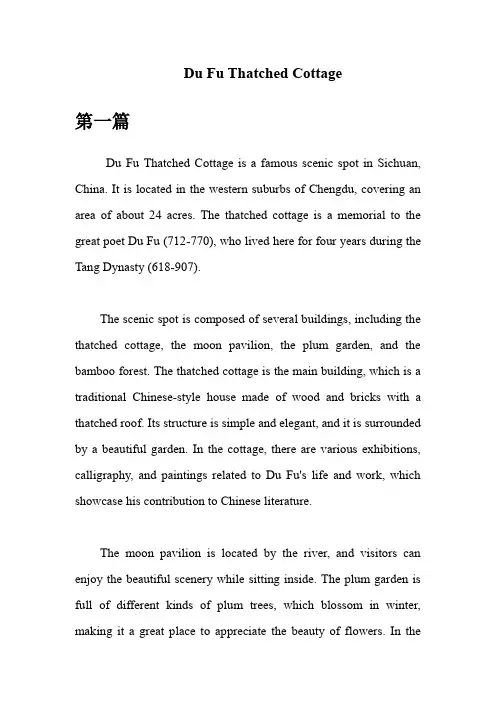
Du Fu Thatched Cottage第一篇Du Fu Thatched Cottage is a famous scenic spot in Sichuan, China. It is located in the western suburbs of Chengdu, covering an area of about 24 acres. The thatched cottage is a memorial to the great poet Du Fu (712-770), who lived here for four years during the Tang Dynasty (618-907).The scenic spot is composed of several buildings, including the thatched cottage, the moon pavilion, the plum garden, and the bamboo forest. The thatched cottage is the main building, which is a traditional Chinese-style house made of wood and bricks with a thatched roof. Its structure is simple and elegant, and it is surrounded by a beautiful garden. In the cottage, there are various exhibitions, calligraphy, and paintings related to Du Fu's life and work, which showcase his contribution to Chinese literature.The moon pavilion is located by the river, and visitors can enjoy the beautiful scenery while sitting inside. The plum garden is full of different kinds of plum trees, which blossom in winter, making it a great place to appreciate the beauty of flowers. In thebamboo forest, visitors can experience the tranquility of nature and enjoy the fresh air.Throughout the year, the scenic area holds various cultural activities and events, such as poetry readings, art exhibitions, and folk performances. It attracts many tourists and literary enthusiasts from all over the world who come to admire the beauty of the cottage and the legacy of the great poet.In summary, Du Fu Thatched Cottage is not only a tourist attraction but also a symbol of Chinese literature and culture. It is a must-visit place for anyone who is interested in Chinese history and literature.That's all for my introduction of Du Fu Thatched Cottage. If you have any questions about Du Fu Thatched Cottage, feel free to ask me. Thank you!第二篇Du Fu Thatched Cottage is a famous tourist attraction in Sichuan Province, China. It is located in the western suburbs ofChengdu, the capital city of Sichuan Province, and covers an area of about 24 hectares.Du Fu Thatched Cottage is a memorial museum for the famous Tang Dynasty poet Du Fu. Du Fu lived in the cottage for about four years during his exile from Chang'an, the capital of Tang Dynasty China. During this time, he wrote many great poems that have been widely praised for their literary and historical value.Today, Du Fu Thatched Cottage is a well-preserved complex of buildings that includes several halls, pavilions, and gardens. The main buildings are made of wood and bamboo, with thatched roofs and white plaster walls. The gardens are full of towering bamboo groves, beautiful lotus ponds, and a variety of flowering plants and trees.Visitors to Du Fu Thatched Cottage can explore the buildings and gardens, read Du Fu's poetry, and learn about his life and work through exhibitions and multimedia presentations. There are also traditional Chinese cultural activities available, such as calligraphy, painting, and tea ceremonies.Overall, Du Fu Thatched Cottage is a beautiful and peaceful place that offers a glimpse into the life and work of one of China's greatest poets. Whether you're a poetry enthusiast or simply looking for a relaxing and educational experience, a visit to this historic site is highly recommended.That's all for my introduction of Du Fu Thatched Cottage. If you have any questions about Du Fu Thatched Cottage, feel free to ask me. Thank you!。
四川旅游景点英文介绍之杜甫草堂(SichuanDuFuThatchedCottagetou..
四川旅游景点英文介绍之杜甫草堂(Sichuan Du Fu Thatched Cottage tourist attractions English introduction)Du Fu(712-770)草堂曾经是Du Fu以前的磨练,一个在唐代最伟大的诗人。
位于成都西郊,现场由流标,古代风格的建筑,亭塔,年龄老的树。
别墅由六个重要部分,他们是前门,大厅,诗歌史厅、水亭、工部祠、草堂。
在唐朝的时候,Du Fu的诗歌第一次被认可。
不同时期的读者都认为Du Fu是中国传统的最伟大的诗人。
这样的协议可以部分地通过他的作品的巨大的各种解释,这是非常不同的口味和时尚的历史变迁。
就像莎士比亚在英国的传统,Du Fu的诗歌是深深地与文学价值的宪法束缚了一代又一代诗人和评论家们重新发现了自己和他们的利益在某些方面的诗人从宋代中国评论家称Du Fu为“诗人的历史学家”。
之前,芦山起义后,Du Fu亲眼目睹了一个典型的政治和社会形势;百姓仍生活在贫困中,皇帝和他的高级官员很愚蠢的奢华生活。
他创作了许多诗如歌”的战车”、“三官”,和“三离开”。
他的诗歌表达了他的政府和他的百姓遗憾不满。
Du Fu用他的诗歌评论时事和历史图像。
Du Fu 创造了特定情况下的反应成为历史学家。
Du Fu很有天赋。
当他年轻的时候,他想在政府部门找个好工作。
不幸的是,Du Fu拒绝了好几次。
当他开始为长安的一个小官他五十多岁(西安)。
Gongbu是他在化学工业主管官方头衔,也许他是。
Du Fu并没有在政府的政治技能的幸存者。
他在转会到化州人事管理员后的形式驳回,所以离开长安。
杜甫很快就放弃了这个小职位厌恶又带着他的家人到钦州西北。
一个短暂停留后,他再次搬迁,759年他来到成都。
他建立了一个简朴的农舍和一些钱,他借他的朋友担任地方长官。
在小屋里,他已经有了三年的简单而平静的生活,写240porms。
大多是灵感的小屋,流在成都附近的风景。
这些诗给人的印象是,他更喜欢在成都比在其他任何时间,他的生活。
杜甫草堂的导游英文作文

杜甫草堂的导游英文作文"英文,"Visiting Du Fu Thatched Cottage was truly an enchanting experience. As I stepped into the serene surroundings, I couldn't help but feel a sense of awe at the historical significance of this place. The tour guide led us through the various sections of the cottage, narrating the life and works of the great poet Du Fu.Walking through the courtyard, I imagined Du Fu himself strolling here, finding inspiration for his timeless poems. The guide's vivid descriptions painted a picture of Du Fu's daily life, from his struggles to his moments of creativity. It was like stepping back in time and witnessing history firsthand.One of the highlights of the tour was the Bamboo Pavilion, where Du Fu is said to have spent many hours writing poetry. Sitting in the tranquil pavilion,surrounded by bamboo and the sound of flowing water, I could almost feel the poetic spirit lingering in the air.Another fascinating aspect was the exhibition hall, displaying artifacts and manuscripts related to Du Fu'slife and works. Seeing his calligraphy up close and reading excerpts from his poems gave me a deeper appreciation for his talent and legacy.Overall, the tour of Du Fu Thatched Cottage was notjust informative but also deeply inspiring. It made me realize the power of literature to transcend time and connect people across generations. It's an experience I'll cherish for years to come."中文,"游览杜甫草堂真是一次迷人的经历。
杜甫草堂英语导游词5篇

杜甫草堂英语导游词5篇成都杜甫草堂博物馆在宋元明清历代都有修葺扩建,已演变成一处集纪念祠堂格局和诗人旧居风貌为一体,建筑古朴典雅、园林清幽秀丽的著名文化圣地。
以下是关于杜甫草堂英语导游词5篇,欢迎阅读参考!杜甫草堂英语导游词(1)Du Fu Thatched CottageWell , ladies and gentlemen, next stop where we will visite is Du Fu Thatched Cottage. It was constructed in memory of Du Fu and it is located in the western suburbs of Chengdu. It used to be the former home of Du Fu. The present cottage consists of 6 parts : front gate ,lobby ,hall of historical poetry ,water pavilion ,Gongbu shrine and thatched pavilion .I don’t know if you know Du Fu or not. Maybe some of you know and some of you don’t. I think it is necessary to provide you with some background to help you better understand what the displays in the Cottage are.First of all, let me tell you who is Du Fu. Well he is Chinese Shakespeare who is wellknown as the poet-historian in Chinese history.. He was born in Gongxian county , Henan province in 712AD. He was also known as Du Zimei. He spent his great part of his boyhood in Luoyang city, the capital of Henan province. In 746AD, he went to Chang’an city,the capital of Tang dynasty in an attempt to obtain an official post. However ,he had only reached a minor post as he entered the age of 50. He lived at the turning point of the Tang dynasty when its prosperity began to decline. In 755AD, An Lushan Rebellion broke out which permanently weakened the dynasty. The rebellion lasted 7 years from 756AD to 763AD and forced the Tang Court into exile. DuFu fled the capital but was captured by the rebels. Du Fu escaped in 757AD and offered his service to the new emperor. In 759AD, he resigned and came to Chengdu. He stayed in Chengdu 3years and 9 months .At last he died on the way back to his hometown in 770AD.Du Fu witnessed a typical political and social situation ,the people living poverty but the emperor and his officials enjoying a foolishly luxurious life. Du Fu frequently used his poetry to expose social injustice and voice the suffering of the people. His poems include the “the song of war chariots, three officials , and three departures”. His poems expressed his dissatisfaction with the government and his great pity for the common people. Throughout his life,Du Fu was deeply concerned with politics, and many of his poems were on current events.Du Fu’s poetry came to be recognized even during the tang dynasty. Readers of many different periods have considered Du Fu as the greatest poet of Chinese tradition. In 759AD,he arrived in Chengdu where he set up a modest cottage. He had a simple and peaceful life here and wrote about 240 poems. Most of the poems were inspired by the cottage, stream nearby and the scenery in Chengdu. They sound like he had enjoyed his stay in Chengdu.Well ,ladies and gentlemen, the immense variety of Du Fu’s work holds up quite well todifferent tastes from readers both at home and abroad. Like Shakespeare in the English tradition,Du Fu ’s poetry became deeply bound up with the literary culture of China. The poets and critics in his following generations always rediscover their interests and values in some aspect of the poet’s work.Now we are arriving at Du Fu Thatched Cottage. It is really agreat place for you to visit. By the way ,it is also a great place for you to have a cup of tea in the outdoor tea house while you are enjoying the traditional show held in Chinese lunar calendar from January 1st to 7th every year and today.杜甫草堂英语导游词(2)Ladies and gentlemen, today Wang will take you to the place is the Du Fu Thatched Cottage, we now went to the cottage parking lot, you take care of your valuables, and I walked into the cottage.Now we can see into the yard, the door has a very thin bronze statue, we carefully approached a look, yes, this is a bronze statue of Du Fusu, we have seen the like is very thin, can be in the heart to think: Du Fu was too thin for adults like, even for their own sake of the country, so he is the spirit of everyone can learn.We continue walking in the hall, there are many different attitude: a bronze statue of Li Bai, Wang Changling and so on many of the poet's statue, we look at the hall of the middle of a big white stone head, did not feel very as before in the flying school art book "". We continue to go to the back of the hall, the two high Asherahs, here is a wooden, but there is a true to life pleasure in the columns above the look, like all things wild and intractable contempt for the world. From the hall after passing through a door, I saw the door above the plaque reads flower diameter of two characters, after one of the walls, top with blue and white porcelain pieces of the two word cottage. The statue you see now is a famous Du Fu, but unlike the last one, this is a half - body image and a goatee beard.Now the pool, which is full of Koi, different sizes, different color: golden red, white, and black.Now you can feel the atmosphere of literati's former residence. After half an hour, we gathered at the parking lot that we just got off. You should pay attention to safety and pay attention to time.杜甫草堂英语导游词(3)Dear visitors, the morning we went to Kuan Alley and Zhai Alley, it will take you to the small advantages brought a scenic spot - Du Fu Thatched Cottage, as the name implies, Du Fu Thatched Cottage is Du Fu once lived is now the cottage, the attraction is due to the previous cottage too broken too old, so the government funded the cottage again repaired. Du Fu Thatched Cottage has also become one of the tourist attractions that visitors come to Chengdu. So we're going to see it, too.Now we do the amount such as the cottage, the first thing we saw was a statue of Du Fu, a few can see Du Fu wearing a large cloak on his knees, hands on his knees, as if thinking what everyone said, Du Fu has a pair of well written poetry, who touched it for his aura, write good articles. So if a friend wants to write a composition or want to write a good article, you can touch it and hope to bring good luck to you.We continue to move forward, everyone is very curious why here is a very old house and, yes, that is Du Fu's house, there are nine rooms, Du Fu's life and life is very hard, the cottage was built in or under the auspices of a friend.杜甫草堂英语导游词(4)Hello, I am your tour guide Party tiger, hope you all happy to spend in the next few days. Welcome to Chengdu again! Chengdu is known as the land of abundance, today I first take you to visit the former residence of the literati -- Du Fu Thatched Cottage!Du Fu Thatched Cottage is located in the western suburbs of Chengdu City, Huanhua brook, in 1961 by the State Council as the first batch of key national cultural relics protection unit. The tour line of today's gates - shrine Hall - - - the temple gate Poetry - Industry hall and out the back door. The tour will take about 50 minutes or so. After an hour, we will gather at the back door.The tourists, after the door, a large shrine after we came to Du Fu Thatched Cottage Shi Tang poetry. You can see it. In the center of the hall, a bronze statue of Du Fu, made by Liu Kaiqu, a famous sculptor of our country, is placed in the center of the hall. Poetry hall is Du Fu Thatched Cottage center building. Here are all the poems of Du Fu on display here, you will be here by replying to the infinite charm of poetry. Du Fu's poetry is known as "with the poem card history, make up the history by the poem" argument, it is known as the "history of poetry", so named Tang poetry.Well, the tourists, read so many of Du Fu's poems, I think you will have a lot of feelings! Next, it is the time for tourists to visit freely, and you can quietly kiss and feel the style of Du Fu's big poets. 20 minutes later, we will gather at the back door, please remember the time, remind each other, if there is anything to help, please contact me in time, thank you.杜甫草堂英语导游词(5)Friends: welcome to visit Du Fu Thatched Cottage. I'm your guide, Xiao Li.The Du Fu Thatched Cottage in Chengdu, is China's Tang Dynasty poet Du Fu in Chengdu residence. In 1961, the State Council announced that it was the first national key cultural relic protection unit.Now we come to the cottage Front Gate, the front of thissection of the river is looking through the waves in the poems of Du Fu repeatedly mentioned huanhuaxi.When it comes to the origin of "the poetic name HUANHUAXI", there is a touching story. It was said that in the Tang Dynasty, a girl with a surname in the brook was beautiful and good. One day, she was washing the brook, came a monk was sore scabies, pedestrians are far away, but the girl not to avoid. So the monk took off with your bloody wash rack for her, the girl readily accepted. Which know your aircraft into the water, suddenly thrown Manxi lotus flowers, and the monk, but already disappear without a trace. People are very surprised, they named the river HUANHUAXI.In Front Gate, we see the garden of bamboo trees, green water carry, a natural beautiful scenery, which is reflected in Du Fu's Poetry: "the stream of water sodu, master Bu Lintang".The hall is the statue of Du Fu, the famous sculptor Mr. Qian Shaowu's masterpiece of China Central Academy of Fine Arts.It is worth a visit to visit Du Fu Thatched Cottage, where there are walls lined the streets, with the bamboo flower diameter, porcelain mosaic, quaint chic cottage wall, beautiful scenery and unique charm of the plum garden. The Wonderland into the eyes, have their own experience, I would not have introduced one by one.Thank you for your visit.。
用英语写成都的杜甫草堂的作文及中文
用英语写成都的杜甫草堂的作文及中文全文共3篇示例,供读者参考篇1Du Fu's Thatched Cottage in Chengdu is a famous historical site in China. It is located in the western suburbs of Chengdu City, Sichuan Province. The cottage was built to commemorate the great poet Du Fu of the Tang Dynasty. Du Fu lived there for four years and created more than 240 poems during his stay.The cottage covers an area of 3 hectares and is surrounded by a tranquil environment with ancient trees, bamboo groves, and flowing streams. The architecture of the cottage is simple and elegant, reflecting the style of the Tang Dynasty. Visitors can see the main hall, the thatched house, the "Poetic Lanes" where Du Fu's poems are engraved, and the beautiful gardens.Du Fu's Thatched Cottage also houses a museum that displays cultural relics and historical materials related to the poet's life and works. Visitors can learn about Du Fu's literary achievements, his experiences during his stay in Chengdu, and the historical background of the Tang Dynasty.In addition to its historical significance, Du Fu's Thatched Cottage is also a popular tourist destination for its natural beauty and cultural charms. Many people visit the cottage to pay homage to Du Fu, appreciate the poetry, and enjoy the tranquility of the surroundings.Overall, Du Fu's Thatched Cottage is a place of historical, cultural, and aesthetic value. It is a must-visit destination for anyone interested in Chinese literature and history. The cottage preserves the memory of Du Fu and his contributions to Chinese poetry, allowing visitors to experience the legacy of this great poet firsthand.成都杜甫草堂是中国著名的历史遗迹,位于四川省成都市西郊。
介绍杜甫草堂的英语作文
杜甫草堂:古诗之韵,文化之魂Nestled in the heart of Chengdu, Sichuan Province, China, stands a place that is not just a tourist attraction, but a symbol of Chinese literature and history - the Dufu Cottage. This cottage, named after the renowned TangDynasty poet Du Fu, is a testament to the rich cultural heritage of China.The cottage was initially built in the Tang Dynasty,and although it has undergone several renovations and reconstructions over the centuries, it still retains its original charm and authenticity. The layout of the cottage follows the traditional Chinese architectural style, with tiled roofs, wooden beams, and elegant pavilions. The gardens are a treat to the senses, filled with blooming flowers, lush greenery, and tranquil ponds.What makes the Dufu Cottage truly unique is its association with Du Fu, one of the greatest poets in Chinese history. Du Fu, known for his profound andemotional poetry, lived and wrote many of his works here. His poems, which reflect the social and political upheavalsof his time, are a valuable resource for historians and literature enthusiasts.Visitors to the Dufu Cottage are treated to a guided tour that takes them through the various sections of the cottage, explaining its historical significance andcultural value. They can also explore the extensive collection of Du Fu's works, displayed in beautiful calligraphy, and appreciate the beauty of his poetry.The cottage is not just a place to learn about Chinese literature and history; it is also a serene and peaceful escape from the hustle and bustle of modern life. Here, visitors can relax, reflect, and connect with their inner selves, much like Du Fu did when he resided here.The Dufu Cottage is not just a place; it is a symbol of Chinese culture and heritage. It is a must-visitdestination for anyone interested in Chinese literature, history, or culture. Here, one can experience the beauty of ancient Chinese poetry, appreciate the wisdom of the past, and understand the rich tapestry of Chinese civilization. **杜甫草堂:古诗之韵,文化之魂**位于中国四川省成都市心脏地带的杜甫草堂,不仅仅是一个旅游景点,更是中国文学和历史的象征。
杜甫草堂英文介绍
杜甫草堂英文介绍Du Fu Thatched Cottage is the former residence of the great poet Du Fu of the Tang Dynasty in China, and it is also an important cultural heritage in the history of Chinese literature. Located in Chengdu, Sichuan Province, China, it was founded in the Tang Dynasty and has undergone multiple repairs, with a history of over a thousand years to this day.The thatched cottage architecture is ancient and elegant, with beautiful garden scenery, and is a treasure of Chinese culture. Here, we can appreciate the charm of Du Fu's poetry and feel the vast and profound ancient Chinese culture.Entering the Du Fu Thatched Cottage, the first thing that catches your eye is the ancient and simple gate. The four large characters "Du Fu Thatched Cottage" hang on the forehead of the door, with strong and striking strokes. Passing through the gate, we arrived at a wide courtyard with a small bridge running water in the center, surrounded by various precious flowers and trees, providing a pleasant scenery.After passing the courtyard, it is Du Fu's former residence. This is a two-story building, simple and elegant, with a strong sense of history. There are many poems, cultural relics, and pictures of Du Fu displayed upstairs and downstairs, showcasing his life and creative process. Here, we can learn about Du Fu's poetic style and ideological connotations, and feel his poetic talent and personal charm.In addition to his former residence, Du Fu Thatched Cottage also has many other attractions. For example, there is a "Da Ya Tang" that displays the calligraphy treasures and cultural relics of literati from various dynasties, showcasing the breadth and depth of Chinese culture. There is also a "Wanjuanlou" that houses many ancient books and documents, making it an important place to study ancient Chinese culture.In addition, the garden scenery of Du Fu Thatched Cottage is also very beautiful. The park is shaded by green trees, with a fragrant fragrance of flowers, a small bridge flowing water, and winding paths leading to seclusion. Walking here, you can feel the beauty of nature and the richness of culture.In short, Du Fu Thatched Cottage is a tourist attraction worth visiting. Here, we can learn about the vast and profound ancient Chinese culture, as well as Du Fu's life and creative process. At the same time, you can also appreciate the beautiful garden scenery and appreciate the charm of Du Fu's poetry.杜甫草堂是中国唐代伟大诗人杜甫的故居,也是中国文学史上的重要文化遗产。
介绍杜甫草堂的英语作文
介绍杜甫草堂的英语作文Du Fu Thatched Cottage: A Poetic Sanctuary in ChengduNestled in the heart of Chengdu, Sichuan province, lies a tranquil haven that has stood as a testament to the life and works of one of China's most revered poets, Du Fu. The Du Fu Thatched Cottage, also known as Du Fu Cao Tang, is not merely a historical site but a living museum that breathes the essence of traditional Chinese culture and the profoundspirit of poetry.The cottage was constructed in the Tang Dynasty and is believed to have been the residence of Du Fu during his exile. It was here that the poet found solace and inspiration, penning some of his most famous verses that have resonated through the ages. The site has been meticulously preservedand restored over the centuries, offering visitors a glimpse into the life of the poet and the era he lived in.As you enter the grounds, a serene atmosphere envelops you, with lush bamboo groves and gently meandering paths that lead to the thatched cottage itself. The architecture issimple yet elegant, reflecting the modest lifestyle of Du Fu. The main building houses a collection of his poems, inscribed on wooden plaques that hang from the walls, inviting visitors to immerse themselves in the lyrical beauty of his words.Beyond the cottage, the gardens are a delight to thesenses, with a variety of plants and flowers that would have been familiar to Du Fu. The fragrance of the blossoms and the gentle rustle of leaves create a peaceful backdrop for contemplation. A small pond adds to the tranquility, its waters reflecting the sky and the surrounding greenery.The Du Fu Thatched Cottage also serves as a cultural center, hosting exhibitions, poetry readings, and educational programs that aim to keep the legacy of Du Fu alive. It is a place where scholars and poetry enthusiasts alike can come to appreciate the depth and breadth of his work.Visiting the Du Fu Thatched Cottage is more than just a trip to a historical site; it is a journey into the soul of Chinese poetry. It is a place where the past and present merge, allowing one to connect with the timeless emotions and observations that Du Fu captured so vividly in his poetry. Whether you are a literature lover or simply seeking a moment of peace in a bustling city, the Du Fu Thatched Cottageoffers a unique and enriching experience.。
用英语写成都的杜甫草堂的作文及中文
用英语写成都的杜甫草堂的作文及中文Du Fu Thatched Cottage in Chengdu is a historical site that showcases the life and works of one of China's most famous poets, Du Fu. Located in the western suburbs of Chengdu, the cottage is a tranquil oasis that attracts visitors from all over the world.Du Fu, who lived during the Tang Dynasty, is known for his poems that capture the hardships and joys of life. His thatched cottage in Chengdu is where he lived for four years during a period of political upheaval in China. Today, the cottage has been restored to its original state, allowing visitors to step back in time and experience the poet's world.The cottage is surrounded by a lush garden, a winding stream, and towering bamboo trees. Visitors can explore the various buildings on the property, including Du Fu's living quarters, his study, and a small museum dedicated to his life and work. The museum houses artifacts related to Du Fu, including manuscripts of his poems, calligraphy, and paintings.One of the highlights of a visit to Du Fu Thatched Cottage is the chance to read some of the poet's most famous works in the setting where they were written. Visitors can sit in the courtyardor by the stream, immerse themselves in Du Fu's poetry, and reflect on the beauty and complexity of life.In addition to exploring the cottage, visitors can also enjoy cultural activities such as calligraphy and painting classes, traditional tea ceremonies, and performances of traditional Sichuan opera. The cottage is a hub of cultural exchange, where visitors can learn about Chinese history and literature while soaking in the peaceful surroundings.Overall, a visit to Du Fu Thatched Cottage in Chengdu is a must for anyone interested in Chinese literature and history. The cottage provides a unique opportunity to connect with one of China's greatest poets and to experience the beauty and tranquility of his world.成都杜甫草堂是一处展示中国著名诗人杜甫生平和作品的历史遗址。