
【学无止境】高中英语(译林牛津版)必修二教案 Unit3 Reading (2-1) The curse of the mummy同步授课教案
模块二Unit3:Reading (2-1) The curse of the mummy同步授课教案M2 U3 Amazing PeopleReading (2-1) The curse of the mummyTeaching goal: To improve Ss’ reading skills as well as form an active attitude towards life Teaching objectives:By the end of this period, Ss will:Language:1.Describe their loved amazing people.2.Understand and master reading strategy-predicting information.3.Improve reading skills in analysis, generalization and implication.e words and expressions such as,curious,preserved, as well as, go out,coincidence…Skills & Strategies:5.Read article and gain Egyptian cultures in the process6.Gain deep comprehension of the article by doing different reading testing exercises7.Deal with the structure of the text using analysis.8.Grasp the way of prediction by comparing title with the first paragraphCulture and Morals9.Stimulate Ss’ culture awareness10.Arouse Ss’ desire for reading and curiosity about the character of amazing people.11.Learn from them and develop their nature and outlook in exploring the world.Keys & puzzles1.How to precisely master the new words through context2.How to lead Ss to strengthen their spirits in front of obstacles.Teaching approaches1.Task-based Teaching Approach (TBT)a, comparison teaching methodb ,Question-and-Answer Teaching method2. Situational Teaching Approach (ST)a ,Free-discussion Teaching methodTeaching aidsMulti-media and a blackboardTeaching Procedures:In generalThis section Reading deals with an amazing man who contributed most of his time to making discoveries in Egypt and strange things that happened after his finding the tomb of the king Tutankhamen. Therefore, the teacher is supposed to use pictures and film excerpt to arouse Ss’ curiosity about the cruse and the mummy. Then, to emphasize the importance of the reading strategy of this unit, and actually because that Ss are intended to become better and more active readers, it would be a good idea to make a copmparison: prediction from title and from the first paragraph. After that, Ss can draw a conclusion that which one is the fast and suitable way topredict in advance and it’s essential for them to have such a good reading habit in the further study. Only with this feature can we grasp general idea in the smallest amount of time. In terms of reading contents, Ss need to get prepared for the detailed reading. In the process of reading comprehension, Ss will do different types of reading testing exercises to know some facts, understand some information between the lines and infer some preliminary evaluation beyond the lines. Teacher should provide Ss with some related exercises to consolidate their understanding. Finally, a discussion about reasons whether Ss want to stick to their goals or not will be conducted to unearth article’s deep meaning.(图片和视频激趣――阅读策略的引入――阅读策略的总结――文章各段落细节信息的理解――文章结构的分析和练习总结――展开讨论――布置作业)In detail:Step 1 Lead—in (3 mins)Students are asked a question: What is a mummy?→Ss are able to guess the meaning by mummies’ pictures easily.Then give them another question: What is the curse? Do you know the curse’s definition?Play a film clip(Belphecor: Phanton of the Louvre《卢浮魅影》)Ss will know the cruse: Bring them death and make them die(on ppt)Death shall come on swift wings to him who disturbs the peace of the king.→谁扰乱这位法老的安宁,死神将展翅在他头上降临。
I am a defender of Tutankhamen’s tomb and it was driving me to use the fire of the desert to grave robbers→我是图坦卡蒙陵墓的保卫者,是我用沙漠之火驱赶那些盗墓贼More questions after watching video:Do you believe these words?Who are cursed in the film?Step 2 Brainstorming (5 mins)Tell Ss that today’s reading passage’s title is exactly the curse of the mummy. Please use their imagination to guess the article’s contents.T: Since you‘ve gotten so many related topics on the mummy. Do you want to identify your suspicion? Guide Ss to read the first paragraph and then make a comparison.the mummyComments: The first paragraph usually tells us what the reading passage will be about. So please pay special attention to it, for it just be like a light-tower to give you a guidance.Step 3 Reading comprehension (1 min)1. SkimmingAsk Ss to skim the passage as quickly as possible and complete the 3 questions in Part A on page 42.(This exercise is done easily because Q1 and Q2 both have been discussed before)2.Careful reading (20 mins)Para 1Q: What’s the function of this paragraph?A.Statements to support the bodyB.ConclusionC.Beginning Answer: CComments: In English articles, the first paragraph is usually the topic Paragraph, which plays an important role in the structure. It often show the readers some basic elements, such as “5W”(what,who,where,how…)Para 2 Howard Carter’s lifeWhat characters can you find from Carter?→bright/curious about…Did it have a positive effect on his discoveries?→YesRead between the lines: Line 4/Line7Original M: … was taught to draw by his father, who was an artist.implyBe good at drawing maps or recoding the findings using pencils.Original M: …at age of 17, he set sail for Alexandria, Egypt. implyBrave and adventurousV ocabulary: When I came to Egypt, I became curious about pyramids.I was curious to find out what the curse was.(Paraphrase: having a strong desire to know something)Preserved: V-ed .adj guess themeanings invo- Preserved books ved in contextYiyang is well-known for preserved eggs.(Paraphrase: something be kept in its original state.)Further question: Compared with the amazing persons we have talked in Welcome to the unit, who do you like best?Why?Para 3 DiscoveryQ 1: Please find out the topic sentence in this paragraph?→Line 16.He found the tomb of King Tutankhamen.Comments: (Knowledge about topic sentence)The topic sentence is usually the first sentence of the paragraph and contains the main idea of it. However, the topic sentence also will be the sentence in the middle or the last sentence. For instance, the first sentenc e→In 1922, Howard Carter made his most amazing discovery of all…→?What is the most amazing discovery? →Line 16.He found the tomb of King Tutankhamen.Q 2: What’s the result of his discovery?→rich and famousPara4-5 CurseMatch the following sentences with the correct time order and complete the missing part with attributive clauses.Bad Luck ( 4 ) George Gould, who…,had a high fever the following day and died.( 1 ) Carter’s lucky pet bird, w hich…,was eaten by a snake.( 5 ) Richard Bethell, who…, died of heart trouble.( 2 ) Lord Cararvon, who…, fell ill with a fever and died in Egypt and the lights went out in Cairo at the moment of his death.( 6 ) Arthur Mace, who…,also died shortly after the discovery.( 3 ) Back in England, Lord Carnarvon’s dog died at the same time.If time is permitted, the teacher can conduct a debate:Life Vs RichesWhich one do you think is more important for you?(Keys:①21 ②Explanations ③coincidence ④the mummy’s curse ⑤viruses are) Comments: Pay attention to plural, possessive case and passive voicePara 8 ConclusionWhat is the author’s opinion?→never been fully explainedStep 4 Consolidation ( 8 mins)The teacher assign Ex C1,D on page 44 to Ss.Analyze the structure of the textAccording to the diagram, let Ss make a summary of the text and retell the story.Step 5 Post-reading activities (8 mins)A situational design:Suppose that the tomb of Qinshihuang is being unearthed. You occasionally find a secret cave to the centre room of Qinshihuang.Thinking questions:Do you believe in life after death?Have you heard of the tales of this tomb?Are you afraid of the curse and mystery of it?What would you do to protect yourself if you want to explore it?Do you still want to continue your exploration if you need to risk your life?Further Discussion:What qualities should we have in order to succeed in the future?Ambition bravery patience perseverance…Step 6 Homework1.Read the passage aloud again after class and underline some important or difficultsentences. Look up these words in the dictionary.2.Write a short discourse based on the discussion on how to stick to your goal.FeedbackMineTo begin with, I’d like to say all pre-set aims have been very well achieved, and because that Ss were quite attracted by the topics (curse/mummy), therefore, they actively involved themselves into my each Task-based teaching procedure and understand article’s contents, structure and values step by step. The highlight of this class is Ss’ good participation and production during the discussion part. Not only were students from high level to low interested in it, but also this activity have Ss hold a belief that they will succeed in time as long as they hold on to the dream and work hard.Yours。
【牛津译林版】必修二:Unit3 Amazing people reading教案

Unit 3 Amazing peoplePeriod 2 Reading(2)一.【设计思想】通过各种形式的练习如单选填空等加深学生对新句法的理解二.【教学目标】1. 知识目标:学习课文中重点知识点的用法。
2. 能力目标:(1)能学会分析长难句;(2) 能灵活运用本课重点词汇三.【教学重难点】The usage of some important words and phrases.四.【教学环节】【课堂导入】请在课文中找出这些短语:1. be curious about 对……感到好奇2. at the age of 在……岁的时候3. set sail (for) 启航(去某地)4. search for 搜寻……5. along with 与……一起6. be known as 被称为……7. make a discovery of…. 发现了……8. come across 偶遇;无意中发现9. as well as 同样;也;以及 10. fall ill 病倒11. upon (one’s) doing…. 一……就12. be present (at) 出席,在场13. only to do…. 不料,竟然14. catch a high fever 发高烧15. die of heart trouble 死于心脏病16. shortly after 在……后不久17. have something to do with和……有关18. live on 继续活着;以……为食19. in connection with 与……有关联20. fresh air 新鲜空气21. result in…. 导致,引起22. remain a riddle 仍然是个谜23. pay off 成功,得到回报;还清【预习检查】Analyze some long and complicated sentences you have underlined.【课堂教与学】重点单词、词组或句子用法探究1.[原句回放]By the 1920s, he had become an explorer, searching for the tombs of the Egyptian kings.句中by the 1920s 意思是;请思考:句中谓语动词的时态能用其他时态替换吗?。
译林牛津版高中英语必修第二册-UNIT 3 Reading2教学课件

Appreciation
4. I was so caught up in the party fever that I hardly noticed five hours fly by! What does the “fever” mean here?
“Fever” here means “great interest or excitement about something”. The author was so absorbed and interested in the party that he failed to notice that five hours had passed.
Revision
Funeral rituals are an important part of a country’s traditions. They can vary quite a lot in different places around the world. At traditional Chinese funerals, people wear white, while in Western countries people usually wear black.
Appreciation
Use a group of words related to a topic to describe your experience at a festival. This year, I had the chance to attend the Beltane Fire Festival in Edinburgh. I have always had a burning desire to check out this festival, and I really loved it. Originally a small event, it is now one of the hottest tickets in town. It lit up my heart to see the amazing performances, which are based on ancient local traditions. The warmth of the local people was also great and I felt really welcomed. I hope I can go back one day!
牛津译林版高中英语必修二Unit 3《Amazing people》(reading)教案

Unit 3 Amazing peoplePeriod 2 Reading(2)一.【设计思想】通过各种形式的练习如单选填空等加深学生对新句法的理解二.【教学目标】1. 知识目标:学习课文中重点知识点的用法。
2. 能力目标:(1)能学会分析长难句;(2) 能灵活运用本课重点词汇三.【教学重难点】The usage of some important words and phrases.四.【教学环节】【课堂导入】请在课文中找出这些短语:1. be curious about 对……感到好奇2. at the age of 在……岁的时候3. set sail (for) 启航(去某地)4. search for 搜寻……5. along with 与……一起6. be known as 被称为……7. make a discovery of…. 发现了……8. come across 偶遇;无意中发现9. as well as 同样;也;以及 10. fall ill 病倒11. upon (one’s) doing…. 一……就12. be present (at) 出席,在场13. only to do…. 不料,竟然14. catch a high fever 发高烧15. die of heart trouble 死于心脏病16. shortly after 在……后不久17. have something to do with和……有关18. live on 继续活着;以……为食19. in connection with 与……有关联20. fresh air 新鲜空气21. result in…. 导致,引起22. remain a riddle 仍然是个谜23. pay off 成功,得到回报;还清【预习检查】Analyze some long and complicated sentences you have underlined.【课堂教与学】重点单词、词组或句子用法探究1.[原句回放]By the 1920s, he had become an explorer, searching for the tombs of the Egyptian kings. 句中by the 1920s 意思是;请思考:句中谓语动词的时态能用其他时态替换吗?。
译林牛津版必修二Unit3 Reading教学课件(共20张PPT)
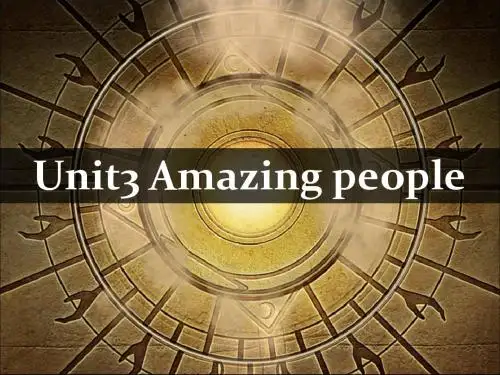
Part 4 (Para. 6-8) Explanations of the deaths
Some people say: coincidence Others believe that: the mummy’s curse Still others believe : a scientific explanation
-- viruses Conclusion:
It remains a _r_i_d_d_l_e__ to this day.
The mobile laser scanner
bright
brave/ courageous
persistent optimistic
creative
curious
learned
Part 2 (para. 3) The most amazing discovery
Did Carter keep all the contents?
If you were Carter, what would you do with the contents?
An amazing person needs to be ____d_e_vo__te_d_____.
amazicnucgruidorisseictoyveries
DISCOVERY
The World is Just Awesome! The amazement of our world lies in those Mg people
Prediction
The curse of the mummy
Para. 1
“ famous explorer , explore, discovered many amazing things ”
【学无止境】高中英语(译林牛津版)必修二教案 Unit3 Project同步授课教案
高一上模块二Unit3:Project同步授课教案Module 2Unit 3 Amazing people—ProjectTeaching goal:1. Understand the related vocabulary correctly while reading.(orbit, astronaut, northeastern, army, fighter, pilot, project, candidate, survival, rocket, commander etc)2. Develop the ability of understanding biographies and some details;3. Write an easy biographyTeaching objectives:By the end of this period, Ss will:Language1. Understand the passage correctly and master some key vocabulary; Skills & strategies2. Know the structure of a biography and how to write one;Culture & morals3. Encourage Ss to learn from Yang Liwei and set their own goals andwork hard to realize their dreamsKeys & puzzles1.How to get and deal with some in formation about Yang Liwei through adopting different reading skills;2.How u nderstand Yang Liwei’s story more deeply and learn to think the story and express in English;Teaching approaches1. Free-talk method to get the students to be interested in the topic and use their imagination freely;2. Task-based method to get the Ss to understand the main idea of the passage;3.Inductive method to make students master the structure of a biography;4.Exercise method to consolidate what have been learnt in classIn detailStep 1 Lead-in (2 minutes)Draw Ss’ attention to the topic of the text--- Yang Liwei by asking a series of questions:1.Have you ever read any books about some great explorers?2.What kind of person can be called “explorer”?3. Who is the typical example in your mind? Why?Step 2 Fast reading (8 minutes)1.Show a picture of Yang Liwei to the students and a short video of his life and career2. Ask Ss to read the text quickly and try to find the answers to two questions:1. How long did Yang Liwei’s journey last?2. What should be learned in ordered to be an astronaut?Step 3 While reading (20 minutes)Ask Ss to find the missing information in a CV of Yang Liwei to be more familiar with the text as well as to review what have been learned in the early task.1. Try to finish a CV of Yang Liwei.Name: Yang Liwei Sex: MaleBorn: ____________ Nationality: ____________ Education: 1998—2003 Trained to be an ____________1983—1984 ____________ from the No.8 Aviation College Work experience:2003 Became China’s first astronaut1998 Became a ____________ of Project 9211983 Joined the ____________Interests: Loves science and technology2. Interview practiceAsk Ss to practice an interview between Yang Liwei and a reporter according to some requirements, and take notes while interviewing.What is your job now, a pilot or an astronaut?When were you sent into space?Were you afraid before the sending up?Where and when were you born?What were you interested when you were young?Is it easy to be an astronaut?…3. A mini discussionAsk the students have a discussion about the following topic. This will encourage Ss to work hard to realize their dreams.What spirit can we find in Yang Liwei?Which of Yang’s personalities attracts you most? Why?Step 4 Post Reading (10 minutes)1. Ask Ss to read the whole passage again and pay special attention to the structure of this biography through finding the missing information of the main idea of each paragraph.Part One: The most important achievement of the main character.Part Two: The main character’s hard struggle to success. Usually it is written in time order.Part Three: A thought-provoking conclusion: Yang is really worth our respect.2. Ask Ss to write a very short summary about Yang Li w ei in pairs according to the structure. (One student writes the introduction in 3 sentences and the conclusion in 2 sentences, while the other student writes the body in 5 sentences. )3. Share two works of Ss.Step 5 Extensive reading, interviewing and writing(5 minutes)Hand out each S a copy of Helen Keller’s biography and one of Jay Zhou and ask Ss to select one in pairs.First, skim the chosen passage and get some necessary information individually;Then, interview the partner for the information of another biography and take notes through interviewing.Step 6 Homework1. Revise what we have learnt in this part.2. Try to finish the writing of Helen Keller and Jay Zhou.FeedbackMineIn this period, T plays the role as a director and uses some encouraging ways to light the learning desire of Ss. Students’ interests were lit through individual reading, group discussion and interviewing etc. It also follows the 3 principles below:First, the teaching content, teaching approaches and teaching activities can be flexible and open. So T simplified the teaching material according to the students’level , and changed a free interview into a biography. However, Ss can still practice the skills interviewing, notes-taking and the lower level of biography writing.\ Second, the teaching objectives are designed according to the task-based teaching approaches. And all the tasks are connected very smoothly and naturally. For Ss, they meet different challenges as the tasks change in order to develop their integrated skills.Third, T pays much attention to the efficient output of language based on the efficient input of language material. It always sticks to the procedure: Read—speak---Write.。
【学无止境】高中英语(译林牛津版)必修二教案 Unit3 词汇、语法讲学稿

模块二Unit3:词汇、语法讲学稿Unit6 Amazing people1.of all time 自古以来,有史以来鲁迅是自古以来最著名的作家之一。
2.the world “世界上的人,人类”作主语,谓语用单数。
全世界的人都在关注着这次奥运会。
watching the Olympic Games.3.ever adv.①曾经,以前(用于疑问句,if从句)②无论什么时候都不(否定句)③到底,究竟(特殊疑问句)④永远(肯定句)Have you ever heard of such a thing?None of us will ever forget this unusual day.What ever do you want ?If you ever have any problems, let me know.You will find me ever ready to help you.ever/ onceHave you ever been to London? This is the most interesting film that I have ever seen. When ever did you lose it? The town isn’t as big as it was once.4.adventurous adj.①(人)有冒险精神的②(事)充满危险的,惊险的那是一次惊险的旅行。
That is journey.她的生活方式充满刺激。
She lives in lifestyle.她不够胆大。
She isn’t enough.5.bright adj. 光明的,明亮的,鲜艳的,聪明的,快乐而生气勃勃的The leaves on the trees are bright green in spring.Don’t be so bad about your future. You should see the bright side of things.The doctor has a bright future before him.His teacher didn’t think Edision bright.She gave me a bright smile.The sun is brighter than the moon.bright/ wise/ clever6.curious adj.①好奇的,求知欲强的be curious about sth , be curious to do, be curious that 小孩子会自然地对周围每一件事感到好奇。
英语必修2译林牛津版Unit 3reading
Module Two Unit Three Amazing PeopleReading The curse of the mummy Teaching contents:Reading——The curse of the mummyTeaching Objectives:Knowledge and skills:1. Develop Ss’ ability of predicting information.2. Train students' reading ability.3. Help the students have a better understanding of the text.Process and methods:1.Questions-and-answer activity to check students’ understanding of the text.2.Individual, pair or group work to make every student work in class.3.Skimming, scanning, listening and careful reading.4.Discussion to help students understand better what they have learned. Emotion, attitude and values:1.Develop the students’ desire for exploring, the qualities of courage, cooperation, confidence and so on.2.Provide chances for students to increase their knowledge of history. Teaching Important Points:1. Improve the students’ reading ability.2. Enable the students understand the text better.3. Develop the students’ creative, comprehensive and consolidating abilities. Teaching Difficult Points:1. How to make the students understand the passage better.2. How to help the students develop their reading comprehension abilities. Teaching Aids:The multimedia, the blackboardTeaching procedures:Step 1 Lead-in1. What do you think of when you talk about Egypt?Picture showing: (the River Nile, Pyramids and Sphinx)2. Have you ever read or thought about what is inside the pyramids?Picture showing: (treasures and mummies)3. Explanation of curse.Today we’ll come to the reading part: the curse of the mummy.How do you understand the title?What does the ‘curse’ mean?(Curse: words believed to have magical powers that can harm people)Step 2 Reading strategy1.Skills learningAsk students to go through the reading strategy.How can we predict information in an article?1) the title (too general)2) the first paragraph (more specific)(It usually tells us what the passage will be about. We should look for the key words when we read it. These may help us prepare for and predict what will come next.)2.PracticePredicting information of the text.1) by reading the titleWhat might be the connections between ‘The curse of the mummy’ and the famous explorer?Why does the writer choose ‘The curse of the mummy’ as the title?From your point of view, what might be talked about in the article?2) by reading the first paragraphWhat’s the first paragraph about?(An introduction to Howard Carter.)Can you predict what the following paragraphs will tell us?A. Carter’s hobbiesB. Carter made some unexpected discoveriesC. Carter’s familyD. Carter’s school lifeStep 3 Reading Comprehension1.Fast reading1) Scan the article and the answer the questions.What amazing discovery did Howard Cater make?(He found the tomb of King Tutankhamun.)Wha t happened to some of Carter’s team members after the tomb was opened? (They fell ill and died.)2)Skim the article and finish part C2.a.There is a scientific reason why people died after entering the tomb.b.Howard Carter did not go to school and later became an explorer.c.Lord Carnarvon died after visiting the tomb.d.Howard Carter discovered the tomb of King Tutankhamun.e.Howard Carter is a world-famous explorer.f.The ‘curse of the mummy’ remains a mystery.g.More people died after Carter’s discovery.h.People keep wondering why so many people died and have suggested allkinds of explanation.Paragraph 1 e Paragraph 2 bParagraph 3 d Paragraph 4 cParagraph 5 g Paragraph 6 hParagraph 7 a Paragraph 8 f2.Carful reading1)Divide the passage into four parts.Part 1 (para 1) A short introduction to Howard Carter.Part 2 (para 2-3) More information about Carter.Part 3 (para 4-5) Some people died after the tomb was opened.Part 4 (para 6-8) Different explanations, but no conclusion.2)Read 1-3 paragraph carefully and find out more information about HowardCarter.Education: learnt to draw from his fatherInterest: loved to visit and explore new placesWent to Egypt: in 1891, at the age of 17Job: explorer (by the 1920s)Discoveries: many amazing thingsGreatest discovery: King Tutankhamun’s tombWhere and when: in the Valley of the Kings, in Egypt, in 19223) ListeningListen to 4-5 paragraph and finish the following chart:4) Read 6-8 paragraph carefully and find out:What are the different explanations of the deaths?Some people say: coincidenceOthers believe that : in connection with a mummy’s curseHowever, still others believe: a scientific explanation----virusesStep 4 ConsolidationFill in the blanks according to the article.Howard Carter is one of the most famous explorers the world has ever known. Hewas bright and curious about the world outside his hometown when he was very young. By the 1920s, he had become an explorer, searching for the tombs of the Egyptian kings. In 1922, Howard Carter made his most amazing discovery of all, in the Valley of the Kings, in Egypt, where he came across the tomb of King Tutankhamun.However, not lo ng after the tomb had been opened, people in Carter’s team began to fall ill and die. Within seven years, 21 people who had something to do with the opening of the tomb died. Some people say the deaths were just coincidence. Others believe that they were in connection with a mummy’s curse. However, still others believe that there is a scientific explanation, because inside the tombs there are many viruses.Step 5 DiscussionAsk students to work in pairs and have a discussion:1. What kind of personality should an explorer like Carter has to have?2. As for students, what kinds of personalities should we have?Step 6 Assignments:1. Finish part E on page 45.2. Read part A on Page 106 in Workbook.3. Write a summary about Howard Carter.。
【学无止境】高中英语(译林牛津版)必修二教案 Unit3 语法竟教教案
● Grammar and UsageHere we will learn to recognize situations where the past perfect tense is used and the time expressions used together with the tense. We will also see how the tense is formed. You will read two stories and complete them using the correct verb forms. Pay attention to the differences between the past perfect tense and the simple past tense.Step 1: Past perfect tensePast perfect tense is used to indicate that one action occurred before another action in the past. In other words, past perfect tense indicates the first of the two actions.Form of Past Perfect[had] + [past participle]Examples:I had studied a little English when I came to the U.S.They had never met an American until they met John.Note : When you are using a verb tense with more than one part such as Past Perfect (had met), adverbs often come between the first part and the second part (had never met).USE 1Completed Action Before Something in Past The Past Perfect expresses the idea that something occurred before another action in the past. It can also show that something happened before a specific time in the past.Examples:I had never seen such a beautiful beach before I went to Kauai.Had you ever visited the U.S. before your trip in 1992?Yes, I had been to the U.S. once before in 1988.USE 2Duration Before Something in the Past(Non-continuous Verbs) With Non-progressive Verbs and some non-progressive uses of Mixed Verbs, we use the Past Perfect to show that something started in the past and continued up until another action in the past. Examples:We had had that car for ten years before it broke down.By the time Alex finished his studies, he had been in London for over eight years.IMPORTANT Specific Times with the Past PerfectUnlike the Present Perfect, it is possible to use specific time words or phrases with the Past Perfect. Although this is possible, it is usually not necessary.EXAMPLE:She had visited her Japanese relatives once in 1993 before she moved in with them in 1996.If the Past Perfect action did occur at a specific time, the Simple Past can be used instead of the Past Perfect when before or after is used in the sentence. The words before and after actually tell you what happens first so the Past Perfect is optional. Both sentences below are correct. EXAMPLE:She had visited her Japanese relatives once in 1993 before she moved in with them in 1996.She visited her Japanese relatives once in 1993 before she moved in with them in 1996. HOWEVERIf the Past Perfect action did not happen at a specific time, Past Perfect MUST be used at all times. Compare the two sentences below.EXAMPLE:She had never seen a bear before she moved to Alaska. CorrectShe never saw a bear before she moved to Alaska. Not CorrectACTIVE / PASSIVE FORMS of Past PerfectEXAMPLESGeorge had repaired many cars before he received his mechanics license. ACTIVEMany cars had been repaired by George before he received his mechanics license. PASSIVEStep 2: Practice1. Read Point 1 on page 48 to see which action happens first in the sentence given. Note that the past perfect tense is often used with the simple past tense. If one action happens before another in the past, the past perfect tense is used. So these two tenses are often used together.Look at the diagram in Point 1 first, and then read the example sentence. Note how the past perfect tense is used with the simple past tense.2. Read the following two sentences to see how the predicate is changed when the sentence is turned from the direct speech into the indirect speech.Toby said, “I will/shall not be in London next week.”Toby said that he would not be in London the next week.Next let’s look at another two sentences:Toby said, “I went to Africa a month ago.”Toby said that he had gone to Africa a month before.So you see if a sentence which uses the simple past tense in the direct speech is changed into the indirect speech, it will use the past perfect tense. Now go over Point 2 on page 48.3. Go over Point 3 to see in what situation the past perfect tense can be used.4. Please talk about what time expressions can be used with the past perfect tense and how the tense is formed. Then we’ll go over Points 4 and 5 on page 48.Step 3:Present perfect or past perfect?We’ve learned both the present perfect tense and the past perfect tense, but do you know when to use the present perfect and when the past perfect.1. Please go over the guidelines and the example sentences on page 51 and identify the differences between the present perfect tense and the past perfect tense.Look at the examples:Howard Carter is one of the most famous explorers the world has ever known.Not long after the tomb had been opened, people in Carter’s team began t o fall ill and die strangely.Now from the following diagrams you can see the different times of each example sentence given.Howard Carter became famousFuturePresentPastThe tomb had People began to fallbeen opened. ill and die strangely.2. Please read the following two sentences and identify the differences between them:Toby said, “I have stayed in Africa for more than a month.”Toby said that he had stayed in Africa for more than a month.Note that when we change a sentence from the direct speech into the indirect speech like this, the tense will be changed from the present perfect tense to the past perfect tense.Step 4: Consolidation1. Go over the notes about Amelia Earhart on Page 49 to see who she was and what happened to(1)I asked him to let me drive as he ___________ for hours. (drive)(2) Since you ________ the rules, you can correct these grammatical mistakes by yourselves.(learn)(3) They _______ because their schoolbags are still in their desk. (not leave)(4) Mr Bell,, who I ___________ to London, still lives in Liverpool. (think, move)(5) When the noise _______ down, the schoolmaster began his speech. (die)(6) It _________ cold this year, I wonder when it is going to get warmer. (be)(7) I _________ cakes. That’s why my hand s are all covered with flour. (make)(8) When I got back, they _______ down most of the houses in the street. (pull)(9) It was not until I _________ your letter that I knew the truth. (read)(10)The lady has been to the shop several times, but she ___________ anything. (buy, never)Step 5: Grammar execisesI. Relative items in recent years’ college entrance examinations:1.All morning as she waited for the medical report from the doctor, her nervousness______.A. has grownB. is growingC. grewD. had grown2.The news came as no surprise to me. I _______ for some time that the factory was going toshut down.(A. had knownB. knewC. have knownD. know3.I thought Jim would say something about his school report, but he _______ it.A. doesn’t mentionB. hadn’t mentionedC. didn’t mentionD. hasn’t mentioned4.I arrived late; I ______ the road to be so icy.A. wouldn’t expectB. haven’t expectedC. hadn’t expectedD. wasn’t expecting5.My mind wasn’t on what he was saying so I’m afraid I ______ half of it.A. was missingB. had missedC. will missD. missed6.The crazy fans _______ patiently for two hours, and they would wait till the movie stararrived.A. were waitingB. had been waitingC. had waitedD. would wait7.He kept looking at her, wondering whether he ______ her somewhere.A. sawB. has seenC. seesD. had seen8.---George and Lucy got married last week. Did you go to their wedding?---No. I _______. Did they have a big wedding?A. was not invitedB. have not been invitedC. ha dn’t been invitedD. didn’t invite9. I ______ Bill this morning, but I ______ him since.A. have seen; haven’t seenB. saw; haven’t seenB. saw; didn’t see D. had seen; haven’t seen10. ---Dad, do you know I had long been looking forward to your staying with me for the lastweekend?---Sorry, son. I ______, but I was just too busy.A. had really wanted toB. have planned toC. have intended toD. had hoped me to11. He _________ more that 5,000 English words when he entered the university at the age of 15.A. has learnedB. would have learnedC. learnedD. had learned12. When the old man ______ to walk back to his house ,the sun _____ itself behind themountain.A.started ;had already hidden B.had started ;had already hiddenC.had started ;was hiding D.was starting; hid13. The young girl sitting next to me on the plane was very nervous. She before.A. hasn't flownB. didn't flyC. hadn't flownD. wasn't flying14. I was giving a talk to a large group of people, the same talk I_______ to a dozen other groups.A. was givingB. am givingC. had givenD. have given15. John, a friend of mine, who got married only last week, spent $3,000 more than he _______ for the wedding.A. will planB. has plannedC. would planD. had plannedII. Filling the blanks with proper tense.(Simple Past / Present Perfect / Past Perfect)1. When I (arrive) ______home last night, I discovered that Jane (prepare) ______a beautiful candle-lit dinner.2. Since I began acting, I (perform) ______in two plays, a television commercial and a TV drama. However, I (speak, never even) _______publicly before I came to Hollywood in 1985.3. By the time I got to the office, the meeting (begin, already) ______without me. My boss (be) _____furious with me and I (be) ______fired.4. When I (turn) _____the radio on yesterday, I (hear) ______a song that was popular when I was in high school. I (hear, not) ______the song in years, and it (bring) _____back some great memories.5. When Jack (enter) ______the room, I (recognize, not) ______him because he (lose) ______so much weight He looked totally different!6. The Maya established a very advanced civilization in the jungles of the Yucatan; however, their culture (disappear, virtually) _____by the time Europeans first (arrive) ______in the New World.7. I (visit) ______so many beautiful places since I (come) ______to Utah. Before moving here, I。
牛津译林版必修二Unit3Reading第一课时课件
Arthur Mot mentioned
Part 3: Para 6-8
Different explanations: ➢The deaths were just coincidenc. e ➢It was a punishment from the curse of a
Carter's
secretary
He visited the had a high
tomb.
fever
He was p resent fell ill
when the tomb with a fever
was opened.
He entered
the tomb.
died of
heart trouble
Different explanations about the deaths.
Careful Reading
Part 1: Para 1-3
Brief introduction:
Identity: a famous explorer Education: didn't go to school and learnt to
P6: People keep wondering why so many people died
and have suggested all kinds of explanations.
III P7: There’s a scientific reason why people died after
draw from his father Interest: loved to visit and explore new places Year he went to Egypt: 1891 Most amazing discovery: King Tutankhamun’s tomb Time and place of the discovery: 1922, in the
牛津译林版必修二二Unit 3 reading 课件(共26张PPT)
牛津译林版必修二二Unit 3 reading 课件(共26张PPT)
OfficePLUS
Read 背景图片素材 the first paragraph together!
Who is Howard Carter? He is one of the most famous explorers the world has ever known.
Education
He didn’t go to school but learnt to d__r_a_w___ from h__is__f_a_t_h_e_r__.
Experience
a. In 1891, he set sail for _A_l_e_x_a__n_d_r_i_a___. b. By the 1920s, he had become an _e_x__p_l_o_r_e_r____, searching for the
Para.7 - aP.aTrht eIrIeI:isDaisfcfieernetnifticerxepasloanna..t.itoonmsb.
Para.8 - f. The ‘curse of the mummy’ remains a mystery.
牛津译林版必修二二Unit 3 reading 课件(共26张PPT)
牛津译林版必修二二Unit 3 reading 课件(共26张PPT)
牛津译林版必修二二Unit 3 reading 课件(共26张PPT)
OfficePLUS
背景图片素R材ead the whole article carefully and finish the exercise. (P.44 C2)
OfficePLUS