
六年级上册英语讲义-unit1 Growing up习题精讲 知识拓展 巩固提高(有答案) 沪教牛津版
Unit 1 Growing up1.通过对本节的学习,学生掌握如何描述某人过去时的体貌特征。
2.学习谓语动词的一般过去时的常见变型。
3.通过对本节课的学习,加强学生在描述外貌特征上的口语表达。
1.新单词、字母拼读、一般过去时。
n. 月份1. month英[mʌnθ]美[mʌnθ]【例句】I was about six months old.【互动】【象形记忆法】adj. 可爱的2.cute 英[kju:t] 美[kjut]【例句】You were a cute baby.【互动】【象形记忆法】adj. 漂亮的3.pretty 英[ˈprɪti] 美[ˈprɪti]【例句】kate is a pretty girl.【互动】 【象形记忆法】英[ˈhænsə4.handsome【互动】【象形记忆法】[ˈtɜ:rtl] n. 乌龟【例句】There are many turtles in the pool.英[kæt ʃ] 美[kæt 6.catch【例句】I can catch flies.【互动】 【象形记忆法】一、读一读,选出相应的单词。
( )1.苍蝇 A.butterfly B. fly C. frog ( )2.可爱的 A. cute B. handsome C.pretty ( )3.月份 A. mouth B.month C.pretty ( ) 4.乌龟 A.turtle B. fish C. bird二、单项选择。
1. ---Mum,_______are you? ---I am in the kitchen.A. whereB.whatC.when 2. Frogs can _____flies.A. catchesB.catchingC.catch3. ---Are you Kitty?---______,I am Lucy.A. No,I am notB. Yes,I amC.No,you are not.英[fla ɪ]美[flai]n.苍蝇7.fly【例句】Some flies are flying.【互动】 【象形记忆法】4.---Where was you born?---_______.A.In ShanghaiB.On October 2ndC.I like it5.---What colour is a frogs?---______.A.It is greenB. It is redC. It is black6.Cindy will meet Peter______.A.At homeB. at the schoolC. at the airport7.What time will Cindy meet Peter?A.At eleven o’clockB. At twelve o clockC. At one o clock\三、连词成句。
1.Three the months is old baby.2. tall Alice and is pretty.__________________________________________________________________ 3.primary was she school a student.__________________________________________________________________ 3.is Mary’s long hair.__________________________________________________________________一、BABA二.BCAAABA三.1.The baby is three months old.2.Alice is tall and pretty.3.She is a primary school student.4.Mary’s hair is long.A:In photo1, Sallywas a baby. She was about two months old.She was samll and cute. B: In photo 2, Sally was one year old. Her hair was short and her eyes were big.【重点解析】1.Her hair was short and her eyes were big.句型:主语+was/ were +表示体貌特征的形容词。
2.---How was your summer holiday?---It was wonderful.句型:---How was +sb’s +假期?--- It was +形容词。
3.---What did you have for breakfast this morning?---I had some bread and milk.句型:---What did+sb. +have+for breakfast/lunch/supper+时间?---sb.+had +食物。
一、翻译句子。
1.Her hair was short and her eyes were big._____________________________________________________________________ 2.她大概两个月大。
_____________________________________________________________________ 3.她上初中。
_____________________________________________________________________4.她又高又漂亮。
1、她的头发很短眼睛很大。
2、She was about two months old3、Her to go to junior high schoo4、She is tall and pretty一般过去时一、定义表示过去某一时候或某一段时间所发生了的事情或存在的状态。
二、标志词常与yesterday, this morning, just now, a moment ago, in May, last night / year / week, once upon a time, the other day, before …, when – clause, in the past 连用。
三、句型肯定句结构为:主语+动词的过去式+其它。
如:He went to the toy store yesterday. 他昨天去玩具店了.I watched cartoons.She visited the zoo.否定句结构为:主语+did not (didn’t)+动词原形+其它。
如:He didn’t go to the toy store yesterday. 他昨天没去玩具店。
They didn’t go the park yesterday.He didn’t make model ships last week.一般疑问句的构成:Did+主语+动词原形+其它?如:-Did you go to Beijing last week?-Yes, we did. (No, we didn’t.)特殊疑问句的构成:特殊疑问词+did+主语+动词原形+其它?如:-What did you do last night?-I did my homework.四、动词过去式的变化规则变化:(1)一般在动词后加-ed。
如:play—played, offer—offered, weigh—weighed, sign—signed.(2)在以字母e 结尾的动词后,只加-d。
如:like—liked, hate — hated,(3)以重读闭音节(即:辅音+元音+辅音)结尾且末尾只有一个元音字母和一个辅音字母的动词,双写末尾的辅音字母,再加-ed,如:stop-stopped(4)以“辅音字母+y”结尾的,变y 为i,再加-ed,如:study-studied不规则变化:am,is-was, are-were, do-did, see-saw, say-said, give-gave, get-got, go-went, come-came, have-had, eat-ate, take-took, run-ran, sing-sang, put-put, make-made, read-read, write-wrote, draw-drew, drink-drank, fly-flew, ride-rode, speak-spoke, sweep-swept, swim-swam, sit-sat即时即练:写出下列动词的现在分词形式work___________ sing__________ play__________ study__________dance__________ have__________ write__________ take__________run__________ sit__________ shop__________ swim__________Worked sang played studiedDanced had wrote tookRan sit shopped swam词汇month, cute, pretty, handsome, turtle, catch, fly, grow up, junior high schoolbreak out,record,symbol,victory,spirit,die of,German,thoug ht,admire,courage,in fear of one’s life对话1.Her hair was short and her eyes were big.2.She was a primary school student.33 3.She goes to junior high school.M 4.She is tall and pretty.5.Little Justin was born in the river.6.He has a round head and a long hair.7. 7.Kitty was a cute baby.8.She was about six months old.听说1.How was your summer holiday?2.What did you have for breakfast this morning?故事Little Justin一.补全单词并写出中文意思。
六年级英语上册Unit 1 Growing up 练习 沪教牛津版(深圳用)
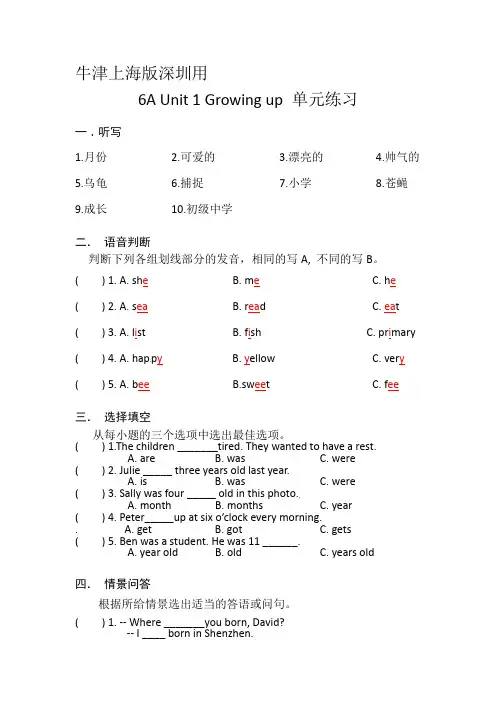
牛津上海版深圳用6A Unit 1 Growing up 单元练习一.听写1.月份2.可爱的3.漂亮的4.帅气的5.乌龟6.捕捉7.小学8.苍蝇9.成长10.初级中学二.语音判断判断下列各组划线部分的发音,相同的写A, 不同的写B。
( ) 1. A. sh e B. m e C. h e( ) 2. A. s ea B. r ea d C. ea t ( ) 3. A. l i st B. f i sh C. pr i mary ( ) 4. A. happ y B. y ellow C. ver y ( ) 5. A. b ee B.sw ee t C. f ee三.选择填空从每小题的三个选项中选出最佳选项。
( ) 1.The children _______tired. They wanted to have a rest.A. areB. wasC. were( ) 2. Julie _____ three years old last year.A. isB. wasC. were( ) 3. Sally was four _____ old in this photo.A. monthB. monthsC. year( ) 4. Peter_____up at six o’clock every morning.. A. get B. got C. gets( ) 5. Ben was a student. He was 11 ______.A. year oldB. oldC. years old四.情景问答根据所给情景选出适当的答语或问句。
( ) 1. -- Where _______you born, David?-- I ____ born in Shenzhen.A.are,amB. were,wasC. were,were ( ) 2. -- _______is Ben?-- He is twelve.A.WhatB. WhyC. How old ( ) 3. -- What are they?-- They are .A.workerB. pencilC. workers ( ) 4. -- What does Justin __________?--He is small and black.A.looks likeB. likeC. look like( ) 5. --does your father go to work every day?-- By busA.WhenB. WhereC. How五.阅读理解i. 判断句子是否符合短文内容,相符的写A, 不相符的写B。
Unit 1 Growing up-六年级英语上册-沪教牛津版(深圳用)(含答案)
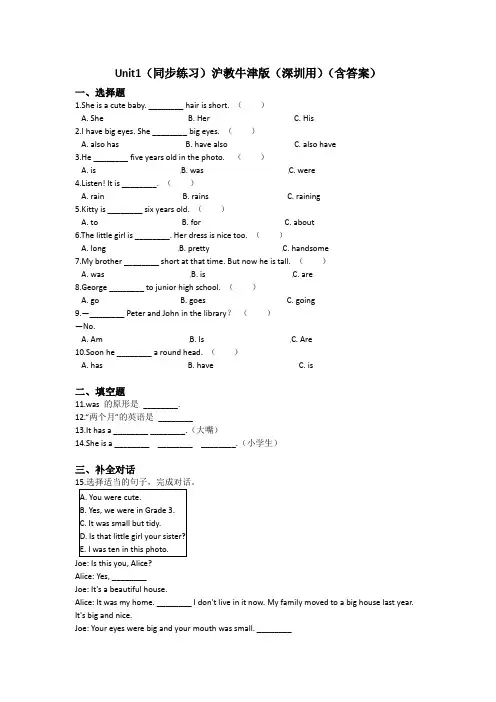
Unit1(同步练习)沪教牛津版(深圳用)(含答案)一、选择题1.She is a cute baby. ________ hair is short. ()A. SheB. HerC. His2.I have big eyes. She ________ big eyes. ()A. also hasB. have alsoC. also have3.He ________ five years old in the photo. ()A. isB. wasC. were4.Listen! It is ________. ()A. rainB. rainsC. raining5.Kitty is ________ six years old. ()A. toB. forC. about6.The little girl is ________. Her dress is nice too. ()A. longB. prettyC. handsome7.My brother ________ short at that time. But now he is tall. ()A. wasB. isC. are8.George ________ to junior high school. ()A. goB. goesC. going9.—________ Peter and John in the library?()—No.A. AmB. IsC. Are10.Soon he ________ a round head. ()A. hasB. haveC. is二、填空题11.was 的原形是________.12.“两个月”的英语是________13.It has a ________ ________.(大嘴)14.She is a ________ ________ ________.(小学生)三、补全对话A. You were cute.B. Yes, we were in Grade 3.C. It was small but tidy.D. Is that little girl your sister?E. I was ten in this photo.Joe: Is this you, Alice?Alice: Yes, ________Joe: It's a beautiful house.Alice: It was my home. ________ I don't live in it now. My family moved to a big house last year. It's big and nice.Joe: Your eyes were big and your mouth was small. ________Alice: Thank you.Joe: ________Alice: No. That's my friend.Joe: Were you in primary school then?Alice: ________四、情景交际16.句子搭配。
沪教牛津版(深圳用)英语六年级上册Module 1 Unit 1 Growing up第1课时课件
The difference before & after summer holiday
Let’s talk about your differences
before & after summer holiday
I was
I am
short white thin weak in Grade 5
tall black fat strong in Grade 6
This is Brain.
Look. This is Brain. He is thin. His hair is long. He is handsome.
He is growing up.
What does “growing up” mean?
To be taller?
To be smarter?
Now Sally is _fo_u_r_t_e_e_n_ years old. She goes to __j_u_n_io_r_h_i_g_h_s_c_h_o_o_l_. She is _ta_l_l _a_n_d_p_r_e_tt_y_. Her hair is __lo_n_g__.
14 long short
What did she like when she was a baby? month(s)/year(s) old?
In Photo 1, Sally was a _b_a_b_y_. She was about _t_w_o__m_o_n_t_h_s_ old. She was ___sm__a_ll_a_n_d__c_u_te____.
Oxford English
Module 1 Getting to know you
沪教牛津版六年级英语上精品课件-Unit 1 Growing up
about在本句中的意思是“大约”,后面接数词。 以前我们学过的about的意思是“关于”。
例句:彼得大约10岁。 Peter is about ten years old.
2. In Photo 2, Sally was one year old. 在照片2中,萨莉一岁。 year old的意思是“岁”,当岁数大于一时, year old要变成复数形式,即:years old。
__s_i_x__ years old at primary school
__t_w_o__ months old small and cute
Language points
1. She was about two months old.她大约两个月大。
本句用到一般过去时态。一般过去时表示过 去某个时间发生的动作或存在的状态,过去习惯 性、经常性的动作、行为和过去主语的性格和所 具有的能力。
表示过去的时间状语有:yesterday (昨天),last weekend (上周末),last year (去年),just now (刚才), two days ago (两天前),in 1996 (在1996年)等。
一般过去时的构成 1. be动词的一般过去时
a.肯定式:I was … He (She/It) was… We(You/They)were…
b.否定式:在be动词后加not,且was not可简写为 wasn’t, were not可简写为weren’t。
c.一般疑问句:Was I (he/she/it)…? / Were you(we/they)…?
肯定回答:Yes, I was. (you/they were.) 否定回答:No, I wasn’t. (you/they weren’t.)
人教版小学英语六年级上unit1~unit6知识点归纳及练习
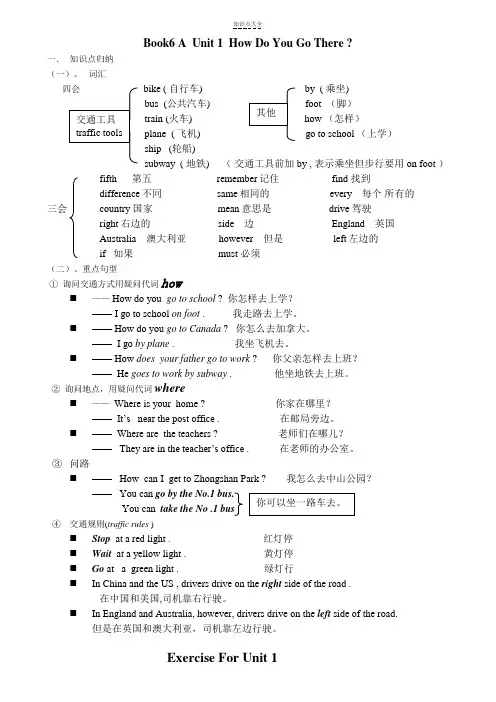
Book6 A Unit 1 How Do You Go There ?一. 知识点归纳(一)、 词汇bike ( 自行车乘坐)公共汽车(脚) 火车(怎样) 飞机(上学)轮船)地铁) ( 交通工具前加by , 表示乘坐但步行要用on foot )fifth 第五 remember 记住 find 找到difference 不同 same 相同的 every 每个 所有的三会 country 国家 mean 意思是 drive 驾驶right 右边的 side 边 England 英国Australia 澳大利亚 however 但是 left 左边的if 如果 must 必须(二)、重点句型① 询问交通方式用疑问代词how⏹ —— How do you go to school ? 你怎样去上学?—— I go to school on foot . 我走路去上学。
⏹ —— How do you go to Canada ? 你怎么去加拿大。
—— I go by plane . 我坐飞机去。
⏹ —— How does your father go to work ? 你父亲怎样去上班?—— He goes to work by subway . 他坐地铁去上班。
② 询问地点,用疑问代词where⏹—— Where is your home ? 你家在哪里? —— It’s near the post office . 在邮局旁边。
⏹ —— Where are the teachers ? 老师们在哪儿?—— They are in th e teacher’s office . 在老师的办公室。
③ 问路⏹ —— How can I get to Zhongshan Park ? 我怎么去中山公园?—— You can go by the No.1 bus. You can take the No .1 bus .④ 交通规则(traffic rules )⏹Stop at a red light . 红灯停 ⏹Wait at a yellow light . 黄灯停 ⏹Go at a green light . 绿灯行 ⏹In China and the US , drivers drive on the right side of the road . 在中国和美国,司机靠右行驶。
沪教版小学六年级英语上Unit 1 Growing up 教案
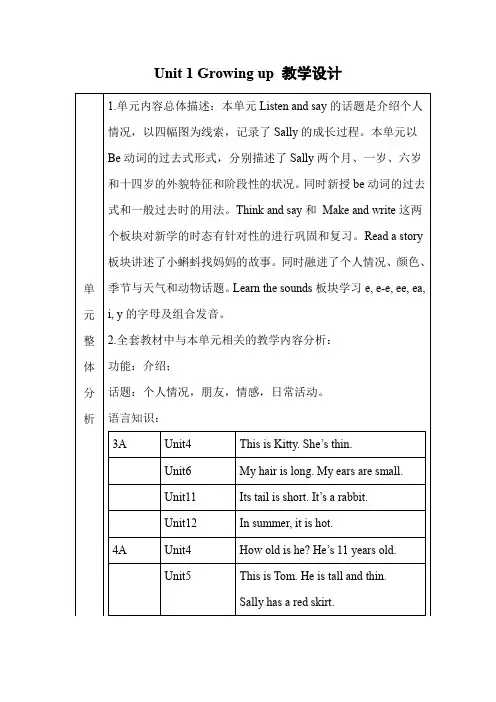
Is she aprimary school student or a junior high school student?
第二课时
Listen and say
Learn the sounds
单词
grow up, junior high school
看图说话,讲述并写出他人的情况。
本册教材与此相关的内容分析:
由于是新授的时态,所以本册的时态重点是一般过去时及过去式的几种形式的用法,学习其陈述句、一般疑问句和特殊疑问句的句式及使用,共有6个单元学习本时态。
Unit1
Her hair was short and her eyes were big.
Unit2
How was your summer holiday? It was wonderful. We went to the Great Wall.
My friend’s childhood
句型
She was six months old. Her hair was short.
语音
e, e-e, ee, ea, i, y
听音,圈出准确的单词
第三课时
Read a story
单词
catch, turtle, fly, be born
运用本单元目标语说说家人的情况。
How was Sally?
Was she pretty?
初步感知和运用目标词汇和目标语。
Sally’s childhood
句型
Her hair was short and hereyes were big.
Sally was a pretty girl.
沪教版(三年级起点)六年级上册小学英语 Unit 1 Growing up 课件
What have we learned in this class?
Summary
Show time. Some language points. 1. on one’s mind.
2. be worried about(doing).
3. Growing up is hard.
Summary
Practice
Work in pairs to practice the dialogue. Sample conversation : S1: How do you learn about the world? S2: I like to learn about the world from films.
Presentation
Learn T: How do you learn about the world?
Practice
Listen to part B. Ask: How does Mille learn about the world? Why?
Practice
Listen to part B. Ask: How does Simon learn about the world? Why?
8. as soon as.
9. a great deal of.
Homework
1. Revise the contents we’ve learned in this period .
2. Recite the comic strip fluently .
3. Finish exercises in <workbook for each period>.
See you!
沪教版六年级上册英语Unit1 Growing up知识点习题
Unit 1 Growing up 一、基本知识点(一)词汇:month [mʌnθ]cute [kjuːt]handsome ['hæns(ə)m]pretty ['prɪtɪ]catch [kætʃ](二)短语:grow upjunior high school基数词+year(s)/month(s)+ oldat primary schoollook aroundlook likea round headcatch fliesbe born(三)句型:1. Her hair was short and her eyes were big.她的头发很短并且眼睛很大。
2. In Photo 2, she was ... months/years old.在第二张照片里,她有...月/岁大。
3. She was small and cute.她既小巧又可爱。
4. Little Justin was born in the river.小贾斯汀出生在河里。
5. Your mun has four legs.你的妈妈有四条腿。
6. She can catch flies.她会捕捉苍蝇。
7. What does his mother look like?他的妈妈长什么样子?(四)重难点、易错点:1. 一般过去时is/ am-----was are-----were(否定形式缩写)2. 一般现在时---单三( goes, has, meets)3. 名词变复数fly-----flies4. 复习器官词汇mouth tail 等5. 音标:[i:] [ɪ ]6. 写作:学会如何描述一个人在不同的年龄(年龄、外貌、所在学校)My father is _________________________________________ 年龄He was _________________________________________ 职业或所在学校His ____________________________________________ 外貌特征二、典型例题1. The turtles were born ________ the river.A. atB. inC. under【解析】答案:B 根据句意:“乌龟出生在河里”。
六年级上册英语课件Unit 1《Growing up》1_牛津上海版 (共13张PPT)
13、He who seize the right moment, is the right man.谁把握机遇,谁就心想事成。2021/8/302021/8/302021/8/302021/8/308/30/2021 14、谁要是自己还没有发展培养和教育好,他就不能发展培养和教育别人。2021年8月30日星期一2021/8/302021/8/302021/8/30 15、一年之计,莫如树谷;十年之计,莫如树木;终身之计,莫如树人。2021年8月2021/8/302021/8/302021/8/308/30/2021 16、教学的目的是培养学生自己学习,自己研究,用自己的头脑来想,用自己的眼睛看,用自己的手来做这种精神。2021/8/302021/8/30August 30, 2021 17、儿童是中心,教育的措施便围绕他们而组织起来。2021/8/302021/8/302021/8/302021/8/30
9,教职员躬亲共学;要学生守的规则,教职员躬亲共守。2021/8/302021/8/30Monday, August 30, 2021 10、阅读一切好书如同和过去最杰出的人谈话。2021/8/302021/8/302021/8/308/30/2021 9:33:39 PM 11、只有让学生不把全部时间都用在学习上,而留下许多自由支配的时间,他才能顺利地学习……(这)是教育过程的逻辑。2021/8/302021/8/302021/8/30Aug-2130-Aug-21 12、要记住,你不仅是教课的教师,也是学生的教育者,生活的导师和道德的引路人。2021/8/302021/8/302021/8/30Monday, August 30, 2021
六年级英语上册Unit1Growingup(第1课时) ppt课件
85.每一年,我都更加相信生命的浪费是在于:我们没有献出爱,我们没有使用力量,我们表现出自私的谨慎,不去冒险,避开痛苦,也失去了快乐。――[约翰· B· 塔布] 86.微笑,昂首阔步,作深呼吸,嘴里哼着歌儿。倘使你不会唱歌,吹吹口哨或用鼻子哼一哼也可。如此一来,你想让自己烦恼都不可能。――[戴尔· 卡内基] 87.当一切毫无希望时,我看着切石工人在他的石头上,敲击了上百次,而不见任何裂痕出现。但在第一百零一次时,石头被劈成两半。我体会到,并非那一击,而是前面的敲打使它裂开。――[贾柯· 瑞斯] 88.每个意念都是一场祈祷。――[詹姆士· 雷德非] 89.虚荣心很难说是一种恶行,然而一切恶行都围绕虚荣心而生,都不过是满足虚荣心的手段。――[柏格森] 90.习惯正一天天地把我们的生命变成某种定型的化石,我们的心灵正在失去自由,成为平静而没有激情的时间之流的奴隶。――[托尔斯泰] 91.要及时把握梦想,因为梦想一死,生命就如一只羽翼受创的小鸟,无法飞翔。――[兰斯顿· 休斯] 92.生活的艺术较像角力的艺术,而较不像跳舞的艺术;最重要的是:站稳脚步,为无法预见的攻击做准备。――[玛科斯· 奥雷利阿斯] 93.在安详静谧的大自然里,确实还有些使人烦恼.怀疑.感到压迫的事。请你看看蔚蓝的天空和闪烁的星星吧!你的心将会平静下来。[约翰· 纳森· 爱德瓦兹] 94.对一个适度工作的人而言,快乐来自于工作,有如花朵结果前拥有彩色的花瓣。――[约翰· 拉斯金] 95.没有比时间更容易浪费的,同时没有比时间更珍贵的了,因为没有时间我们几乎无法做任何事。――[威廉· 班] 96.人生真正的欢欣,就是在于你自认正在为一个伟大目标运用自己;而不是源于独自发光.自私渺小的忧烦躯壳,只知抱怨世界无法带给你快乐。――[萧伯纳] 97.有三个人是我的朋友爱我的人.恨我的人.以及对我冷漠的人。 爱我的人教我温柔;恨我的人教我谨慎;对我冷漠的人教我自立。――[J·E·丁格] 98.过去的事已经一去不复返。聪明的人是考虑现在和未来,根本无暇去想过去的事。――[英国哲学家培根] 99.真正的发现之旅不只是为了寻找全新的景色,也为了拥有全新的眼光。――[马塞尔· 普劳斯特] 100.这个世界总是充满美好的事物,然而能看到这些美好事物的人,事实上是少之又少。――[罗丹] 101.称赞不但对人的感情,而且对人的理智也发生巨大的作用,在这种令人愉快的影响之下,我觉得更加聪明了,各种想法,以异常的速度接连涌入我的脑际。――[托尔斯泰] 102.人生过程的景观一直在变化,向前跨进,就看到与初始不同的景观,再上前去,又是另一番新的气候――。[叔本华] 103.为何我们如此汲汲于名利,如果一个人和他的同伴保持不一样的速度,或许他耳中听到的是不同的旋律,让他随他所听到的旋律走,无论快慢或远近。――[梭罗] 104.我们最容易不吝惜的是时间,而我们应该最担心的也是时间;因为没有时间的话,我们在世界上什么也不能做。――[威廉· 彭] 105.人类的悲剧,就是想延长自己的寿命。我们往往只憧憬地平线那端的神奇【违禁词,被屏蔽】,而忘了去欣赏今天窗外正在盛开的玫瑰花。――[戴尔· 卡内基] 106.休息并非无所事事,夏日炎炎时躺在树底下的草地,听着潺潺的水声,看着飘过的白云,亦非浪费时间。――[约翰· 罗伯克] 107.没有人会只因年龄而衰老,我们是因放弃我们的理想而衰老。年龄会使皮肤老化,而放弃热情却会使灵魂老化。――[撒母耳· 厄尔曼] 108.快乐和智能的区别在于:自认最快乐的人实际上就是最快乐的,但自认为最明智的人一般而言却是最愚蠢的。――[卡雷贝· C· 科尔顿] 109.每个人皆有连自己都不清楚的潜在能力。无论是谁,在千钧一发之际,往往能轻易解决从前认为极不可能解决的事。――[戴尔· 卡内基] 110.每天安静地坐十五分钟· 倾听你的气息,感觉它,感觉你自己,并且试着什么都不想。――[艾瑞克· 佛洛姆] 111.你知道何谓沮丧---就是你用一辈子工夫,在公司或任何领域里往上攀爬,却在抵达最高处的同时,发现自己爬错了墙头。--[坎伯] 112.「伟大」这个名词未必非出现在规模很大的事情不可;生活中微小之处,照样可以伟大。――[布鲁克斯] 113.人生的目的有二:先是获得你想要的;然后是享受你所获得的。只有最明智的人类做到第二点。――[罗根· 皮沙尔· 史密斯] 114.要经常听.时常想.时时学习,才是真正的生活方式。对任何事既不抱希望,也不肯学习的人,没有生存的资格。 ――[阿萨· 赫尔帕斯爵士] 115.旅行的精神在于其自由,完全能够随心所欲地去思考.去感觉.去行动的自由。――[威廉· 海兹利特] 116.昨天是张退票的支票,明天是张信用卡,只有今天才是现金;要善加利用。――[凯· 里昂] 117.所有的财富都是建立在健康之上。浪费金钱是愚蠢的事,浪费健康则是二级的谋杀罪。――[B·C·福比斯] 118.明知不可而为之的干劲可能会加速走向油尽灯枯的境地,努力挑战自己的极限固然是令人激奋的经验,但适度的休息绝不可少,否则迟早会崩溃。――[迈可· 汉默] 119.进步不是一条笔直的过程,而是螺旋形的路径,时而前进,时而折回,停滞后又前进,有失有得,有付出也有收获。――[奥古斯汀] 120.无论那个时代,能量之所以能够带来奇迹,主要源于一股活力,而活力的核心元素乃是意志。无论何处,活力皆是所谓“人格力量”的原动力,也是让一切伟大行动得以持续的力量。――[史迈尔斯] 121.有两种人是没有什么价值可言的:一种人无法做被吩咐去做的事,另一种人只能做被吩咐去做的事。――[C·H·K·寇蒂斯] 122.对于不会利用机会的人而言,机会就像波浪般奔向茫茫的大海,或是成为不会孵化的蛋。――[乔治桑] 123.未来不是固定在那里等你趋近的,而是要靠你创造。未来的路不会静待被发现,而是需要开拓,开路的过程,便同时改变了你和未来。――[约翰· 夏尔] 124.一个人的年纪就像他的鞋子的大小那样不重要。如果他对生活的兴趣不受到伤害,如果他很慈悲,如果时间使他成熟而没有了偏见。――[道格拉斯· 米尔多] 125.大凡宇宙万物,都存在着正、反两面,所以要养成由后面.里面,甚至是由相反的一面,来观看事物的态度――。[老子] 126.在寒冷中颤抖过的人倍觉太阳的温暖,经历过各种人生烦恼的人,才懂得生命的珍贵。――[怀特曼] 127.一般的伟人总是让身边的人感到渺小;但真正的伟人却能让身边的人认为自己很伟大。――[G.K.Chesteron] 128.医生知道的事如此的少,他们的收费却是如此的高。――[马克吐温] 129.问题不在于:一个人能够轻蔑、藐视或批评什么,而是在于:他能够喜爱、看重以及欣赏什么。――[约翰· 鲁斯金]