
闽教版三年级英语下册
1.“Happy Birthday to You(you可以用名字替换).”回答:Thank you. Let’s buy a present for ×××.让我们买个礼物送给×××?Mom: Hello, Sally. Happy birthday! Here’s a present for you.Sally: What’s this?Mom: It’s a bag.Sally: Thank you, Mom.2.can是情态动词,表示“能力”,其后跟动词原形。
Can you ride a bike? 一句中的can既指一时的可能,也指长期的能力。
在疑问句中可将情态动词置于句首,后接句子的主语和主要谓语动词。
其否定形式由can加not构成。
否定式的书面形式有三种:can not,can’t和cannot。
can’t 是can not的缩写形式,bike和bicycle意思相同,指“自行车”I can swim. I can draw. I can….表达自己的能力。
I’m a duck. I can swim.Can you…? Yes, I can./No, I can’t. I can’t….I can ride a bike. Can you ride a bike?I can run. Can you run?I can swim / dance/ draw/ skate/ sing.food意为“食物”或“食品”(通常作物质名词,并且用单数,不加不定冠词),如:food and drink(食物和饮料)(注意:不说drink and food.)。
作为食物种类,food 作可数名词,如:too many sweet foods (过多的甜食)sweet作形容词意为“甜的”。
它还可以作名词,“糖果”的意思。
hamburger“汉堡包”,是可数名词。
noodle意为“面条”,通常加s 作复数用。
rice是不可数名词,表示“米”、“饭”、“稻子”。
用米做成的糕饼是rice cake. grape 意为“葡萄”,通常加s 作复数用。
英语中的名词,可以计数的,称为可数名词;不能计数的,称为不可数名词。
可数名词又有单数和复数两种形式。
复数形式通常是在单数形式后加词尾”s”或”es”构成的,其规则如下:(1)一般情况加s,如:cake —cakes, apple —apples, banana —bananas , egg —eggs , melon —melons , grape —grapes等。
s加在清辅音后读[s], 加在浊辅音或元音后读[z]。
(2)在以s, sh, ch, x 结尾的词后加es, 如:box --- boxes , class --- classes, watch --- watches, peach --- peaches, bus --- buses, 其中es读[ɪz] 。
(3)在以o 结尾的名词后,多数在词尾加es, 少数加s, 如:potato --- potatoes, piano --- pianos, radio ---radios,其中es 和s 均读[z] 。
而photo 则直接加s.(4)在以“辅音字母+y”结尾的词后,变y为i , 再加es, 如:city --- cities , party --- parties,其中es 读[z]。
(5)在以f 或fe结尾的词后变f 或fe为v , 再加es , 如:leaf --- leaves , life --- lives,其中ves读[vz]。
(6)有一些名词的复数是变化内部元音,如:man --- men, woman --- women , foot --- feet , tooth --- teeth。
(7)有一些名词的单复数同形,如,fish, sheep , deer, Chinese , Japanese. They are Food.强调指出表达喜欢某个物品时要使用名词的复数形式。
like意思为“喜欢”、“喜爱”,否定形式为don’t like, 是do not like的缩写,I like grapes. What about you? I like grapes.(或I like grapes , too. ) They are not sweet.I don’t like grapes. 其中don’t like是不喜欢,don’t是do not 的缩写形式,表示否定。
I don’t like ice cream/apples / eggs… .4.询问现在几点钟What’s the time? What time is it ? 回答一般有两种读法,一种为直接读出钟点的阿拉伯数字,如8:30可读作eight thirty;另一种则用past和to表示:表示等于或少于半小时的时刻,用介词past(几点过几分),英国人用past,美国人用after;而表示多于半小时的时刻,则用to,后接比较接近的时刻数,意思是“几点差几分”。
例如8:45可读作eight forty-five 或a quarter to nine。
如果分钟数在10之内,如10:05,其中的0读成字母o的音。
“What’s the time? It’s … o’clock.”So many….如:So many pencils. So many apples.5.face指“脸”。
还可以指“表情”,如:开朗的表情(beaming face),忧郁的表情(glum face), 闷闷不乐的表情(long face)等。
eye指“眼睛”。
复合词有eyeball(眼球),eyebrow(眉毛),eyelash(睫毛),eyelid(眼睑),eyeshadow(眼影),eyebrow pencil(眉笔)等。
nose指“鼻子”。
复合词有鼻孔(nostril),鼻尖(tip),长/短鼻(a long/short nose),扁平鼻(a flat nose),鼻梁(the bridge of the nose),擤鼻子(blow one’s nose),捏住鼻子(hold one’s nose),鼻子灵(have a good nose)等。
head是指包含脸、脖子以上的身体部分,有时亦指眼睛以上及后面长有头发的部分。
head还指“头脑”、“智慧”、“智力”,如:a clear head (清醒的头脑),Use your head(动动你的脑),head还可指“长官”“首脑”,如:the head of a school/a company(校长/董事长)。
feet是foot的复数形式,类似变化的单词还有tooth –teeth。
Hands up.(举手。
)指双手向上举, Hands down.(放下手。
)与Hands up动作正相反。
6.裤子、鞋子、袜子一类的词都要用复数形式,通常用a pair of socks/ stocking 表示“一双短袜/ 长袜”。
胶鞋,如休闲鞋,可称为sneakers。
运动鞋称为sports shoes。
put on 意为“穿戴”、“穿上(衣服、鞋子、帽子等)”,其相反意思是put off 或take off, 但take off 用得较为普通。
put on 还意为“打开(电灯、电视等)”,相当于turn on,其相反意思是put off 或turn off,但turn off用得较为普通。
put on与wear的意思不同。
put on(穿上)指穿上衣服的动作,如:He is putting on a coat.(他正在穿一件大衣。
)wear表示穿着衣服的状态,如:She wears a coat.(她穿着一件大衣。
)What size do you wear?(你穿多大号的?)size原意是“大小”、“尺寸”,这里可理解成“号码”。
我们购买衣服时通常所见到的S,M,L,XL分别是small(小号),medium(中号),large(大号),extra large(特大号)的缩写。
large和big都指“大”。
large通常指具体事物体积或容积的大小,此时可以与big互换,但一般不用来修饰人。
big用于具体事物时,强调数量或重量,可用来修饰人;用于抽象事物时,含有“重要”之义。
little和small都指“小”。
little表示小或少,且常带有一种感情色彩。
如:a little girl既指未成年的女孩,又包含了令人怜爱的感情意味。
small多指达不到平均的尺寸,如:a small girl强调比同龄人矮小的女孩。
Put on your T-shirts.It’s too big/ small.I like the monkey. He is in a blue T-shirt. So handsome.教师板书句子It’s too big.和It’s too smal l.What size do you wear?Size M。
如果不是M号的,就用:It’s too small.或It’s too big.能用They’re too small. They’re too big.来描述服装尺寸的大小。
My T-shirt is too big.Oh, my bag is too small.Oh, my sports shoes are too small.7.衬衣分男式和女式,男式衬衣叫作shirt,女式衬衣叫作blouse。
whose是疑问代词who的所有格形式,作定语,用来修饰名词。
如:Whose book is this? (这是谁的书?) 类似的说法还有:Whose is this pencil? (这根铅笔是谁的?)注意whose与who’s (who is的缩写形式) 之间的区别。
两者发音相同,但拼写与词义均不同。
Whose 是who的所有格形式,who’s是who is 的缩略形式。
It’s Yang Ming’s.是It’s Yang Ming’s jacket. 的简略说法。
Yang Ming’s是名词所有格。
表示二者共有的物品时,只要在后一个名词后加’s;表示两者各自所有的物品,则每个名词词尾都加’s。
如:Sally and Kate’s room (房间是二人共有)Sally’s and Kate’s room (萨莉和凯特各自的房间)英美人听到赞扬时,会大方地表示“谢谢”。
当说:Your sweater is beautiful.的时候,回答:Thank you.Ilike cake better than the sweet.(我喜欢蛋糕胜过糖果。
新闽教版小学英语三年级下册全册教案
1)What present do Sally get?
2)What do they say to Sally?
T: Is it a bird?
Ss: No. (重点教读bird)
T: Then it’s a…(学生说出rabbit) Yes, you are very good. It’s a rabbit.那他们见到Sally的第一句话是什么?
Now listen to the tape, and answer following questions:
1)Who’s birthday partyis this?
2)How does she invite her friends?
3)What present do they prepare for her?
板书设计
Unit 1 Birthday
Part B
Happy birthday!
What’s this?abird
It’s….a rabbit
a cake
教学反思
课题
Unit2 Ability Part A
总教时数()节本节系第()教时
执教班级
三年级
时间
第周星期节课
教学内容
闽教版小学英语三年级下册9-10页
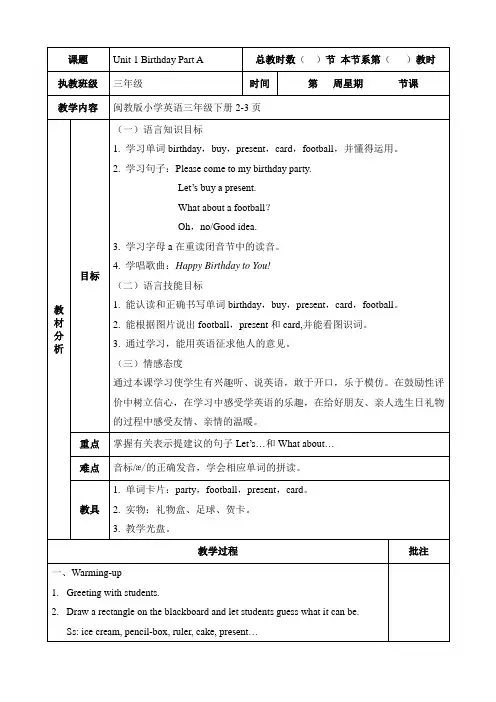
4.听第二部分的录音,找出另外一句表示提建议的句子:Let’s…并教授新词buy。
三、Practice
1.学生听录音,跟读书本一、二部分的对话。
2.一、二组同学扮演男生,三四组同学扮演女生,老师扮演Sally,模仿该对话。
3.四个组互换角色,表演该对话。
四、Consolidation
1.板书cat, bag, hat, black,指导学生理解字母a的发音为/æ/。
闽教版英语三年级起点三年级下册全册教案
闽教版英语三年级起点三年级下册全册教案播放vcd 跟读磁带教学反思与建议本课继续学习巩固关于身体部位单词,利于指令动作反应游戏有效复习操练上节课所学单词,并调动课堂气氛,要特别强调的是单词单复数形式的使用,结合画画活动,让学生在活动中学习本课句型。
上课时间年4月1日第2节授课教师年级三年级学科英语备课时间年3月24日课题unit 5 parts of the body (2) lesson 9主备教师参与教师教学目标 1.掌握单词:leg, hand, arm, foot, feet, knee, clap, wave, stamp, bend 2.能听懂:clap your hands. stamp your feet. wave your arms. bend your knees.并按照指令做动作。
3.掌握句子:how many ___ can you see?i can see …重点、难点能熟练的读出句子并运用其进行交流。
资源准备1.some pictures of new words .2.a computer教学过程资源应用step l warm up1.greetings找教案2.sing a song: head ,shoulders,knees and toes.step 2 review1.review no. from 1 to 102.play a game : touch your body.step 3 presentation1. unit 4 parts of the body (2) lesson 92. ask two students to the front of the classt: how many eyes can you see?t: how many ears can you see?lead students to say :i can see…continue like this:noses, necks, heads3. learn the new words:legt: how many legs can you see?s:i can see ….t:read after me :leg .ask students to tell leg and legs continue to learn hand,arm,feet4.look at the screen and read after the vcdhow many legs can you see? i can see_____legs.how many hands can you see? i can see_____hands.how many arms can you see? i can see_____armshow many feet can you see? i can see_____feet.step 4 play a game1. ask the winner to clap their hands2. ask the last to stamp their feet3. ask the other students to wave their arms ,bend their knees4. do as the vcd.。
闽教版三年级起点小学英语三年级下(英语单词表)
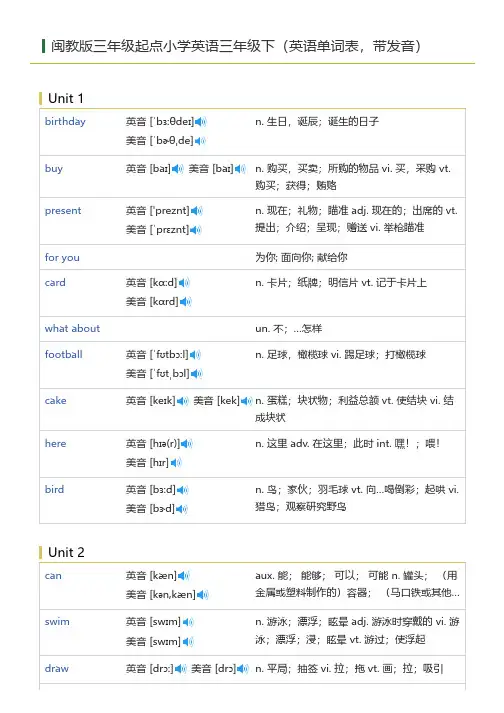
闽教版三年级起点小学英语三年级下(英语单词表,带发音)Unit 1Unit 2birthday英音 [ˈb ɜ:θde ɪ]美音 [ˈb ɚθˌde]n. 生日,诞辰;诞生的日子buy英音 [ba ɪ]美音 [ba ɪ]n. 购买,买卖;所购的物品 vi. 买,采购 vt.购买;获得;贿赂present英音 [ˈpreznt]美音 [ˈpr ɛznt]n. 现在;礼物;瞄准 adj. 现在的;出席的 vt.提出;介绍;呈现;赠送 vi. 举枪瞄准for you 为你; 面向你; 献给你card英音 [kɑ:d]美音 [kɑrd]n. 卡片;纸牌;明信片 vt. 记于卡片上what about un. 不;…怎样football英音 [ˈf ʊtb ɔ:l]美音 [ˈf ʊt ˌbɔl]n. 足球,橄榄球 vi. 踢足球;打橄榄球cake英音 [ke ɪk]美音 [kek]n. 蛋糕;块状物;利益总额 vt. 使结块 vi. 结成块状here英音 [h ɪə(r)]美音 [hɪr]n. 这里 adv. 在这里;此时 int. 嘿!;喂!bird英音 [b ɜ:d]美音 [b ɝd]n. 鸟;家伙;羽毛球 vt. 向…喝倒彩;起哄 vi.猎鸟;观察研究野鸟can英音 [kæn]美音 [kən,kæn]aux. 能; 能够; 可以; 可能 n. 罐头; (用金属或塑料制作的)容器; (马口铁或其他…swim英音 [sw ɪm]美音 [sw ɪm]n. 游泳;漂浮;眩晕 adj. 游泳时穿戴的 vi. 游泳;漂浮;浸;眩晕 vt. 游过;使浮起draw英音 [drɔ:]美音 [dr ɔ]n. 平局;抽签 vi. 拉;拖 vt. 画;拉;吸引Unit 3run 英音 [r ʌn]美音 [r ʌn]n. 奔跑;赛跑;趋向;奔跑的路程 vt. 管理,经营;运行;参赛 vi. 经营;奔跑;运转ride 英音 [ra ɪd]美音 [ra ɪd]n. 骑;乘坐;交通工具;可供骑行的路;(乘坐汽车等的)旅行;乘骑;(乘车或骑车的…bike 英音 [ba ɪk]美音 [ba ɪk]n. 自行车;脚踏车 vi. 骑自行车(或摩托车)skate 英音 [ske ɪt]美音 [sket]n. 溜冰;冰鞋 vi. 滑冰;滑过yes 英音 [jes]美音 [j ɛs]n. 是(表示肯定) adv. 是, 是的can't abbr. 不能(can not)cannot英音 [ˈkæn ɒt]美音 [ˈkænɑt, k əˈnɑt, kæ-]v. 不能;无法like英音 [la ɪk]美音 [la ɪk]vt. 喜欢;想;愿意 vi. 喜欢;希望 prep. 像;如同 adj. 同样的;相似的 n. 爱好;同样的…rice 英音 [ra ɪs]美音 [ra ɪs]n. 稻;米饭 vt. 把…捣成米糊状hamburger英音 ['hæmb ɜ:ɡə(r)]美音 [ˈhæm ˌb ɚɡɚ]n. 汉堡包,火腿汉堡;牛肉饼,肉饼;碎牛肉grape 英音 [ɡre ɪp]美音 [ɡrep]n. 葡萄;葡萄酒;葡萄树;葡萄色sweet 英音 [swi:t]美音 [swit]n. 糖果;乐趣;芳香;宝贝 adj. 甜的;悦耳的;芳香的;亲切的 (俚)酷毙了jump 英音 [d ʒʌmp]美音 [d ʒʌmp]n. 跳跃;暴涨;惊跳 vt. 跳跃;使跳跃;跳过;突升 vi. 跳跃;暴涨;猛增don'tn. 禁忌(等于do not) aux. 表示否定(等于do not)do not 无Unit 4early英音 ['ɜ:l ɪ]美音 [ˈɜː(r)l ɪ]adj. 早期的;早熟的 adv. 提早;在初期eleven英音 [ɪˈlevn]美音 [ɪˈl ɛv ən]num. 十一;十一个 n. 十一;十一个 adj. 十一的;十一个的twelve英音 [twelv]美音 [tw ɛlv]num. 十二;十二个 n. 十二;十二个 adj. 十二的;十二个的o'clock abbr. …点钟(等于of the clock)home英音 [h əʊm]美音 [hom]n. 家,住宅;产地;家乡;避难所 adj. 国内的,家庭的;有效的 vt. 归巢,回家 adv. 在…story英音 ['st ɔ:r ɪ]美音 [ˈst ɔr ɪ, ˈstor ɪ]n. 故事;小说;新闻报道;来历;假话 vt. 用历史故事画装饰 vi. 说谎late英音 [le ɪt]美音 [let]adj. 晚的;迟的;已故的;最近的 adv. 晚;迟;最近;在晚期sorry英音 ['s ɒr ɪ]美音 [ˈsɑr ɪ, ˈs ɒr ɪ]adj. 遗憾的;对不起的,抱歉的 int. 对不起,抱歉(表示委婉的拒绝等)so英音 [s əʊ]美音 [so ʊ]conj. 所以;因此 adv. 如此,这么;确是如此pron. 这样many pron. 许多;许多人 adj. 许多的so manyna. 那么多的;很多(的);和…一样多的;全都是clock英音 [kl ɒk]美音 [klɑk]n. 时钟;计时器 vt. 记录;记时 vi. 打卡;记录时间time英音 [ta ɪm]美音 [ta ɪm]n. 时间;时代;次数;节拍;倍数 adj. 定时的;定期的;分期的 vt. 计时;测定…的时…mom英音 [m ɒm]美音 [mɑ:m]n. 妈妈London英音 ['l ʌnd ən]美音 ['l ʌnd ən]n. 伦敦Unit 5face英音 [fe ɪs]美音 [fes]n. 脸;表面;面子;面容;外观;威信 vi.向;朝 vt. 面对;面向;承认;抹盖eye英音 [a ɪ]美音 [a ɪ]n. 眼睛;视力;眼光;见解,观点 vt. 注视,看then英音 [ðen]美音 [ðɛn]conj. 然后,当时 n. 那时 adv. 然后;那么;于是;当时;此外nose英音 [n əʊz]美音 [noz]n. 鼻子;嗅觉;突出的部分;探问 vt. 嗅;用鼻子触 vi. 小心探索着前进;探问mouth英音 [ma ʊθ]美音 [ma ʊθ]n. 口,嘴;河口 vt. 做作地说,装腔作势地说;喃喃地说出 vi. 装腔作势说话ear英音 [ɪə(r)]美音 [ɪr]n. 耳朵;穗;听觉;倾听 vi. (美俚)听见;抽穗touch英音 [t ʌt ʃ]美音 [t ʌt ʃ]n. 接触;触觉;格调;少许 vt. 接触;触动;使轻度受害 vi. 触摸;涉及;接近;提到honey英音 ['h ʌn ɪ]美音 [ˈh ʌn ɪ]n. 蜂蜜;宝贝;甜蜜 adj. 甘美的;蜂蜜似的vt. 对…说甜言蜜语;加蜜使甜 vi. 奉承;说…hand英音 [hænd]美音 [hænd]n. 手,手艺;帮助;指针;插手 vt. 传递,交给;支持;搀扶armn. 手臂;武器;袖子;装备;部门 vt. 武装;备战 vi. 武装起来head英音 [hed]美音 [h ɛd]n. 头;头痛;上端;最前的部分;理解力 adj.头的;主要的;在顶端的 vt. 前进;用头顶…leg英音 [leɡ]美音 [l ɛɡ]n. 腿;支柱foot英音 [f ʊt]美音 [f ʊt]n. 脚;英尺;步调;末尾 vt. 支付;给……换底 vi. 步行;跳舞;总计pupil英音 [ˈpju:pl]美音 [ˈpjup əl]n. 学生;[解剖] 瞳孔;未成年人Unit 6Unit 7put on na. 假话T-shirt n. 短袖圆领汗衫wear英音 [we ə(r)]美音 [w ɛr]n. 衣物;磨损;耐久性 v. 穿着;用旧;耗损;面露too英音 [tu:]美音 [tu]adv. 太;也;很;还;非常;过度size英音 [sa ɪz]美音 [sa ɪz]n. 大小;尺寸 adj. 一定尺寸的 vt. 依大小排列vi. 可比拟big英音 [b ɪɡ]美音 [b ɪɡ]adj. 大的;重要的;量大的 adv. 大量地;顺利;夸大地small英音 [sm ɔ:l]美音 [sm ɔl]n. 小件物品;矮小的人 adj. 少的,小的;微弱的;几乎没有的;不重要的;幼小的 adv.…want英音 [w ɒnt]美音 [wɑnt, w ɒnt]n. 需要;缺乏;贫困;必需品 vt. 需要;希望;应该;缺少 vi. 需要;缺少sports英音 [sp ɔ:ts]美音 [sp ɔ:ts]n. 运动;运动会(sport的复数);(报纸)体育版面;突变;娱乐 adj. 运动的;适用于…shoe 英音 [ʃu:]美音 [ʃu]n. 鞋;蹄铁;外胎 vt. 给……穿上鞋;穿……鞋sports shoesn. 球鞋whose英音 [hu:z]美音 [huz]pron. 谁的(疑问代词)shirt 英音 [ʃɜ:t]美音 [ʃɚt]n. 衬衫;汗衫,内衣sweater英音 [ˈswet ə(r)]美音 [ˈsw ɛt ɚ]n. 毛线衣,运动衫;大量出汗的人,发汗剂beautiful 英音 ['bju:t ɪfl]美音 [ˈbjut əf əl]adj. 美丽的 出色地 出色的 迷人的 迷人地skirt 英音 [sk ɜ:t]n. 裙子 vt. 绕过,回避;位于…边缘 vi. 沿边走,绕开;环绕Unit 8美音 [sk ɚt]hat英音 [hæt]美音 [hæt]n. 帽子 vt. 给……戴上帽子 vi. 供应帽子;制造帽子kid英音 [k ɪd]美音 [k ɪd]n. 小孩;小山羊 vt. 欺骗;取笑;戏弄 vi. 欺骗;取笑;戏弄 adj. 小山羊皮制的;较年幼的child英音 [t ʃa ɪld]美音 [t ʃa ɪld]n. 儿童,小孩,孩子;产物;子孙;幼稚的人;弟子day英音 [de ɪ]美音 [de]n. 一天;时期;白昼 adj. 日间的;逐日的adv. 每天;经常在白天地Children's Day na. 儿童节park英音 [pɑ:k]美音 [pɑ:rk]n. 公园;[交] 停车场 vt. 停放;放置;寄存 vi.停放车辆fly英音 [fla ɪ]美音 [fla ɪ]n. 飞行;苍蝇;两翼昆虫 adj. 敏捷的 vi. 飞;驾驶飞机;飘扬 vt. 飞行;飞越;使飘扬play football na. 踢足球;对难办的事采取踢皮球的态度ready英音 ['red ɪ]美音 [ˈr ɛd ɪ]n. 现款;预备好的状态 adj. 准备好;现成的;迅速的;情愿的;快要…的 vt. 使准备好…boat英音 [b əʊt]美音 [bot]n. 小船;轮船 vi. 划船fun英音 [f ʌn]美音 [f ʌn]n. 乐趣;玩笑;有趣的人或事 adj. 供娱乐用的 vi. 开玩笑。
闽教版(三起)英语三年级下册全册课件

Hello, I’m Mimi.
Happy birthday, Mimi!
1.On birthday, Mimi can eat (Mimi过生日应该吃什么?)
______,______...
I can swim.
It’s yellow.
4
cake
A. run
B.draw
draw too. I can _______,
A. run
B.draw
sun
ru n gun fun
swim sing draw run dance I can ________.
Listen and follow(听音跟读)
加上适当的动作表情, 自然地表演出来。 不看书,声音响亮、发音正确。
Can you dance?
Can you ride a bike?
Can you sing?
Can you swim? C
a
Can you ride a bike?
Can you skate?
1.Can you ride a bike? 2.Can you skate?
闽教版三年级下册
英 语 全册优质课件
Unit 1 Birthday
party
a cake
a pencil-case
a bag
a kite
a doll
a story book
a doll How about ____________ ?
a bag How about ____________ ?
Listen and answer
1.Fido, can you ride a bike?
Yes I can.
新闽教版小学英语三年级下册全册教案
(三)全班合唱歌曲:Happy Birthday to You,结束本节课。
五、Homework
1.抄写单词bird,rabbit,cake,baby。
2.完成《活动手册》中本节课的练习。
3.模仿课本第6页的Learn to write.制作一张生日贺卡送给近期要过生日的同学。
C: No.
D: What about a ______
C: Good idea.
五、Homework
1.抄写单词football, present, card以及句型Let’s buy a present./ What about a football?。
2.完成《活动手册》中本节课的练习。
3.“假设明天是Jim的生日,你们会为他准备什么礼物?”以此进行讨论,课后与同学展开探讨,并写成一段对话。
Now listen to the tape, and answer following questions:
1)Who’s birthday partyis this?
2)How does she invite her friends?
3)What present do they prepare for her?
1.教授新词dance, sing, swim, draw, run。
1)教师做出跑步动作,学生猜测出单词run,板书run,带读,注意其音、形、义。
教师边跑边说:I can run, I can run.学生跟读。
2)教师做出唱歌动作,学生猜测出单词sing,板书sing,带读,注意其音、形、义。
(一)Show Time
A: Happy birthday.
闽教版三年级英语下册课件
三遍以内猜出可得分。
Chant: 空处打拍子(音乐节奏课)
a在闭音节中的发音
apple
cat
bag
hat
black
Chant: 空处打拍子(音乐节奏课)
a在开音节中的发音
cake
Kate
baby
绝对开音节:辅音字母+元音字母结尾
相对开音节:元音字母+辅音字母+e结尾
Class: Here’s a present for you. Student: What’s this?
Class: Guess! Student: a …
三遍以内猜出可得分。
Chant: 空处打拍子(音乐节奏课)
Guessing Game
Class: Here’s a present for you. Student: What’s this?
不发ei的单词不能读
Quick Mouth
cake
apple
baby
cat
Kate
hat
Байду номын сангаас
bag
找不同
• apple bag Kate
• daddy cake cat • baby black apple black
• rabbit orange
e在闭音节中的发音
e在开音节中的发音
/i/
i i在闭音节中的发音
Let's buy a present.
让我们买个礼物吧。
present
• What about a/an…? • Good idea.
What about a football? 足球怎么样?
闽教版三年级下册英语教案
闽教版三年级下册英语教案闽教版三年级下册英语教案Unit 1: My SchoolLesson 1: Hello, Everyone!•Objective:–Students will be able to greet their classmates and teacher appropriately.–Students will learn basic classroom language. •Materials:–Greetings flashcards–Whiteboard and markers–CD player and audio CD•Procedure:1.Greet the students and introduce yourself using“Hello, everyone! My name is [your name].”2.Show the greetings flashcards and teach thestudents how to say “Hello”, “Goodbye”, “Goodmorning”, and “Good afternoon” in English.3.Practice the greetings with the students by sayingeach phrase and having them repeat after you.4.Play the audio CD and have the students listen andfollow along.5.Have the students practice greeting each other inpairs or small groups.6.Review the classroom language, such as “Sit down”,“Stand up”, “Open your book”, “Close yourbook”, etc.e the whiteboard to write down the vocabulary andhave the students copy it in their notebooks. Lesson 2: My Classroom•Objective:–Students will be able to identify objects in their classroom.–Students will learn vocabulary related to theclassroom.•Materials:–Classroom objects flashcards–Whiteboard and markers–Real objects from the classroom ( pen, book, desk, etc.)•Procedure:1.Review the greetings from the previous lesson.2.Introduce the vocabulary related to the classroomobjects using flashcards.3.Show real objects from the classroom and have thestudents identify and say the English word for eachobject.4.Practice the vocabulary by playing a game of“Simon Says”, where you give instructions usingthe vocabulary ( “Simon says, touch your book”).5.Have the students work in pairs or small groups andask each other questions like “Do you have a pen?”and respond with “Yes, I have a pen” or “No, Idon’t have a pen”.6.Write down the vocabulary on the whiteboard andhave the students copy it in their notebooks.Unit 2: My FamilyLesson 1: My Family•Objective:–Students will be able to talk about their family members.–Students will learn vocabulary related to family members.•Materials:–Family flashcards–Whiteboard and markers•Procedure:1.Review the greetings and classroom language fromthe previous lessons.2.Introduce the vocabulary related to family membersusing flashcards.3.Teach the students how to use “This is” and“These are” to introduce family members.4.Have the students practice introducing their familymembers to each other in pairs or small groups.5.Play a game of “Guess Who?” where one studentdescribes a family member and the other studentshave to guess who it is.6.Write down the vocabulary on the whiteboard andhave the students copy it in their notebooks. Lesson 2: My Home•Objective:–Students will be able to describe their home.–Students will learn vocabulary related to rooms and furniture.•Materials:–Home flashcards–Whiteboard and markers–Pictures of different rooms and furniture •Procedure:1.Review the family vocabulary from the previouslesson.2.Introduce the vocabulary related to rooms andfurniture using flashcards.3.Show pictures of different rooms and furniture andhave the students identify and say the English wordfor each.4.Discuss with the students about their own homes andask them question s like “Do you have a livingroom?” and “What is in your bedroom?”.5.Have the students work in pairs or small groups anddescribe their own home using the vocabularylearned.6.Write down the vocabulary on the whiteboard andhave the students copy it in their notebooks.Unit 3: My WeekLesson 1: Days of the Week•Objective:–Students will be able to recognize and say the days of the week.–Students will learn basic time-related vocabulary. •Materials:–Days of the week flashcards–Whiteboard and markers•Procedure:1.Review the greetings from the previous lessons.2.Introduce the days of the week using flashcards.3.Teach the students how to say each day and askquestions like “What day is it today?”.4.Practice saying the days of the week in order andrandomly.5.Have the students work in pairs or small groups andask each other questions like “What day wasyesterday?” and “What day will it be tomorrow?”.6.Write down the days of the week on the whiteboardand have the students copy them in their notebooks. Lesson 2: My Daily Routine•Objective:–Students will be able to talk about their daily routine.–Students will learn vocabulary related to daily activities.•Materials:–Daily activities flashcards–Whiteboard and markers–Clock prop•Procedure:1.Review the days of the week from the previouslesson.2.Introduce the vocabulary related to dailyactivities using flashcards.e a clock prop to demonstrate different times ofthe day and talk about the corresponding activities.4.Have the students work in pairs or small groups andask each other questions about their daily routineusing the vocabulary learned ( “What do you do inthe morning?”).5.Create a daily routine schedule on the whiteboardand have the students copy it in their notebooks.6.Write down the vocabulary on the whiteboard andhave the students copy it in their notebooks. Additional Resources:•[闽教版三年级下册英语教材](•[闽教版三年级下册英语练习册](Note: Please replace “” and “” with actual links to the textbooks and exercise books if available.。
闽教版英语三年级起点三年级下册全册教案
闽教版英语三年级起点三年级下册全册教案年级三年级学科英语备课时间课题unit1 ability lesson 1主备教师参与教师教学目标1. sixskillwords:swim,run,ride a bike,sing,dance,draw 2. the drills:can you ...?yes,i can. no,i can’t . 3. teaching key points:new words of part2 .重点、难点talking about the drills skillfully.资源准备①some pictures of new words .②acomputer andasoftware.③alarge screen projecter.④arecorder andsome pictures.教学过程资源应用ⅰ.warm-up 1.free talk 2.greetingsⅱ.reviewwords:sing,danceⅲ.presentation1. learn the words:swim , run , draw, ride,bike ,can, present 2.look and sayi can swim/run/ride a bike/sing/dance/draw.3.ask and answer. can you swim? yes, i can.can you ride a bike? no, i can’t. 4.practice the words and the sentences.5.sing a song.my little bicycle6.learn to say. the teacher explains the words: like and uncle,then translates the text to the student. ask the students to read after the tape for several times.ⅳ.practice1.1.read the new words.2. 2.ask and answer.3. 3.play the game.ⅴ.homework1. 1.read the text. 2. activity book lesson 1 ⅵ.writing design:unit 1 ability lesson 1can you …? ride a bikeyes, i can. run swim singno, i can’t. draw dance出示动作的图片,学习相关的单词录音学歌曲听录音,跟读磁带教学反思与建议本课重点学习六个动作的单词,swim,run,ride a bike,sing,dance,draw。
闽教版小学英语三年级下册全册课文文本
闽教版小学英语三年级下册全册课文Unit 1 BirthdayPart APlease come to my birthday party. 请大家来参加我的生日派对。
Let’s buy a present. (让)我们去买个礼物吧。
And a birthday card. 还要买一张生日贺卡。
What about a football? 买一个足球怎么样?Oh, no! 哦,不行!What about a rabbit? 买一只兔子怎么样?Good ideal. 好主意!巩固练习Let’s buy a present.What about a ?Good ideal.Pencil-box ruler bag rabbit pen football card笔盒尺子书包兔子钢笔足球贺卡,卡片Part BHappy birthday, Sally! 生日快乐,莎莉!Here’s a present for you. 送你一个礼物。
Oh, thank you! 谢谢!What’s this? A bird? 这是什么?一只鸟?No. 不是。
Oh! It’s a rabbit. Thank you. 哦!是一只兔子。
谢谢你们。
句型巩固:What’s this?这是什么?It’s an orange。
这是一个橘子。
Part C学习写生日贺卡Happy birthday!例:Dear Sally,Happy birthday, my dear friend, may you be happy every day!from BettyUnit 2 Ability(能力)Part AI can dance. 我会跳舞。
I can dance, too. 我也会跳舞。
I can swim. 我会游泳。
I can swim, too. 我也会游泳。
I can draw. 我会画画。
I can draw, too. 我也会画画。
闽教版三年级下册英语教案(一)
闽教版三年级下册英语教案(一)闽教版三年级下册英语教案Lesson 1: My Room•Objectives:–Students will be able to identify and name items in their room.–Students will be able to describe the position of items using prepositions.•Materials:–Picture cards of items found in a room.–Flashcards with prepositions (on, in, under, etc.). •Procedure:1.Warm-up activity:•Show a picture of a room and elicit vocabulary related to the items in the room.•Use flashcards to review prepositions ofposition.2.Presentation:•Introduce new vocabulary by showing picture cards one by one and eliciting the names fromstudents.3.Practice:•Divide students into pairs and have them take turns describing the position of the itemsusing prepositions.•Encourage students to use full sentences and ask questions to their partners.4.Consolidation:•Have a few pairs of students demonstrate their descriptions to the class.•Provide feedback and correct any mistakes.5.Wrap-up:•Assign a homework task where students draw their own room and label the items usingEnglish vocabulary.•Encourage students to use prepositions to describe the position of the items.Lesson 2: At the Zoo•Objectives:–Students will be able to identify and name animals found at the zoo.–Students will be able to use the verb “can” to describe the abilities of animals.•Materials:–Flashcards with pictures of different zoo animals. •Procedure:1.Warm-up activity:•Show flashcards of various animals and elicittheir names from students.•Ask if they have ever been to a zoo and whatanimals they saw.2.Presentation:•Introduce new vocabulary by showing theflashcards one by one and eliciting the namesfrom students.•Model the use of the verb “can” to describethe abilities of animals (e.g. “A monkey canclimb trees.”).3.Practice:•Divide students into pairs and have them taketurns describing the abilities of differentanimals using “can.”•Encourage students to be creative and think of unique abilities for each animal.4.Consolidation:•Ask a few pairs of students to share theirdescriptions with the class.•Provide feedback and correct any mistakes.5.Wrap-up:•Play a “Guess the Animal” game where eachstudent describes an animal’s ability and theother students guess the animal.Lesson 3: Daily Routines•Objectives:–Students will be able to talk about their daily routines using simple present tense.–Students will be able to use time expressions to sequence their daily activities.•Materials:–Flashcards or pictures representing different daily activities.–Time expression cards (e.g. morning, afternoon, evening, etc.).•Procedure:1.Warm-up activity:•Review time expressions by showing the cardsand eliciting when each time occurs.•Ask students to share one activity theyusually do at each time.2.Presentation:•Introduce new vocabulary by showingflashcards/pictures of different dailyactivities.•Model sentences using simple present tense todescribe the activities (e.g. “I brush myteeth in the mornin g.”).3.Practice:•Divide students into pairs and have them taketurns describing their daily routines usingsimple present tense and time expressions.•Encourage students to ask follow-up questionsto their partners.4.Consolidation:•Ask a few pairs of students to share theirdaily routines with the class.•Provide feedback and correct any mistakes.5.Wrap-up:•Play a “Daily Routine Memory Game” whereeach student takes turns flipping over twocards to find matching daily activities anddescriptions.Lesson 4: My Family•Objectives:–Students will be able to identify and name family members.–Students will be able to describe their family using possessive pronouns.•Materials:–Flashcards or pictures representing different family members.•Procedure:1.Warm-up activity:•Show flashcards/pictures of different familymembers and elicit their names from students.•Ask students to share something about theirfamily.2.Presentation:•Introduce new vocabulary by showingflashcards/pictures of different familymembers.•Model sentences using possessive pronouns todescribe family relationships (e.g. “This ismy sister. Her name is Lily.”).3.Practice:•Divide students into pairs and have them taketurns describing their family members usingpossessive pronouns.•Encourage students to ask questions about each other’s families.4.Consolidation:•Ask a few pairs of students to share abouttheir families with the class.•Provide feedback and correct any mistakes.5.Wrap-up:•Have students create a family tree using their own names and the names of their familymembers.•Encourage students to use possessive pronounsto describe the relationships.Lesson 5: Food and Drinks•Objectives:–Students will be able to identify and namedifferent food and drinks.–Students will be able to express their preferences using “like” and “don’t like”.•Materials:–Flashcards or pictures representing different food and drinks.•Procedure:1.Warm-up activity:•Show flashcards/pictures of different food and drinks and elicit their names from students.•Ask students to share their favorite food ordrink.2.Presentation:•Introduce new vocabulary by showingflashcards/pictures of different food anddrinks.•Model sentences using “like” and “don’tlike” to express preferences (e.g.“I likepizza. I don’t like broccoli.”).3.Practice:•Divide students into pairs and have them taketurns expressing their preferences fordifferent food and drinks.•Encourage students to ask each other abouttheir preferences.4.Consolidation:•Ask a few pairs of students to share theirpreferences with the class.•Provide feedback and correct any mistakes.5.Wrap-up:•Play a “Food and Drinks Bingo” game wherestudents have to match the food and drinkscalled out with the pictures on their Bingocards.Lesson 6: My Hobbies•Objectives:–Students will be able to identify and namedifferent hobbies.–Students will be able to talk about their ownhobbies using “I like” or “I don’t like”.•Materials:–Flashcards or pictures representing different hobbies.•Procedure:1.Warm-up activity:•Show flashcards/pictures of different hobbies and elicit their names from students.•Ask students to share one hobby they enjoydoing.2.Presentation:•Introduce new vocabulary by showingflashcards/pictures of different hobbies.•Model sentences using “I like” or “I don’t like” to talk about hobbies (e.g.“I likereading. I don’t like playing soccer.”).3.Practice:•Divide students into pairs and have them take turns talking about their own hobbies using“I like” or “I don’t like”.•Encourage students to ask questions about each other’s hobbies.4.Consolidation:•Ask a few pairs of students to share their hobbies with the class.•Provide feedback and correct any mistakes.5.Wrap-up:•Have students create a poster or collageshowcasing their favorite hobbies.•Encourage students to use sentences todescribe each hobby.。