
人教版高中英语必修五Unit1知识点详解
必修5 Unit1 Great scientistsPart 1. Warming up1.explain及物动词(vt.)解释;说明;阐明[(+to)][+wh-][+(that)]He explained that he had been cheated. 他解释说他是上当受骗了。
Can you explain how the machine operates?你能解释一下这机器是如何运转的吗?Please explain this rule to me.请给我讲解一下这条规则。
不及物动词(vi.)解释;说明;辩解I've got to explain about it. 我得解释一下此事。
2.characteristicn. 特征;特性Kindness is one of his characteristics.adj. 独特的I heard my friend’s characteristic laugh.be characteristic of sb./sth. 是.....的特性Such bluntness is characteristic of hin. 如此迟钝是他的特性。
3. Who put forward a theory about black holes?put forward 提出(建议等);提名;提前,把时钟往前拨He put forward a new plan. 他提出一个新计划。
May I put your name forward as a possible chairman of the committee?我能否提名你当委员会主席?[归纳拓展]put down 记下;镇压put out 关掉;熄灭put aside 放在一边;储存;保留put off 推迟;延期put up 建造;举起;张贴put on 穿上put away 收好选词填空(put off, put up, put forward, put aside, put out)①The plan that you _____ at the meeting is wonderful.②Many tall buildings were _____ along the road.③Firefighters have been called to _____ the fire in the city center.④He has a little money to _____ for a rainy day.⑤Don’t _____ until tomorrow what can be done today.Part 2. Pre-reading, reading and comprehending1. Do you know how to prove a new idea in scientific researchhow to prove a new idea 为“疑问词+不定式”结构,该结构可在句中作主语、宾语、表语等。
We haven’t decided where to go. 我们还没有决定去哪里。
The question is when to leave. 问题是什么时候动身。
2.draw a conclusion 得出结论1)conclusion作名词,意为“结束,结论”come to/reach/arrive at a conclusion 得出结论in conclusion 最后I will in conclusion say a few words about my visit to Tokyo.最后,我对我的东京之行说几句。
2)conclude作动词,“结束;断定;决定”。
to conclude(作插入语)最后,作为总结(= to sum up)To conclude, I think smoking does more harm than good to us.3.John Snow was a famous doctor in London — so expert, indeed, that he attended Queen Victoria as her personal physician. 约翰·斯诺是伦敦一位著名的医生——他的确医术精湛,以至于成了照料维多利亚女王的私人医生。
expert①n. 专家,能手an expert in psychology(心理学)an agricultural expert② adj. 熟练的,有专门技术的an expert job需专门知识的工作He is expert in / at cooking.attend vt. &vi 参加,注意,照料① be present at参加attend a ceremony / lecture / a meeting② attend to (on): to look after, care for, serve伺候, 照顾,看护The queen had a good doctor attending (on )her.Dr Smith attended her in hospital.Mother had to attend to her sick son.③ attend to处理,注意倾听Can you attend to the matter immediately?I may be late – I have got one or two things to attend to.4. But he became inspired when he thought about helping ordinary people exposed to cholera. 但当他一想到要帮助那些得了霍乱的普通人时,他就感到很振奋。
(1) exposed to cholera 在句中是过去分词作后置定语,表示被动。
意为“患霍乱的”。
如:The book written by Luxun is very popular. 鲁迅写的书是很受欢迎的。
The man seen by us yesterday is Professor Smith. 昨天我们看见的那个人是史密斯教授。
(2) expose①暴露expose sb/sth to sth He exposes his skin to the sun. 他把皮肤暴露在阳光下。
②揭露He exposed their plot. 他揭穿了他们的阴谋。
The crime of the corrupt officials must be exposed without any reserve. 对贪官污吏的罪行一定要毫无保留地予以揭发。
exposed adj. 暴露的,暴露于风雨中的,无掩蔽的exposedness n. 暴露,显露expose sth. to the light of day 把某事暴露于光天化日之下expose a fraud 揭穿骗局练习:The disc, digitally _____ in the studio, sounded fantastic at the party that night.A. recordedB. recordingC. to be recordedD. having recorded5.Neither its cause nor its cure was understood. 对于它的起因和治疗方法人们都不清楚。
neither...nor...既不……也不,连接句中两个相同成分。
①I neither knew nor cared what had happened to him.我既不知道也不关心他出了什么事。
②Neither France nor Britain will attend the meeting next week.法国和英国都将不会参加下星期的会议。
③Neither Jim nor his parents have seen the film.=Neither his parents nor Jim has seen the film.吉姆和她的父母都没有看过这部电影。
cure vt. 治疗,治愈,改正n. 治疗,治愈,治疗法①cure sb(of sth)治好了某人(的...,...)The only way to cure backache is to rest. 治疗背痛的唯一办法是休息。
When I left the hospital I was completely cured.That nasty shock cured him of his inquisitiveness for ever. 那一沉重教训根除了他凡事爱打听的毛病。
This illness cannot be cured easily. 这种病不好治.②a cure for sth.治疗…的方法;解决问题,改善困境Is there a certain cure for cancer yet? 癌症迄今有无有效的治疗方法?The prices are going up every day, but there is no cure for rising prices.6.So many thousands of terrified people died every time there was an outbreak.人们既不知道它的病因,也不懂如何治疗。
每次爆发霍乱时就有成千上万惊恐的人病死。
(1)本句为复合句,“So many thousands of terrified people died” 为主句,every time引导时间状语从句,意思是“每当……”。
(2)有些名词短语或副词可以起连词的作用,引导时间状语从句。
例如:every time,eachtime,the last time,next time,the moment,the minute,immediately,instantly等。
①Every time/Each time I express an opinion,she argues back.每当我发表意见时,她总是反驳。
②I found myself in an entirely new world the moment/the minute/immediately I arrived here.我一到这里就感到耳目一新。
高中英语人教版必修5知识点汇总
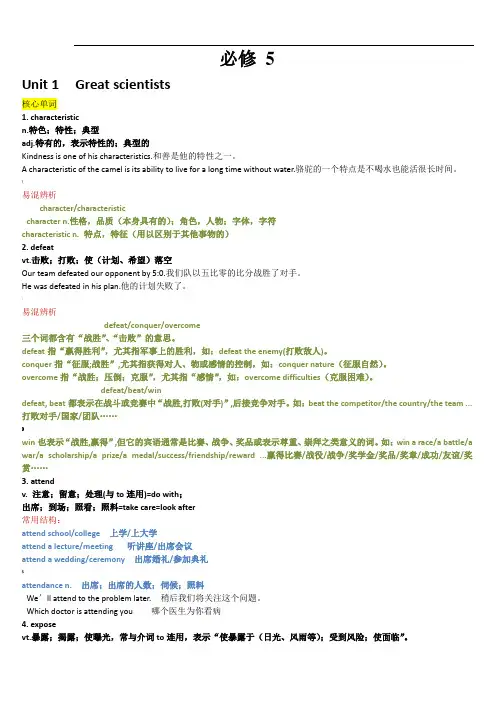
必修5Unit 1 Great scientists核心单词1. characteristicn.特色;特性;典型adj.特有的,表示特性的;典型的Kindness is one of his characteristics.和善是他的特性之一。
A characteristic of the camel is its ability to live for a long time without water.骆驼的一个特点是不喝水也能活很长时间。
\易混辨析character/characteristiccharacter n.性格,品质(本身具有的);角色,人物;字体,字符characteristic n. 特点,特征(用以区别于其他事物的)2. defeatvt.击败;打败;使(计划、希望)落空Our team defeated our opponent by 5:0.我们队以五比零的比分战胜了对手。
He was defeated in his plan.他的计划失败了。
-易混辨析defeat/conquer/overcome三个词都含有“战胜”、“击败”的意思。
defeat指“赢得胜利”,尤其指军事上的胜利,如:defeat the enemy(打败敌人)。
conquer指“征服;战胜”,尤其指获得对人、物或感情的控制,如:conquer nature(征服自然)。
overcome指“战胜;压倒;克服”,尤其指“感情”,如:overcome difficulties(克服困难)。
defeat/beat/windefeat, beat都表示在战斗或竞赛中“战胜,打败(对手)”,后接竞争对手。
如:beat the competitor/the country/the team ...打败对手/国家/团队……》win也表示“战胜,赢得”,但它的宾语通常是比赛、战争、奖品或表示尊重、崇拜之类意义的词。
人教版高中英语必修5_unit_1_单词讲解 精品优选公开课件

• outstanding adj. 杰出的;显著的; • outdoor adj. 户外的,露天的;喜欢户外活
动的
• 14. challenge n.[c] 挑战;怀疑 vt. 向…挑战 • adj. challenging 挑战的;引起挑战性兴趣的
生 break out (战争,疾病等)爆发 • 短语 Tornado Outbreak龙卷风爆发;
disease outbreak疾病爆发 • outlook n. 前景,展望; 见解;景色;眺望处
v. 瞪着看,瞧;比…漂亮;用目光压倒
output n.[c,u] 产量;输出;[计]输出信号 vt. 输出
expose one’s skin to the sun 使皮肤暴露于阳光下
11. deadly adj.极端的,非常的; 致命的, 非常
有效的; 如 a deadly disease 顽症 adv.极其, 非常; deadly serious 十分认真
die vi.死,死亡dying death n.(c,u)死亡,死亡事件 dead adj.死的,无生命的
join in多指参加小规模的活动如“球赛、游戏” 等,常用于日常口语。
join in the football game
• take part in 指参加会议或群众性活动等, 着重说明句子主语参加该项活动并在活动中 发挥积极作用。
• We'll take part in social practice during the summer vacation. 暑假期间我们将参加社 会实践。
高中英语必修五unit1知识点
高中英语必修五unit1知识点高中英语必修五unit1是英语中比较基础的单元,主要学习的是人类发展史和人类文明的进程。
该单元比较重要,需要同学们认真学习。
本文将对该单元中的一些重要知识点进行详细的讲解。
一、词汇学习1. human being:人类,通常指人类共同的品质和能力。
2. migration:迁徙,指人类或动物集群从一个地方到另一个地方的过程。
3. civilization:文明,指一种生活方式,包括政治、社会、文化、经济等方面的进步。
4. Paleolithic Age:旧石器时代,指人类最早的时期,从大约250万年前到1.8万年前。
5. Neolithic Age:新石器时代,指人类的生产力得到提高,人类社会出现了大规模农业的时期,大约在1.0万年前到5000年前左右。
6. Bronze Age:青铜时代,指人类制造青铜器的时代,大约在公元前3000年到公元前1000年之间。
7. Iron Age:铁器时代,指人类制造铁器的时代,大约在公元前1000年到公元前500年之间。
二、语法学习1. 主谓一致:主语和谓语在数上要保持一致。
例如:The history of human beings is rich and interesting. 人类的历史是丰富而有趣的。
2. 时态的使用:需要根据叙述的时间,选择合适的动词时态。
例如:In the past, human beings lived in caves. 过去,人类住在洞穴里。
Today, human beings live in comfortable houses. 现在,人类住在舒适的房子里。
3. 介词的使用:需要正确使用介词,以表达出完整和准确的意思。
例如:The early humans had to struggle against nature. 早期的人类必须与自然斗争。
4. 特殊句子的使用:需要注意特殊句子的使用,例如:If the human beings had not learned to control fire, their development would have been greatly limited. 如果人类没有学会控制火,他们的发展将受到严重限制。
人教版英语必修五第一单元知识点ppt课件
• the way of doing sth.= the way to do … “做….. 的方法”
• 她给我们示范清洗它的办法.
• She showed us the way of cleaning it.= She showed us the way to clean it.
• the way引导的定语从句的引导词有三种, 可以用that;可以用in which;还可以省略.
.
4. So many people pass ___ and never notice
the change.
1.passed from 2. down 3.on 4.by
最新版整理ppt
3
5 Who invented the way of giving electricity to everybody in large cities?是谁发明了把电带给 大城市中的每个人的办法?
• 内行厨师
最新版整理ppt
11
10 attend • (1)to be present at 出席,到场. 如: • attend school 上学 • attend a lecture 听讲座 • attend church 去教堂 • attend (at) a wedding 出席婚礼
(2)to take good care of (a sick person, for example) 照看,照料.如:The doctor attended (on / upon) the
那些都是事实,你能从中得出什么结论?
Conclude (from sth) that (从某事)得出结论
The teacher concluded the class by one sentence.
(人教)高中英语必修五Unit1知识点详解.pdf
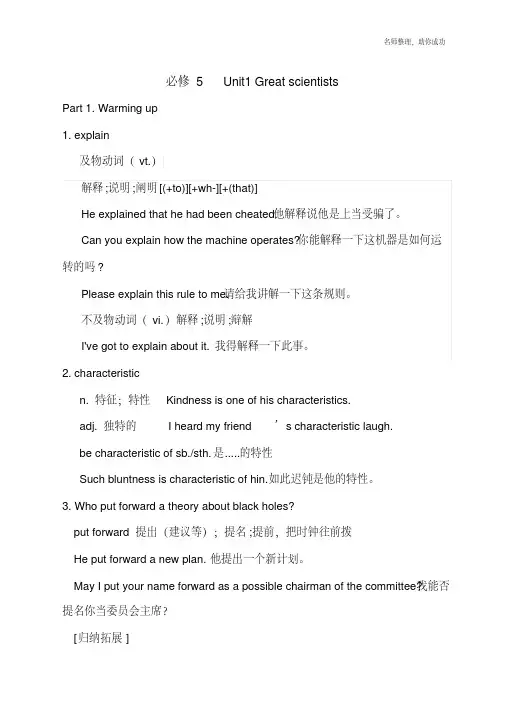
必修5 Unit1 Great scientistsPart 1. Warming up1.explain及物动词(vt.)解释;说明;阐明[(+to)][+wh-][+(that)]He explained that he had been cheated. 他解释说他是上当受骗了。
Can you explain how the machine operates?你能解释一下这机器是如何运转的吗?Please explain this rule to me.请给我讲解一下这条规则。
不及物动词(vi.)解释;说明;辩解I've got to explain about it. 我得解释一下此事。
2.characteristicn. 特征;特性Kindness is one of his characteristics.adj. 独特的I heard my friend’s characteristic laugh.be characteristic of sb./sth. 是.....的特性Such bluntness is characteristic of hin. 如此迟钝是他的特性。
3. Who put forward a theory about black holes?put forward 提出(建议等);提名;提前,把时钟往前拨He put forward a new plan. 他提出一个新计划。
May I put your name forward as a possible chairman of the committee?我能否提名你当委员会主席?[归纳拓展]put down 记下;镇压put out 关掉;熄灭put aside 放在一边;储存;保留put off 推迟;延期put up 建造;举起;张贴put on 穿上put away 收好Part 2. Pre-reading, reading and comprehending1. Do you know how to prove a new idea in scientific researchhow to prove a new idea 为“疑问词+不定式”结构,该结构可在句中作主语、宾语、表语等。
人教版高二英语 必修五unit1 知识点
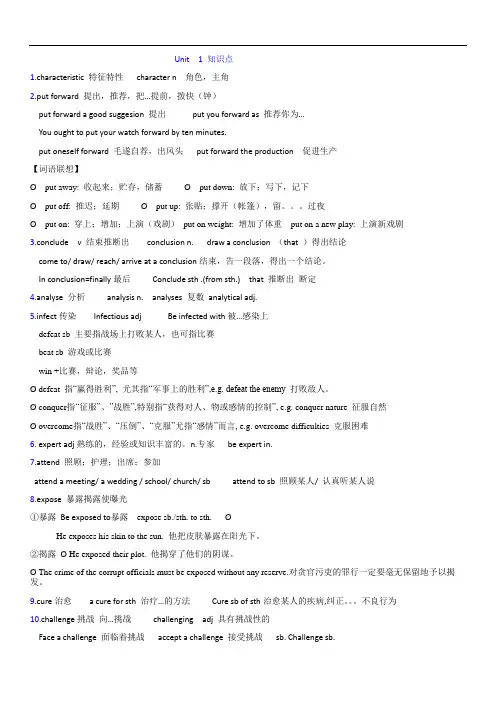
Unit 1 知识点1.characteristic 特征特性character n 角色,主角2.put forward 提出,推荐,把…提前,拨快(钟)put forward a good suggesion 提出put you forward as 推荐你为…You ought to put your watch forward by ten minutes.put oneself forward 毛遂自荐,出风头put forward the production 促进生产【词语联想】Ø put away: 收起来;贮存,储蓄Ø put down: 放下;写下,记下Ø put off: 推迟;延期Ø put up: 张贴;撑开(帐篷),留。
过夜Ø put on: 穿上;增加;上演(戏剧)put on weight: 增加了体重put on a new play: 上演新戏剧3.conclude v 结束推断出conclusion n. draw a conclusion (that )得出结论come to/ draw/ reach/ arrive at a conclusion结束,告一段落,得出一个结论。
In conclusion=finally最后Conclude sth .(from sth.) that 推断出断定4.analyse 分析analysis n. analyses 复数analytical adj.5.infect传染Infectious adj Be infected with被…感染上defeat sb 主要指战场上打败某人,也可指比赛beat sb 游戏或比赛win +比赛,辩论,奖品等Ø defeat 指“赢得胜利”, 尤其指“军事上的胜利”,e.g. defeat the enemy 打败敌人。
人教版高中英语必修5_unit_1_单词讲解 PPT课件 图文
• put away/aside 放在一边;收拾起来;储存 • put down 写下;镇压;放下 • put off 延期,推迟(后接doing) • put on 穿上;(速度、体重)增加;上演 ;假装 • put out 扑灭,熄灭 ;出版 • put up 举起;建造;张贴 • put up with 忍受,忍耐,容忍
6. defeat vt. 打败;战胜;使受挫;n. (c)失败;战胜 • defeat/beat/win这三个单词用法
这三个词都有“赢”的意思,但其用法不尽相同:
(1)defeat和beat用法相同,其宾语必须是 “人或某个集体”。如a team, a class, a school, an army等。注意:defeat侧重在战 场上打败敌人,beat常用于游戏或比赛中, 但在平时运用中常替换使用。
• treat sb. for sth.医治某人的病;还可作“对 待,看待”讲,treat...as把……看作/视为。 (2)cure意为“治愈,痊愈”,特别指病后的恢
复健康。其后可接表示疾病的名词或代词,也可 接sb. of再加表示疾病的名词。另外,还可作“矫 正,纠正”解,借喻指消除社会上某种不良现象
challengeable 挑战性的 • n. (c)challenger 挑战者
15.absorb vt. 吸收,吸进(液体、气体等); 理解,获取(信息);吸引住某人的注意力或 兴趣 absorb water(=take in) 吸收水 absorb what sb. said 理解某人所说的话 absorb one's attention 吸引某人的注意力 be absorbed in... 全神贯注于……
或个人恶习等。 (3)heal意为“治愈”,多用于治愈外伤, 如:wound, cut, injury, burn等。
高二英语人教课标必修5 unit1_知识点讲解.
功能 语法
描述人物(Describing people: characteristics and qualities)
过去分词作定语和表语(The Past Participle as the Attribute and the Predicative)
英语(人教版 ·必修5)
答案:B
课 后 强 化 作 业
英语(人教版 ·必修5) 2.characteristic
重 点 词 汇 重 点 短 语 难 点 解 析
Unit 1
Great scientists
1)adj.~(of sb./sth.) 典型的;独特的;特有的
①Sympathy is the characteristic feeling of mankind. 同情心是人类特有的感情。
Unit 1
Great scientists
重 点 词 汇 重 点 短 语 难 点 解 析
课 后 强 化 作 业
英语(人教版 ·必修5)
Unit 1
Great scientists
重 点 词 汇 重 点 短 语 难 点 解 析
1.discover v. 发现;发觉 ①Columbus discovered American in 1492.
课 后 强 化 作 业
英语(人教版 ·必修5) 活学活用
重 点 词 汇 重 点 短 语 难 点 解 析
Unit 1
Great scientists
Please go and________when the train leaves.
A.find C.discover B.find out D.invent
重 点 词 汇 重 点 短 语 难 点 解 析
(完整版)人教版高中英语必修五Unit1知识点详解
必修5 Unit1 Great scientistsPart 1. Warming up1.explain及物动词(vt.)解释;说明;阐明[(+to)][+wh-][+(that)]He explained that he had been cheated. 他解释说他是上当受骗了。
Can you explain how the machine operates?你能解释一下这机器是如何运转的吗?Please explain this rule to me.请给我讲解一下这条规则。
不及物动词(vi.)解释;说明;辩解I've got to explain about it. 我得解释一下此事。
2.characteristicn. 特征;特性Kindness is one of his characteristics.adj. 独特的I heard my friend’s characteristic laugh.be characteristic of sb./sth. 是.....的特性Such bluntness is characteristic of hin. 如此迟钝是他的特性。
3. Who put forward a theory about black holes?put forward 提出(建议等);提名;提前,把时钟往前拨He put forward a new plan. 他提出一个新计划。
May I put your name forward as a possible chairman of the committee?我能否提名你当委员会主席?[归纳拓展]put down 记下;镇压put out 关掉;熄灭put aside 放在一边;储存;保留put off 推迟;延期put up 建造;举起;张贴put on 穿上put away 收好选词填空(put off, put up, put forward, put aside, put out)①The plan that you _____ at the meeting is wonderful.②Many tall buildings were _____ along the road.③Firefighters have been called to _____ the fire in the city center.④He has a little money to _____ for a rainy day.⑤Don’t _____ until tomorrow what can be done today.Part 2. Pre-reading, reading and comprehending1. Do you know how to prove a new idea in scientific researchhow to prove a new idea 为“疑问词+不定式”结构,该结构可在句中作主语、宾语、表语等。
(完整版)人教版高中英语必修五Unit1知识点详解
必修5 Unit1 Great scientistsPart 1. Warming up1.explain及物动词(vt.)解释;说明;阐明[(+to)][+wh-][+(that)]He explained that he had been cheated. 他解释说他是上当受骗了。
Can you explain how the machine operates?你能解释一下这机器是如何运转的吗?Please explain this rule to me.请给我讲解一下这条规则。
不及物动词(vi.)解释;说明;辩解I've got to explain about it. 我得解释一下此事。
2.characteristicn. 特征;特性Kindness is one of his characteristics.adj. 独特的I heard my friend’s characteristic laugh.be characteristic of sb./sth. 是.....的特性Such bluntness is characteristic of hin. 如此迟钝是他的特性。
3. Who put forward a theory about black holes?put forward 提出(建议等);提名;提前,把时钟往前拨He put forward a new plan. 他提出一个新计划。
May I put your name forward as a possible chairman of the committee?我能否提名你当委员会主席?[归纳拓展]put down 记下;镇压put out 关掉;熄灭put aside 放在一边;储存;保留put off 推迟;延期put up 建造;举起;张贴put on 穿上put away 收好选词填空(put off, put up, put forward, put aside, put out)①The plan that you _____ at the meeting is wonderful.②Many tall buildings were _____ along the road.③Firefighters have been called to _____ the fire in the city center.④He has a little money to _____ for a rainy day.⑤Don’t _____ until tomorrow what can be done today.Part 2. Pre-reading, reading and comprehending1. Do you know how to prove a new idea in scientific researchhow to prove a new idea 为“疑问词+不定式”结构,该结构可在句中作主语、宾语、表语等。