
Unit 2 What time do you go to school 教案
课时教案教学过程Step 1 Say the time1. Show the clocks and ask them: -What’s this in English?-What time is it?2. Show the way how to express the time.Step 2 Presentation1.Show a clock, ask them to say the time2.Show the picture and let them to sayWhat does he do?If they cannot say, let them say in Chinese. Show the English of the action: get up,3.Ask him: What time do you usually get up?To the class: What time does he get up?To show the sentences and read.4.Do the others one by one in the same way.5.Teach ‘take a shower’ and lead them to guess the time that Rick takes ashowerStep 3 Listen and say1.Listen to the tape and fill in the blanks in page66 2a, and choose one to say.2.Listen and complete the tablet.3.Ask them to talk about the shower schedule for Rick’s family.4.Choose some pairs to say.Step 4 Look, listen and match1.Page 65 let them look and match the picture.2.Listen and match the time.3.Show the pictures and let them to say again.Step 5 Interview1.Let them to say the actions they do everyday.2.Show some pictures they may do, and let them try to say English.3.Show the tablet and let them discuss in groups of4.4.Report what they get.Step 6 HomeworkWrite a short passage about the tablet they interviewed作业布置:熟读课文和单词并预习下一节课课时教案教学过程:Step 1 Warming up1.Check their homework and ask some questions from their report:What time does he usually get up?2.Show the time and ask them to say in different ways.3.Show the actions they learnt and ask them to say, then to make a sentence.4.Show 6:30 8:10 11:20 4:15 and ask them to say.Step 2 Presentation(1)Show the new pictures of actions and let them try to say: brush teeth, dohomework, go to bed, wash face,play computer game.2. Ask them to ask and answer in pairs by using the drills in this unit;Choose some pairs to say.Step 3 Listen and circle1.Play the tape and let them to listen to 2a.2.Check and let them spell the words.3.Listen again and write the times 2b.4.Check and let them ask and answer in pairs, and help them to use ‘when’.G ets up at 17:00课时教案教学过程:Step 1 Say the time1. Show the clocks and ask them: -What’s this in English?-What time is it?2. Show the way how to express the time.Step 2 Presentation6.Show a clock, ask them to say the time7.Show the picture and let them to sayWhat does he do?If they cannot say, let them say in Chinese. Show the English of the action: get up,8.Ask him: What time do you usually get up?To the class: What time does he get up?To show the sentences and read.9.Do the others one by one in the same way.10.Teach ‘take a shower’ and lead them to guess the time that Rick takes ashowerStep 3 Listen and say5.Listen to the tape and fill in the blanks in page66 2a, and choose one to say.6.Listen and complete the tablet.7.Ask them to talk about the shower schedule for Rick’s family.8.Choose some pairs to say.Step 4 Look, listen and match4.Page 65 let them look and match the picture.5.Listen and match the time.6.Show the pictures and let them to say again.Step 5 Interview5.Let them to say the actions they do everyday.6.Show some pictures they may do, and let them try to say English.7.Show the tablet and let them discuss in groups of 4.8.Report what they get.Step 6 HomeworkWrite a short passage about the tablet they interviewed作业布置:抄写第二单元的语法课时教案教学过程:Step 1 Check their homeworkChoose some students to tell us the Sunday schedule and collect itStep 2 Self check1.Page 70 part 1,Let them to finish it.2.Have a dictation.Step 3 Desi gn a survey1. According to the knowledge, let them to design a survey.2. Write down on page 70.3. Ask some students to do it orally.Step 4 Game(1)Divide them into three groups, and write the name, time and actions on thepaper.(2)Collect them into three boxes, and ask students to choose, then make a sentence.(3)If he is right, his group will get one flag.Step 5 Culture notes1.Read through ‘just for fun’.2.Discuss in groups.3.Tell us what happened.Step 5 HomeworkArrange your class in a weekMonday. Tuesday Wednesday Thursday Friday7:30-8:10Break time作业布置:预习第三单元。
人教版七下 Unit 2 What time do you go to school?知识点总结
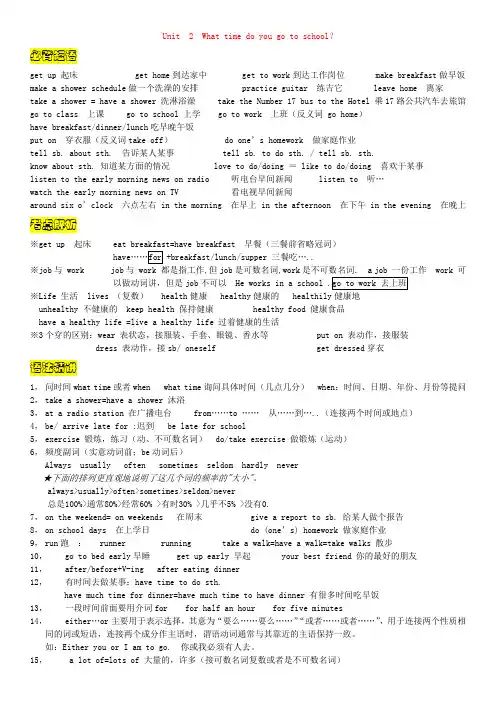
Unit 2 What time do you go to school?必背短语get up 起床 get home到达家中 get to work到达工作岗位 make breakfast做早饭make a shower schedule做一个洗澡的安排 practice guitar 练吉它 leave home 离家take a shower = have a shower 洗淋浴澡 take the Number 17 bus to the Hotel 乘17路公共汽车去旅馆go to class 上课 go to school 上学 go to work 上班(反义词 go home)have breakfast/dinner/lunch吃早晚午饭put on 穿衣服(反义词take off) do one’s homework 做家庭作业tell sb. about sth. 告诉某人某事 tell sb. to do sth. / tell sb. sth.know about sth. 知道某方面的情况 love to do/doing = like to do/doing 喜欢干某事listen to the early morning news on radio 听电台早间新闻 listen to 听…watch the early morning news on TV 看电视早间新闻around six o’clock 六点左右 in the morning 在早上 in the afternoon 在下午 in the evening 在晚上考点解析※get up 起床 eat breakfast=have breakfast 早餐(三餐前省略冠词)have三餐吃…..※job与 work job与 work 都是指工作,但job是可数名词,work是不可数名词. a job 一份工作 work 可以做动词讲,但是job不可以※Life 生活 lives (复数) health健康 healthy健康的 healthily健康地unhealthy 不健康的 keep health 保持健康 healthy food 健康食品have a healthy life =live a healthy life 过着健康的生活※3个穿的区别:wear 表状态,接服装、手套、眼镜、香水等 put on 表动作,接服装dress 表动作,接sb/ oneself get dressed穿衣语法精讲1,问时间what time或者when what time询问具体时间(几点几分) when:时间、日期、年份、月份等提问2,take a shower=have a shower 沐浴3,at a radio station 在广播电台 from……to ……从……到…..(连接两个时间或地点)4,be/ arrive late for :迟到 be late for school5,exercise 锻炼,练习(动、不可数名词) do/take exercise 做锻炼(运动)6,频度副词(实意动词前;be动词后)Always usually often sometimes seldom hardly never★下面的排列更直观地说明了这几个词的频率的"大小"。
初中英语七年级下册 Unit2 what time do you go to school

always
usually
often
sometimes
never
频度副词的位置
频度副词通常位于实义动词之前,be动词之后:
Tom is always late for school.
Mary doesn’t often help her friends.
___________________________________
4) _______________________________?
Anna never eats breakfast.
5) What time does your best friend go to school?
_________________________________
Jenny: I usually get up at 7:00.
You: What time do you exercise?
Jenny: I usually exercise at eight.
You: What time do you usually eat dinner?
Jenny: I usually eat dinner at 6:30.
人教版英语科目第二单元第二课时教学设计
Unit 2 What time do you go to school?
Section A (Grammar Focus-3c)
课题
Unit 2 What time do you go to school?
单元
第二单元
学科
英语
年级
七年级下册
Unit 2 What time do you go to school 教学设计

5. My father usually________(go) to work at 7:00.
(三)选择
1. Rick _____ early mornig news on TV.
A. sees B. reads C. watches D. have
希望、祝愿________
4、完成3a。
翻译下列句子:
1)感谢你的来信。_______ _______ your letter.
2)你想了解我的早晨吗? Do you ______ to _________ _________ my morning?
3)我通常大概在七点整去上班。I usually ______ to work__________ _________ 7:00.
__________________________________________________________________
今天的疑问:__________________________________________________________________
__________________________________________________________________
b. Who it the letter from?
c. Does she often eat breakfast at seven?
d. When does she usually go to school?
3.完成3b和4。
【整理学案】
今天发了_____次言
今天的收获:__________________________________________________________________
Unit2 What time do you go to school 教案1
Unit2 What time do you go to school?第一课时Teaching goals:Ss master the basic words about daily activities.Ss know how to express time briefly.Ss can talk about rountines.Train Ss’s interests in taking part in the activities.Teaching Important Points:the study of verb phrases (talk about daily abilities)the new sentence pattern”What time do you usually……?”and its answer to its time.Teaching Difficult Points:Ask and say times.( how to express time)Teaching Aids:book tape PPT chalk blackboardBlackboard Design:get up What time do you usually…..?go to school I usually…..atget dressed When do you……?brush teeth I…..at…….eat breakfasttake a showerTeaching Procedures:Step1: show the daily activities verb by PPT (pictures)(get up go to school get dressed brush teeth eat breakfast )Teacher---lead readStudents-----select to readStep2: check the wordsFinish 1a in the book( Match the activities with the pictures )Pair check class checkStep3: 1. Finish 1b, listen and match the times with the actions. Draw lines from the clocks to the picture.2. lead the sentence by these pictures“ What time do you usually take a shower/?I usually take a shower at six forty.3. practice it with deskmateAsk 3 groups to check.Step4: let Ss learn how to express time3 situations then exercisesStep5: 1.a summary by PPTAsk some students to conclude what they learnt in this class.2. Do a survey( homework )Reflection:第二课时Teaching goals:Ss master the usage of frequency wordsSs can put the frequency words to use.Train Ss’ listening ability.Teaching Important Points:Do 2a and 2b in the book to select important information.the usage of frequency wordsTeaching Difficult Points:Let Ss use the frequency words to make some sentences of their own.. Teaching Aids:book tape PPT chalk blackboardBlackboard Design:Frequency words: always usually often seldom never Teaching Procedures:Step1: review what we have learnt last class1.check the daily activities phrases (write it on the paper)2.practice the sentence” What time do you usually….?”Step2: Do the Listening1.2a: Listen to the conversation and complete the sentences.2.Listen again. Complete the shower schedule for Jim’sfamily. (group check)3.Listen and repeat after the tape.Boys: A Girls: B then exchange to read4.Now talk about yourself. (group work)A: What time do you usually get up?B: I usually get up at six thirty.C: I never get up so early.Step3: How many frequency words have you heard?Lead always often usually sometimes seldom neverUse figure to show its exact meanings by PPTThen do exercisesStep4: HomeworkWrite about something you always do, something you usually do,and something you never do.Reflection:第三课时Teaching goals:Ss master the words about morning, afternoon and evening.Ss know the difference between am and pmTrain Ss have a reasonable plan for their day.Teaching Important Points:the difference between am and pmTeaching Difficult Points:Do the listening (1b and 1c)Teaching Aids:book tape PPT chalk blackboardBlackboard Design:Morning afternoon eveningTeaching Procedures:Step1: 1.a guessing game (human being)2.review how to express time and the frequency words.Step2: 1.How can you show the difference between two o’clock in the morning and two o’clock in the afternoonLead in a.m. and p.m. related to three periods in a day2 Do 1a in P10. Match the activities with the time of a day. Step3: Do the listening1.Listen and circle the activities you hear.2.Listen again. Write the times next to the activities youcircled in 1c.3.Listen and repeat.(boys and girls)4.ask and answer questions about Tom.When does Tom usually get up///?He usually gets up at half past five///.Reflection:第四课时Teaching goals:Ss can express what their daily rountine.Ss should master the language points given by PPTTrain Ss to develop a healthy life style.Teaching Important points:Ss can read the Tony and Mary’s daily life in 2b.SS can understand the language points in 2bTeaching Diffficult Points:Let Ss number the sentences to make a story.Ss can write down their own daily rountine.Teaching Aids:book tape PPT chalk blackboardBlackboard Design:What time / when …e.g. When do you go to school?What time do you go to school?listen to hear look at see look for findTeaching Procedures:Step1: Finish 2a: Check the activities you think are healthy..Step2: Look at a series of pictures of Tony’s daily life by PPT.Let ss have a brief understanding of the passage.Step3: 1. Finish 2b( circle the healthy activities.)2.Write down the unhealthy habits of each person. Then thinkof healthy activities for them.3.Learn important language points:get…make/eat/haveget home lunchget to school dinnerget to work supperget upget readyStep4: Exercise3a. Number the sentences in order to make a storyStep5: WritingWrite about your own daily rountine based on the passage.Step6: Homework:Finish self check after class. Reflection:。
Whattimedoyougotoschool教案
have Chinese class
第3页
What time is it?
a quarter past seven seven fifteen
At this time, what do you do ?
第4页
get up
have breakfast
第5页
1a When do students usually do these things?
第10页
1c Listen and circle the activities you hear.
1. get up 2. run 3.eat breakfast 4.go to school 5.go home
6. do my homework 7. clean my room 8. eat dinner 9. take a walk 10. go to bed
第11页
1d Listen again. Write the times next to the
activities you circled in 1c.
1. get up
___5_:_3_0__ 6. do my homework _5_:3_0__p_.m__.
2.run
_6_:_0_0_a_._m_. 7. clean my room ________
第16页
组词成句:
1. time,is,it,what?
What time is it
?
2. does,get,up,she,time,usually,what?
What time does she usually get up
?
3. volleyball,he,time,what,play,does?
Unit2WhattimedoyougotoschoolSectionA(1a-2d)课件(完整版)

答案: 4. brush teeth 5. take a shower 6. eat breakfast
Ⅱ. 句型展示
1. 你通常几点起床?
do you
?
2. 他在一家广播电台工作。
He
a radio
.
3. 那个时间吃早饭真有意思!
That’s a
breakfast!
答案: 1. What time; usually get up 2. works at; station
②We have an English class on Monday morning. (对画线部分 提问)
do you
an English class?
答案: ①What time ②When; have
2. He works at a radio station. 他在一家广播电台工作。 【自主领悟】work在此作不及物动词, 意为“工作”, 其后常接 地点状语或时间状语。例如: My father works in a factory. 我爸爸在一家工厂工作。
Unit 2 What time do you go to school? Section A(1a-2d)
Ⅰ. 选词配图 get dressed go to school brush teeth eat breakfast get up take a shower
答案: 1. get up 2. go to school 3. get dressed
C. go to the work D. go to home
4. —Do you get a
?
—Yes, I
in a hotel.
A. work; work B. job; job
Unit 2 What time do you go to school英语人教版七年级下册精品课件
Lead in: Can you read the times?
What time is it , please?
It’s two o five . It’s five past two.
What time is it , please?
It’s three ten . It’s ten past three .
What time does Rick eat He eats breakfast at seven
breakfast?
o’clock.
When does Scott go to
work?
When do your friends
exercise?
what time和when都 可用来提问时间, 他 们的用法有何异同?
Unit 2 What time do you go to
school?
Section A Grammar Focus3c
Objects:
To learn to ask and answer What time questions. To learn to ask about and say times. To learn to use adverbs of frequency.
巧记:频度副词在句中的位置
➢ 频度副词很重要,句中位置要记牢; ➢ 放在实义动词前,助、be、情态动词后; ➢ sometimes最活跃,句首、句中、句末均可找。
拓展
➢ 对频度副词提问,用how often, 意为“多久一次”。
例:——你姐姐多久打一次篮球? ——她从不打篮球。 —How often does your sister play basketball? —She never plays basketball.
七年级下 Unit 2 what time do you go to school 教案(全)
人教版七年级英语下册B Unit 2 What time do you go to school?教案一.单元分析本单元以学生最为熟悉的日常作息习惯为谈论话题,通过对句型:(---What time is it? ---It is six .)---What time do you usually get up?---I usually get up at six a.m. 谈论daily routines并练习时间的表达和询问方式,同时逐步的培养学生合理安排时间的能力。
整个单元以谈论日常作息时间安排为主线,将日常生活中所涉及到的语言、词汇和时间的表达法融入一系列的小任务中,七年级学生通过完成一个个的任务达到交际的目的,从而能够合理的安排自己的作息时间;且初步了解时差。
二.学情分析学生通过前段时间的学习,对一般现在时态的用法已经有了一定的语感和模仿运用的能力,也能够用简单的英语表达个人意见。
通过本单元学习能基本掌握时间的表达法并能用英语谈论作息时间安排。
三.课时安排四课时四.教学过程Period 1 (A1a-2c)I. Teaching Objectives1. Knowledge Objectives:(1) Expressions: up, get up, dress, get dressed, brush, tooth/teeth, shower, take a shower, usually,forty, wow, never, early, fifty, o’clock, half.(past, to)(2) Structure: ---What time is it? ---It is six.---What time do you usually get up? ---I usually get up at six a.m.3) Grammar: what time questions2. Ability Objectives:(1) Learn how to express the time.(2) Get Ss to ask about and say times.(3) Let Ss use what time questions.(4) Let Ss have the first understanding of always, usually and never.3. Moral Objectives: Time waits for no man.II. Teaching Importance(focus)(1) Learn how to press the time.(2) Get Ss to ask about and say times.(3) Let Ss to use what time questions.III. Teaching Difficulties1. 三种表达时间的方法,学生对past,to来表达时间会有可能混淆。
七年级新目标下Unit_2_What_time_do_you_go_to_school教案
Unit 2 What time do you go to school?耿晶1. 教材分析本单元以Daily routinesand times为话题,共设计了三个部分的内容。
旨在通过单元教学使学生学会谈论日常行为、询问并答复有关时间的问题、询问并回答人们在特定时间所从事的活动。
Section A 学习谈论日常作息时间。
1a, 1b, 1c 重点学习和学生息息相关的几种日常行为的英文表示方法,学会询问和答复日常作息时间。
2a, 2b, 2c ,2d继续学习谈论自己或他人的日常作息时间。
重点学习如何询问,这也是本单元的语法重点。
3a, 3b, 3c 学会叙述他人的日常活动安排,同时学习询问时间和时间表达法,进一步巩固询问别人的日常作息时间的表达法。
Section B 继续学习询问和谈论别人的日常行为。
1a, 1b, 2a, 1c,1d,1e,学会谈论和询问一天内各个时间段的活动安排。
2a,2b,3a,3b学会通过两个人的对比介绍来判断并养成好的作息时间。
Self check 重点单词句型复习2. 课型设计与课时分配Period 1 Listening and speaking (I)(Section A: 1a, 1b, 1c)Period 2 Listening and speaking (II)(Section A:2a, 2b, 2c,2d)Period 3 Integrating skills(Section A:3a, 3b, 3cSection B: 1a, 1b,1c,1d,1e)Period 4 Reading and writing(Section B:2a, 2b, 2c,3a,3b)Period 5 Self checkⅢ. Teaching plans for each periodPeriod 1 Listening and speaking(Ⅰ) Target language目标语言1. Words && phrases生词和短语Up,get up,dress,get dressed,brush,tooth,shower,take a shower,usually,forty, what time,2. Key sentences重点句子When do people usually ...? People usually ...What time do you usually ...? I usually ...Ability goals能力目标Enable students to learn to talk about daily routines.Learning ability goals学能目标Help the students learn how to talk about daily routines.Teaching important / difficult points教学重难点How to talk about daily routines.Teaching aids教具准备A tape recorder and a model clock.Teaching procedures and ways教学过程与方式Step ⅠWarming upIn this procedure, motivate students to learn some words and phrases by singing the songs they’ve learned before.T: Good morning, everyone. (sing) “Good morning to you. Good morning to you. Good morning, dear children. Good morning to you.” This song is easy to learn. Who can sing it to us?Encourage students to sing the song.T: Well done. Thank you! We sing “Good morning to you” in the morning. Then what do we sing in the afternoon and in the evening? S: We sing Good afternoon to you in the afternoon and Good evening to you in the evening.T: That’s right. I know all of you are very good at singing. Does anyone want to sing Good afternoon to you or Good evening to you to us?Step ⅡTalking and reading (1a)In this procedure, ask students to finish the required task and learn some key phrases about daily actions.T: As we all know, time is very important and in English there is a famous saying "An hour in the morning is worth two in the evening." So what do you do in the morning?S1: I read English. S2: I do morning exercise.T: And what do you do in the afternoon and in the evening?S1: I play basketball in the afternoon. S2: I watch TV in the evening.T: I’m very glad to hear that. You use your time very well. And there’re many daily things we can do. Now let’s read these phrases in 1a and match these actions and the time of day.Step ⅢPracticeIn this procedure, students will learn how to talk about actions and the time of day.T: I know you’re very clever. Now I want you to tell if my statements are right or wrong. First, I usually eat dinner in the morning. S: Wrong.T: When do I usually eat dinner? S: In the evening.T: Second, she gets up at 19:00 in the morning. S: Wrong.T: What is the correct way of saying the sentence? S: She gets up at 7:00 in the morning.T: How clever you are! Now let’s read the conversation in groups and see which group reads better.Ask students to do pairwork.T: Please ask your partner when people usually do these things: do homework, eat dinner, eat breakfast and go to bed.(Write “When do people usually ...”on the blackboard)Sample dialogue:S1: When do people usually do homework?S2: People usually do homework in the afternoon.Interest the students in going on practicing the conversation using a new way of reading.T: Now let’s try a new way of reading. First I name one student to ask a question, and then ask all of you repeat this question together. After that, I name another student to answer this question, and all of you repeat the answer together.Sample dialogue:S1: When do people usually go to bed?S: When do people usually go to bed?S2: People usually go to bed in the evening.S: People usually go to bed in the evening.Step ⅣTalking about time (1c)In this procedure, students will learn how to ask about and say hour times and learn some key phrases about daily routines.T: Boys and girls, please listen to what I’m saying and guess what it is. 小小骏马不停蹄,日日夜夜不休息,蹄声哒哒似战鼓,提醒人们争朝夕。
unit2 what time do you go to school教案
课题Unit2 What time do yougo to school?(2) 2a-3c课型New 教具录音机时间周次课时第二周第二课时总6节教材解读本节课是第二单元的第二课时,是对上一节课的复习和巩固;通过本节课的学习,同学们能够进一步的完善学习不同时间店的表达方式,合理安排作息,提高听说能力。
教学目标知识和能力:过程和方法:情感态度和价值观:教学重难点1.熟练拼写和运用重点单词和短语。
2.运用when和what time引导的特殊疑问句询问时间。
教学内容及流程学生学习活动教师指导活动时间1.情境导入(1)问候全班(2)(1)问候全班(2)检查上一节课的作业。
3’2.教学2a,2b,2c (1)学生听录音,完成2a。
(2)再次播放录音,学生完成2b。
(3)最后播放一次录音,让学生集体检查和更正答案。
(4)根据录音内容,学生两人一组谈论:Whattime do you usually getup?(1)播放录音前,让学生看好要求。
(2)播放录音。
(3)检验答案。
3.教学2d (1)学生自己选择角色扮演:一个是Interviewer,另一个是Scott。
(2)几组学生上台展示。
(1)选几组学生上台演示。
(2)对表演较出色的学生老师给予适当的奖励,以激发学生学习英语的兴趣。
4.学习Crammer Focus 小组讨论他们所学到的谈论自己及他人的日常生活及日常作息习惯的句型。
教师可补充说明when和what time的区别5.巩固和发展(1)完成3a的练习。
学生要注意品读副词的正确使用,可采取小组探究。
(2)个人活动完成3b。
(3)两人活动完成3c。
指导学生完成3a的练习,要求学生根据所学到的对话句式来进行补全对话。
对于有难度的句子老师可适当解释。
6.小结几名学生总结本节课他们所学到的,其他同学补充说明。
如果不够完整,教师给予补充7.布置作业熟练掌握Crammer Focus中的句子。
板书设计Unit 2 What time do you go to school?(2) 2a-3cWhat time do you usually get up? I usually get up at six thirty.When does Scott go to work? He always goes to work at eleveno’clock.教学后记。