
2015新牛津译林版五年级英语上册1-4单元语法知识点归纳
2015新牛津译林版五年级英语上册1-4单元语法知识点归纳Unit1
1.There be句型表示“某处有某物”,be动词用is还是用are遵循下面的原则:
①be动词后面如果跟的是单数名词或不可数名词,就用is;
There is a pencil case in the school bag.
There is some soup/milk
/tea/coffee/juice/water/chocolate.
② be动词后面如果跟的是可数名词的复数,就用are.
There are some desks in the classroom.
③be动词后面如果跟的是不止一种物品,就根据离它最近的物品选用is或are.(就近原则)
There are some pictures and a telephone.
There is a telephone and some pictures.
2.There be 句型的否定形式:在be动词的后面加not(is not可以缩写为isn't,are not可以缩写为 aren't)把some 改成any。
例:There is a pencil in the pencil-box.(改为否定句)There isn't a pencil in the pencil-box.
There are some crayons on the desk.(改为否定句)
There aren't any crayons on the desk.
3.“some”和“any”都有“一些”的意思.“some”一般用于肯定句,“any”用于否定句和一般疑问句。
但在一些表示委婉请求,
想得到对方肯定回答的疑问句中,也用“some”.
例:1.There are some watermelons in the basket.(肯定句)
2.There aren't any birds in the tree.(否定句)
3.Are there any toy trains on the table?(疑问句)
4.Would you like some tea?(表委婉请求)
4.can在否定句中的用法:表示某人不能做某事时,通常在can后面加否定词not,注意not一般与can连写,也可缩写成can’t.后面加动词原形。
Bobby cannot(can’t) see any cakes in the fridge.
Unit2
1. There be句型的一般疑问句:
将be动词提前到there 之前,首字母大写,句末用问号即可。
其肯定答语为“Yes,there is/are.”;否定答语为“No,there
isn’t/aren’t.”。
在疑问句中,要将some改为any。
1)There is a house near the park. (改为一般疑问句,并肯定回答)
Is there a house near the park? Yes , there is.
2)There are some desks and chairs in the classroom.
(改为一般疑问句,并否定回答)
Are there any desks and chairs in the classroom?No , there aren't.
2.特殊疑问句及答语
(1)提问主语为可数名词的数量时,用“how many”,句型结构为:
‘How many +复数名词+are there+其他?’(无论主语是单数还是复数)
There is a football under the desk.(对划线部分提
问)
How many footballs are there under the desk?
“How many+可数名词复数+are there?”本句型为there be句型的特殊疑问句形式,表示“在某处某物的数量有多少?”。
回答时不用Yes/No,要给出具体的回答。
How many days are there in a month? There are thirty.
(2)提问句子的主语(包括主语前的修饰语)时,句型一律用“What is+地点介词短语?”(无论主语是单数还是复数都用is)例:There are some bananas on the tree.
What’s on the tree?
3.序数词:表示先后顺序或等级的词。
first(第一),second(第二),third(第三),序数词用在句中时,要在其前面加上定冠词the.
4. on the…floor意为“在几楼”用介词“on”
5.It is time for+名词= It is time to+动词;是该做某事的时候了。
It is time for lunch.= It is time to have lunch.
6. 宾格 :动词和介词后面用人称代词的宾格。
I –me, you-you , he –him, she –her, they- them
follow me/him/her listen to me/him/her help me/him/her find him/her
Unit3
1.have / has 用法:have 可用于第三人称单数之外的所有人称之后,has 只能用于第三人称单数之后。
have / has 的肯定句结构为:
(1)主语(除第三人称单数)+ have + 某物。
(2)主语(第三人称单数)+ has+某物。
have / has 的一般疑问句结构为:
(1)Do+ 主语(除第三人称单数)+ have+ 某物?
(2)Does +主语(第三人称单数)+have +某物?
have / has 的否定句结构为:
(1)主语(除第三人称单数)+ don’t+ have + 某物。
(2)主语(第三人称单数)+ doesn’t+ have + 某物。
2.can +动词原形
Unit4
1. like + doing sth动词接ing:
(1).一般在动词末尾加ing,如:think → thinking stand → standing
(2).以不发音字母e结尾的动词,先去掉e,再加ing,如skate → skating make → making dance → dancing write → writing have → having ride → riding come → coming (3).以重读闭音节结尾的动词,末尾只有一个元音字母(闭音节),以及一个辅音字母,应双写末尾的辅音字母,再加ing, 如: put
→putting run-running swim → swimming jog → jogging sit → sitting
作文范例 My hobbies
I have many hobbies . I like watching films . I often watch films on Sundays with my friends, I like reading too. I like reading storybooks. I like my hobbies.
My friend’s hobbies
Nancy likes listening to music. She likes singing and dancing. Tom likes playing basketball . He is good at playing basketball. Su Hai and Su Yang like watching films. They like their hobbies.。
译林版五年级上册英语1-4单元单词和短语
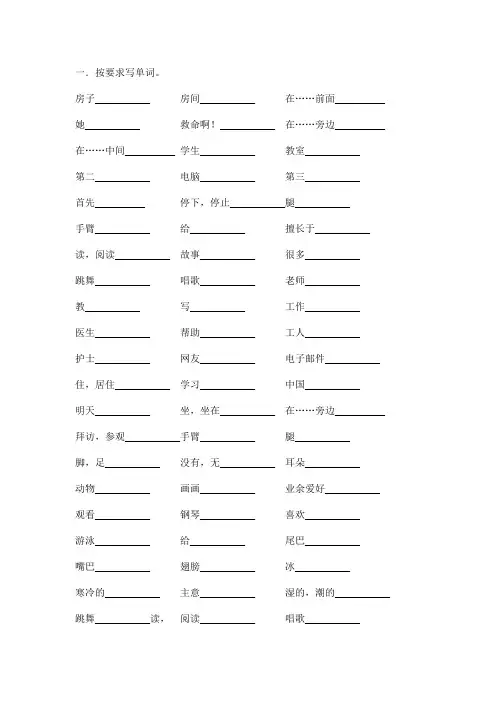
一.按要求写单词。
房子___________房间___________在……前面__________她___________救命啊!___________在……旁边__________在……中间__________学生___________教室___________第二___________电脑___________第三___________首先__________停下,停止___________腿___________手臂___________给___________擅长于___________读,阅读___________故事___________很多___________跳舞___________唱歌___________老师___________教___________写___________工作___________医生___________帮助___________工人___________护士___________网友___________电子邮件___________住,居住___________学习___________中国___________明天___________坐,坐在___________在……旁边__________拜访,参观___________手臂___________腿___________脚,足___________没有,无___________耳朵___________动物___________画画___________业余爱好___________观看___________钢琴___________喜欢___________游泳___________给___________尾巴___________嘴巴___________翅膀___________冰___________寒冷的___________主意___________湿的,潮的___________跳舞___________读,阅读___________唱歌___________重的,沉的___________ 推___________ 停下,停止___________高的___________ 硬的___________ 汤___________柔软的___________ 找到,发现___________热的___________(与be连用)有___________第三___________ 电脑___________秋千___________ 很多的,极大的___________. ....旁边___________ . ....中间___________ 房子___________ 房间___________她(宾格)___________ 熊___________ 学生___________教室___________ 第一;首先___________ 第二___________二.按要求写短语。
最新牛津译林版五年级上册英语U1-U4复习资料

最新⽜津译林版五年级上册英语U1-U4复习资料Unit 1 Review the phrases1.在森林⾥in the forest2.在桌⼦上on the table3.在房间⾥in the room4.⼜累⼜渴tired and thirsty5.饥寒交迫hungry and cold6.害怕be afraid7.害怕熊be afraid of bear s8.在她前⾯in front of her9.在房⼦旁beside the house10.在课桌中间between the desk s11.在你和我中间between you and me12.⼀些热汤some hot soup13.正好just right14.太硬too hard15.真软so softRead and translate1.put on your coats 穿上你们的外套2.in the kitchen 在厨房⾥3.in the fridge 在冰箱⾥4.find their cousin 找到他们的表弟5.Really? 真的吗?6.Coffee is popular in Western countres.咖啡在西⽅国家流⾏。
7.Tea is popular in China.茶在中国流⾏。
8.Hamburgers are popular in Western countries.汉堡在西⽅国家流⾏。
9.Noodles are popular in China.⾯条在中国流⾏。
Ask and anwer1.What’s in the forest?2.What’s on the table?4.Finally, how is Goldilocks? Why?Read and thinkBobby is h_____. He can h_____ some cakes in the k______. But there a_____ any cakes in the f______. Why? Because t_____ cousin eats the cakes now.语法知识整理1.What’s +地点问?There be 句型答例:What’s in your classroom?There is a computer.区分:What’s this/ that?It’s a comp uter.2.感叹句What a beautiful house!=How beautiful the house is!What+名词词组How+形容词3.very 很so 真too 太very hard 很硬so hard 真硬too hard 太硬4.be afraid 害怕be afraid of bears 害怕熊We are afraid of bears.我们害怕熊。
五年级上册1-4单元重点单词和句型填空牛津译林版英语
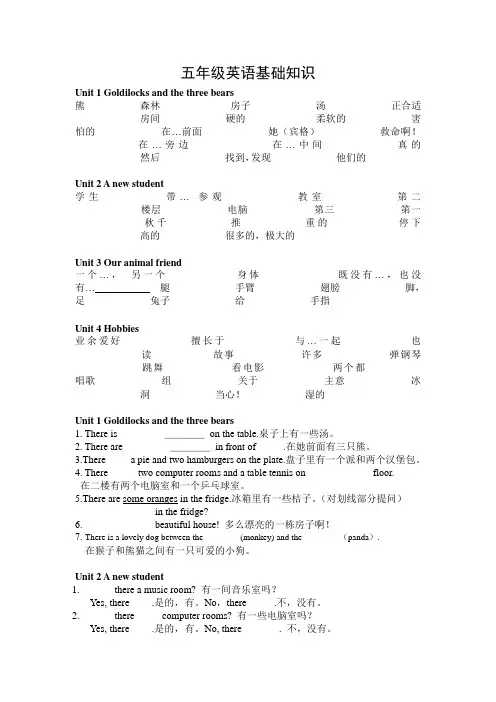
五年级英语基础知识Unit 1 Goldilocks and the three bears熊___________森林___________ 房子___________ 汤___________ 正合适___________ 房间___________ 硬的___________ 柔软的___________ 害怕的___________ 在…前面___________ 她(宾格)___________ 救命啊!___________ 在…旁边___________ 在…中间___________ 真的___________ 然后___________ 找到,发现___________ 他们的___________ Unit 2 A new student学生___________ 带… 参观___________ 教室___________ 第二___________ 楼层___________ 电脑___________ 第三___________ 第一___________ 秋千___________ 推___________ 重的___________ 停下___________ 高的___________ 很多的,极大的___________Unit 3 Our animal friend一个…,另一个___________ 身体___________ 既没有…,也没有…___________ 腿___________ 手臂___________ 翅膀___________ 脚,足___________ 兔子___________ 给___________ 手指___________Unit 4 Hobbies业余爱好___________ 擅长于___________ 与…一起___________ 也___________ 读___________ 故事___________ 许多___________ 弹钢琴___________ 跳舞___________ 看电影___________ 两个都___________ 唱歌___________ 组___________ 关于___________ 主意___________ 冰___________ 洞___________ 当心!___________ 湿的___________Unit 1 Goldilocks and the three bears1. There is ___________on the table.桌子上有一些汤。
江苏译林(牛津)版英语五年级上册知识点整理讲课教案

江苏译林(牛津)版英语五年级上册知识点整理Unit1Goldilocks and the three bears一、单词(默写)1.bear熊2.forest森林3.there(与be连用)有4.house房子5.soup汤6.just right正合适7.room房间8.hard硬的9.soft柔软的10.afraid害怕的11.their他们的12.her她(宾格)13.help救命14.beside在……旁边15.between在……中间16.really真正地17.then然后18.find找到,发现19.in front of在……前面二、词组(默写)1、in the forest在森林里2、a beautiful house一座漂亮的房子3、hungry and thirsty又饿又渴4、some soup一些汤5、too cold/hot太冷/热6、in the room在房间里7、too hard/soft 太硬/软8、three bears三只熊9、have some cakes吃些蛋糕10、in the kitchen在厨11、in the fridge 在冰箱里12、find their cousin发现他们的表弟三、句型(默写)1.There is a house in the forest.在森林里有一个房子。
2.There is some soup on the table.在桌子上有一些汤。
3.There are three bears in front of her.在她前面有三只熊。
4.This soup is too cold.这汤太冷了。
5.What a beautiful house!多么漂亮的房子!6.She is hungry and thirsty.她是又饿又渴。
7.Bobby cannot(can’t)see any cakes in the fridge.波比看不到冰箱里有蛋糕。
新译林英语五年级上册U1-4单元知识归纳
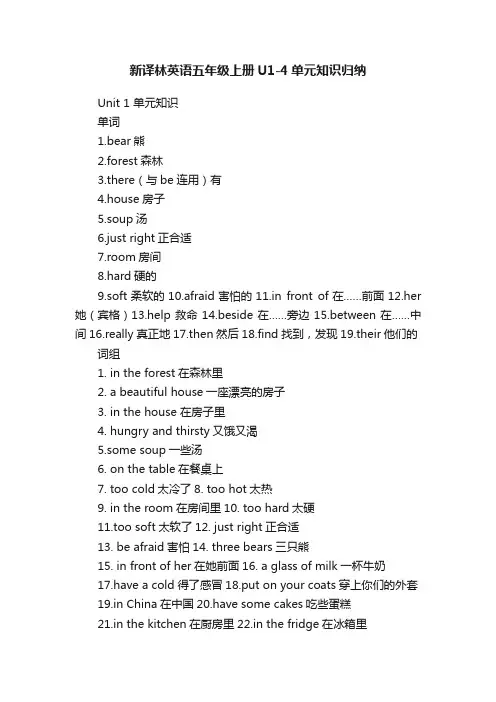
新译林英语五年级上册U1-4单元知识归纳Unit 1 单元知识单词1.bear熊2.forest森林3.there(与be连用)有4.house房子5.soup汤6.just right正合适7.room房间8.hard硬的9.soft柔软的10.afraid害怕的11.in front of在……前面12.her 她(宾格)13.help救命14.beside在……旁边15.between在……中间16.really真正地17.then然后18.find找到,发现19.their他们的词组1. in the forest在森林里2. a beautiful house一座漂亮的房子3. in the house 在房子里4. hungry and thirsty又饿又渴5.some soup一些汤6. on the table在餐桌上7. too cold太冷了8. too hot太热9. in the room在房间里10. too hard太硬11.too soft太软了12. just right正合适13. be afraid害怕14. three bears三只熊15. in front of her在她前面16. a glass of milk一杯牛奶17.have a cold得了感冒18.put on your coats穿上你们的外套19.in China在中国20.have some cakes吃些蛋糕21.in the kitchen在厨房里22.in the fridge在冰箱里23.between the windows and the door在窗户和门之间24.find their cousin找到他们的表弟句型1. There is a house in the forest.在森林里有一个房子。
2. There is some soup on the table.在桌子上有一些汤。
译林版五年级英语上册语法要点梳理

译林版五年级英语上册语法要点梳理1. 一般现在时- 表示经常发生的动作或存在的状态,或者陈述普遍真理。
- 动词原形作谓语。
- 表示第三人称单数时,动词加-s或-es。
2. 一般过去时- 表示过去某个时间发生的动作或存在的状态。
- 动词过去式作谓语。
- 表示动词是不规则变化的过去式时,需熟记其过去式形式。
3. 现在进行时- 表示现在进行或发生的动作。
- 助动词be的各种形式与动词的现在分词形式连用。
4. 一般将来时- 表示将来要发生的动作或存在的状态。
- 助动词will与动词原形连用。
5. 可数名词和不可数名词- 可数名词可以用来表示一个或多个,可以用a或an修饰单数形式,也可以用数词修饰。
- 不可数名词表示无法分割的事物或抽象概念,通常不能用a或an修饰,也不能用数词修饰。
6. 形容词比较级- 形容词比较两个或多个人或事物的程度。
- 形容词比较级的构成规则是在形容词后加-er,若形容词以e结尾则直接加-r,若形容词以辅音字母+y结尾,则变y为i,再加-er。
- 形容词比较级的否定形式是在比较级前加not。
- 形容词比较级的表示方式也有不规则变化,需熟记。
7. 物主代词- 表示所属关系。
- 有形式和物质两种形式。
8. 人称代词的宾格形式与形容词性物主代词的形式- 宾格形式用作动词的宾语,常见的人称代词宾格形式有me, you, him, her, it, us, them。
- 形容词性物主代词用于修饰名词,通常放在名词前面,常见的形容词性物主代词有my, your, his, her, its, our, their。
9. 动词的过去分词- 表示被动或完成的动作。
- 过去分词通常由动词的过去式形式加-ed构成,也有一些不规则的形式需熟记。
10. 常见的情态动词- 情态动词用来表示说话人对某个动作或状态的态度、推测、能力、意愿等。
- 常见的情态动词有can, could, may, might, must, shall, should, will, would。
译林版五年级英语上册语法知识归纳
译林版五年级英语上册语法知识归纳
在五年级的英语上册中,我们研究了许多重要的语法知识。
以下是这些知识的简要总结:
1. 一般现在时
- 表示经常性或普遍的事实、惯、规律等。
- 动词原形作谓语,要加s/es:he/she/it。
- 反意疑问句的回答要与直陈句的主谓肯定或否定保持一致。
2. 一般过去时
- 表示过去发生或已经完成的动作或状态。
- 动词过去式作谓语,要加ed:worked, played。
- 反意疑问句的回答要与直陈句的主谓肯定或否定保持一致。
3. 现在进行时
- 表示现在正在进行的动作。
- be动词加动词-ing形式作谓语:am/is/are + doing。
- 反意疑问句的回答要与直陈句的主谓肯定或否定保持一致。
4. 动词的不定式
- 表示动作尚未发生,或者作为动词的宾语、表语等。
- 动词不定式前可加to:to play, to eat。
- 动词不定式可以有逻辑主语,也可以没有。
5. 人称代词
- 用来代替人或物。
- 人称代词有主格和宾格:I, you, he, she, it, we, they。
- 宾格代词作为动词的宾语或介词的宾语。
以上是译林版五年级英语上册的语法知识归纳。
希望对你有所帮助!。
牛津译林版小学英语五年级上学期语法知识点汇总
1.一般现在时- 动词的原形用于第三人称单数时,加s或es。
- He/She/It + 动词原形 + 其他。
- I/We/You/They + 动词原形 + 其他。
- 动词的否定句,在动词前加do not或doesn’t。
- 动词的一般疑问句,将助动词do/does置于句首。
-使用一般现在时,描述经常发生的事情、客观事实或普遍真理。
例句:- He eats an apple every day.(他每天吃一个苹果。
)- They play football on Saturdays.(他们在周六踢足球。
)- She doesn’t like carrots.(她不喜欢胡萝卜。
)- Do you go to school by bus?(你坐公交车上学吗?)- Does he have a pet dog?(他有一只宠物狗吗?)2.一般过去时-动词的过去式形式。
- 动词的过去式的构成规则:大多数动词加-ed或-d,部分规则发生变化。
例句:- I played basketball yesterday.(我昨天打篮球。
)- She didn’t wat ch TV last night.(昨晚她没看电视。
)- Did you visit your grandparents last weekend?(你上周末去看望你的祖父母了吗?)- Did they have breakfast at home this morning?(他们今天早上在家吃早餐了吗?)3.现在进行时- am/is/are + 动词的ing形式 + 其他。
-表示现在正在进行的动作。
-“现在正在进行”可以和“现在正在发生”混淆,要根据上下文进行判断。
例句:- She is eating lunch now.(她现在正在吃午饭。
)- They are playing basketball in the park.(他们正在公园打篮球。
译林版小学英语五年级上册各单元语法知识
译林版小学英语五年级上册各单元语法知识Unit 1-2Summary of "There be" sentence structure:1."There be" XXX place。
"There is" is used with singular or uncountable nouns。
while "There are" is used with XXX.2.The form of the verb (is/are) depends on the noun closest to it。
Use "is" for singular and "are" for plural.3.In negative sentences。
"not" is added after the verb "be"。
Use "any" instead of "some".4.To form a yes/no n。
move the verb "be" to the beginning of the sentence。
Use "any" instead of "some"。
The positive answer is "Yes。
there is/are"。
and the negative answer is "No。
there XXX't".5.To ask about a specific n。
use "What's + n?" (Note: only use "What's" to ask).6.To ask about a number。
译林版五年级上册个单元知识点整理
5A Unit1 Goldilocks and three bears 一、单词:1. forest 森林2. house 房子3. soup 汤4. hard 硬的5. soft 软的6. afraid 害怕7. help 救命8. bear 熊9. really 真的10. beside 在…旁边11. find 找到12. between 在…之间13. their 他们的14. then 然后二、词组:1. in the forest 在森林里2. a beautiful house 一个漂亮的房子3. in the house 在房子里4. hungry and thirsty 又饿又渴5. some soup 一些汤6. on the table 在桌子上7. too cold 太冷8. too hot 太热9. just right 正好10. three beds 三张床11. too hard 太硬12. too soft 太软13. three bears 三只熊14. in front of her 在她前面15. in the room 在房间里16. on the chair 在椅子上17. a glass of milk 一杯牛奶18. have a cold 感冒19.put on 穿上20.have some cakes 吃些蛋糕/有一些蛋糕21.in the fridge 在冰箱里22.in the kitchen 在厨房里23.find their cousin 找到他们的表弟24. in the living room 在客厅25. in the glass 在玻璃杯里26. in the tree 在树上。
三、句型:1. There‟s a house in the forest.在森林里有一座房子。
5. This soup is just right. 这汤刚刚好。