
七年级英语上册《Unit 1 My name is Gina.》教案 人教新目标版
广东省汕头市龙湖实验中学七年级英语上册《Unit 1 My name isGina.》教案人教新目标版3.numbers 0-9Period 1Content : Section A 1a. 1b 1c2a 2b 2Teaching key points:What’s y our /his/ her name? Nice to meet youWhat is =What’s, I am=I’mTeaching di fficulties:the vocabulary, the English nameLearning Methods:Yangsi Learning Mode, Cooperative LearningTeaching Methods:Yangsi Teaching Mode, Situational Approach, Task-based Teaching Approach, the teaching mode of Two-way InteractionTeaching procedures:Step 1. Warming-up.Greeting(say hello between the teacher and the Ss).Chatting(sing ABC song to enliven the atmosphere of the class).Step 2. Language input.The teacher is chatting with the students:①Hello / Hi! / I’m / my name’s Jun.What’s your name? (Let the Ss tell the teac her their own English names. If someone doesn’t have , choose names for them ).②Nice to meet you .( Teach these expressions to ask the Ss to make new friends ).Step 3. InterviewingGroup work: Interview the members of his / her group, and fill in the blanks. Then ask one to report the informati on of the group member(句型:What’s your name? Nice to meet you.)Report:I’m… . My friend is ….Step 4 . Listening and arranging.Listen and number the conversation(1b).Step 5. Practice.Practice the conversation (1c), then meet other students in their class.Step 6. Game1. Guessing game:Ask some students to show the famous persons, let others guess the name of these persons by using:Is he/she …?Each student has three chances to guess. Then see which group is the winner.2. Teaching What’s his / her name? His / Her name is … by using the photos of the students in the class. Then work in three to make a dialogue:A:What’s his name?B:His name is …A:Hi …, nice to meet you.C:Nice to meet you.Step 7. Listening.Listen and circle the names. (2b).Step 8. Make a seat table.The Ss collect the names of the class, and make a seat table of the whole class. Step 9. Homework.Remember English names as many as possible and some interrelated exercises.板书设计教后反思:Period 2Content : Section A 3a,3b,4Teaching key points:I am/ You are/ He is/She is ;first name , last name, boy , girlWhat’s your /his/ her first(last / family )name?Teaching difficulties:The differences between Chinese name and English nameLearning Methods:Yangsi Learning Mode, Cooperative LearningTeaching Methods:Yangsi Teaching Mode, Situational Approach, Task-based Teaching Approach, the teaching mode of Two-way InteractionTeaching procedures:Step 1. Warming-up1. Greeting.2. Chatting.①What’s your /his/ her name?② Hi / Hello !③ Nice to meet you.3. Calling the students’ names.The teachers says “Who is Jenny /Tom ?”Let the students say:I’m here /Tom is here.Step 2. Presentation.The teacher asks the Ss to put on their false front to act as famous persons, and say(for example):Today some friends come to our school. This is Jacky Zhang (张学友), Then the famous persons introduce themselves to the class:Hello, my name’s (first name + family name). The Ss welcome them. Let the Ss know thedifferences between English names and Chinese names. Then make a short dialogue between the Ss and the famous people, let them know each other.Step 3 Making own ID card.Let the Ss make their own ID cards(including first name and last name).First Name:__________________Last Name:__________________Step 4 Distinguish names.1. Let the Ss tell first names and last names by doing exercise in the book (3a).Step 5. Name Game(记忆库)petition:list names as many as possible, see which group gets the most names. S1:My name is Jenny Green.S2:Her name is Jenny Green. My name is Tony White.S3:Her name is Jenny. His name is Tony White. My name is Jim King.2. 接龙游戏(以前一名字的末字母为后一名字的首字母来接名字)eg:S1:Nick S2:Kim S3:Mary……Step 6. Homework学生收集一份班级中英文名字对照表. 完成练习册Section A板书设计:教后反思:Content : Section B 1a—2cTeaching key points:1.Review and master the numbers 0-92.掌握一些常用数字(如110,121,119,114,120等)的实际意义。
3.Fill in the ID cardTeaching difficulties:数字的中英文对应关系。
Learning Methods:Yangsi Learning Mode, Cooperative LearningTeaching Methods:Yangsi Teaching Mode, Situational Approach, Task-based Teaching Approach, the teaching mode of Two-way InteractionTeaching procedures:1. Warming-up and revision(课堂热身和复习)(1)Daily gre etings to the students(日常问候)(2)Revision(复习)Part one: what's his/her name?His name is … Her name is …Part two:Good morning. What’s your name, please?2. Presentation(呈现)T: Please tell me how to say it in English? (show the Ss the number cards, one by one)Ss: It’s one.Ss: It’s two.…3. GameT: We have 10 groups. Every group has a number. When I show the number card, the group must stand up and say the number loudly. Ready?(Every time, T shows the Ss one card. The group must stand up.)Ss: Five./Seven./Three.Part twoT: Now, this time, I’ll show you the number card, but the next number group must stand up and say the number loudly.(T shows the Ss one card.)T: (Show the card—2)Ss: Three. (Group 3 st ands up and say the number loudly)Part threeT and the Ss play the game again, but this time, not the next group stands up, but the number before.T: (Show the card—5)Ss: Four. (Group 4 stands up and read the number loudly)4.PracticeT shows the Ss some numbers (car number, room number etc), asks them to read out. T: (show a car number) 浙A3M827Ss: Zhe-A-three-M-e ight-two-seven.T: (Show a room number)1508Ss: Room one-five-o-eight.5. Work on 1b(完成P4--1b)(T asks the Ss how the number is divided up. Guide them to understand that three numbers come before the hyphen and four numbers after it)T: Now let’s listen to the tape.…T: (ask the Ss to write the phone numbers in the blank.)…T: (check the answers:2-7-8-6-9-2-6)6.Work on 1c(完成P4- -1c)T: Now please work with your group (four students in one group) and ask each other questions about phone numbers.S1: What’s your telephone number, S2?S2: It’s 356-9865.S1: 356-9865. Thanks.7.Work on 2a,2b(完成P4-2a,2b)T: Point to the numbered names. Read each one aloud along with the number that comes before it. Then say each number and ask a student to read the name after that number.Point to the blanks in the four telephone numbers. Tell the Ss that the last two numbers of each telephone number are missing. Listen to the tape and then fill in these numbers.Play the tape then check the answers.(1.c 2.d 3.b 4.a)(278-7928, 555-8042, 398-6149, 929-3160)8.Work on 2c(完成P4-2c)T: (Point out the address book headings “names” and “phone Numbers”.)Let the Ss ask other four students in the class these questions to complete the chart.( the four students who are asked should not be in his/her group) 11.HomeworkOral work: (1) Listen to Section B 2a, read and recite it.(2) Go on making up your dialogues with your partner and polish it.Written work: (1) Finish workbook P.3. Exx 4 and 5.(2) Bring some photos of your friends’ or your relatives’ telephone numbers, car numbers and get ready to introduce to the classmates.教后反思:Period 4Content : Section B 3a—3cTeaching key points:(1)—What’s her telephone number ? —What’s her family name ?—What’s her first name ?(2)—My name is Tina. Nice to meet you. — I’m Mary . Nice to meet you too. Teaching difficulties:The differences between English names and Chinese names.Learning Methods:Yangsi Learning Mode, Cooperative LearningTeaching Methods:Yangsi Teaching Mode, Situational Approach, Task-based Teaching Approach, the teaching mode of Two-way InteractionTeaching procedures:1. Warming-up and revision(课堂热身和复习)(1)Daily greetings t o the students(日常问候)(2)Revision(复习)T: What’s your English name ?T: What’s your family name ?T; What’s your deskmate’s first name ?T: What’s his telephone number ?2. Work on 3a(完成P5 1a)T: Now look at the pictures on P5. Please Find the last names and write them below. (使用教材第5页上图片的挂图,给学生一分钟时间独立或和同桌讨论来完成此项任务。
人教新目标七年级英语上册Unit 1 My name is Gina全章教案
Step 3: Drills.
1.Make a survey about your partners’telephone numbers.
Teacher: Thank you for your help. But do you want to know your friends’ telephone numbers? Now let’s make a survey about it and try to fill in the chart.
能力目标
学会如何用英语询问他人的名字。
情感目标
在特定的情景下表演对话更符合实际,更贴近生活。
教学重点
询问姓名(分别问姓和名)及怎样回答,要求学生分清姓和名。
教学难点
Talk about the names.
主要教法
Leading method
教学媒体
Tape
教学过程
Teaching content:Section A(2a-2c)
Sa: Nice to meet you, too. I’m Jim’s sister. Welcome to Jim’s birthday party. Make yourself at home.
Sb: Thanks, I will.
Step 3: Choose English names.
1.Play a name game.
Step 1: Greeting and duty report.
Step 2: Revise the sentence patterns.
人教版七年级英语上册 Unit 1 My name’s Gina.教案
Is Mr. Zhu ___________ English teacher? Is his money ___________? (你们的)
Jenny and Linda like _________ pens. But the rulers are not _________. (她们的)
There is __________ “r” in the word “your”.
A. aB. anC. theD. /
【答案】B
【解析】Rr/ɑ:/以元音开头,所以应选B an。,
_______(you) are a boy, too. _________ (you) name is Mike.
his
her
its
our
your
their
名
mine
-s
-
-s
-
-s
-s
-s
用法规则:形容词性物主代词后必须加名词,名词性物主代词后不准加名词。即空后有名词,空上用第一行;否则用第二行。
【应用】
找出划线部分发音不同的一项
A. dadB. nameC.andD. family
找出划线部分发音不同的一项
A. aB. anC. theD. /
【答案】B
【解析】解析该题按音标h/eɪtʃ/以元音/e/开头,应选B。易错认h是辅音字母而选A。
【应用2】It is ________ useful book.
A. aB. anC. theD. /
【答案】A
【解析】句意是:它是一本有用的书。useful开头音标是/ju:/,辅音/j/开头,因此选A。
人教版英语七年级上册Unit 1 My name's Gina 教案(2课时)
Period One课型:Watching, Listening and Writing方法:Interactive approach主要内容:Key vocabulary:my, name, clock, nice, meetKey structures:What’s your name? Nice to meet to you!目标:To learn to greet others and make simple introduction involving his or her name.To review some of the old words such as book, fish, fall, clock, etc.教学步骤:Step 1 Warming-up操作:·教师以问候形式开始第一节课,教师可以说:Nice to meet you, everybody!如果学生不能正确反应,帮他们作答。
·教师接着作一个自我介绍,说:My name is…, I’m…years old. 引导出目标语言并写在黑板上。
•教师与单个学生对话,说:My name is….? What’s your name, can you tell us? 必要时帮助学生回答:My name is….Step 2 Compete to say the words (1a)目的:本活动是为了让学生培养图片联想单词的能力,并通过竞赛形式激发学习兴趣。
操作:•教师拿起一个钟,问道:What’s this?在学生回答正确后,把clock这个单词写在黑板上。
·用图片或实物,请学生们认读单词book, door, fish, ball, window, ruler, etc.·让学生看课本图片写下尽可能多的英语单词。
·检查结果,看哪个学生写下最多的正确单词。
请一个学生在黑板上写下他的单词,让其他的同学进行补充。
人教版英语七年级上册Unit 1 My name’s Gina.教学设计
人教版英语七年级上册Unit 1 My name’s Gina.教学设计一. 教材分析人教版英语七年级上册Unit 1 My name’s Gina.主要介绍自我介绍和相互认识。
本课通过介绍主人公Gina和她的家人、朋友以及老师,让学生掌握基本的自我介绍句型如:Hello, my name is…, I’m from…, This is my…等,同时学习如何用英语提问和回答关于姓名、年龄、国籍和来自哪里等问题。
教材内容贴近学生生活,有利于激发学生学习兴趣,培养他们的交流能力。
二. 学情分析七年级的学生已具备一定的英语基础,掌握了基本的英语语法和部分词汇。
但部分学生对英语的学习兴趣不高,课堂参与度较低。
针对这一情况,教师应充分调动学生的积极性,创造轻松愉快的学习氛围,让他们在愉快的氛围中学习英语。
三. 教学目标1.知识目标:学生能够掌握自我介绍的基本句型,如:Hello, my nameis…, I’m from…, This is my…等,并学会用英语提问和回答关于姓名、年龄、国籍和来自哪里等问题。
2.能力目标:学生能够在实际情景中运用所学知识进行简单的自我介绍和相互认识。
3.情感目标:通过本课的学习,学生能够增强自信心,提高英语学习的兴趣。
四. 教学重难点1.重点:自我介绍句型的掌握和运用。
2.难点:询问他人姓名、年龄、国籍和来自哪里等问题的表达。
五. 教学方法1.情境教学法:通过设定真实的生活情境,让学生在实际交流中掌握自我介绍句型。
2.互动式教学法:鼓励学生积极参与课堂活动,提高他们的交流能力和合作意识。
3.游戏教学法:通过趣味性游戏,激发学生学习兴趣,巩固所学知识。
六. 教学准备1.教材:人教版英语七年级上册。
2.课件:制作包含图片、动画和游戏等多媒体课件,丰富教学手段。
3.学具:准备姓名卡片、国家标志等教学辅助材料。
七. 教学过程1.导入(5分钟)利用课件展示一幅世界各国地图,引导学生谈论各自的国家和地理位置。
七年级英语上册 Unit 1《My name’s Gina》教案 人教新目标版

Unit1 My name is Gina.Language goals:In this unit students learn to introduce themselves, greet people and ask for and give telephone number.New languages:What’s your name? My name is /I’m …Hello! I’m … /Hi! I’m …Nice to meet you!What’s his name? His name is …What’s her name? Her name is …What’s her family name?What’s her first name?What’s your phone number?Difficult points:1. How to introduce yourself and greet people in the right way.2. I mprove the students’ reading, listening, speaking and writing skills.3. The difference between Chinese names and English names.Teaching aids:puter, recorder, colorful chalkTeaching periods:Period 1: Section A 1a /1b /1c /2a /2b /2c/ Grammar FocusPeriod 2: Section A 3a /3b /4Period 3: Section B 1a /1b /2a /2b /2cPeriod 4: Section B 3a /3b /3c /4 / Self checkPeriod 1Teaching aims:1. Memorize the words on page1and page2.2. Learn the target languages:My name is Gina.What’s your name?Hello! I’m Mary.Hi! I’m Jim.What’s his name?What’s her name?3. Train the listening and speaking skills.Teaching procedure:Step 1 Free talkLet students talk in pairs using the sentences they’ve learned in Starter or ask some questions in Starter, have students answer them. For example: Good morning/afternoon/evening!How are you?What’s this in English?What color is it?Step 2 Section A 1aThis activity tests students’ vocabulary.1. Draw student’s attention to the pictures. Point to an object in it andask what it is. Say, now look at the picturesand write down as many words as you can2. Ask two students to write the words on the blackboard.3. Check the students’ answers. Ask some students to call out their wordsand spell them. Write down the words on the board.Step3 Section A 1bThis activity gives students practice in understanding the target language in spoken conversation.Read the instruction to the students. Make sure the students understand how to do it. Say, now listen and number the conversations 1-3.(1) Play the recording for the first time. Students only listen.(2) Play the recording a second time. Students number the conversations.(3) Check the answers together.Step 4 Section A 1cThis activity provides guided oral practice using the target language.(1) Ask three pairs to read the conversations in 1b. If necessary, ask studentsto repeat the names after the teacher.(2) Have students work in pairs to practice the conversations.(3) Say, Now use your own names when you have conversations .Move around theroom monitoring their work. Offer language or pronunciation support asneeded.(4) Let several pairs e to the front of the class and act out theirconversations.Step 5 Section A 2aThis activity gives students practice in understanding the key words and target languages.1. Point to a boy and a girl. Say, His name is---, her name is--- Have studentsunderstand the meaning of his and her.2. Read the instruction to the students.3. Play the recording for the first time. Students only listen.4. Play the recording a second time. Students number the pictures 1-4.5. Check the answers.Step 6Section A 2bThis activity provides listening practice.(1) Have one student read the names in the box.(2) Say, listen to the four conversations again.This time circle the names you hear.(3) Students listen and circle the names.(4) Check the answers.Step 7 Section A 2cThis activity provides guided oral practice using the target language.(1) Call attention to the two conversations in the box.Ask one pair to act out the first one. Tell them to use their own names.Ask another pair to act out the second one.Have them point to a boy or a girl when they ask the questions:What’s his name/What’s her name?(2) Let students work in pairs to practice the two conversations. As studentswork, move around the classroom, monitoring the conversations andoffering assistance if necessary.(3) Have several pairs of students present their conversations to the class. Step 8Grammar Focus(1) Divide the class into two groups to say the questions and responses.(2) Write down the full forms and contractions of the words on the right.Have students pare them. Then ask them to say the sentences in two ways. Step 9 Conclusion(1) Learn the words and phrases.(2) Master the target languages:My name is Gina.What’s your name?Hello! I’m Mary.Hi! I’m Jim.What’s his name?What’s her name?Step 10 Homework(1) Learn the words by heart.(2) Practice the conversations in 1b and Grammar Focus.(3) Do some preparing.Period 2Teaching aims:1. Memorize the words and phrases: first, first name, last, last name, boy, girl2. Learn about first name and last name.3. Train writing and speaking skills.Teaching procedure:Step 1 Revision1. Go over the words in last class. (Play a game. Divide the class into twogroups: boys and girls. Give them three minutes to read and write the words.Then look at the Chinese meaning on the cards. See which group can say andspell the words more quickly and correctly. )2. Ask students to make conversations about introduction and greeting. Step 2 SectionA 3aThis activity introduces the western concept of first name and last name.1. Write down a Chinese name and an English name on the board. For example:Deng Yaping and Jim Smith.2. Ask students to discuss the names. Encourage them to tell the differencebetween them. (English names are listed with the given name first and thefamily name or surname second. While Chinese names are listed with thefamily name first and given name second.)3. Ask some students to say their family names and first names.4. Have two students read the list of names in the box. Say, Guess, whichnames are first names and which are last names?5. Ask students to write F for first name and L for last name next to thewords. Students do the exercise by themselves.6. Check the answers.Step3 Work in pairs(1) Call attention to the picture on the right. Students look at the pictureand the sentences carefully. Have them pay attention to what the teacherwrites.(2) Have two students read the conversations in the picture aloud.(3) Ask students to work in pairs.Ask and answer about their first names and last names.Step4 SectionA 3bThis activity provides guided oral practice using the target language.(1) Point to the names in 3a.( You can write more names on the board.)(2) Say, Which names would you like to choose as your first name and lastname? Now choose your names.(3) Have students take turns to ask and answer the questions (using theirnew names):What’s your first name?What’s your last name?Students make a list of names.Then exchange their lists to correct any mistake they make.Step5 SectionA 4 (Game)This activity gives students an opportunity to practice target language in an interesting way.1. Demonstrate the game with three students.2. Say, Now in groups of four, play the game. As they work, move around theclassroom making sure students understand the procedure and correcting anymistake.3. Ask two groups to present their games to the class.Step 6 Conclusion(1) Learn the words and phrases in this class.(2) Grasp the target languages:What’s your first name?What’s your last name?Step 7 Homework(1) Memorize the words and phrases.(2) Make a conversation about asking for first name and last name.(3) Prepare next lesson.Period 3Teaching aims:1. Memorize the words on page4.2. Target languages:What’s your phone number?It’s …3. Train the listening and speaking skills.Teaching procedure:Step 1 Free talkLet students work in pairs. Make conversations using the target languages they’ve learned. For example:What’s your name? My name is …What’s his name? His name is …What’s her name? Her name is …What’s your first name?What’s your last name?Step 2 Section B 1aThis activity learns the numbers from 0 to nine.(1) Write the numbers 0-9 on the board. Ask who can say them in English.Encourage more students to read them.(2) Play the recording for the first time. Students only listen.(3) Play the recording a second time. Have students repeat the numbers.(4) Give students two or three minutes to read and write the mummers. Thenhave some students say them quickly and ask if anybody can spell them.Cheer for the students who do best.Step3 Section B 1bThis activity gives students practice recognizing the numbers 0-9 in spoken telephone numbers.Say, Now listen to the conversation, and write down the telephone number you hear.(1) Play the recording for the first time. Students only listen.(2) Play the recording a second time.Have students write the numbers in the blank.(3)Check the answers.(4) Work in pairs and practice the conversation.Step 4 Section B 1cThis activity gives students speaking practice using the target language.(1) Call attention to the conversation on the right. Have two students read it.(2) Practice the conversation in pairs.(3) Say,Now in groups of three or four, make up conversations using any phonenumber you like .As they work, move around the room monitoring their work.Offer language or pronunciation support as needed.(4) Let several pairs e to the front of the class to perform theirconversations for the class.Step 5 Section B 2aThis activity provides listening practice with the target language.1. Call attention to the names and the numbers in the box.2. Read each one to the class or ask some students to read them.3. Point to the blanks in the four telephone numbers. Say, The phone numbersaren’t finished. You need to write the last two numbers later. Now listenand match the names with the telephone numbers.4. Play the recording for the first time. Students only listen.5. Play the recording a second time Students write the letter of the person’stelephone number in the space after that person’s name.6. Check the answers.Step 6Section B 2bThis activity gives students practice recognizing the spoken numbers 0-9. (1) Say, Now let’s listen to the conversations again and finish each telephonenumber.(2) Students listen and fill in the missing numbers.(3) Check the answers.(4) If have time, have students repeat the telephone number after the recording.(5) Practice the four conversations in pairs.Step 7 Section B 2cThis activity provides guided oral practice using the target language.(1) Call attention to the address book. Ask one student,“What’s your phone number?” Write his/her name and phone number inthe address book.Make sure all the students understand how to fill in the address book.(2) Say, Now ask your four classmates their phone numbers and fill in theform.Step 8 Conclusion(1) Learn the numbers 0-9.(2) How to asking for phone number:What’s your phone number?It’s …Step 9 Homework(1) Remember the numbers from 0 to 9.(2) Make two conversations.(3) Do some preparing.Period 4Teaching aims:1. Memorize the words and phrases on page2. How to ask for first names/last names/phone numbers.3. Train speaking and writing skills.Teaching procedure:Step 1 Revision1. Go over the numbers in last class.Ask the students to read and spell numbers from 0-9.2. Talk about phone numbers.Step 2 Section B 3aThis activity reviews about first name and last name.1. Say, Look at the picture. How many cards can you see?Can you read the names on the card?2. Ask four students to read the names on each card. Then say,“Which is first name and which is last name? Do you know?”3. Point out the blank line following each first name in the exercise.Say, Write each person’s last name in the blank after the first name.4. Students finish the exercise individually.5. Check the answers.Step 3 Section B 3b & 3cThis activity provides speaking and writing practice using the target language.(1) Point to the ID card. Say, Look at the girl on the card. What’s hertelephone number? What’s her family name? What’s her first name?(2) Have students work in pairs and answer the three questions.(3) Check the answers.(4) Say, Look at the ID card in 3c. This is your card. Write your own firstname, last name, and telephone number on it.(5) As students work, move around the room checking progress.Step 4 Section B 4This activity gives students an opportunity to practice target language ina game.Read the instruction to the class. Make sure all the students know how to do it. Move around the room monitoring their work. Offer language or pronunciation support as needed.。
Unit 1 My name is Gina. 教案 人教版七年级英语上册
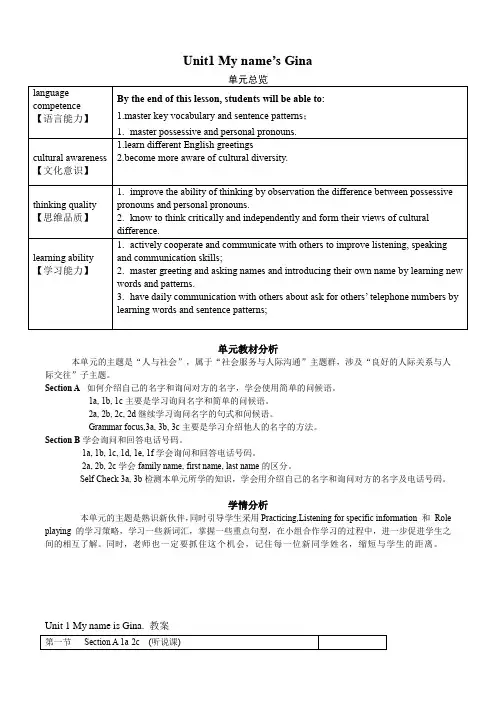
Unit1 My name’s Gina单元教材分析本单元的主题是“人与社会”,属于“社会服务与人际沟通”主题群,涉及“良好的人际关系与人际交往”子主题。
Section A如何介绍自己的名字和询问对方的名字,学会使用简单的问候语。
1a, 1b, 1c主要是学习询问名字和简单的问候语。
2a, 2b, 2c, 2d继续学习询问名字的句式和问候语。
Grammar focus,3a, 3b,3c主要是学习介绍他人的名字的方法。
Section B学会询问和回答电话号码。
1a, 1b, 1c,1d, 1e, 1f学会询问和回答电话号码。
2a, 2b, 2c学会family name, first name, last name的区分。
Self Check3a, 3b检测本单元所学的知识,学会用介绍自己的名字和询问对方的名字及电话号码。
学情分析本单元的主题是熟识新伙伴,同时引导学生采用Practicing,Listening for specific information 和Role playing 的学习策略,学习一些新词汇,掌握一些重点句型,在小组合作学习的过程中,进一步促进学生之间的相互了解。
同时,老师也一定要抓住这个机会,记住每一位新同学姓名,缩短与学生的距离。
Unit 1 My name is Gina. 教案Teaching procedures:Step 1:Read the sentences and fill in blanks.你的名字叫什么?_______ your _______?我的名字叫艾伦。
_____ _______ Alan.2. 注意以下几种缩略的表达法:what’s = what is, name’s = name is, I’m = I am, he’s = he is, she’s = she isStep 2:Look at the sentences and find the rule.一、be动词的一般现在时用法1. be动词的一般现在时有三种形式am, is, are,它随主语变化而变化。
七年级英语上册 Unit1 My name is Gina教案 人教新目标版
Unit1 My name’s Gina【单元预习导航】:相见、相识是一种恩。
亲爱的同学们,你们喜欢交朋友吗?你怎么认识新朋友知道他(她)的名字并且打招呼呢?平常怎么和朋友们联系,你们在网上联系吗?你会用英语询问同学朋友的QQ号码和号码吗?本单元学习目标:1学会用英语介绍自己、问候他人、询问和给出号码(会读写数字)。
2.知道中国人姓名和英美人姓名的异同。
【能力目标】:1.掌握简单的问候语,并能自我介绍,初步培养用英语进行交际的能力。
2.掌握听的技能,在听的过程中准确获取数字信息。
3.了解英语国家文化、生活等方面的知识,提高英语语言修养。
【重点难点】:语法:A 学会am, is, are的用法B 人称代词:I, you, he, she, it, we, you, they形容词性物主代词: my, your, his, her, its, our, your, their汉译:C What 引起的特殊疑问句【学法指导】:(积极参与,勤动手来,勤动脑,张张嘴巴读出来)背景知识:在英语中如何拼写中国人的姓名,联合国教科文组织已做规定“一律按汉语拼音的写法。
姓和名分开,姓在前,名在后”。
现举例说明:(1)如果是单姓,名又是单字,则姓与名的第一个字母要大写,其余字母用小写。
如:Li Lei李雷。
(2)如果是单姓,名是双字,则姓的第一个字母大写,名的第一个字母大写,名的双字合在一起算一个词,不得分开。
如:Han Meimei韩梅梅。
(3)如果是复姓,则把复姓字母连在一起,只是第一个字母大写,名字的拼写方法同上。
如:Sima Zhao司马昭,Ouyang Yunsong欧阳云松。
中英姓名比较──中文姓名是姓在前,名在后;英文姓名是姓在后,名在前。
Mr用于姓前,如Mr Green不能说成Mr Jim.(4)如果名字里有可能造成音的混淆的拼写时,要用连字号“-”或隔音号“’”隔开。
如:Yang Xi-an(Xi’an)杨西安,如写成Yang Xian就成了杨仙。
人教版七年级英语上册Unit1MynamesGina教案
人教版七年级英语上册Unit1Myname'sGina教案人教版七年级英语上册Unit1Myname'sGina教案对于英语课本内容,要多读,多张嘴,这样可以快速提高语感,在做完型填空的时候就很会很容易得选出答案。
做题的时候可以不根据语法也能做对题。
下面是小编为大家整理的人教版七年级英语Unit1 My name's Gina教案,希望对您有所帮助!人教版七年级英语Unit1 My name's Gina教案1. 让学生学会向别人做自我介绍,学会交朋友。
2. 学会使用与他人见面时的问候语。
3. 学会电话号码的表达方法并能向他人索取电话号码。
单元教学目标1. 语言知识目标1) 学生能听、说、读、写课标内单词zero-nine,phone number,first name /last name , hi, hello 等。
2) 学生学会运用这些句型:a. what’s your/her/his name?b. hello. nice to meet you.c. what’s her last/first name?d. what’s your phone number? it’s…2. 语言技能目标1) 能正确流利地用英语向他人介绍自己,并乐于与同伴交往。
2) 能正确使用问候语。
3) 能积极主动提供并获取个人信息资料(如:名字、电话号码)4) 能对所获取的信息进行初步的整理和总结。
5) 能归纳一定的语言现象。
(如:what is =what’s he is =he’s 等 )3. 学习策略目标a) 能积极与同伴合作,共同完成学习任务。
b) 能通过网络等多种资源获得相关信息,拓展所学知识。
c) 能积极动手、动脑,培养自己的想象力和创造力。
4. 情感态度目标1. 使学生对英语产生强烈的兴趣和愿望,乐于参加各种语言实践活动。
2. 能与伙伴团结一致、友好相处,学会如何礼貌地与他人交往。
七年级英语上册 Unit1_My_name's_Gina教案 人教新目标版
Unit1 My name’s Gina教学目标:1.知识目标掌握介绍自己和问候他人的句型:What’s your/his /her name?His/Her/ My name’s Gina. Nice to meet you!掌握数字0-9 ,及的问答:What’s your/his /her telephone number? My /His/Hertelephone number is 234-5873. It’s …..掌握Be的一般现在时形式掌握What引导的特殊疑问句掌握形容词性物主代词:my, your, his, her2.能力目标学会从对话中获取对方的信息及他人信息,让学生把所学到的语言知识和生活实际联系起来,使学习过程生活化。
学会用自己已有的知识水平和生活经历来解决实际问题。
如个性化名片的设计,培养了学生的动手能力,展示了学生的个性。
3.情感目标通过小组对话、讨论、调查和设计等一系列的活动,培养学生的合作意识和团队精神。
通过结交新朋友,学会如何礼貌地与他人交往。
了解中西方文化的差异。
课时划分:Period One : Section A :1a-- 2b Period Two : Section A :2c--- 4Period Three : Section B: 1a – 2b Period Four : Section B:3a --- 4Period Five : Self check & RevisionPeriod OneStep One Revision1. Greet with the students by using “Good morning/ Good afternoon/ Hello/ Hi…”2. Revise “What’s this in English?” by showing some lovely toys. (e.g. a clock)3. Ask the students to look at the picture in 1a and see how many other words they know.4 Find out who knows the most,encourage the Ss to remember.Step Two Leading – in1 The teacher asks the winners above “What’s your name?”help the winners to introduce themselves “I’m… or My name is…” . Then the teacher puts on a lovely mask and says “ Oh, I’m… Nice to meet you, …” Help the students to answer “Nice to meet you , too.”Repeat with several Ss.2 Write the target language on the blackboard and ask the students to repeat.----What’s your name?----I’m Gina.----My name is Alan. Nice to meet you!----Nice to meet you, too.3 Ss practice in two like the modle above.4 T asks Sa : What’s your name?,then asks Sb : What’s his /her name? T helps to answer :His /Her name is …. Write the target language on the blackboard and ask the students to repeat.5 Ss practice in three like the modle on the BD.6. Show some pictures of boys and girls and teach the new words of the boy’s name : Alan, Jim ; the girls’ names : Mary, Jenny, Gina.T says:His name is …,Her name is ….Ss follow the T.Step Three Listening 1b1 Look at 1b ,listen and number the conversations 1- 3.2 Play the recording for the first time. Students only listen.3 Play the recording a second time. Students number the conversations.4 Check the answers.5 Listen and follow 1b.Step Four Listening 2a 2b1 Look through the four pictures quickly ,get ready to listen.2 Listen and number the pictures.3 Check the answers .4 2b Listen again,circle the names you hear.5 listen and follow the conversations,then practice them.T makes modles with the Ss first.Step Five petition1. Ask the students to greet each other within five minutes and write down their partners’ names. The more , the better. They can use the target language.--What’s your English name? ----My name’s …--How do you spell it? ----…-Hello. I’m … Nice to meet you! ---- Nice to meet you , too.2. The Ss who gets the most names are the winners.Step Six Sum upHelp the Ss to sum up what they learnt.Step Seven Exercise TongbuStep Eight Homework Ask the students to bring some picturesPeriod TwoStep One Revision1 Revise the following dialogue : A: Hello! What’s yourname ? B:My name’s …/I’m …A:I’m …,nice to meet you .B: Nice to meet you,too. C: Hi,A! What’s his /her name?Can you tell me ? A:OK,his /her name is …C:Hi,B! Nice to meet you B: Nice to meet you,too.2 Talk about the pictures that the Ss bring using “ This is…What’s his /her name?”etc.Step Two Presentation1. The teacher shows two of the famous person and introduces like this: Hisname is Bill Gates. Bill is his first/given name and Gates is his last/family name. Her name is Zhang Ziyi. Zhang is her last/family name. Ziyi is her first/ given name.Help the students understand the first/given name and the last/family name and the differences between Chinese names and English names.Draw the diagram.2. Write more full names on the blackboard and ask “What”s his first/ lastname? What’s her first / last name?”3. Look at 3a and ask the students to read the lists of the names below.4. Ask the students to write F for first name and L for Last name. Check theanswers.5. Ask the students to read after the teacher the following names: Smith,Miller, Green, Brown.Step Three Choose the name1. Add more mon English names on the blackboard and ask the students to choosea first name and a last name they like. Check that the students are pronouncingthe names correctly.2. Rehearse the question and answer once more( What’s your first /last name?),then let them ask their classmates about their new first name and last name and make a list, then find out who writes down the most ,then she /he is the winner. Step Four One- minute speech1. Give the students a few minutes to prepare for introducing themselves andtheir friends or favorite persons etc in a minute. They can begin like this : Hello, everyone. I’m a boy . My Chinese name is … My first name is … My last name is … My English name is … I have a friend. His /Her name is … His /Her first name is … His /Her last name is…His /Her English name is …2. After one minute ,get the student to report themselves and theirfriends ,who can say the most correct sentences are the winners.Step Five Sum upHelp the Ss to sum up what they learnt.Step Six Practice1Get the Ss to write the sentences on the BD,try to dictate them.2 Get the Ss to read the names in groups .Step Seven ExerciseTongbuStep Eight HomeworkPeriod ThreeStep One Warming up1. Enjoy the song “Ten Little Indian Boys”,and learn to sing . pay attentionto the numbers .Step Two Numbers Section B 1a1. Listen and repeat the numbers.2. Write the numbers on the board in random order. Point to the numbers oneat a time and ask the students to repeat.3. Play a Bingo game or Play the next number game4. Look at some signs or pictures and ask the students “ What’s the telephonenumber?”“ 114,119 120, 110, 96316, 12345, 121…”5. Ask the students “What’s your phone number?” Let them try to answer,then write the numbers on the blackboard and tell the students how to write a telephone number__ __ __ - __ __ __ __ .Step Three PracticeSs ask their telephone numbers ,and write them down ,then report to the class. Step Four Listening Section B 1b1. Before listening,ask the students to work in pairs , one say the numbersin random order, the other writes them down.2. Play the tape for the first time. Students only listen.3. Ask the students to write the numbers in the blank as the teacher playsthe tape the second time.4. Check the answers.Step Five Listening Section B 2a 2b1 Ss look through the requests.2 Play the recording for the first time. Students onlylisten.3 Listen to the recording again, students write the letter of each telephone numberin the blank after the person’s name.4 Check the answers in pairs by asking and answering in pairs.5 Listen to the recording a third time,plete the phone nunmbers ,check theanswers.6 Listen to the recording several times ,get the Ss to follow the recording ,tryto recite them .7 Imitate the conversations in pairs or in groups .Step Six Speech petition1 Give the Ss one minute to prepare prepare for introducing themselves and their friends. They can begin like this : Hello, everyone. I’m a boy /girl. My Chinese name is ... My first name is ... My last name is ...My English name is ...My phone number is ... I have a friend. His /Her name is ... His /Her first name is (i)/Her last name is…His /Her English name is …Her phone number is …2 T walks around to see if the Ss need help .3 After one minute ,get the student to report themselves and their friends ,whocan say the most correct sentences are the winners.Step Seven Sum upStep Eight ExerciseStep Nine HomworkPeriod FourStep One Survey1. In about five minutes, let the students ask their classmates about their telephone numbers and write them down . They must use the target language “What’s your phone2. Ask some students to make a report like: Lisa’s phone number is… Jim’s phone number is…3. Answer the teacher’s questions: “What’s Lisa’s/Jim’s phone number?”“Her/ His phone number is..”Step Two Creative conversations1. Make up conversations to talk about the names and the phone numbers. Tmakes modles with the Ss.eg.A: Hello,B ! B: Hello,A ! Who’s this?A: This is my new friend . B: What’s his /her name ?A: His/Her name is C. B: What’s his /her phone number ?A: Sorry,I don’t know . Hi,C! What’s your phone number ?C:It’s … .A: Thank you .Hi,B! His /Her phone number is ….B: Hi,C!I’m A . Nice to meet you .C: Nice to meet you,too!2. Use some pictures or objects to create some different kinds of situationsand ask the students to make conversations.Step Three Talking about names1. Look at the name cards in 3a and ask something about the first name andthe last name.2. Ask students to take turns reading the names on each card.3. Tell the students how to finish 3a.4. Ask the students to finish 2—5 on their own.5. Collect any ID cards , library cards etc and ask the students to talk about them. Step Four Practice1. Do 3b as a class exercise. Ask the students to look at the ID card. First get the class to ask and answer the questions in pairs. Then get the Ss to write down the answers.2. Ask the students to fill in their own ID card. (3c)3. Exchange the ID cards and ask the students to look at the picture on thecards and ask and answer in pairs: What’s his / her family name? What’s his /her first name? What’s his /her telephone number?Step Five A game1. The students write their own telephone numbers on a piece of paper and putthem in a bag.2. The teacher hands out every student a piece of paper and asks them to findthe owner by asking “What’s your phone number?”3. The student who finds the owner with three guesses is the winner.4. Ask the winner to make a report like this: His /Her name is …His / Herfamily name is… His / Her first name is … His / Her telephone number is…Step Six Sum upStep Seven Write the important sentences.Step Eight ExerciseHomework:Design a name card for yourself.假如下个星期你班将来一位外籍教师,请你为自己设计一X名片,以便交流,Period FiveStep One ConversationsMake up conversations like the follow.1 A:Hello! I’m /My name’s Mary. What’s your name ?B:Hi ,Mary! My name is Jim .Nice to meet you .A:Nice to meet you ,too. Who’s this ?B:This is my new friendA:What’s his/her name?B: His/Her name is Alan. Alan, this is Mary.A: Hello, Alan ! Nice to meet you .C: Nice to meet you,too.2 A: Hello, Liu Ming ! What’s English name ?B: Hi,Lin tao .My English name is Alan Green, my first nameis Alan, my last/family is Green .What about yours?A: My English name is Nick Brown,my first name is Nick,my last/family is Brown.3 A: Hello, Liu Ming !What’s your phone number?B: My phone number is 5356248,what about yours ?A: My phone number is 663458,what’s Li Lei’s ?B: His phone number is 667892.Step Two Words and Sentences1 Get the Ss to read the words of Unit 1 ,first read in pairs .2 Check the words and the sentences. First give the Ss a few minutes to revisethe words and the sentences. Then dictate them ,hand in and check, sum up the results. If necessary, give the Ss a few more minutes to revise again.Step Three Writing1 .Self Check 3. Ask the students to think of two classmates , one a boy and onea girl. Have them write their classmates’ details in the charts. Get several Ss to write on the BD.2. Check in pairs, T walks around to check.Step Four Tongbu Self Check。
七年级英语上册 Unit 1 My name’s Gina(第1课时)教案 (新版)人教新目标版
My name’s Gina.Section A 单词name n. 名字;名称nice adj. 令人愉快的;宜人的to常用于原形动词之前,表示该动词为不定式meet v. 遇见;相逢too adv. 也;又;太your pron. 你的;你们的Ms. (用于女子的姓氏或姓名前,不指明婚否)女士and conj. 和;又;而his pron. 他的her pron. 她的yes interj. 是的;可以she pron. 她he pron. 他no adv. & adj. 不;没有;不是not adv. 不; 没有短语your/his/her/my name你的/他的/她的/我的名字句型1. —What’s your/his/her name? 你的/他的/她的名字是什么?—My/ His/ Her name is…我的/他的/她的名字是……2. —Nice to meet you. 见到你很高兴。
—Nice to meet you, too. 见到你我也很高兴。
Section B 单词zero num. 零one num. 一two num. 二three num. 三four num. 四five num. 五six num. 六seven num. 七eight num. 八nine num. 九telephone n. 电话;电话机phone n. 电话;电话机number n. 号码;数字China 中国friend n. 朋友middle adj. 中间的n. 中间last adj. 最后的;末尾的first adj. 第一school n. 学校短语first name 名字middle school 中学;初中last name 姓in China在中国telephone/phone number 电话号码句型—What’s your telephone number? 你的电话号码是多少?—It’s…它是……语法1. 连系动词be的用法2. 形容词性物主代词知识目标掌握形容词性物主代词。