
外研版英语七年级上册:Module 3 Unit 1-教案(3)
外研社七年级上册Module3My school Unit1There are thirty students in my class. 教学设计
一、教学内容分析
本次课的授课内容为外研社七年级上册Module3 My school中的Unit1 There are thirty students in my class.该课是一堂听说课,所以我将主要的教学环节设计为“学习单词、听力训练、朗读训练、说(练)句型与对话”四大部分。
其中,“学习单词、听、读”为知识的输入环节,“说(练)”为知识输出环节。
以学生为主体,围绕重难点,通过图片、音频、视频的穿插来进行8个详细的课堂环节的设计①课程导入②单词学习③词汇游戏④短、长听力训练⑤阅读训练⑥说练环节⑦“珍惜所有,努力学习”感情升华⑧布置作业。
通过这些环节的设计,引导其掌握thirty, forty, there, picture, wall, world 等单词与“There are...”,“Is there...?.”“Yes, there is./No, there isn’t.”等重点句型。
二、教学对象分析
本节课的授课对象是刚刚上初一年级的学生,根据初中生活泼好动、好奇心强的特点,我在多媒体课件的设计中利用了图片、音频、视频等形式来提升学生对该课的兴趣,并且设计了游戏表演的环节,提升课堂参与度。
并通过分角色朗读的形式、小组合作等教学方式,尽可能多地让学生表现自己,参与进课堂活动,让孩子们在生动且有意义的教学环境中学习到新的知识。
三、教学目标
1、知识与技能
重点词汇与短语:thirty, forty,fifty, sixty, seventy, eighty, ninety, there, picture, wall, world, computer,furniture,map, picture, television, a lot of, really, how many.
重点句型:①There are...
②—Is there...? —Yes, there is./No, there isn’t.
③—How many ... are there in ...? —There are...
④—Are there ...? —Yes, there are./No, there aren't.
2、过程与方法
①能够听懂介绍教室情况的对话。
②能够运用重点句型讨论并介绍自己所在的教室。
3、情感态度与价值观
孩子们在一堂课中,不仅仅学习知识,也培养自己的感恩之心。
了解自己能够在宽敞明亮的教室学习是多么幸福的事情,并且学会珍惜所拥有的一切,认真学习,努力拼搏。
四、教学重点、难点
1、教学重点:
①能够通过词汇学习、听力、朗读、说练这些环节掌握重点词汇与短语。
②能够正确地、大声地、优美地朗读课本对话内容。
2教学难点:
掌握“there be”句型的肯定、否定、一般疑问及特殊疑问句式和相应回答.并能运用此句式来介绍自己教室的样子。
B: Yes, there is./No, there isn't. A: Are there ...? B: Yes, there are./No, there aren't.
4.encourage three pairs to come in front of the classroom to practise the dialogue. 4.Show time(3 pairs) 和对话模板进行两两对话。
巩固刚才学习的句型、提高
学生对知识的关注度与保
持注意力,目的是希望大家
都能参与讨论,并熟练运用
这节课的重点句型。
减少分
心和开小差。
3. 鼓励三对同学到讲台前
进行展示,检查学生们是否
真正能将所学的知识运用
到对话当中,同时锻炼勇
气,树立榜样。
Watching a video Show a video
about the learning
environment of the
poor children in
the poor mountains
area
Watch a video about the
learning environment of
the poor children in the
poor mountains area
这一环节的设计是升华
课堂主题,让孩子们在一堂
课中,不仅仅学习知识,也
培养自己的感恩之心。
了解
自己能够在宽敞明亮的教
室学习是多么幸福的事情,
并且学会珍惜所拥有的一
切,认真学习,努力拼搏。
Homework 1.recite the new
words.
2.Make a dialogue
(对话)about your
ideal classroom.
Write a passage about
their ideal classroom .
将作业设计为两部分,第一
个作业是要求孩子们背单
词和熟读课文;第二个作业
是较为开放型的作业,让孩
子们自己完成一个关于自
己理想中的教室的对话,运
用there be句型。
(可从网
上或者报纸搜集)
六、板书设计
Module 3 My school 小组评价
、Unit 1 There are thirty students in my class.
①—What’s in your classroom? T1 T2 T3
—There is /are ________.
②—How many students are there in your class?
—There are sixty.
③—Is there...? —Yes, there is./No, there isn’t.
④—Are there ...? —Yes, there are./No, there aren't.。
Unit 3 Family ties(教案)2024-2025学年外研版七年级英语上册

Unit 3 Family ties单元教材分析本单元的主题是“人与社会”下的“社会服务与人际沟通”,归属于“和谐家庭与社区生活”这一子主题内容。
本单元教材围绕家庭关系展开,内容包括:谈论家庭及家庭成员;描述家人在一起的温馨时刻;理解家庭存在的意义。
旨在让学生感受家庭的爱,热爱自己的家庭。
课时分解第一课时Starting out&ReadingTeaching Objects【教学目标】1.Talk about family and family members.2.Know how to write a film review.3.Understand fathers’ love.Teaching Aids【教学工具】an English book,a tape recorder and CAITeaching Steps【教学过程】★Step 1Lead in【导入】1.Ask the Ss to look at the picture on page 46 and answer the following questions.①How many people are there in the picture?②What’s the relationship among them?③What are they doing?④How do they feel?2.Let some Ss share their answers.Starting outPage 47,11.Ask the Ss to look at the pictures on page 47 and answer the question:What is each family doing in the pictures?2.Let some Ss share their answers.3.Check the answers with the class.Picture a:They are having dinner together.Picture b:The father is accompanying his daughter doing her homework.Picture c:They are preparing food together.Picture d:They are go hiking together.4.Ask some Ss to share their answers to the question: What activities do you usually do with your family members?Page 47,21.Ask the Ss to look at the picture and answer the following questions.①What does each person in your family do?②What do you think the word “family” stands for?2.Let some Ss share their answers.Understanding ideas(1—4)★Step 2 Pre-task【准备任务】Page 48,11.Ask the Ss to look at the three pictures on page 48-49, and then ask them to figure out what it is on each picture.2.Check the answers with the class.Picture 1:It is a sea.Picture 2:It is a tree.Picture 3:It is a mountain.3.Let the Ss answer the following questions.①Which picture reminds you of your father?②How can you describe your father and his love for you?4.Give them some words as follows.silent heart quietly home care love5.Let some Ss say their answers.★Step 3 While-task【过程任务】Page 48,21.Ask the Ss to read the film review and ask them to answer the following question. What is the father’s love like according to the writer?2.Let some Ss say their answers.3.Check the right answer with the class.Page 50,31.Ask the Ss to read and tick the answers to the question: What does the film review include?2.Let some Ss say their answers.3.Check the right answers with the class.4.Introduce the way to write a film review to the Ss as follows.①Choose a movie.②Write a brief introduction.③Summarize the plot.④Analyze the movie.⑤Form an overall opinion.Page 50,41.Show the notes on page 50 to the Ss, and then let them guess what may be filled in the blanks.2.Ask the Ss to complete the notes with the words from the passage.3.Check the answers with the class.★Step 4Post-task【后续任务】Think and share1.Ask the Ss to choose three words to describe the father and the son each and give their reasons.2.Give the Ss some prompts. For example, to make comments about a character, always look for what they do. Actions speak louder than words.3.Ask the Ss to answer the question: Do you want to watch the film after reading the review? Why or why not?4.Give the Ss some prompts.5.Let some Ss share their answers with the class.★Step 5Language points【语言要点】1. remind 的用法作动词,意为“提醒;使想起”。
外研版七年级英语上册教案全集
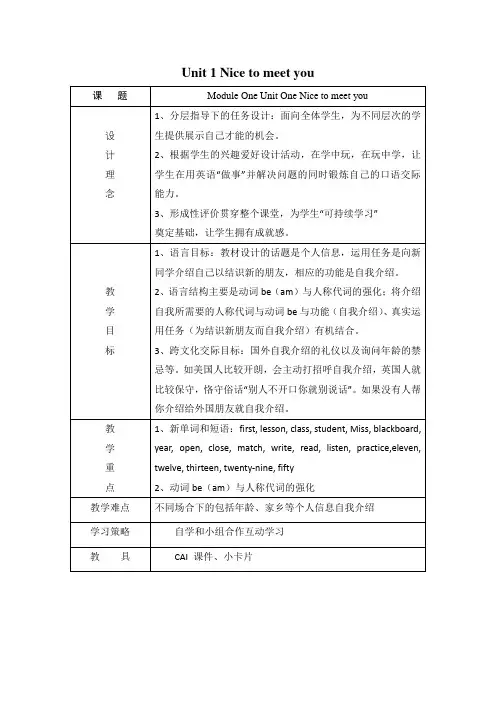
Unit 1 Nice to meet you教学流程图: 教学步骤 l (1课时)一、第一教学环节:情景创设、布置任务、激趣导入二、第二教学环节:师生互动、培养能力、给予成就感三、第三教学环节:评价总结、激发竞争、巩固提高附:评价表(小组成员之间进行评价,以星号为标记,五个星为最高,但是必须小组全票才能通过生效)Unit 2 I’m from China and I’m ChineseTeaching aimKnowledge: *useful expressions in introducing and greeting*nominal genitive pronoun & determinative genitive pronounAbilities: To be able to introduce oneself and others and greet peopleMoral education:To build up students’ confidence and interest in English- learning Key points: Introducing othersThis is Betty. This is my friend, Tony.Difficult points: 1) Asking for and receiving personal information.What’s your nameCan you introduce yourself please, BettyI’m from America. I’m 13 yea rs old.2) To master the names \ languages\ of some countriesTeaching methods: Group work, displayTeaching aids: Computer recorderTeaching procedures:Step 1 Teacher’s self-introduction (Lead-in)Name, Country, language, Age otherKey Sentence Structures:My name is ##.My first name is ##.My telephone number is ##.I’m from ##. I ‘m ##.My age is a secret.I am from Beijing. I come from Beijing. I am a native in Beijing.I come from China. I was born in China and brought up in China. I speak Chinese. In my spare time, I enjoy ###.My E-mail Address is ##.Step 2 Foreign teacher’s introduction (The same)This is our foreign teacher. (Name, Country, language, Age other) Students’ Activity: Listen and get some informationStep 3. The stud ents’ IntroductionNameAgeTeacherYearClassPhone numberE-mail addressCountryLanguageOtherListen and prepare the introduction.Introduce themselves according to the form.Pair work; Introduce themselves.Step 4. Part 2 on the book.Please listen to the tape so that we can know more about Daming, Lingling and Wang Hui. Please don’t open your books. Look at the blackboard.Listen and Answer.:1)Where is Daming from2)Where is Lingling from3)Where is Wang Hui from4)How old are theyName Country Language Age OtherBettyTonyLinglingWork in pairs to practise the dialogue.Students’activity: Listen to the tape; Practise their listening; Improve their abilities of get informationStep 5. Learning the dialogue.Practise the listening skill & Role playStudents’ activity: According to the form, they work in groups to practise the dialogue.Step6. Show a map of the world to practise the names \ languages of the countries Listen and think so many foreign countries’ names.Step7. Read aloudThe students read aloud to practise oral English.Write some sentences about the pictures.Step9. Learning the language item.1)My name’s … /I’m from…/He’s fourteen years old.2)The names of the countries.The students learn the language points.Homework: Introduce one of your pen-friends.Unit 3 Language in use学习目标:1.学习be动词的简单用法。
外研版七年级英语上册 Module3 unit1教案 (3)

模块1 unit one 学案一read the dialogue and Check (√) the true sentences.1. Tony thinks the Giant’s Causeway is the largest natural wonder.( )2. Lingling thinks Victoria Falls is more fantastic than the Giant’s Causeway.( )3. Betty and Daming are more interested in man-made wonders.( )4. For Daming, the Three Gorges Dam is more fantastic than the Terracotta Army.( ) 二Read the passage and answer the questions.1. Where is the Giant’s Causeway?2. How wide is Victoria Falls?3. What wonders does Betty think are more exciting?4. How old is the Terracotta Army?三language points1. Let’s call Wonders of the World and join in the discussion.我们给《世界奇观》节目打电话,加入讨论吧。
(1).wonder n. 奇迹长城是新世界七大奇观之一。
The Great Wall is one of the seven wonders of the new world.vi. & vt. 1). 觉得奇怪;惊奇= be surprisedI wonder that each man speaks a different language in England.我感到十分惊奇在英国每个人都说着一种不同的语言。
外研版英语七年级上册Module 3教案
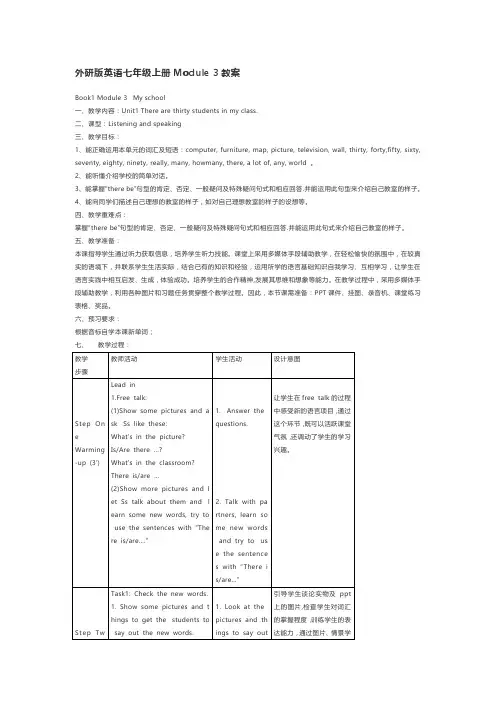
外研版英语七年级上册Module 3教案Book1 Module 3 My school一、教学内容:Unit1 There are thirty students in my class.二、课型:Listening and speaking三、教学目标:1、能正确运用本单元的词汇及短语:computer, furniture, map, picture, television, wall, thirty, forty,fifty, sixty, seventy, eighty, ninety, really, many, howmany, there, a lot of, any, world 。
2、能听懂介绍学校的简单对话。
3、能掌握“there be”句型的肯定、否定、一般疑问及特殊疑问句式和相应回答.并能运用此句型来介绍自己教室的样子。
4、能向同学们描述自己理想的教室的样子,如对自己理想教室的样子的设想等。
四、教学重难点:掌握“there be”句型的肯定、否定、一般疑问及特殊疑问句式和相应回答.并能运用此句式来介绍自己教室的样子。
五、教学准备:本课指导学生通过听力获取信息,培养学生听力技能。
课堂上采用多媒体手段辅助教学,在轻松愉快的氛围中,在较真实的语境下,并联系学生生活实际,结合已有的知识和经验,运用所学的语言基础知识自我学习、互相学习,让学生在语言实践中相互启发、生成,体验成功。
培养学生的合作精神,发展其思维和想象等能力。
在教学过程中,采用多媒体手段辅助教学,利用各种图片和习题任务贯穿整个教学过程。
因此,本节课需准备:PPT课件、挂图、录音机、课堂练习表格、奖品。
六、预习要求:根据音标自学本课新单词;七、教学过程:教学步骤教师活动学生活动设计意图Step On e Warming -up (3’)Lead in1.Free talk:(1)Show some pictures and ask Ss like these:What’s in the picture?Is/Are there …?What’s in the classroom?There is/are …(2)Show more pictures and let Ss talk about them and learn some new words, try touse the sentences with “There is/are….”1. Answer thequestions.2. Talk with partners, learn some new wordsand try to use the sentences with “There is/are...”让学生在free talk的过程中感受新的语言项目,通过这个环节,既可以活跃课堂气氛,还调动了学生的学习兴趣。
StarterModule3Unit1教案-外研版七年级英语上册
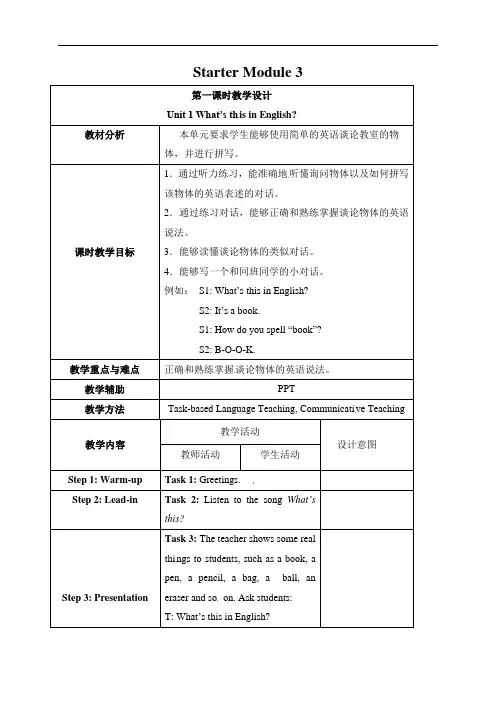
Starter Module 3第一课时教学设计Unit 1 What’s th is in English?教材分析本单元要求学生能够使用简单的英语谈论教室的物体,并进行拼写。
课时教学目标1.通过听力练习,能准确地听懂询问物体以及如何拼写该物体的英语表述的对话。
2.通过练习对话,能够正确和熟练掌握谈论物体的英语说法。
3.能够读懂谈论物体的类似对话。
4.能够写一个和同班同学的小对话。
例如:S1: What’s this in English?S2: It’s a book.S1: How do you spell “book”?S2: B-O-O-K.教学重点与难点正确和熟练掌握谈论物体的英语说法。
教学辅助PPT教学方法Task-based Language Teaching, Communicati ve Teaching教学内容教学活动设计意图教师活动学生活动Step 1: Warm-up Task 1: Greetings.Step 2: Lead-in Task 2:Listen to the song What’sthis?Step 3: Presentation Task 3: The teacher shows some real thi ngs to students, such as a book, a pen, a pencil, a bag, a ball, an eraser and so on. Ask students:T: What’s this in English?S: It’s a/a ...Task 4:Let the students make up dialogues, using their own things.S1: What’s this in Eng li sh?S2: It’s a/an ...Task 5: Show some pictures on the screen with something covering them, and ask Ss to guess what they are.T: What’s this in English?S: It’s a/an ...T: How do you spell “...”?S: ...Task 6: Let students make their own dialogues in pairs.S1: What’s this in English?S2: It’s a/an ...S1: How do you spell “...”?S2: ......Step 4: Listening andspeaking Task 7: Listen to the passage.Task 8: Listen again and try to readafter listening.Task 9:Let the students read thedialogue in roles in groups. Try topronounce correctly.Task 10: Listen to the pronunciationand read./ə/favourite dangerous today1. C heck how manystudents c anunderstand thedialogue fully andfollow listening.2. Check whichgroup can read thebest. Pay attention totheir。
初中英语《七年级上册Module 3 My School》单元教学设计以及思维导图
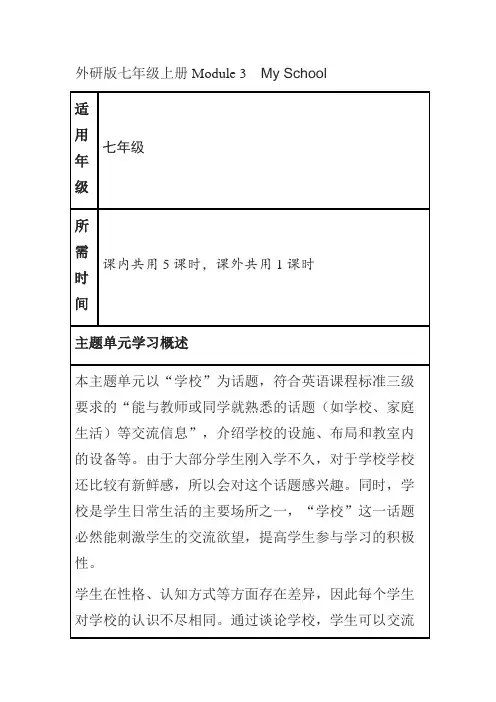
专题一: My Classroom ( 课内2 课时)
专题二: My School ( 课内2 课时)
专题三: Foreign Schools ( 课外2 课时)
其中,专题 三中的活动 around the world 作为研究性学习
专题一
首先通过图片练习了教室有关的词汇。对话情景是大明向琳达询问英国学校教室的样子,并对自己的教室做了一些介绍。最后谈论自己的教室和理想中的教室,并做绘画或ppt展示。
What are there in our classroom?
How many … are there in our classroom?
Is there a … in our classroom?
活动3:听对话录音回答问题:
How many students are there in Daming’s class?
What is my ideal classroom like?
评价要点
学生学习成果评价
1显示图片,学生能快速说出对应的单词。
2 学生能两人小组依据表格内容流畅问答。
3 学生能流畅的陈述教室内存在的物品和数量。
4 学生能绘制自己理想中的教室并讲述。
评价方法:教师口头评价学生互评学生组间评价教师评价小组
语言技能目标:
听:能听懂介绍学校的简短对话;
说:能利用“there be”句型介绍自己的班级和学校;
读:能通过描述判断出途中物体之间的位置关系;
写:能正确使用表示方位的介词来描述图中物体的位置关系;
运用:描述自己的学校内设施;
学习策略:
自学策略:能借助图片掌握单词;
合作学习策略:学会倾听,并在小组活动中充分发挥自己的作用。
外研版英语七年级上册Unit 3 教案
Module 7 ComputersUnit 3 Language in use 课型Revision and application教材分析本单元是一个练习单元,是通过练习和活动,对学生在本模块一、二单元中所学的电脑方面的基本词汇、一般现在时的特殊疑问句和答句等知识进行复习和巩固,使学生能更为透彻地理解、更为准确运用所学知识。
语言知识目标1.语法:复习巩固一般现在时的用法,尤其是本模块所学的一般现在时特殊疑问形式2.词汇:①生词:holiday②复习本模块所学的有关电脑方面的词汇语言技能目标1.听:能听懂所学的有关电脑方面的词汇;听懂一般现在时的特殊疑问句2.说:能就电脑的使用进行简单的问答;能运用一般现在时特殊疑问形式进行问答3.读:能读懂简单的特殊疑问句及其回答4.写:能结合本模块所学的语言知识,准确运用所学句型结构写出相关的表达学习策略目标1.认知策略:联系、归纳、推测等技能。
如能通过观察、应用,总结归纳出一般现在时特殊疑问句的用法2.调控策略:从同伴处得到反馈,对自己在叙述及书写中的错误进行修改3.合作学习策略:同学之间互相学习,取长补短文化意识目标了解不同国家和地区的人们使用电脑的情况情感态度目标通过学习电脑方面的词汇提高对英语的学习兴趣任务设计一个有关电脑方面的问卷教学重点1.复习巩固一般现在时的用法,尤其是本模块所学的一般现在时特殊疑问形式2.复习巩固本模块所学的电脑词汇及一些动宾搭配的使用。
教学难点较熟练地运用本模块中所学的词汇和句型,区别应用助动词do, does教学方法任务教学法教学设备录音机;多媒体课件教教学步骤设计意图教师活动学生活动Step 1Warming-up对本模块所学的有关电脑的词汇进行复习,在复习过程中调动学生的学习积极性。
强化对词汇及一些动宾搭配的理解、记忆和掌握,为任务的开展做好词汇的储备。
1.Greetings.2.Review the words.1) I can see pictures and information onit.(screen)2) Ican use it to print my homework.(printer)3) I can type information into the computer.(keyboard).4) I can click it and open a new document.(mouse). What are they?3. Show some pictures to review the text ofUnit 1 and Unit 2.1. Greetings2. Guessing.3. Look at thepictures, andanswer theteacher’s questions.学过程Step2Languagepractice复习一般现在时疑问句句式。
外研版七年级英语上册《 Unit 1 There are thirty students in my class.》精品教案_23
Step6. Post-reading
1.Retell the role play, write three or four sentences about Linda's class or Daming's class. Or ask Ss to draw the class.Give Ss three minutes to do the exercise.
Step8.Homework.
1. Please go on finishing your dream class, you can draw it or write the introduction(介绍)to us.
2. Please try to recite the role play, and retell the Linda's class and Daming's class.
2.To talk about their dream class.
六、教学方法situational approach Top-down approach
六、教学过程
Step 1.Lead–in
ing a video about students themselves to lead in the topic.
2.注重激发和培养学生的学习兴趣,让学生在快乐中学习。
3.教育不仅要教会知识,更要引导学生正确的价值观。
二、学情调查分析
1.课前已经让学生预习本单元的新单词和there be句型。
2.在学生小学阶段他们已经接触了数字的英文表达,本节课是帮助孩子们复习巩固的过程。
外研版七年级英语上册教案
初一英语教案2015 年 4 月1--2 日教案年 4 月 3 日教案年 4 月7--8 日教案年 4 月17--20 日初一英语教案年4 月21--22 日初一英语教案年4月23--24 日初一英语教案年4月27--28 日初一英语教案年 4 月29--30 日初一英语教案年 5 月15--18 日初一英语教案年 5 月25--26 日初一英语教案年5月27--28 日初一英语教案年 5 月29 日初一英语教案年 6 月1--2 日课题Module 10 Unit 3课型Revision Language in use教学目标To summarise and consolidate grammar focus.To summarise and consolidate expressions and vocabulary.教学重点Present simple: interrogative, negative and affirmative sentences教学难点Present simple: interrogative, negative and affirmative sentences 教具多媒体、录音机课时 1教学过程Step 1. Revision新课标第一网个人修改(1). Revise the words about computers(2). Put the Ss. in pairs to introduce how to use a computer.Step nguage practice1. Run through the examples with the Ss. and make sure that theyare familiar with the use of adverbs of interrogative, negativeand affirmative sentences.2. Ask the Ss. To repeat the sentences in the box.3. Ask ”Can you make other similar examples?”4. Act.1 and Act.2 on page 64. Grasp the use of usually and often.Step 3. Test:课后评价。
Module3unit 1 教案-外研版七年级英语上册
there be句型和方位介词。
教学辅助
教学课件
教学方法
小组合作式教学模式
教学内容
教学活动
设计意图
教师活动
学生活动
Step 1:
Engage投入
1图片匹配
2 Say the positions according to the pictures and read Betty’s words and write her classmates’names on their desks.
教学重点及难点
1与“My school”相关的词汇及方位介词;
2There be句型及用法
教学辅助
课件;点读笔
教学方法
情景式,启发式,小组合作式等教学方式
教学过程
Unit 1 教学设计
教材分析
本课为第三模块的第一单元,围绕“My school”这一话题,主要学习有关学校的词汇,并且通过对话引入本模块的语法---There be句型的使用。通过本课时的学习, 学生用There be句型对教室内的格局进行描述,为下一单元校园各建筑的方位的表达打下基础,因此本课时在本模块中的地位是举足轻重的
熟悉课文中的重点词组与句式,并获取文章细节信息,进一步理解并掌握对话内容。复述则是对对话中的重点句型反复操练,使学生对“there be”句型朗朗上口。通过对文本信息的转化,使学生们能对对话内容掌握并熟练运用的目的
1.家庭作业:
2.1Read the dialogue fluently.
2 Todescribe your classroom by using“there be”structure.
Linda’s classroom is really ___ in _______. There are _____ students in her class. There’s a ____ of England on the classroom wall. In Daming’s classroom, there is _ __ __ furniture. There are ______ girls and ______ boys in his class. There aren’t ___ pictures on the classroom walls.