
牛津译林版英语7BUnit6Grammar(语法归纳)课时练有答案(七年级)
Grammar(语法归纳)
一、写出下列动词的过去式
1. be ________
2. bring ________
3. buy ________
4. come ________
5. find ________
6. drive ________
7. fly ________
8. give ________
9. go ________ 10. hear ________ 11. leave ________ 12. let ________
13. make ________ 14. put ________ 15. sing ________ 16. read ________
17. take ________ 18. teach ________ 19. spend ________ 20. cost ________
二、用所给词的适当形式填空。
1. Tom and Mary _________ (come) to China last month.
2. Mike __________ (no t go) to bed until 12 o’clock last night. So he _______ (get) up late.
3. My mother ___________ (not do) housework yesterday.
4. She watches TV every evening. But she ___________ (not watch) TV last night.
5. ________ your father ________ (go) to work every day last year?
6. The boy_______ (not go) to school yesterday. He _______ (be) ill in bed.
7. What _________ (make) him cry just now?
8. Last year the teacher ________ (tell) us that the earth moves around the sun.
9. There ___________ (be not) any hospitals in my hometown in 1940.
10. I was afraid when I _______ (hear) a whisper.
三、完形填空。
Can flowers sing? You must be 1 to find the answer is ‘YES’. And the plants can sing, 2 .
Flowers are beautiful and they 3 nice. Most people 4 to plant them. If they can sing for us, it's really wonderful. In fact, the flowers or plants in vases really can sing. 5 can they sing? That's because there is a speaker system (音响系统) inside the vases . The speaker system uses the flowers or plants to make 6 . If you like the music or song very much, you can 7 the music or the song 8 the plants in your garden. Music and plants are 9 for you .Do you like to 10 your plants and flowers? Now not only you can talk to them but also for you.
( ) 1. A. excited B. surprising C. surprised D. interested
( ) 2. A. also B. too C. both D. either
( ) 3. A. look B. taste C. sound D. feel
( ) 4. A. are fond of B. would like C. dislike D. are crazy about ( ) 5. A. When B. Where C. What D. Why
( ) 6. A. sound B. voice C. whisper D. noise
( ) 7. A. hear B. listen C. listen to D. hear from ( ) 8. A. for B. on C. from D. of
( ) 9. A. good B. well C. nice D. wonderful ( ) 10. A. sing to B. talk with C. dance with D. shout to
四、句型转换。
1. The children have a good time in the park. (用last Sunday改)
_________________________________________________________
2. The baby cried hard at home yesterday evening.(改为一般疑问句,并作否定回答)
_________________________________________________________
3. Jim was at home with his parents last Sunday.(改为否定句)
_________________________________________________________
4. The little cat in the bushes was very weak.(对划线部分提问)
_________________________________________________________
5. We went t o the Funny Museum yesterday.(对划线部分提问)
_________________________________________________________
Grammar
一、1. was/ were 2. brought 3. bought 4. came 5. found 6 drove 7. flew 8. gave 9. went 10. heard 11. left 12. let 13. made 14. put 15. sang 16. read 17. took 18. taught 19. spent 20. cost
二、1. came 2. didn’t go; got 3. didn’t do 4. didn’t watch 5. Did go 6. didn’t go; was
7. made 8. told 9. weren’t 10. heard
三、1-5 CBABD 6-10 ACCAB
四、1. The children had a good time in the park last Sunday.
2. Did the baby cry hard at home yesterday evening? No, he didn’t.
3. Jim wasn’t at home with his parents last Sunday.
4. Which little cat was very weak?
5. Where did you go yesterday?。
牛津译林版英语七年级下册7B Unit6 知识点梳理及考点归纳

7B Unit 6 Outdoor funⅠ概况7BU6的主要考点为以下几点:1.much,many,few和little的辨析2. alone=by oneself或on one’s own(属于初一略微提及,初二上学期全面学习的词组。
初一升初二衔接知识点)3.反身代词herself(属于初一略微提及,初二上U3重点讲解的语法。
初一升初二衔接知识点)4. put up的用法,表示搭建的意思。
考察与put out,.put on,和put away的辨析5.too … to …表示太而不能的意思,考句型...考单选...6. reach,在本句中做动词,意思是够得到。
考察动词词义辨析Ⅱ详细讲解一、重点词组二、重要句型1、Hurry up, Eddie. 快点,埃迪!hurry up意为“快点”。
如:Hurry up, or you will be late. 快些,不然要迟到了。
(1)hurry to +地点意为“赶往某地”,如:Betty hurried to the garden. 贝蒂急忙奔向花园。
(2)(be)in a hurry意为“匆忙地;仓促地”,翻译:你为什么这么匆忙?(3)hurry to do sth. 急忙做某事翻译:我正急着去赶火车。
2、Hobo, carry it for me. 霍波,帮我拿包吧。
[辩异]bring, carry 和takebring表示“拿来”(从远到近)take表示“拿走”(从近到远)carry表示“搬、运”1.____________ me my food here, please.2.You can read the book here but you can’t ______ it home.3.Trains _______ more things than trucks.答案:1.bring 2.take 3.carry3、You complain too much. 你抱怨太多了。
牛津译林版七年级英语下册7B-Unit6-Grammar课时作业(含答案)知识讲解

牛津译林版七年级英语下册7B-U n i t6-G r a m m a r课时作业(含答案)7B Unit6 Outdoor funPeriod4(Grammar)一、单项选择( ) 1. Mary _______ to school last Monday because she was ill.A. don't goB. didn't goC. won't goD. doesn't go( ) 2. -Excuse me. Look at the sign: NO SMOKING!-Sorry, I _______ it.A. don't seeB. wasn't seeC. didn't seeD. won't see( ) 3. Tom with his mother _______ some shopping yesterday afternoon.A. is doingB. doesC. didD. do( ) 4. Please _______ your hands if you have some questions.A. put onB. put ofC. put downD. put up( ) 5. -He didn't go shopping with you three days ago, did he? - _______.A. Yes, he didB. Yes, he didn'tC. No, he didD. No, he doesn't ( ) 6. -How much _______ the new iPad _______ you when you bought it? -5,000 yuan.A. do; costB. was; costC. does; costD. did; cost( ) 7. - _______ you _______ your lunch?-At my grandparents'. The food was great.A. When did; haveB. How did; haveC. Where did; haveD. Who did; have( ) 8. -Who cleaned the classroom yesterday morning? -My sister _______.A. clean B does C. was D. did( ) 9. -Where _______ you two hours ago?-I _______ in the garden with my mum.A. were; wasB. were; wereC. was; wasD. was; were( )10. -I'm sorry I broke (弄坏) your bike.-Oh, really? _______. I can ask someone to fix it.A. You were too badB. It doesn't matterC. Not at allD. Don't be sorry二、句型转换1. I did my homework last night.(改为否定句)I _______ _______my homework last night.(改为一般疑问句,并作否定回答)_______ _______ _______ _______ homework last night?_______,I _______.(对画线部分提问)_______ _______ _______ _______ last night?2. He took a photo in the park.(对画线部分提问)_______ _______ _______ _______ he_______ in the park?3. He left his hometown two years ago.(改为一般疑问句)_______ _______ _______ his hometown two years ago?4. This city was beautiful when l was a little child.(改为一般疑问句,并作肯定回答)- _______ this city beautiful when you _______ a little child?- _______, _______ _______.5. Tom read the new book last Sunday.(对画线部分提问)_______ _______ Tom _______ the new book?三、动词填空1. Who______ (be) late for school yesterday morning?2. Tom______ (visit) us in three days.3. I saw him______. (fall) off the sofa just now. It was dangerous.4. -______ he______ (have) breakfast at school this morning? -Yes, he did.5. The sad news______ (surprise) everybody a lot. Some of them cried.6. It always______ (take) me two hours to do my homework last year.7. "______ (stand) up!" The monitor (班长)said when the teacher came in.8. -When______ you______ (pass) by the chocolate store (店)? -At about 3 p. m. yesterday.四、完形填空Mr Brown lived by the sea.He had a big 1 and had to work hard,or his wife and children would be hungry.so he had to 2 early in the morning.After breakfast he left for the sea in a small boat.He always hoped to 3 more fish. One morning the man got to a good place for 4 He threw a long rope(绳)with many hooks(钩)into the water.He found it 5 and pulled the hooks out of the sea.He saw there was a gold chain(金链)on the hooks.He was of course very 6 .“I′ll sell the gold chain for a lot of 7 ”he thought to himself.“ I’ll build a new house,and buy lots of expensive things.I’ll be 8 man in the world.”Mr Brown went on thinking and didn’t notice(注意)what was 9 to his boat.It began to sink(下沉).As he was pulling the gold chains,the boat sank into the sea.He 10 not only the gold chains,but also his boat and life!( )1.A.family B.house C.farm D.factory( )2.A.go to bed B.get up C.go home D.go to work( )3.A.buy B.find C.catch D.eat( )4.A.resting B.sleeping C.swimming D.fishing( )5.A.dangerous B.light C.heavy D.safe( )6.A.helpful B.glad C.worried D.strange( )7.A.food B.fruits C.clothes D.money( )8.A.the richest B.richer C.poorer D.the poorest( )9.A.1istening B.happening C.thinking D.saying( )10.A.found B.had C.lost D.Got五、阅读理解Americans with small families have a small car or a large one.If both parents are working they usually have two cars.When the family is large,one of the cars is sold(卖)and they will buy a van .A small car can hold(容纳)four persons and a large car can hold six persons but it is verycrowded(拥挤).A van hold seven persons easily,so a family with three children could ask their grandparents to go on a holiday travel.They could all travel together.Mr Green and his wife had a third child last year.This made them sell a second car and buy a van.The sixth and seventh seats are used to put other things,for a family of five must carry many suitcases when they travel.When they arrived at the grandparents’home,the suitcases are brought into the room,the two seats can then carry the grandparents.Americans call vans motor homes.A motor home is always used for holidays.When a family are traveling to the mountains(大山)or to the seaside,they can live in their motor home for a few days.All the members of a big family can enjoy a happy life when they are traveling together.That is why motor homes have become popular(欢迎).In America there are many parks for motor homes.( )1.From the passage,a van is called .A.a motor car B.a motorbikeC.a motor home D.a big truck( )2.Before Mr Green and his wife bought a van,they .A.sold their old house B.moved to their grandparents’houseC.built a new place for a van D.sold their second car( )3.Americans usually use motor homes .A.to travel with all the family members for holidayB.to do some shopping with all the family membersC.to visit the grandparents at weekendsD.to drive the children to school every day( )4.Motor homes have become popular because .A.they can take people to another city when people are freeB.they can let families have a happier life when they go out for holidays C.some people think motor homes are cheapD.big families can put more things in motor homes( )5.What does“van”mean in the pas sage? .A.货车 B.电动车 C.房车 D.摩托车六、翻译句子1. 昨天我们在靠近湖的地方搭起了一个帐篷。
7B英语七年级下册(牛津译林版) unit6Grammar课件
2. He found some meat in the fridge. (一D般id疑问句fin) any ______ hed_____ ______ meat in
the
3. She stayed there for a week. (划线部分提问) _H_o_w__ l_o_n_g__d_id___ shseta_y____ there?
agoD. id your father go…?
TdoamysaanDgdoid.JaTcokmsatunddieJdafcokr sthtuedtye…st?three
It was sunny.
How was the weather ?
He cleaned his room last week.
be
were not
Was Alice asnugrpryrisaetdthaet rthabebriat?bbit? Yes, she was. No, she wasn’t.
• Was Bingbing fat/ beautiful/ slim when she was young?
• Was old Xuzhou ….? • Was/ were there any … in the past?
When did he…clean…?
They had a spring camping last weekend.
MWyhfeatnhedridwtehnetyto…thheavbee…ac?h three years agWo.here did your father …go…?
Tom and Jack studied for the test three
unit6语法复习及练习有答案2021-2022学年牛津译林版七年级上册英语
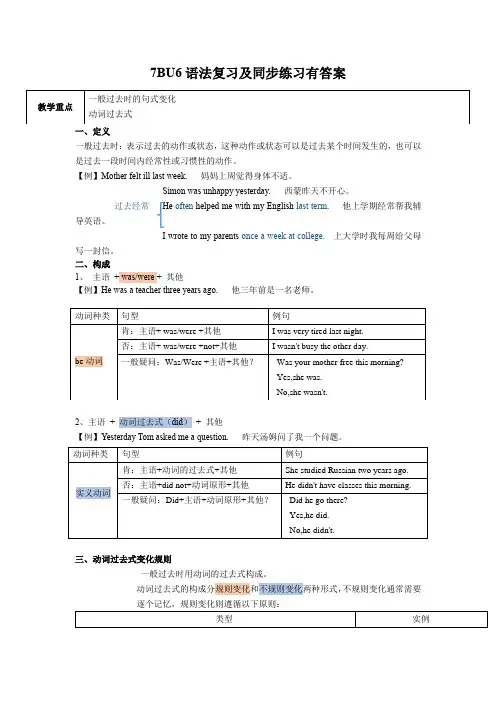
7BU6语法复习及同步练习有答案一、定义一般过去时:表示过去的动作或状态,这种动作或状态可以是过去某个时间发生的,也可以是过去一段时间内经常性或习惯性的动作。
【例】Mother felt ill last week. 妈妈上周觉得身体不适。
Simon was unhappy yesterday. 西蒙昨天不开心。
过去经常He often helped me with my English last term . 他上学期经常帮我辅导英语。
I wrote to my parents once a week at college . 上大学时我每周给父母写一封信。
二、构成1、 主语 + was/were + 其他【例】He was a teacher three years ago. 他三年前是一名老师。
2、主语 + 动词过去式(did ) + 其他【例】Yesterday Tom asked me a question. 昨天汤姆问了我一个问题。
三、动词过去式变化规则一般过去时用动词的过去式构成。
动词过去式的构成分规则变化和不规则变化两种形式,不规则变化通常需要逐个记忆,规则变化则遵循以下原则:● 动词词尾为"t 、d” 时,发/id/音:want→wanted 、need→needed● 动词词尾为清辅音时,发/t/音:help→helped 、laugh→laughed 、look→looked 、kiss→kissed、wash→washed、watch→watched● 动词词尾为t、d 以外之浊辅音或元音时,发/d/音:call→called 、stay→stayed【部分不规则动词过去式归纳】四、基本用法1、【时间状语】● 常见标志词:yesterday,the day before yesterday,the other day● last短语:last night / week / month / term / trip● 时间词+ ago :three days ago,few days ago,a moment ago● 介词+ 过去的时间词:in 2010,during last month,in the old days,in the past● 其他标志词:just now, at that time, in those days, once upon a time等。
(2021年整理)最新版译林牛津七年级7B语法全册整理
(完整)最新版译林牛津七年级7B语法全册整理编辑整理:尊敬的读者朋友们:这里是精品文档编辑中心,本文档内容是由我和我的同事精心编辑整理后发布的,发布之前我们对文中内容进行仔细校对,但是难免会有疏漏的地方,但是任然希望((完整)最新版译林牛津七年级7B语法全册整理)的内容能够给您的工作和学习带来便利。
同时也真诚的希望收到您的建议和反馈,这将是我们进步的源泉,前进的动力。
本文可编辑可修改,如果觉得对您有帮助请收藏以便随时查阅,最后祝您生活愉快业绩进步,以下为(完整)最新版译林牛津七年级7B语法全册整理的全部内容。
内部资料,请勿外传7B unit11。
基数词:表示数目的数词为基数词,它在句中主要作定语,也可作主语、宾语、表语和同位语等。
关于基数词的用法我们要注意以下几点:(1)基数词的构成:①21至99的两位数:十位数与个位数之间加连字符.如:22 = twenty-two 78 = seventy—eight②三位数:百位数与最后两位数之间(若十位数为0,则与个位数之间),要加and(美国英语中可省去and)。
如:101 = one hundred(and)one999 = nine hundred(and)nine③四位数:thousand之后,百位数之前加逗号,百位数与十位数之间(若十位数为0,则与个位数之间)加and。
如:1,401 = one thousand,four hundred and one④表示一万以上的大数目:将数字从个位起每向前三位加一逗号,使一个数分成若干小节,分别称为thousand节,million节等,然后按节处理。
如:101,203,001 = one hundred and one million,two hundred and three thousand and one.⑤表示十亿,美国用one billion,英国用one thousand million.(2)基数词的运用:以上这些表示确切数目的数词中,hundred,thousand,million,billion等一般用单数形式.但在以下几种情况里,基数词以复数形式出现。
牛津译林英语七年级下册7B Unit6全单元课时作业及答案
牛津译林英语七年级下册7B Unit6全单元课时作业第1课时Ⅰ.根据句意及英文解释、首字母或汉语提示完成句子1.Doing more o________ activities is good for our health.2.Don't c ________ about too much homework. You should work hard.3.I think ________(the sport of gliding on the ice) is great fun.4.Last night it snowed ________(在外面).5.He likes going ________(骑马) with his friends on sunny days.Ⅱ.用所给单词的适当形式填空6.Jim, never ________(ride) a bike alone in a busy street. You are too young.7.This morning Daniel got up late, so he ________(hurry) to school without breakfast.8.I don't think all of the outdoor ________(activity) are dangerous if we are careful.9.We like going ________(climb), but they want to stay at school to play basketball.10.I always dream of ________(be) an artist in the future.Ⅲ.单项选择()11.—________,or we'll be late for the concert.—It's only half past twelve. We have enough time left.A.Hurry up B.Don't worryC.Never mind D.Be quiet()12.—Mrs Smith always gives us too much homework!—You ________ too much! Why don't you spend less time on your phone?A.worry B.speakC.complain D.wonder()13.Andy, the problem isn't ________ difficult. Try to work it out by yourself.A.like B.thatC.this D.what()14.—________ China?—The people and the history.A.What do you think ofB.What do you like aboutC.How do you likeD.How do you like aboutⅣ.根据汉语意思完成句子15.这个包太重了。
Unit 6 Grammar课时练习 牛津译林版英语七年级上册(含答案)
Unit 6 Food and lifestyleGrammar一、根据句意及首字母提示或英文释义,写出单词1. -What can I do for you, madam?-I’d like three________(1,000 grams) of tomatoes.2. Would you like a c________of tea or a glass of water?3. I’m hungry. Please bring me two p________of bread.4. Pass me the s ________, please. I need it for my soup.5. Jack often has some bread and a b________of milk for breakfast.二、用括号内所给单词的正确形式填空1. There are some different kinds of________(bread) on the table.2. My grandma always tells me some interesting________(story).3. My mother bought two________(fish) this morning.4. Help yourself to some________(fish), Jim.5. Victor likes rice and________(noodle) very much.6. I want to be a________(dance) when I grow up.7. -How many________(kilo) of beef do you want?-Two, please.8. Are there any________(tomato) in the basket?9. He can speak English without________(think).10. Every day Jimmy needs to take in 800________(calory).三、单项选择( ) 1. Eating________apple________day keeps the doctor away.A. an, aB. a, anC. a, aD. an, an( ) 2. -What fruit do you like best?-I like________best.A. beefB. carrotsC. lemonsD. cabbages ( ) 3. -________do you go on a picnic?-About once a week.A. What timeB. How oftenC. How longD. How much( ) 4. I don’t like sweet snacks, so I________eat them.A. usuallyB. oftenC. alwaysD. seldom( ) 5. They are thirsty. Please give them some________water to drink.A. bottle ofB. bottles ofC. bottleD. bottles( ) 6. My mother likes eating________.A. orangeB. chickenC. potatosD. breads( ) 7. There are few________in the fridge. Let’s go and buy some peas, carrots and cabbages.A. fruitB. vegetablesC. eggsD. meat( ) 8. How many________do you want?A. milkB. fruitC. bananaD. apples( ) 9. -Would you like something to drink, Amy?-Yes, I’d like some________. Thank you.A. hamburgersB. hot dogsC. cokeD. bread( ) 10. How many________do you want?A. glass of apple juiceB. glass of apple juiceC. glasses of apple juiceD. glasses of apples juice四、句型转换1. Let’s buy three packets of sugar.(对画线部分提问)________ ________ ________of sugar shall we buy?2. There is a sheep in the garden.(改为复数句)There________ ________ ________in the garden.3. There is a newspaper on the table.(改为复数句)There________some________on the table.4. Simon has some bread for breakfast.(改为否定句)Simon________ ________ ________bread for breakfast.5. I’d like two kilos of fish.(对画线部分提问)________ ________ ________ ________you like?五、根据所给汉语完成下列句子1. 我们需要三公斤牛肉。
七年级的牛津7B牛津7BUnit6Integratedskills(综合技能)课时练含答案
Integrated skills(综合技术)一、采用下边的单词并用其适合的形式填空。
interest, with, amaze, care, life, look, many, surprise, die, they1.Lots of _________ things happen every day.2.Lily is a good girl. She always listens to her teacher ________ in class.3.There is no plant life ________ air or water.4.Elephants are one of the largest ___________ animals on land.5.After you tell me about your school, I know __________ about it.6.Neighbours were _________ to find the old man dead in his bedroom.7.My little sister is fond of ___________ after her baby cat.8.His grandfather _________ five years ago.9.The postcards belong to Tom and Daniel, they are ___________.10.After reading the storybook, I find it very____________.二、依据句意及中文提示, 写出句中所缺的单词1.My father can make a model car out of ________ ( 木头 ).2.In fact, we are living in a modern _________ ( 期间 ).3.We will go camping tomorrow. I want to put up the _________ near a lake.4.Hyde Park was first opened to the public about four _________ ago.5.Does your cousin work in Chengdu, Sichuan _________?6. Mr Wang likes the works of art in Tang _________ (朝代).7.At last, the _________ ( 意大利的 ) football team won the match.8.All the students were very _________ at the exciting news.三、按要求变换以下句型。
牛津译林7BUnit6 单元语法专练练习课件
单元语法专练
一般过去时( 二 ) 1.行为动词的一般过去时的肯定句、否定句及一般疑问句的构成 ( 1 )肯定句:主语+动词过去式+其他。例如: They had a picnic in the park last week.上周他们在公园里野餐了。 ( 2 )否定句:主语+did not/didn’t+动词原形+其他。例如: We didn’t have classes yesterday.我们昨天没有课。
Ⅲ.按要求完成句子,每空一词 1.There were some people at the concert.( 改为一般疑问句 )
Were there any people at the concert? 2.( 新疆中考 )She put the keys on the table yesterday.( 改为一般疑问句 )
C.were;wasn’t D.did;wasn’t
( B )4.( 广元中考改编 )—What did you do the day before yesterday?
—I
for an English test.
A.study B.studied
C.studying D.studies
( C )5.—Hi,Sarah.
Did she put the keys on the table yesterday? 3.( 上海中考 )John went to church with his brother ast Sunday morning.( 改为否定句 )
John didn’t go to church with his brother last Sunday morning. 4.( 达州中考 )Steve with me read Yu Gong Moves a Mountain in the library last month.( 改为否定句 )
牛津译林版英语七下(初一)U6 Grammar
Unit6. Grammar
Sandy: (1)__D__id__ you and your family ___g_o__ (go) camping last week? Simon: No, we (2)_d_i_d_n_’_t . We (3)_w__e_n_t_ (go) camping last month. Sandy: (4)_W__a_s__ (be) it interesting? Simon: Yes, it (5)__w__a_s_ . Sandy: What (6)__d__id__ you ___d_o__ (do) there? Simon: We (7)___p_u_t_ (put) up our tent near a
By Qin Dongting
Unit6. Grammar
Make sentences with words (连词成句)
row, Lily, a, boat, in, last, park, the, weekend Lily rowed a boat in the park last weekend.
实义动词 肯定句:主语+ 动词过去式 +其他 否定句: 主语+ didn’t +动词原形 +其他
By Qin Dongtபைடு நூலகம்ng
Unit6. Grammar
Did Alice see doors all around ?
Yes, she did.
Did she see the rabbit?
No, she didn’t.
一般过去时一般疑问句句式的构成及回答
实义动词
Did + 主语 + 动词原形 + 其他?