
苏教版七年级下册英语知识点
初一英语时态专题复习一、一般现在时:(1、现在的状态。
2、经常或习惯性动作。
3、主语所具备的性格和能力。
4、真理。
)1、标志:often(经常),usually(通常),sometimes(有时),always(总是),never(从不),on Sundays(在星期天), every day/month/year(每一天/月/年)2、结构:(1)主语+连系动词be(am/is/are)+名词/形容词/数词/介词短语/副词等做表语表状态(包括There be +n.)练习:1.I__am____(be) a student. My name__is___(be) Tom.2. Where __are___(be) my shoes? They_are__(be) here.3.Who _is___(be) the girl with long straight hair? I think she _is__(be) Kate.4. You and I _don’t are__(not be) in Class Six.5._Are__(be) there a supermarket on the Fifth Avenue? Yes, there_are____(be).6. _Do___ her parents tall? No, she__don’t__.(2)主语(非第三人称单数)+行为动词原形+其他(用助动词do 帮助构成否定句、一般疑问句和特殊疑问)(3)主语(第三人称单数)+行为动词的第三人称单数+其他(用助动词does 帮助构成否定句、一般疑问句和特殊疑问句)行为动词第三人称单数加-s的形式 1.- s 2. 辅音+y: study-studies 3.以s,x,ch,sh结尾watch-watches teach-teaches4特殊have-has do-does go-goes.1)His parents _______(watch) TV every night. 肯定句1) My brother _________(do) homework every day.2)His parents _________(not watch) every night.否定句2)My brother________(not do)homework every day.3)_____his parents_____(watch) TV every night?一般疑3)______ your brother _____ homework every day?Yes, they _______. No, they _______. Yes, he______. No, he _________.4)When___ his parents _____(watch) TV? 特疑4)When _____ your brother ____(do) homework?They watch TV every night. He does homework every day.二.现在进行时:表示说话瞬间或现阶段正在进行的动作。
1、标志: now(现在)listen(看)look(听)2、结构:主语+助动词be(am/is/are)+行为动词的现在分词(doing)现在分词的构成: 1.-ing: eat-eating 2.辅音字母+e: take-taking3. sit, put, begin, run, swim, stop, get, shop,(双写最后一个辅音字母,再加ing.)练习:1. Jim __________________(take) photos in the park now. 2. Jim_________(not take) in the park now. 3. _______________Jim____________(take) photos in the park now? Yes, he _____. No, he _______.4. Where _________Jim ____________ photos now? In the park.三、情态动词:1、任何主语+can/may/must+动词原形2、主语+ can’t/may not/mustn’t+动词原形3、Can/May/Must + 主语+ 动词原形?4、疑问词+can/may/must+主语+动词原形?四、非谓语动词(是固定搭配)1. like+ to do不定式/doing动名词2.want to do sth.3. love to do4. would like to do sth.5. enjoy doing sth.6. thanks for doing7. stop doing sth8. let sb. do sth.She wants _____(have) a party. Does he like _______(swim)?Thanks for _______(enjoy) CCTV show. She never stops ____(talk).五.祈使句:Go straight and turn left/ right.Go through Fifth Avenue.Take a taxi(Take a bus,Take a walk……)六.综合练习: 1.Mr Green _____(be) a worker. Now he ____(work) in the field. 2.Listen!Who_______(sing)?3.What time ____ your brother usually _____(do) his homework?4.You can_______(come) here by bus.5. Who ____(have) a ruler?6.Are they_____(clean) the room?7.-____ you____(eat) dinner? – Yes, we are.8.Jack ____(have) a soccer ball, but he ____(not have) a basketball. 9._______Jim _______(like)______(run)?10.They _____(be) from Canada. They______(not speak) Chinese. 11. He wants _________________(be) tall.1.我们正在吃晚餐。
2、我们每天6点起床。
We __________________________. We __________________ at six every day.3.你们在聊天吗?是的。
4、他们常常聊天吗?不是。
_______ they _______? Yes, they _____. ______ they often ______ ? No, they ________.5、他在做什么?他在做作业。
6、他晚上常干什么?他常做作业。
What ____he ___? He_______. What ___he usually ___ in the evening? He usually______.答案: 1.are having dinner 2. get up 3. Are , talking , are 4. Do , talk, don’t5. is doing, is doing homework6. does, do, does , homework七.人称代词:我你他她它我们你们他/她/它们主格:I you he she it we you they宾格:me you him her it us you them形容词性物主代词:我的你的他的她的它的我们的你们的他/她/它们的my your his her its our your their练习:1.________(我) am a worker. _________(你) are a doctor. ______(她) is a teacher.2.This is (他的)shirt.3. This is __________(我的)pen.4._________(他们的) trousers are there.5. I like this picture. Please give ________(它) to ________(我).6. People get ________(他们的) money from _________(我).7._____(他们) are new students. _____(他们的) names are Lucy and Lily.8. These are _____(我们的) shoes. Can ____(我们) wear ______(它们).9.Thank _______ for _______(你的) help.10. _______(他) loves _______(她), and _______(她) loves _______(他),too._______(我) love _________(你), and ________(你) love _______(我),too.八,There be句型句型转换1)There is a bank on the street. 2) There are some cars in front of the park.否定句:There _______a bank on the street. 否定句:There ______ _______cars in front of the bank.一般疑问句:_______ ______ a bank on the street? 一般疑问句:____ ______ ______cars in front of the bank?就划线部分提问:________ on the street? 就划线部分提问:_____ _____ in front of the bank?There’s a bank on the street. There are some cars in front of the bank.同上:____ ______ ______are there on the street? 同上:____ ____ ____ are there in front of the bankThere’s only one. There’re some.2)将下列句子改为否定句、一般疑问句,并就划线部分提问。
七年级下册u1英语苏教版知识点

七年级下册u1英语苏教版知识点七年级下册英语是学生们高中阶段的基础语言学习阶段,其中包含了很多知识点和语法规则。
本文将会着重讲述七年级下册U1英语苏教版知识点,包含以下几个方面的内容:一、单词二、语法三、练习四、阅读理解一、单词:1. morning 早上2. afternoon 下午3. evening 晚上4. night 夜晚5. music 音乐6. art 艺术7. swimming 游泳8. basketball 篮球9. soccer 足球10. Russian 俄语11. Australia 澳大利亚12. pencil case 铅笔盒13. schoolbag 书包14. library 图书馆15. science museum 科技馆二、语法:1. be 动词:am, is, are2. 一般现在时:主语+谓语动词3. 情态动词:can, can’t, must4. 疑问词:what, where, when, who, why, how三、练习:1. 将以下句子变成肯定句:a. She isn’t tall.She is tall.b. I can’t swim.I can swim.c. They aren’t in Australia.They are in Australia.2. 将以下句子变成否定句:a. He is playing basketball.He isn’t playing basketball.b. We are in the library.We aren’t in the library.c. They can speak Russian.They can’t speak Russian.四、阅读理解:Mr. Black is a teacher. He works in a school. He gets up early in the morning. He has breakfast at 6:30. He goes to school at 7 o’clock. He teaches English. He has lunch at 12 o’clock. He goes home at 4:30 in the afternoon. He has dinner with his family at 6. He watches TV after dinner. He goes to bed at 10 o’clock.根据以上短文,选择正确答案:1. What does Mr. Black do?A. He’s a doctor.B. He’s a teacher.C. He’s a lawyer.2. What time does Mr. Black get up?A. At 6:00.B. At 6:15.C. Early in the morning.3. What subject does Mr. Black teach?A. Chinese.B. English.C. Math.4. When does Mr. Black go home?A. At 12:00 in the afternoon.B. At 4:30 in the afternoon.C. At 6:30 in the evening.5. When does Mr. Black go to bed?A. At 8:00.B. At 10:00.C. At 12:00.以上就是本文所涵盖的七年级下册U1英语苏教版知识点内容,希望对学生们的英语学习有所帮助。
七年级下册英语(苏教版七年级)7BU3 Task知识点
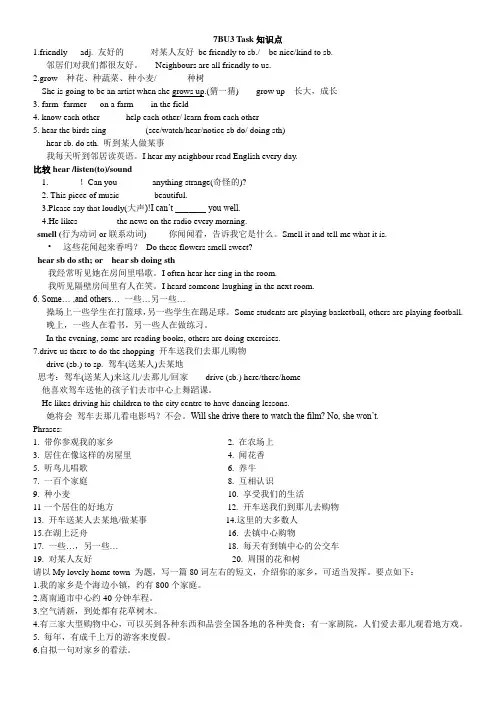
7BU3 Task知识点1.friendly adj. 友好的对某人友好be friendly to sb./ be nice/kind to sb.邻居们对我们都很友好。
Neighbours are all friendly to us.2.grow 种花、种蔬菜、种小麦/ 种树She is going to be an artist when she grows up.(猜一猜) grow up 长大,成长3. farm- farmer on a farm in the field4. know each other help each other/ learn from each other5. hear the birds sing (see/watch/hear/notice sb do/ doing sth)hear sb. do sth. 听到某人做某事我每天听到邻居读英语。
I hear my neighbour read English every day.比较hear /listen(to)/sound1.______ !Can you _______ anything strange(奇怪的)?2. This piece of music _______ beautiful.3.Please say that loudly(大声)!I can’t _______ you well.4.He likes ________ the news on the radio every morning.smell (行为动词or联系动词) 你闻闻看,告诉我它是什么。
Smell it and tell me what it is.•这些花闻起来香吗?Do these flowers smell sweet?hear sb do sth; or hear sb doing sth我经常听见她在房间里唱歌。
七年级下英语知识点苏教版
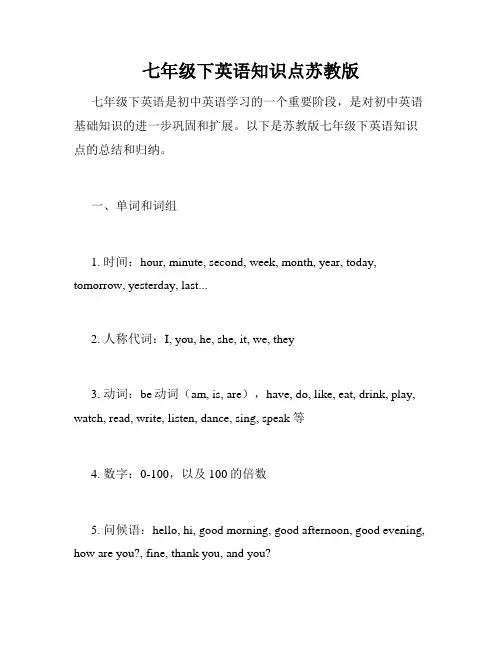
七年级下英语知识点苏教版七年级下英语是初中英语学习的一个重要阶段,是对初中英语基础知识的进一步巩固和扩展。
以下是苏教版七年级下英语知识点的总结和归纳。
一、单词和词组1. 时间:hour, minute, second, week, month, year, today, tomorrow, yesterday, last...2. 人称代词:I, you, he, she, it, we, they3. 动词:be动词(am, is, are),have, do, like, eat, drink, play, watch, read, write, listen, dance, sing, speak等4. 数字:0-100,以及100的倍数5. 问候语:hello, hi, good morning, good afternoon, good evening, how are you?, fine, thank you, and you?6. 词组:happy birthday, be quiet, how much, how many, this is..., that is..., my name is..., nice to meet you, what's your name?, where are you from?, what's the time?二、语法知识1. 一般现在时:主语+动词原形(I eat breakfast in the morning.)2. be动词的用法:am/is/are+主语(I am a student.)3. be动词的否定形式:主语+am not/isn't/aren't+动词-ing(I am not playing basketball.)4. be动词的疑问形式:be动词+主语+?(Are you a teacher?)5. 一般过去时:主语+动词过去式(He watched a movie last night.)6. 表示过去发生的时间的介词:in/on/at(I was born in 2006.;I went to Beijing on February 1st.; My birthday is on December 1st.; I have English class at 9:00 in the morning.)7. 现在进行时:主语+am/is/are+动词-ing(I am eating breakfast.)8. 句型:S+V+O(主语+谓语动词+宾语)(I like music.)9. 祈使句:主语省略+动词原形(Be quiet.;Open the window.)10. have的用法:have + 名词(I have a new book.)11. have的否定和疑问形式:have not/has not/hasn't+名词;have/has+主语+?(I haven't a pen.;Have you a pen?)12. 形容词比较级和最高级:比较级+than(Tom is taller than Jim.);the+最高级+名词(My sister is the tallest in my family.)三、听力技巧1. 提前预测答案:在听到问题之前,尽量预测答案,以便在听到答案时更快地作出选择。
苏教版初一下册英语知识点汇总
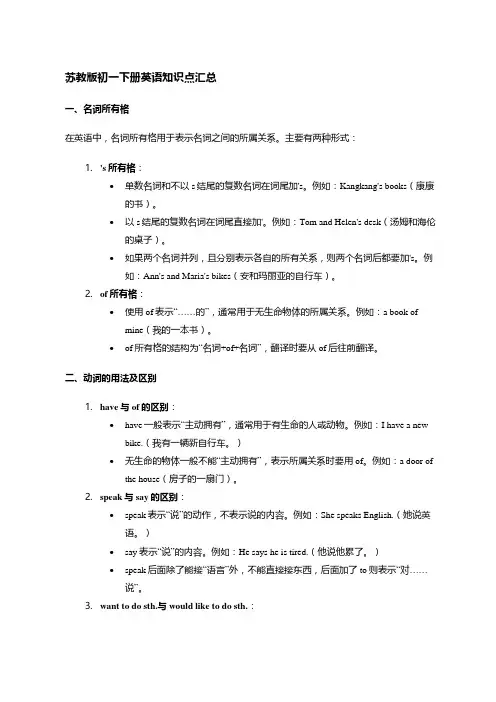
苏教版初一下册英语知识点汇总一、名词所有格在英语中,名词所有格用于表示名词之间的所属关系。
主要有两种形式:1.'s所有格:•单数名词和不以s结尾的复数名词在词尾加's。
例如:Kangkang's books(康康的书)。
•以s结尾的复数名词在词尾直接加'。
例如:Tom and Helen's desk(汤姆和海伦的桌子)。
•如果两个名词并列,且分别表示各自的所有关系,则两个名词后都要加's。
例如:Ann's and Maria's bikes(安和玛丽亚的自行车)。
2.of所有格:•使用of表示“……的”,通常用于无生命物体的所属关系。
例如:a book of mine(我的一本书)。
•of所有格的结构为“名词+of+名词”,翻译时要从of后往前翻译。
二、动词的用法及区别1.have与of的区别:•have一般表示“主动拥有”,通常用于有生命的人或动物。
例如:I have a new bike.(我有一辆新自行车。
)•无生命的物体一般不能“主动拥有”,表示所属关系时要用of。
例如:a door of the house(房子的一扇门)。
2.speak与say的区别:•speak表示“说”的动作,不表示说的内容。
例如:She speaks English.(她说英语。
)•say表示“说”的内容。
例如:He says he is tired.(他说他累了。
)•speak后面除了能接“语言”外,不能直接接东西,后面加了to则表示“对……说”。
3.want to do sth.与would like to do sth.:•两者都表示“想要做某事”,可以互换使用。
例如:I want to go shopping.(我想要去购物。
)/ I would like to go shopping.(我想要去购物。
)4.both与all的区别:•both表示“两者都……”。
七年级下册英语u1知识点苏教版

七年级下册英语u1知识点苏教版一、重点单词1. bookbag n. 书包2. geography n. 地理(学)3. history n. 历史4. science n. 科学5. art n. 艺术6. PE n. 体育7. math n. 数学8. English n. 英语9. Chinese n. 汉语10. music n. 音乐二、重点句型1. What's your favorite subject? 你最喜欢的科目是什么?2. My favorite subject is… 我最喜欢的科目是…3. What day is it today? 今天星期几?4. It's … today. 今天是…5. What class do you have first/second/…? 你上什么课:第一/二/…?6. I have…first/second/… 我是上…一节/二节/…三、重点语法1. 一般现在时:用于表述日常习惯、常规活动以及现在的状态等,常用动词原形。
例如:I usually have lunch at noon. 我通常在中午吃午饭。
2. 一般疑问句:将be动词(am/ is/ are)、助动词(do/does)、情态动词(can/could/may/might/will/would/should等)置于主语前即可。
例如:Do you like English? 你喜欢英语吗?3. 反意疑问句:将疑问句变成陈述句后,将陈述句的主语和动词的位置调换,同时加上相应的助动词和主语的缩写。
例如:You like English, don't you? 你喜欢英语,是吗?四、重点知识点1. 介绍自己喜欢的科目。
例如:What's your favorite subject?My favorite subject is English/ Chinese/ math, etc.2. 询问日期和星期几。
2023年七年级下册英语苏教版七年级知识点

7BU1 Welcome知识点1. 做梦have a dream;梦见某人(物)dream of/ about sb/sth梦见做某事dream about/ofdoingsth; 梦见某人做某事dreamthat +宾语从句多奇怪旳一种梦啊! Whatastrangedream!你昨晚做了个可怕旳梦吗?Did you have aterrible dream?我梦见住在这样旳宫殿里。
Idreamabout living in apalace like this.My dream is __________(live)in such a castle.2.----Would you like to dosth?他想住在哪个首都?Which capital would he liketo live in?来些茶怎么样?Wouldyoulike some tea?Would you like todo sth?-----Yes, I'd like to./I'd love to. (----Sure,that sounds great. ---I'd loveto,but ... --Thank you,but I'm afraidI...)----Wouldyou likesth?(------Yes, please. ------No,thanks.)3.住在宫殿里live inapalace4. nextto=beside ...紧靠着...,在...隔壁我学校隔壁旳购物中心theshoppingmall next to myschool他坐在我旁边Heis sitting next to me.5.在镇上in town; 在小镇上in asmall town6.big---原级bigger---比较级biggest---最高级无比较对象,very, quite, too; 两者比较用than; 三者或三者以上,一般和the 连用…是我班最高旳学生。
新版牛津译林苏教版小学英语七年级下册各单元知识汇总
新版牛津译林苏教版小学英语七年级下册各单元知识汇总一、Unit 1: Greetings 问候本单元主要研究如何进行简单的问候和介绍。
重点词汇有:- Hello! 你好!- Hi! 嗨!- Good morning! 早上好!- Good afternoon! 下午好!- Good evening! 晚上好!- What's your name? 你叫什么名字?- My name is [name]. 我叫[name]。
- Nice to meet you! 很高兴见到你!- How are you? 你好吗?- I'm fine, thank you. 我很好,谢谢。
二、Unit 2: Classroom Objects 教室物品本单元主要研究教室里常见的物品。
重点词汇有:- desk 课桌- chair 椅子- book 书- pen 笔- pencil 铅笔- ruler 尺子- eraser 橡皮擦- bag 书包- notebook 笔记本- blackboard 黑板三、Unit 3: Numbers 数字本单元主要研究基本的数字表达。
重点词汇有:- one 一- two 二- three 三- four 四- five 五- six 六- seven 七- eight 八- nine 九- ten 十四、Unit 4: Family 家庭本单元主要研究家庭成员的称呼。
重点词汇有:- father 父亲- mother 母亲- brother 兄弟- sister 姐妹- grandfather 爷爷- grandmother 奶奶- aunt 阿姨- uncle 叔叔- cousin 堂兄弟/堂姐妹五、Unit 5: Colors 颜色本单元主要研究颜色的表达。
重点词汇有:- red 红色- blue 蓝色- yellow 黄色- green 绿色- orange 橙色- purple 紫色- black 黑色- white 白色- pink 粉色- brown 棕色六、Unit 6: Weather 天气本单元主要研究天气的描述。
七年级英语下册重要知识点总结苏教版
七年级英语下册重要知识点总结苏教版语法特殊疑问句通常以“what”、“who”、“which”、“when”、“where”、“how”、“howold”、“howmany”等开头,对某一具体问题进行提问。
特殊疑问句的基本构成有两种情况:1.疑问句+一般疑问句结构。
这是最常见的情况。
例如:what’syourgrandfather’stelephonenumber?你爷爷的电话号码是多少?whoisthatboywithbigeyes?那个大眼睛的男孩是谁?whichseasondoyoulikebest?你最喜欢哪个季节?whenishegoingtoplaythepiano?他什么时候弹钢琴?wheredoeshelive?他住在哪儿?Howareyou? 你好吗?Howoldareyou?你多大了?Howmanybrothersandsistersdoyouhave? 你有几个兄弟姐妹?2.疑问句+陈述句结构。
这时疑问词作主语或修饰主语。
例如:whoisondutytoday?今天谁值日?whichmanisyourteacher?哪位男士是你的老师?我们学过的what/Howabout+名词/代词+其他?也是特殊疑问句,它是一种省略结构。
例如:IlikeEnglish.what/Howaboutyou? 我喜欢英语。
你呢?whataboutplayingbasketball? 打篮球怎么样?苏教版英语七年级下册复习重点:词组1.acrossfrom……在……的对面acrossfromthebank在银行的对面2.nextto……紧靠……nexttothesupermarket紧靠超市3.between……and……在……和……之间betweentheparkandthezoo在公园和动物园之间among表示位于三者或三者以上之间4.infrontof……在……前面Thereisatreeinfrontoftheclassroom.课室前面有棵树。
(完整版)苏科版英语七年级下册知识点总结
(完整版)苏科版英语七年级下册知识点总结苏科版英语七年级下册知识点总结Unit 1: Hello!- Greetings- Personal introductions- Numbers 11-20- Classroom objectsUnit 2: School Life- Subjects and school activities- Classroom instructions- Time and daily routines- Adverbs of frequencyUnit 3: My Family and Friends- Family members- Describing people's appearance and personality - Possessive adjectives- Present continuous tenseUnit 4: Let's Celebrate!- Festivals and celebrations- Customs and traditions- Food and drinks- ImperativesUnit 5: Shopping Madness- Shopping vocabulary- Money and prices- Simple present tenseUnit 6: Out and About- Places in the town- Giving directions- Transportation- Prepositions of placeUnit 7: Health and Fitness- Parts of the body- Describing illness and symptoms- Giving advice- Modal verbs (should, should not, can, cannot) Unit 8: Nature and Environment- Animals and plants- Weather and seasons- Nature conservation- Present continuous tense (future arrangements)Unit 9: Food and Lifestyle- Food and drinks- Healthy/unhealthy habits- Expressing preferences- Can/Can't for abilityUnit 10: Around the World- Countries and nationalities- Travel and tourism- Cultural differences- Past simple tenseUnit 11: Hobbies and Interests- Free time activities- Sports and hobbies- Expressing likes and dislikes- Present continuous tense (future plans)- Expressing opinions- Forming questions- Reported speech以上是苏科版英语七年级下册的知识点总结,每个单元涵盖了相关的话题和语法知识。
苏教版七年级下册英语知识点_0.doc
苏教版七年级下册英语知识点为大家整理的苏教版七年级下册英语知识点的文章,供大家学习参考!更多最新信息请点击初一考试网十、名词所有格1、Kangkang’s books;Tom and Helen’s desk; Ann’s and Maria’s bikes;2、用of表示“......的”,但要从of后往of前翻译:a book of mine(我的一本书)3、have与of的区别:have一般表示“主动拥有”,往往用于有生命的人或动物;无生命的物体一般不能“主动拥有”,表示所属关系时要用of。
例如:I have a new bike. She has two big eyes.a door of the house十一、课本中的知识点1、Unit 1 ——Unit 21)问候语:Good morning/ afternoon/ evening.How are you?---Just OK, thank you. How are you?---Not bad, thanks.Hi! Hello!How do you do?2)道别用语:Nice/ Glad to meet/ see you.(meet用于初次见面,see用于熟人间)Nice to meet/ see you, too.Goodbye. Byebye. Bye. See you (later/ tomorrow/ next time)! So long! Good night!3)介绍人或者物的句型:This is...4)Excuse me.与I’m sorry.的区别:Excuse me.是要引起对方的注意,而I’m sorry.则是向对方道歉。
5)词组be from = come fromin English5)当问句中问到this/ that时,回答要用it;问到these/ those 时,要用they来回答。
例如:What’s this in English?----It’s an eraser.What are those?----They are books.6)对Thanks.的回答:That’s OK./ You’re welcome./ My pleasur.7)look the same = have the same looksgive sth. to sb. = give sb. sth.be like = look likein the tree/ on the tree (树上结的、长出来的用on,否则用in)in red(穿着红色的衣服)in the desk(在空间范围之内)in English(用英语)help sb. do sth.8)both与all的区别:both表示“两者都......”;all表示“三者及以上都......”。