
人教版一年级起点六年级上册英语《Unit 3 Animal World lesson 2》(一等奖课件)
They are mammals. (category)
kind
n. 种类 adj. 和蔼的
find blind behind
They are different kinds of animals. The girl is kind to the whales.
1.What can monkeys do?
They can cຫໍສະໝຸດ imb trees very well. (activity)
2.What do monkeys like to eat?
They like to eat peaches and bananas. (food)
What can monkeys do? What do monkeys like to eat?
My favorite animals are… They are… They can…
Which animals are they talking about now?
A:Monkeys. B:Sharks. C:Butterflies.
Which animals are they talking about now?
They are my favourite animals.
Let’s write your favourite animals!
Title Beginning
Body
My Favourite Animals
I like ...
They ... They are ...(category) They can ... (activity) They like ... (food)
A:Monkeys. B:Sharks. C:Butterflies.
What do monkeys look like?
Watch and answer
1.What kind of animals are monkeys? 2.What can monkeys do? 3.What do monkeys like to eat?
What kind of animals are monkeys?
They are mammals.
Mammals have warm blood.
Mammals are covered with hair or fur.
Mother mammals feed milk to their babies.
Ending
They are my favourite animals.
Homework
Recite the passage.
Describe your favourite animals.
Make a poster about your favorite animals. You can write how to protect them.
Yaoyao: I saw the monkeys. Miss Wu: What kind of animals are monkeys?
Yaoyao: They are mammals. Miss Wu: Very good! What can monkeys do?
Yaoyao: They can climb trees very well. Miss Wu: I see. What do monkeys like to eat?
They can climb trees very well. They like to eat peaches and bananas.
What else can monkeys do?
What kind of animals are monkeys? What can monkeys do? What do monkeys like to eat?
Miss Wu: Boys and girls, what animals did you see at the zoo yesterday?
Yaoyao: I saw the monkeys. Miss Wu: What kind of animals are monkeys? Yaoyao: They are mammals. Miss Wu: Very good! What can monkeys do? Yaoyao: They can climb trees very well. Miss Wu: I see. What do monkeys like to eat? Yaoyao: They like to eat peaches and bananas. Miss Wu: Do you like monkeys? Yaoyao: Yes, I like them very much. They are my favourite animals.
They are ____. (category) They can______. (activity) They like________. (food)
All insects have six legs. Mother insects lay eggs. Most insects can fly. Most insects have wings.
They are ____. (category) They can______. (activity) They like________. (food)
What kind of ___ are ____? What can _____ do? What do _____ like to eat?
Let’s write your favourite animals!
Title Beginning
Body Ending
My Favourite Animals
I like rabbits.
They each have two long ears and two red eyes. They are white and very cute. They are mammals.(category) They can jump very far. (activity) They like to eat carrots. (food)
Miss Wu: Boys and girls, what animals did you see at the zoo yesterday?
Yaoyao: I saw the monkeys. Miss Wu: What kind of animals are monkeys? Yaoyao: They are mammals. Miss Wu: Very good! What can monkeys do? Yaoyao: They can climb trees very well. Miss Wu: I see. What do monkeys like to eat? Yaoyao: They like to eat peaches and bananas. Miss Wu: Do you like monkeys? Yaoyao: Yes, I like them very much. They are my favourite animals.
Unit 3 Animal World
lesson2
Chenxiang Nine-year School Xu Mingzhu
My favorite animals are rabbits. They are white and they are very cute. They can jump very far.
Yaoyao: They like to eat peaches and bananas.
Miss Wu: Do you like monkeys? Yaoyao: Yes, I like them very much. They are my favourite animals.
1.What animals do you like? 2.What do they look like? 3.What kind of animals are…? 4.What can they do? 5.What do they like to eat?
What kind ___________? What can ___________? What do ___________?
They _______.(category) They _______. (activity) They ________. (food)
Miss Wu: Boys and girls, what animals did you see at the zoo yesterday?
人教版六年级上册英语第3单元Animal World知识清单及练习题
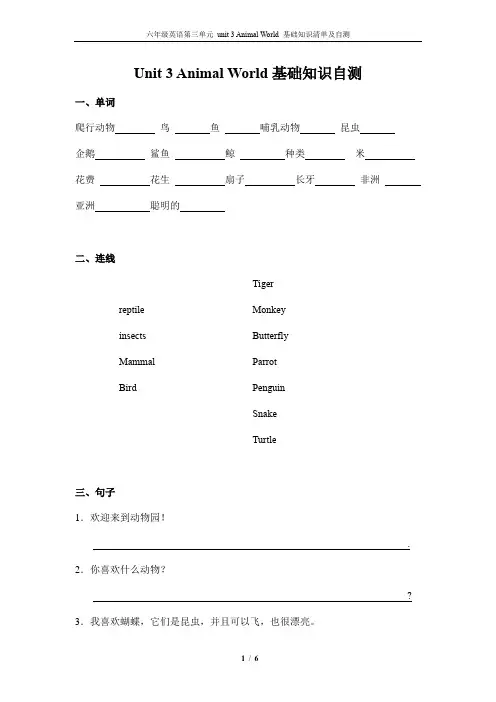
Unit 3 Animal World基础知识自测一、单词爬行动物鸟鱼哺乳动物昆虫企鹅鲨鱼鲸种类米花费花生扇子长牙非洲亚洲聪明的二、连线Tigerreptile Monkeyinsects ButterflyMammal ParrotBird PenguinSnakeTurtle三、句子1.欢迎来到动物园!. 2.你喜欢什么动物?? 3.我喜欢蝴蝶,它们是昆虫,并且可以飞,也很漂亮。
. 4.我喜欢猴子,他们是哺乳动物,它们能爬树。
. 5.猴子是哪种动物?? 6.它们是哺乳动物。
. 7.猴子能干什么?? 8.它们爬树非常厉害。
. 9.猴子喜欢吃什么?? 10.它们喜欢吃桃子和香蕉。
. 11.关于大象你了解什么?? 12.它们有四米高,它们不吃肉,只吃水果、树叶和草。
. 13.哺乳动物是热血并且它们都有毛发挥着皮覆盖,哺乳动物妈妈会给他们的孩子喂奶。
Mammals have . And they are and mothermammals to their babies.14.所有的鸟都有羽毛,并且有两只翅膀,鸟会下蛋。
All birds have , and have and mother birds . 15.爬行动物是冷血动物,并且所有的爬行动物都麟,爬行动物也会产蛋。
Reptiles have and all reptiles have and mother reptiles lay eggs.16.所有的昆虫都有六条腿,并且昆虫会下蛋,它们也会飞、有翅膀。
All insects have and mother insect and they can fly and have wings.17.Tom的爸爸是一名兽医。
Tom’s father is an .18.Tom的妈妈是一名动物饲养员。
Tom’s mother is an at the zoo.19.当Sharon15岁的时候失明了。
六年级上册英语教学设计-Unit 3《Animal World》(Story Time)|人教(新起
六年级上册英语教学设计-Unit 3《Animal World》(StoryTime)|人教(新起点)一、教学目标1.能听懂、读懂、会说及用语调朗读单词和句子。
2.能听懂故事,在理解过程中获得快乐,在娱乐中获得学习。
3.能掌握动词短语,掌握一些日常生活用语。
二、教学内容教材:人教版《新起点》(六年级上)Unit 3《Animal World》(Story Time)三、教学重难点重点:掌握故事中重要的单词和短语;难点:理解并口头表达故事中的单词和句子。
四、教学准备1.教学PPT。
2.相关课件及教具。
3.学生手册。
五、教学过程1. Warm-up(10 mins)1.Greetings: 教师会问候学生,并开始复习上一节课学习过的内容。
2.Review: 复习一些关于动物的单词,如Dog,Cat等。
3.Game: 教师会选择适合学生学习动物相关单词的游戏展开。
如竞速说出某种动物的单词。
2. Presentation(5 mins)1.通过图片呈现本节课的故事,引导学生对故事主题进行预备性认知,学生要务必掌握本节课的故事内容。
2.教师利用图片、肢体语言等方式对本节课的故事进行呈现,并帮助学生理解并记忆故事中的单词与句子。
3. Practice(20 - 30 mins)1.学生阅读书本中的故事,并理解故事的主要内容、条理与要点等。
在此基础上,请学生进行小组讨论与分享,并互相询问与回答问题。
2.学生通过听故事并回答问题的方式来进一步理解本节课教学要点。
3.学生分析故事中的句子并试着口头表达一遍。
课堂上对本节课涉及的单词、句子等内容进行集体口头复述与模仿练习。
4. Application(10 - 15 mins)1.令学生配对并表演本章故事,每个小组的五名学生成立一个小剧团来演绎故事,要求角色表演生动,台词清晰,流畅,搭配扮相等策略来便于学生进行主题语言表达的设计。
2.令学生发表自己对于故事的内心体验,并寻求以主题语言表达自己的看法与想法。
人教版一年级起点六年级上册英语《Unit 3 Animal World Fun Time》(一等奖课件)
Fun Time
Let’s sing!
Let’s talk!
Unit 3 Animal World How many kinds of animals are there in the passage?
How do mother animals give birth to their babies?
1.All insects have C____legs.
A. 7 B. 4 C. 6
2.Mother insects _B______.
A. feed milk B. lay eggs C. make milk
3.Most insects have _C____.
A. feathers B. scales C. wings
_______in danger __________________
_____________________
________________________
________________________
________________________ Try to use the new words . ____________ Why should we love them?
Mammals have warm blood
be covered with
The tree _i_s_c_o_ve_r_e_d_w_i_th_f_lo_w_e_r_s.__.
be covered with
Last night the road w__as__c_ov_e_r_e_d_w_it_h_s_n.ow
Tips: •Don’t eat wild animals. •Say no to animals’ coat. •Don’t pollute the water. •Don’t cut down the trees. •Tell people to protect the animals….
六年级上册英语教案-Unit3《AnimalWorld》(第3课时)|人教(新起点)

六年级上册英语教案-Unit 3《Animal World》(第3课时)|人教(新起点)教学内容本课时为《Animal World》第3课时,内容主要围绕动物世界的多样性,包括动物的分类、生活习性以及与人类的关系。
学生将通过学习,了解不同动物的特点,并学会如何用英语描述它们。
教学目标1. 知识目标:学生能够掌握并运用关于动物的词汇和句型,如“elephant”, “giraffe”, “They are tall and strong”等。
2. 能力目标:学生能够运用所学知识,进行简单的英语对话,描述动物的特点。
3. 情感目标:培养学生对动物世界的热爱和保护意识。
教学难点1. 动物词汇的记忆和应用。
2. 句型的正确运用。
3. 描述动物特点时的语言组织。
教具学具准备1. 多媒体教学设备。
2. 动物图片和卡片。
3. 教学录音机。
教学过程1. 导入利用多媒体展示动物世界的视频,引发学生的兴趣。
2. 新知识学习展示并教授新的动物词汇和句型。
3. 练习学生进行小组练习,用所学词汇和句型描述动物。
4. 游戏进行动物词汇的记忆游戏,巩固所学知识。
5. 对话学生进行角色扮演,模拟动物园的场景,用英语进行对话。
板书设计1. 动物词汇列表。
2. 句型示例。
3. 动物世界的简单介绍。
作业设计1.抄写并记忆动物词汇。
2.用所学句型描述自己喜欢的动物。
3.预习下一课时的内容。
课后反思本课时通过丰富的教学活动,激发了学生对动物世界的兴趣,提高了他们的英语应用能力。
但也存在一些不足,如部分学生对动物词汇的记忆不够牢固,需要在今后的教学中加强巩固。
重点细节:教学难点动物词汇的记忆和应用1. 直观教学法:利用动物图片和实物模型,让学生在视觉上与动物名称建立直接联系。
2. 游戏化学习:设计记忆游戏,如“动物卡片匹配”或“我是谁”游戏,让学生在游戏中不知不觉地记忆单词。
3. 情境模拟:创设真实的语言环境,如模拟动物园或动物保护区,让学生在实际对话中使用动物词汇。
六年级上册英语教学设计-Unit 3 Animal world 教学设计-人教新起点 (2)

六年级上册英语教学设计-Unit 3 Animal world 教学设计-人教新起点 (2)教材分析此单元主要涵盖了有关动物的词汇和句子,其中包括了家庭宠物、动物栖息地、食品链等内容。
教材重点落在了阅读和听力上,培养学生口语表达能力的同时,提高了他们对英语的理解和阅读能力。
教学目标•学习表达有关动物的词汇和句子;•培养学生的语言能力,提高口语表达能力;•提供学生了解动物的基础知识;•提高学生阅读和听力能力。
教学安排第一课时教学内容•学习并掌握动物的基本词汇;•了解动物的分类和栖息地。
教学重点•学生应该能够熟练掌握单词和词组,如“dog, cat, bird, frog, fish, mouse, rabbit, pet, jungle, desert, forest, pond, ocean”等。
教学难点•学生应该能够较为流利地表达动物的栖息地和基本特征。
教学方法•以图片和音频为主要辅助教学资源;•以听力和口语为主要教学形式。
教学过程1.教师出示图片,向学生介绍不同种类的动物,并引导学生讨论它们之间的区别。
2.教师播放有关动物的声音,引导学生猜测对应的动物,并帮助学生掌握发音。
3.教师引导学生学习家庭宠物的基本词汇,并帮助他们记住这些单词的发音和汉语意思。
4.教师演示诵读单词和词组,并要求学生跟读。
5.教师向学生介绍动物的分类和栖息地,并引导学生用英语表达。
教学扩展学生可以探索更多有关动物的信息和视频资料,帮助他们更好地了解动物。
第二课时教学内容•学习有关食品链的单词和词组;•了解动物在食品链中的位置。
教学重点•学生应该能够掌握与食品链有关的单词和词组,如“carnivore, herbivore, omnivore, predator, prey”等。
教学难点•学生应该能够理解动物在食品链中的位置,并能够用英语表达出来。
教学方法•以图片和音频为主要辅助教学资源;•以阅读和口语为主要教学形式。
教学过程1.教师出示有关动物的图片和相关文字,引导学生从图片中理解动物在食品链中的地位,并帮助他们掌握有关单词的发音和汉语意思。
小学英语人教版六年级上册Unit3AnimalWorldlesson2教学设计
小学英语人教版六年级上册Unit3AnimalWorldlesson2教学设计【名师授课教案】1教学目标词汇:kind2、句型:What kind of animals are monkeys?They are mammals…3、灵活运用所学单词和句型。
2学情分析1、词汇:kind2、句型:What kind of animals are monkeys?They are mammals…3重点难点能够运用所学知识进行灵活运用。
4教学过程4.1第一学时教学活动1【导入】Animal world1、猜谜语,引出新课。
Here is an animal.It’s white.It has long ears.It likes to eat carrots.It can jump.What is it?2【讲授】Animal world1、猜谜语,引出新课。
Here is an animal.It’s white.It has long ears.It likes to eat carrots.It can jump.What is it?2、出示一些上节课重点学习的单词图片,说单词,并回答问题。
复习巩固有关动物种类的词汇,激活学生已有的知识储备。
3、看动画,回答下列问题。
1.What animals did Yaoyao see at the zoo yesterday?2.What kind of animals are monkeys?3.What can monkeys do?4.What do monkeys like to eat?。
人教版小学六年级英语上册《Animal world Lesson 3》图文
升调
降调
The elephants has two long, white teeth called tusks. It is the only animal with a trunk –a special long nose. The elephant can use its trunk to pick up a big tree or small peanut. The elephant is also the mammal with the biggest ears. They look like two big fans. Elephants live in Africa and Asia. They live together in family groups. They are very strong, very smart and of course, very, very big.
连读符号
升调
降调
My favourite animal My favourite animal is a cat. Cats like eating fish and catching mice. At noon its eyes get small and get big in the morning and in the afternoon. It can run and jump. But it can’t fly and swim. It usually catches mice in the evening and sleeps in the next morning. The cat is very cute and everybody likes it.
Look and say.
小学英语人教版六年级上册Unit 3 Animal World《lesson 1》优质课公开课教案教师资格证面试试讲教案
小学英语人教版六年级上册Unit 3 Animal World《lesson 1》优质课公开课教案教师资格证面试试讲教案1教学目标1、听懂会说动物名称单词whale,shark, monkey, tiger,butterfly,penguin2、能模仿本课所学动物的特征性动作,并且能听指令做动作。
3、在活动中熟悉单词,了解动物,热爱自然。
2学情分析本课时是人教版小学英语六年级上册Unit 3 Animal World 第一课时,是学生在学习动物词汇的基础上,给动物词汇归类。
学习6个动物单词:whale,shark, monkey, tiger,butterfly,penguin。
要求学生模仿动物的形体动作,学生要能根据指令做动作,此部分的活动主要是让学生在做中练习语言,习得语言。
虽然学生对英语有一定基础,也算感兴趣,但困难在所难免。
为让他们有兴趣、有信心学好这一课,我通过复习已经学过的动物单词入手,引导学生的学习积极性,激发他们想学习更多动物单词的学习欲望,从而达到更好的学习效果。
教师可以用生动可爱的动物图片和课件帮助学生学习动物单词。
3重点难点1、学习新的动物单词butterfly,penguin2、单词squirrel, elephant, mouth and mouse, bird and bear 的发音。
4教学过程教学活动1【导入】引入It’s a fine day today. I have a piece of good news for you.We're going to visit the An imal World.(贴出动物世界的图片)Are you happy?2【导入】新授Oh,we'll see so many animals.That's great!Now,please look here.We'll meet many animal f riends today.There are all kinds of animals in the zoo. There are reptiles, birds, inse cts, mammals. What animals can you see at Animal World?I see monkeys.What kind of animal are monkeys?They’re mammals.Oh,yes.This monkey is for you!(以下whale,shark, butterfly,penguin 等同上)评析:用学生已经学过的动物单词引出“What kind of animal are monkeys? They’re mammals”新授句型。
六年级上册Unit3AnimalWorldUnit3AnimalWorldLesson1
Unit 3 Animal World Lesson 1教学设计教学目标通过本节课的学习,学生能够达到以下目标:1. 知识目标(1)能够听懂、会说reptiles, birds, fish, mammals, insects, penguin, shark, whale等单词,尝试借助音标、拼读规律和其他词汇学习策略记忆单词,并能根据语境选择恰当的单词或短语。
(2)能够听懂、会说用来询问动物类别的功能句:What animals do you like? 及相应答语:I like … They are … They can … 能够初步学会在恰当的情境中运用,并能按要求在所提供的语境中说几个意义连贯的句子。
2. 能力目标(1)能够使用本单元所学的句型,谈论自己所喜欢的动物及他们的类型。
(2)能够仿写与动物有关的单词和句子。
3. 其它目标(1)能够积极参与课堂上的各种活动或游戏,并能与同伴合作完成活动。
(2)能够在活动中认真倾听同伴发言,并尝试表达自己的观点。
教学重点用英语表达某种动物的类别。
教学难点引导学生综合运用语言描述动物类别及特征。
教学过程1.复习(复习U2重点单词)设计意图:复习以前学习过的单词和句子。
唤醒学生大脑中已有的知识。
T: Look at the picture. What animals can you see the picture?S: Animal.T: Good! Today we are going to learn Unit 3 Animal World. (教师板书课题)2. 学习(1)单词教学)①教学reptileT: (点击课件,出现一只正在爬行的乌龟) What’s this?Ss: Turtle.T: Yes. It’s a turtle. What do you know about turtles?S: …T: What kind of animals are turtles? Let’s listen and choose. (点击课件)Ss: BT: What does reptile mean?S: 爬行动物T: Right! What does e say? Let’s have a look! ( 点击课件,出现red)S: /e/T: What does i-e say? (点击课件,出现like, nice)Ss: /ai/T: Well done! How to read this word?S: /′reptaɪl/T: Good! Follow him/her!Ss: /′reptaɪl/设计意图:在新单词的学习之中,采用旧单词带出新单词的读音。
六年级上册英语教案-Unit3《AnimalWorld》(Let’sCheck)|人教(新起点)
六年级上册英语教案-Unit 3《Animal World》(Let’sCheck)|人教(新起点)教学内容本节课教学内容为人教版六年级上册英语《Animal World》单元中的“Let’s Check”部分。
该部分主要围绕动物世界的多样性,通过听力练习、阅读理解和语言运用活动,让学生复习和巩固本单元所学的有关动物的知识点,如动物名称、特征及其生活习性等。
教学目标1. 知识与技能:学生能够正确理解和运用本单元所学的有关动物的词汇和句型。
2. 过程与方法:通过听力、阅读和讨论活动,提高学生的英语听、说、读能力,并培养他们的合作意识。
3. 情感态度价值观:激发学生对动物世界的好奇心和探索欲,增强他们保护动物、爱护环境的意识。
教学难点1. 正确理解并运用描述动物特征和生活习性的词汇和句型。
2. 能够准确完成听力练习,理解听力材料的主旨。
教具学具准备1. 多媒体设备:用于播放听力材料和展示相关图片。
2. 动物图片和卡片:用于课堂展示和练习。
3. 学生练习册:用于学生完成相关练习。
教学过程1. 热身活动:通过展示动物图片,引导学生复习本单元所学的动物词汇。
2. 听力练习:播放听力材料,学生完成相应的练习题,检查对听力材料的理解。
3. 阅读理解:学生阅读相关文章,回答问题,进一步巩固所学知识。
4. 小组讨论:学生分组讨论,用英语描述自己喜欢的动物,并分享给全班同学。
板书设计板书将突出本节课的重点词汇和句型,通过图表和关键词汇的形式,直观展示动物的主要特征和生活习性。
作业设计1. 听力练习:学生完成练习册上的听力练习,巩固听力技能。
2. 阅读小短文:学生阅读一篇关于动物的短文,并回答问题。
3. 写作任务:学生写一篇简短的英语作文,描述自己最喜欢的动物。
课后反思重点细节:教学过程教学过程是整个教案中最为关键的部分,因为它直接关系到教学目标能否实现,学生能否有效吸收和掌握知识。
在本教案中,教学过程的设计应注重学生的参与度和互动性,确保教学内容与学生的实际水平相匹配,同时也要注意教学活动的多样性和趣味性,以保持学生的学习兴趣。