
外研社三年级上册(一年级起点)复习知识点
外研社三年级上册(一年级起点)复习知识点★短语复习
1.be hard for…对…来说很难
2.a knife and fork 一副刀叉
3.be easy for…对…来说很简单
4.fast food 快餐
5.ride my bike 骑自行车
6.make a cake (for…)(为…)做蛋糕
7.good idea 好主意
8.be quiet 安静
9.go to your room 回你的房间 10.play the piano 弹钢琴
11.water the flowers 浇花 12.here you are 给你
13.watch tv 看电视 14.do the homework做家庭作业
15.make planes 制作飞机 16.dragon boats 龙舟
17.over there 在那里 18.get out/go out 出去
19.run fast 跑得快 20.jump far 跳得远
21.look at 看 22.have a drink 喝一杯饮料
23.have a cake 吃一块蛋 24.have an ice cream吃一块冰淇淋25.go to shop 去商店 26.have some sweets 吃一些糖
’t worry 别担心
29.row a boat 划船 30 write a letter 写一封信
31.have got 有 32.has got 有(第三人称单数形式)33.play with…和…一起玩 34.be careful 小心
35.have/has got a headache/stomach ache/cold/cough
有头痛/胃痛/感冒/咳嗽
36.bring…to…带…到… 37.listen to music 听音乐
40.do the long jump 参加跳远 41.do the high jump参加跳高42,run a race 参加跑步 43.play football 踢足球
46.at the airport 在飞机场 47.in the sea在海里
48.on Friday 在周五 49.have a class 上课
★重点句型复习:
1.Do you use chopsticks in the UK ? Yes, I do./ No, I don’t.
你在英国使用筷子吗?是的,我用。
/不,我不用。
2.Do you want noodles? Yes, please./ No, thank you.
你想要面条吗?好的。
/不用了,谢谢。
3.What are you eating? I’m eating hamburgers and chips.
你正在吃什么?我正在吃汉堡包。
4.What are you doing? I’m/We’re making a cake.
你正在做什么?我/我们正在做蛋糕。
5.What is he doing? He is watching TV.
他正在做什么?他正在看电视。
(read-reading watch-watching play-playing
make-making hide-hiding write-writing ride- riding
swim-swimming get-getting run-running)
6.These ducks are very naughty.
这些鸭子十分淘气。
7.The ducks are playing in the rain.
这些鸭子正在雨里玩耍。
8.I can/can’t jump far.
我能/不能跳得远。
Can you jump far? Yes, I can ./ No, I can’t.
你能跳得远吗?是的,我能/不,我不能。
9.What can you see? I can see a bird .It can fly.
你能看见什么?我能看见一只鸟。
它能飞。
10.Can I have a cake? Yes, you can ./No you can’t.
我能吃一块蛋糕吗?是的,你能。
/不,你不能。
11.I’ve got new shorts.
我有新的短裤。
Have you got new shorts ? Yes, I have./ No, I haven’t
你有新短裤吗?是的,我有。
/不,我没有。
12.He’s got a cold.
他得了感冒吗?
Has he got a cold? Yes, he has./ No, he hasn’t.
他得了感冒吗?是的,他有。
/不,他没有。
13.This is S am’s book。
这是山姆的书。
14.This is my mum’s umbrella.这是我,妈妈的雨伞。
Is this your mum’s umbrella? Yes, it is./ No, it isn’t.
这是你妈妈的雨伞吗?是的,它是。
/不,它不是。
15.What are you going to do?
你在将要去做什么?
I’m going to play football.我将要去踢足球。
Are you going to play football? Yes, I am./ No, I am not.
你将要去踢足球吗?是的,我将要去。
/不,我不会去。
16.What are you going to be?你将要成为什么(职业)
I’m going to be a doctor.我将要成为一名医生。
17.What are you going to see?你将要去看什么?
I’m going to see The Monkey King.我将要去看《大闹天宫》。
★知识点:
1.let+动词原形
2.be动词+动词ing 表示“正在做……“
3.there is+单数名词
there are+复数名词
4.情态动词 can+动词原形
5.乐器前加the 如:play the drums
运动前不加the 如:play basketball
5.be going to +动词原形表示“将要……“
6.人称代词
7.形容词性物主代词。
外研社英语教材(一年级起点)三年级上册知识点总结

外研社英语教材(一年级起点版)三年级上册知识点总结1.Do开头的疑问句:Do开头的疑问句,Yuki-外研社英语3年级上册(一年级起点版)①Do you use a knife and fork in England? (你在英格兰用一幅刀叉吗?)--- Yes, I do. (是的,我用。
)②Do you usechopsticksin England?(你们在英格兰用筷子吗?)--- No, we don't. (不,我们不用。
)③Do you want noodles? (你想要面条吗?)--- Yes, I do. (是的,我想)/ No, I don't. (不,我不想。
)(英文中"you"可以表示“你”,也可以表示“你们”,看语境回答即可。
)(England可以用地名替换,如: China, Qingdao, Hebei... ; a knife and fork可以用物品替换,如: a cup, a spoon...或者a book, an eraser... ; noodles也可以用食物代替,如: eggs, hamburgers, rice...)2.It's +形容词的用法:It's+形容词的用法,Yuki-外研社英语3年级上册(一年级起点版)①It's easy for you. (这个对你来说是简单的。
)②It's hard for us. (这个对我们来说是困难的。
)(somebody = sb. 表示某个人,这里是宾格,所以替换you或us的话需要用me, him, her, it, them,详细内容见“附录”,同样you可以表示“你”或者“你们”。
)③ 扩展:It's good for him. (这个对他有好处。
)(easy/hard可以用形容词来代替,如: nice, bad...)3. be doing现在进行时特殊疑问句及回答:bedoing现在进行时特殊疑问句及回答,Yuki-外研社英语3年级上册(一年级起点版)①What are you do ing? (你正在做什么?)---I'm watch ing TV. (我正在看电视)②What are you do ing? (你们正在做什么?)---We're listen ing to music. (我们正在听音乐。
小学英语外研版(一年级起点)三年级上知识点总结(彩色完全版)
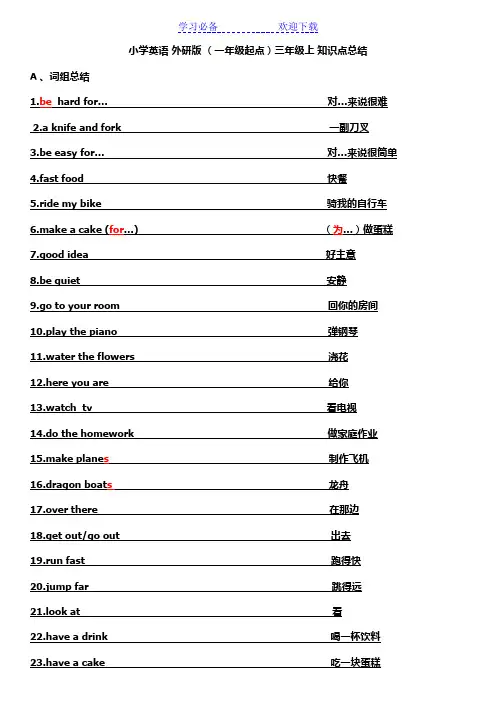
小学英语外研版(一年级起点)三年级上知识点总结A 、词组总结1.be hard for…对…来说很难2.a knife and fork 一副刀叉3.be easy for…对…来说很简单4.fast food 快餐5.ride my bike 骑我的自行车6.make a cake (for…) (为…)做蛋糕7.good idea 好主意8.be quiet 安静9.go to your room 回你的房间10.play the piano 弹钢琴11.water the flowers 浇花12.here you are 给你13.watch tv 看电视14.do the homework 做家庭作业15.make plane s制作飞机16.dragon boat s 龙舟17.over there 在那边18.get out/go out 出去19.run fast 跑得快20.jump far 跳得远21.look at 看22.have a drink 喝一杯饮料23.have a cake 吃一块蛋糕24.have an ice cream 吃一块冰淇淋25.go to shop 去商店26.have some sweets 吃一些糖e in 进来28.don’t worry 别担心29.row a boat 划船30 write a letter 写一封信31.have got 有32.has got 有(第三人称单数形式)33.play with…和…一起玩34.be careful 小心35.have/has got a headache/stomach ache/cold/cough有头痛/胃痛/感冒/咳嗽36.bring…to…带…到…37.listen to music 听音乐38.be from=come form 来自39.sport s day 运动日40.do the long jump 参加跳远41.do the high jump 参加跳高42,run a race 参加跑步43.play football 踢足球44.play basketball 打篮球e on 加油46.at the airport 在飞机场47.in the sea 在海里48.on Friday(s)在(每个)周五49.have a class 上课50.has a test(tests) (第三人称单数)做一次(些)测试51. in the UK 在英国52. speak Chinese/English 说汉语/英语53. feed the ducks 喂鸭子54. play hide-and-seek 玩捉迷藏55. in the rain 在雨中56. under the tree 在树下57. in the sky 在空中58. have a look 看一看59. go to the shop 去商店60. read books 读书61. make friends 交朋友62. our star 我们的明星63. see a film 看电影64. visit my friends 拜访我的朋友65. visit Hainan 游览海南66.drive a train 开火车67. fly a plane 开飞机68.help the ill 帮助病人B.句型总结:1.Do you use chopsticks in the UK ? 你在英国使用筷子吗?2.Yes, I do./ No, I don’t. 是的,我用。
外研社一起小学三年级上英语知识点
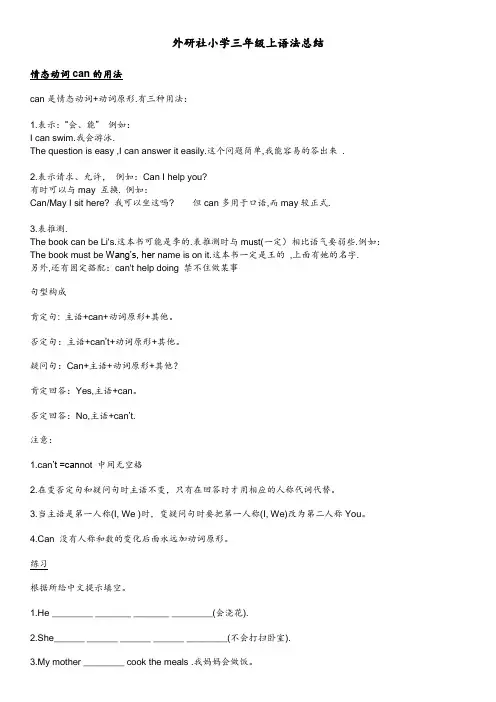
外研社小学三年级上语法总结情态动词can的用法can是情态动词+动词原形.有三种用法:1.表示:“会、能”例如:I can swim.我会游泳.The question is easy,Ican answer it easily.这个问题简单,我能容易的答出来 .2.表示请求、允许,例如:Can I help you?有时可以与may 互换.例如:Can/May I sit here?我可以坐这吗?但can多用于口语,而may较正式.3.表推测.The book can be Li's.这本书可能是李的.表推测时与must(一定)相比语气要弱些.例如:The book must be Wang’s, her name is on it.这本书一定是王的,上面有她的名字.另外,还有固定搭配:can't help doing 禁不住做某事句型构成肯定句: 主语+can+动词原形+其他。
否定句:主语+can’t+动词原形+其他。
疑问句:Can+主语+动词原形+其他?肯定回答:Yes,主语+can。
否定回答:No,主语+can’t.注意:1.can’t =can not 中间无空格2.在变否定句和疑问句时主语不变,只有在回答时才用相应的人称代词代替。
3.当主语是第一人称(I, We )时,变疑问句时要把第一人称(I, We)改为第二人称You。
4.Can 没有人称和数的变化后面永远加动词原形。
练习根据所给中文提示填空。
1.He ________ _______ _______ ________(会浇花).2.She______ ______ ______ ______ ________(不会打扫卧室).3.My mother ________ cook the meals .我妈妈会做饭。
4.她姐姐会说英语。
Her sister_______ speak English.5.你会唱歌吗?______ ______ sing?按要求改写句子Ms. Wang can play table tennis.(变否定句)We can make ice cream together. (变一般疑问句,并作肯定回答)I can play computer games. ( 对划线部分提问)补全对话1.A: ____________ you clean the bedroom?B: ____________, I can’t.A: What can you______________?B: I ____________ cook the meals and empty the trash.A: _____________ are helpful.2.A: ____________ can Amy do?B: She _____________ water the flowers and cook the meals.A: ___________ ___________ helpful. ____________ you cook the meals?B: ___________, Ican.Have got /has got的用法Have/Has got句型:它表示某物归某人所有,是一种所属关系,主语为人,只有“拥有”的意思Have/Has got句型的转换A、否定句:在Have或Has后加not, 缩写为Haven’t或Hasn’t.如:I have got three sisters. → I haven't got three sisters.He has got a bike. → He hasn't got a bike.B、一般疑问句与回答:把Have或Has提前到句首I have got three sisters. → Have you got three sisters? Yes,I have./No,I haven't.He has got a bike. → Has he got a bike? Yes, he has./No, he hasn't.用have got或has got填空。
外研版(一起)英语三年级上册(全)语法知识点
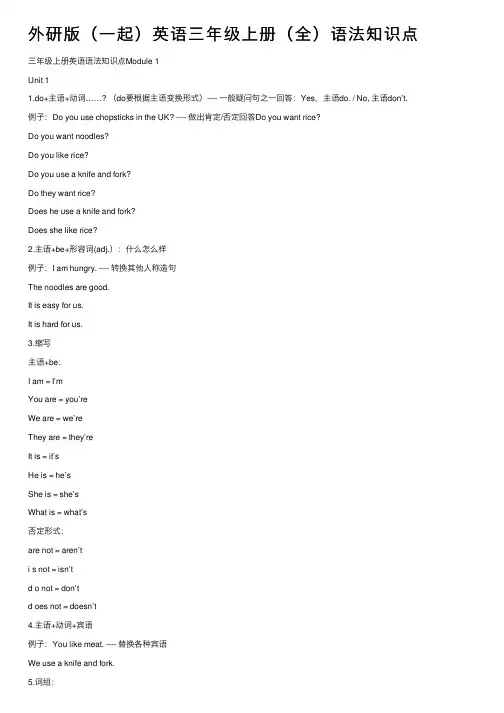
外研版(⼀起)英语三年级上册(全)语法知识点三年级上册英语语法知识点Module 1Unit 11.do+主语+动词……? (do要根据主语变换形式)---- ⼀般疑问句之⼀回答:Yes,主语do. / No, 主语don’t.例⼦:Do you use chopsticks in the UK? ---- 做出肯定/否定回答Do you want rice?Do you want noodles?Do you like rice?Do you use a knife and fork?Do they want rice?Does he use a knife and fork?Does she like rice?2.主语+be+形容词(adj.):什么怎么样例⼦:I am hungry. ---- 转换其他⼈称造句The noodles are good.It is easy for us.It is hard for us.3.缩写主语+be:I am = I’mYou are = you’reWe are = we’reThey are = they’reIt is = it’sHe is = he’sShe is = she’sWhat is = what’s否定形式:are not = aren’ti s not = isn’td o not = don’td oes not = doesn’t4.主语+动词+宾语例⼦:You like meat. ---- 替换各种宾语We use a knife and fork.5.词组:Look at + 名词Look at the mess! ---- 替换各种名词Look at me!Look !Unit 21.What + be + 主语+动词ing? 谁正在做什么?回答:主语+ be + doing……谁正在做什么。
What are you doing?What are you eating? ---- I am eating grass,(替换meat, rice, noodles, hamburgers and chips, apples. )2.现在进⾏时结构:be + 动词ing 正在……(四⼤时态之⼀)What are you eating? ---- 特殊疑问句---- 找出各⾃的be + doing What are you doing? ---- 特殊疑问句I’m eating grass. ---- 肯定句I’m eating meat.I’m eating hamburgers and chips.I’m using my hands.He’s using chopsticks.She’s using a knife and fork.3.be+主语+动词i ng……?(be要根据主语变换形式) ---- ⼀般疑问句之⼆回答:Yes,主语be. / No, 主语be not. Are you eating an apple? ---- 做出肯定/否定回答Are you eating a hamburger?Are they eating grass?Is he eating chips?Is she eating rice?Is your mother eating noodles?4.词组:Speak + 语⾔:说什么语⾔Speak EnglishSpeak ChineseSpeak JapaneseSpeak FrenchPlease 请Try them, please. (放最后的时候⼀般⽤逗号隔开)Please try them. (放前⾯不需要逗号隔开)Module 2Unit 15.现在进⾏时结构:be + 动词ing 正在……(四⼤时态之⼀)What are you doing? ---- 特殊疑问句---- 找出各⾃的be + doing We’re making a cake. ---- 肯定句We’re making a cake for you.We’re making a plane.I’m riding my bike.I’m making a cake.I’m reading.I’m working.Amy’s playing the piano.Sam’s playing the drums.(写出每个肯定句的特殊疑问句)6.祈使句a)Let + 某⼈+ 动词原形+ 某事:让某⼈做某事Let’s make a cake for Mum and Dad.Let’s go to school.Let’s go home.Let me do it.缩写:l et’s = let us 让我们扩展:let后⾯的⼈称代词+宾格b)动词原形+ 宾格!or Be + 形容词!Be quiet!Please be quiet!Please go to your room!Please stop!7.词组:Good idea! 好主意!Thank you!谢谢你!Thanks!谢谢!Many thanks! ⾮常感谢!Yes!是的!Unit 21.现在进⾏时结构:be + 动词ing 正在……(四⼤时态之⼀)What are you doing? ---- 特殊疑问句---- 找出各⾃的be + doing What’s he doing?What’s she doing?What are they doing?I’m watching TV.I’m watering the flowers.He’s riding.She’s eating.He’s doing his homework.He is reading.He’s writing.She’s sleeping.They are drawing.She is getting up.We’re making ducks.We’re making planes.A cat is running.2.主语+be+形容词:什么怎么样I’m sorry.It’s lovely.3.This is my bag.These are my books.Those are your books.缩写:that’s = that is4.词组:Here you are. 给你。
外研社英语三年级上册(一年级起)第一模块知识点
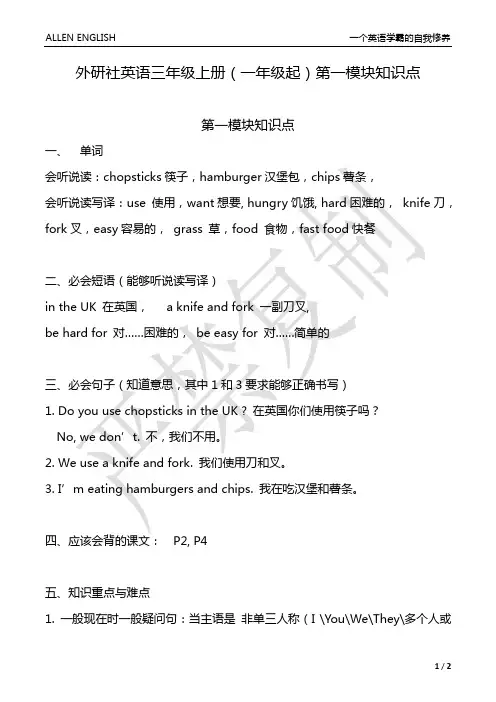
外研社英语三年级上册(一年级起)第一模块知识点第一模块知识点一、单词会听说读:chopsticks筷子,hamburger汉堡包,chips薯条,会听说读写译:use 使用,want想要, hungry饥饿, hard困难的,knife刀,fork叉,easy容易的,grass 草,food 食物,fast food快餐二、必会短语(能够听说读写译)in the UK 在英国, a knife and fork 一副刀叉,be hard for 对……困难的,be easy for 对……简单的三、必会句子(知道意思,其中1和3要求能够正确书写)1. Do you use chopsticks in the UK ? 在英国你们使用筷子吗?No, we don’t. 不,我们不用。
2. We use a knife and fork. 我们使用刀和叉。
3. I’m eating hamburgers and chips. 我在吃汉堡和薯条。
四、应该会背的课文:P2, P4五、知识重点与难点1. 一般现在时一般疑问句:当主语是非单三人称(I \You\We\They\多个人或物)时,句首用Do提问;当主语是单三人称(He\She\It\单个人名、单个称呼一个人或物)时,句首用Does提问。
2. 现在进行时的标志:is/am/are + 动词ing. 表示正在做的动作。
is,am, are用法(会背):I 和am 不分家。
见了you 就用are,多于一个也用are。
人名称呼他她它,小小is 跑来啦。
3. use(现在进行时)---using easy反义词—hardbe hard/ easy for …对于…困难/容易don’t= do not。
外研社三年级上册(一年级起点)复习知识点

三年级(一起)总复习★短语复习1.be hard for…对…来说很难2.a knife and fork 一副刀叉3.be easy for…对…来说很简单4.fast food 快餐5.ride my bike 骑自行车6.make a cake (for…)(为…)做蛋糕7.good idea 好主意8.be quiet 安静9.go to your room 回你的房间 10.play the piano 弹钢琴11.water the flowers 浇花 12.here you are 给你13.watch tv 看电视 14.do the homework做家庭作业15.make planes 制作飞机 16.dragon boats 龙舟17.over there 在那里 18.get out/go out 出去19.run fast 跑得快 20.jump far 跳得远21.look at 看 22.have a drink 喝一杯饮料23.have a cake 吃一块蛋 24.have an ice cream吃一块冰淇淋25.go to shop 去商店 26.have some sweets 吃一些糖27.e in 进来 28.don’t worry 别担心29.row a boat 划船 30 write a letter 写一封信31.have got 有 32.has got 有(第三人称单数形式)33.play with…和…一起玩 34.be careful 小心35.have/has got a headache/stomach ache/cold/cough有头痛/胃痛/感冒/咳嗽36.bring…to…带…到… 37.listen to music 听音乐38.be from=e form 来自 39.sports day 运动日40.do the long jump 参加跳远 41.do the high jump参加跳高42,run a race 参加跑步 43.play football 踢足球44.play basketball 打篮球 45.e on 加油46.at the airport 在飞机场 47.in the sea在海里48.on Friday 在周五 49.have a class 上课★重点句型复习:1.Do you use chopsticks in the UK ? Yes, I do./ No, I don’t.你在英国使用筷子吗?是的,我用。
外研社英语一年级起点三年级上册
外研社英语一年级起点三年级上册一、单词部分。
1. 重点单词。
- 动物类。
- cat(猫),dog(狗),bird(鸟),fish(鱼),panda(熊猫)。
例如:I have a cat. It's very cute.- 颜色类。
- red(红色),blue(蓝色),green(绿色),yellow(黄色),black(黑色),white(白色)。
可以说:The flower is red.- 数字类。
- one(一),two(二),three(三),four(四),five(五),six (六),seven(七),eight(八),nine(九),ten(十)。
如:There are three apples on the table.- 日常用品类。
- pen(钢笔),pencil(铅笔),book(书),ruler(尺子),eraser(橡皮)。
We use a pen to write.2. 单词记忆方法。
- 联想记忆法。
- 对于动物单词,比如看到cat,可以联想猫柔软的毛、会抓老鼠等特点。
看到panda就想到它黑白相间的样子和爱吃竹子的习性。
- 卡片记忆法。
- 把单词写在卡片的一面,解释或者图画写在另一面。
例如,在“red”这张卡片的一面写单词,另一面可以画一个红色的苹果。
- 游戏记忆法。
- 玩猜单词游戏。
一个人描述单词的特征,比如“It's an animal. It can fly. It has two wings.”(它是一个动物,它能飞,它有两个翅膀),让其他人猜出“bird”这个单词。
二、句型部分。
1. 自我介绍句型。
- I'm...(我是……),例如:I'm Tom. I'm a student.- My name is...(我的名字是……),My name is Lily.2. 描述事物特征句型。
- It's...(它是……),可以用来描述颜色、形状等。
外研版(一起)英语三年级上册(全) 语法知识点
三年级上册英语语法知识点Module 1Unit 11.do+主语+动词……? (do要根据主语变换形式)---- 一般疑问句之一回答: Yes, 主语do./ No, 主语don’t.例子: Do you use chopsticks in the UK? ---- 做出肯定/否定回答Do you want rice?Do you want noodles?Do you like rice?Do you use a knife and fork?Do they want rice?Does he use a knife and fork?Does she like rice?主语+be+形容词(adj.): 什么怎么样例子:I am hungry.---- 转换其他人称造句The noodles are good.It is easy for us.It is hard for us.2.缩写主语+be:I am = I’mYou are = you’reWe are = we’reThey are = they’reIt is = it’sHe is = he’sShe is = she’sWhat is = what’s否定形式:are not = aren’ti s not = isn’td o not = don’td oes not = doesn’t3.主语+动词+宾语例子: You like meat.---- 替换各种宾语We use a knife and fork.词组:Look at + 名词Look at the mess! ---- 替换各种名词Look at me!Look !Unit 2What + be + 主语+动词ing? 谁正在做什么?回答: 主语+ be + doing……谁正在做什么。
What are you doing?What are you eating? ---- I am eating grass,(替换meat, rice, noodles, hamburgers and chips, apples.)现在进行时结构: be + 动词ing 正在……(四大时态之一)What are you eating? ---- 特殊疑问句---- 找出各自的be + doing What are you doing? ---- 特殊疑问句I’m eating grass.---- 肯定句I’m eat ing meat.I’m eating hamburgers and chips.I’m using my hands.He’s using chopsticks.She’s using a knife and fork.1.be+主语+动词i ng……? (be要根据主语变换形式) ---- 一般疑问句之二回答: Yes, 主语be./ No, 主语be not.Are you eating an apple? ---- 做出肯定/否定回答Are you eating a hamburger?Are they eating grass?Is he eating chips?Is she eating rice?Is your mother eating noodles?词组:Speak + 语言: 说什么语言Speak EnglishSpeak ChineseSpeak JapaneseSpeak FrenchPlease 请Try them, please. (放最后的时候一般用逗号隔开)Please try them. (放前面不需要逗号隔开)Module 2Unit 1现在进行时结构: be + 动词ing 正在……(四大时态之一)What are you doing? ---- 特殊疑问句---- 找出各自的be + doing We’re making a cake.---- 肯定句We’re making a cake for you.We’re making a plane.I’m riding my bike.I’m making a cake.I’m reading.I’m working.Amy’s playing the piano.Sam’s playing the drums.(写出每个肯定句特殊疑问句)2.祈使句Let + 某人+ 动词原形+ 某事: 让某人做某事Let’s make a cake for Mum and Dad.Let’s go to school.Let’s go home.Let me do it.缩写: let’s = let us 让我们扩展: let后面的人称代词+宾格动词原形+ 宾格!or Be + 形容词!Be quiet!Please be quiet!Please go to your room!Please stop!词组:Good idea! 好主意!Thank you!谢谢你!Thanks!谢谢!Many thanks! 非常感谢!Yes!是的!Unit 2现在进行时结构: be + 动词ing 正在……(四大时态之一)What are you doing? ---- 特殊疑问句---- 找出各自的be + doing What’s he doing?What’s she doing?What are they doing?I’m watching TV.I’m watering the flowers.He’s riding.She’s eating.He’s doing his homework.He is reading.He’s writing.She’s sleeping.They are drawing.She is getting up.We’re making ducks.We’re making planes.主语+be+形容词: 什么怎么样I’m sorry.It’s lovely.1.That’s my flower!This is my bag.These are my books.Those are your books.缩写: that’s = that is词组:Here you are. 给你。
外研版新标准一起三上语文重点知识
外研版新标准一起三上语文重点知识
一、红色单词
1. 红色单词是本学期的重点词汇。
2. 学生需要熟练掌握这些词汇的发音和意思。
3. 红色单词将在听、说、读、写等多个方面进行训练。
二、课文内容
1. 本学期的课文内容主要包括人物、事件、情节等。
2. 学生需要认真分析文本,理解故事情节和人物性格。
3. 学生还需记住重要课文的关键句子和篇章结构。
三、阅读理解
1. 阅读理解是本学期的重点训练内容。
2. 学生需要通过阅读文章,理解文章主旨、推理推断和提取细节等。
3. 学生还需练阅读理解题,提高阅读速度和准确性。
四、写作训练
1. 本学期的写作训练主要包括作文、填写表格、写日记等。
2. 学生需要通过写作训练,提高语言表达能力和写作技巧。
3. 学生还需注意书写规范,合理组织文章结构。
以上是《外研版新标准一起三上语文重点知识》的主要内容。
学生需要根据这些重点知识进行研究和训练,以提高语文水平和综合应用能力。
请注意,以上内容仅为简要概括,详细内容请参考教材或教师的指导。
【精编】小学英语超详细外研版(一年级起点)三年级上知识点归纳总结(彩色完全版)
【精编】小学英语超详细外研版(一年级起点)三年级上知识点归纳总结(彩色完全
版)
重点词汇:
1.26个字母:20个辅音字母,5个元音字母,1个半元音字母。
2.1-10数词:one、two、three、four 、five 、six 、seven、eight、nine、ten
3.事物名词:eraser、rubber、pen、pencil、pencil-box、ruler、book 、map、bell、cap、hat、vest、well、zip、bus
4.水果名词:apple、orange、banana、pear
5.动物名词:duck、bear、monkey、dog、cat、bird、fox、chick、hen、pig、bee 、fish、frog、panda、giraffe Elephant、bat、pat
6.身体部位名词:head、arm、hand、foot、leg、body、ear、nose、eye
7.形容词:good、nice 、fine、glad、sad 、bad、big new、old
8.人物名词:girl、boy、baby、dad、mum、Miss、Mr.、Mrs.
9.颜色形容词:white,red,yellow,blue,green,orange,brown,purple,black
10.动词:open、close、turn on、turn off、clean、find、come、go、look、see 、run、jump 、swim、sing 、dance.
11.人称代词:I、you、he、she、it、we、you、they。