
五年级英语第二单元练习题1
4.别人问你:“What do you have on Saturdays?” 你应该回答:( ) A. I like Saturdays. B.I play computer games and read books on Saturdays. C. I have English, maths and music. 5.“你呢?”除了说“What about you?”外,还可以说:( ) A. Oops! B. Oh, Really? C. And you?
( )6.It's 8:00. It’s time _______get up.A. to B. \ C. for ( )7.-I often play ping-pong.-Great! I can play ______you. A. at B. with C. and ( )8. We have two English classes this afternoon. Really? We have English,________. A. two B. too C. to ( )9.Is your mother kind ? ____________. A.Yes, she is. B. Yes, he is. C. No, he isn’t. ( )10.I often read some ________ and watch TV. A. book B. books C. notebook ( )11.Amy_________Saturdays. A. like B. on C. likes
选择填空。(24分) ( )1.What do you often do _____ the weekend? A. on B. at C. in ( ) 2.We have English______ Mondays and Wednesdays. A. in B. of C. on ( )3.I often ______ books on Saturdays. A. see B. read C. reads ( )4.Who’s that young man? -__________is our PE teacher . A. He B. she C. She ( )5.I often do my homework_______the weekends. A. in B. on C. of
情景交际。(10分) 1.如果你想问“星期四你有什么课?”应该说:( ) A. What do you do on Thursdays? B. What day is it today? C. What do you have on Thursdays? 2. 如果你想问“你们星期一上什么课?”应该说:( C ) A. Monday is my favorite. B. We have English, math, and P.E. C. What do you have on Mondays? 3.如果你想说:“我喜欢星期六。”应该说:( C ) A.What do you do on Saturdays? B. I like Sundays. I watch TV on Sundays. C. I like Saturdays.
)
4.别人问你:“What do you have on Saturdays?” 你应该回答:( A. I like Saturdays. B.I play computer games and read books on Saturdays. C. I have English, maths and music. 5.“你呢?”除了说“What about you?”外,还可以说:( ) A. Oops! B. Oh, Rea际。(10分) 1.如果你想问“星期四你有什么课?”应该说:( ) A. What do you do on Thursdays? B. What day is it today? C. What do you have on Thursdays? 2. 如果你想问“你们星期一上什么课?”应该说:( C ) A. Monday is my favorite. B. We have English, math, and P.E. C. What do you have on Mondays? 3.如果你想说:“我喜欢星期六。”应该说:( ) A.What do you do on Saturdays? B. like Sundays. I watch TV on Sundays. C. I like Saturdays.
)
选择填空。(24分) ()1.What do you often do _____ the weekend? A. on B. at C. in ( ) 2.We have English_____Mondays and Wednesdays. A. in B. of C. on ( )3.I often ______ books on Saturdays. A. see B. read C. reads ( )4.Who’s that young man? -___is our PE teacher . A. He B. she C. She ( )5.I often do my homework_______ the weekends. A. in B. on C. of
( A )6.It's 8:00. It's time _______get up.A. to B. \ C. for ( )7.-I often play ping-pong.-Great! I can play ______you. A. at B. with C. and ( )8. We have two English classes this afternoon. Really? We have English,________. A. two B. too C. to ( )9.Is your mother kind ? ____________. A.Yes, she is. B. Yes, he is. C. No, he isn’t. ( )10.I often read some ________ and watch TV. A. book B. books C. notebook ( )11.Amy_________Saturdays. A. like B. on C. likes
选择填空。(24分) ( )1.What do you often do _____ the weekend? A. on B. at C. in ( ) 2.We have English______ Mondays and Wednesdays. A. in B. of C. on ( )3.I often ______ books on Saturdays. A. see B. read C. reads ( )4.Who's that young man? -__________is our PE teacher . A. He B. she C. She ( )5.I often do my homework____the weekends. A. in B. on C. of
情景交际。(10分) 1.如果你想问“星期四你有什么课?”应该说:( C ) A. What do you do on Thursdays? B. What day is it today? C. What do you have on Thursdays? 2. 如果你想问“你们星期一上什么课?”应该说:( ) A. Monday is my favorite. B. We have English, math, and P.E. C. What do you have on Mondays? 3.如果你想说:“我喜欢星期六。”应该说:( ) A.What do you do on Saturdays? B. like Sundays. I watch TV on Sundays. C. I like Saturdays.
选择填空。(24分) ( )1.What do you often do _____ the weekend? A. on B. at C. in ( ) 2.We have English______ Mondays and Wednesdays. A. in B. of C. on ( )3.I often ______ books on Saturdays. A. see B. read C. reads ( )4.Who’s that young man? -__________is our PE teacher . A. He B. she C. She ( )5.I often do my homework_______ the weekends. A. in B. on C. of
4.别人问你:“What do you have on Saturdays?” 你应该回答:( A. I like Saturdays. B.I play computer games and read books on Saturdays. C. I have English, maths and music. 5.“你呢?”除了说“What about you?”外,还可以说:( ) A. Oops! B. Oh, Really? C. And you?
情景交际。(10分) 1.如果你想问“星期四你有什么课?”应该说:( ) A. What do you do on Thursdays? B. What day is it today? C. What do you have on Thursdays? 2. 如果你想问“你们星期一上什么课?”应该说:( ) A. Monday is my favorite. B. We have English, math, and P.E. C. What do you have on Mondays? 3.如果你想说:“我喜欢星期六。”应该说:( ) A.What do you do on Saturdays? B. like Sundays. I watch TV on Sundays. C. I like Saturdays.
【单元卷】人教PEP版小学五年级英语上册第二单元测试卷(一)含答案
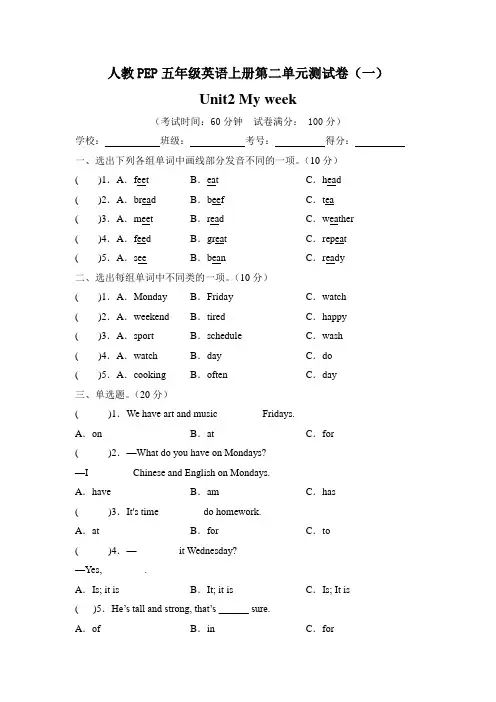
人教PEP五年级英语上册第二单元测试卷(一)Unit2 My week(考试时间:60分钟试卷满分: 100分)学校:班级:考号:得分:一、选出下列各组单词中画线部分发音不同的一项。
(10分)( )1.A.feet B.eat C.head( )2.A.bread B.beef C.tea( )3.A.meet B.read C.weather ( )4.A.feed B.great C.repeat( )5.A.see B.bean C.ready二、选出每组单词中不同类的一项。
(10分)( )1.A.Monday B.Friday C.watch( )2.A.weekend B.tired C.happy( )3.A.sport B.schedule C.wash( )4.A.watch B.day C.do( )5.A.cooking B.often C.day三、单选题。
(20分)( )1.We have art and music ________ Fridays.A.on B.at C.for( )2.—What do you have on Mondays?—I ________ Chinese and English on Mondays.A.have B.am C.has( )3.It's time ________ do homework.A.at B.for C.to( )4.—________ it Wednesday?—Yes, ________.A.Is; it is B.It; it is C.Is; It is( )5.He’s tall and strong, that’s ______ sure.A.of B.in C.for( )6.It’s 8:00. It’s time ______ get up.A.to B.\ C.for( )7.I need to do some ______. I need some ______.A.shop; crayons B.shoping; crayons C.shopping; crayons( )8.—Who’s that young lady?—______ is our principal.A.He B.she C.She( )9.Do you often ________ in this park?A.reads books B.read books C.reading books( )10.Zhang Peng often _________ football on the weekend.A.play B.plays C.to play四、句图匹配。
五年级英语上册第二单元测试卷【含答案】
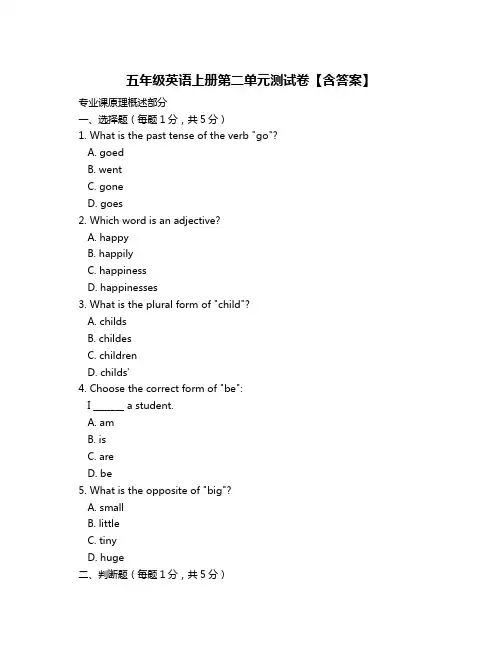
五年级英语上册第二单元测试卷【含答案】专业课原理概述部分一、选择题(每题1分,共5分)1. What is the past tense of the verb "go"?A. goedB. wentC. goneD. goes2. Which word is an adjective?A. happyB. happilyC. happinessD. happinesses3. What is the plural form of "child"?A. childsB. childesC. childrenD. childs'4. Choose the correct form of "be":I _______ a student.A. amB. isC. areD. be5. What is the opposite of "big"?A. smallB. littleC. tinyD. huge二、判断题(每题1分,共5分)1. "He don't like apples." ( )2. "She goes to school bus." ( )3. "I am watching TV now." ( )4. "They are playing football in the park." ( )5. "The cat is sleeping on the bed." ( )三、填空题(每题1分,共5分)1. I _______ a book yesterday.2. She _______ to the library every weekend.3. We _______ at the zoo last week.4. They _______ football after school.5. He _______ his homework every evening.四、简答题(每题2分,共10分)1. What is the present simple tense?2. What is the past continuous tense?3. What is the present perfect tense?4. What is the difference between "like" and "love"?5. What is the opposite of "old"?五、应用题(每题2分,共10分)1. Write a sentence using the past simple tense.2. Write a sentence using the present continuous tense.3. Write a sentence using the future simple tense.4. Write a sentence using the parative form of "tall".5. Write a sentence using the superlative form of "happy".六、分析题(每题5分,共10分)1. Expln the difference between "I did" and "I have done".2. Expln the difference between "I am going to do" and "I will do".七、实践操作题(每题5分,共10分)1. Write a short paragraph about your favorite animal using at least 5 adjectives.2. Write a short dialogue between two friends discussing their favorite hobbies.八、专业设计题(每题2分,共10分)1. 设计一个简单的英语学习计划,包括每天的学习内容和目标。
人教版五年级上册英语第二单元测试题
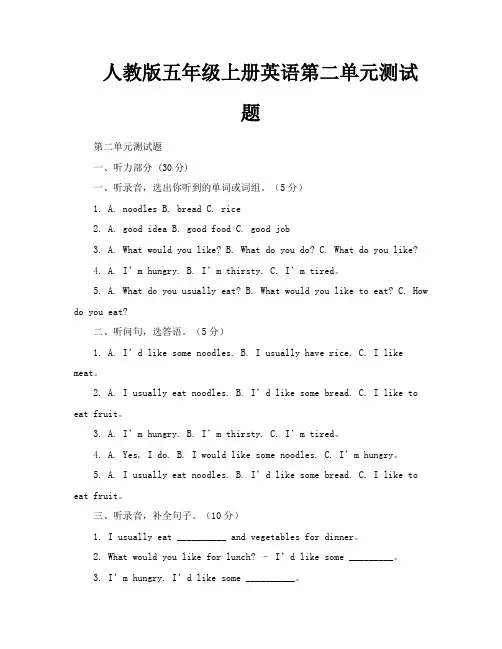
人教版五年级上册英语第二单元测试题第二单元测试题一、听力部分 (30分)一、听录音,选出你听到的单词或词组。
(5分)1. A. noodles B. bread C. rice2. A. good idea B. good food C. good job3. A. What would you like? B. What do you do? C. What do you like?4. A. I’m hungry. B. I’m thirsty. C. I’m tired。
5. A. What do you usually eat? B. What would you like to eat? C. How do you eat?二、听问句,选答语。
(5分)1. A. I’d like some noodles. B. I usually have rice. C. I like meat。
2. A. I usually eat noodles. B. I’d like some bread. C. I like to eat fruit。
3. A. I’m hungry. B.I’m thirsty. C. I’m tired。
4. A. Yes, I do. B. I would like some noodles. C. I’m hungry。
5. A. I usually eat noodles. B. I’d like some bread. C. I like to eat fruit。
三、听录音,补全句子。
(10分)1. I usually eat __________ and vegetables for dinner。
2. What would you like for lunch? –I’d like some _________。
3. I’m hungry. I’d like some __________。
【三套试卷】小学五年级英语下册第二单元试题(附答案)(1)
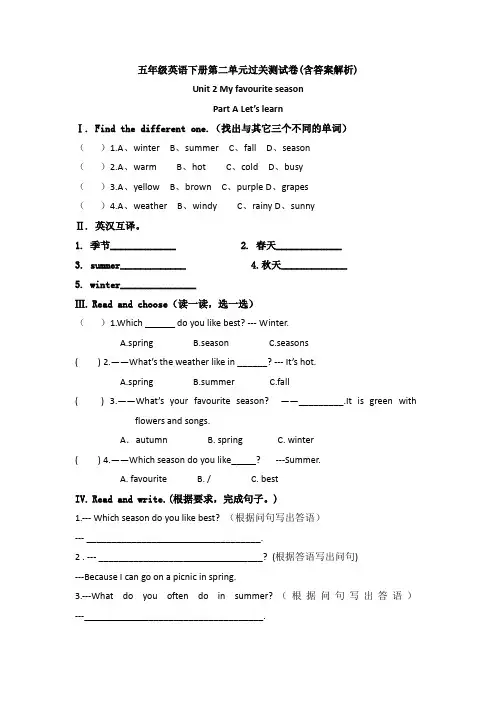
五年级英语下册第二单元过关测试卷(含答案解析)Unit 2 My favourite seasonPart A Let’s learnⅠ. Find the different one.(找出与其它三个不同的单词)()1.A、winter B、summer C、fall D、season()2.A、warm B、hot C、cold D、busy()3.A、yellow B、brown C、purple D、grapes()4.A、weather B、windy C、rainy D、sunnyⅡ.英汉互译。
1. 季节_____________2. 春天_____________3. summer_____________4.秋天_____________5. winter_______________Ⅲ.Read and choose(读一读,选一选)()1.Which ______ do you like best? --- Winter.A.springB.seasonC.seasons( ) 2.——What’s the weather like in ______? --- It’s hot.A.springB.summerC.fall( ) 3.——What’s your favourite season? ——_________.It is green with flowers and songs.A.autumn B. spring C. winter( ) 4.——Which season do you like_____? ---Summer.A. favouriteB. /C. bestIV.Read and write.(根据要求,完成句子。
)1.--- Which season do you like best? (根据问句写出答语)--- ___________________________________.2 . --- _________________________________? (根据答语写出问句)---Because I can go on a picnic in spring.3.---What do you often do in summer?(根据问句写出答语)---____________________________________.4. ---___________________________________(根据答语写出问句)---I like autumn best.5. ---What is the weather like in winter?(根据问句写出答语)---___________________________.五年级(下)第二单元第1课时当堂达标题答案Unit 2 My favourite seasonPart A Let’s learnⅠ.1.D解析:ABC为具体的季节2. D解析:ABC为描述天气的词3.D解析:ABC为颜色4. A解析:BCD为具体的描述天气的形容词Ⅱ.1.season2.spring3.夏天4.autumn5.冬天Ⅲ.1.B解析:根据答语winter排除A,which 后面接单数名词排除C2.B解析:答语对天气的描述为hot,所以应选B。
人教版小学五年级上册英语第二单元测试题(大全五篇)

人教版小学五年级上册英语第二单元测试题(大全五篇)第一篇:人教版小学五年级上册英语第二单元测试题人教版小学五年级上册英语第二单元测试题班级:姓名:得分:听力部分(40分)一、听录音,选出你听到的单词,每小题听两遍。
(10分)()1.A.MondayB.TuesdayC.Thursday()2.A.waitB.whiteC.what()3.A.read booksB.do homeworkC.watch TV()4.A.SaturdayB.SundayC.Wednesday()dy()6.A.do homeworkB.do houseworkC.do sports()7.A.oftenB.oldC.on()8.A.whatB.what colourwhat about()9.A.tomorrowB.todayC.day()puter二、根据所听短语选出正确的图片,每小题听两遍。
(10分)()1.A.B.()2.A.B.()3.A.B.()4.A.B.()5.A.B.三、选出你听到的句子,每小题听两遍。
(10分)()1.A.What day is it today?B.what day is it tomorrow?()2.A.I often paint or watch TV.B.I often paint and watch TV.()3.A.What classes do you like ?B.What class do you like?()4.A.What do you do on Saturdays?B.What do you do on Sundays?()5.A.We have English and science.B.We have English and Social Studies.四、听对话,连线,听两遍。
(10分)Wu Yifando homeworkon MondaySarahread bookson FridayAmyclean bedroomon TuesdayJohnwatch TVon SundayChen Jieplay computer gameson Saturday, October笔试部分(60分)一、找出下面每组单词中与其他两个不同类的单词。
译林版小学英语五年级上册第二单元:Unit 2 A new student测试卷一(含答案)
译林版小学五年级上册第二单元测试卷(一)Unit 2 A new student(时间: 60分钟满分: 100分)一、单选题。
(每小题2分, 共10分)1.—How is your new bed, Jack? ( )—It’s small but very ___________.A.longB.redC.soft2.—David, playing the swing is fun.Don’t be ___________.( )—All right.Let me try.A.afraidB.tiredC.sad3.—Is Su Hai tall, Liu Tao? ( )—No, so she sits ___________ Helen.A.besideB.onC.in front of4.—___________ any milk and five pies on the table now, Tim? ( )—Yes, mum.A.There isB.Is thereC.Are there5.—Are you hungry or tired, Yang Ling? ( )—No, I’m just ___________, Mike.A.hungryB.thirstyC.tired二、找出错误部分并改正。
(每小题2分, 共10分)1.改错: Let’s goes to school._____________→_____________2.改错: There aren’t some cakes here._____________→_____________3.改错: There are a swing._____________→_____________4.改错: It’s time to lunch._____________→_____________5.改错:There is a art room._____________→_____________三、选词填空。
最新人教精通版英语五年下册unit2第二单元考试测试卷及答案共三套
最新人教精通版英语五年下册unit2第二单元考试测试卷及答案共三套考试测试卷一Part 1: ListeningSection ADirections: In this section, you will hear 10 short conversations. At the end of each conversation, a question will be asked about what was said. Both the conversation and the question will be spoken only once. After each question, there will be a pause. During the pause, you must read the four choices marked A), B), C) and D), and decide which is the best answer. Then mark the corresponding letter on the Answer Sheet with a single line through the centre.1. A) To a restaurant. B) To a concert.C) To a museum. D) To a train station.2. A) $45. B) $35.C) $50. D) $30.3. A) In a shop. B) At a market.C) In a restaurant. D) By a river.4. A) It's great. B) It's boring.C) It's difficult. D) It's helpful.5. A) On the Internet. B) From the teacher.C) From a friend. D) From the library.6. A) At 8:00. B) At 8:15.C) At 8:30. D) At 8:45.7. A) Because she likes swimming.B) Because she likes the heat.C) Because she wants to lose weight.D) Because she wants to stay healthy.8. A) She has to write to her dad.B) She has to finish her homework.C) She has to go to the library.D) She has to pick up her sister.9. A) The colorful flowers. B) The green trees.C) The fresh air. D) The beautiful birds singing.10. A) Because it's fun. B) Because it's convenient.C) Because it's challenging. D) Because it's harmful.Section BDirections: In this section, you will hear 3 short passages. At the end of each passage, you will hear some questions. Both the passage and the questions will be spoken only once. After you hear a question, you mustchoose the best answer from the four choices marked A), B), C) and D). Then mark the corresponding letter on the Answer Sheet with a single line through the centre.Passage OneQuestions 11 to 13 are based on the passage you have just heard.11. A) In a classroom. B) In a library.C) In a bookstore. D) In a coffee shop.12. A) Get a part-time job. B) Save money.C) Go to the cinema. D) Buy a new book.13. A) She is interested in reading.B) She likes spending time alone.C) She is not good at making friends.D) She is too busy to do other things.Passage TwoQuestions 14 to 16 are based on the passage you have just heard.14. A) In a hotel. B) In a restaurant.C) In a supermarket. D) In a coffee shop.15. A) $15. B) $10.C) $20. D) $5.16. A) Because she was treated badly in the restaurant.B) Because she enjoyed the atmosphere in the coffee shop.C) Because the food in the hotel was too expensive.D) Because the waitress in the supermarket was friendly.Passage ThreeQuestions 17 to 20 are based on the passage you have just heard.17. A) On a sunny day. B) On a rainy day.C) On a snowy day. D) On a windy day.18. A) To a movie. B) To a cafe.C) To a park. D) To a museum.19. A) Attended a concert. B) Played video games.C) Watched a movie. D) Went hiking.20. A) He was impressed by the city's beauty.B) He enjoyed the street performances.C) He was satisfied with the delicious food.D) He was interested in the history of the city.Part 2: Phonetics, Vocabulary and GrammarSection ADirections: In this section, you will hear 15 short conversations. At the end of each conversation, you will hear a question about the conversation. Both the conversation and the question will be spoken only once. After youhear a question, you must choose the best answer from the four choices marked A), B), C) and D). Then mark the corresponding letter on the Answer Sheet with a single line through the centre.21. A) She wishes to visit the beach.B) She's making plans for a vacation.C) She often goes to Florida for vacation.D) She has already been to the beach.22. A) She is going to take a nap.B) She is rehearsing for a play.C) She is preparing for a meeting.D) She is going to have dinner.23. A) The desk is dirty. B) The desk is worth $100.C) The desk is broken. D) The desk is in good condition.24. A) They cannot eat in the restaurant.B) They should have booked a table in advance.C) They can only order takeout from the restaurant.D) They need to make another reservation.25. A) The man should follow the detour signs.B) The road is blocked due to road construction.C) The car in front of them is driving too slowly.D) The man can speed up and get to the highway.26. A) He's from England. B) He's hosting a dinner party.C) He would like to visit the man's country.D) He wants to practice speaking English.27. A) She can lend her friend her bike.B) She doesn't own a bicycle.C) She has just bought a bicycle.D) She cannot ride a bicycle anymore.28. A) The man should pay attention to the traffic light.B) The man should drive faster to catch up with the light.C) The light will stay green for a long time.D) The light will change to green soon.29. A) She mostly enjoys stories about animals.B) She is not interested in fiction books.C) She prefers non-fiction books.D) She reads books to help her sleep.30. A) They can't find their way to the cafe.B) They don't want to go to the cafe.C) The cafe is too busy.D) The cafe is closed today.31. A) She wants to invite the man to a party at her place.B) She is not interested in holding a party.C) She wants to invite the man to a party elsewhere.D) She is not capable of organizing a party.32. A) It's a hotel room. B) It's a hospital room.C) It's a hotel reception. D) It's a hospital reception.33. A) The man can ask the waitress for assistance.B) The man should try another dish on the menu.C) The man should go to a different cafe.D) The man should avoid eating meat.34. A) He has a pain in his hand.B) He is seeking advice on how to grow taller.C) He wants to play basketball.D) He wants to know how the woman grew taller.35. A) It's raining heavily outside.B) The man should get his umbrella.C) It's impossible for them to go outside.D) The woman needs to call a taxi.Section BDirections: In this section, you will hear 3 short passages. At the end of each passage, you will hear some questions. Both the passage and the questions will be spoken only once. After you hear a question, you must choose the best answer from the four choices marked A), B), C) and D). Then mark the corresponding letter on the Answer Sheet with a single line through the centre.Passage OneQuestions 36 to 38 are based on the passage you have just heard.36. A) She went shopping. B) She worked in the store.C) She tried on some clothes. D) She sold some clothes.37. A) The man lost his new shirt. B) The store had no change available.C) The man didn't find anything he liked. D) The man had to wait for the sale to end.38. A) A raincoat. B) A hat.C) A sweater. D) A scarf.Passage TwoQuestions 39 to 41 are based on the passage you have just heard.39. A) On a farm. B) On a construction site.C) On a university campus. D) On a football field.40. A) The man is too old for the job.B) The man already has a job.C) The man is not experienced enough.D) The man is not interested in the job.41. A) To go back to the office. B) To bring more tools.C) To continue the interview. D) To find another worker. Passage ThreeQuestions 42 to 45 are based on the passage you have just heard.42. A) Follow the map on the website.B) Take a bus to the town center.C) Stop asking others for directions.D) Walk straight for 10 minutes.43. A) To buy some clothes. B) To eat in a seafood restaurant.C) To buy some fresh seafood. D) To taste some famous cakes.44. A) It has high-quality clothes.B) It serves delicious seafood.C) It has many cultural activities. D) It offers famous local dishes.45. A) They can try some local seafood.B) They can buy some souvenirs.C) They can take a walk along the coast.D) They can visit the historical site.Part 3 Reading and WritingSection ADirections: For each blank in the following passage, there are four choices given below and marked A), B), C) and D). Choose the one that is most suitable and mark your answer by blackening the corresponding letter on the Answer Sheet.One day, an old man was on the beach. He found a boy with a 46 . The boy was picking up the starfish and throwing them into the sea. He said to the boy, "What are you doing?" The boy said, "I'm saving the starfish." The old man 47 , "There are hundreds of starfish on the beach. You can't save48 ."The boy picked up another starfish and threw it in the water. Then he 49 , "I can save this one." The old man laughed again and said, "But you can't save all the starfish on the beach." The boy looked at the old man and said nothing. He 50 picked up a starfish and threw it into the sea. Then he explained, "I can't save them all, but I can save some of them." The old man was 51 . He watched the boy as he threw starfish after starfish into the sea.Sometimes, we can't make a big 52 . But we can all do small things. And many small things will make a big effect in the end. You don't need to be 53 ,rich or famous to make things better. Anyone can do it. What you do may even change 54 's life. And the kindness you give to others will come back to you. Just like what the boy did, everybody can make a difference in the world.46. A) bucket. B) net.C) fishing rod. D) fishing basket.47. A) thought. B) argued.C) replied. D) refused.48. A) none of them. B) all of them.C) most of them. D) a few of them.49. A) emphasized. B) noticed.C) whispered. D) questioned.50. A) angrily. B) silently.C) willingly. D) quickly.51. A) impatient. B) curious.C) depressed. D) touched.52. A) effort. B) challenge.C) mistake. D) difference.53. A) kind. B) polite.C) strong. D) brave.54. A) someone. B) no one.C) everyone. D) anyone.Section BDirections: Read the following passage carefully and then answer the questions. Mark your answers by blackening the corresponding letter on the Answer Sheet.Thomas Edison was a famous American inventor. He was born on February 11, 1847, in a small town in Ohio. Edison was a hardworking and curious child. He had a strong desire to know how things worked.Edison didn't do well in school because he found it boring. His teacher considered him a slow learner. However, his mother encouraged him to continue learning at home. She taught him the basics of reading, writing, and math.When he was a teenager, Edison got a job selling newspapers on a train. He learned Morse code and set up a small telegraph in the baggage car. Through this, he started sending and receiving messages. Soon, he became an expert telegraph operator.As an adult, Edison continued to invent and experiment. He created many useful devices, such as the phonograph and the motion picture camera. His most famous invention was the practical electric light bulb. Edison's invention changed the world. People no longer had to rely on candles or gas lamps to light their homes.Edison's success didn't come easily. He once said, "Genius is one percent inspiration and ninety-nine percent perspiration." This means that ideas and inspiration are important, but hard work and perseverance are even more important.55. When was Thomas Edison born?A) February 11, 1852. B) February 11, 1842.C) February 11, 1857. D) February 11, 1847.56. How did Edison learn Morse code?A) By attending school. B) By reading a book.C) By practicing with a telegraph. D) By watching a movie.57. What was Edison's most famous invention?A) The phonograph. B) The motion picture camera.C) The electric light bulb. D) The telegraph.58. What did Edison mean by saying "Genius is one percent inspiration and ninety-nine percent perspiration"?A) Being intelligent is essential for success.B) Having great ideas is critical for inventors.C) Working hard is more important than being smart.D) A little effort can lead to a big achievement.Section CDirections: Complete the following passage by using the words in the box. Each word can only be used once. Note that there is one extra word that you do not need to use. Mark your answers by blackening the corresponding letter on the Answer Sheet.【1】,struggle,very,time,do,explore,opportunity,and,effort,failure,successTo achieve success, one must be willing to 【2】 put in both time 【3】as well as make every 【4】 . Often, 【5】 , success only comes after a long period of hard work 【6】 . In fact, it is through 【7】 that lessons are learned and pathways towards 【8】 become clearer. 【9】 ,many successful people have faced tremendous challenges before reaching their goals. They have been persistent and have not let 【10】 discourage them from continuing to rise above.。
人教版五年级英语上册第二单元测试卷
人教版五年级英语上册第二单元测试卷一、单词拼写与汉语意思1.S__t__ __day ( )2.Fr__ d__y ( )3.W__dn__ __day ( )4.Th__ __ __ day ( )5.S nday ( )6.T__ __sday( )答案:1.Saturday 星期六2.Friday 星期五3.Wednesday 星期三4.Thursday 星期四5.Sunday 星期日6.Tuesday 星期二二、单项选择1.What _____ you have on Wednesdays?A. areB. doC. have2.What do you do _____ the weekends?A. onB. toC. from3.It's 7:00. It's time _____ go to school.A. forB. toC. on4.We often _____ books in the evening.A. lookB. watchC. read5.We often go to school from _____ to Friday.A. WednesdayB. SundayC. Monday答案:1. B2. A3. B4. C5. C三、连词成句1.have what do on you Saturday(?)2.I watch often TV Sundays on (.)3.day what today it is(?)4.Sunday homework often I on my do(.)5.about, you, what(?)6.homework, do, too, I, my(.)答案:1.What do you have on Saturday?2.I often watch TV on Sundays.3.What day is it today?4.I often do my homework on Sunday.5.What about you?6.I do my homework too.四、翻译句子1.What do you do on Saturdays? I often paint or watch TV.2.今天星期几? What day is it today?3.你们星期四上什么课? What do you have on Thursdays?五、阅读理解(文章内容略,以下是根据文章内容设计的题目)1.It's ________ today.A. ThursdayB. FridayC. Saturday2.Lily has ________ on Fridays.A. English, science and musicB. English, maths and musicC. Chinese, maths and PE3.Lily's PE teacher is _________.A. strictB. funnyC. kind4.Does Lily often play sports?A. Yes, she does.B. No, she doesn't.C. We don't know.5.Tom often ________ on the weekend.A. draws picturesB. plays ping-pongC. plays football答案:(答案根据具体文章内容填写,以下为示例答案)1. B2. A3. A4. A5. C。
五年级上册英语第二单元测试题及答案可打印
五年级上册英语第二单元测试题及答案可打印五年级上册英语第二单元测试题及答案可打印英语单元考试涵盖着一个单元的英语学习内容,五年级的学生在复习的时候要借助英语试题进行复习。
以下是小编准备的一些五年级上册英语第二单元测试题及答案,仅供参考。
五年级上册英语第二单元测试题My days of the week一、判断下列单词划线部分发音是否相同,相同的打“ √” ,不同的打“ ×” 。
1.h ow m ou th ( )2. br ea d t ea cher ( )3. th i n b i ke ( )4.t a ke a pple ( )5.sh ee p sl ee p ( )6.p u t b u t ( )7.gr ea t s ea t ( ) 8.n ow wind ow ( ) 9.p ea ch j ea ns ( )二、英汉互译。
1.wait______________2.often______________3.love_______4.yeah___________5.tomorrow_________6.play computer games_________7.play ping-pong______8.play football_______9.do housework__________10.do sports___________11. 看电视 ____________12. 在星期六早上 _______________13. 做作业_______14. 读书_______________15. 上科学课____________16. 在周末____________17. 在星期三___________18. 三天____________19. 太大_____________20. 我爸爸的朋友__________________________________三、默写星期一星期二星期三星期四___________ _______________ ___________ _______________星期五星期六星期日_______________ _______________ ___________________四、翻译下列句子。
小学五年级上册英语第二单元基础练习题
小学五年级上册英语第二单元基础练习题一、找出不同类的单词。
(10分)1. A. Monday B. Tuesday C. today D. Friday.解析:Monday(星期一)、Tuesday(星期二)、Friday(星期五)都是表示具体星期几的名词,而today(今天)是一个表示时间的副词,概念与其他三个不同,所以答案是C。
2. A. art B. music C. English D. teacher.解析:art(美术)、music(音乐)、English(英语)都是学科类名词,teacher(教师)是职业名词,与其他三个不同类,所以答案是D。
3. A. strict B. funny C. kind D. often.解析:strict(严格的)、funny(有趣的)、kind(和蔼的)都是描述人物性格特征的形容词,often(经常)是副词,所以答案是D。
4. A. read B. play C. food D. have.解析:read(阅读)、play(玩耍)、have(有;吃;喝等)都是动词,food (食物)是名词,所以答案是C。
5. A. park B. Sunday C. Monday D. Saturday.解析:Sunday(星期日)、Monday(星期一)、Saturday(星期六)都是表示星期的名词,park(公园)是表示地点的名词,所以答案是A。
二、单项选择。
(20分)1. ______ is your English teacher? Mr. Smith.A. WhatB. WhoC. HowD. Where.解析:根据答语“Mr. Smith.”(史密斯先生),可知问句是在询问“谁是你的英语老师”,what(什么),how(怎样),where(在哪里)都不符合题意,who (谁)用来询问人物,所以答案是B。
2. What's he like? He is ______.A. strongB. a strongC. teacherD. like.解析:“What's he like?”是询问人物的外貌或性格特征,回答应该是描述性的形容词,a strong表达错误,teacher(教师)是名词,like(喜欢;像)不符合题意,strong(强壮的)是形容词,所以答案是A。