
pep人教版三年级英语上册Unit 5 Let’s eat! A Let's learn课件
Let’s learn
some eggs
have some eggs
Look and say
an egg
2 eggs some eggs
--I’m hungry! (我饿了!) --Have some eggs.
(吃些鸡蛋。)
Look and say
I see _b_lu_e_eggs.
Let's Do!
have some cola drink some cola
have≈ eat / drink
Read and choose
( C)1. 蛋糕 A. cat
B. Coke C. cake
( B)2. 嘴 A. monkey B. mouse C. mouth
( A)3. 什么 A. what B. fork C. plate
(吃点面包)
Do you know? short bread(短面包)
long bread
Do you know?
big bread
small bread
Let's learn
some juice
have some juice
Let's learn
juice
some juice
--I’m hungry! (我饿了!) --Have some juice.
英语·人教版·三年级上
Look and answer
What time is it? She is hungry.
Look and read
Good morning, Sarah. Good morning,Mum. I’m hungry.
Let's Learn
Let's Learn
bread [bred]
丽生,活感像谢春你天的一阅样读阳。光,心情像桃花一样美 6Ju、莫ly吾愁1生前2,也路20有无20涯知7/,已12而,/2知天02也下0 无 谁涯人。不识9时君5。分99时时55分分91时2-5Ju分l-1220-7J.u1l2-2.20072.102.2020 丽,感谢你的阅读。 76、纸人生上生命得贵太来相过终知短觉,暂浅何,,用今绝金天知 与 放此钱弃事。了要明20躬天.7.行不12。一20定2.07能..71.得212到02.0。7..719.2时1。2522分00.792.时01年25。分7月210212-2J0日u年l星-72月0期71日.122日二.2星〇02期二0日〇
egg [ɛɡ]
milk [mɪlk]
juice
[dʒuːs]
Let's say and do
Let’s open your books. Let’s close your books. Let’s stand up. Let’s sit down. Let’s…. Let’s have a picnic .
Look and say
Look and say
Hi! What’s your name?
My name’s bread. What’s your name?
I’m egg.
Good morning, milk.
Good morning, juice.
How are you?
I’m fine, thank you.
039、:0少成57年功.1易都2.学永20老远20难不09成会:0,言57一弃.1寸 ,2.光放20阴弃20不者09可永:0轻远50。不9。会:05成:0功37。.12.202009:057.12.2020
盛开的春地去方春,又在回这,醉新人桃芬换芳旧的符季。节在,那愿桃你花 409、:0桃57花.1潭2.水20深20千09尺:0,57不.1及2.汪20伦20送09我:0情50。9:05:037.12.202009:057.12.2020 盛开的地方,在这醉人芬芳的季节,愿你 74.、12敏不.2而要02好为07学它.1,的2.不结20耻束20下而09问哭:0。 ,50。应9当7:0.15为20.9它2:0的250:开073始.1029而.:20笑052:。00309:0509:0509:05:0309:05:03
生盛活开像的春地天方一,样在阳这光醉,人心芬情芳像的桃季花节一,样愿美你 57.、12少海.2壮内02不存07努知.1力已2.,20老天20大涯09徒若:0伤 比50悲邻9。:05S0u9n:d0a5y:0,3J0u9ly:0152:0, 32020July 20Sunday, July 12, 生活像春天一样阳光,心情像桃花一样美 250、2生07命/1的2/2成0长20,需要吃饭,还需要吃苦,吃亏。Sunday, July 12, 2020July 20Sunday,
( C)4. 面包 A.book
B. milk C. bread
( A)5. 熊猫 A. panda B. milk C. pink
Find the difference
1. chicken hamburger bread
like
2. some cake French fries hot dog
3. purple rainbow pink
black
Let's Learn
亲亲爱爱的的读读者者:: 1、学盛生而年活不思重相则来信罔,眼,一泪思日,而难眼不 再 泪学晨并则。不殆及代。时表宜软20自弱.7.勉。12,270.岁.172.月1.22不072.待1020人.92:。025。0099:0:055:0039J:0u5l-:20030J9u:l0-25009:05 春亲去爱春的又读回者,: 20、.7一世.1年上27之没.1计有2.在绝20于望20春的09,处:0一境50日 ,9:之只05计有:0在对3J于处ul晨境-20。绝0二望9:0〇的5二人〇。年二七〇月二十〇二年日七月20十20二年日7月201220日年星7月期1日2日 春去春又回,新新桃桃换换旧旧符符。。在在那那桃桃花花 32星、期莫千日等里闲之,行白,了始少于年足头下, 。空20悲20切年。7月12日星期日
(喝点果汁)
Let's learn
some milk
have some milk
Do you know?
cow
Let’s read
Milk is healthy(健康的) for us. It makes us strong (强壮)and clever(聪明). We should drink milk everyday(每天).
丽,感谢你的阅读。 二年7、〇七放二月眼〇十前年二方七日,月只十要二我日们继续,收获的季节就在前方。20.7.1220.7.1220.7.12。2020年7 8月、1熟勇2日读气星唐通期诗往日三天二百堂〇首,二,怯〇不懦年会 通七作往月诗地十也狱二会。日吟09。:050099:0:0550:90:3075.:1023.72.0120.2S0u2n0dSauyn, dJauyly, J1u2l,y21022,02020 8、拥有梦想只是一种智力,实现梦想才是一种能力。09:0509:05:037.12.2020Sunday,
Let's learn
have a picnic(野餐)
Let's learn
I’m hungry.
Let's learn
some bread
have some bread
Leቤተ መጻሕፍቲ ባይዱ's learn
bread
some bread
一些面包
--I’m hungry! (我饿了!)
--Have some bread.
Do you know?
夏威夷早餐 西班牙早餐 意大利早餐 丹 麦 早 餐
韩国早餐
加拿大早餐 美 国 早 餐
Let’s learn
可数名词
不可数名词
Let’s learn
可数名词
不可数名词
s×
s√
s×
s×
juice bread milk egg
eat/drink
知识加油站
have a hamburger eat a hamburger
July 12, 2020
人教PEP版英语三年级上册Unit 5 Let’s eat! A Let’s talk课件

I’d like some juice,please.
Thanks.
Here you are. Have some bread, too.
A:I’d like some ... /I’d like some...and... /I’d like some...,...and...
B: Here you are.
A: Good morning. B: Good morning. A: I’d like some milk/... ,please. B: Here you are.
Have some bread/..., too. A: Thanks.
Western food
B. juice
What would Mike like?
A. milk
B. juice
I'd like some juice,please!
I’d like=I would like Here you are!
I'd like some ________,please!
I'd like some _a_pp_l_e_j_u_ic_e,please!
I'd like some ________,please!
I'd like some _b_a_n_a_n_a_j_u_ic_e_,please!
I'd like some ________,please!
I'd like some _o_r_a_n_ge__j_ui_c_e_,please!
What else?(还吃了什么?)
Thanks.
人教版.小学三年级上册英语课文翻译及单词(带音标)
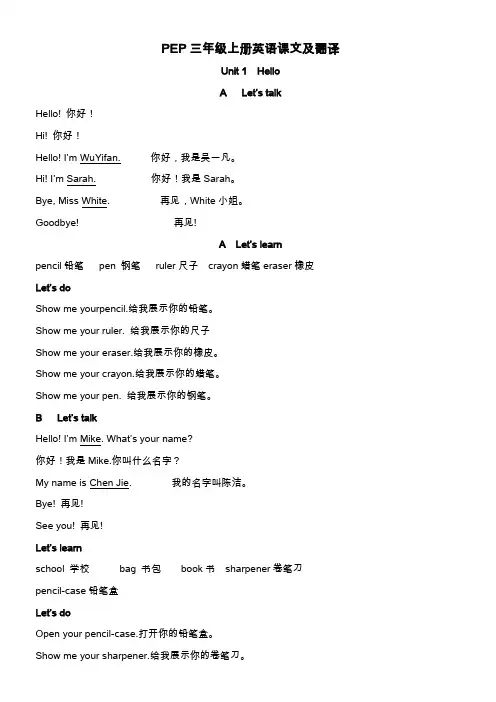
PEP三年级上册英语课文及翻译Unit 1 HelloA Let’s talkHello! 你好!Hi! 你好!Hello! I’m WuYifan. 你好,我是吴一凡。
Hi! I’m Sarah. 你好!我是Sarah。
Bye, Miss White. 再见,White小姐。
Goodbye! 再见!A Let’s learnpencil铅笔pen 钢笔ruler尺子crayon蜡笔eraser橡皮Let’s doShow me yourpencil.给我展示你的铅笔。
Show me your ruler. 给我展示你的尺子Show me your eraser.给我展示你的橡皮。
Show me your crayon.给我展示你的蜡笔。
Show me your pen. 给我展示你的钢笔。
B Let’s talkHello! I’m Mike. What’s your name?你好!我是Mike.你叫什么名字?My name is Chen Jie. 我的名字叫陈洁。
Bye! 再见!See you! 再见!Let’s learnschool 学校bag 书包book书sharpener卷笔刀pencil-case铅笔盒Let’s doOpen your pencil-case.打开你的铅笔盒。
Show me your sharpener.给我展示你的卷笔刀。
Close your book.合上你的书。
Carry your bag.背起你的书包。
Go to school.去上学。
Unit 2 Look at me A Let’s talkGood morning! 早上好!Good morning! 早上好!Hello!你好!Hi! 你好!This is John. 这是John.Nice to meet you. 见到你很高兴。
Let’s go to school. 我们一起去上学吧!OK!好的!Let’s learnhead头ear 耳朵eye眼睛nose鼻子face 脸mouth嘴Let’s doTouch your head. 摸摸你的头。
2024年人教版PEP小学英语三年级上册unit5-课件

C Story time
欢乐记单词 轻松学语法
A Let’s talk
I’d like some juice,please.
Thanks.
Here you are. Have some bread,too.
课文翻译
请给我些果 汁。
谢谢。
给你。 也吃点面包。
“I’d like...”句型秀
“I’d like+食物/饮料.”意思是“我想 要吃/喝……”用于表达自己想要吃的 食物或者喝的饮料。
返回导航
返回导航
Listen and circle. 返回导航
B Let’s talk
Can I have some water,please?
Thank you.
Here you are.
You’re welcome.
课文翻译
请给我些水好吗?
谢谢你。
给你。
不用谢。
表示请求的句型“Can I...?”
返回导航
Let’s learn
water
cake
fish
rice
判断单词与图片是(√)否(×)相符。
rice
water
fish
cake
(× ) ( √ ) (× ) ( √ )
返回导航
Let’s do
Drink some water.
Eat some rice.
Eat some fish. Cut the cake.
都二
能分
运浇
用灌
好,
“八
二分
八等
定待
律;
”二
,分
我管
们教
一,
起八
,分
人教版小学英语三年级上册 名师教学PPT课件 Unit 5 Let's eat!
Unit 5 Let’s eat !
A Let’s learn Let’s do
好好学习 天天向上
1
Let's sing Hello!
• Hello,Sarah!Do,oh,do. • Hello,John!Do,oh,do. • Hello,Mike!Do,oh,do. • Hello!Hello!Hello!
好好学习 天天向上
48
谢谢观看
好好学习 天天向上
49
好好学习 天天向上
41
They are st好a好r学v习in天g天(向他上 们在挨饿42 )
Mum, I’m hungry! 妈妈,我饿了!
Mum ,I’m hungry
Mum ,I’m hungry
好好学习 天天向上
43
Eat some bread
好好学习 天天向上
44
Have some juice
milk
好好学习 天天向上
23
好好学习 天天向上
24
好好学习 天天向上
25
Eggs, eggs, eggs, have some eggs. Juice, juice, juice, have some juice. Bread, bread, bread, eat some bread. Milk, milk, milk, drink some milk.
好好学习 天天向上
14
quail eggs 鹌鹑蛋 duck eggs
好好学习 天天向上
15
colourful eggs(彩蛋)
好好学习 天天向上
16
好好学习 天天向上
17
好好学习 天天向上
pep三年级英语上册Unit5 A Talk-优质课件
Who’s faster?比比谁反应快! . I’d like some …,please
What would
like for
breakfast? (Mike早餐想吃什么?)
would like(想) some _B___
A: bread B: juice
What does mom suggest?
A: milk
B: juice
Happy Dinner Time
幸福的晚餐时光
Sum up: I can say!
I’d like some juice, please. Here you are. Have some bread, too.
Homework:
1.Listen to the dialogue and try to act it out.
(妈妈提了什么建议呢?)
Have some bread, too. Thanks.
I can dub(我来配音)
Have some bread, too.
Tip1:请读出妈妈的关心。
Thanks.
Tip2: thanks 表示有礼貌的接受。
Tip:listen quietly and enjoy. (用心 倾听并感受英语的美。)
(他们正在谈论什么?)
A: Weather.
B: Foods.
Guess: What’s on the table?
桌子上有什么呢?
Guess: What’s on the table?
桌子上有什么呢?
I’d like some…, please.
juice
bread
Here you are.
(听并表演对话)
小学英语人教PEP新版三年级上册unit5_Lets_eat课堂实录反思专家点评

小学英语人教PEP新版三年级上册Unit 5 Let’s eatPart A Let’s talk鱼岳三小陈燕一、教学背景分析:1、教材分析:本节课选自人民教育出版社(PEP)小学英语三年级上册Unit5 PartA Let’s learn部分,内容主要包括学习“bread、juice、egg、milk”这些单词以及要求学生根据指令做相应的动作,以练习和运用所学的单词。
2、学情分析:在实际的常规教学中,三年级学生接触英语时间不长,所学内容有限,年龄偏小,注意力不能持久,教师更难以模拟这些环境对学生进行相关的话题交流,按照常规教学模式,本课会枯燥无味。
我从丰富的远程教育资源中获取相关的素材,进行加工,弥补这一不足,以便能高效地完成教学任务。
二、设计理念与思路:根据《新课标》要求,要把语言交际和语言运用与生活实际相结合的原则,体现“话题-功能-结构-任务”结合起来的思路,采用了“TPR”(Total Physical Response全部动作反应法),让学生在做中学、玩中学(Learning English by doing/playing…)的教学设计方案。
于是,我借助丰富的远程教育资源及Powerpoint技术,制成生动,逼真的幻灯片,结合相关的音频资料、图片资料、实物直观的向学生展示面包,牛奶,果汁,鸡蛋等,使学生直观,生动的感受到。
利用Powerpoint制成的“学中玩、玩中学”课件进行游戏教学,可以提高学生的学习兴趣,同时学生也很容易就学会“bread、juice、egg、milk”这些单词。
提高英语学习效率。
三、教学目标:1.能听、说、认读本节课所学的关于食物和饮料的单词:“ juice”, “egg”, “milk”, “bread”。
2.能用英文介绍这些食物。
3.能听懂一些简单的有关进食的指示语,并能按照指令做出相应的动作。
四、教学重、难点:重点:1.能听、说、认读单词:“ juice”, “egg”, “milk”, “bread”。
人教版pep小学英语《Let’s eat!》教案及教学反思(共3课时)
人教版pep小学英语《Let’s eat!》教案及教学反思(共3课时)一. 教材分析《Let’s eat!》是人教版PEP小学英语第三册第五单元的主题句,本节课主要让学生掌握有关食物的名词和动词的运用,以及句型“What’s this? It’s …”和“Do you like…? Yes, I do./ No, I don’t.”。
通过本节课的学习,学生能够听懂、会说、会读本节课的重点单词和句型,并能够运用所学知识进行简单的日常交流。
二. 学情分析考虑到学生的年龄特点和认知水平,他们对食物的兴趣浓厚,生活中也经常接触到各种食物,因此对于学习有关食物的知识会比较感兴趣。
但是,部分学生可能在发音和听力方面存在困难,需要教师在教学过程中给予重点关注和指导。
三. 教学目标1.知识目标:学生能够掌握有关食物的名词和动词,以及句型“What’sthis? It’s …”和“Do you like…? Yes, I do./ No, I don’t.”。
2.能力目标:学生能够在日常交流中运用所学知识进行简单的对话。
3.情感目标:培养学生对英语学习的兴趣,增强他们的自信心。
四. 教学重难点1.重点:单词:apple, banana, rice, cake, milk, water;句型:What’sthis? It’s … 和Do you like…? Yes, I do./ No, I don’t.2.难点:单词的发音和句型的运用。
五. 教学方法1.情境教学法:通过设定各种情境,让学生在实际语境中学习和运用英语。
2.交际教学法:通过小组合作、角色扮演等形式,让学生在实际交流中提高英语水平。
3.游戏教学法:通过趣味游戏,激发学生的学习兴趣,提高他们的学习积极性。
六. 教学准备1.准备食物图片和相关词汇的卡片。
2.准备食物模型的实物或图片。
3.准备录音机和磁带,或者使用多媒体设备。
七. 教学过程1.导入(5分钟)教师通过提问方式引导学生谈论他们喜欢吃的食物,激发学生的学习兴趣。
Unit 5 Let’s eat! A Let’s learn (教案)人教PEP版英语三年级上册
教案:Unit 5 Let’s eat! A Let’s learn 人教PEP版英语三年级上册一、教学目标1. 知识与技能目标:学生能够听懂、会说、会读本课的生词,如“bread, egg, milk, water, juice”等,并能用“Would you like…? ”的句型进行问答。
2. 过程与方法目标:通过图片、游戏、情景创设等教学手段,让学生在真实语境中运用所学知识,提高学生的英语口语表达能力。
3. 情感态度与价值观目标:培养学生良好的饮食习惯,教育学生要珍惜食物,不浪费。
二、教学内容1. 词汇:bread, egg, milk, water, juice2. 句型:Would you like…?三、教学重点与难点1. 教学重点:掌握本课的生词和句型,能够用英语进行简单的问答。
2. 教学难点:正确运用“Would you like…?”句型,进行食物的询问和回答。
四、教具与学具准备1. 教具:PPT、图片、单词卡片、食物模型2. 学具:英语课本、练习本、彩笔五、教学过程1. 热身导入利用歌曲“Hello”和学生打招呼,营造轻松愉快的课堂氛围。
然后出示一些食物图片,引导学生复习已学的食物类单词,为新课做好铺垫。
2. 新课展示(1)利用PPT展示本课的生词,引导学生跟读,并注意纠正发音。
(2)通过图片、实物展示,让学生了解生词的意思,帮助学生记忆。
(3)创设情景,让学生用“Would you like…?”句型进行食物的询问和回答。
3. 活动练习(1)组织学生进行“猜谜语”游戏,巩固本课的生词。
(2)分组进行角色扮演,模拟餐厅点餐场景,练习“Would you like…?”句型。
(3)布置任务,让学生用本课所学知识,为自己设计一份合理的早餐。
4. 总结反馈教师针对学生在课堂上的表现,进行总结和反馈,强调重点知识,解答学生疑问。
六、板书设计1. Unit 5 Let’s eat! A Let’s learn2. 主要内容:bread, egg, milk, water, juice, Would you like…?七、作业设计1. 听力作业:听录音,跟读本课生词和句型。
小学英语三年级上册 Unit5 Let's eat A Let's learn教案+反思 人教PEP
小学英语三年级上册 Unit5 Let's eat A Let's learn教案+反思人教PEP版教学目标:1.学生能够听懂、会说并正确运用英语单词:banana, apple, bread, milk。
2.学生能够识别并正确使用目标单词,并能将其运用于简单日常口语中。
3.学生在游戏和实验中培养观察和思考的能力。
教学重点:1.教授四个简单的单词banana, apple, bread, milk。
2.能够听懂、会说、会读出单词及其正确的发音,能在日常口语中灵活运用。
教学难点:1.准确地发音并正确使用英语单词。
2.培养学生的观察能力及运用实验结果进行思考的能力。
教学准备:1.熟悉所学英语单词及其发音,准备纸板图。
2.实验所需的物品:一些新鲜的食物(如香蕉、苹果、面包、牛奶)。
教学过程:Step 1. Warming-up1. Greeting and sing a song “Let's eat”.2. Talk about food with the students: “What do youlike to eat?”“Do you like bananas/apples/bread/milk?”Encourage the students to express their own thoughts.Step 2. Vocabulary learning1. Show the pictures of each food on the board.2. Point to each picture and say the name of the food out loud.3. Encourage the students to repeat after the teacher and practice pronouncing each word until they feel comfortable.4. Show the name of the food on the board and practice reading and pronouncing each word again.Step 3. Vocabulary review1. Play a game: “What food am I holding?” The teacher can hold up a picture or a real piece of food and the students have to guess what it is.2. Another game: “What’s missing?” Show the studentsa few pictures of food on the board, and then have them close their eyes. Remove one picture and ask which food is missing.Step 4. Language practice1. Use the target vocabulary in some simple sentences such as “I like apples/bananas/bread/milk.”2. Role-play: teacher can pretend to be a customer in a shop and the students can pretend to be salespeople recommending different food and drinks to the teacher.Encourage the students to use the target vocabulary in this role-play.Step 5. Observation and experiment1. Bring out the food items that were previously prepared and ask students to observe the differences among them.2. Ask questions such as “Which food isbigger/smaller?”“What color is this food?”“What shape is this food?”3. Let the students touch, smell and taste each food and compare the differences among them.4. Encourage the students to describe the taste, texture, and smell of each food.Step 6. Consolidation1. Review the four words and encourage students to continue practicing saying them.2. Provide more opportunities for the students to use the new vocabulary in their daily life.Step 7. Homework:1. Encourage the students to find and observe different foods at home, and then describe and talk about them with their parents.反思:1.教学情况:本次教学采用了直观教学法,通过对各种食品的实物、图片呈现让学生对单词的发音、词汇、语言进行了深入的学习。
人教版(PEP)三上《Unit 5 Let's eat》(Period Four)教学设计
人教版(PEP)三上《Unit 5 Let’s eat》(Period Four)教学设计一. 教材分析《Unit 5 Let’s eat》是人教版(PEP)三上册的一篇主题单元,主要围绕着食物和餐饮话题展开。
通过本单元的学习,学生能够听、说、读、写关于食物和餐饮的词汇,如apple, banana, rice, cake等,并能够运用所学语言进行简单的日常交流。
本单元还包括了简单的食物搭配和餐饮礼仪的介绍,旨在提高学生的饮食健康意识。
二. 学情分析针对三年级的学生,他们已经有了一定的英语学习基础,能够听懂并简单说出一日常用语。
但是,对于一些关于食物和餐饮的新词汇,他们可能还需要一定的引导和练习。
此外,学生的学习兴趣和动机对于英语学习来说非常重要,因此,在教学过程中,我将注重激发学生的学习兴趣,通过丰富多彩的活动和游戏,提高他们的学习积极性。
三. 教学目标1.知识目标:学生能够听懂、会说、会读、会写关于食物和餐饮的词汇,如apple, banana, rice, cake等;学生能够理解并在适当的情境中运用句子“What would you like?”, “I’d like some…”进行日常交流。
2.能力目标:学生能够通过图片和情景理解故事内容,并能运用所学词汇和句型进行简单的对话交流。
3.情感目标:学生能够培养良好的饮食健康习惯,了解基本的餐饮礼仪。
四. 教学重难点1.重点:学生能够听懂、会说、会读、会写关于食物和餐饮的词汇,如apple, banana, rice, cake等;学生能够理解并在适当的情境中运用句子“What would you like?”, “I’d like some…”进行日常交流。
2.难点:学生能够正确运用所学词汇和句型进行简单的对话交流,并能运用所学知识进行实际的情景交际。
五. 教学方法1.情境教学法:通过设置各种真实的情境,让学生在实际情境中学习和使用英语,提高学生的语言运用能力。