
新目标人教版英语八年级下学期UNIT1复习归纳
复习归纳
一、句型
What’s wrong with you? What’the trouble? What’s the matter with you? What’s up? What happend to you?
Im fine,thank you...... have+a+人体部位+ache (Eg:have a headache) have a sore+人体部位 (Eg:have a sore back/leg...) have a pain in+人体部位 (Eg:have a pain in head...)
7、辨析put on 与 put...on... put on为固定短语,意为“穿上”表示穿衣动作。 Eg:It is cold outside.Please put on your coat。 外面很冷请你穿上你的外套。 Put...on...意为“把...放在...上面” Put your coat on the desk.把你的衣服放在桌子上。
( C ) 例题:——You look really tired. ____ ?I didn’t sleep well last night.I had a headache. A.How about you B.What should I do
C.What’s the matter
D.How are you
5.thanks to“幸亏,由于”
thanks to用作介词短语,在句中作状语,表示原 因,相当于because of.其后只能接名、代、动名, 不能接动词原形
thanks to
doing
n 代词
Eg:Thanks to your help,we finished the task ahead of time. Thanks to the central government,I can go to school again
(B)
ed to do sth与 be used to sth/doing sth Used to do sth“过去常常......”表示过去经常发生的动作 例句:We used to draw pictures badly. be used to sth/doing sth意为“习惯于某事/做某事”be动词可以用 get或become代替.指不从习惯到这一过程的转变 例句:I was not used to city life,but now I have got used to lwing in this city.我以前不习惯都市生活,但我现在已经习惯这个城市了。 In the end,I got used to doing hard work.最后,我习惯于做艰苦的工 作了。
THANKS
By集才华和美貌于一身 的小组 郭紫瑄 周鹏霄 石子瑞 王广思
• • • •
The old lady fell down in the street and broke her leg. 这个老太太在街上跌掉了,把腿摔断了。 He fell down from his bike and hurt badly. He fell off his bike and hurt badly.
agree to(do sth)同意(做某事)
三、知识精讲
• 1.“What’s the matter? 你怎么啦?”此句用来询问别人的病 情。 • 拓:matter作动词用,意为“要紧,有关系”,主要用于疑问 句和否定句。 It doesn’t matter.一般用来回答对方的道歉。意 思是:“没关系,不要紧”
• 4.But to his surprise... 但是令他吃惊的是...... • to one’s surprise 表示“令人惊奇的是...”,其中surprise是名 词,one’s 是形容词性物主代词。To one’s surprise=主 +be+surprised. • Eg:To his surprise.He found the girl was blind.=He was surprised to find the girl was blind.
• • • •
6.trouble的用法 1. trouble用作名词,意为“烦恼、困难、麻烦” Eg:his life is full of trouble.他的生活充满了麻烦。 we can read trouble on his face.
Trouble用作动词,意为“麻烦、打扰” What is troubling you?什么使你烦心? 拓展: In trouble处在困境中 get into trouble 陷入困难 have trouble (in) doing sth做某事有困难
• 拓: in surprise 惊奇地. Eg:The two girls,looked at each other in surprise. • be surprised at 对...感到惊奇 Eg:We are very surprised at the news. • Surprising 令人惊奇的 Eg:His surprising success made us feel surprised.
Hale Waihona Puke • 拓展:与fall有关的短语
fall into落入 • fall ill 病了
•
fall off 跌落 fall behind落后
fall over 摔下 fall asleep入睡
例题:What is wrong with Tom? ――Bad luck! Tom_his bike and hurt his leg. 解析:fall off sth=fall down from sth“从......跌落下来” Drop是有意识的行为 故选B
询问问题
2.回答:1.没事:
2.有问题:
3.提出建议:
You should lie down and rest. You should drink hot tea with honey. May I take your temperature? Let me check your blood pressure. Take this medicine three times a day. You need an operation at once.
二、必记短语
lie down 躺下 to one’s surprise 出乎...意料 be used to 习惯于.... get into trouble 造成麻烦 take risks 冒险 run out(of)用尽 cut off 切除 get out of 离开 be in control of 管理 keep on(doing sth)继续坚持(做某事) take one’s temperature 量体温
例题:
Please your coat when you go out. ( A ) A.put on B dress c.wear 解析:put on强调动作其后接服饰类名词。 dress给某人穿衣,其后接宾语应为人 wear意为“穿着”强调状态,其后接服饰类名词。
• 8.fall down 倒下,掉落,跌掉
人教版新目标八年级下第一单元知识点汇总

1.what’s the matter with...?....怎么了2.have a sore back 后背疼3.talk too much 说太多话4.drink enough water 喝足够的水5.lie down and rest 躺下休息6.hot tea with honey 加蜂蜜的热茶7.see a dentist 看牙医8.get an X-ray 拍X光片9.put some medicine on 上药,敷药10.sound like 听起来像11.move my neck 移动我的脖子12.on the weekend 在周末13.all weekend 整个周末14.play computer games 玩电脑游戏15.That’s probably why. 那可能就是原因16.need to do 需要做某事17.take breaks 休息18.away from 远离19.sit in the same way 以相同的方式坐20.for too long 持续太久21.without doing sth. 没有做某事22.go to a doctor 去看医生23.feel hot 感觉热24.go along the road沿着公路行驶25.see sb doing sth看见某人正在做某事26.lie on the side of the road躺在马路边上27.next to在…旁边28.shout for help大喊求救29.24-year-old 24岁的30.without thinking twice没多想31.get off/on下车/上车32.what happened发生了什么33.have a heart problem有心脏病34.go to the hospital去医院35.have to do不得不做36.act quickly快点行动37.take sb. to sp.带某人去某地38.expect sb to do sth期待某人做某事39.most or all of the passengers大多数或所有乘客40.wait for the next bus等待下班车41.to one's surprise令某人吃惊的是42.agree to do同意做某事43.go with和…一起去44.help sb to do sth帮助某人做某事45.move…onto抬到…上46.thanks to多亏47.be saved by被…救48.in time及时49.help others帮助别人50.get into trouble陷入麻烦51.think about doing 考虑做某事52.save a life救命53.right away=at once立刻54.have a cold感冒55.have a cough咳嗽56.have a fever发烧57.have a headache头疼58.have a stomachache胃疼59.have a sore throat喉咙疼60.have a nosebleed流鼻血61.take one's temperature测体温62.hurt oneself/one's.....伤到自己或部位63.cut oneself/one's....切到自己或部位64.get hit on the head/nose撞到头鼻子65.get hit in the face/eye打到脸或眼睛66.get hit by a ball被球打了67.put a bandage on...绑绷带68.run it under water冲水69.press the sides of your nose压鼻子两侧70.put your head down把你的头低下71.clean your face洗脸72.rest for a few days休息几天73.feel sick感觉生病难受74.fall down摔倒75.get sunburned晒伤76.have problems breathing呼吸困难77.tell sb to do sth告诉某人做某事78.in PE class在体育课上79.be interested in=take an interestin对……感兴趣80. a mountain climber攀登者81.be used to doing习惯于做某事82.be used to do sth.=be used fordoing sth.被用于做某事ed to do sth.过去常常做某事e sth. to do sth.用某物做某事85.take risks=take a risk 冒险86.lose one’s life 丧命87.because of因为88.find sb. in a very dangeroussituation发现自己置于危险境地89.fall on sb. 掉在某人身上90.by oneself 独自91.free his arm 挣脱手臂92.run out (of) 用光,耗尽93.have to do sth. 不得不做某事94.save one’s own life 拯救自己的生命95.be ready to do 准备好做某事96.cut off 切除97.bandage oneself给自己包扎98.so that 为了99.so...that如此……以至于100.lose too much blood失血太多101.climb down the mountain 爬下山102.Between a rock and a Hard Place生死抉择103.mean doing sth.意味着做某事104.be in a difficult situation 在困境中105.seem to do 似乎做某事106.get out of 从……出来107.the importance of ……的重要性108.make good decisions 做好的决定109.be in control of 控制……110.in the control of在……控制下111.love for 对……的热爱112.keep on doing 坚持做某事113.the same as 和……一样114.think about 考虑115.make a decision=decide 做决定116.have a serious accident 有严重事故117.go mountain climbing 去爬山118.free oneself 挣脱自己119.give up doing sth. 放弃做某事120.mind doing sth. 介意做某事1)怎么了2)后背疼3)说太多话4)喝足够的水5)躺下休息6)加蜂蜜的热茶7)看牙医8)拍X光片9)上药,敷药10)听起来像11)移动我的脖子12)在周末13)整个周末14)玩电脑游戏15)那可能就是原因16)需要做某事17)休息18)远离19)以相同的方式坐20)持续太久21)没有做某事22)去看医生23)感觉热24)沿着公路行驶25)看见某人正在做某事26)躺在马路边上27)在…旁边28)大喊求救29)24岁的30)没多想31)下车/上车32)发生了什么33)有心脏病34)去医院35)不得不做36)快点行动37)带某人去某地38)期待某人做某事39)大多数或所有乘客40)等待下班车41)令某人吃惊的是42)同意做某事43)和…一起去44)帮助某人做某事45)抬到…上46)多亏47)被…救48)及时49)帮助别人50)陷入麻烦51)考虑做某事52)救命53)立刻54)感冒55)咳嗽56)发烧57)头疼58)胃疼59)喉咙疼60)流鼻血61)测体温62)伤到自己或部位63).切到自己或部位64)撞到头鼻子65)打到脸或眼睛66)被球打了67)绑绷带68)冲水69)压鼻子两侧70)把你的头低下71)洗脸72)休息几天73)感觉生病难受74)摔倒75)晒伤76)呼吸困难77)告诉某人做某事78)在体育课上79)对……感兴趣80)攀登者81)习惯于做某事82)被用于做某事83).过去常常做某事84)用某物做某事85)冒险86)丧命87)因为88)发现自己置于危险境地89)掉在某人身上90)独自91)挣脱手臂92)用光,耗尽93)不得不做某事94)拯救自己的生命95)准备好做某事96)切除97)给自己包扎98)为了99)如此……以至于100)失血太多101)爬下山102)生死抉择103)意味着做某事104)在困境中105)似乎做某事106)从……出来107)…的重要性108)做好的决定109)控制……110)在……控制下111)对……的热爱112)坚持做某事113)和……一样114)考虑115)做决定116)有严重事故117)去爬山118)挣脱自己119).放弃做某事120)介意做某事。
新人教版八年级英语下册第一单元知识点
新人教版八年级英语下册第一单元知识点
第一单元主要介绍了动词的时态、情态动词以及一般现在时态和现在进行时态的用法。
1. 动词的时态:
- 一般现在时:表示经常性或普遍性的动作或状态。
- 一般过去时:表示过去某个时间发生的动作或状态。
- 一般将来时:表示将要发生的动作或状态。
- 现在进行时:表示现在正在进行的动作。
- 过去进行时:表示过去某个时间正在进行的动作。
- 现在完成时:表示过去的某个时间开始,并持续到现在的动作或状态。
- 过去完成时:表示过去的某个时间前完成的动作或状态。
2. 情态动词:
- can/could:表示能力或许可。
- may/might:表示可能性、许可或请求。
- must:表示必须。
- should:表示建议或义务。
- will/would:表示意愿、习惯或请求。
3. 一般现在时的用法:
- 表示经常性或习惯性的动作或状态,常与频率副词连用(如always, often, sometimes等)。
- 表示客观事实或真理,常用于科学、历史等领域。
- 表示现在的状态、感觉或所属关系。
4. 现在进行时的用法:
- 表示现阶段正在进行的动作或临时状态。
- 表示计划或安排的未来动作。
- 与always或often连用,表示经常性的不满或抱怨。
以上是第一单元的知识点,希望对你有帮助。
(完整版)新版人教版八年级英语下册第一单元重点知识点汇总

(完整版)新版人教版八年级英语下册第一单元重点知识点汇总新版人教版八年级英语下册第一单元重点知识点汇总新版人教版八年级英语下册第一单元重点知识点汇总Unit 1. what’s the atter?一.重点短语归纳1. ft---feet 脚 <复> tth---teeth 牙齿 <复>2. have a ld 感冒3. have a stahahe 胃疼4. have a sre bak背疼5. have a sre thrat喉咙疼6. have a fever发烧7. lie dwn and (have a)rest 躺下休息 have a rest 休息8. ht tea with hney 加蜜的热茶9. see a dentist 看牙医 see a dtr 看医生10.drink lts f water多喝水11.lts f ,a lt f, a lta lt f=lts f,可以修饰可数名词复数和不可数名词,一般用在肯定句中。
:There are lts f ( a lt f) bks in ur library.There is a lt f water n the grunda lt,是一个副词词组,跟动词连用;表示十分,很等意思;Thanks a lt.12. have a tthahe牙疼13. That’s a gd idea好主意14. g t bed 去睡觉 g t bed early 早上床睡觉15. feel well感到好 feel ill 感到不舒服I dn’t feel well=I’ nt feeling well我感觉不舒服.16. start ding/ t d sth开始做某事T D 是一件事情完成了,开始做另外一件事情DING是原的那件事情做到一半,现在又开始做了,是同一件事情。
17. tw days ag两天前18. get se rest 多休息, 休息一会儿19. I think s我认为是这样20. be thirsty口渴21. be hungry 饥饿22. be stressed ut紧张23. listen t usi听音乐24. healthy lifestyle健康的生活方式25. traditinal hinese dtrs传统中医26. need t d sth 需要做某事I have a tthahe. I need t see a dentist. 我牙痛, 我需要去看牙医.e need t keep ur lassr lean. 我们需要保持教室的干净.27. a balane f yin and yang阴阳平衡28. fr exaple例如29. t uh yin太多的阴, 阴气太盛t uh + 不可数名词太多的…uh t +形/副实在太…极其,非常t any + 可数名词复数太多的…30.be gd fr sth./ ding sth. 对什么有益,对什么有好处be bad fr sth./ ding sth. 对什么有害be gd t 对…好be gd at =d well in 在……方面好,擅长be gd(bad) fr、be gd at的相关用法1.be gd fr 对......有益Ding rning exerises is gd fr yur health.做早操对你们的建康有益。
人教版八年级英语下册第一单元知识点归纳总结

人教版八年级英语下册第一单元知识点归纳总结Unti1 what’s the matter?短语归纳1. too much 太多2.lie down 躺下3. get an X-ray 做个 X 光检查4.take one ’s temperature 量体温5. put some medicine on ...... 在 .... 上敷药6.have a fever 发烧7.take breaks /take a break 休息 8.without thinking twice 没多想9. get off 下车 10.take sb to the hospital 送某人去医院11.wait for 等待12.to one’s surprise 使 ....... 惊讶的13. thanks to 多亏于;由于 14.in time 及时15. think about 考虑 16.have a heart problem 患有心脏病17. get into the trouble 遇到麻烦 18.do the right thing 做正确的事情事情19.fall down 摔倒 20.put ...... on sth 把 ... 放在某物上21. get hit/sunburned 摔伤 / 烧伤 22.be interested in 对 ..... 感兴趣23. be used to 习惯于 .... 24.take risks/take a risk 挑战25.lose one’s life 失去生命 26.because of 因为27.run out of 用完 28.cut off 切除29.get out of 从 ... 出来 30.make a decision/decisions 做决定31. be in control of 掌管;管理 32.give up 放弃用法归纳1. need to do sth . 需要去做某事2.see sb doing sth 看见某人正在做某事3. ask sb sth 询问某人某事4.expect sb to do sth 期望某人做某事5. agree to do sth 同意做某事6.help sb (to) do sth 帮助某人做某事7. want to do sth 想要做某事 8.tell sb to do sth 告诉某人做某事9. have problems(in) doing sth 做某事有困难 e sth to do sth 用某物去做某事11. be/get used to doing sth 习惯于做某事 12.seem to do sth 好像做某事13. keep on doing sth 继续做某事 14.mind doing sth 介意做某事语法点1. 询问某人的健康问题及遇到麻烦的表达方法2. 情态动词 should 的用法3. 不定代词的用法精细解读1. What’s the matter (with you)? 怎么了?出什么事了?What’s the trouble/ the problem / wrong with sb./ sth. ?2. I had a cold. 我感冒了。
新版新目标英语八年级下册Unit 1知识点总结

新版新目标英语八年级下册Unit 1知识点总结新版新目标英语八年级下册 Unit 1 知识点总结一、词汇1. 与学校有关的词汇- classroom:教室- library:图书馆- playground:操场- canteen:食堂- laboratory:实验室- office:办公室- gymnasium:体育馆- bathroom:洗手间2. 与科目有关的词汇- math:数学- English:英语- science:科学- history:历史- geography:地理- art:美术- music:音乐- PE (Physical Education):体育3. 与研究活动有关的词汇- study:研究- homework:家庭作业- test:考试- exam:考试- project:课题- report:报告- presentation:演讲二、句型1. 询问状况的句型- How are you doing?:最近怎么样?- How's everything going?:一切都好吗?- How's it going?:怎么样?- What's up?:有什么新鲜事吗?2. 表达喜欢的句型- I like...:我喜欢...- I love...:我喜爱...- I enjoy...:我喜欢...- My favorite subject is...:我最喜欢的科目是...3. 描述课程安排的句型- We have... on (day):我们在(星期几)有... - I have... at (time):我在(时间)有...- Our class starts at...:我们的课程从...开始- Our class ends at...:我们的课程到...结束三、语法1. 现在进行时现在进行时表示现在(说话时)正在进行的动作。
用法:主语 + am/is/are + 动词-ing- I am studying English now.:我现在正在研究英语。
人教新目标英语八年级下期末总复习Unit 1 词汇、语法
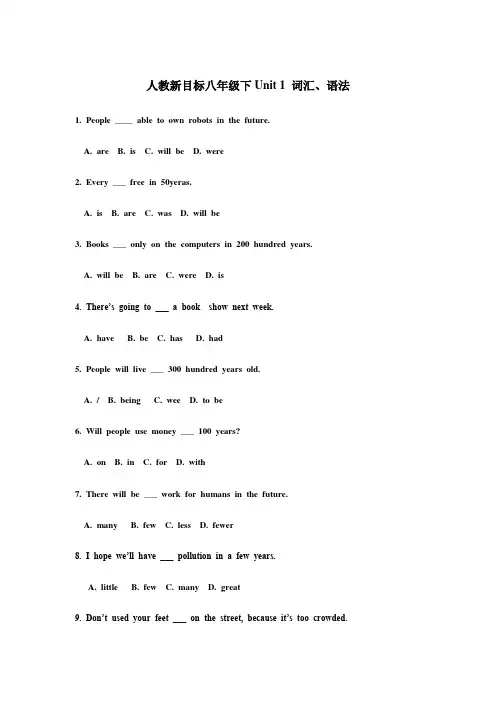
人教新目标八年级下Unit 1 词汇、语法1. People ____ able to own robots in the future.A. areB. isC. will beD. were2. Every ___ free in 50yeras.A. isB. areC. wasD. will be3. Books ___ only on the computers in 200 hundred years.A. will beB. areC. wereD. is4. There’s going to ___ a book show next week.A. haveB. beC. hasD. had5. People will live ___ 300 hundred years old.A. /B. beingC. weeD. to be6. Will people use money ___ 100 years?A. onB. inC. forD. with7. There will be ___ work for humans in the future.A. manyB. fewC. lessD. fewer8. I hope we’ll have ___ pollution in a few years.A. littleB. fewC. manyD. great9. Don’t used your feet ___ on the street, because it’s too crowded.A. playsB. playedC. playingD. to play10. She tells us that Peter is ___ college now.A. ofB. offC. withD. in11. She ___ at middle school 5 years ago.A. wereB. wasC. will beD. is12. There will be ___ cars and more buses in the future.A. fewerB. lessC. littleD. bit13. In 10 years Sally ____ a doctor.A. isB. wasC. wereD. will be14. She ___ now an engineer in 1our company.A. isB. areC. wasD. will be15. She came to China and ___ in love with the country.A. fallsB. fellC. feltD. feels16. ___ a doctor, she tries her best to save others’ lives.A. ForB. AtC. WithD. As17. The old man doesn’t like ____ in the big city.A. live aloneB. to live aloneC. living lonelyD. to live lonely18. Our apartment is too small ___ pets.A. keepB. keptC. to keepD. keeping19. She enjoys____ many different pets.A. to keepB. keepC. keepsD. keeping20. ___ pets can be fun in everyday life.A. KeepsB. KeptC. KeepingD. Keep21. She ___ a suit during weekdays.A. wearsB. puts onC. hasD. dresses22. You needn’t ____ so casually at weenkends.A. putB. dressC. wearD. have23. One day, I’ll be able to ___ a visit to France.A. payB. haveC. putD. take24. Humans ____ to the moon for vacation in 100 hundred years.A. flyB. will flyC. flewD. flies25. She drinks green tea ___ healthy.A. keepsB. keepC. to keepD. kept26. ____ should be a difficult thing.A. PredictB. PredictingC. PredictedD. Predicts27. Some predictions might never ____.A. come trueB. come toC. come fromD. come back28. She saw her mother ____ in the kitchen when she came in.A. cooksB. cookingC. cookedD. to cook29. ___ in the reading room is talking loudly. It’s quiet.A. No oneB. Some oneC. Every oneD. Any one30. The y think computers won’t be ___ by people.A. usedB. usingC. usesD. use31. Kids ___ use the computers to draw in the future.A. canB. couldC. will be able toD. were able to32. Those robots are just ____ humans.A. asB. atC. withD. like33. ___ her help, I could do it well.A. ForB. AtC. InD. With34. ____ a small robot can do many jobs.A. SuchB. SoC. ThisD. That35. She has ___ good a pen pal.A. soB. suchC. thatD. this36. There won’t be pollution in ___ of years.A. one hundredB. two hundredC. hundredsD. hundred37. Humans might live to be 2 ____ years.A. hundredB. hundredsC. hundreds ofD. hundred of38. She always tries her best ____ others.A. helpB. to helpC. helpsD. helping39. She wants to do the same thing ___ her best friends.A. likeB. inC. onD. as40. It’s hard for a child ____ in the early morning.A. wake upB. woke upC. to wake upD. waking up41. There are a few people ____ in the park.A. singingB. to singC. singD. sang42. These robots look ___ like humans.A. fewB. littleC. moreD. bit43. People may get ___ with such a job.A. boredB. boringC. excitingD. interesting44. She’ll get ___ in such a fun magazine.A. interestedB. interestingC. excitedD. exciting45. Humans will have less work ___ in the future.A. doB. doingC. to doD. does46. It’s impossible for us____ robots like humans now.A. madeB. to makeC. makeD. Making47. Don’t worry. she feels ____ better.A. a littleB. littleC. fewD. a few48. No one knows what ___ 100 years ago.A. happensB. happenedC. was happenedD. is happened49. Our sports meeting will ___ in two weeks.A. take placeB. happenC. be happenedD. be taken place50. It’s possible for robots ____ the same thing as humans.A. to doB. doC. didD. doing参考答案1-5: CDABD 6-10: BCADD 11-15: BADAB 16-20: DBCDC 21-25: ABABC 26-3 0: BABAA 31-35: CDDAA 36-40: CABDC 41-45: ACAAC 46-50: BABAA。
人教版(新目标)初中英语八年级下册Unit 1
人教版(新目标)初中英语八年级下册Unit1Unit1 Whats the matter?Unit1 知识梳理【重点单词】matter [?m?t?] v. 重要,要紧,有关系Whats the matter? 怎么了?出什么事了?sore [s?:(r)] adj. 疼痛的,酸痛的have a cold 感冒stomach [st?m?k] n. 胃,腹部stomachache [st?m?ke?k] n. 胃痛,腹痛have a stomachache 胃痛foot(复数feet) [fu:t] n. 脚neck [nek] n. 颈,脖子throat [rt] n. 喉咙fever [fi:v?] n. 发烧,发热lie [la?] v. 躺,平躺lie down 躺下rest [rest] n. 剩余部分,其余;放松,休息cough [k?f] n. v. 咳嗽X-ray [eksre?] n. X光,X射线toothache [?tu:e?k] n. 牙痛take ones temperature 量体温headache [?hede?k] n. 头痛have a fever 发烧break [bre?k] n. v. 休息,暂停;打破take breaks (take a break)休息hurt [h?:t] v. 伤害,损害,使受伤passenger [p?s?nd] n. 乘客,旅客off [?f] adv. prep. 离开(某处);从去掉get off 下车to ones surprise 使惊讶,出乎意料onto [nt?] prep. 向,朝trouble [?tr?bl] n. 麻烦,烦扰,问题hit [hit] n. v. 碰撞,打,打击right away 立即,马上get into 陷入,参与herself [h?:?self] pron. 她自己,她本身(she的反身代词)bandage [b?nd?d?] n. v. 绷带;用绷带包扎sick [s?k] adj. 患病的,不适的knee [ni:] n. 膝盖nosebleed [?nzbli:d] n. 鼻出血breathe [bri:e] v. 呼吸sunburned [?s?nb?:nd] adj. 晒伤的ourselves [ɑ:?selvz] pron. 我们自己(we的反身代词)climber [?kla?m?(r)] n. 登山者be used to 习惯于适应于risk [r?sk] n. v. 风险,危险;冒险take risks (take a risk) 冒险accident [ksid?nt] n. 意外事件;事故situation [?sitju?ein] n. 状况,形式,情况kg=kilogram [?k?l?gr?m] n. 公斤,千克rock [r?k] n. 岩石run out (of) 用尽,耗尽knife [naif] n. 刀,餐刀cut off 切除blood [bl?d] n. 血mean [mi:n] v. 意味着,意思是,意欲get out of 离开,从出来importance [?m?p?:tns] n. 重要性decision [d?sn] n. 决心,决定,抉择control [k?ntrl] v. 控制,支配,操纵be in control of 掌管,管理spirit [sp?r?t] n. 勇气,意志death [de] n. 死亡give up 放弃nurse [n?:s] n. 护士【重点短语】1.have a fever 发烧2.have a cough 咳嗽3.have a toothache 牙疼4.talk too much 说得太多5.drink enough water 喝足够的水6.have a cold 受凉;感冒7.have a stomachache 胃疼8.have a sore back 背疼9.have a sore throat 喉咙痛10. take risks 冒险11.hot tea with honey 加蜂蜜的热茶12.see a dentist 看牙医13.get an X-ray 拍X 光片14.take one s temperature 量体温15.put some medicine on sth. 在上面敷药16. give up 放弃17. sound like 听起来像18. all weekend 整个周末19. in the same way 以同样的方式20. go to a doctor 看医生21. go along 沿着走22. on the side of the road 在马路边23. shout for help 大声呼救24. without thinking twice 没有多想25. get off 下车26. have a heart problem 有心脏病27. to one s surprise 另某人惊讶的是28. thanks to 多亏了;由于29. in time 及时30. make a decision 做出决定31. get into trouble 造成麻烦32. right away 立刻;马上33. because of 由于34. get out of 离开;从出来35. keep on doing sth. 继续或坚持做某事36. put a bandage on sth. 用绷带包扎37. fall down 摔倒38. feel sick 感到恶心39. have a nosebleed 流鼻血40. cut his knee 割伤他的膝盖41. put her head back 把她的头向后仰42. have problems breathing 呼吸困难43. mountain climbing 登山运动44. be used to doing sth. 习惯做某事45. run out (of) 用完;用尽46. so that 以便47. so...that... 如此以至于...48. be in control of 掌管;管理49. in a difficult situation 在闲境中【重点句型】1. Whats the matter with you?= Whatthe trouble with you?= Whats wrong with you? 你怎么了?2. What should she do? 她该怎么办呢?3.Should I take my temperature? 我应该量一下体温吗?4.You should lie down and rest. 你应该躺下休息一会儿。
新目标人教版八年级英语下全册重点及练习
Unit 1 What’s the matter?重点短语:have a stomachache have a cold lie downtake one’s temperature have a fever go to a doctor to one’s surprise agree to (do sth.) get into troublebe used to take risks run out (of)cut off get out of be in control of keep on ( doing sth.) give up语言知识归纳:1. What’s the matter (with you)?此句用来询问别人的病情。
类似的句子还有:What’s wrong with you?/ What’s the trouble?matter作动词用,意为“要紧”“有关系”,主要用于疑问句和否定句。
What does it matter? It doesn’t matter.【例题】Does it ________ if we can’t finish it today?A. mindB. mindsC. matterD. matters2. I have a sore throat.have “患病”,常用“have a /an+ 名词”.have a cold have a fever have a sore back have a stomachache have a cough【例题】( )---Does he often have ______ cold? ---Yes. He also _____a cough and a sore throat.A. a; hasB. /; hasC. a; haveD. /; have3.Lie down and rest! 躺下休息lie down 躺下4.That’s probably why. 那可能就是原因。
人教八下unit1知识点
人教八下unit1知识点人教八年级下册英语Unit 1:How often do you exercise?知识点总结Unit 1的主题是“你多久锻炼一次”,主要通过谈论日常活动的频率来交流。
以下是本单元的主要知识点总结:一、词汇2. Daily activities:exercise(锻炼)、jog(慢跑)、play basketball(打篮球)、ride a bike(骑自行车)、dance(跳舞)、watch TV(看电视)、read(读书)、do homework(做作业)、water plants(浇花)、draw pictures(画画)、help parents(帮助父母)、take photos(拍照)、clean the house(打扫房间)3. Verbs: like(喜欢)、enjoy(享受)、love(喜爱)、hate(讨厌)、prefer(更喜欢)、mind(介意)、practice(练习)、play (玩、打)二、句子1. How often + do + 主语 + 动词原形?表达“多久一次做事”例句:How often do you exercise?(你多久锻炼一次?)2. Adverbs of frequency的用法- always, usually, often位于动词前例句:I always eat breakfast.(我总是吃早餐。
)3. I enjoy/like/love/hate + 动名词例句:I enjoy dancing.(我喜欢跳舞。
)4.表示周、月的时间段的用法- on + 星期几例句:I play basketball on Fridays.(我星期五打篮球。
)- on + 日期例句:I have English class on February 1st.(我2月1日有英语课。
)- in + 月份例句:We have a holiday in July.(我们七月有假期。
八年级人教版英语下册unit1知识点总结
八年级人教版英语下册unit1知识点总结Unit1是八年级英语下册的第一单元,主要围绕“the sentence”这一主题展开。
在学习中,我们需要掌握一些重要的知识点,本文将对这些知识点进行总结。
一、句子的构成句子是表达完整意义的语言单位,主要由主语、谓语和宾语三部分构成。
其中,主语是句子的主要话题或动作的执行者,通常位于句子的最前面;谓语是句子的核心,描述主语的动作或状态;宾语是句子的补充说明,通常位于谓语之后。
句子的构成还包括句子成分和句子成分的分类。
句子成分包括主语、谓语、宾语、表语、定语和状语等。
句子成分的分类主要有三种,即主谓结构、主、谓、宾结构和主系表结构。
二、句子的种类英语中根据句子的用途和表达方式,可以分为陈述句、疑问句、祈使句和感叹句四种。
其中,陈述句用来陈述事实、肯定或否定某种情况,一般语序为主谓宾,常以句号结尾;疑问句用来询问问题,通常以问号结尾;祈使句用来表达请求、命令或建议等语气,通常省略主语,以动词原形开头;感叹句用来表达强烈的情感,常以感叹词或how引导。
三、句子的语态和时态英语中的语态有两种,即主动语态和被动语态。
主动语态表示主语执行动作,而被动语态则表示主语受到动作的影响。
时态是句子非常重要的一部分,用来表示动作发生的时间。
英语中时态主要有现在时、过去时和将来时三种。
其中,现在时表示现在或经常性的动作;过去时表示过去发生的动作;将来时表示将来要发生的动作。
四、句子的修辞手法修辞手法是指用以增强语言表现力的一些技巧或方法,英语中常见的修辞手法包括比喻、拟人、排比、反问、设问、修饰语等。
其中,比喻是常用的一种修辞手法,用来通过两个事物之间的共性来形象地说明某一现象或情况,增强语言的表现力。
拟人则是将非人事物或抽象物质化为人来进行描述,以增强表达的感染力。
以上是八年级人教版英语下册Unit1的知识点总结,希望能够对大家在学习中有所帮助。