
数据结构与算法分析 C++版
space time
When choosing data structures, here are some questions to ask.
是不是所有的数据都在一开始时就插入数据结构,
还是插 入操作是和其它操作夹杂在 起进行?(Are all data items 入操作是和其它操作夹杂在一起进行 inserted into the data structure at the beginning, or are the insertions interspersed with other operations?) 数据能否被删除? (Can data items be deleted?) 是否所有数据都需按一个定义好的顺序进行访问, 还是允 许随机存取?(Are all data processed in some welldefined order, or is random access allowed?)
3
Organizing Data
一组记录的任何一种组织(结构)都可能被检索、 按任意顺序被处理或被修改(Any organization for a collection of records can be searched, processed d in i any order, d or modified.) difi d ) 对数据结构和算法的不同选择会造成程序运行时 间的很大不同: 几秒钟或者很多天(The choice of data structure and algorithm can make the difference between a program running in a few seconds or many days.)
解的代价是指其消耗的资源量的总和(The cost of a solution is the amount of resources that the solution consumes.)
Often
the cost is measured in terms of one key resource
课程目标(Goals of this Course)
1.
Reinforce the concept that costs and benefits exist for every data structure. Learn the commonly used data structures.
2.
10010 10020 10030 10040 10050 10060 10070 10080 10090 Head
970159 李启明 91 100B0 970164 胡 涛 95 10010 970166 杨雪辉 89 10030 970157 李小青 83 10090 970163 王 伟 65 NULL 970168 梅 玲 65 10080 970160 刘 华 78 10060
例:整数类型
(或、与、非)的统一体; 整数类型就是整数值与若干算术运算(加、减、 乘、除、取模)的统一体; 复数类型就是复数值与若干复数运算的统一体; 线性表(List)类型就是列表与插入、删除、清 空、查找等操作的统一体 13
在使用 int i 或 long i 时我们通常只关心 i 是整数,可以对它加减 乘除,并未考虑其实现问题
These form a programmer‘s programmer s basic data structure “toolkit”.(基本的数据结构工具箱)
3.
Understand how to measure the cost of a data structure or program.
每一个数据结构都有其代价和效益(Each data structure has costs and benefits.) 一个数据结构几乎不可能在任何情况下都比 另 个要好 (Rarely is one data structure 另一个要好 better than another in all situations.) A data structure requires:
e1(实部),e2(虚部)
ADT不需要关心数据类型是如何实现的
封装(Encapsulation):
复数
得到一个复数的实部值 得到一个复数的虚部值 两个复数相加 两个复ion details.
每一个ADT上的操作由其输入和输出来定义 (Each ADT operation is defined by its inputs and outputs.)
16
相关操作:插入、删 除、查找记录
10090 100A0
15
100A0 970161 曾小波 90 10040 100B0
顺序存储 100B0
链式存储
抽象数据类型(Abstract Data Type)
抽象数据类型(Abstract Data Type) (cont) -i
复数ADT:
数据项: 基本操作:
17
3
抽象数据类型(Abstract Data Type) (cont)
Grader的ADT
抽象数据类型(Abstract Data Type) (cont)
String的ADT
Operations s.append(str) pare( (str t) s.erase(index, length) s.find(str) s.rfind(str) s.insert(index, str) s.length() or s.size() s.replace(index, len, str) s.substr(start, length) or s.substr(start)
输入两个实数分别作为实部和虚部来构造一个
3-8i i
抽象数据类型(ADT)是未指明具体实现的一组 值的集合及其相关操作(A set of data values
and associated operations that are specified independent of any particular implementation. )
These techniques also allow you to judge the merits of new data structures that you or others might invent.(评判新数据结构的价值)
12
11
2
数据类型(Data Type)
数据类型(Data Type)
第一部分
预备知识
第1章 Chapter 1
数据结构与算法 (Data Structures and Algorithms)
1
2
What is a data structure?
最广义地说, 数据结构是指数据的表示及其相 关操作(In the most general, a data structure is any y data representation p and its associated operations.) 更典型地讲, 数据结构是指一组数据项的组织 或结构(More typically, a data structure is meant to be an organization or structuring for a collection of data items.)
4
Efficiency(效率) and Cost(代价)
Efficiency and Cost (cont)
A solution to a problem is efficient(有效 率的) if it solves the problem within the required resource constraints(资源限制)
数据类型(data type):一组值的集合及其 相关操作(A set of data values and associated operations )
逻辑类型就是逻辑值(是、否)与 逻辑类型就是逻辑值(是 否)与3种逻辑运算
数据类型的逻辑概念(使用者所关心的)和它的物 理实现(生产者所关心的)之间是有区别的(There is a distinction between the logical concept of a data type and its physical implementation)
7
Bank example:
Start account: a few minutes Transactions: a few seconds Close
2.
account: overnight
3.
8
Some Questions to Ask
Data Structure Philosophy 关于数据结构的基本观念
5 6
1
Choosing your Data Structure
1.
Choosing your Data Structure
You should follow these steps
分析问题, 确定解必须满足的资源限制 (Analyze your problem to determine the resource constraints that any solution must meet) 确定必须支持的基本操作, 对每一个操作的资源限 制进行量化(Determine the basic operations that must be supported and quantify the resource constraints for each operation) 选择能最好地满足要求的数据结构(Select the data structure that best meets these requirements)
《数据结构与算法C》PPT课件_OK
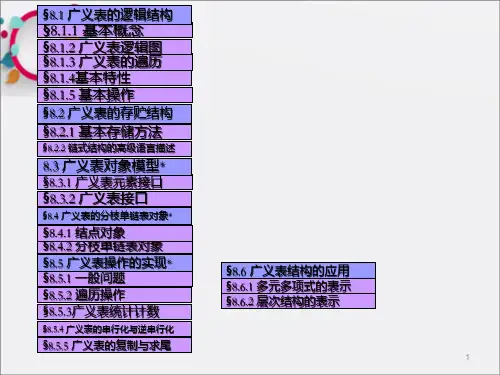
显然,表尾一定是表,但表头不一定。
• 递归表: 若表Ls中某成员含有自己(即Ls),则称Ls为递归 表。
5
• 深度:Ls的深度Depth(Ls)递归地定义为:
• 元素共享性:在同一广义表中,任一元素(单元素或 表)均可以出现多次,同一元素的多次出现都代表的是 同一个目标,可以认为它们是共享同一目标。对多次出 现的元素,显然可以从不同的位置(路径)访问它们, 因此,具有该特性的表也称再入表(Reentrant List)。
13
§8.1.5 基本操作
广义表兼有线性表和树的 特性,因此,它的基本操 作也兼有线性表和树的一 些操作,此外,还有一些 特有操作,如求表头和表 尾。 求表头和表尾是广义表的 重要操作,通过它们,可 以按递归方法处理广义表, 也可实现一般访问。著名 的人工智能语言LISP和 Prolog其实就是以广义表为 数据结构,通过求表头和 表尾实现对象的操作。
8
错误!未找到引用源。给出了广义表图的一个例子。
显然,广义表图中画出了广义表的所有结点。图中结点
之间的边表示“包含/属于”关系,即若结点A到B有边, 则表示B是A的子表之一(A包含B)。
广义表图与树相似,只是
L
由于存在共享元素,使得
广义表图中某些结点
A
C
DE
的“父亲”不唯一。
B
c de
ab
图 8-0 广义表L(见下式) 的逻辑图L(A(B(a,b)), C(B(a,b), c), D(c,d,e), E(e) )
12
• 元素分层性:如果将广义表中不同出现的元素看作不 同的元素,则广义表是层次结构,即对任一元素,它只 直属层号比它大1的元素。不过,广义表的层次性与树 不同,在树中,任一元素只直属一个元素。
数据结构与算法分析C++语言版教学设计

数据结构与算法分析C++语言版教学设计一、课程概述本课程旨在通过介绍数据结构和算法的基础概念,为学生提供C++语言编写程序的能力。
通过理论讲解和实践练习,使学生成为具备工程实践能力的C++程序设计师。
二、授课内容与安排1. 数据结构1.1 算法与数据结构基础•算法与数据结构概述•递归算法•分治法•动态规划1.2 线性结构•数组以及组合相关算法•栈、队列及其应用•链表•树、二叉树及其应用1.3 非线性结构•散列表•图2. C++语言编程2.1 基础语法•变量、常量•控制语句•函数•数组2.2 面向对象编程•类的定义与实例化•继承与多态•异常处理2.3 泛型编程•模板类型•模板函数3. 实践项目3.1 数据结构应用•实现一个简单的图像处理软件,包括调整图片大小、颜色处理等功能3.2 C++程序设计•设计一个简单的CMS系统,包括文章管理、用户管理等功能三、教学方法1. 理论讲授通过课堂讲授梳理课程框架,提供基础理论概念的讲授。
2. 实践演练通过课下习题和课上实验等方式,加强学生对课程知识的巩固和应用。
3. 课程作业安排课下作业,考察学生对知识的掌握情况,提供个性化指导和辅导。
4. 课程设计结合实际项目需求对学生在课程结束时进行综合性的能力考核和实际项目进行设计与实现。
四、教学评分1. 课堂表现•出勤情况(10%)•课堂参与度(20%)•课堂问答互动(20%)•课堂作业提交(20%)2. 期末考试•理论知识(30%)•实践能力(30%)3. 课程设计•设计方案(20%)•实现效果(20%)五、总结数据结构与算法是计算机科学中非常重要的基础,而C++作为一种强大的面向对象编程语言,学习与掌握C++编程也是非常重要的。
本课程通过系统的理论讲授和实践项目,旨在提供学生扎实的数据结构与算法基础和深入的C++编程实践经验,从而充分发挥C++编程优势,成为高水平的编程人才。
数据结构与算法分析C++语言描述第三版课程设计

数据结构与算法分析C++语言描述第三版课程设计一、课程设计背景数据结构与算法是计算机科学与技术专业中必修的一门课程,也是计算机领域中最基础和最重要的学科之一。
本课程设计旨在通过对数据结构与算法的学习和实践,培养学生的计算机编程思维和实践能力。
二、课程设计目的本课程设计旨在帮助学生:1.熟悉C++编程语言和STL标准库的使用;2.掌握常用的数据结构和算法,如数组、链表、栈、队列、二叉树、排序、查找等;3.能够独立设计、开发和实现简单的算法和数据结构程序;4.培养学生的分析和解决问题的能力,提高学生的计算机编程水平和实践能力。
三、课程设计内容和要求3.1 课程设计内容本课程设计包括以下几个部分:1.数据结构与算法分析C++语言描述第三版的阅读和理解;2.根据所学算法和数据结构,设计并实现以下几个程序:•排序算法实现:用C++语言实现冒泡排序、快速排序、插入排序和选择排序等排序算法,并比较它们的优缺点;•数据结构实现:用C++语言实现链表、队列、栈及其基本操作(插入、删除、查找等);•树和图算法实现:用C++语言实现二叉树的遍历算法、图的深度优先搜索算法和广度优先搜索算法;3.设计并实现一个程序,采用自己所学的算法和数据结构,解决一个有实际应用价值的问题,并撰写一份详细的设计报告。
3.2 课程设计要求1.独立完成,不得抄袭他人作业;2.所实现的程序必须使用C++编写,且符合面向对象的程序设计理念;3.必须使用C++标准库中的STL容器和算法;4.撰写一份详细的实验报告,记录程序设计的思路、实现过程和测试结果,报告内容必须使用Markdown文本格式撰写。
四、参考资料1.Mark Allen Weiss著,《数据结构与算法分析C++语言描述第三版》。
2.严蔚敏, 吴伟民, 高一凡著, 《数据结构》。
3.Tomas A. Lipinski, 《STL源码剖析》。
五、结语本课程设计旨在通过对数据结构与算法的学习和实践,培养学生的计算机编程思维和实践能力。
算法与数据结构c语言版第三版教学设计
算法与数据结构C语言版第三版教学设计一、课程简介本课程旨在介绍算法与数据结构在C语言中的应用,包括C语言中的数据类型、控制语句、函数、指针等内容。
通过本课程的学习,学生将会掌握基础的算法和数据结构,以及如何在C语言中进行实现。
本课程要求学生有一定的C语言编程基础。
二、教学目标1.掌握常见数据结构的定义和应用2.掌握算法设计的基本方法和技巧3.熟练掌握C语言对数据结构和算法的实现4.培养学生对算法和数据结构分析和解决问题的能力三、教学内容1.堆、栈、队列、链表、树等数据结构的定义和实现2.常见算法的设计和分析,包括排序算法、搜索算法、贪心算法、动态规划算法等3.C语言中的指针和内存管理4.C语言中的函数编程和模块化设计5.C语言中的文件操作和常见库函数的应用四、教学方法1.讲授:通过教师讲解、课件展示等方式,介绍数据结构的定义、性质、应用场景、算法设计等知识点。
2.实践:通过上机实验、编程练习等方式,帮助学生深入理解算法和数据结构的实现。
3.课外作业:布置与本课程相关的课外作业和项目,让学生进一步熟悉算法和数据结构在真实项目中的应用。
五、评价方式1.考试:安排笔试或机试,测试学生对算法和数据结构的掌握程度。
2.作业:考察学生对编程的理解和对算法和数据结构的应用能力。
六、教学成果1.学生能够掌握数据结构的定义和应用,包括堆、栈、队列、链表、树等。
2.学生能够掌握常见的算法设计和分析方法,如排序算法、搜索算法、贪心算法和动态规划算法等。
3.学生能够熟练应用C语言的指针和内存管理,以及函数编程和模块化设计。
4.学生能够熟练运用C语言进行文件操作和常用库函数的应用。
5.学生能够分析和解决实际问题中的算法和数据结构相关的问题。
数据结构与算法分析c语言描述中文答案

数据结构与算法分析c语言描述中文答案一、引言数据结构与算法是计算机科学中非常重要的基础知识,它们为解决实际问题提供了有效的工具和方法。
本文将以C语言描述中文的方式,介绍数据结构与算法分析的基本概念和原理。
二、数据结构1. 数组数组是在内存中连续存储相同类型的数据元素的集合。
在C语言中,可以通过定义数组类型、声明数组变量以及对数组进行操作来实现。
2. 链表链表是一种动态数据结构,它由一系列的节点组成,每个节点包含了数据和一个指向下一个节点的指针。
链表可以是单链表、双链表或循环链表等多种形式。
3. 栈栈是一种遵循“先进后出”(Last-In-First-Out,LIFO)原则的数据结构。
在C语言中,可以通过数组或链表实现栈,同时实现入栈和出栈操作。
4. 队列队列是一种遵循“先进先出”(First-In-First-Out,FIFO)原则的数据结构。
在C语言中,可以通过数组或链表实现队列,同时实现入队和出队操作。
5. 树树是一种非线性的数据结构,它由节点和边组成。
每个节点可以有多个子节点,其中一个节点被称为根节点。
在C语言中,可以通过定义结构体和指针的方式来实现树的表示和操作。
6. 图图是由顶点和边组成的数据结构,它可以用来表示各种实际问题,如社交网络、路网等。
在C语言中,可以通过邻接矩阵或邻接表的方式来表示图,并实现图的遍历和查找等操作。
三、算法分析1. 时间复杂度时间复杂度是用来衡量算法的执行时间随着问题规模增长的趋势。
常见的时间复杂度有O(1)、O(log n)、O(n)、O(n^2)等,其中O表示“量级”。
2. 空间复杂度空间复杂度是用来衡量算法的执行所需的额外内存空间随着问题规模增长的趋势。
常见的空间复杂度有O(1)、O(n)等。
3. 排序算法排序算法是对一组数据按照特定规则进行排序的算法。
常见的排序算法有冒泡排序、插入排序、选择排序、快速排序、归并排序等,它们的时间复杂度和空间复杂度各不相同。
数据结构与算法分析C语言描述第二版课程设计

数据结构与算法分析C语言描述第二版课程设计一、设计背景数据结构和算法是计算机科学中的重要基础,对于计算机的思维方式和编程能力的提高都起着至关重要的作用。
本次课程设计旨在通过学习C语言描述的数据结构与算法分析第二版来加深对数据结构和算法的理解,并提高学生的编程能力。
二、设计内容本次课程设计主要包括以下内容:1.预备工作学生需要在正式开始课程设计之前,先进行以下预备工作: - 对C语言中基本数据类型的掌握,如int、float、double等; - 掌握C语言中的条件语句、循环语句和结构体的使用; - 对C语言中函数的定义、调用和声明有一定的了解。
2.基本概念的学习在开始具体的数据结构和算法之前,学生需要学习以下基本概念: - 算法的概念和特性; - 数据结构的基本概念及其分类; - 算法分析的方法。
3.单链表的设计单链表是数据结构中最基本的线性结构之一,本次设计的主要内容之一就是针对单链表的设计。
具体内容如下: - 实现单链表的各种操作,如插入、删除、查找等; - 对单链表进行排序; - 通过单链表来实现栈、队列等数据结构;4.树的设计树是一种非常常见的非线性数据结构,此次课程设计的另一大内容即为针对树的设计。
具体内容如下: - 实现二叉树的各种操作,如前序遍历、中序遍历、后序遍历等; - 实现不同类型的二叉树,如满二叉树、完全二叉树等; - 学习通过树来实现的各种算法,如哈夫曼编码、最小生成树等。
5.图的设计图是一种非常复杂的非线性数据结构,在计算机科学中应用非常广泛,如社交网络、地图导航等。
本次课程设计的最后一个内容即是针对图的设计。
具体内容如下: - 实现图的各种操作,如插入节点、删除节点、遍历图等; - 实现不同类型的图,如网格图、稀疏图等; - 学习通过图来实现的各种算法,如最短路径问题、拓扑排序等。
三、设计目标通过本次课程设计,学生应该达到以下目标: - 掌握基本的数据结构和算法知识; - 提高编程能力,能够独立设计和实现各种数据结构和算法; - 了解数据结构和算法在实际工作中的应用。
C语言中的数据结构与算法
C语言中的数据结构与算法
C语言是一种高效且功能丰富的编程语言,广泛用于系统软件开发和嵌入式设备编程。
在C语言中,数据结构和算法是非常重要的概念,能够帮助程序员更好地组织和处理数据,提高程序的效率和性能。
数据结构是指在计算机中存储和组织数据的方式,常用的数据结构包括数组、链表、栈、队列、树等。
在C语言中,我们可以利用这些数据结构来存储和操作数据,使程序更加高效和易于理解。
在C语言中,常用的算法包括查找算法、排序算法、递归算法等。
这些算法能够帮助我们解决各种问题,比如在数组中查找特定元素、对数组进行排序等。
掌握这些算法可以让我们更好地设计和优化程序,提高程序的性能和可读性。
数据结构与算法的重要性在于它们不仅能够帮助我们解决具体的问题,还能够培养我们的思维能力和编程能力。
通过学习和实践数据结构与算法,我们可以更好地理解计算机科学中的基本原理和技术,提升自己的编程水平。
在学习C语言中的数据结构与算法时,我们可以通过书籍、在线教程、实践项目等方式来加深理解和掌握。
同时,可以参与一些编程挑战和竞赛,与其他程序员交流和分享经验,不断提升自己的编程技能。
总的来说,掌握C语言中的数据结构与算法是每一个程序员必备的技能,能够帮助我们更好地解决问题、提高编程效率和质量。
通过不断学习和实践,我们可以不断提升自己的编程能力,成为更优秀的程序员。
愿大家在学习数据结构与算法的过程中取得成功,不断进步!感谢阅读!。
数据结构与算法分析-C++版答案
Data Structures and Algorithm 习题答案Preface ii1 Data Structures and Algorithms 12 Mathematical Preliminaries 53 Algorithm Analysis 174 Lists, Stacks, and Queues 235 Binary Trees 326 General Trees 407 Internal Sorting 468 File Processing and External Sorting 54 9Searching 5810 Indexing 6411 Graphs 6912 Lists and Arrays Revisited 7613 Advanced Tree Structures 82iii Contents14 Analysis Techniques 8815 Limits to Computation 94PrefaceContained herein are the solutions to all exercises from the textbook A Practical Introduction to Data Structures and Algorithm Analysis, 2nd edition.For most of the problems requiring an algorithm I have given actual code. Ina few cases I have presented pseudocode. Please be aware that the code presented in this manual has not actually been compiled and tested. While I believe the algorithmsto be essentially correct, there may be errors in syntax as well as semantics. Most importantly, these solutions provide a guide to the instructor as to the intendedanswer, rather than usable programs.1Data Structures and AlgorithmsInstructor’s note: Unlike the other chapters, many of the questions in this chapter are not really suitable for graded work. The questions are mainly intended to get students thinking about data structures issues.1.1This question does not have a specific right answer, provided the student keeps to the spirit of the question. Students may have trouble with the concept of “operations.”1.2This exercise asks the student to expand on their concept of an integer representation.A good answer is described by Project 4.5, where a singly-linkedlist is suggested. The most straightforward implementation stores each digitin its own list node, with digits stored in reverse order. Addition and multiplicationare implemented by what amounts to grade-school arithmetic. Foraddition, simply march down in parallel through the two lists representingthe operands, at each digit appending to a new list the appropriate partial sum and bringing forward a carry bit as necessary. For multiplication, combine the addition function with a new function that multiplies a single digitby an integer. Exponentiation can be done either by repeated multiplication (not really practical) or by the traditional Θ(log n)-time algorithm based on the binary representation of the exponent. Discovering this faster algorithm will be beyond the reach of most students, so should not be required.1.3A sample ADT for character strings might look as follows (with the normal interpretation of the function names assumed).Chap. 1 Data Structures and Algorithms// Concatenate two stringsString strcat(String s1, String s2);// Return the length of a stringint length(String s1);// Extract a substring, starting at ‘start’,// and of length ‘length’String extract(String s1, int start, int length);// Get the first characterchar first(String s1);// Compare two strings: the normal C++ strcmp function.Some// convention should be indicated for how to interpretthe// return value. In C++, this is 1for s1<s2; 0 for s1=s2;// and 1 for s1>s2.int strcmp(String s1, String s2)// Copy a stringint strcpy(String source, String destination)1.4The answer to this question is provided by the ADT for lists given in Chapter 4.1.5One’s compliment stores the binary representation of positive numbers, and stores the binary representation of a negative number with the bits inverted. Two’s compliment is the same, except that a negative number has its bits inverted and then one is added (for reasons of efficiency in hardware implementation).This representation is the physical implementation of an ADTdefined by the normal arithmetic operations, declarations, and other support given by the programming language for integers.1.6An ADT for two-dimensional arrays might look as follows.Matrix add(Matrix M1, Matrix M2);Matrix multiply(Matrix M1, Matrix M2);Matrix transpose(Matrix M1);void setvalue(Matrix M1, int row, int col, int val);int getvalue(Matrix M1, int row, int col);List getrow(Matrix M1, int row);One implementation for the sparse matrix is described in Section 12.3 Another implementationis a hash table whose search key is a concatenation of the matrix coordinates.1.7Every problem certainly does not have an algorithm. As discussed in Chapter 15, there are a number of reasons why this might be the case. Some problems don’t have a sufficiently clear definition. Some problems, such as the halting problem, are non-computable. For some problems, such as one typically studied by artificial intelligence researchers, we simply don’t know a solution.1.8We must assume that by “algorithm” we mean something composed of steps a reof a nature that they can be performed by a computer. If so, than any algorithm can be expressed in C++. In particular, if an algorithm can be expressed in any other computer programming language, then it can be expressed in C++, since all (sufficiently general) computer programming languages compute the same set of functions.1.9The primitive operations are (1) adding new words to the dictionary and (2) searching the dictionary for a given word. Typically, dictionary access involves some sort of pre-processing of the word to arrive at the “root” of the word.A twenty page document (single spaced) is likely to contain about 20,000 words. A user may be willing to wait a few seconds between individual “hits” of mis-spelled words, or perhaps up to a minute for the whole document to be processed. This means that a check for an individual word can take about 10-20 ms. Users will typically insert individual words into the dictionary interactively, so this process cantake a couple of seconds. Thus, search must be much more efficient than insertion.1.10The user should be able to find a city based on a variety of attributes (name, location,perhaps characteristics such as population size). The user should also be able to insertand delete cities. These are the fundamental operations of any database system: search, insertion and deletion.A reasonable database has a time constraint that will satisfy the patience of a typicaluser. For an insert, delete, or exact match query, a few seconds is satisfactory. If thedatabase is meant to support range queries and mass deletions, the entire operation may be allowed to take longer, perhaps on the order of a minute. However, the time spent to process individual cities within the range must be appropriately reduced.Inpractice, the data representation will need to be such that it accommodates efficient processing to meet these time constraints. In particular, it may be necessary to supportoperations that process range queries efficiently by processing all cities in the range as a batch, rather than as a series of operations on individual cities.1.11Students at this level are likely already familiar with binary search. Thus, they should typically respond with sequential search and binary search. Binary search should be described as better since it typically needs to make fewer comparisons (and thus is likely to be much faster).1.12The answer to this question is discussed in Chapter 8. Typical measures of cost will be number of comparisons and number of swaps. Tests should include running timings on sorted, reverse sorted, and random lists of various sizes.Chap. 1 Data Structures and Algorithms1.13The first part is easy with the hint, but the second part is rather difficult to do withouta stack.a) bool checkstring(string S) {int count = 0;for (int i=0; i<length(S); i++)if (S[i] == ’(’) count++;if (S[i] == ’)’) {if (count == 0) return FALSE;count--;}}if (count == 0) return TRUE;else return FALSE;}b) int checkstring(String Str) {Stack S;int count = 0;for (int i=0; i<length(S); i++)if (S[i] == ’(’)S.push(i);if (S[i] == ’)’) {if (S.isEmpty()) return i;S.pop();}if (S.isEmpty()) return -1;else return S.pop();}1.14Answers to this question are discussed in Section 7.2.1.15This is somewhat different from writing sorting algorithms for a computer, since person’s “working space” is typically limited, as is their ability to physically manipulatethe pieces of paper. Nonetheless, many of the common sorting algorithms have their analogs to solutions for this problem. Most typical answers will be insertion sort, variations on mergesort, and variations on binsort.1.16Answers to this question are discussed in Chapter 8.2Mathematical Preliminaries2.1(a) Not reflexive if the set has any members. One could argue it is symmetric, antisymmetric, and transitive, since no element violate any ofthe rules.(b)Not reflexive (for any female). Not symmetric (consider a brother and sister). Not antisymmetric (consider two brothers). Transitive (for any3 brothers).(c)Not reflexive. Not symmetric, and is antisymmetric. Not transitive(only goes one level).(d)Not reflexive (for nearly all numbers). Symmetric since a+ b= b+ a,so not antisymmetric. Transitive, but vacuously so (there can be nodistinct a, b,and cwhere aRband bRc).(e)Reflexive. Symmetric, so not antisymmetric. Transitive (but sort of vacuous).(f)Reflexive – check all the cases. Since it is only true when x= y,itis technically symmetric and antisymmetric, but rather vacuous. Likewise,it is technically transitive, but vacuous.2.2In general, prove that something is an equivalence relation by proving that it is reflexive, symmetric, and transitive.(a)This is an equivalence that effectively splits the integers into odd andeven sets. It is reflexive (x+ xis even for any integer x), symmetric(since x+ y= y+ x) and transitive (since you are always adding twoodd or even numbers for any satisfactory a, b,and c).(b)This is not an equivalence. To begin with, it is not reflexive for any integer.(c)This is an equivalence that divides the non-zero rational numbers into positive and negative. It is reflexive since x˙x>0. It is symmetric sincexy˙= yx˙. It is transitive since any two members of the given class satisfy the relationship.5Chap. 2 Mathematical Preliminaries(d)This is not an equivalance relation since it is not symmetric. For example,a=1and b=2.(e)This is an eqivalance relation that divides the rationals based on their fractional values. It is reflexive since for all a, a.a=0. It is symmetricsince if a.b=xthen b.a=.x. It is transitive since any two rationalswith the same fractional value will yeild an integer.(f)This is not an equivalance relation since it is not transitive. For example, 4.2=2and 2.0=2,but 4.0=4.2.3A relation is a partial ordering if it is antisymmetric and transitive.(a)Not a partial ordering because it is not transitive.(b)Is a partial ordering bacause it is antisymmetric (if ais an ancestor ofb, then bcannot be an ancestor of a) and transitive (since the ancestorof an ancestor is an ancestor).(c)Is a partial ordering bacause it is antisymmetric (if ais older than b,then bcannot be older than a) and transitive (since if ais older than band bis older than c, ais older than c).(d)Not a partial ordering, since it is not antisymmetric for any pair of sisters.(e)Not a partial ordering because it is not antisymmetric.(f)This is a partial ordering. It is antisymmetric (no violations exist) and transitive (no violations exist).2.4A total ordering can be viewed as a permuation of the elements. Since there are n!permuations of nelements, there must be n!total orderings.2.5This proposed ADT is inspired by the list ADT of Chapter 4.void clear();void insert(int);void remove(int);void sizeof();bool isEmpty();bool isInSet(int);2.6This proposed ADT is inspired by the list ADT of Chapter 4. Note that while it is similiar to the operations proposed for Question 2.5, the behaviour is somewhat different.void clear();void insert(int);void remove(int);void sizeof();7bool isEmpty();// Return the number of elements with a given valueintcountInBag(int);2.7The list class ADT from Chapter 4 is a sequence.2.8long ifact(int n) { // make n <= 12 so n! for long intlong fact = 1;Assert((n >= 0) && (n <= 12), "Input out of range");for (int i=1; i<= n; i++)fact = fact * i;return fact;}2.9void rpermute(int *array, int n) {swap(array, n-1, Random(n));rpermute(array, n-1);}2.10(a) Most people will find the recursive form natural and easy to understand. The iterative version requires careful examination to understand whatit does, or to have confidence that it works as claimed.(b)Fibr is so much slower than Fibi because Fibr re-computes thebulk of the series twice to get the two values to add. What is muchworse, the recursive calls to compute the subexpressions also re-computethe bulk of the series, and do so recursively. The result is an exponential explosion. In contrast, Fibicomputes each value in the seriesexactly once, and so its running time is proportional to n.2.11// Array curr[i] indicates current position of ring i.void GenTOH(int n, POLE goal, POLE t1, POLE t2,POLE* curr) {if (curr[n] == goal) // Get top n-1 rings set upGenTOH(n-1, goal, t1, t2, curr);else {if (curr[n] == t1) swap(t1, t2); // Get names right// Now, ring n is on pole t2. Put others on t1.GenTOH(n-1, t1, goal, t2, curr);move(t2, goal);GenTOH(n-1, goal, t1, t2, curr); // Move n-1 back}}2.12At each step of the way, the reduction toward the base case is only half asfar as the previous time. In theory, this series approaches, but never reaches, 0, so it will go on forever. In practice, the value should become computationally indistinguishable from zero, and terminate. However, this is terrible programming practice.Chap. 2 Mathematical Preliminaries2.13void allpermute(int array[], int n, int currpos) {if (currpos == (n-1)} {printout(array);return;}for (int i=currpos; i<n; i++) {swap(array, currpos, i);allpermute(array, n, currpos+1);swap(array, currpos, i); // Put back for next pass}}2.14In the following, function bitposition(n, i) returns the value (0 or1) at the ith bit position of integer value n. The idea is the print out the elements at the indicated bit positions within the set. If we do this for values in the range 0 to 2n.1, we will get the entire powerset.void powerset(int n) {for (int i=0; i<ipow(2, n); i++) {for (int j=0; j<n; j++)if (bitposition(n, j) == 1) cout << j << " ";cout << endl;}2.15 Proof: Assume that there is a largest prime number. Call it Pn,the nth largest prime number, and label all of the primes in order P1 =2, P2 =3,and so on. Now, consider the number Cformed by multiplying all of the nprime numbers together. The value C+1is not divisible by any of the nprime numbers. C+1is a prime number larger than Pn, a contradiction.Thus, we conclude that there is no largest prime number. .2.16Note: This problem is harder than most sophomore level students can handle.√Proof: The proof is by contradiction. Assume that 2is rational. By definition, there exist integers pand qsuch that√p2=,qwhere pand qhave no common factors (that is, the fraction p/qis in lowestterms). By squaring both sides and doing some simple algebraic manipulation, we get2p2=2q222q= pSince p2 must be even, p must be even. Thus,9222q=4(p)222q=2(p)2This implies that q2 is also even. Thus, pand qare both even, which contra√dicts the requirement that pand qhave no common factors. Thus, 2mustbe irrational. .2.17The leftmost summation sums the integers from 1 to n. The second summation merely reverses this order, summing the numbers from n.1+1=ndown to n.n+1=1. The third summation has a variable substitution ofi.1for i, with a corresponding substitution in the summation bounds. Thus, it is also the summation of n.0=n.(n.1)=1.2.18 Proof:(a) Base case.For n=1, 12 = [2(1)3 +3(1)2 +1]/6=1. Thus, the formula is correct for the base case. (b) Induction Hypothesis.n.12(n.1)3 +3(n.1)2 +(n.1)i2 =.6i=1(c) Induction Step.nn.1i2 i2 +n2=i=1 i=12(n.1)3 +3(n.1)2 +(n.2=+n62n3 .6n2 +6n.2+3n2 .6n+3+n.1 2=+n62n3 +3n2 +n=.6Thus, the theorem is proved by mathematical induction. .2.19 Proof:(a) Base case.For n=1, 1/2=1.1/2=1/2. Thus, the formula iscorrect for the base case.(b) Induction Hypothesis.n.111=1.2in.1 2i=1Chap. 2 Mathematical Preliminaries(c) Induction Step.nn.11 11=+iin222i=1 i=111=1.+n.1 n221=1..n2Thus, the theorem is proved by mathematical induction. .2.20 Proof:(a) Base case. For n=0, 20 =21 .1=1. Thus, the formula is correctfor the base case.(b) Induction Hypothesis.n.12i=2n.1.i=0(c) Induction Step.nn.12i=2i+2ni=0 i=0n=2n.1+2n+1 .1=2.Thus, the theorem is proved by mathematical induction. .2.21 The closed form solution is 3n+1.3, which I deduced by noting that 3F (n).2n+1 .3F(n)=2F(n)=3. Now, to verify that this is correct, use mathematicalinduction as follows.For the base case, F(1)=3=32.3 .n.1The induction hypothesis is that =(3n.3)/2.i=1So,nn.13i=3i+3ni=1 i=13n.3n= +32n+1 .33= .2Thus, the theorem is proved by mathematical induction.11n2.22 Theorem 2.1 (2i)=n2 +n.i=1(a) Proof: We know from Example 2.3 that the sum of the first noddnumbers is n2.The ith even number is simply one greater than the ith odd number. Since we are adding nsuch numbers, the sum must be n greater, or n2 +n. .(b) Proof: Base case: n=1yields 2=12 +1, which is true.Induction Hypothesis:n.12i=(n.1)2 +(n.1).i=1Induction Step: The sum of the first neven numbers is simply the sum of the first n.1even numbers plus the nth even number.nn.12i=( 2i)+2ni=1 i=1=(n.1)2 +(n.1)+2n=(n2 .2n+1)+(n.1)+2n= n2 .n+2n= n2 +n.nThus, by mathematical induction, 2i=n2 +n. .i=12.23 Proof:52Base case. For n=1,Fib(1) = 1 <3.For n=2,Fib(2) = 1 <(5).3Thus, the formula is correct for the base case. Induction Hypothesis. For all positive integers i<n,5 iFib(i)<().3Induction Step. Fib(n)=Fib(n.1)+Fib(n.2)and, by the InductionHypothesis, Fib(n.1)<(5)n.1 and Fib(n.2)<(5)n.2.So,3355 n.2Fib(n) < ()n.1 +()3355 5 n.2<()n.2 +()333Chap. 2 Mathematical Preliminaries85 n.2= ()3355 n.2<()2()33n5= .3Thus, the theorem is proved by mathematical induction. .2.24 Proof:12(1+1)23 =(a) Base case. For n=1, 1=1. Thus, the formula is correct4for the base case.(b) Induction Hypothesis.n.122(n1)ni3 = .4i=0(c) Induction Step. n2(n.1)n2i33=+n4i=02n4 .2n3 +n3=+n4n4 +2n3 +n2=4n2(n2 +2n+2)=2n2(n+1)=4Thus, the theorem is proved by mathematical induction..2.25(a) Proof: By contradiction. Assume that the theorem is false. Then, each pigeonhole contains at most 1 pigeon. Since there are nholes, there isroom for only npigeons. This contradicts the fact that a total of n+1pigeons are within the nholes. Thus, the theorem must be correct. .(b) Proof:i. Base case.For one pigeon hole and two pigeons, there must betwo pigeons in the hole.ii. Induction Hypothesis.For npigeons in n.1holes, some holemust contain at least two pigeons.13iii. Induction Step. Consider the case where n+1pigeons are in nholes. Eliminate one hole at random. If it contains one pigeon, eliminate it as well, and by the induction hypothesis some otherhole must contain at least two pigeons. If it contains no pigeons, then again by the induction hypothesis some other hole must contain at least two pigeons (with an extra pigeon yet to be placed). Ifit contains more than one pigeon, then it fits the requirements of the theorem directly..2.26 (a)When we add the nth line, we create nnew regions. But, we startwith one region even when there are no lines. Thus, the recurrence is F(n)=F(n.1)+n+1.(b) This is equivalent to the summation F(n)=1+ i=1 ni.(c) This is close to a summation we already know (equation 2.1).2.27 Base case: T(n.1)=1=1(1+1)/2.Induction hypothesis: T(n.1)=(n.1)(n)/2.Induction step:T(n)= T(n.1)+n=(n1)(n)/2+n= n(n+1)/2.Thus, the theorem is proved by mathematical induction.2.28 If we expand the recurrence, we getT(n)=2T(n.1)+1=2(2T(n.2)+1)+1)=4T(n.2+2+1.Expanding again yieldsT(n)=8T(n.3)+4+2+1.From this, we can deduce a pattern and hypothesize that the recurrence is equivalent tonT(n)= .12i=2n.1.i=0To prove this formula is in fact the proper closed form solution, we use mathematical induction.Base case: T(1)=21 .1=1.14Chap. 2 Mathematical PreliminariesInduction hypothesis: T(n.1)=2n.1 .1.Induction step:T(n)=2T(n.1)+1= 2(2n.1 .1) + 1=2n.1.Thus, as proved by mathematical induction, this formula is indeed the correct closed form solution for the recurrence.2.29 (a)The probability is 0.5 for each choice.(b)The average number of “1” bits is n/2, since each position has 0.5probability of being “1.”(c)The l eftmost “1” will be the leftmost bit (call it position 0) with probability 0.5; in position 1 with probability 0.25, and so on. The numberof positions we must examine is 1 in the case where the leftmost “1” isin position 0; 2 when it is in position 1, and so on. Thus, the expectedcost is the value of the summationni.2ii=1The closed form for this summation is 2 .n+2, or just less than two.2nThus, we expect to visit on average just less than two positions. (Students at this point will probably not be able to solve this summation,and it is not given in the book.)2.30There are at least two ways to approach this problem. One is to estimate the volume directly. The second is to generate volume as a function of weight. This is especially easy if using the metric system, assuming that the human body is roughly the density of water. So a 50 Kilo person has a volumeslightly less than 50 liters; a 160 pound person has a volume slightly less than 20 gallons.2.31(a) Image representations vary considerably, so the answer will vary as a result. One example answer is: Consider VGA standard size, full-color(24 bit) images, which is 3 ×640 ×480, or just less than 1 Mbyte perimage. The full database requires some 30-35 CDs.(b)Since we needed 30-35 CDs before, compressing by a factor of 10 isnot sufficient to get the database onto one CD.[Note that if the student picked a smaller format, such as estimating the size of a “typical” gif image, the result might wel l fit onto a single CD.]2.32(I saw this problem in John Bentley’s Programming Pearls.) Approach 1:The model is Depth X Width X Flow where Depth and Width are in milesand Flow is in miles/day. The Mississippi river at its mouth is about 1/4 mile wide and 100 feet (1/50 mile) deep, with a flow of around 15 miles/hour =360 miles/day. Thus, the flow is about 2 cubic miles/day.Approach 2: What goes out must equal what goes in. The model is Area XRainfall where Area is in square miles and Rainfall is in (linear) miles/day. The Mississipi watershed is about 1000 X 1000 miles, and the average rainfalis about 40 inches/year ≈.1 inches/day ≈.000002 miles/day (2 X 10.6).Thus, the flow is about 2 cubic miles/day.2.33Note that the student should NOT be providing answers that look like theywere done using a calculator. This is supposed to be an exercise in estimation! The amount of the mortgage is irrelevant, since this is a question about rates. However, to give some numbers to help you visualize the problem, pick a$100,000 mortgage. The up-front charge would be $1,000, and the savingswould be 1/4% each payment over the life of the mortgage. The monthlycharge will be on the remaining principle, being the highest at first and gradually reducing over time. But, that has little effect for the first few years.At the grossest approximation, you paid 1% to start and will save 1/4% each year, requiring 4 years. To be more precise, 8% of $100,000 is $8,000, while7 3/4% is $7,750 (for the first year), with a little less interest paid (and therefore saved) in following years. This will require a payback period of slightlyover 4 years to save $1000. If the money had been invested, then in 5 yearsthe investment would be worth about $1300 (at 5would be close to 5 1/2years.2.34Disk drive seek time is somewhere around 10 milliseconds or a little lessin 2000. RAM memory requires around 50 nanoseconds – much less thana microsecond. Given that there are about 30 million seconds in a year, a machine capable of executing at 100 MIPS would execute about 3 billionbillion (3 .1018) instructions in a year.2.35Typical books have around 500 pages/inch of thickness, so one million pages requires 2000 inches or 150-200 feet of bookshelf. This would be in excess of 50 typical shelves, or 10-20 bookshelves. It is within the realm of possibility that an individual home has this many books, but it is rather unusual.2.36A typical page has around 400 words (best way to derive this is to estimate the number of words/line and lines/page), and the book has around 500 pages, so the total is around 200,000 words.16Chap. 2 Mathematical Preliminaries2.37An hour has 3600 seconds, so one million seconds is a bit less than 300 hours.A good estimater will notice that 3600 is about 10% greater than 3333, so the actual number of hours is about 10% less than 300, or close to 270. (The real value is just under 278). Of course, this is just over 11 days.2.38Well over 100,000, depending on what you wish to classify as a city or town. The real question is what technique the student uses.2.39(a) The time required is 1 minute for the first mile, then 60/59 minutesfor the second mile, and so on until the last mile requires 60/1=60minutes. The result is the following summation.60 6060/i=60 1/i=60H60.i=1 i=1(b)This is actually quite easy. The man will never reach his destination,since his speed approaches zero as he approaches the end of the journey.。
数据结构与算法分析C语言描述第二版教学设计
数据结构与算法分析C语言描述第二版教学设计1. 教学目标本课程旨在帮助学生:•理解数据结构与算法的基本概念和原理;•掌握基本的数据结构与算法的实现方法;•能够编写能够高效运行的程序来解决复杂的问题。
2. 教学内容2.1 数据结构本课程将首先介绍数据结构的基本概念和原理,包括:•数据结构的定义和分类;•数组、链表、栈、队列、树、图等基本数据结构的实现和应用;•数据结构的操作和算法分析。
2.2 算法本课程将进一步介绍算法的基本概念和原理,包括:•算法的定义和分类;•排序、查找、图算法等基本算法的实现和应用;•算法的复杂度分析和优化。
2.3 实践项目本课程将结合实践项目来帮助学生巩固所学的知识和技能。
实践项目将要求学生运用所学的数据结构和算法来解决实际的问题,例如:•用哈希表来实现电话簿的快速查找;•用Dijkstra算法来寻找最短路径;•用红黑树来实现高效的搜索和插入等。
3. 教学方法本课程将采用以下教学方法:3.1 讲授教师将通过教材、PPT和示例代码等方式,向学生讲解数据结构和算法的基本概念和应用,帮助学生了解数据结构和算法的实现原理和基本操作。
3.2 练习教师将通过练习题、课堂演示和实践项目等方式,帮助学生巩固所学的知识和技能,提高学生的编程能力和解决问题的能力。
3.3 讨论教师将通过小组讨论、案例分析和学生汇报等方式,培养学生的团队协作能力和分析问题的能力,提高学生的综合素质和思辨能力。
4. 教学评估本课程将采用以下评估方式:4.1 期中考试期中考试将考察学生对数据结构和算法的基本概念和原理的理解和掌握,占总成绩的30%。
4.2 期末考试期末考试将考察学生对所学知识和技能的综合应用能力,占总成绩的40%。
4.3 作业作业将反映学生对课程所学内容的掌握和应用能力,占总成绩的30%。
5. 教材和参考资料5.1 教材《数据结构与算法分析C语言描述(第二版)》5.2 参考资料•《算法导论》•《算法图解》•《C程序设计语言》•《C和指针》•《数据结构与算法分析Java语言描述(第二版)》6. 教学进度安排本课程计划在15周内完成,具体进度安排如下:时间教学内容第1周 - 第2周数据结构基础知识教学第3周 - 第4周线性数据结构教学第5周 - 第6周树和图教学第7周 - 第8周排序算法教学第9周 - 第10周查找算法教学第11周 - 第12周图算法教学第13周 - 第14周算法复杂度和优化教学第15周实践项目介绍和总结回顾。
【精编】数据结构与算法分析C版答案
【精编】数据结构与算法分析-C++版答案数据结构与算法是计算机科学的核心内容之一,它为解决实际问题提供了有效的方法和技巧。
C++是一种常用的编程语言,具有强大的功能和灵活性,因此在数据结构和算法的学习与实践中被广泛应用。
1. 什么是数据结构?数据结构是组织和存储数据的方式,它涉及到数据的逻辑关系和物理存储方式。
常见的数据结构有数组、链表、栈、队列、树、图等。
2. 什么是算法?算法是解决问题的方法和步骤的描述,它是一个有限的指令集合。
算法包括输入、输出和执行步骤,可以用来解决各种问题。
3. 什么是时间复杂度和空间复杂度?时间复杂度是衡量算法执行时间的度量,表示算法的运行时间与输入规模之间的关系。
空间复杂度是衡量算法所需存储空间的度量,表示算法的存储空间与输入规模之间的关系。
4. 数组和链表的区别是什么?数组是一种连续存储的数据结构,可以通过下标访问元素,但插入和删除元素时需要移动其他元素。
链表是一种非连续存储的数据结构,每个节点包含数据和指向下一个节点的指针,插入和删除元素时只需要修改指针。
5. 栈和队列的区别是什么?栈是一种后进先出(LIFO)的数据结构,只能在栈顶插入和删除元素。
队列是一种先进先出(FIFO)的数据结构,只能在队尾插入元素,在队头删除元素。
6. 二叉树和二叉搜索树的区别是什么?二叉树是一种每个节点最多有两个子节点的树结构。
二叉搜索树是一种二叉树,其中左子树的值小于根节点的值,右子树的值大于根节点的值。
7. 图的遍历算法有哪些?图的遍历算法包括深度优先搜索(DFS)和广度优先搜索(BFS)。
DFS以深度为优先级,沿着图的某一分支尽可能深地搜索,直到无法继续为止。
BFS以广度为优先级,按照距离从近到远的顺序搜索。
8. 动态规划和贪心算法的区别是什么?动态规划和贪心算法都是求解最优化问题的方法。
动态规划通过将问题划分为子问题,并保存已解决子问题的解来求解整个问题。
贪心算法则根据每个子问题的局部最优解,选择当前最优解,而不考虑整体最优解。