
人教版英语八年级上册 unit 7 section B (1a-1e) 12PPT
1. I __li_v_e___ in an apartment across the street
Joe’s life from here.
now
2. I ________ near hmputer programmer.
Joe’s life 4. We ________ in a house in the country.
10 years
ago
5. I ________ the train to school.
6. I_________ an astronaut.
Joe’s life in 10
7. I ________ rockets to the moon.
years 8. I _________ on a space station.
人教版英语八年级上册 unit 7 section B (1a-1e) 12PPT
Tom is my best friend! Do you want to know about him? Let’s have a look!
人教版英语八年级上册 unit 7 section B (1a-1e) 12PPT
1.What will you do in the future? 2.How will you travel or go to work? 3.Where will you live?
___ ______
1a
astronaut house apartment train rocket space station computer
人教版英语八年级上册 unit 7 section B (1a-1e) 12PPT
人教版英语八年级上册 unit 7 section B (1a-1e) 12PPT
1c
Listen to Alexis and Joe. Number the pictures [1-3].
人教版英语八年级上册 unit 7 section B (1a-1e) 12PPT
人教版英语八年级上册 unit 7 section B (1a-1e) 12PPT
人教版英语八年级上册 unit 7 section B (1a-1e) 12PPT
Where are the two students in the picture? What are they doing in the picture? What do you think they are talking about?
人教版英语八年级上册 unit 7 section B (1a-1e) 12PPT
人教版英语八年级上册 unit 7 section B (1a-1e) 12PPT 人教版英语八年级上册 unit 7 section B (1a-1e) 12PPT
人教版英语八年级上册 unit 7 section B (1a-1e) 12PPT
Let's
compare!
Past
Now
Future
He _li_v_e_d__ in a house. He lives in ana_p_a_r_tm__e_n_t_.
He _w_i_ll_l_i_v_e___ on another _p_l_a_n_e_t _.
programmer
Jobs Transportation Places to live
astronaut
computer programmer
train rocket
house apartment
space station
I will be a ... I will go to work by … I will live in a …
人教版英语八年级上册 unit 7 section B (1a-1e) 12PPT
人教版英语八年级上册 unit 7 section B (1a-1e) 12PPT
Let's
compare!
Past
Now
Future
He _w__a_s__ a postman.
He __i_s___ a computer programmer. He __w__il_l _b_e___ an _a_st_r_o_n_au__t .
2
3
1
人教版英语八年级上册 unit 7 section B (1a-1e) 12PPT
1d
Listen again. Fill in the blanks with the correct verbs
in the box. am
will be
work lived took
will live
will fly
Unit 7 Will people have robots?
Section B ( 1a-1e)
First let’s enjoy a video and challenge your memories.
电影.wmv
After watching, let’s check how many jobs you still remember.
人教版英语八年级上册 Unit 7 Section B (导学案)
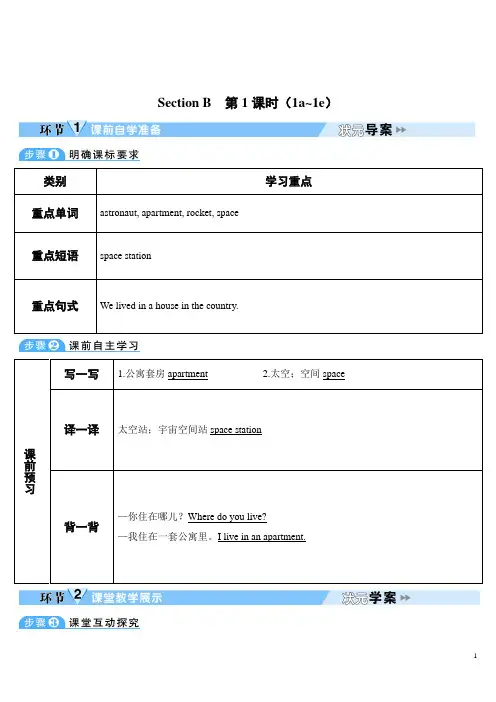
Section B 第1课时(1a~1e)类别学习重点重点单词astronaut, apartment, rocket, space重点短语space station重点句式We lived in a house in the country.课前预习写一写 1.公寓套房apartment 2.太空;空间space 译一译太空站;宇宙空间站space station背一背—你住在哪儿?Where do you live?—我住在一套公寓里。
I live in an apartment.2.apartmentapartment 作名词,意为“公寓套房”,通常是指一套出租的房间(出租给短期居住者,通常带家具)。
如:I live in a three room apartment.我住在一个有三个房间的公寓里。
【问题探究】1.My family live in a big apartment in a big city.2.Kids will go to school next Saturday.(改为否定句和一般疑问句)Kids won’t go to school next Saturday.Will kids go to school next Saturday?活学活练(A)1.I’ll live a space station one day.A .onB .in C. at D. for(B)2.Some scientists think robots will even be able to look humans in 25 50 years.A. like; forB. like; toC. to; from D .to; of(B)3.I will be astronaut in the future.A. aB. anC. theD. /(C)4.A place to live in space is a .A. houseB. ApartmentC. space stationD. space ship布置作业:教师引导学生课后完成本课时对应练习,并预习下一课时内容。
Section B 1a—1e 初中八年级上册英语教案教学设计课后反思

Unit 4 What’s the best movie theater?(Section B 1a—1e)Huizhi Middle SchoolLin ShirongⅠAnalyzing the teaching materialThe material is from Go For it Book II A Unit 4 What’s the best movie theater? Section B (1a-1e). It is a listening and speaking material.ⅡAnalyzing the studentsThe students are Junior Two students and they take a great interest in learning English.ⅢTeaching objectives----Knowledge aims:1.Get the students to learn new words and phrases: creative, performer, upside down, etc.2.Get the students to learn something about talent shows.3.Get the students to use the superlatives in their expression.----Ability aims:1.Develop the students’ listening skills: guess before listen, listen with a purpose and so on.2.Get the students to share their opinions bravely in class.----Emotional aims:1.Get the students to know everyone is good at something and try to make their dreams come true.2. Get the students to try to be a talented and confident person.ⅣTeaching key points1.Get the students to grasp the key words and key phrases.2.Get the students to develop the listening skills and try to express their ideas by using the superlatives.ⅤTeaching Difficult pointsGet the students to use superlatives in practice and try to be a talented and confident person in their daily life.ⅥTeaching methods1.Tasked-based teaching and learning method.municative teaching metho d.3. Audio visual teaching method.ⅦTeaching aidsMultimedia facilities, blackboard , PPT.ⅧTeaching proceduresStep one: Lead-in1. Greetings and free talk.2. Choose the Huizhi Talent for this year. Watch the videos of students’ talent shows. And then ask the students to work in pairs andchoose the best talent show and give their reasons.【Design purpose:The talent show videos are chosen from the students in our school. It is designed as the lead-in part due to the following three functions: 1. Situational function: students can imagine themselves as judges for the talent shows, which can arouse their interests immediately. 2. Practical function:by using the material they are familiar with, students are supposed to use the superlatives they have learnt in practice. 3. Cooperation function: through the pair work, students can learn to cooperate with each other.】Step Two:Presentation and ProductionActivity 1: Exercise of 1a.Write these words and phrases next to their opposites in the chart.【Design purpose: Through this exercise, students are expected to review the changing rules of the superlatives learnt in previous classes.】Activity 2: Games1. Say it quickly. Show the adjectives on the balloons. Ask all the students to stand up and say the superlatives of the adjectives as quickly as they can.2. The magic hand. Say the opposite forms of the superlatives. Encourage all the students to take part in the games.【Design purpose: Games can not only make the atmosphere alive,but also help the students to consolidate what they have learnt in a way they are interested in.】Activity 3: Listening1. Pre-listening activity1) Prediction: Show pictures of different talent shows together and ask the students to guess the main idea of the passage.【Design purpose:Prediction is a good listening skill. It reduces the difficulties and paves way for later tasks.】2) Talk about the pictures: Look at the pictures and talk about the talent shows in each picture.【Design purpose: Through the process, students are expected to learn the new words they are going to hear in the listening material, which reduces the obstacles in the following activities.】2. While-listening activity1) Listen and match.(1c) Listen to people talking about a school talent show. Match the pictures with the performers.【Design purpose:Students are supposed to match the people and their talent shows, which help them to have a further understanding of the listening material.】2) Listen and choose.Question 1: Why did they think Dennis was the worst?A. He kept dropping the balls.B. His performance was not interesting.C. He could not sing very well.Question 2: Vera was the most creative because _______.A. She was very funny.B. She played the guitar upside down.C. She was an excellent piano performer.【Design purpose:It is a process of careful listening. Students are required to pay special attention to the superlatives used for certain people, which makes the later exercise of 1d more easy.】3) Listen and fill.(1d) Listen and fill in the chart with the adjectives you hear.【Design purpose: In this part, students are required to take notes by paying attention to the superlatives and adjectives while listening. 】4) Listen and role playFill in the blanks with the correct answers and then role play the conversation.【Design purpose:It helps students to consolidate what they have listened and then improve their spoken English through role play.】3. Post-listening activity : Who’s the most talented in our class?After listening to the material, divide the students into group of four. Ask them to choose the most talented students in our class for the next Huizhi Talent.【Design purpose:On the one hand, it helps students to learn to cooperate with each other through group discussion; on the other hand, the topic they discussed echoes the lead-in part of this lesson.】。
人教版八年级英语上册Unit7SectionB1a1e教学设计

(一)导入新课,500字
在课堂开始阶段,我将采用以下方法导入新课:
1.激发兴趣:向学生提问:“Do you know about space exploration? Have you ever imagined what it would be like to travel in space?”通过问题引导学生展开想象,激发他们对太空探索的兴趣。
2.家长要关注孩子的学习进度,协助孩子完成作业,并给予适当的指导。
3.学生在完成作业后,要进行自我检查,确保作业质量。
4.教师在批改作业时,要关注学生的错误,及时给予反馈效率。
难点:如何帮助学生克服在听力过程中遇到的生词、语速等困难,提高学生的听力水平。
(二)教学设想
1.创设情境,激发兴趣:通过展示太空探索的图片、视频等资源,创设真实、有趣的情境,激发学生的学习兴趣。
2.分层教学,关注个体差异:针对学生的不同水平,设计难易程度不同的教学活动,使每个学生都能在课堂上得到锻炼和提升。
2.强化语法训练,帮助学生熟练掌握一般现在时和一般过去时,提高学生的句子构建能力。
3.激发学生的兴趣,通过丰富的教学资源和活动,引导学生主动参与课堂,提高学生的学习积极性。
4.针对不同学生的学习水平,制定分层教学目标,使每个学生都能在课堂上获得成就感。
5.关注学生的情感需求,鼓励学生积极参与课堂讨论,培养学生的合作意识和团队精神。
1.回顾重点:对本节课所学的词汇、短语、句型和语法进行回顾,巩固重点知识。
2.答疑解惑:针对学生在课堂中遇到的问题,进行解答,帮助学生消除疑惑。
3.课堂小结:总结本节课的学习内容,强调学习方法和技巧,提高学生的学习效果。
4.课后作业:布置适量的课后作业,要求学生在课后巩固所学知识,为下一节课的学习做好准备。
人教八年级上册Unit7SectionB(1a1e)教学设计
为了巩固本节课所学的一般现在时和频率副词的用法,以及日常活动的描述,我设计了以下作业:
1.家庭作业:请学生根据本节课的内容,编写一段关于自己或家庭成员日常生活的对话,要求使用一般现在时和频率副词。对话内容需包含至少5个不同的日常活动,并在下节课前提交。
目标:通过实际编写对话,使学生能够更熟练地运用目标语言,提高他们的写作能力。
2.口语作业:学生与家长合作,进行一次角色扮演活动。学生扮演老师,向家长介绍一般现在时和频率副词的用法,并教授家长如何描述日常活动。完成后,家长需在学生的作业记录本上签名,以示完成。
目标:通过亲子互动,激发学生的学习兴趣,提高他们的口语表达能力,并增进家校合作。
3.小组作业:将学生分为小组,每组设计一份关于日常活动调查问卷。问卷中至少包含5个问题,涉及同学们的日常活动及频率。小组成员相互采访,完成问卷,并将调查结果整理成报告。
5.利用多媒体教学手段,提高学生的学习兴趣,激发学生的学习动力。
(三)情感态度与价值观
在本章节的教学中,教师将关注以下情感态度与价值观的培养:
1.培养学生热爱生活、珍惜时间、合理安排日常活动的意识。
2.培养学生学会倾听、尊重他人,关心同学,养成良好的团队合作精神。
3.引导学生正确看待自己的优点和不足,学会自我激励,努力学会使用频率副词,如:always, usually, often, sometimes, never等,来描述活动的频率。
4.能够听懂并阅读关于他人日常活动的描述,抓住关键信息。
5.能够运用所学知识,进行简单的调查活动,并以表格、对话或短文的形式呈现调查结果。
3.引导学生关注动词在一般现在时中的变化,通过头脑风暴的方式,让学生们列举出已经学过的动词第三人称单数形式。
人教版英语八年级英语上册Unit7SectionB(1a~1e)教学设计
1.教师设计丰富的课堂练习,包括听力、阅读、写作和口语等方面,以巩固所学知识。
2.听力练习:教师播放一段与太空探索相关的听力材料,学生完成相应的练习题。
3.阅读练习:学生阅读课文,完成信息匹配、归纳总结等任务,提高阅读理解能力。
4.写作练习:学生根据所给话题,用一般现在时和一般过去时撰写一篇短文,如:“My dream of becoming an astronaut.”
4.通过听力训练,引导学生掌握听力策略,如预测、关键词定位等,提高听力理解能力。
5.鼓励学生进行课外阅读,拓展知识面,提高学生的跨文化交际能力。
(三)情感态度与价值观
1.培养学生对太空探索的兴趣,激发学生的科学精神。
2.引导学生了解我国在太空领域的成就,培养学生的民族自豪感。
3.通过学习太空探索的相关知识,培养学生热爱自然、保护地球的意识。
3.阅读作业:阅读一篇关于太空探索的文章,完成文章后的练习题,并总结文章的主要观点。
4.听力作业:观看一段太空探索相关的英语视频,回答相关问题,提高听力理解能力。
5.写作作业:以“我的太空梦”为主题,运用本节课所学的词汇、短语和时态,撰写一篇英语短文,字数在100-120词左右。
6.小组作业:分组进行太空探索项目研究,选择一个太空探索领域的话题,如:火星探测、月球基地等,搜集资料、整理数据,并以PPT形式展示研究成果。
(1)过程性评价:关注学生在课堂活动中的表现,鼓励学生积极参与,勇于表达。
(2)终结性评价:通过单元测试、期中考试等,检验学生对知识点的掌握情况。
(3)自评与互评:培养学生自我反思、自我评价的能力,以及学会欣赏他人、互相学习的品质。
四、教学内容与过程
(一)导入新课(500字)
新人教版八年级上册英语第七单元精选练习题附答案

新人教版八年级上册英语第七单元精选练习题附答案Unit7 Will people have robots?第一课时Section A(1a~2d)01基础过关Ⅰ.根据句意及汉语提示填写单词。
1.One day his ________(预测) may become true.2.What should we do to save the ________(环境)?3.Do you know the meanings of the last two ________(部分) of the article?4.We all know the moon goes round the ________(地球).5.How many ________(行星) are turning around the sun?Ⅱ.用括号内所给单词的适当形式填空。
6.I think cities in 50 years will be big and ________(crowd).7.There are different kinds of green ________(plant) in the park.8.The ________(pollute) in the city is becoming more and more serious.9.There is lots of ________(paper) on the desk. You can take some.10.Mr.Zhang will ________(teach) us math this term.Ⅲ.单项选择。
( )11.She will be a teacher ________ two months.A.on B.after C.in D.at( )12.Now ________ is very serious.Some rivers and lakes are ________. A.pollution;polluteB.polluted;pollutionC.pollution;pollutedD.pollute;polluted( )13.You can study ________ a computer ________ home ________ the future. A.on;at;at B.on;at;inC.in;at;in D.on;in;at( )14.—Will there be any paper money?—No,________.A.there won't B.they won'tC.they aren't D.there will( )15.The doctor wanted my father to eat ________ pears and drink ________ coffee. A.less;fewer B.fewer;lessC.few;fewer D.less;lessⅣ.根据汉语意思完成句子,每空一词。
新人教版八年级上册英语第七单元精选练习题附标准答案
新人教版八年级上册英语第七单元精选练习题附答案Unit7 Will people have robots?第一课时Section A(1a~2d)01 基础过关Ⅰ.根据句意及汉语提示填写单词。
1.One day his ________(预测) may become true.2.What should we do to save the ________( 环境)?3.Do you know the meanings of the last two ________( 部分) of the article?4.We all know the moon goes round the ________( 地球).5.How many ________( 行星) are turning around the sun?Ⅱ.用括号内所给单词的适当形式填空。
6.I think cities in 50 years will be big and ________(crowd) .7.There are different kinds of green ________(plant) in the park.8.The ________(pollute) in the city is becoming more and more serious.9.There is lots of ________(paper) on the desk. You can take some.10.Mr.Zhang will ________(teach) us math this term.Ⅲ.单项选择。
( )11.She will be a teacher ________ two months.A.on B.after C.in D.at( )12.Now ________ is very serious.Some rivers and lakes are ________. A.pollution ;polluteB.polluted ;pollutionC.pollution ;pollutedD.pollute ;polluted( )13.You can study ________ a computer ________ home ________ the future. A.on;at;at B.on;at;inC.in;at;in D.on;in;at( )14.—Will there be any paper money?—No,________.A.there won't B.they won'tC.they aren't D.there will( )15.The doctor wanted my father to eat ________ pears and drink ________ coffee. A.less;fewer B.fewer;lessC.few ;fewer D.less;lessⅣ.根据汉语意思完成句子,每空一词。
英语人教版八年级上册Unit 7 SB (1A-1E)
Unit 7 Will people have robots?(Section B 1a-1e)教学设计I.设计思路:根据对教材和学生实际的分析,本着“Learning by doing”的理念,我将本节课的教学设计如下:本课主要采用听力教学法。
在本节课设计的学习过程中,通过听力活动输入,通过遮盖记忆操练的方式来充分发挥学生的学习主体性和合作学习的意识,使学生们体验、实践、参与、合作与交流,输出方式采用写一篇小短文的形式,从有效的输入到合理的输出,学生能够参与课堂并能真正运用语言。
II. 教学目标:一、知识目标1、学生能听说读写单词与词组:astronaut、apartment、rocket、space, etc.短语: space station、fly rockets to other planets2、I’ll be an astronaut./I’ll fly rockets to the moon./ I’ll live in an apartment.二、技能目标学生学会使用一般现在时、一般过去时和一般将来时和本课重点句型谈论现在、过去及未来的工作、住所及交通工具。
三、情感目标回顾过去,珍惜现在,展望未来。
III. 教学重点:学生学会正确使用一般现在时、一般过去时和一般将来时.IV. 教学过程:1Watch a video and have a free talk.2 Before listening. Teach the new words.3 First listening, listen for the main idea.4 Second listening, listen for the details.5 Practice.6 After listening: retell Joe’s life.7 Write a short passage about your own life.。
人教八上Unit7Willpeoplehaverobots(SectionB1a1e)教学设计
(一)教学重难点
1.重点:学生能够熟练运用一般将来时(will)来预测和表达未来;掌握与机器人相关的词汇和表达;能通过阅读短文获取、整理和归纳信息。
2.难点:学生在实际语境中灵活运用一般将来时(will);阅读理解能力的提升,尤其在信息提取和归纳方面。
(二)教学设想
1.情境创设:结合学生的生活经验和兴趣,创设与机器人相关的真实语境,让学生在情境中感知、体验和运用目标语言。
人教八上Unit7Willpeoplehaverobots(SectionB1a1e)教学设计
一、教学目标
(一)知识与技能
1.学生能够掌握与机器人相关的词汇,如robot, appearance, ability, intelligence, perform, invent, predict等,并能熟练运用这些词汇描述机器人的外貌、能力和智能。
2.阅读理解:完成一篇关于未来机器人发展的短文阅读,并回答相关问题。要求学生通过阅读,提高信息提取和归纳能力。
3.课后调查:分组进行课后调查,了解家人、朋友对未来机器人的看法和期待。每组整理调查结果,形成一份简要的调查报告,并在下节课上进行分享。
4.角色扮演:设计一个关于未来机器人的对话场景,与同学进行角色扮演。要求使用一般将来时(will)进行表达,锻炼学生的口语交流能力。
3.教师强调科技进步对社会生活的影响,引导学生关注科技发展,培养他们的责任感和社会责任感。
4.最后,教师布置课后作业,要求学生结合本节课所学,预测未来生活中的机器人,并用自己的语言进行描述。
五、作业布置
为了巩固本节课所学知识,提高学生的英语综合运用能力,特布置以下作业:
1.写作任务:结合本节课学习的主题“Will people have robots?”,让学生运用一般将来时(will)描述自己设想的未来机器人。要求至少包含机器人的外貌、能力和智能三个方面,字数不少于80词。
人教版英语八年级上册Unit 7Section B (1a-1e)课件
...
How did you go to school?
...
Homework
Write a paragraph to talk about your life 5 years ago and 10 years from now.
2. I _w__o_rk__ near here.
3. I __a_m___ a computer programmer.
am live work
4. We _l_i_v_ed__ in a house in the country. lived took
5. I __to_o_k__ the train to school.
will be will live
6. I _w_i_ll_b_e_ an astronaut.
will fly
7. I _w_i_ll_f_ly_ rockets to the moon.
8. I _w_i_ll_l_iv_e_ on a space station.
Student A is Alexis and Student B is Joe. Talk about Joe’s life now, 10 years ago and 10 years from now.
driห้องสมุดไป่ตู้erless car
What kind of houses did people live in ancient China?
wooden houses
brick houses
What kind of houses do people live in now?