
外研版小学英语三年级第二册Module3Unit2教材内容全解
an English song.The pupils are doing morning exercises. 【归纳记忆】
表达自己喜欢或不喜欢做某事的句型
——I like/ don’t like+动词-ing 形式(+其他).
课文应用 I like swimming.我喜欢游泳。 I don’t like swimming.我不喜欢游泳。
左下图:I like morning exercises.
中上图:I don’t like basketball.
中下图:I like table tennis.
右上图:I like riding my bike.
右下图:I don’t like swimming.
4.Listen and say.Then chant.听一听,说一说,然后说唱。
艾米:我喜欢游泳。
Amy:I don’t like swimming.
艾米:我不喜欢游泳。
【课文注解】swim(动词)游泳,[第三人称单数形式]swims,[动词-ing 形
式]swimming,短语:go swimming 去游泳,例句:We can go swimming in summer.
我们可以在夏天去游泳。——Let’s go swimming.我们去游泳吧。——OK.好的。
注意:1)只有动词才有动词-ing 形式;
2)还有几种不常见变化规则,以后再了解。
2.Listen and say.听一听,说一说。
【课文全译】I like swimming.
我喜欢游泳。
I don’t like skipping.
我不喜欢跳绳。
I like skipping.
我喜欢跳绳。
I don’t like riding my bike. 我不喜欢骑我的自行车。
1.活动目标:此游戏主要练习“I like…”句型。
2.步骤与过程:这是一个考验记忆力的游戏,可以分成几个小组进行比赛。
一组成员站成一排,由第一个人说出他/她喜欢的运动项目,第二个人重
复前一个人的句子并补充一个自己喜欢的运动项目,第三个人重复前两个
人的句子再补充一个自己喜欢的运动项目。以此类推,最后哪组说得最快、
【课文注解】①skip(动词)跳绳,第三人称单数形式 skips,动词-ing 形式 skipping,
例句:She likes skipping.她喜欢跳绳。My little sister likes skipping.我妹妹喜欢跳
绳。
②ride(动词)骑,第三人称单数形式 rides,动词-ing 形式 riding,短语:ride one’s
5.Play the game.Follow and say.玩游戏,跟着说一说。
-3-
【课文全译】I like football.
我喜欢足球。
I like football and basketball.ll,basketball…
我喜欢足球,篮球…
【游戏指导】
★此句型的“动词-ing 形式”,是动名词,作 like 的宾语,而 不是现在分词,即该句型是一般现在时,而非现在进行时。
班上来了一名新同学,他的名字叫 Bob,看看 Bob 的自我介绍 吧:
Bob:Hello,everyone!My name is Bob.I come from America.I am
I don’t like basketball…
我不喜欢篮球…
Sport 体育运动
Name 名字
【活动指导】
1.活动目标:此活动主要练习表达自己喜欢什么和不喜欢什么。
2.步骤与过程:自制一份调查表,先画上一些运动项目,并在你喜欢的运
动项目下面画上
,在你不喜欢的运动项目下面画上
。然后拿
着你的调查表到 教室前面用句型“I like…I don’t like… ”向大家
去上学。
3.Point and say.指一指,说一说。
【课文全译】I don’t like football.I like morning exercises.
我不喜欢足球。我喜欢早操。
football 足球
basketball 篮球
riding my bike 骑我的自行车 morning exercises 早操
拓展
like 的用法
like
sth.(名词/代词): 喜欢某物,like 后跟名词或代词
to do sth.(动词不定式) 喜欢做某事/想做某事,表示具体的一次动作
doing sth.(动名词) 喜欢做某事,表示一种习惯性的兴趣爱好
例句:I like table tennis.我喜欢(打)乒乓球。 I like to play football.我喜欢踢足球。(具体的一次动作) I like playing football.我喜欢踢足球。(一直喜欢的)
最准确,哪组就获胜。
6.Listen,repeat and trace the letters.听一听,重复并描写字母。
【课文全译】Ee elephant 大象
Ff football 足球
Gg girl 女孩
7.Do and report.做一做并汇报。
【课文全译】I like football.
我喜欢足球。
【课文全译】I like coffee.
我喜欢咖啡。
I like tea.
我喜欢茶。
I like cats
我喜欢猫
and they like me.
并且它们喜欢我。
I like coffee.
我喜欢咖啡。
I like tea.
我喜欢茶。
I don’t like lions
我不喜欢狮子
and they don’t like me. 并且它们不喜欢我。
table tennis 乒乓球
swimming 游泳
【活动指导】
1.活动目标:此活动主要练习表达自己喜欢和不喜欢的运动项目。
2.步骤与过程:图中画 表示喜欢,画 表示不喜欢。六人一组,每
名成员分别选择两幅
图片来表达
自己喜欢和不喜欢的运动
项目,并在组内向其他成员汇报。
【答案链接】左上图:I don’t like football.
进行汇报。
3.举行范例:I like football。I don’t like swimming.
-4-
——主语+like/ likes+动词-ing 形式/名词+其他. ——主语+don’t /doesn’t like +动词-ing 形式/名词+其他.
详解
★该句型中,like/likes 后面不能直接跟动词,应当换成其对应的 动名词形式。如:Amy likes bread.埃米喜欢面包。We like skipping and riding bikes.我们喜欢跳绳和骑自行车。 ★动名词是动词加上-ing 之后变成了名词,动名词具有名词的 特征,在句中作主语、宾语和定语等。
句型结构 I like/ don’t like+动词-ing 形式(+其他).
重点解析 生活实例
★句中的 like 意为“喜欢”,后接动词时要跟“动词-ing 形式” (也可以跟“to+动词原形”,其区别见 Module3 Unit1 教材内容全 解 2 之“like 的用法” )。
★此句型中的“动词-ing 形式+其他”可以为“riding a bike 骑自 行车,playing in the park 在公园里玩”等。
bike=ride bikes=ride a bike,ride a horse 骑马,例句:I don’t like riding bikes.我
不喜欢骑自行车。Riding a horse is very dangerous.骑马是非常危险的。
③bike(名词)自行车,形近词 like,例句:He goes to work by bike.他骑自行车
【知识链接】
动词-ing 形式的变化规则
swimming 是动词 swim 的动词-ing 形式(动词-ing 形式,既叫动名词,也叫 现在分词,其变化规则一致),动词-ing 形式变化规则如下:
1.大部分动词直接在词尾加-ing。例如:do——doing,point——pointing, stand — — standing , look — — looking , help — — helping , know — — knowing,thank——thanking
2.以不发音的字母 e 结尾的动词,去掉 e 再加-ing。例如:ride——riding, like——liking,come——coming
-2-
3.以单个辅音字母结尾的重读闭音节词,先双写末尾的辅音字母,再加-ing。
例如:swim——swimming,sit——sitting,skip——skipping,run——running
-1-
ten years old.I like football.I don’t like basketball.I like riding my bike.I don’t like skipping.大家好!我的名字叫鲍勃。我来自美国。 我十岁。我喜欢足球。我不喜欢篮球。我喜欢骑我的自行车。我 不喜欢跳绳。 【拓展记忆】 表达某人喜欢或不喜欢做某事的句型
外研版小学英语三年级第二册 Module3Unit2 教材内容全解
Module3Unit2 教材内容全解
Module3 Unit2 I don’t like riding my bike.我不喜欢骑我的自行车。
1.Listen,point and say.听一听,指一指,说一说。
外研版(三起)-英语-三年级下册--Module 3 Unit 2教材同步讲解
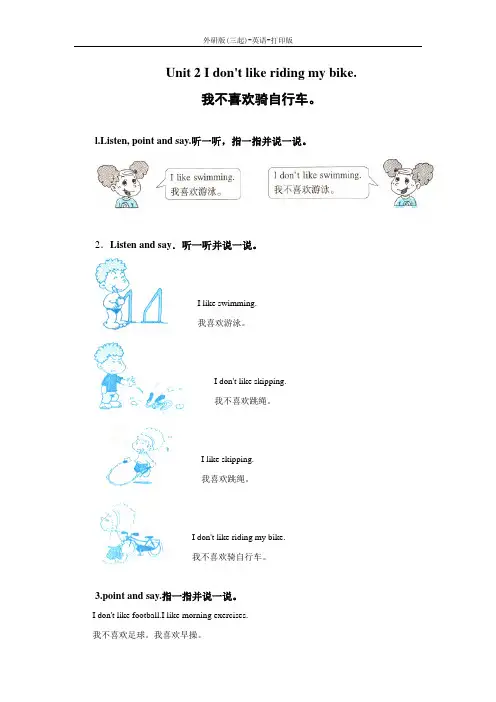
Unit 2 I don't like riding my bike.我不喜欢骑自行车。
l.Listen, point and say.听一听,指一指并说一说。
2.Listen and say.听一听并说一说。
I like swimming.我喜欢游泳。
I don't like skipping.我不喜欢跳绳。
I like skipping.我喜欢跳绳。
I don't like riding my bike.我不喜欢骑自行车。
3.point and say.指一指并说一说。
I don't like football.I like morning exercises.我不喜欢足球。
我喜欢早操。
4.Listen and say. Then chant.听一听并说一说。
然后朗诵。
I like coffee.我喜欢咖啡。
I like tea.我喜欢茶。
I like cats and they like me.我喜欢小猫,它们也喜欢我。
I like coffee.我喜欢咖啡。
I like tea.我喜欢茶。
I don’t like lions and they don't like me.我不喜欢狮子,它们也不喜欢我。
5.Play the game,Follow and say.做游戏。
句子接龙。
6.Listen,repeat and trace the letters.听一听,读一读并描一描字母。
7.Do and report.做一做并报告。
单词解析basketball(名词)篮球basketball是由basket(篮子)+ball(球)构成的;play basketball打篮球。
例:We play basketball after school.我们放学后打篮球。
swimming(名词)游泳swimming是由动词swim(游泳)双写m再JU-ing构成的。
外研版三年级下册They're monkeys.说课课件
设计意图
通过此活动,引出本课 重点句型“What are they?”及回答,让学生 感“What’s this? ”和 “What are they?的区 别。把本文的重点句型 运用到日常生活中去, 使教学内容生活化。 创设了引发学生探 索、思维的活动情景, 学生通过参与、体验学 习过程,锻炼学生解决 问题的能力。
三年级学生还不会书写,因此,知识目标及情感目 标的评价,在本课的教学及活动中及时评价。
培养合作发展
句型 学习
图片
词汇 学习
语言 练习 任务型活 动突破
任务 呈现
情境 导入
导入 方式
教 学 模 式
说课流程 之
说设计
四. 说设计
听读唱演 趣学课文 11分钟 英语 课中操 2分钟 拓展延伸 灵活运用 5分钟
以旧带新
妙学单词 6分钟 创设情境 激情导入 2分钟
律动热身 师生互动 2分钟
Learn to say the new sentences.
通过出示单数图片,师 运用“What’s this?” 提问,学生用“It’s a … It’s big/small.” 句型训练,运用教室内 的实物,如书、窗户、 桌子进行提问。为后面 的目标语句打好基础。 让学生跟读模仿课文的 语音、语调。在跟读和 小组分角色表演课文过 程中,注意纠正学生不 正确的发音。
1. 运用图片、视频等非常语 言手段,引导学生保护自然, 爱护动物的意识。 2. 强调坐 姿,读姿,规范板书,培养 学生认真听读写的习惯。
外研版小学三年级下册英语精品教学课件 Module3 Unit2
Watch and follow.
点击图片,播 放视频
Look and say E is for elephant.
Look and say F is for football.
Look and say G is for girl.
Summary
自行车
ride、ride、 ride my bike I like riding my bike .
What else do you like?
skip
跳绳
I like skipping .
swimming
riding my bike
skipping
I like
.I like
I l.ike
.
swimming riding my bike skipping I don't like... .
Watch and follow
点击图片,播 放视频
Read the text in pairs.
I like swimming! I don't like skipping!
I like skipping! I don't like riding
my bike!
Point and say
ቤተ መጻሕፍቲ ባይዱ
Follow and say
Read and chant
Football, football, I like football. Basketball, basketball,I like basketball. Table tennis, table tennis, I don't like table ten Morning exercises, morning exercises, I don't like morning exercises.
三年级英语下册教案-Module 3 Unit 2 .(6)-外研版(三起)

Module 3 Unit 2I don't like riding my bike.Teaching Aims(1) Students can listen, read and say the new words and phrase: swim - swimming, skip - skipping, ride my bike - riding my bike.(2) Students can listen, read and say the sentences: I like swimming/skipping/ riding my bike. I don’t like swimming/skipping/riding my bike.(3) Improve the students’ enthusiasm and interest for English learning and encourage them to talk in English.Teaching Key Points:Students can use the words “ swimming, skipping and riding my bike” in the sentences “I like ... . or I don’t like ... .”. And they can use these two sentence patterns to express their other hobbies.Teaching Aids:PPT, Computer, blackboard, pictures, soft magnets.Teaching Procedures:Step 1、Warming up(1)Greetings.T: Good morning, boys and girls. S: Good morning, teacher. T: How are you today? S: I’m fine ,thank you. And how are you? T: I’ m fine, too. Thank you. Today we’re going to learn Module 3 Unit 2 I don't like riding my bike. Now read after me:... . S: ... .(跟读课文标题)(2)Say a chant. ( Play the video for twice.)I like coffee. I like coffee.I like tea. I like tea.I like cats I don’t like lionsand they like me. and they don’t like me.T: First let’s chant. Ready? Go! (Play the video and clap hands.)S: Chant together for twice and claps theirs hands.(3)Let’s review.The students look at the pictures about sports in the PPT and use the sentence “ I like... . / I don’t like... . ” to talk about the sports they have learned before( football, basketball ,table tennis and morning exercises).T: Look at the first picture. What is it?S: football.......(老师一张图片一张图片地问,学生一起回答)T: OK. Here’s a question: Do you like them? S: Yes!T:(展示句型:I like... . /I don’t like... .) You can say “I like... . /I don’t like... .”). For example, I like table tennis. But I don’t like football. What about you?S1: I like... . I don’t like... . S2: I like... . I don’t like... . (提问几个学生。
最新外研版小学英语三年级上册Module 3 Unit2 Point to the

Module 3 Unit2 Point to the desk.【学习目标】①、能力目标:能够快速的做出老师发出的指令。
②、知识目标:能够听、说、认、读本课的单词:desk, chair句型:Point to...【热身复习】1、Greeting:师生问候2、Game “I say and you do”请全体学生起立,执行老师发出的指令,答对的学生继续做游戏,答错的学生坐下。
【自主学习】1.首先听录音,请学生边看边听,Daming, Lingling, Amy和Sam分别对小鸟说了什么,小鸟是怎么反应的。
然后再听录音,听完后复述所听到的内容。
2.听过几次录音后,请一个学生上前当“小老师”,带领全班练习“Point to the desk.”,请全班同学在跟读句子时同时执行相应的指令。
【合作交流】1、分角色表演课文内容。
鼓励扮演小鸟的同学为自己的角色设计丰富的动作。
2、猜单词。
邀请一个学生上前,通过模仿动作表演教室中的物品,请其他学生猜测该学生所要表现的是什么物品。
3、拍单词游戏请两名学生到讲台上来,老师发出指令,让他们拍黑板上相应的图片。
谁的速度快,谁就获胜。
4、Boys say and Girls do/Girls say and Boys do【巩固检测】把全班分为多组,各组轮流参加游戏,老师不断发出指令,并不断加快速度,坚持最久的组获胜。
将新学习的“chair、desk”等单词运用到指令中。
【板书设计】Unit2 Point to the desk.desk, chairPoint to...【作业】1、读课文15分钟。
2、运用所学知识,指一指自己房间的物品。
3、预习Module 4 Unit 1。
【反思】。
三年级英语上册 Module 3 Unit 2(3)教案 外研版
外研版三年级英语上册教案Unit 2 Point to the deskTeaching Aims:1.能正确使用(听、说、认、读)单词:desk,chair.2.熟练表达并执行以下指令: point to the chair/desk.3.能演唱歌曲 Please stand up.Important Points:能口头运用 Point to the chair.这类语句发指令,并根据指令做动作。
能在图片提示下整体识别单词: desk、chair.Teaching proceduresⅠ. Warm-up: Listen and point.1. Point to the blackboard/window/door/bird…2. Free talk:Where did you go....? What did you do?Did you……? When did you come back?Ⅱ. Presentation:1. Ss watch the CAI and learn the words: desk 、chair.T: This class, I’ll introduce a friend for you. Look, it’s a bird.Now, let’s watch the cartoon together, OK?Ss watch the cartoon.2. Ss listen and point.T: Point to the desk. Point to the chair.Ⅲ.New:1. Listen to the tape.2. Listen and underline the new words: desk, chair.3. Listen and repeat.4. Practice the text in groups5. Act the text.6.Games: Ask and answer some questions。
外研版小学英语三年级第二册Module2Unit2教材内容全解
外研版小学英语三年级第二册Module2Unit2教材内容全解Unit2教材内容全解Unit2 That man is short.那个男人是矮的。
1.Listen,point and say.听一听,指一指,说一说。
【课文全译】Sam:He’s tall. 萨姆:他是高的。
Sam:Oh,he’s short! 萨姆:哦,他是矮的!【课文注解】①tall(形容词)高的,形近词wall墙/ball球,对应词(反义词)short矮的,近义词high高的,巧记:字母t+all(每个;全体)=tall(高的),例句:My little brother is a tall boy.我弟弟是一个高个子的男孩。
【注意】tall用于指人的身高,也可以用于指树木、楼房或其他细长物体的垂直高度。
例如:Yao Ming is very tall.姚明很高。
That is a tall building.那是一幢高楼。
How tall is that door?那扇门多高?(how old多大)②short(形容词)矮的,其反义词(对应词)是tall(高的),形近词shout(喊叫),例句:Li Ming is very short.李明很矮。
That man is short and fat.那个人又矮又胖。
My brother is tall.我哥哥很高。
My little sister isn’t tall.She is short.我妹妹不高,她是矮的。
short作形容词时,还有“短的“之意,其反义词是long“长的”),例如:The rabbit’s tail is short.兔子的尾巴短。
The panda has a short tail.熊猫长着一条短尾巴。
某人/某物+be动词(am/is/are)+(表示特征的)形容词She is very old.她年龄很大。
The policeman is very tall.这个警察个子很高。
外研版小学英语(三起)三年级下册全册教案
外研版三年级下册教案(共45课时)外研版三年级下册教案(共45课时)1Module 1 Unit 1 It’s the ABC songs2第一课时3第二课时3第三课时3Module 1 Unit 2 My favourite colour is yellow.4第一课时4第二课时5第三课时5Module 2 Unit 1 they’re monkeys6第一课时6第二课时6Module 2 Unit 2 That man is short.7第一课时8第二课时8第三课时9Module 3 unit 1 I like football.9第一课时9第二课时10Module3 Unit2 I don’t like riding bikes.11第一课时11第二课时12Module 4 Food Unit 1 Do you like meat?13第一课时13第二课时15Module 4 Unit 2 Does Lingling likes oranges?16第一课时16第二课时16第三课时17Module 5 Unit 1 She goes to school on Mondays17第一课时18第二课时18Module5 Unit 2 Does your mum go to work on Saturdays?19 第一、二课时19第三课时20Module 6 Unit1 What do you do on Sundays?20第一课时21第二课时22Module 6 Unit 2 What does Lingling have at school?22第一课时23第二课时24Module7 unit 1 We fly kites in spring.24第一课时25第二课时26Mo dule7 Unit 2 It’s warm today26第一课时27第二课时28Module8 Unit1 It’s on you r desk.28第一课时29第二课时30Module8 Unit 2 Daming flies a kite in the park.30第一课时31第二课时32Module9 Unit1 I’ve got a new book.32第一课时33第二课时34Module 9 Unit 2 Has Amy got a bike?34第一课时35第二课时36Module10 unit 1 Here is a red hat.37第一课时38第二课时38Module10 unit 2 She’s got an orange sweater.39第一课时40第二课时40Module 1 Unit 1 It’s the ABC songs.教学目标1.知识技能目标:能听说读写26个英文字母。
外研版(三起)三年级英语下册教案
Module 1 Unit 1 It’s the ABC songs。
Teaching aim:Describing the alphabetsTeaching importance and difficulty: alphabetsV ocabulary: favourite, song。
Letters:A—-ZTeaching steps:一、Warming up:1。
Sing songs:Good morning! Please stand up!二、Revisions: Free talk1。
T: Hello,…,how are you? S1:….2。
T: Hi, good morning! What’s your name?S2:….How old are you?…3. T:Hello, …,how are you? S3:…。
Point to the window,please. …Point to the door,please. …4。
T:Hi, good morning!S4:….What’s this ?…。
What colour is it ?….T:Oh, yes, it's …。
Do you like …? I like …,too. We can also say,My favourite colour is …. What’s your favourite colour?你最喜欢的颜色是什么?启发学生用It’s ….来回答问题。
教授新词favourite.再问:What's your favourite song? 你最喜欢的歌曲是什么?教授新词song。
三、New lessons:1. T : My favourite song is the ABC song. OK, today we’ll learn the new lesson: Module 1 Unit 1 It’s the ABC song。
三年级英语下册 Module 3 Unit 2(1)教案 外研版
外研版三年级英语下册教案MODULE 3 PlaygroundUnit 2 I don’t like riding bikes教材分析本课内容是上课内容的一个延伸,由于有上课的基础本课只要学习几个生词即可。
所以本课的教学重点就是几个生词和字母的教学,难点就是这几个词的发音。
在重、难点的突破上还是想利用游戏法来突破。
教学方法本课主要是采用游戏法来进行教学,让学生在玩中学,学中玩。
在老师引导下学生采用自主的方法进行学习。
教学目标(1)学习并掌握:swimming skipping riding bikes 并能运用在句子中。
(2)掌握三个字母的书写教学重、难点同教学目标教具录音机单词卡字母卡教学过程(1)热身:boys and girls ,let’s do some exercises ,OK?复习上节课的单词,边做动作边说,每个5遍有节奏地说。
(2)把单词卡贴在黑板上,做句型的练习。
T: I like football, what about you?Ss: I like.... 多问几名同学进行练习。
T: I don’t like basketball, what about you?Ss: I don’t like . 多问几名同学进行练习.(3)利用 I like …句型来导入两个单词一个短语。
每个单词或短语导入时要放在句型中,而且要边说词边做动作,每个用有节奏的方式来说5遍,这样有利于学生记忆,并且每个词教完后就要进行一个小游戏。
①反升降调游戏②猜口型③综合三个词进行拍单词游戏(4)复习7个运动名词和短语后,进行句型练习What’s your favourite exercises?(5)打开书,听录音跟读。
(6)出示图片dog (正面是手写体dog 反面是手写体Dd )What’s the first letter?导出字母Dd,范写,同样方法导出Ee, Ff范写,最后让学生在作业本上书写,老师要在课堂上发现并解决问题。