
译林版牛津英语七年级上册期末复习知识点整理
译林版牛津英语七年级上册期末复习知识点整理Units1--4重点知识点总结整理教师:Mr Sunn.名词v.动词vt.及物动词vi.不及物动词adj.形容词adv.副词prep.介词pron.代词conj.连词1、喜欢like / love / enjoy / be interested in / be crazy about (痴迷于)/ have fun / have a good time +doing sth.动词+doing 的还有Go doing sth. / finish doing sth./Be good at doing sth./ do well in doing sth.How/what about doing sth./practise doing sth.2、“四大看”read vt.看读物(read books/newspaper/magazines/a map等)look vi. 瞧常用短语look at/ for/around/after/out/over/upsee vt.看见,强调结果I can see you.watch vt.带有欣赏性的观看watch TV/ a film / a football game3、“五大穿着”Put on 强调“穿上”的动作eg. He ____a coat and goes for a walk.Wear 强调“穿着”的状态;进行时态表示暂时的情况eg. She is wearing a new skirt now. / wear glasses Dress (1)dress sb. (2) dress oneself (3) dress up as (4) get dressedIn (穿戴)后接颜色(或衣服),表示状态look!Lucy is_____a red skirt and a pair of pink shoes. On 后接人指衣服穿在某人身上看出区别来。
The red coat looks nice on you.4、“四大花费”Spend:sb.(人)+ spend + 时间/金钱+ on sth.sb.(人)+ spend + 时间/金钱+(in) doing sth.pay:sb.(人)+pay + 金钱+for sth.cost:sth.(物) + cost + sb.+金钱Doing sth.costs + sb.+时间take:it takes sb. +时间+ to do sth.5、“三大地点副词”Home / there /here 前不加任何的介词welcome home / come here / go there6、“三大使役动词”Make sb. do sth./ have sb. do sth. / let sb.do sth.7、见面打招呼用语(1)Nice to meet you . (2) Glad to meet you . (3) How are you ? (4) How are you doing ?(5)How is it going ? (6)How is everything going? (7) What’s up?8、基数词+year(s)+old 表示“…岁”提问用“how old”名词性短语数词-year-old 也表示年龄,但其为形容词性短语“前有冠词后有名(词)”Eg. Helen is 11 years old = Helen is an 11-year-old girl.9、Let’s 与let us 的区别Let’s do sth. 指包括听者(对方)和说者(我们)都在内,表示建议Let us do sth.指“让(允许)我们做某事”而听者(对方)不做,只有“我们”做10、play+the+乐器类名词e.g. Play the pianoPlay + 球类运动play+ football / play cards / play chess11、She comes from Shanghai= She is from Shanghai . 注:如何提问Shanghai 及如何改一般疑问句12、be good at =do well in = be clever at = study sth. wellBe good at (反) be bad at do well in (反) be poor in13、介词over的用法1(1)”在…正上方” There is a bridge over the r iver.(2)”越过” A plane flies over the house(3)”超过” There are over 20 boys in this class.(4)”结束” Class is over! / Game is over.14、every one 与everyone 辨析区别(1)Every one 可以与of 连用,而everyone 却不能与of连用Eg.every one of the children likes playing the computer games.(2) everyone 只指人=everybody而every one 既指人又可指物共同点:谓语动词都要用“三单”15、family 的用法:“家庭”作为整体谓语动词用“单数”He has a big family.“家人”强调成员,是复数含义,谓语动词用“原形” My family are at home.拓展:集体名词有people、class、police、sheep、deer、furniture等16、all/ both/ each/every/neither/ either 的用法all (1)三者或三者以上“全部、都”(2)all + the + 名词(all the afternoon = the whole afternoon) (3)all 放在行为动词前,名词前;be 动词后(4) all of +宾格/名词复数Both(1)两者都(2)后可跟of +宾格/名词复数Both sides of the streetare grown trees.Each 指两个或两个以上“每一个”个体Each side of the street isgrown trees.Every 指许多人或事物的“全体”后接名词单数Every student is here .所有人都在。
Neither指两者都不neither of you will go to the party.Either 指两者中任意一人意为“要么.要么” Either you or your brother will go to the party.17、Walk 的用法(1)作为及物动词;意为“遛(动物);陪着某人走”walk the dog = take the dog for a walk(2)作为不及物动词;意为“走、步行”walk to school =go to school onfoot(3)作为名词;意为“步行、走”take a walk after supper =go walkingafter supper(4)walking作为动名词常做主语Walking is good for you.18、含有o 结尾的名词变成复数加es的有:黑人(Negro)英雄(hero)喜欢吃芒果(mango)、西红柿(tomato)和土豆(potato)19、系动词中的感官类动词:look(看起来)sound(听起来)smell(闻起来)taste(尝起来)feel(摸起来)后加形容词20、make的两种用法:(1)make + sb. + adj. eg. Make me happy (2)make sb.+do sth.21、hope 的用法(1)不及物动词hope to do sth. I hope to hear from you soon.(2) 后加that从句I hope you can finish your work soon.注意:无hope sb.to do sth. 用法;只有wish sb. to do sth.22、week/weekday/weekend的用法Week 周;指from Monday to Sunday weekday 工作日;指from Monday to FridayWeekend 周末;指Saturday and Sunday (at /on weekends)23、else 与enough 的用法else 放在不定代词、疑问代词后面如:what else / anyone elseenough形容词放在enough 前面;名词放在enough后面,简称“形前名后” lucky enough ;enough time 24、one、it用法辨析One“同类不同一”只可代指可数名词单数I don’t like the yellowbike , show me a r ed one.Ones 是one 的复数;Would you like a toy? Ye s, I’d like new ones = I’d like new toys.It 代指“同一物品”I have a car. It is red.25、What’s the date today ? what day is it today? What’s thetime ?=what time is it?26、in front of 与in the front of 区别In front of 在个体外部的前面(反)behind in the front of 在物体内部的前面(反)at the back of 27、help 的用法(1)help sb. (to)do sth. (2)help sb. with sth.28、say hello to sb. / say sorry to sb./ say goodbye to sb./ say thanks to sb.29、open 的用法(1)及物动词,“打开” open the box (2) 形容词“开着的” The windowis open.Close 的用法(1)及物动词,“关上”close the door 过去式、过去分词皆为closed(2)形容词为closed The shop is closed all the morning.30、两“借”lend 与borrow的用法A lendB sth. = A lend sth. to B (A 把东西借出去借给了B ) eg.He lend his bike to meA borrow sth. fromB (A 向B 借了某物,A 为借入) eg.She borrowed a book from the library.31、far away from=be far from但两者前皆不可跟具体距离My home is far (away ) from my sister’s .Away from 前可跟具体距离My home is ten miles away from the park.32、few / a few / little / a little 的区别Little / a little + 不可数名词few/ a few + 可数名词A few / a little 表示肯定(一点/一些)few/little 表示否定(几乎没有)33、Exercise 动词或名词“锻炼”不可数。
牛津译林版七年级上册英语期末复习重难点整理复习提优训练(word版含答案)
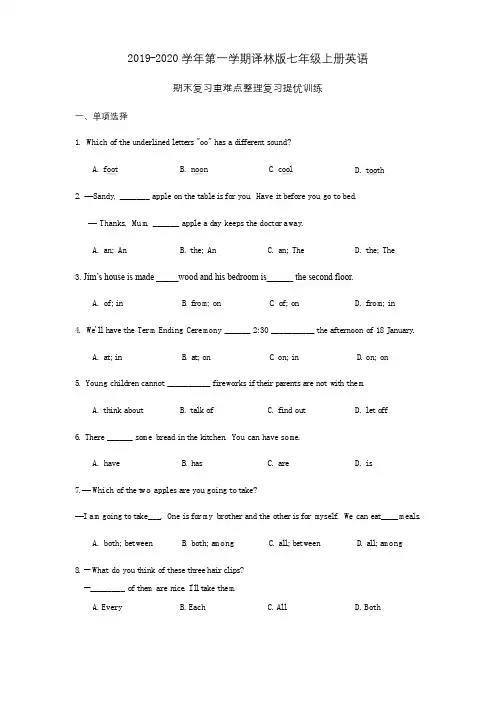
2019-2020 学年第一学期译林版七年级上册英语期末复习重难点整理复习提优训练一、单项选择1. Which o f the under l ined l e t t e r s "oo" has a d i f fe ren t sound?A. foo tB. noon C . coo l D. too th2. —Sandy , _______ app le on the t abl e i s fo r you . Have i t be fore you go to bed .— Thanks , Mu m. ______ app le a day keeps the doc tor away .A. an ; An 3. Jim’s house is made _____wood and his bedroom is______ the second floor.A. of ; in B . f rom; on C . o f ; onB. the ; AnC. an ; TheD. the ; TheD. f rom; in4. We 'l l have the Term Ending Ceremony ______ 2:30 __________ the a f t e rnoon o f 18 January .A. a t ; in B . a t ; on C . on; in D . on; on5. Young ch i ld ren canno t __________ f i reworks i f the i r pa ren t s a re no t wi t h them.A. th ink abou t 6. There ______ some bread in the k i t chen . You can have some.A. have B . has C. a re 7.—Which o f the t wo apples a re you going to t ake?—I am go ing to t a ke___. One i s fo r m y bro ther and the o the r i s fo r myse l f . We can ea t____m ea l s .A. bo th ; be tween B . bo th ; a m ong C. al l ; be tween D . a l l ; a m ongB. ta lk o fC. f ind ou tD. le t o f fD. i s8. --What do you t hink o f these th ree ha i r c l ips?--________ o f them are n ice . I 'l l t ake t hem.A.EveryB.EachC.Al lD.Both9.--What would you l ike to o rder?--Le t me have a look a t the ________ , p lease .A.bookB.d ishC.menuD.pla te10.—________ do you ce lebra te Chinese New Year?—Al l my fami l i es ge t toge ther and have a b ig d inner .A.WhyB.WhatC.Ho wD. Where11. The ac t iv i ty i s _______. And we send _______ to the ch i ld ren in poor areas .A. enough meaningfu l , enough foodC. mean ingfu l enough , enough foodB. enough meaningfu l , food enough D. mean ingfu l enough , food enough 12.Danie lA.a lways 13.Which o f the fol lowing cities isn’t a capital city?A.Pai r sB. London plays compute r games now because he i s busy wi th h i s a f t e r -school ac t iv i t i es . B. usua l lyC. of tenD. se ldomC. New YorkD. Moscow14. —What ______ b ig f i sh i t i s !—So i t i s ! And ______ f i sh i s my favor i t e food .A. /; /B. a ; theC. /; theD. a ; /15.—______ do you take ______?—Every day . And I am very hea l thy .A. How of ten ; exerc i seB. How long ; exerc i ses D. How many; exerc i sesC. How much; exerc i se 16. It’s polite to__________ the door first before you go into someone else’s room.A. f ind ou t B . knock on C . shout a t D. look fo r17.—The passage i s easy . There a re ____ new words in i t .—Yes, but I don’t think ______can understand it.A. few; anyoneB. a few; anyoneC. few; everyoneD. a few; everyone18.In the baske t ___________a p iece of mea t and some t o matoes .A. hasB. haveC. i sD. a re19. I hope_______t o my b i r thday par t y nex t F r iday .A. them to comeB. they to comeC. them can comeD. they can come20. ―My trousers fit me wel l . What a bout ________?―Mine are too small. I’d like to buy a new _________.A. you ; oneB. yours ; oneC. yours ; pa i rD. you ; pa i r21. — ________ m y purp le g loves?— They a re n ice .A. What do you l ike abou tB. How do you th i nk of D. What do you th i nk ofC. What do you l ike22. —________your b ro ther f ree a t weekends?— No. He______ has much homework to do . A. I s ; a lways B. Does ; a lways C. Does ; se ldom D. I s ; se ldom23. —The new k ind of b ike i s more t han 5000 yuan .—Yes . Good th ings a lways _______ m uch.A. pay 24. My paren t s and I ______ l ike ea t i ng wes te rn food .A. a re a l l B . a l lB. spendC. cos t C. bo thD. takeD. a re bo th25. —Who i s ___________ boy over the re?—He i s To m. He l i kes read ing . He i s read ing ___________ use fu l book .A. the ; an 26. The shopping mal l near our school _________ fo r 12 hours a day . I t _________ a t 9:00 p .m..A. opens ; c loses B . opens ; i s c losed C . i s open ; i s c lose D . i s open ; c l oses27.Lucy’s desk is_____ the classroom and Lily is s tand i ng _____of he r desk now.B. a ; anC. the ; /D. the ; aA. in f ron t o f ; in f r ont o fB. in the f ron t o f ; i n the f ron t o f D. in the f ron t o f ; i n f ron t o fC. in f ron t o f ; in the f ron t o f 28._____students can work out the maths problem on time because it’s too difficult.A. Lots o f 29.To m l ives 3 k i l o mete rs_____ school , so he mus t ge t up ea r ly in the morn ing .A. f rom B . f a r away f rom C . awayB. MuchC. FewD. A fewD. fa r away30. The Spring Festival is usually____January or February and it’s often cold_____this time of year.A. in ; onB. a t ; inC. in ; a tD. on ; a t31. Can you he lp me __________ when the t ra in l eaves?A. look fo rB. f indC. th ink o fD. f ind ou t32. —Do you know ______the Yangt ze River i s?—More than 6,300 k i lomete rs .A.how fa rB. how longC. how manyD. how of ten33. Everyone ge t s a g i f t packe t and i t ______a T-sh i r t and a map .A. matches B . i s match ing C . inc ludes 34. I th ink you ________ your l i f es ty l e . Ea t l e ss and exerc i se more .D. i s inc lud ingA. need keepB. need to keepC. need changeD. need to change35. Look! Mol ly wi th he r baby dogs ___________ on the g rass in the sun. How love ly!A.l i eB.l i e sC.i s ly ingD.a re ly ing36. Our PE teacher _________ an o range T-sh i r t and b lue j eans today. He l ooks younger.A.i s pu t t ing onB.i s wear ingC.i s hav ingD.i s t ry ing37. It’s about 1 a.m. There are very__________ people in the street and cars are running fast.A .few B.a few C.m uch D. many38.一The job real ly ____________you, To m my.一Yeah,I love i t!And i t makes my dream _____________t rue.A.f i t s;to come C.f i t s;comeB. matches;come D. matches;to come39. ___________of my paren t s l ike me very much. ___________ o f us in m y fami ly a re f r i e ndly.A. Al l; Bo thB. Bo t h; Al lC. Al l; Al lD. Both; Both40.I am a me mber o f the ________ Club. Look,in the p i c ture,I am scor ing a goa l.A. Footba l lB.MathsC. Read ingD. Swim ming二、词汇运用1.We can see some (hero) pho tos on the wal l. We should l ea rn f rom them.2. Dr ink ing too much co la i s bad fo r our________(too th).3. To m my i s no t ________(in te res t)in go ing on a p icn i c, he l ikes go ing for a pa r ty.4.Ca thy speaks very good Engl i sh, because she p rac t i ces ________ (speak)Engl i sh wi th he rf r i end in the US A every day.5. Sandy’s boots are ________ (make) of leather. She looks modern in them.6.— Ho w many (r ad io)a re the re in your home?— Only one.7. More and more people beg in to love _________(现代的) a r t.8. There a re a l l k inds o f ________(围巾) in the clothes shop. I don’t know which one to buy.9.To m fee l s i t ve ry (舒适的)to l ive in the house wi th a s wi m ming pool.10. The price of the CDs isn’t(昂贵的),I wan t to buy them.11.(地理)i s an in te rest ing sub jec t,I l ike i t ve ry much.12.—Can you te l l me the (原因)fo r your be i ng la te fo r school?—Sor ry,I go t up l a te th i s morn ing.三、完成句子1.李华和大卫都是运动俱乐部的成员,他们篮球打得很好。
Unit3知识点整理牛津译林版七年级英语上册
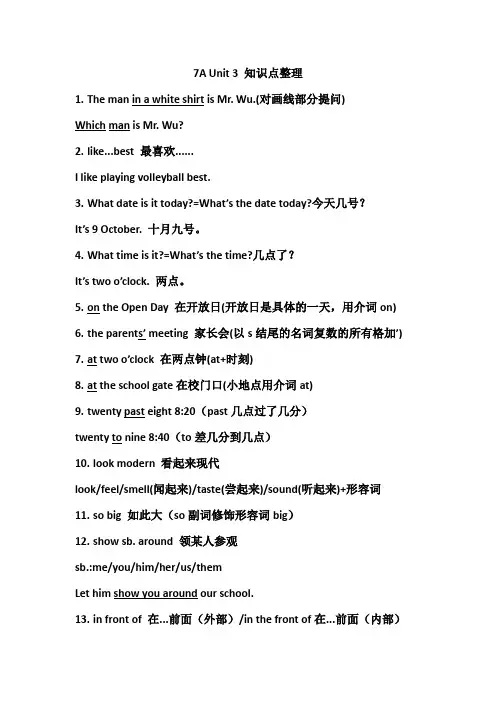
7A Unit 3 知识点整理1.The man in a white shirt is Mr. Wu.(对画线部分提问)Which man is Mr. Wu?2.like...best 最喜欢......I like playing volleyball best.3.What date is it today?=What’s the date today?今天几号?It’s 9 October. 十月九号。
4.What time is it?=What’s the time?几点了?It’s two o’clock. 两点。
5.on the Open Day 在开放日(开放日是具体的一天,用介词on)6.the parents’ meeting 家长会(以s结尾的名词复数的所有格加’)7.at two o’clock 在两点钟(at+时刻)8.at the school gate在校门口(小地点用介词at)9.twenty past eight 8:20(past几点过了几分)twenty to nine 8:40(to差几分到几点)10.look modern 看起来现代look/feel/smell(闻起来)/taste(尝起来)/sound(听起来)+形容词11.so big 如此大(so副词修饰形容词big)12.show sb. around 领某人参观sb.:me/you/him/her/us/themLet him show you around our school.13.in front of 在...前面(外部)/in the front of在...前面(内部)Miss Li is standing in the front of our classroom and writing some new words on the blackboard.There is a tree in front of our house.14.on the ground/first/second/third floor在一楼/二楼/三楼/四楼The cinema is on the third floor.15.two classroom buildings两栋教学楼名词修饰名词时一般第一个名词用单数,但也有一些特例:clothes shops/sports shops/women teachers/men doctors16.have meetings/have a meeting 开会I want to know when to have the meeting.17.the man in a white shirt/the man in white穿着白衬衫的男的/穿着白衣服的男的in介词+颜色/衣服:穿着......(状态) The man in white is my brother.wear动词+衣服:穿着......(状态) I wear a red coat today.put on动词短语+衣服:穿上......(动作)It’s cold outside. Please put on your coat.18.the man with glasses 戴眼镜的那个男的(with介词:戴着)Who is the man with glasses?(句中有谓语,用介词with)Daniel wears glasses.(句中无谓语,用动词wear作谓语)19.look(v.) at=have a look(n.) at 看一看......Let me look at the picture.=Let me have a look at the picture.20.the pictures of my friends 我朋友们的照片21.on the wall 在墙上There is a picture on the wall.(墙上挂的或贴的东西用on)There is a hole in the wall.(墙内部的用in)22.Let me see. 让我想想。
Unit2知识点整理牛津译林版七年级英语上册

7A Unit 2 知识点整理1.many times a day 一天许多次once一次/twice两次/...times ......次Eddie walks to his bowl three times a day.(对画线部分提问)How often does Eddie walk to his bowl?Eddie walks to his bowl three times a day.(对画线部分提问)How many times does Eddie walk to his bowl a day.2.walk to my bowl 走向我的碗walk home 步行回家(此处home副词,前面不加to)4.What/ How about doing sth. 做......怎么样?What/How about going swimming? 去游泳怎么样?5.What’s your favourite sport?你最喜欢的运动是什么?6.my favourite football player我最喜爱的足球运动员sb’s favourite football player(sb’s:my/your/his/her/our/their)play(v.)player(n.)类似的变化:teachteacher swimswimmer writewriter singsinger7.be a member of ...=be in... ...的一名成员He is a member of Huanghe Football Club.=He is in Huanghe Football Club.8.look happy(adj.) 看起来高兴(look是感官动词,后接形容词) look/taste尝起来/smell闻起来/sound听起来/feel摸起来+形容词look at sb. happily(adv.) 高兴地看着某人(look实义动词,用副词修饰)My parents look happy and they look at me happily.9.play football very well足球踢得非常好(very well副词修饰动词play)10.What does he look like?=How does he look?He looks slim.他看起来怎么样?(提问外貌)他看起来苗条。
Unit3知识点梳理牛津译林版英语七年级上册

牛津译林版七上Unit 3 知识点梳理1.Which of the subjects do you like best, Eddie? 埃迪,你最喜欢哪一门学科?= Which is your favourite subject, Eddie?like...best:“最喜欢……”= favourite。
which:疑问代词,“哪一个”。
辨析:which/whatwhich:“哪一个”,表示在一定范围内进行选择。
what:“什么”,不强调限定范围。
2.I have two cakes, and you have one. 我有两块蛋糕,你有一块。
辨析:one/itone:指代同类人或物中的一个,但不是同一个。
(同类不同物)复数:onesit:指代上文中提到的事物本身。
(同类同物)复数:they3.So I can eat three! 所以我能吃三块(蛋糕)!so:conj.“因此,所以”。
4.问日期:What date is it...? = What’s the date ...?5.英语日期的表达:(1)日、月、年:“月”与“年”之间用逗号,书写时,“日”用序数词的形式,也可以用阿拉伯数字的形式。
读时,“日”要读成序数词,而且前面要加the。
(2)月、日、年:“日”与“年”之间用逗号,书写时,“日”用序数词的形式,也可以用阿拉伯数字的形式。
读时,“日”要读成序数词。
6.提问具体的时刻:What time is it? = What’s the time?回答:It’s + 具体时间.辨析:what time/whenwhat time:提问具体时刻,通常询问钟点。
when:常询问日期、年份或月份,也可以询问时刻。
英语中时间的表示:(1)先时钟数,后分钟数:six thirty “6:30”;ten fifty “10:50”(2)先分钟数,后时钟数:①当分钟数小于等于30分钟时:twentyfive past nine “9:25”;half past eight “8:30”②当分钟数大于30分钟时:ten to ten “9:50”;three to eleven “9:57”(3)整点:时钟数(+ o’clock)six (o’clock) “6:00”(4)半点:时钟数+ thirty/half past + 时钟数 e ight thirty/half past eight “8:30”注意:15分钟可以用a quarter。
译林版牛津英语七年级上册期末复习知识点整理4

译林版牛津英语七年级上册期末复习知识点整理Units1--4重点知识点总结整理教师: Mr Sunn.名词v.动词vt.及物动词vi.不及物动词adj.形容词adv.副词prep.介词pron.代词conj.连词1、喜欢like / love / enjoy / be interested in / be crazy about (痴迷于)/ have fun / have a good time +doing sth.动词+doing 的还有G.doin.sth..finis.doin.sth./B.goo.a.doin.sth..d.wel.i.doin.sth.How/what about doing sth./practise doing sth.2.“四大看”read vt.看读物(read books/newspaper/magazines/a map等)loo.vi.瞧常用短语loo.at.for/around/after/out/over/upse.vt.看见,强调结..ca.se.you.watch vt.带有欣赏性的观看watch TV/ a film / a football game3.“五大穿着”Pu.o.强调“穿上”的动作eg.H.____.coa.an.goe.fo..walk.Wea. 强调“穿着”的状态;进行时态表示暂时的情况eg.Sh.i.wearin..ne.skir.now..wea.glasses Dres. (1.dres.sb..(2.dres.onesel. (3.dres.u.a. (4.ge.dressedIn (穿戴)后接颜色(或衣服), 表示状态look!Lucy is_____a red skirt and a pair of pink shoes. On 后接人指衣服穿在某人身上看出区别来。
The red coat looks nice on you.4.“四大花费”Spend: sb.(人)+ spend + 时间/金钱+ on sth.sb.(人)+ spend + 时间/金钱+(in) doing sth.pay: sb.(人)+pay + 金钱+for sth.cost: sth.(物) + cost + sb.+金钱Doing sth.costs + sb.+时间take: i.take.sb.+时间.t.d.sth.5.“三大地点副词”Home / there /here 前不加任何的介词welcome home / come here / go there6.“三大使役动词”Mak.sb.d.sth..hav.sb.d.sth..le.sb.d.sth.7、见面打招呼用语(1)Nic.t.mee.yo..(2.Gla.t.mee.yo..(3.Ho.ar.yo..(4.Ho.ar.yo.doin.?(5)How is it going ? (6)How is everything going? (7) What’s up?8、基数词+year(s)+old 表示“…岁”提问用“how old”名词性短语数词-year-old 也表示年龄, 但其为形容词性短语“前有冠词后有名(词)”Eg.Hele.i.1.year.ol..Hele.i.a.11-year-ol.girl.9、Let’s 与let us 的区别Let’.d.sth.指包括听者(对方)和说者(我们)都在内, 表示建议Let us do sth.指“让(允许)我们做某事”而听者(对方)不做, 只有“我们”做10、play+the+乐器类名词e.g.Pla.th.pianoPlay + 球类运动play+ football / play cards / play chesse.fro.Shanghai.Sh.i.fro.Shangha.. 注: 如何提问Shangha.及如何改一般疑问句12、b.goo.a.=d.wel.i..b.cleve.a..stud.sth.wellBe good at (反) be bad at do well in (反) be poor in13.介词over的用法(1)”在…正上方” There is a bridge over the river.(2)”越过” A plane flies over the house(3)”超过” There are over 20 boys in this class.(4)”结束” Class is over! / Game is over.14.every one 与everyone 辨析区别(1)Every one 可以与of 连用, 而everyone 却不能与of连用Eg.every one of the children likes playing the computer games.(2) everyone 只指人=everybody而every one 既指人又可指物共同点: 谓语动词都要用“三单”15.family 的用法: “家庭”作为整体谓语动词用“单数”He has a big family.“家人”强调成员, 是复数含义, 谓语动词用“原形”My family are at home.拓展: 集体名词有people、class、police、sheep、deer、furniture等16.all/ both/ each/every/neither/ either 的用法all (1)三者或三者以上“全部、都”(2)all + the + 名词(all the afternoon = the whole afternoon)(3)all 放在行为动词前, 名词前;be 动词后(4) all of +宾格/名词复数Both(1)两者都(2)后可跟of +宾格/名词复数Both sides of the street are grown trees.Each 指两个或两个以上“每一个”个体Each side of the street is grown trees.Ever.指许多人或事物的“全体”后接名词单.Ever.studen.i.her..所有人都在。
原题目:牛津译林版七年级英语上册期末复习语法专题练习(含)

原题目:牛津译林版七年级英语上册期末复习语法专题练习(含)一、动词时态1. 现在进行时:构成:主语 + am/is/are + 动词ing2. 一般过去时:构成:主语 + 动词过去式3. 将来时:构成:主语 + will + 动词原形二、名词的单复数1. 可数名词的复数形式:一般在词尾加s2. 不可数名词的复数形式:不可数名词没有复数形式三、形容词及副词的比较级和最高级1. 形容词比较级:构成:原级 + er2. 形容词最高级:构成:原级 + est3. 副词比较级:构成:原级 + er4. 副词最高级:构成:原级 + est四、介词的常见用法1. in:表示在某个范围或时间内2. on:表示在某个表面上3. at:表示在某个地点或时间点上五、情态动词的用法1. can:表示能力和许可2. must:表示必须和推测3. should:表示建议和责任六、冠词的用法1. 不定冠词a/an:用于泛指单数可数名词之前2. 定冠词the:用于特指已知的人或物之前七、连词的用法1. and:连接两个相同类型的成分2. or:表示选择、否定或者并列关系八、形容词性物主代词的用法1. 形容词性物主代词:my, your, his, her, its, our, their2. 用法:修饰名词,表示物主关系九、副词性物主代词的用法1. 副词性物主代词:mine, yours, his, hers, its, ours, theirs2. 用法:用于代替名词,表示物主关系以上是牛津译林版七年级英语上册期末复的语法专题练,希望能帮助同学们复并巩固所学的知识点。
祝大家考试顺利!。
Unit4知识点梳理牛津译林版七年级英语上册
牛津译林版七上Unit 4 知识点梳理1.Wake up, Eddie. 醒醒,埃迪。
wake up:“醒来”。
“唤醒某人”:如果所接宾语是人称代词,只能放在wake和up中间;如果所接宾语是名词,放在up、前后均可。
awake:adj.“醒着的”。
2.Is it time fro breakfast? 到吃早饭的时间了吗?It’s time for sth.“是做某事的时间了。
”= It’s time to do sth.It’s time for sb. to do sth.“该是某人做某事的时候了。
”3.Shall we go walking in the hills? 我们去山上散步好吗?Shall we...? “我们……好吗?”(表示征求或提出建议。
)4.I seldom go out. 我很少外出。
seldom:adv.“很少,不常,难得”(位于行为动词之前,助动词、情态动词或连系动词之后),表示否定。
go out:“出去”。
5....and then I have lunch. ……然后吃午饭。
have lunch:“吃午饭”。
→have breakfast “吃早饭”;have dinner/supper “吃晚饭”。
have:v.“吃;喝”;“有”;“举办,举行”;“度过,经历”。
三单:has。
6.After lunch, I always need a good rest. 午饭后,我总是需要好好休息。
need:v.“需要”。
need sth. “需要某物”;need to do sth. “需要做某事”;need sb. to do sth. “需要某人做某事”;sth. need(s) doing “需要”。
情态动词,“需要”,后接动词原形,常用于否定句和疑问句。
rest:n.“休息,歇息”(= break)。
have a (good) rest “(好好)休息”。
作动词,“休息”。
最新译林牛津版七年级英语上册期末复习资料
最新译林牛津版七年级英语上册期末复习资料第一章:单项选择1.高频题及相关知识点,解题思路在选择题中,a与an意为“一个”,the意为“这个,那个”。
因此只需翻译出句意即可。
此外,XXX用在特指某物,此题特指那个书架。
答案为C。
2.a,an问题在选择a还是an时,需看因素而非字母。
21个辅音字母中,f、h、l、m、n、s、x为元音因素开头用an,其他为a。
此外,hour、honest前面用an,usual、useful前用a。
答案为B。
3.介词in,on,at问题具体某一天早中晚用on。
此外常出现的有:at Christmas、At the Middle XXX festival、on XXX’ Day。
答案为B。
4.花费问题需掌握四个花费的用法:1.Sb XXX.2.It takes sb some time/money to do sth.3.Sb pay some money for sth.4.Sth cost sb some money.Spend与pay的主语是人,XXX是it,cost是物体。
Spend与take常与动词搭配,pay与cost没有。
答案为C。
注意:pay for表示支付。
5.关于how的疑问词组问题句意为“从你家到学校要多久?”20分钟的步行路程。
答案为A。
和用法。
现在进行时常用于表述正在进行的动作,用be+动词-ing形式构成,常和now,XXX,currently等时间状语连用。
一般现在时则表示经常性或客观事实,用动词原形构成,常和always,usually,often等频度副词连用。
根据句意可知,老师正在找XXX,而XXX可能正在图书馆看书,所以选B。
答案BNowadays。
people are always in a rush。
At present。
everyone is busy with their own XXX and use our time wisely。
译林版牛津初中英语七年级上册期末复习重难点整理
译林版牛津初中英语七年级上册期末复习重难点整理Unit 1: My Friends- 词汇重点:friend, kind, helpful, smart, funny, meet, introduce- 语法重点:be动词的肯定句、否定句和疑问句的构成方式,如"I am kind.","She is not helpful.","Are you smart?"- 句子重点:描述自己和朋友的特征,介绍朋友给他人。
Unit 2: My School- 词汇重点:school, classroom, teacher, student, desk, chair, board - 语法重点:指示代词this和that的用法,如"This is my school.","That is my teacher."- 句子重点:描述自己的学校和课室,以及介绍老师和同学。
Unit 3: My Family- 词汇重点:family, father, mother, brother, sister, grandparents- 语法重点:所有格的构成方式,如"My father's name is John.","Her sister's house is big."- 句子重点:描述自己的家庭和家庭成员,以及介绍家庭成员的特征和职业。
Unit 4: My Day- 词汇重点:day, morning, afternoon, evening, night, breakfast, lunch, dinner- 语法重点:一般现在时态的陈述句和疑问句的构成方式,如"I get up at 7 o'clock.","Do you have lunch at school?"- 句子重点:描述自己的一天,包括起床、用餐、上学等活动。
牛津译林版七年级英语上册音标专题 知识清单(预习复习知识点巩固练习)
七年级英语国际音标教学知识清单使用牛津初中英语教材以来,我们在教学中发现学生学习英语的最大障碍是词汇记忆问题。
一遍遍教单词、背单词、默单词、批单词让师生在枯燥和大量时耗费的苦海中挣扎,但效果甚微。
怎样解决这一难题呢?教会学生英语国际音标,教会学生拼读记忆单词的正确方法,帮助学生建立起单词“音”、“形”之间对应关系,攻克英语学习中的第一大障碍--词汇关,对课堂教学效益的提升有着举足轻重的作用。
下面所列音标教学要点和教学建议供各位同行教学时参考。
1.48个国际音标的认读教学中利用卡片和教学课件要求学生认读48个语音音素,不要求学生书写。
认读要求:准确、快速、大声。
(1)采用新音标字体进行教学,与牛津英语教材保持一致;(2)区分元音和元音字母,辅音和辅音字母;(3)注意纠正口型不准发音不到位的情况及本地区发音缺陷。
如易混音素:/n/和/l/,/aɪ/和/e/,/θ/和/s/,/ð/和/z/,/w/和/v/,/e/和/eɪ/等。
2.识记20个元音和28个辅音(见附录I)教学中不需要将音标分类过细(如摩擦音,破擦音,前元音等),为减少记忆负担只需让学生识记哪些是元音、清辅音(共11个)和浊辅音(共17个),目的是便于今后学习名词复数,动词单三形式、动词过去式词尾的读音变化。
3. 26个字母读音归类和26个字母的音标拼读(见附录II、III)音标与字母教学相结合,字母读音归类帮助学生纠正部分字母发音错误,如字母Cc/si:/会误读为/seɪ/等;学习字母音标拼读有助于解决小学阶段难以表述的不定冠词的选用问题。
4. 学会并掌握单音节词拼读方法本环节是音标教学的关键步骤,掌握拼读方法:辅音轻短元音重,两音相连猛一碰,反复操练。
设计拼读练习如下:(1)元音+辅音[i:t] [eg] …(2)辅音+元音[pi:] …(3)辅音+元音+辅音[bed] [dʌk] …教师提供一组例词,示范,然后让学生举例,课后从小学教材中找出尽可能多的列出对应例词,分组拼读,相互纠正,集中反馈。